Volunteering for Villainy (悪人志願, Tsutomu Tamura, 1960)

Tamotsu Tamura is best known as a screenwriter who worked closely with Nagisa Oshima, though he did actually direct a film himself at the beginning of his career. Having originally planned to become a reporter, Tamura was offered a job at Sankei Shimbun but his employment was postponed for medical reasons and he decided to retake the entrance exam for Shochiku joining the studio in 1955. Unfortunately Volunteering for Villainy (悪人志願, Akunin Shigan, AKA The Samurai Vagabonds) was not successful at the box office and Tamura soon left Shochiku along with Oshima and became a screenwriter at his independent production company. 

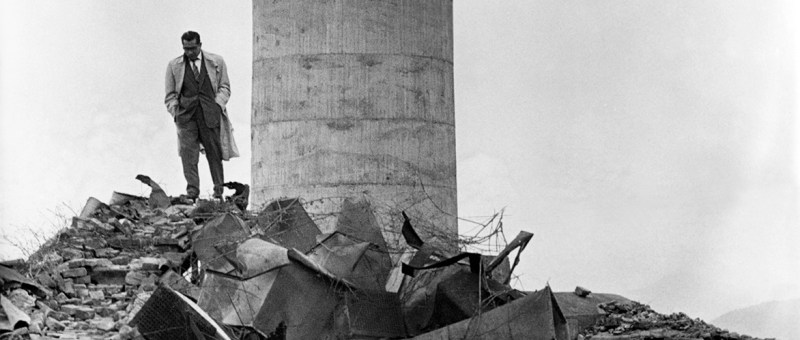
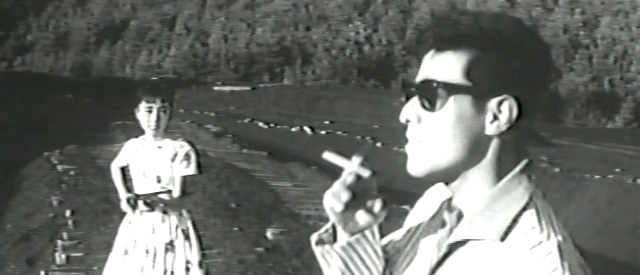
In any case, the film is very reminiscent of New Wave filmmaking both in terms of theme and aesthetic. It repurposes a moribund quarry town as an almost literal purgatorial space casting the protagonists into a deep hole from which they are eternally unable to escape. As the film opens, a collection of children are taunting a young woman, Hide (Kayoko Hono), calling her a murderer and castigating her for failing to die, though it later transpires that they’ve been hired by a henchmen of Tatsuo (Masahiko Tsugawa), the brother of the man she was involved in double suicide with who is determined to become some kind of local dictator.

But even he is in some ways rebelling against his powerlessness as the son of a local politician he brands as phoney and corrupt. Tatsuo claims he hates people who claim to be good but aren’t, in much the same way as Hide claims she can no longer trust anyone. Tatsuo seems to want revenge for the death of his brother for which he holds Hide responsible but insists he doesn’t want to settle it with money nor is he in favour when a shady local man makes vague allusions to having her bumped off.

When a new recruit, Yasuo (Fumio Watanabe), joins the quarry he becomes its latest kicking bag not least because it was Hide who escorted him into town. Yasuo has a stammer and incredibly meek manner that leans towards obsequiousness. “You’re as obedient as a dog,” people often remark with Tatsuo later astutely observing that he’s the sort of person who can’t do anything without someone telling him to do it. Yet it later seems as if his desire to obey, to be liked and accepted by those around him, has led him to commit a terrible crime claiming that he only did what everybody wanted done even if they were too afraid to say so.

Ashamed of himself and his corrupted masculinity Yasuo alternately rebels and overcompensates. He refuses to hit Hide when ordered to by Tatsuo, and to sleep with her when forced by the other men, but later hits and sleeps with her possibly not quite consensually when his masculinity is challenged. The irony is that Tatsuo who claimed he wouldn’t tolerate anyone defying him cannot control Hide’s free spirit and is therefore unable to overcome his powerlessness. He bullies and harasses her insisting that she leave town, but Hide refuses to go and is continually unbothered by the way she’s treated. Hide also eventually rejects Yasuo for his cowardice, severing her ties to him on realising that he informed on one of the other men who was fugitive from justice to curry favour with Tatsuo and take the heat off himself. She tells Tatsuo that though he’s always wanted things his own way, she’s always decided for herself, infuriating him with her free decision to leave having realised how petty and meaningless it was to stay in this petty and meaningless purgatory of broken and hopeless men. 

Tamura shoots with a roving and curious camera that takes on a life of its own swooping through the dorms but lends a degree of mythic eeriness to the final confrontation in the quarry as the workers begin to dot the skyline looking down at Hide below in a scene somehow reminiscent of L’Avventura. The town’s only bright spot is presented by Tatsuo’s younger sister Kiyoko (Chiaki Tsukioka) as the voice of reason even as she  brands everything boring and meaningless but thereby suggesting that it might not have to be this way. Her words, however, fall on largely deaf ears save those of Hide perhaps finally awake to her own agency only to have it immediately crushed by fragile masculinity.

High and Low (天国と地獄, Akira Kurosawa, 1963)

A self-made man is landed with an unthinkable dilemma when his chauffeur’s son is kidnapped in place of his own just at the moment he’s staked his entire fortune on a manoeuvre to outsmart cynical executives set on taking over his company in Kurosawa’s post-war crime film, High and Low (天国と地獄, Tengoku to Jigoku). The movie’s Japanese title, Heaven and Hell, might hint more strongly at the growing economic disparities in the era of the economic miracle but also at the dualities embodied in the hero’s choices. “Success isn’t worth losing your humanity” his wife tells him, but he still struggles with the validity of choosing his heart over his head knowing that to pay anyway even though it’s another man’s son means financial ruin, the final question being if he is really prepared to allow a child to die simply to maintain his own wealth and status. 

The problem is that Gondo (Toshiro Mifune) has attempted to mount a rebellion against the evils of consumerism, incurring the ire of the cynical executives who attempt to get him on their side in their attempt to oust the boss whose outdated ideas are running the business into the ground. Though Gondo appears sympathetic, hinting that he might be interested if there’s a good enough promotion in it, he later tells them where to go on seeing that their business plan is to start producing poor quality disposable footwear. Gondo started on the factory floor and he doesn’t want to put the company’s name on such shoddy produce nor does he think that their admittedly fair point that if the shoes are well made and last a long time no one will need to buy any is a good way to do business. He doesn’t think the boss is right either and wants to make shoes his own way which is why he’s remortgaged the sizeable mansion he owns on top of a hill overlooking the city and has pretty much run through his wife’s dowry to buy a majority stake in the company.

On top of a hill is a good place to live if you want a good vantage point to oversee the land below, but while you’re looking down others look up and not all of them kindly. Gondo is as he says a self-made man, but also out of touch with contemporary society and not so far from an ambitious courtier always after a little more. He says it isn’t about getting the top job but getting shoes made right, but it seems he too had been bitten by the consumerist bug and is otherwise unable to affirm his status without material proof. When he thinks it’s his own son that’s been kidnapped, he’d have given it all away but when it’s the driver’s boy it’s a different question. Shinichi (Masahiko Shimazu) isn’t his responsibility and as he points out there are plenty of other wealthy men, why is he the only one to pay? While his wife (Kyoko Kagawa) tearfully urges him to do the right thing, his assistant (Tatsuya Mihashi) tries stop him, insisting he should take the sizeable cheque they’ve had drawn up to Osaka and the stakeholder he’s buying the shares from. 

While he vacillates, the driver, Aoki (Yutaka Sada), is humiliated and forced into servitude. Gondo seems to have the old-fashioned idea that the kidnappers would simply let Shinichi go on realising they’ve got the wrong boy and his father can’t pay, but Aoki knows there’s nothing he can do to save his son but throw himself on Gondo’s mercy. He falls to the ground and prostrates himself, but later retracts all telling Gondo it doesn’t matter, that he hadn’t realised what he was asking of him, and insisting that Shinichi is a bright boy who will look for a chance to escape on his own. Once the boy is returned he treats him harshly, interrogating him about anything he might have forgotten and later driving him around looking for the hideout where he was kept in an attempt to do something and repay the debt he now feels he owes to Gondo by helping the police retrieve the money Gondo eventually agreed to pay for him. 

In agreeing to give up the money, Gondo is in a sense unburdened knowing he has made the right choice and realising that he would never live a comfortable life in that house if cost a child’s life to keep it. Part of his rationale for not wanting to pay had been that though he had been poor before and might be again, his wife had not been and does not truly understand what it is to live in poverty much as she says her life of luxury means nothing to her. She has never wanted for anything, after all. As for the kidnapper, Ginjiro (Tsutomu Yamazaki), we know little of his motives save for his intense resentment living quite literally in the shadow of Gondo’s mansion and feeling as if it were mocking him. Then again, though his life is hard Ginjiro already had a path to success in that he would soon have completed his medical studies implying at least that he or someone else was able to cover his tuition and costs of living, that he was able to continue in education, and really had no need to take such drastic action in rebellion against the antagonistic capitalism of the post-war society. “Do you think we have to hate each other?” Gondo asks him, but Ginjiro has no answer only his intense resentment for everything he represents.

The “hell” that Gondo inhabits is a backstreet wasteland peopled by the hopeless. Tokura (Tatsuya Nakadai), the earnest policeman, follows him through thronging clubs and on into “dope alley” where Ginjiro picked up his accomplices so desperate to escape their suffering that they’d agree to help him kidnap a child. Though it costs him his job, Gondo decision to do the right thing makes him a national hero, the working class millionaire who mows his own lawn and can still knock up a pair of shoes should the occasion call while women across the country decide to boycott the company in protest at his treatment. Ginjiro can only howl like a caged animal while facing a death sentence for the coldblooded murder of his accomplices. The light bouncing off his mirrored sunshades gives him an eerie supernatural quality, a demon arising from depths of hell to wreak havoc in heaven but finding only infinite tragedy in the contradictions of the consumerist post-war society.


High and Low screens at the BFI Southbank, London on 19th January 2023 as part of the Kurosawa season.

Original trailer (English subtitles)

The Bad Sleep Well (悪い奴ほどよく眠る, Akira Kurosawa, 1960)

Bad Sleep Well posterThere’s something rotten in the state of Japan – The Bad Sleep Well (悪い奴ほどよく眠る, Warui Yatsu Hodo Yoku Nemuru), Akira Kurosawa’s take on Hamlet, unlike his previous two Shakespearean adaptations, is set firmly in the murky post-war society which, it becomes clear, is so mired in systems of corruption as to be entirely built on top of them. Our hero, like Hamlet himself, is a conflicted revenger. He intends to hold a mirror up to society, reflecting the ugly picture back to the yet unknowing world in the hope that something will really change. Change, however, comes slow – especially when it comes at the disadvantage of those who currently hold all the cards.

We open at a wedding. A small number of attendants lineup around a lift waiting for the arrival of the married couple only for a carriage full of reporters to pour out, apparently in hope of scandal though this is no gossip worthy society function but the wedding of a CEO’s daughter to his secretary. The press is in attendance because the police are – they believe there will be arrests today in connection with the ongoing corruption scandal engulfing the company in which a number of employees are suspected of engaging in kickbacks on government funded projects.

The rather strange wedding proceeds with the top brass sweating buckets while the bride’s brother (Tatsuya Mihashi), already drunk on champagne, takes to the mic with a bizarre speech “refuting” the claims that the groom, Nishi (Toshiro Mifune), has only married the bride, Yoshiko (Kyoko Kagawa), for financial gain before avowing that he will kill his new brother-in-law if he makes his little sister sad. Nishi, as we later discover, has indeed married with an ulterior motive which is anticipated by the arrival of a second wedding cake in the shape of a building at the centre of a previous corruption scandal with one black rose sticking out of the seventh floor window from which an employee, Furuya, committed suicide five years previously.

The police are keen to interview their suspects, the press are keen to report on scandal, but somehow or other the system of corruption perpetuates itself. The top guys cover for each other, and when they can’t they “commit suicide” rather than embarrass their “superiors” by submitting themselves to justice. The system of loyalty and reward, of misplaced “honour” mixed with personal greed, ensures its own survival through homosocial bonding with backroom deals done in hostess bars and the lingering threat of scandal and personal ruin for all should one rogue whistleblower dare to threaten the governing principle of an entire economy.

Nishi chooses to threaten it, partly as an act of revolution but mainly as an act of filial piety in avenging the wrongful death of his father who had, in a sense, cast him aside for financial gain and societal success. Wanting to get on, Nishi’s father refused to marry his mother and instead married the woman his “superiors” told him to. Later, his father threw himself out of a seventh floor window because his “superiors” made him understand this was what was expected of him. Furuya wasn’t the last, each time a man’s transgressions progress too far his “superiors” sacrifice him to ensure the survival of the system. Strangely no one seems to rebel, the men go to their deaths willingly, accepting their fate without question rather than submitting themselves to the law and taking their co-conspirators down with them though should someone refuse to do the “decent” thing, there are other ways to ensure their continuing silence.

Reinforcing the post-war message, Nishi chooses a disused munitions factory for his secret base. Both he and his co-conspirator, a war orphan, had been high school conscripts until the factory was destroyed by firebombing and thereafter were forced to live by their wits alone on the streets. Nishi swears that he wants to take revenge on those who manipulate the vulnerable, but finds himself becoming ever more like his prey and worse, hardly caring, wanting only to steel himself for the difficult task ahead.

In any revolution there will be casualties, but these casualties will often be those whom Nishi claims to represent. Chief among them his new wife, Yoshiko, who has been largely cushioned from the harshness of the outside world thanks to her father’s wealth and seeming care. She loves her husband and wants to believe in her father or more particularly that the moral arc of her society points towards goodness. Nishi, tragically falling for his mark, married his wife to destroy her family but ironically finds himself torn between genuine love for Yoshiko, a desire for revenge, and a mission of social justice. Can he, and should he, be prepared to “sacrifice” an innocent in the same way the “superiors” of the world sacrifice their underlings in order to end a system of oppression or should he abandon his plan and save his wife the pain of learning the truth about her husband, her father, and the world in which she lives?

In the end, Nishi will waver. Yoshiko’s father, Iwabuchi (Masayuki Mori), will not. Goodness becomes a weakness – Iwabuchi turns his daughter’s love and faith against her, subverting her innocence for his own evil. He makes a sacrifice of her in service of his own “superiors” who may be about to declare that they “have complete faith” in him at any given moment. The only thing that remains clear is that Iwabuchi will not be forgiven, the wronged children of the post-war era will not be so quick to bow to injustice. Let the great axe fall? One can only hope.


Original trailer (English subtitles)