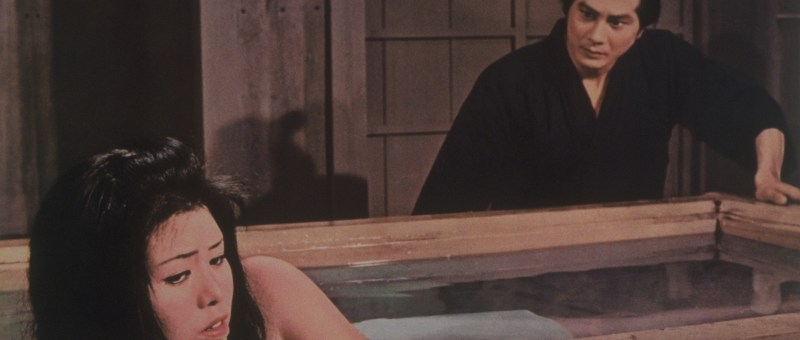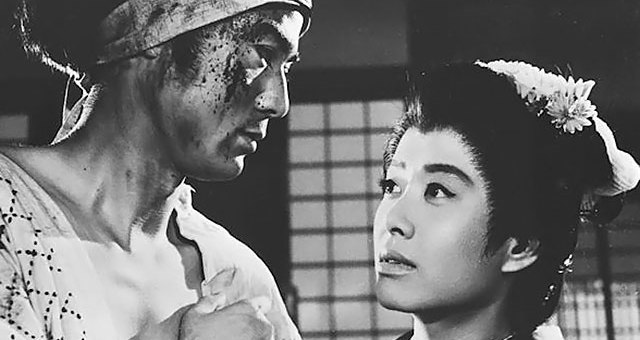
Female Yakuza Tale (やさぐれ姐御伝 総括リンチ, Teruo Ishii, 1973)

Having completed her quest for revenge, Ocho (Reiko Ike) returns in Female Yakuza Tale (やさぐれ姐御伝 総括リンチ, Yasagure anego den: Sokatsu Lynch) once again swept up in intrigue after being framed for a bizarre series of murders. With Teruo Ishii taking up the reins from Norifumi Suzuki, the film has a slightly more realistic aesthetic making frequent use of handheld particularly in the narrow backstreets of the late Meiji Society while eventually taking a bizarre detour into the cruel world of an early 20th century mental health institution. 

In any case, Ocho’s troubles start when she’s met at Kobe harbour by a woman who says she’s come to fetch her. On arrival at her destination, Ocho is chloroformed and sexually assaulted by three men who evidently think she’s think she’s someone else and decide to get rid of her after realising their mistake. She wakes up next to the dead body of another woman and is in danger of becoming the prime suspect in a series of murders the subtitles don the “crotch-gauge” killings. After managing to escape, she sets about trying to find out who set her up and what’s going on while getting involved in a succession crisis in the Ogi in which the old boss who was once good to her has been killed. 

Though with much less political subtext, the film nevertheless indulges in the Sinophobia common in many similarly themed dramas in revealing a Mr Lee of Yokohama to be a major player in a drug trafficking scam in which women are forced to smuggle drugs in their vaginas after the gang gets them hooked to manipulate them. Besides Ocho, another woman dressed eerily like Sasori in a black wide brimmed hat and loose dress known as “Yoshimi of Christ” is also on their tail and seeking revenge while echoing some of the religious themes of the first film. She later teams up with recently released yakuza Jyoji who is looking for the daughter of the old boss who has gone mysteriously missing while he is also convinced that present boss Gondo had something to do with it along with the old man’s death. 

This is however mainly a tale of female revenge, Ocho’s being on the yakuza who cut off the Old Boss’ finger after he stood up for her as a teeanger whens she was caught cheating at a gambling den. Nevertheless, what eventually emerges is a sense of female socildairy as Ocho, Yoshimi, and the other women abused by the gang come together to free themselves from its grasp in a strange orgy of violence utilising eerie green lighting to lend it an almost supernatural dimension even if in the end the final blow is struck by a man and not without a little irony. 

This sense of unreality otherwise out of keeping with the immediacy of Ishii’s handheld camera is also seen in the mental institution to which the film eventually travels, a foggy gothic building echoing the Western mansion in the first film but similarly filed with oppressed and abused women sent mad by a patriarchal society or perhaps merely sent there to become so by men who wanted them out of the way. Gondo himself seems to be a regular visitor bringing along his own electroshock machine but finally resorting to using his bare hands in order to tie up a loose end and preserve his own position as head of the clan. 

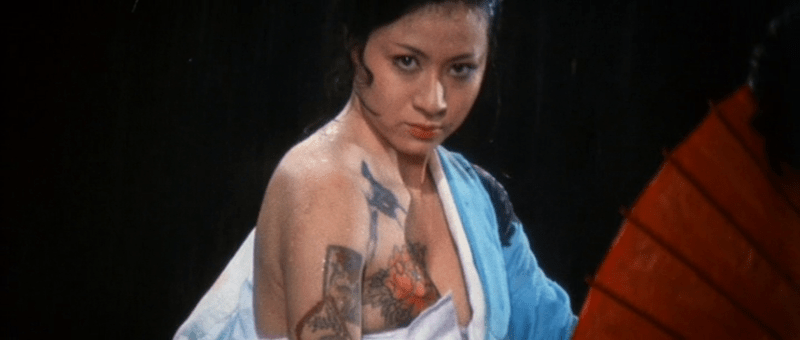
Ocho is not above using her sexuality to manipulate him, while Ishii maintains the naked sword fights from the first film both from the balletic opening of Ocho and her parasol to the chaos of the final sequence as the women come together to take their revenge as one. Perhaps strangely there isn’t an awful lot of gambling in the film, but Ocho nevertheless makes good use of her trademark hanafuda cards while in a moment of symmetry it’s the wife of her target who eventually settles the matter in a more diplomatic fashion by subjecting herself to the same humiliation to which Ocho had been subjected to bring the circle to a close. Having once again stood up against corrupt crooks and greedy men, Ocho later takes her sisters with her as she walks off this time into the sunset rather than the dark. 


Original trailer (no subtitles)

The Insatiable (現代ポルノ伝 先天性淫婦, Norifumi Suzuki, 1971)

History repeats itself in Norifumi Suzuki’s erotic drama The Insatiable (現代ポルノ伝 先天性淫婦, Gendai Porno Den: Sentensei Inpu). The film’s Japanese title, Modern Porno Tale: Inherited Sex Mania, better hints at its true intentions in essentially repurposing a sense of class anxiety and moral conservatism as familiar from classic melodrama to fit Toei’s line of erotically charged movies but eventually offers little judgement of the heroine’s surrender to her fate (after gaining her revenge) in putting on her mother’s kimono to follow the path set down for her.

That was not, however, what Yuki’s (Reiko Ike) mother (Yoko Mihara) originally wanted. Hoping to save her from the life of a bar hostess with terrible taste in men, she sent her to a religious boarding school in Tokyo which has given her a toxic sense of shame in her sexuality. Sharing a bed with a classmate, she relates her fear and horror of sleeping with men which she assumes she is expected to do in time, though goes on to explore herself sexually with the other girl who feels much the same despite the warning from their lesson books that looking at another woman with desire is no different from adultery. 

Nevertheless, on returning to her mother’s home in Kyoto Yuki is later raped by her mother’s latest boyfriend who is for some reason a bowling enthusiast. His sensibility is emblematic of that of most men in the film who see Yuki merely as an object to be conquered. Following this violation, Yuki quits school and spends all her time in clubs in Shibuya unable to reconcile herself with her sexuality and living as good time girl if resenting herself when others see her as a sex worker. Sucked into the world of sleazy clubs, she becomes a kind of pass around for wealthy men while also cared for by a besotted yakuza who has been quite literally emasculated by his love for her, leaving Yuki unable to fully return his affections because he can no longer satisfy her sexually.

Eventually she meets handsome architect Yoichiro (Hiroshi Miyauchi) with whom she falls in a more wholesome love, but continues to believe that she cannot really be with him because of her sordid past. She then realises that not only does he have unfinished business with a French woman he met while studying abroad (Sandra Julien), but that his father, Matsumura (Tatsuo Endo), is the seedy loanshark who’s been trying to get his hands on her through middleman Akihito (Fumio Watanabe) who is connected with her mother’s new partner Tomoguchi, and also Yoichiro’s brother-in-law.

Akihito is really the villain of the piece, though mostly for his attempt to wage class warfare by taking over Matsumura’s business. His wife, Ayano (Miwako Onaya), has turned away from him knowing that her father brought him into the family for his ruthlessness while exclaiming that she hates self-made men. In much the same way that Yuki was attempting to escape her mother’s legacy, Akihito is also trying to overcome his impoverished background to catapult himself into the upper classes though Matsumura himself appears to have earned his wealth in dubious ways. In any case, he rejects Yoichiro’s decision to marry Yuki not only because he wants her himself but because he claims he wants to find a more appropriate wife for his son presumably as he found Ayano a husband who would benefit himself. 

In any case, Yuki is drugged and abused much like her mother turned into a plaything for men. Yuki resents her only momentarily for her role in her rape and sickening attempt to placate her boyfriend after having stood up for Yuki and confronted him about his betrayal. The two women later reconcile and find solidarity in their maternal relationship even if her mother can never escape the pattern of behaviour that keeps her dependent on bad men which is something Yuki may have overcome in the film’s closing moments as she in turn, wearing her mother’s kimono, opens a bar under her own name living as an independent woman. 

To get her revenge, she manipulated the men around her by using her sexuality against them only to be backed into a corner by Akihito’s chilling claim that she was now his slave. Her salvation at the hands of another man who damns himself in her defence and the defence of their love as something pure despite having cruelly rejected Yuki as a “whore” perhaps undercuts the message but also in the film’s eyes redeems her from her wandering life as an insatiable sex addict now free of her sense of shame and the lingering trauma of her rape. In this patriarchal and classist society, all men are animals driven only by destructive influences, while Yuki is even able to bond with Yoichiro’s French former lover with whom she also shares a sexual encounter. Suzuki films with characteristically romantic imagery and a wry sense of humour but nevertheless allows his heroine to find her way out of a world of beasts while refusing to shame her even as she embraces her mother’s legacy. 


*Norifumi Suzuki’s name is actually “Noribumi” but he has become known as “Norifumi” to English-speaking audiences.

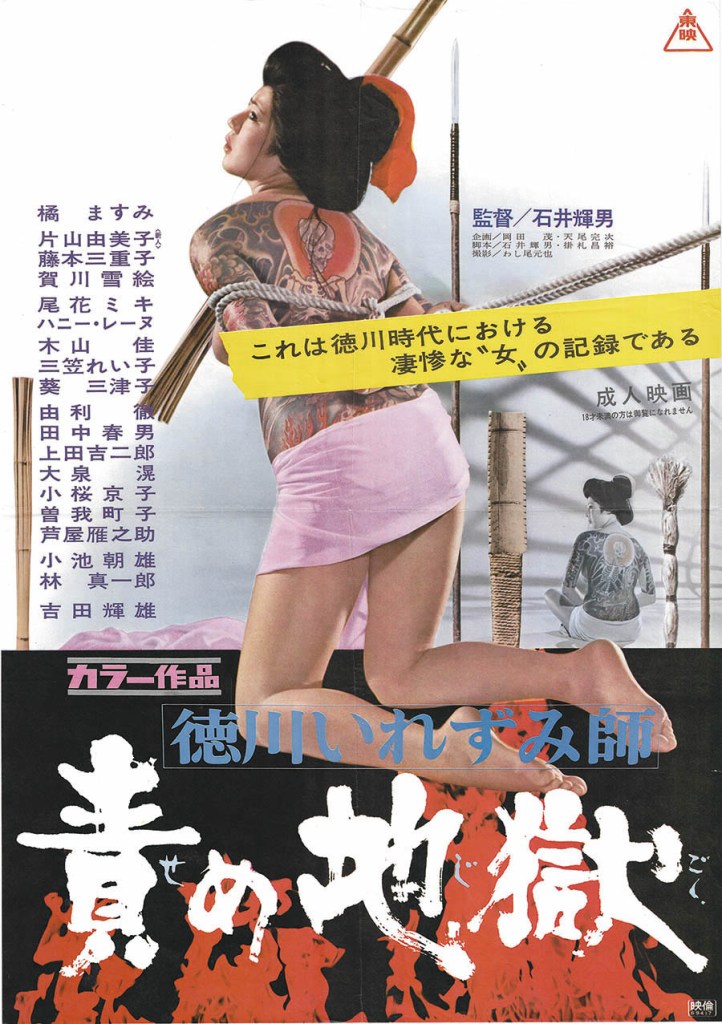
Inferno of Torture (徳川いれずみ師:責め地獄, Teruo Ishii, 1969)

“There’s no hope for us anymore” cries the hero, redeeming himself with one last act of humanity before allowing himself to be consumed by the flames of Edo-era barbarity. Another tale of feudal exploitation, Teruo Ishii’s Inferno of Torture (徳川いれずみ師:責め地獄, Tokugawa Irezumi-shi: Seme Jigoku) opens with an otherwise unrelated scene of female crucifixion followed by an elaborate beheading, presenting both of these events with a degree of historical authenticity they do not perhaps possess. Nevertheless, his central tale which turns out to be less about two women than two men, turns on the exploitation of female bodies, subtly suggesting that the modern society is itself founded on female exploitation. 

Though dropping the portmanteau structure frequently employed in the Joys of Torture series, Ishii returns from the prologue with the end of the first arc in which the presumed heroine, Yumi (Yumiko Katayama), makes a stealthy visit to a ghostly cemetery in which she trashes the grave of a man named Genzo (Shinichiro Hayashi), digs him up and dismembers his body to retrieve a key we later see him swallow which she hopes will unlock her womanhood currently imprisoned by an ornate chastity belt, only the key doesn’t fit. 

Flashing back again, we see Yumi forced into sex work in payment of a debt and imprisoned in a labyrinthine brothel which specialises in bondage and torture under the guidance of lesbian madam Oryu* (Mieko Fujimoto) and her samurai fixer Samejima (Haruo Tanaka). The brothel’s USP is in its tattooed women which neatly leads us into the main narrative as Yumi’s body becomes a battleground contested by two men, top tattoo artists in search of the perfect canvas in order to win, ironically, the hand of their master’s pure and innocent daughter Osuzu (Masumi Tachibana). 

Horihide (Teruo Yoshida) and Osuzu are in love, but the dark and brooding Horitatsu (Asao Koike) is determined to frustrate his rival’s desires by becoming the successor to Osuzu’s dying father, the tattooist Horigoro. The “hori” which prefixes each of the men’s names relates to the process of tattooing and comes from the verb to chisel, hinting at the way they prick and channel their desires into the canvas which is human skin. Horihide is our “hero”, described by Horigoro as the light to Horitatsu’s dark, Horitatsu currently making more of an impact with his designs of violent intensity, but each of them is in a very real way content to use and exploit the bodies of women without their full consent in order to practice their art. It is essentially an act of violence if not of “torture”. 

Meanwhile, Oryu and Samejima are profiting off their “merchandise” more directly in participating in the trafficking of tattooed ladies to lecherous foreigners displaying an early fetishisation of Asian women. This being late Edo, Japan is still in its isolationist period in which fraternising with foreigners was illegal which is why the action eventually takes us to Nagasaki and the Dutch trading port of Dejima, here presented as a nexus of corruption, where Samejima and Oryu prove themselves very much in league with foreign powers dealing with powerful businessman Clayton (Yusuf Hoffman), despite his name apparently a Dutchman, and his Chinese associates. Like Nikkatsu’s borderless action films of the ‘50s and ‘60s, Inferno of Torture indulges in an unpleasant Sinophobia which culminates in a chase through a crowded Chinese wet market in which we catch sight of dogs hanging bound ready for the slaughter in similar poses to those of the women in the brothel, not to mention thrusting snakes, before being confronted by a basket full of adorable puppies presumably headed for a dark destination, while we finally rediscover Hidetatsu collapsed in an opium den after being forcibly addicted by Oryu as a means of control. 

“This is a house of horrors” the Chinese gang leader tells a group of women bought by Samejima from a prison and promised a life of wealth and ease as geisha catering to high class clients. It’s difficult to tell if Ishii is critiquing Edo-era misogyny or that of the present day, or merely revelling in it with increasingly perverse scenes of sexual violence and degradation which continually imply that women have no role or value outside of reflecting the desires of men while those who try to claim their own agency are brutally put down by an inherently misogynistic, patriarchal society. After a Count of Monte Cristo-esque subplot in which Horihide is framed for murder but escapes to plot his revenge, the psychedelic final showdown returns us to the tattooists’ artistic face off as they again weaponise female bodies to embody their own ambitions, Horihide turning a blameless young woman into an iridescent peacock to get back at her father. Nevertheless, he finally reassumes his humanity in ending his mission of vengeance before it takes more innocent lives while accepting that he may now be too corrupted to return to his former life. Elegantly composed often unconsciously recalling the keyhole in Yumi’s chastity belt as it imprisons women within the peephole of the frame, Inferno of Torture ends exactly as it began, with a scene of grim and ironic punishment in which the female form is itself obliterated. 


Inferno of Torture is available on blu-ray from Arrow Video in a set which also includes an in-depth commentary from Tom Mes discussing the treatment of the various actresses involved with the series, Ishii, and Toei in general; Jasper Sharp’s Miskatonic lecture Erotic Grotesque Nonsense & the Foundations of Japan’s Cult Counterculture; and a booklet featuring new writing by Chris D.

Original trailer (no subtitles)

*This character’s name is rendered as “Oryu” in the subtitles but “Otatsu” (different ways of reading the same character which means “dragon”) in the accompanying booklet.

River Washes Away the Moon (残月大川流し, Yasushi Sasaki, 1963)

River Washes Away the Moon posterTimes are changing fast in Edo. Hibari Misora reunites with director Yasushi Sasaki for another jidaigeki adventure only this time one with much less song and dance and fewer tomboy antics for the often spiky star. Set in 1868 in the immediate aftermath of the fall of the Tokugawa Shogunate, River Washes Away the Moon (残月大川流し, Zangetsu Okawa Nagashi) is, in its own way, a story of revolutions, personal and political, as sides are picked and alliances forged in midst of a city in flux.

Edo, 1868. The Tokugawa Shogunate has been drummed out of the capital by the collective forces of Satsuma, Choshu, and Tosa but a new regime has yet to solidify itself. While some remain loyal to the Tokugawa cause, others join the new imperial armies leaving Edo a fractured state in which loyalists are on the run and violence rules the streets. Meanwhile, ordinary Edoities are trying to go about their everyday business. Ogin (Hibari Misora), an orphan, is a member of a pickpocketing gang run by a cruel mistress who metes out extreme punishments to those deemed to have transgressed her stringent rules, most often by trying to keep some of the money for themselves rather than hand it to the bosses for “redistribution”. Ogin is good at pickpocketing, but she has a noble heart and feels sorry for the country bumpkins who often become her prey. The madame wants her to take over the gang, but she wants out of the criminal life as soon as possible.

With things the way they are, the the loyalists ask the pickpockets for a favour – steal the shoulder badges off the Imperialist mercenaries so they won’t be able to return to their camps. The madame declares herself apolitical and declines but Ogin, a true child of Edo, feels quite differently and is only too keen to support the loyalists in whichever way she can. She gets her opportunity when a wounded soldier, Shinzaburo (Yoshitomo Ogasawara), creeps into the house she hides out in to get away from the gang. Ogin bravely hides Shinzaburo from the Imperialist troops and then hides him again when he returns sometime later after another battle with a lost little girl in tow. The pair grow closer, but Shinzaburo is under the impression Ogin is a wealthy merchant’s daughter and has no idea she is a poor orphan forced to pick pockets on the streets in return for safe harbour.

Unlike many of Misora’s jidaigeki heroines, Ogin is a much more “feminine” figure – she never gets to do any fighting of her own and the (extremely subdued) romance with Shinzaburo becomes the film’s main focus. She is however steadfast and bold. She stands up to her madame as much as feels she is able and is desperate to extract herself from the criminal world. As an orphan without any other means of support, however, her options are limited and even when she tries to do good it’s thrown back in her face.

Even Shinzaburo whose ideals one would hope to be more compassionate is after all a loyalist and not a revolutionary. His ideals are conservative if bending towards the moral good and therefore when he finds out what Ogin really is their connection is broken, he loses respect for her and though she never lied to him he blames her for the life she was forced to lead. A man like Shinzaburo might have lost his place, but he’s never known the kind of hardship a woman like Ogin has had to endure and the concepts are alien to him.

After getting her heart broken by Shinzaburo, Ogin finds the strength to break away from her criminal family by becoming an itinerant musician which gives Misora a chance to sing another song – her only other musical number is a full on set piece taking place during a community show held to raise money for orphans and possibly reunite dislocated people with their families in the process. Nevertheless Misora delivers an impressive performance as the continuously lovelorn Ogin, convinced that her world is limited by the circumstances of her birth and only latterly realising she has the power to change her fate (if for the slightly dubious reasons of proving herself worthy of Shinzaburo). Ogin opts for her personal revolution while Shinzaburo opts for a political one. By 1963 the winds of change were indeed blowing through Tokyo once again, though if there are any political messages to be found in River Washes Away the Moon they are fairly subtle and lean more towards compassionate living and finding the strength to live by your principles than advocating for direct agitation as the best path towards a fairer world.


Hibari’s musical numbers (no subtitles)

https://www.youtube.com/watch?v=UVKtBrUsS5c