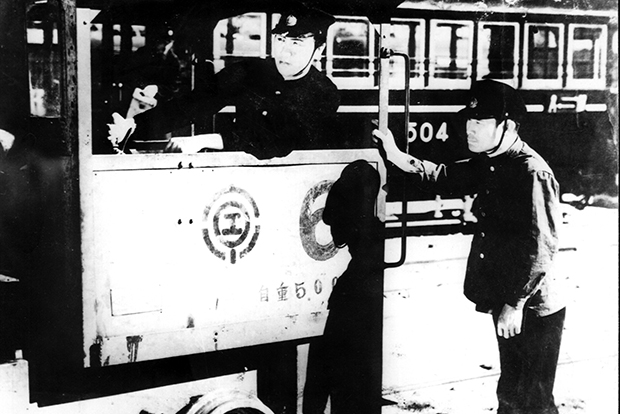
The Eagle and the Hawk (鷲と鷹, Umetsugu Inoue, 1957)

Strapping sailors meditate on revenge and forgiveness while trapped aboard a moribund cargo ship in Umetsugu Inoue’s otherwise charming musical youth drama, The Eagle and the Hawk (鷲と鷹, Washi to Taka). One of several films Inoue released starring muse of the moment Ishihara, the film uses the boat as a kind of metaphor for a reluctance to deal with the unfinished past as several of its crew members are actively engaged in a self-imposed limbo wilfully remaining in a transient space floating between two harbours with no plans to disembark. 

This is most obviously true for the zombified Ken (Kinshiro Matsumoto) who wanders around the boat in a depressive daze unable to get over a girlfriend who left him for another man though as it turns out the bosun too is hiding out at sea waiting for the statue of limitations to run out on the murder of his lover 30 years previously. When two new recruits show up from the sailors union despite only one having been requested, many are under the assumption that they too are running from something on land though the boat itself is a confined environment from which there is no real escape so it’s also an ideal space for confrontation. 

The thing they may be running from is the murder of the boat’s chief engineer in the film’s noirish opening sequence in which a middle-aged man in a sailor’s cap is stalked by a youngster in jeans before being knifed with a ceremonial dagger. If they were running from that particular crime, it might be ironic that they chose this particular boat but then as the murdered man’s son, First Mate Goro (Hiroyuki Nagato), discovers the dagger was part of a set and the other one’s owned by the captain who seems very alarmed by the whole affair. Meanwhile, the captain’s daughter, Akiko (Ruriko Asaoka), has secretly stowed away along with Akemi (Yumeji Tsukioka), the heartbroken former girlfriend of one of the two new guys, Senkichi (Yujiro Ishihara). 

Women are regarded as unlucky on board, and it’s not difficult to guess why with Goro offering strict instructions to the new guys not to try anything with Akiko while one of the other sailors later attempts to rape Akemi with a palpable desperation existing within the crew. There is also a degree of homoerotic tension between the two new guys, the other being Sasaki (Rentaro Mikuni) who typically walks around shirtless in a pair of tight jeans and works hard to give the impression of having a mysterious past all of which leads Senkichi to suspect he’s an undercover cop possibly there after him or one of the other crew members though unbeknownst to (almost) everyone there is another crime in motion on board. 

As usual, it’s the past that’s come calling with Senkichi on the boat ironically running towards rather than away from a confrontation while others desperately try to cover up their crimes or deflect their responsibility for the dodgy dealings of their youth. Both Senkichi and Sasaki immediately remark that the boat’s a “junker” as soon as they get on board, implying that it too is on its way out, its disrepair a sign of its captain’s lack of respect and care for ship and crew alike. Then again, it seems the crew were intent on drinking half the cargo, most of them clearly happy in their work and enjoying a pleasant sense of camaraderie even on this crummy ship and its presumably not quite above board trip to Hong Kong which might hint at why Akemi shows up in cheongsam though for stowaways both women seem to have brought extensive wardrobes which in all honesty are not particularly well suited to life at sea. 

In any case, the boat becomes an unexpected place of healing and forgiveness largely brokered by manly magnanimity as Goro, on learning the truth behind his father’s murder, accepts that the killer’s motivations are “understandable” even while cautioning them against the fallacy of revenge which he insists will only create more hate and violence. He’s also fairly okay with Senkichi romancing his girl, Akiko, who sadly tells him she sees him more like a brother and isn’t interested in marrying him even if that’s what her father also expects neatly reflecting the dynamic which arises between Akemi and the lovelorn Ken who begins to cheer up and consider leaving the boat to open a transistor radio shop only for Akemi to describe him as a little brother while continuing to chase Senkichi despite his interest in Akiko. An expressionistic storm scene provides some divine justice, but also provokes a bittersweet romantic resolution which suggests it’s time to get off the boat and the face the past but with a kind of cheerfulness for the future otherwise at odds with the rage and violence of the original crime. Of course, this being a vehicle for Yujiro Ishihara, Inoue works in a few romantic scenes with his ukulele and a mournful song about the moon and ocean but finally sends him back to dry land a little more “grounded” for having found his sea legs.

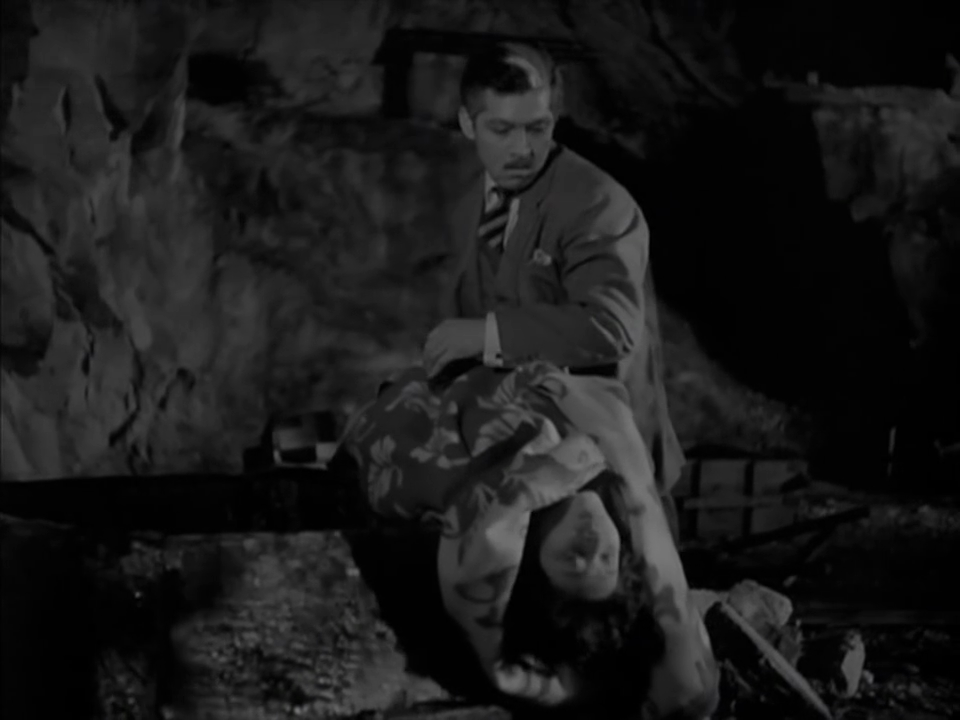
Crossroad (死の十字路, Umetsugu Inoue, 1956)

An adulterous industrialist finds himself in a sticky situation after accidentally killing his wife in Umetsugu Inoue’s bizarre noir Crossroad (死の十字路, Shi no Jujiro). Based on a story by Edogawa Rampo, the film like any good noir suggests that in the end you can’t outrun your fate and all transgressions must be paid for but also turns on cosmic irony and strange coincidence in the great “tapestry” of life in which everything really is connected.

Shogo Ise (an aged-up Rentaro Mikuni) is the director of a construction firm about to complete a hugely expensive dam project which requires the sinking of a village and quarry. Apparently unhappily married to a woman obsessed with Nichiren Buddhism believing it helped to cure her of a serious illness during the war, he more or less lives with his secretary/mistress Harumi (Michiyo Aratama) who has been receiving incredibly weird and definitely threatening letters from Shogo’s wife Tomoko (Hisano Yamaoka). Tomoko claims that she has received an order from the “Child of the Sun” insisting that she must exact vengeance for the “great sin” Harumi has committed. The letter seems to be the last straw for Shogo who has decided to leave his wife, despite her incredible wealth, and set up home with Harumi permanently. 

Shogo hadn’t taken the threat very seriously, but sure enough Tomoko later shows up with some kind of ceremonial dagger and barges in to attack Harumi in the bath. During the struggle, Shogo accidentally kills Tomoko while trying to wrestle the knife from her. After briefly considering turning himself in, he realises that doing so will involve them all in scandal so he decides the best thing to do is dump her body in a well at the quarry which is shortly to be sunk. However, the plan soon goes awry and not least because a random man with a head injury climes into his car after he has a fender bender on a set of crossroads and later dies there leaving Shogo no choice but dump him alongside Tomoko. 

Inoue casts the abandoned quarry in truly eerie light, filled with gothic winds as if Shogo were being chastised by the gods themselves. In a sense, he’s paying not only for his sexual transgression but for the breaking of a taboo. A homeless man who once lived in the village later relates that he stayed until the last day because he did not want to leave his ancestors’ land. Shogo is part of the post-war construction boom but there’s also an underlying implication that this industrialisation is harmful to the land itself, not least in constraining a natural flow with the imposition of a dam in addition to causing a displacement of the people who once lived in the village while literally drowning the ancestral spirits. 

Harumi too speaks of feeling as if they’re both sinking beneath the waves, chasing a happiness to which they have no entitlement though she herself seems completely blameless save for her involvement in an extra-marital affair and strangely wholesome in comparison to the film’s otherwise sordid atmosphere. Even for a noir, Inoue’s sensibility is surprisingly sleazy for the world of 1956 and more than a little suggestive. A detective that randomly shows up, Minami (Shiro Osaka), lives with his foxy assistant and the interaction between them is constantly sexually charged while Inoue frequently returns to the backstreets of a neon city and the bars that line the streets approaching the crossroads where Shogo’s fate will align. 

It could be inferred that Shogo is a man whose life was marked by the war, his marriage perhaps in haste and then regretted while his wife developed her illness and subsequent obsession with Nichiren because of its corruption. Nevertheless, he’s portrayed as a basically “good” man in a very bad situation who made some very bad choices he wasn’t in the end bad enough to carry through properly hence the amazing series of collisions that seal his fate. On the one hand, like the young couple related to the drunk man who ended up in Shogo’s car, he and Harumi are just two otherwise ordinary people who decided to chase happiness albeit through an extra-marital affair only to pay a heavy price for daring to dream of a better future. Inoue has his usual amount of fun playing with noir archetypes as men strike matches in darkened alleyways and silhouettes of mysterious men in trench coats line the walls, not to mention the gothic sense of dread in the abandoned quarry, while constantly wrong footing us only to set us on our own collision course with the vagaries of post-war morality. 


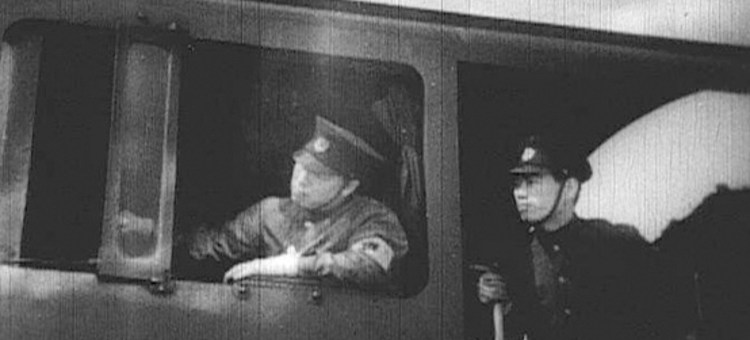
Military Train (軍用列車 / 군용열차, Seo Gwang-jae, 1938)

Military Train still 2Though there had obviously been increasing pro-Japanese sentiment in Korean cinema throughout the colonial era, 1938’s Military Train (軍用列車 / 군용열차, Gunyongyeolcha), a co-production with Toho, is accounted as the first government backed propaganda film. Military Train is in fact the only film ever directed by Seo Gwang-jae who began his career after winning a contest run by the Chosun Film Art Association which selected 20 people for a one year film course, later becoming an actor and film critic before debuting with his first and only feature. Prior to travelling to Japan to train with the Tokatsu Kinema in Kyoto, Seo had been a member of the left-wing Korea Proletarian Artist Federation, but it appears that by the time he came to make Military Train he had abandoned his socialist ideals and embraced militarism.

Taking advantage of the heated political context of 1937 following the break out of the Sino-Japanese war, Military Train was produced to promote the important work of the Chosun Railway running soldiers and supplies to the front lines. The hero is train driver Jeom-yong (Wang Pyong) who longs to get the opportunity to drive one of the military trains which all the men look on at with envy as they pass them by. Jeom-yong is best friends with his roommate, Won-jin (Dok Eun-gi), who is also dating his little sister Young-shim (Moon Ye-bong). Young-shim is currently working as “gisaeng” or bar girl – an occupation she took up some years ago to support her family after her father died. She and Jeom-yong have another older brother who is currently in Manchuria trying to make his fortune so he can comeback and redeem Young-shim.

The drama occurs when Young-shim’s madam informs her that there is a client interested in purchasing her contract. Young-shim obviously does not want this to happen as she is intending to marry Won-jin as soon as she is released from her life as a gisaeng. Though she assures the madam that her brother will shortly be returning from Manchuria cash in hand, there is little she can do about the fact that she will likely be sold unless they can gazump the wealthy client. This awkward situation provides an in for a shady looking man who’s been hanging round the railway. Overhearing the drama in a cafe, he approaches Won-jin and offers him a large amount of money in return for information on the movement of military trains. At his wits end, Won-jin agrees but is ambivalent about his betrayal of his country and endangerment of his friend.

This being a propaganda film, the obvious message is that Won-jin’s selfish decision to pursue his romantic desires over the national good is an unacceptable act of treason. Nevertheless, Seo’s framing of Won-jin’s dilemma is perhaps not quite the one which might be expected in that it’s only latterly that the national betrayal becomes the paramount issue. Won-jin’s primary conflict is in his betrayal of his friend, who he later hopes will become his brother-in-law, in the full knowledge that what he’s doing places them all in danger from the authorities as well as the Independence Movement while also placing Jeom-yong in the direct line of fire seeing as he may very well be aboard one of the trains blown up by the Resistance.

Then again, it is surprising in itself that the existence of the Resistance movement is even hinted at even if not directly named within the film (the suspicious-looking man is referred to only as a “Chinese spy”). This would seem to undermine the “one nation” idea that Korean cinema has been intent on pushing and explicitly enforces in the final stretch of the film in which Jeom-yong gets to drive a military train and is reminded that he does not belong to himself but to the Japanese citizens. The film carries this idea to its natural conclusion in casting a number of Japanese stars alongside their Korean counterparts including Jeom-yong’s pretty girlfriend Soon-hee (Nobuko Sasaki) and his boss at the railway. Nevertheless, Won-jin’s eventual letter of contrition further makes plain his “mistake” as he instructs Jeom-yong to do his best to preserve the Chosun Railway in order to preserve “peace in Asia”.

The action concludes “positively” from the point of view of the colonial regime as Won-jin’s treachery and subsequent reconsideration allow them to bust a Resistance cell before it can prove effective. Young-shim is eventually saved by her older brother’s return from Manchuria where he has apparently made something of himself thanks to the benefits of empire while Jeom-yong prepares to drive the shiny military train North towards glory leaving his sister behind in the pre-modern past as he prepares to enter a new age of modernity and prosperity as symbolised by the coming of Japan.


Military Train was screened as part of the Early Korean Cinema: Lost Films from the Japanese Colonial Period season currently running at BFI Southbank. It is also available as part of the Korean Film Archive’s The Past Unearthed: the Second Encounter Collection of Chosun Films in the 1930s box set. Not currently available to stream online.