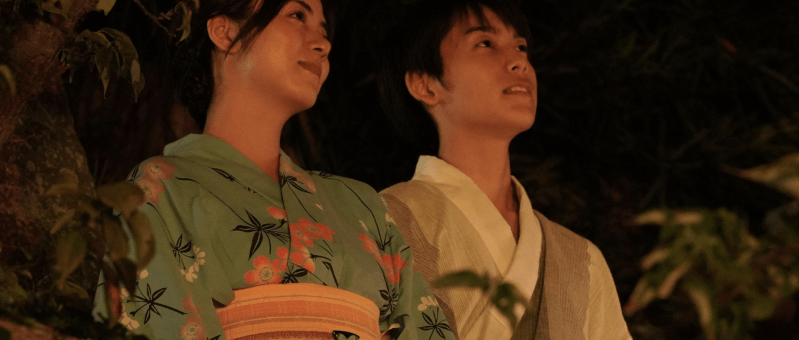
Rewrite (リライト, Daigo Matsui, 2025) [Fantasia 2025]

A mysterious transfer student arrives from the future. You have 20 wonderful days with him, but then he must return to his own time. He tells you that he came back to meet you and experience your time because of a book you will write, and your future self also shows you the book, tells you you did indeed write it, and that everything’s going to be okay. But in 10 years’ time, when you’re your “future self”, you from the past does not show up to get any of this information. Did something go wrong? Is the timeline crumbling? Or did you just imagine all this as a manifestation of “youth”?

When this happened to her, Miyuki (Elaiza Ikeda) believed that she was “the heroine of that summer,” but the truth is of course that she was always the heroine of her own life and had the right and power to make her own choices. Adapted from the novel by Haruka Honjo, Daigo Matsui’s Rewrite (リライト) is, like Obayashi’s The Little Girl Who Conquered Time, about the dangers of nostalgia and the over romanticisation of youth. What Miyuki gradually comes to realise is that one of the formative experiences of her teenage years may not have been unique or special but happened to literally everyone and changed them too in ways that were not always good. Because she met Yasuhiko (Kei Adachi) from 300 years in the future, she became a writer. But it remains true that her first few books weren’t about him at all. She always had the talent and the inclination. The impetus of destiny was only what gave her the confidence to pursue it. She knew she could, because she already had.

Yet, she’s in her hometown to close a loop on this unresolved romance of her youth despite having built a good life for herself as a successful author with a nice husband she met during the course of her work who is caring and supportive of her career. At the high school reunion she’s cajoled into going to, her former classmates sing the song they were practising for choir, “Cherry” by Spitz, which is also about “rediscovering each other, some day, same place,” echoing Yasuhiko’s cryptic claim that they’d meet again “in the future” (whose he doesn’t say) hinting at the way these feelings have been left hanging with only a yearning for the past and a painful nostalgia in their place. What Miyuki really has to ask herself is if she’s the person she wants to be in the present and is who she is because of the choices she made independently rather than solely because she was trying to fulfil the destiny given to her Yasuhiko.

To do so, she must face the fallacy of the “chosen one” mentality. The film rams this home in the parallel story of one of Miyuki’s classmates who tells her that she wasn’t chosen but actively chose to accept a kind of destiny rather than simply going along with it and that Miyuki too could “rewrite” the past if she wanted. In effect, this is what she’s already done as her husband implies when he repeatedly asks her if the book is “fiction”. Of course, it is, though she believed it not to be because it’s rooted in nostalgia and the personal myth making of the idealised romance of her youth. Matsui too plays with this sense of nostalgia in moving the setting of the story to Onomichi to mimic that of Obayashi’s The Little Girl Who Conquered Time and making frequent visual references to the 1983 film along with casting Toshinori Omi, the original boy who leapt through time, as the class teacher at the 10 years later reunion.

But the truth remains that Miyuki must learn to let go of the past, or else take mastery over it by rewriting her own story to accept that, as her husband says, the past and present are all hers. She can write anything and can finally leave her own time loop by writing her way out of youthful nostalgia and accepting something more like an objective reality along with the life she has now which appears to be happy and successful. Scripted by Makoto Ueda who has a long history of time-travel themed movies from Summer Time Machine Blues to River, Matsui’s poignant drama is shot through with irony and in constant dialogue with pop culture touchstones from the Obayashi film to Shunji Iwai’s Love Letter, while at the same time insisting that while you are the main character in your own life, you’re not the only one and a hundred stories are going on at the same time as yours. What really matters is not hanging on to the memories of an idealised past, but to live the life you want in the present for as long as this particular loop lasts.


Rewrite screened as part of this year’s Fantasia International Film Festival.

Original trailer (English subtitles)

The Three Sisters of Tenmasou Inn (天間荘の三姉妹, Ryuhei Kitamura, 2022)

Caught in a space of existential limbo, a young woman struggles with the uncertain nature of life. What’s the point of living in a world that might end, she asks herself, seemingly not having realised that it’s as it always was, the world is always ending and may blink out at any given second. Ryuhei Kitamura’s adaptation of the manga by Tsutomu Takahashi The Three Sisters of Tenmasou Inn (天間荘の三姉妹, Tenma so no San Shimai) plays out a little like a mashup of Hirokazu Korea’s Afterlife and Our Little Sister, but ultimately meditates on how to live on in the shadow of loss.

After all, as the relentlessly cheerful heroine Tamae (Non) later says, life is hard but the world is not so bad and everyone has their part to play. That’s something she discovers for herself after falling into a coma following a traffic accident and arriving at Tenmasou Inn in the picturesque seaside town of Mitsuse. As is explained to her, the inn exists in a liminal space between Heaven and Earth where those caught between life and death are expected to make a choice on their direction of travel. 

But Tamae begins to enjoy her time at Tenmasou in part after learning that the owner’s daughters, Nozomi (Yuko Oshima) and Kanae (Mugi Kadowaki), are her half-sisters. They are fully aware of their liminal status and that unlike Tamae they can never return to the mortal world or make any kind of life for themselves in Mitsuse where time stands still. Nevertheless, Tamae’s relentless cheerfulness and knack for human empathy prove key assets, beginning to return an energy and warmth that has those around her giving new thought to their cosmic inertia and if it’s really possible to go on living in a constant state of timelessness. 

Tamae might want to stay, experiencing for the first time the sense of family that she’s searched for all her life. She considers giving up the rest of her time to stay with them, but is reminded that no one can stay in this transient place forever while this version of Mitsuse which seems to hang over the “real life” town may soon disappear. Those who live there describe it as like living in a dream, a confusing simulacrum of life in which no time passes. There are those who make the eventual decision to pass on towards rebirth while others opt to stay, still having unfinished business or perhaps just not quite yet ready. 

Recalling the 2011 tsunami, the film touches on the difficult subject of survivor’s guilt and how to come to terms with loss on a mass scale while Tamae tries to process what it means to live and to not to. She resolves that “people don’t end when they die” but live on in the memories of those who remember them, though her conviction that she must live on as a kind of conduit for the souls of others may also rob her of a degree of her selfhood in her own right to live simply as herself.

Even so as she admits life is hard. An old woman suffering with liver cancer who had been blind for many years looks for beauty in the afterlife only to be reminded that there are beautiful things everywhere if you take the time to look. She too has had a life of sadness, but discovers that it might not be too late to make up for lost time, while a very young woman who felt herself to be alone learns that she has a friend and there are those who care for her even she did nearly burn the inn down in a fit of temper. Unabashedly sentimental, the film is as much about moving on as it is about learning to live in the present as the various guests contemplate whether to return to the world of the living with all of its pain and loneliness, or proceed to that of the dead knowing that there’s no guarantee the next life will be any better. Melancholy but also in its way uplifting, Kitamura’s empathetic drama eventually settles on a note of poignancy in which the act of living becomes its own memorial and defiant act of remembrance in the face of constant and unexpected loss.


The Three Sisters of Tenmasou Inn screens in New York Aug. 6 as part of this year’s JAPAN CUTS.

Original trailer (English subtitles)

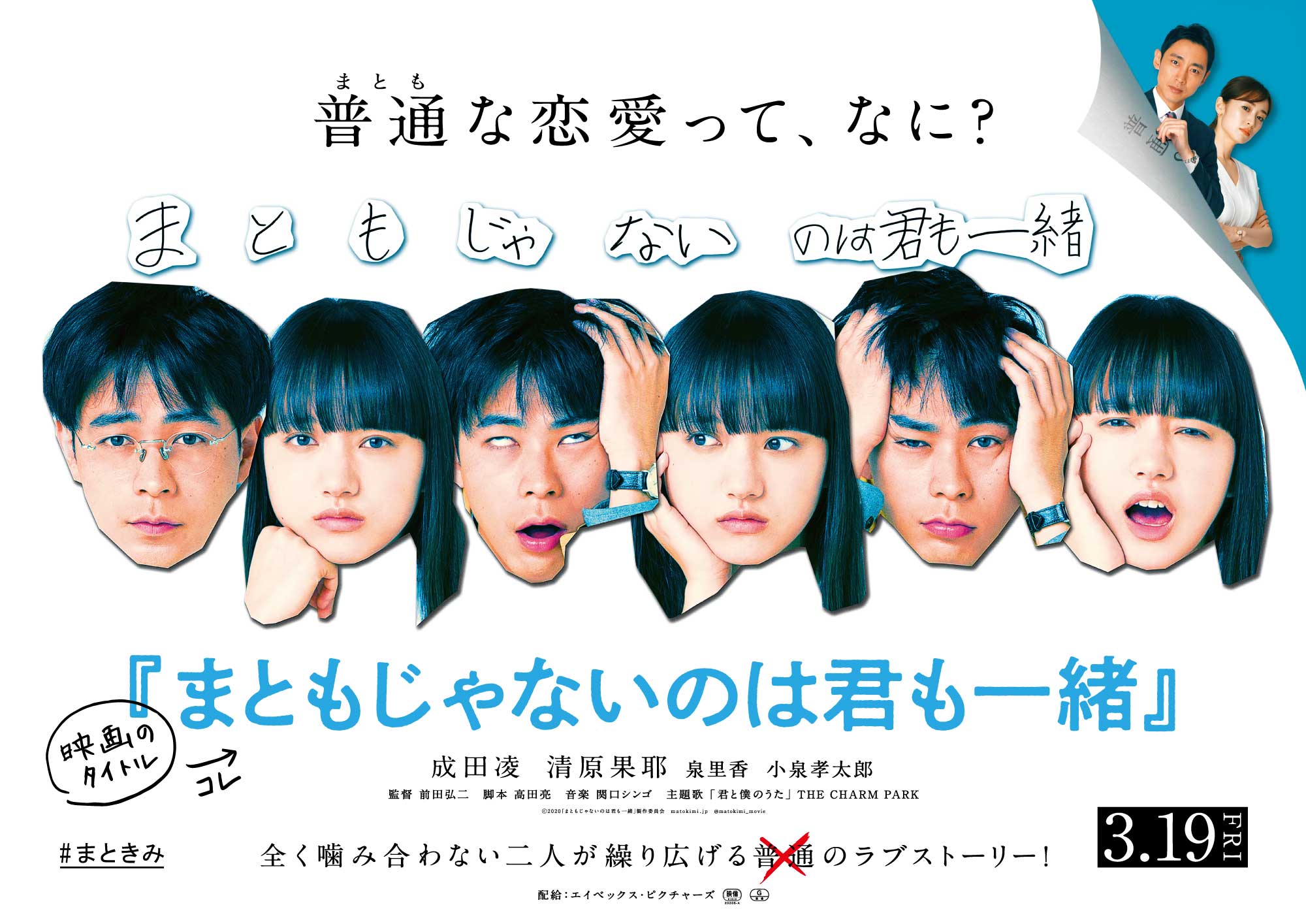
You’re Not Normal, Either! (まともじゃないのは君も一緒, Koji Maeda, 2021)

What’s so great about being “normal” anyway? As the title of Koji Maeda’s quirky screwball comedy You’re Not Normal, Either! (まともじゃないのは君も一緒, Matomo Janai no wa Kimi mo Issho) suggests neither of its heroes is quite in tune with the world around them but then again, is there really such a thing as “normal” or is it more that most people are making themselves unhappy by settling for less simply because they think that’s just how things are and resistance only makes you seem awkward? 

Nerdy cram school maths teacher Yasuomi (Ryo Narita) thought he was OK with being a little different, but just recently he’s begun to feel lonely and fears the possibility of being alone for the rest of his life. Perhaps inappropriately, he looks to one of his students, forthright high schooler Kasumi (Kaya Kiyohara), for romantic and life advice hoping that she will teach him how to be, or at least present as, more “normal”. Unbeknownst to him, however, Kasumi is not quite “normal” herself and is in fact obsessed with a tech entrepreneur, Isao (Kotaro Koizumi), who is all about a new and freer future in which humanity is freed from the burden of labour. Finding out that her crush is already engaged to Minako (Rika Izumi) the daughter of a hotel magnate, Kasumi hatches a plan to break them up while training Yasuomi in the art of seduction. 

Kasumi’s insecurities seem to be down to her failure in her middle school exams, attracted to Isao’s philosophies because they offer a possibility of freedom outside the rigid demands of academic success in Japan. She tells Isao in a not quite by chance meeting that she wants to become a teacher in order to expand children’s minds rather than force them into a fixed perspective as the rather authoritarian, rote learning system of education often does. Yet she also feels out of place among her peers whom she sees as vacuous always gossiping about part-time jobs and boys. She frowns at Yasuomi when he accidentally cuts the conversation dead with an awkward comment while attempting to chat up a pair of bubbly office workers in a bar, but often does the same thing herself while sitting with her high school girl friends who fall silent and then change the subject after she injects a little realism into their mindless chatter. 

Yasuomi had viewed himself as “normal” and never understood why others didn’t, noticing that people often stopped associating with him but not knowing the reason why. Obsessed with pure mathematics, over literal, and overstimulated by the complications of life he takes refuge in the forest and the sensory overload of its nocturnal creatures speaking quite eloquently about the beauty of numbers and actually fairly emotionally intelligent in his understanding of the two women. Resolutely failing at Kasumi’s Cyrano act, he comes into himself only when speaking more honesty much to Kasumi’s annoyance actually hitting it off with Minako who is herself just as lonely and alienated but perhaps wilfully trapped. 

Predictably enough, Isao isn’t exactly “normal” either or perhaps he is but only in the most depressing of ways, his rosy vision of the future delivered with more than a little snake oil and just as much sleaze. Minako may know what sort of man Isao is, that her marriage is largely a dynastic affair set up by her overbearing, authoritarian father, but she too may think this is “normal” and might have preferred not to have to confront her sense of existential disappointment while attempting to fulfil the role of a “normal” woman content with creating a comfortable space in which her husband can thrive.  

Romantically naive, Kasumi wonders how people come to fall in love informed by two relatively mature classmates that for them at least falling in love is a gradual process of increasing intimacy generated through casual conversation. This turns out to be pretty much true for Kasumi too, though in ways she didn’t quite expect watching as Yasuomi opens up to Minako and finding herself unexpectedly jealous while reluctant to let go of the idealised vision she had of Isao as some kind of messiah for a better Japan. There is something a little uncomfortable in the potentially inappropriate relationship between a student and her teacher even as the roles are, on one level at least, reversed but there’s also a kind of innocence in their childish friendship and later determination to start small and let things grow while abandoning the idea of the “normal” altogether to embrace their true selves in a freer future of their own creation. 


You’re Not Normal, Either! screens in Chicago on Oct. 7 as part of the 13th season of Asian Pop-Up Cinema 

Original trailer (English subtitles)

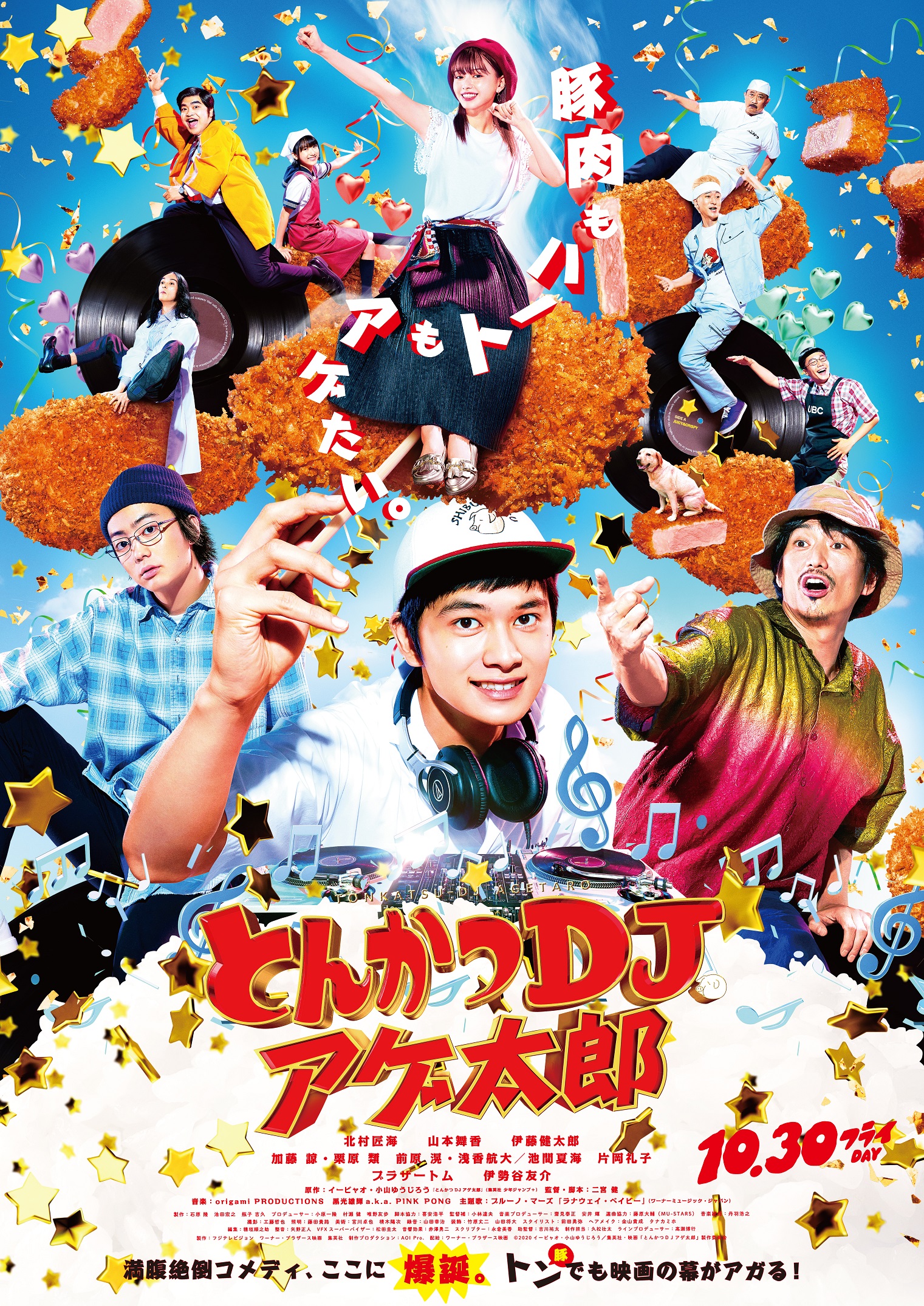
Tonkatsu DJ Agetaro (とんかつDJアゲ太郎, Ken Ninomiya, 2020)

Among the more prolific of young indie talents currently emerging in Japan with five features released since his 2015 debut Slum-Polis, Ken Ninomiya is fast becoming the go to chronicler of Tokyo’s contemporary club scene but unlike The Limit of Sleeping Beauty or Chiwawa, Tonkatsu DJ Agetaro (とんかつDJアゲ太郎) is a surprisingly wholesome take on the same phenomenon as an otherwise clueless young man begins to step into himself after accidentally falling love with the live house vibe. 

As his slightly amusing name implies, Agetaro (Takumi Kitamura) is the third generation heir to a tonkatsu (deep fried pork cutlet) restaurant. It’s not that he doesn’t want to take over the family business, but admits that he’d largely be doing it because he doesn’t know what else to do. His rather nerdy friends, all sons of small business owners in an area of Shibuya with a distinctly small-town vibe, are in much the same position. Ironically remarking that Agetaro always loses at The Game of Life as they hang out playing boardgames, the guys eventually find him with a pair of binoculars staring at a girl in an apartment opposite they are convinced inhabits a different word where people eat prosciutto and cheese and drink fancy wine. Agetaro gets an unexpected chance to meet his unobtainable crush, Sonoko (Maika Yamamoto), when he’s summoned to deliver a bento to a dance club after hours for a moody DJ, Oily (Yusuke Iseya), who describes tonkatsu as the area’s “soul food” and rates Agetaro’s dad’s as the very best. Allowed to step onto the dance floor, he finds himself blown away by Oily’s set and determines to become the very first tonkatsu chef/DJ partly in the hope of impressing Sonoko. 

Though set very much in the present day, there’s a pleasingly retro quality to Tonkatsu DJ Agetaro that recalls old school Showa-era musical youth movies in which young guys from humble backgrounds make something of themselves by working hard and staying true to their roots. Agetaro’s problem is that he’s caught in a moment of adolescent anxiety, resentful of his father (Brother Tom) whom he feels looks down on him, refusing to let his son anywhere near the fryer while making him chop cabbage all day and reminding him he doesn’t have to take over the shop if he doesn’t want to. Agetaro’s dad won’t teach him to fry because he thinks he doesn’t take anything seriously, and he might be right, but as his sister (Natsumi Ikema) says he’s worried about him too secretly trying to be supportive by standing at the back of the room when Agetaro gets his big break at the local club. 

Despite being mentored by Oily, however, Agetaro blows his first opportunity failing to get the crowd moving with a rather naff set designed to entertain his equally nerdy friends. But failure, crucially, only endears him to Sonoko who had previously been put off by his cheesy attempts to become a viral YouTube star with a series of gimmicky videos featuring himself and his friends wearing novelty “tonkatsu” outfits. Where he thought of giving up, Sonoko’s reminder that everyone makes a mess of things once in a while and no one should expect success right out of the gate helps Agetaro realise that what he needs to do is bring all of himself to his set which in this case means understanding that the thing is learning do something well and in that there’s no difference between frying the perfect cutlet and finding the perfect beat. Simply put, he needs to become the Tonkatsu DJ for real. 

Attracted to DJing because of the freedom it offers, Agetaro eventually finds his “heaven” on the dance floor marrying both sides of himself as he accepts his tonkatsu legacy and claims his space within the club scene which here is unproblematically joyful, a warm and welcoming space in which young people come together to enjoy good music, dance, and have wholesome fun. Simply put, it’s hard not to fall in love with a film which makes space for an unironic and unapologetically joyful moment of catharsis featuring Belinda Carlisle’s Heaven is Place on Earth. Shifting away from the slick music video aesthetic of his earlier work, Ninomiya hits lowkey charm in his tale of minor slacker success as his feckless hero finally figures himself out and learns how to cook up a storm in the store and on the floor. 


Tonkatsu DJ Agetaro screens on July 4/6/9 as part of this year’s Neuchâtel International Fantastic Film Festival (NIFFF)

Original trailer (English subtitles)
Code Blue: The Movie (劇場版コード・ブルー –ドクターヘリ緊急救命–, Masaki Nishiura, 2018)

Code Blue posterThe common complaint plaguing popular Japanese cinema is that it’s increasingly dependent on existing source material, not in only the prevalence of manga adaptations, but the continuing influence of TV drama. Ever since the massive success of the Bayside Shakedown franchise, big screen outings for popular series have been a mainstay of the Japanese film industry, the problem of course being, from a certain point of view, that their nature as an extension of an already existing narrative universe makes them not only impossible for export but also a potential audience turn off to those not already invested.

Code Blue is itself comparatively unusual in being one of the few Japanese TV dramas to head into multiple series. That being so, a movie was something of an inevitability, but like many medical shows which generally adopt a case of the week formula, Code Blue thrives on finely crafted characterisation. Rather than jump this obvious hurdle, director Masaki Nishiura opts for the time-honoured solution of a brief flashback highlighting the key events of the previous three seasons and otherwise tries to avoid too many references to past events. It remains true however that viewers already acquainted with the Doctor Heli team will be best placed to navigate the complex interpersonal relationships informing the rest of the action.

Those would be, chiefly, the unexpected return of aloof doctor Aizawa (Tomohisa Yamashita) who is about to take up a research position in Toronto, while Dr. Hiyama (Erika Toda) is also preparing to follow her dream by moving on to head up the perinatal department at a nearby hospital. As is stressed in the opening sequence for those who might not be aware, the Doctor Heli program does not airlift passengers by helicopter but drops doctors into emergency situations where they are most urgently needed. Aizawa’s arrival coincides with the forced return of a flight originally heading to Vietnam which experienced heavy turbulence with multiple casualties needing evacuation from the plane or treatment on the ground. One such patient turns out to be an especially difficult case seeing as she has not only sustained serious injuries, but is also suffering from stage 4 stomach cancer and was trying to take a last vacation in her final days.

The Doctor Heli team are deeply touched by Tomizawa’s (Kasumi Yamaya) plight, knowing that though her injuries would otherwise not be regarded as serious, she may well end up spending her remaining time in their ICU rather than doing the things she wanted while she could. A talk with her parents reveals a painful breakup and canceled wedding, neatly echoing a conflicted nurse desperately trying to get out of the, in her view unnecessary, wedding ceremony her fiancé has organised. Tomizawa’s former boyfriend (Mackenyu) eventually returns and apologises, hoping to make up for lost time, but she isn’t sure she should let him, not only because he let her down by running away, but because she fears that if she does she might prevent him moving on with his life after the inevitable occurs.

Despite being skilled at fixing the human body, the doctors confess they are often at a loss when it comes to the human heart. They struggle to communicate their true feelings to each other, keeping their minds on the job with well practiced practicality, but are all too aware of the precariousness of being alive. What they all advise is that it’s best to let the people you love know your true feelings because you never really know if there will be another opportunity. Dependable leader Shiraishi (Yui Aragaki) can’t quite find the words to express her feelings for her soon to be departed best friend Hiyama, while she struggles with her essential “awkwardness” yet has a knack for the good kind of “direct”, always knowing the right words to help people feel better.

Aizawa, who had no family of his own, is stoical and patient with those of others, comforting a young man who’s gotten into a car accident with the abusive father he’d tried to reconnect with, letting him know that there was nothing wrong in his rage or resentment but also nothing wrong in his desire to tell him that he has become a fine man on his own and that his father’s violence has not destroyed him. Likewise, a young nurse, Futaba (Fumika Baba), gets an unexpected shock when her older sister brings their alcoholic mother (Rino Katase), from whom she’d become wilfully estranged, into the hospital after she fell and got a kitchen knife stuck in her head. Aizawa tells her that she did what she needed to do and shouldn’t feel guilty about “abandoning” her mother, but also gives her the space to reconnect with her as she begins to understand a little of her mother’s suffering.

You can’t deny that Code Blue: The Movie (劇場版コード・ブルー –ドクターヘリ緊急救命–, Gekijoban Code Blue Doctor Heli Kinkyu Kyumei) is basically a two hour TV special, shot exactly like the TV series with seemingly no increase in budget or production values, but it topped the Japanese box office and obviously provided fans with exactly what they were looking for. A little less melodramatic than might be feared, the series’ big screen finale (?) is unabashedly emotional but celebrates as much the close bonds between the Doctor Heli team as those with their patients as they face the unthinkable time and again but get through it together.


Teaser trailer (no subtitles)

https://www.youtube.com/watch?v=nhbuZpcdHTo