
Hoodlum Soldier (兵隊やくざ, Yasuzo Masumura, 1965)

The opening voiceover of Yasuzo Masumura’s Hoodlum Soldier (兵隊やくざ, Heitai Yakuza) explains to us that the settlement we’re looking at is effectively a huge prison in the desert inhabited only the Japanese military from which there is no escape. To ram the point home, the camera lingers on the decomposed skeleton of Japanese infantrymen half-buried in the mud only a short distance from the fort’s borders. This is the fate of the soldier, it seems to tell us with nihilistic futility as if in effect all of these men are already dead while imprisoned inside the death cult that is militarism. 

Yet, our heroes will eventually escape. At least that’s how it seems at the end of the film though there are a further eight instalments in this series. A mismatched pair who develop something akin to a sadomasochistic relationship, they each resist this system in opposing ways. “College boy” Arita (Takahiro Tamura) is just waiting out the end of his contract, continually refusing promotions so that he will be discharged at the end of his three-year term and allowed to return to Tokyo a free man. Omiya (Shintaro Katsu), by contrast, is a man who has no real concept of hierarchy or authority. As he later says, he doesn’t do anything he doesn’t want to do and it’s not so much that he resists authority but is simply indifferent to it.

As Arita explains, the the army is a hierarchy that’s founded on violence. The mildest infraction is dealt with through a process of slapping in which those of higher status assert their authority by inflicting violence on those below. We’re told that laws have recently been put in place to regulate the violence implemented as disciple with excessive force now apparently frowned upon leaving this culture of slapping as the only accepted form of judging an action right or wrong though it’s also clear that these rules are not always respected even by those who made them. The very system is then itself corrupt and unfair, which Arita knows and therefore contrives to live outside of it in so much as he does not participate in this chain of violence.

Neither does Omiya but in an opposing way. On joining the unit, he simply does not react to being slapped by his superior officer and in that way makes it clear that he cannot be controlled by violence. He does not fight back, but only uses to violence to oppose what he sees as injustice and it’s this refusal to just accept the unfairness of army life that makes him a thorn in the side to army command. They assign a reluctant Arita as his mentor, much to his chagrin because he fears that Omiya will get him into trouble and damage his chances of making it to his discharge without incident. But the funny thing is that Omiya does submit himself to Arita’s authority precisely because he does not brutalise him and never uses violence as a means of control. Omiya respects Arita, and therefore listens to him when he explains why a particular course of action is disadvantageous to himself and will only result in further violence. 

To Arita, Omiya at times seems like a bullheaded brawler who thinks a fight is over when someone is knocked out or surrenders and is unable to see the potential for reprisals, but he’s smarter than he gives him credit for and the bond between them is quite genuine even at times homoerotic as they each declare they don’t want to be parted from each other seemingly the only two sane men marooned amid the folly of war in Manchuria. Omiya respects Arita because he does not use violence against him, but in other senses perhaps craves it and is willing to inflict violence on himself in order to save Arita from being forced to do so by the system under which they live which would obviously cause him mental anguish. The power dynamics between them shift as the fortunes of the war decline with Arita eventually declaring that Omiya is now his superior and may issue him orders which he will then obey.

The statement may however be ironic in that they are in the process of escaping the hierarchal society by hijacking its most potent symbol, a train. Omiya declares themselves free of it in pointing out that China stretches to the borders of Russia and Europe as if the whole world were now open to them that they are no longer bound by the walls of the literal prison that is the army camp and the symbolic ones of the militarist society ruled by violence. As Arita had pointed out, the camp ran itself like a prison and was akin to a yakuza society with the different factions often at war with each other. Goverened by macho posturing, every transgression must be solved through violence to approve each man’s status with Omiya’s perpetually high in part because he doesn’t really care very much for the hierarchy only for what he sees as righteousness. 

The two men bond with a Japanese sex worker who they realise is just as trapped as they are by the force that underpins militarism, violent patriarchy. She also feels her situation to be futile, that even if she should return to Japan there will no future for her because of her past in sex work while she currently has no more control than they do and is simply pulled around by her employers to wherever the army goes now that the frontlines are in constant flux and the retreat south has begun. Arita and Omiya free themselves by decoupling from the train leaving the sleeping soldiers yet to awake from the cruel spell of militarism inside while they seek freer futures. Our heroes are men who in effect simply choose to remove themselves from an absurd and destructive social order which speaks just as well to the contemporary society of docile salarymen living in a different kind of prison but perhaps no more free than previous generations while tied to a feudalistic, patriarchal social hierarchy. 


Hoodlum Soldier screened as part of this year’s Camera Japan.

Original trailer (no subtitles)

The Drifting Classroom (漂流教室, Nobuhiko Obayashi, 1987)

Drifting ClassroomNobuhiko Obayashi may have started out as an experimental filmmaker and progressed to a lengthy narrative film career but he remains best known for his “what the hell am I watching?” cult classic Hausu. Aside from his 1983 take on The Girl Who Leapt Through Time, very little of his other work has travelled outside of Japan. In the case of 1987’s The Drifting Classroom (漂流教室, Hyoryu Kyoshitsu), this is doubly surprising firstly because it’s based on a hugely popular manga by the godfather of horror comics Kazuo Umezu and secondly because it’s set in an international school so around 80% of the dialogue is in English.
Obayashi jettisons most of Umezu’s original plot which involves an ordinary Japanese school being suddenly and mysteriously uprooted from its city centre location leaving only a gaping hole to mark its place. This time our hero is Shou – a teenage boy who has recently returned from living in LA and is attending Kobe International School until his Japanese improves enough to get into a normal establishment. Having lived abroad for so long, Shou is a totally Americanised boy with a rebellious, individualistic streak and just wants to hang out with his cool American pals rather than study like his parents want him to do so he can get a foot on the all important ladder of the Japanese educational system. Consequently he argues with his mother and says some very harsh things which leads to her telling him to get out and not to bother coming back – sentiments which both are about to spend the rest of their lives regretting.

Right before taking the register some weird shit goes down and there’s an intense storm which fills most of the school building with sand. Looking out of the windows, everything seems to have become desert. The kids and the two remaining teachers think about what to do and settle on practical things like rationing the food and water left in the school canteen. Back in Kobe, there’s just a giant hole in the ground and a whole lot of confusion….

For some reason, Obayashi decided to set the story in an international school which means that most of the dialogue is in English (though judging by the accents and languages there are some Europeans and students from other parts of Asia around too). This is the single worst decision of the adaptation as the dialogue, which is overly silly to begin with, is offered in stilted, halting tones by its disappointing child actors with the native English speakers not doing very much better than the Japanese kids who are at least trying their best. Perhaps for these reasons (or just out of operational necessities) the film is entirely shot in non-sync sound and the dubbing never quite links up either.

It almost seems as if Obayashi is targeting an overseas audience as his tone is very much indebted to ‘80s kids’ movies with its cast of slightly plucky (sometimes irritatingly so) youngsters trying to solve the mystery of their own disappearance. However, it doesn’t seem as if the film was ever released outside of Japan (where it has never even been released on DVD) despite the presence of one time American star Troy Donohue leaving the strange Americanisms as a sort of exotic plot element with no real resolution.

Though the story seems to be aimed at older children with the usual themes of perseverance in times of adversity and the importance of teamwork and friendship, there are a few scary moments including a psycho style gag where a teacher’s head spins round before dissolving into sand. However, the majority of the special effects are extremely unconvincing resembling an ‘80s kids TV programme with a host of matte paintings, bad green screen, early digital effects and even some tokusatsu style people in rubber suits playing strange cockroach-like monsters. Arguably the best of these is the friendly creature who hangs round with the kids from school and most closely resembles a disgruntled potato with legs (but may actually be giving the most accomplished performance in the entire film).

All of this could have added to the film’s kitsch, “bad movie” vibe but Obabyashi opts to get serious every now and then and ruins everyone’s fun in the process. Weirdly, everyone just seems to accept the “timeslip” argument right away as if that’s a perfectly normal thing that happens every now and then like sinkholes or spontaneous human combustion – there’s even a geologist (?) being interviewed on the news who just says “yes – it is probably a timeslip” when asked to provide some “scientific commentary” on the disappearance of the school children. Completely bizarre but not in a very interesting way, The Drifting Classroom is a misfire on all levels neither making a good adaptation of its source material or an entertaining movie in its own right. Camp classics enthusiasts or Obayashi fanatics only.


The Drifting Classroom was also adapted into a TV drama in 2002 under the title of Long Love Letter which is much better than this movie.

A short scene from the film starring its best character whom I have decided to name “Spuddy” (English dialogue):

http://www.youtube.com/watch?v=g87XmnPjrNw

The Snake Girl and the Silver-Haired Witch (蛇娘と白髪魔, Noriaki Yuasa, 1968)

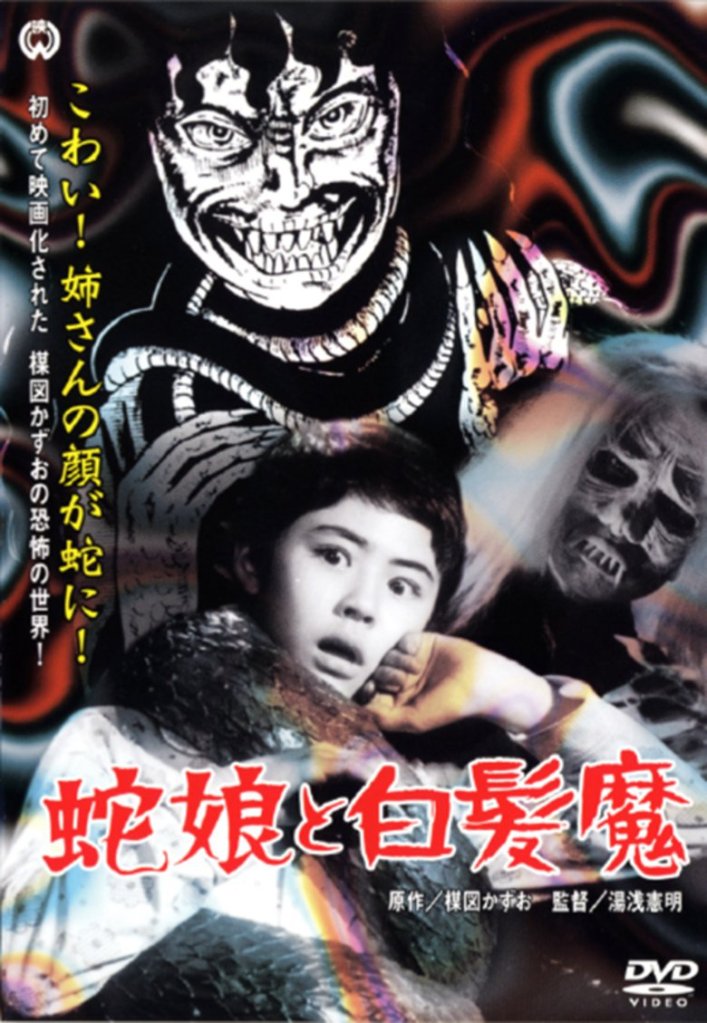
snake girl and the white haired witchLittle Sayuri has had it pretty tough up to now growing up in an orphanage run by Catholic nuns, but her long lost father has finally managed to track her down and she’s going to able to live with her birth family at last! However, on the car ride to her new home her father explains a few things to her to the effect that her mother was involved in some kind of accident and isn’t quite right in the head. Things get weirder when they arrive at the house only to be greated by the guys from the morgue who’ve just arrived to take charge of a maid who’s apparently dropped dead!

If that weren’t enough her “mother” calls her by the wrong name and then dad gets a sudden telegram about needing to go to Africa for “several weeks” to study a new kind of snake! On her tour of the house, Sayuri finds a room full of snakes, reptiles and insects (and also for some reason a large vat of acid?!) as well as a room with a buddhist altar where the food seems to disappear just as if Buddha himself were really eating it. Eventually, Sayuri is introduced to her secret sister, Tamami, who has slight facial disfigurement and a wicked disposition which has seen her locked away from view for quite some time…..

Based on the manga by Kazuo Umezu, Snake Girl and the Silver-Haired Witch (蛇娘と白髪魔, Hebi Musume to Hakuhatsuma) is, apparently, aimed at a younger audience which explains its child’s eye view of events but the film makes no concessions to the supposed softness of little minds. With a host of surreal imagery including dream sequences full of creepy, hypnotic spirals, and moments of shocking violence such as a large frog being suddenly ripped in half right in front of Sayuri’s eyes the film certainly doesn’t stint on blood, horror and general freakiness.

Sayuri herself seems largely unperturbed by these strange goings on outside of her nightmarish serpentine visions. She seems to have been well cared for at the orphanage and is happy to have found her family rather than just to be escaping the institution. On getting “home” she does her best to fit in right away, acting politely and trying to bond with her mother even in her confused state. She even tries to get on well with her mysterious sister despite the ominous warning to keep her very existence a secret from her father. Tamami, however, is a nightmare child with homicidal tendencies who isn’t interested in playing happy families with the girl who’s come to usurp her place in the household.

There’s a little more to the set up than just snake based horror (the clue being the Silver-Haired Witch of the title) but the secondary message seems to be one of remembering that the true beauty of a person lies not in their external appearance but in the goodness of their soul. The previously deformed Tamami is later said to be looking sweeter after having “redeemed” herself and Sayuri pledges to honour Tamami’s sisterly sacrifice by always remembering to hold fast and true to the beautiful things in her own soul without being swayed by worldly charms.

Snake Girl and the Silver-Haired Witch is more of a psychological horror tale than some of the effects laden efforts of the period. However, there are a fair few practical effects on show most notably during the dream sequences – one of which sees Sayuri actually fighting a giant snake with a sword, as well as the creepy spirals and the appearance of weird vampire-like snake women, dancing oni masks and the Silver-Haired Witch herself.

A children’s film that no one in their right mind would actually show to a child, Snake Girl and the Silver-Haired Witch is a freakishly psychological horror show seen through the eyes of a little girl. Part dreamscape and part terrifying reality, the film mixes the real and the imagined with a fiendish intensity and it just goes to show that sometimes you really do need to pay attention to the strange fancies of intrepid young ladies.


This trailer doesn’t have any subtitles but it is actually quite scary…..

https://www.youtube.com/watch?v=rLtwDVvTtA8