Lady Sazen and the Drenched Swallow Sword (女左膳 濡れ燕片手斬り, Kimiyoshi Yasuda, 1969)

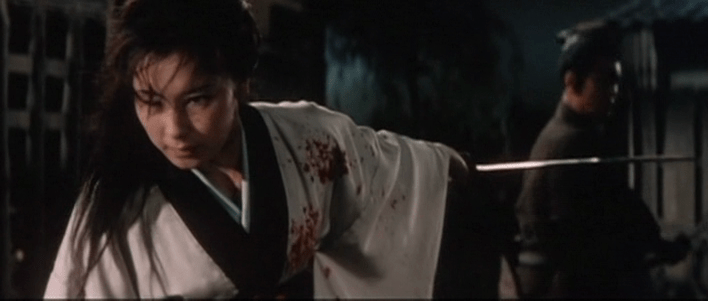
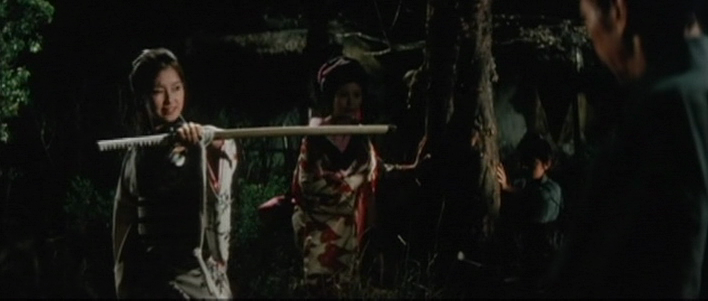
A one-armed, one-eyed swordswoman finds herself fighting a war on two fronts after rescuing a young woman running away from mistreatment while herself pursued by a venal lord determined to get his hands on her ancestral blade in Kimiyoshi Yasuda’s jidaigeki adventure Lady Sazen and the Drenched Swallow Sword (女左膳 濡れ燕片手斬り, Onna Sazen: Nuretsubame Katate Giri). This wasn’t the first time the classic character of Tange Sazen had been re-envisioned as a woman, though it does appear to have been an attempt by Daiei to launch a Toei-style female-led period action series even if no further instalments were ever made.

Nicknamed “Lady Sazen”, Okin (Michiyo Yasuda) lives in a small shack with the former retainer, Gosuke (Yusaku Terashima), who raised her, and Yasu, a little boy they seem to have taken in. Gosuke provides for them by weaving baskets, while it remains true Okin occupies an awkward space in Edo-era society. Having lost an arm and bearing a large scar over one eye which is no longer functional, Okin likely could not marry even if she wanted to, nor are there any occupations which are open to her which is why the only way that she can make money is by participating in the male world of sword fighting and gambling, much to Gosuke’s disapproval. It’s also why she’s branded monstrous by her opponents simply for being a woman who is able to use a sword.

A mysterious wanderer remarks that it might have been better had she been born a man, a sentiment with which Okin agrees even as the man jokingly complains about her lack of femininity and subsequent inability to offer the customary hospitality to a guest. She also speaks roughly and drinks sake directly from a gourd. Nevertheless, she sympathises with Omitsu (Natsuko Oka) precisely because of the similarity in their life stories as two women wronged by the patriarchal samurai order. Omitsu was promised advancement through serving at the castle, but was then essentially trafficked by the Minister for Temples and Shrines who sent her to the corrupt priest at Hojoji temple where she was pressed into sex work. Having attempted to escape, she returns home to discover both her parents have been murdered after reusing to give up her location. Okin’s parents were similarly murdered by a greedy lord who demanded her father give up his sword and killed him when he refused.

There is a degree of homoerotic tension that arises between Omitsu and Okin as the pair settle in to a kind of domesticity, yet the film hints at a potential romance with sometime enemy Eizaburo (Kojiro Hongo) who has been sent by his lord who is obsessed with swords to get hold of Okin’s. Eizaburo later gives up on the idea after finding out her family history, but is also beholden to samurai mores especially when he learns his sister is to be sent to the corrupt priest as part of his lord’s plan to win favour and possible promotion from the high priest. As Okin now lives outside of samurai society, she cannot restore order within it, but is determined to use public pressure to flush the wrongdoers out by exposing the corruption through a series of pamphlets. The priest, however, is able to simply blame everything on his former co-conspirator thanks to the fact he has already installed his daughter as the shogun’s mistress. 

The unseen Lady Osode wields power in a different way, even if on the surface it looks like she too is being trafficked by her father. Refreshingly enough, Okin’s abilities as a one-armed swordswoman are totally respected. Though she may sometimes fight alongside men or they may provide assistance to her by buying time for her to escape, they never try to take over or get in her way. Rather, they treat her as an equal who is not in need of their protection. Though Eizaburo vows to give up the sword and abandon his samurai status, this is something that Okin can ever do because her duty lies in protecting her familial legacy in the form of the blade inherited from her father. She may be to a degree feminised in assuming a maternal position over Yasu, but maintains her independence in once again taking to the road in search of new adventures.


Hoodlum Soldier (兵隊やくざ, Yasuzo Masumura, 1965)

The opening voiceover of Yasuzo Masumura’s Hoodlum Soldier (兵隊やくざ, Heitai Yakuza) explains to us that the settlement we’re looking at is effectively a huge prison in the desert inhabited only the Japanese military from which there is no escape. To ram the point home, the camera lingers on the decomposed skeleton of Japanese infantrymen half-buried in the mud only a short distance from the fort’s borders. This is the fate of the soldier, it seems to tell us with nihilistic futility as if in effect all of these men are already dead while imprisoned inside the death cult that is militarism. 

Yet, our heroes will eventually escape. At least that’s how it seems at the end of the film though there are a further eight instalments in this series. A mismatched pair who develop something akin to a sadomasochistic relationship, they each resist this system in opposing ways. “College boy” Arita (Takahiro Tamura) is just waiting out the end of his contract, continually refusing promotions so that he will be discharged at the end of his three-year term and allowed to return to Tokyo a free man. Omiya (Shintaro Katsu), by contrast, is a man who has no real concept of hierarchy or authority. As he later says, he doesn’t do anything he doesn’t want to do and it’s not so much that he resists authority but is simply indifferent to it.

As Arita explains, the the army is a hierarchy that’s founded on violence. The mildest infraction is dealt with through a process of slapping in which those of higher status assert their authority by inflicting violence on those below. We’re told that laws have recently been put in place to regulate the violence implemented as disciple with excessive force now apparently frowned upon leaving this culture of slapping as the only accepted form of judging an action right or wrong though it’s also clear that these rules are not always respected even by those who made them. The very system is then itself corrupt and unfair, which Arita knows and therefore contrives to live outside of it in so much as he does not participate in this chain of violence.

Neither does Omiya but in an opposing way. On joining the unit, he simply does not react to being slapped by his superior officer and in that way makes it clear that he cannot be controlled by violence. He does not fight back, but only uses to violence to oppose what he sees as injustice and it’s this refusal to just accept the unfairness of army life that makes him a thorn in the side to army command. They assign a reluctant Arita as his mentor, much to his chagrin because he fears that Omiya will get him into trouble and damage his chances of making it to his discharge without incident. But the funny thing is that Omiya does submit himself to Arita’s authority precisely because he does not brutalise him and never uses violence as a means of control. Omiya respects Arita, and therefore listens to him when he explains why a particular course of action is disadvantageous to himself and will only result in further violence. 

To Arita, Omiya at times seems like a bullheaded brawler who thinks a fight is over when someone is knocked out or surrenders and is unable to see the potential for reprisals, but he’s smarter than he gives him credit for and the bond between them is quite genuine even at times homoerotic as they each declare they don’t want to be parted from each other seemingly the only two sane men marooned amid the folly of war in Manchuria. Omiya respects Arita because he does not use violence against him, but in other senses perhaps craves it and is willing to inflict violence on himself in order to save Arita from being forced to do so by the system under which they live which would obviously cause him mental anguish. The power dynamics between them shift as the fortunes of the war decline with Arita eventually declaring that Omiya is now his superior and may issue him orders which he will then obey.

The statement may however be ironic in that they are in the process of escaping the hierarchal society by hijacking its most potent symbol, a train. Omiya declares themselves free of it in pointing out that China stretches to the borders of Russia and Europe as if the whole world were now open to them that they are no longer bound by the walls of the literal prison that is the army camp and the symbolic ones of the militarist society ruled by violence. As Arita had pointed out, the camp ran itself like a prison and was akin to a yakuza society with the different factions often at war with each other. Goverened by macho posturing, every transgression must be solved through violence to approve each man’s status with Omiya’s perpetually high in part because he doesn’t really care very much for the hierarchy only for what he sees as righteousness. 

The two men bond with a Japanese sex worker who they realise is just as trapped as they are by the force that underpins militarism, violent patriarchy. She also feels her situation to be futile, that even if she should return to Japan there will no future for her because of her past in sex work while she currently has no more control than they do and is simply pulled around by her employers to wherever the army goes now that the frontlines are in constant flux and the retreat south has begun. Arita and Omiya free themselves by decoupling from the train leaving the sleeping soldiers yet to awake from the cruel spell of militarism inside while they seek freer futures. Our heroes are men who in effect simply choose to remove themselves from an absurd and destructive social order which speaks just as well to the contemporary society of docile salarymen living in a different kind of prison but perhaps no more free than previous generations while tied to a feudalistic, patriarchal social hierarchy. 


Hoodlum Soldier screened as part of this year’s Camera Japan.

Original trailer (no subtitles)