Missing (ミッシング, Keisuke Yoshida, 2024)

Why is it that we rush to judgement rather than empathy? When a little girl disappears during a short walk from a local park to her home, less than helpful members of the public are quick to turn on the parents while news media, eager for ratings and clicks, is only too happy to give the people what they want casting aside ethical concerns in their exploitation of the parents’ pain all while the little girl remains missing.

In this society, it’s quite normal culturally for children of Miu’s age, six, to walk short distances alone and be left unsupervised at home at for short periods of time. Nevertheless, the public is quick to blame the mother, Saori (Satomi Ishihara), because she had gone to a concert that night and didn’t notice frantic calls from her husband worried because Miu was not at home when he got back from work at 7pm. Soari too blames herself, as is perhaps natural, but it’s unreasonable to expect anyone to never go out for an evening again after having children. Her husband comes in for less scrutiny, which might be surprising, though her brother, Keigo (Yusaku Mori), soon finds himself the prime suspect having been the last to see Miu and allowed her to walk home alone though he would previously have walked her back.

The family find themselves under scrutiny with their every move judged by an unforgiving society. When they dare to buy fancy pastries, online trolls suggest they can’t be all that bothered about Miu after all and are living the high life with the extra money they no longer need to spend on her. Given all that, it might be surprising that they turn to the media for help but in their desperation to find Miu they will leave no stone unturned. Idealistic reporter Sunada (Tomoya Nakamura) seems to want to help them, but is constantly undermined by his bosses who pressure him to take the story into more sensational territory. Though he wanted to write a human interest piece supporting the parents and raising awareness about Miu’s disappearance, he ends up placing them in the firing line for even more trolling and particularly of Saori’s brother Keigo who is an introverted, awkward man not suited to appearing on television. 

Sunada says he wants to help, but it’s undeniable that the media is exploiting the parents’ desperation raising serious ethical concerns as to how they safeguard sources and subjects while shaping the narrative around sensitive issues. Sunada takes a producer to task for placing images of a cement mixer and the sea into the ident for the piece as if it were hinting at what might have happened to Miu but really what the station is most interested in is digging up dirt on the family rather than drawing out new information on the case. A fellow journalist is having great success with a salacious story about the mayor’s son committing fraud, but his piece is less crusading investigative journalism than gossip inviting judgement. Disliking his flippant attitude, Sunada reminds him their job’s not to make people laugh, but his colleague gets a fancy promotion to head office while Sunada is stuck doing random feel good stories about seals.

Their treatment at the hands of the media also exposes a divide within the couple with Saori often frustrated by her husband’s attitude, feeling as if he isn’t invested enough. Yutaka (Munetaka Aoki) suggests simply not reading the online comments and ignoring the trolls while Saori feels compelled to defend herself. He is also warier of pranks and scammers, unwilling to simply jump on every lead out of desperation when so many people seem intent on causing them further pain. Perhaps it makes people feel more in control of their lives to blame the parents, as if something like this couldn’t happen to them because they make what they feel to be better choices, rather than accept that life is random and unfair and little girls can disappear into thin air mere steps from their own door. Unable to find her own daughter, Saori begins defending other people’s children getting a job as a crossing guard to ensure they reach home safely while simultaneously frantic and afraid, handing out fliers to a largely disinterested populace ever hungry for novelty and excitement and embarrassed by her pain even as they continue to feed on it.


Missing screened as part of this year’s Toronto Japanese Film Festival.

Original trailer (English subtitles)

The Apology King (謝罪の王様, Nobuo Mizuta, 2013)

The Apology King.jpgThere are few things in life which cannot at least be improved by a full and frank apology. Sometimes that apology will need to go beyond a simple, if heart felt, “I’m Sorry” to truly make amends but as long as there’s a genuine desire to make things right, it can be done. Some people do, however, need help in navigating this complex series of culturally defined rituals which is where the enterprising hero of Nobuo Mizuta’s The Apology King (謝罪の王様, Shazai no Ousama), Ryoro Kurojima (Sadao Abe), comes in. As head of the Tokyo Apology Centre, Kurojima is on hand to save the needy who find themselves requiring extrication from all kinds of sticky situations such as accidentally getting sold into prostitution by the yakuza or causing small diplomatic incidents with a tiny yet very angry foreign country.
Kurojima promises to know an even more powerful form of apology than the classic Japanese “dogeza” (falling to your knees and placing your head on the ground with hands either side, or OTL in internet lingo), but if you do everything he tells you to, you shouldn’t need it. His first case brings him into contact with Noriko (Mao Inoue) whose awful driving has brought her into contact with the yakuza. Not really paying attention, Noriko has signed an arcane contract in which she’s pledged herself to pay off the extreme debts they’ve placed on her by entering their “employment” at a facility in Osaka. Luckily, she’s turned to Kurojima to help her sort out this mess, which he does by an elaborate process of sucking up to the top brass guys until they forget all about Noriko and the money she owes them in damages. Impressed, Noriko ends up becoming Kurojima’s assistant in all of his subsequent cases, helping people like her settle their disputes amicably rather allowing the situation to spiral out of control.

Mizuta begins with a neat meta segment in which Kurojima appears in a cinema ad outlining various situations in which you might need to apologise including allowing your phone to go off during the movie, or attempting to illegally film inside the auditorium etc ending with a catchy jingle and dance routine pointing towards the contact details for his apology school. Kurojima’s instructions are also offered throughout the film in a series of video essays in which he outlines the basic procedures for de-escalating a conflict and eventually getting the outcome you’re looking for.

Of course, all of this might sound a little manipulative, which it is to a degree, but the important thing to Kurojima lies in mutual understanding more than “winning” or “losing” the argument. The second case which comes to him concerns a young man who has some very outdated ideas and has, therefore, been accused of sexual harassment. Unfortunately, Numata (Masaki Okada) is a classic sexist who only makes the situation worse for himself and completely fails to understand why he was at fault in the first place. Even following Kurojima’s expertly crafted instructions, Numata further insults his female boss whilst attempting to apologise meaning Kurojima has to come up with an even more elaborate plan to smooth the situation which involves pretending to be the ghost of a man who threw himself under a train after being accused of harassing a young woman at work who did not return his affections. This seems to do the trick and the relationship between Numata and his boss appears to have improved even if Numata still has a long way to go in the person stakes, though it does perhaps make light of a serious workplace problem.

Numata follows all of Kurojima’s instructions but still gets everything wrong because he refuses to understand all of the various social rules he’s broken and therefore why and how the apology process is intended to make amends for them. Understanding and sincerity are the keys to Kurojima’s ideology but Numata, after a quick fix, fails to appreciate either of these central tenets and so is unable to work things out for himself. Similarly, in another case the parents of an actor are required to make a public apology when their son is captured on CCTV getting into a street fight. Only, being actors, they find genuine sincerity hard to pull off on the public stage either resorting to chewing the scenery or overdoing the dignified act, not to mention plugging their latest appearances at the end of the speech. The public apology is an important part of the Japanese entertainment industry though it might seem odd that the famous parents of a “disgraced” celebrity would be expected to apologise to the nation as a whole, but as it turns out all that was needed to settle the matter was a quick chat between the people involved, fully explaining the situation and reaching a degree of mutual understanding.

The innovative structure of Apology King neatly weaves each of the cases together as they occur in slightly overlapping timeframes but each contribute to the final set piece in which Kurojima becomes an advisor during a diplomatic incident caused when a film director unwittingly offends the small nation of Mutan by accidentally turning their crown prince into an extra in his film. Mutan is a nation with many arcane rules including a prohibition on filming royalty as well as on drinking and eating skewered meat, all of which the crown prince is seen doing in the movie. Matters only get worse when the film crew travel to Mutan to apologise but make even more faux pas, especially when it turns out that Japanese dogeza is actually incredibly rude in Mutanese culture. Revisiting elements from each of the previous cases, Kurojima is only able to engineer a peaceful solution by convincing the Japanese authorities to utter a set phrase in Mutanese which means something quite different and very embarrassing in their own language. Apologies are, of course, always a little humiliating, but then that is a part of the process in itself – placing oneself on a lower level to those who’ve been wronged, as symbolised in the dogeza.

Full of zany, madcap humour and culminating in a gloriously unexpected pop video complete with dancing idols of both genders exhorting the benefits of a perfectly constructed (and sincere) apology, The Apology King is a warm and innocent tribute to the importance of mutual understanding and its power to ease even the deepest of wounds and most difficult of situations. Hilarious but also heartfelt, The Apology King is a timely reminder that unresolved conflicts only snowball when left to their own devices, the only path to forgiveness lies in recognising your own faults and learning to see things from another perspective. Kurojima’s powers could be misused by the unscrupulous, but the most important ingredient is sincerity – empty words win no respect.


Original trailer (no subtitles)

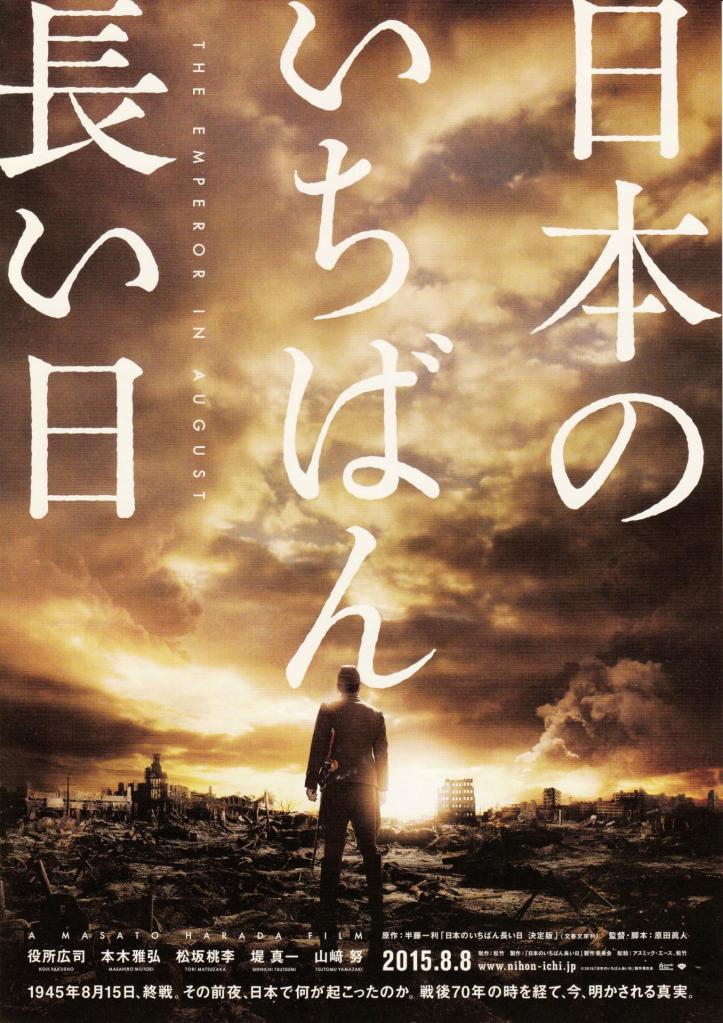
The Emperor in August (日本のいちばん長い日, Masato Harada, 2015)

bbc56b4fff657dfc4fcc0499f8be9741How exactly do you lose a war? It’s not as if you can simply telephone your opponents and say “so sorry, I’m a little busy today so perhaps we could agree not to kill each other for bit? Talk later, tata.” The Emperor in August examines the last few days in the summer of 1945 as Japan attempts to convince itself to end the conflict. Previously recounted by Kihachi Okamoto in 1967 under the title Japan’s Longest Day, The Emperor in August (日本のいちばん長い日, Nihon no Ichiban Nagai Hi) proves that stately events are not always as gracefully carried off as they may appear on the surface.

By the summer of 1945, it’s clear that the situation as deteriorated significantly and Japan can no longer cling to any kind of hope of victory in the wider scale. Tokyo has been firebombed almost out of existence leaving only the Imperial Palace untouched – even the Emperor and his wife have been reduced to eating gruel. Everyone knows it’s time for a solution, but no one is quite ready to say it. In the wake of the atomic bomb, the situation becomes ever more desperate and even if the Emperor himself advocates a surrender, he needs the approval of his advisors. The Prime Minister, Navy and other officials are in favour but the Army, represented by General Anami, is committed to fighting on to the last man. Eventually, Anami comes around to the Emperor’s point of view but some of his men prove much harder to convince…

It might seem like a strange time to make a film about grace in the face of defeat given the recent political troubles stemming back to Japan’s wartime activities, but director Masato Harada is not lamenting the course of the war or trying to advocate for any rightwing agenda so much as trying to make plain the final absurdity of recognising when the battle is over. The civilians and even the Navy might be in favour of accepting the terms of the Potsdam Declaration and ending the war as quickly as possible but a soldier is a soldier and the Army wants to go down fighting. They aren’t alone, of course, there are ordinary people who feel this way too but the writing is well and truly on the wall here.

The bulk of the film takes place within the palace, debating halls or army buildings all of which have escaped major damaged but every time we venture outside we’re shown a scene of utter desolation. A great, gaping hole where once there was a city. Anami’s wife undertakes a four hour walk to try and get in contact with a man who knew their son and can tell them how it was that he fell somewhere in Manchuria. She sees people fleeing, some thinking the enemy are about to descend any minute or that Tokyo will be the next target for an atomic bomb, and walks on through a barren, eerie landscape emerging soot covered and, finally, too late.

Closer to home, the situation among the soldiers is reaching boiling point. Originally committed to rejecting the terms of the treaty, Anami is now in favour of a surrender (with a few caveats) and is desperately working against the threat of an internal coup. Though the top brass have seen enough of warfare to know when it’s time to put down your weapons, the young hotheads have not yet learned the value of pragmatism. Seeing themselves as a second incarnation of the February 26th rebels, a cadre of young officers breaks ranks to try and stop the Emperor’s message of surrender from hitting the airwaves, hoping instead to spread the false message that the Russians have invaded and it’s all hands on deck. Needless to say, they don’t fare any better than the young officers of 1936 and if anything their bullheaded refusal to see sense becomes a microcosmic allegory for the years of militarism as a whole.

In the midst of all this chaos, the real heart of the film is Koji Yakusho’s conflicted general who feels his era passing right in front of him. Grieving for his fallen son yet also clinging to his military duty which dictates no surrender, no retreat he finally sees each of his ideals crumbling and comes to the realisation that the only way to save Japan is to abandon the military. Making a sacrifice of himself, he ensures the safe passage of his nation along a road on which he cannot travel.

The Emperor is a sympathetic figure here, gentle, soft, wanting the suffering to end for everyone but being more or less powerless to effect it despite his title. All he can do is advocate and try to convince his council that surrender is the right course of action as his country burns all around him.

Harada manages to keep the tension high even though a lot of the film comes down to a group of men discussing the proper wording for a treaty. A timely and beautifully photographed exploration of the last days of a war, The Emperor in August is another much needed reminder that decisions which will affect millions of lives are made by handfuls of men in tiny, closed up rooms that most people will never get to see.


The Japanese blu-ray/DVD release of The Emperor in August includes English subtitles.

Unsubtitled trailer: