Tokyo Sonata (トウキョウソナタ, Kiyoshi Kurosawa, 2008)

Orphaned salarymen are the soulless ghosts haunting an increasingly empty city in Kiyoshi Kurosawa’s eerie tale of urban anxiety Tokyo Sonata (トウキョウソナタ). Undermining the certainty of the traditional family, Kurosawa paints it as a simulacrum dependent on each member playing their respective role blindly or otherwise, though in this case the integrity of the family unit is shaken by an economic intervention in which the accepted rules of the society have been upended with a vindictiveness that seems inexplicably unfair. 

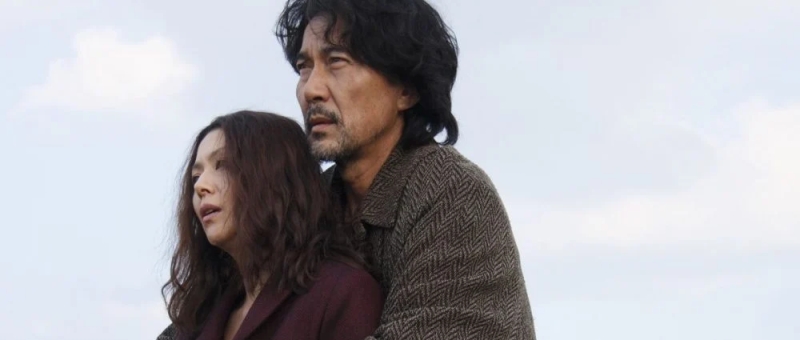
This is the bargain of the salaryman dream. A man like Sasaki (Teruyuki Kagawa) now aged 46 came of age at the tail end of an era of economic prosperity. He was brought up in an atmosphere of jobs for life in which the corporate family was almost more “real” than the emotional which is one reason why it comes as such a shock when his boss effectively divorces him. He’s found someone new, planning to outsource Sasaki’s entire department to China while less than kindly explaining that as he has no other skills he of no more use to the company. Sasaki immediately clears his desk in anger, walking home early with a pair of carrier bags then, after meeting his son in the street, attempting to climb in through an upstairs window to avoid alerting his wife, Megumi (Kyoko Koizumi), to the fact he’s home early.

Sasaki is unable to tell her that he’s lost his job in part because of the acute embarrassment it would cause him. Somewhat dazed and confused, he’s become one of many disenfranchised salarymen who survived the 15 years of economic stagnation only to have the rug pulled out from under them. Being a salaryman was in a way his whole identity and without it he doesn’t know who he is, which is one reason he puts on a suit every day and goes to sit in the park surrounded by other similarly dressed men with briefcases who now seem to haunt the city like crows ominously dotting the horizon. In a repeated motif, Kurosawa shows us people trapped in kafkaesque queuing situations shuffling around buildings while prevented from moving forward but forced to keep pace with the increasingly glacial environment. At the moment an old school friend he runs into, Kurosu (Kanji Tsuda), seems to give up he is swept into a great parade of the suited and hopeless while Sasaki hovers on its edges. 

It’s this threat to Sasaki’s masculine pride which is largely founded on his economic ability to support a family that kickstarts a chain reaction in his home even he becoming increasingly violent and authoritarian in an effort to overcome the sense of humiliation and powerlessness he feels after being made “redundant”. His younger son, Kenji (Kai Inowaki), tells him he wants to learn the piano but Sasaki irritably shuts him down either because he’s now worried about the money or simply sees it as a frivolous waste of time. Later when Megumi asks him why he won’t he change his mind he insists that he has to stick to his original decision otherwise it would undermine his patriarchal authority as a father. 

But this “authority” was perhaps already largely illusionary given that an intense work schedule meant he was rarely home to do much parenting. After finding out Kenji spent his lunch money on piano lessons behind his back he ironically shouts at him for lying and keeping secrets even though this is obviously what he himself has been doing in keeping up the illusion of his identity as a conventional salaryman. His older son, Takashi (Yu Koyanagi), was keeping secrets too his being his desire to join the US military believing that Japan no longer has a future for him in an atmosphere of stagnation not only economic but emotional and spiritual. Takashi tells his mother she should leave Sasaki, but to her question of who would play the role of mother replies that it makes no difference simultaneously encouraging her to reclaim an individual identity and perhaps robbing her of one just as Sasaki lost his in being shorn of his salaryman credentials. 

Lying on the sofa one evening she raises her arms and poignantly asks someone to lift her up but Sasaki has already gone to bed without even looking at her. Her life as a housewife is thankless and emotionally unfulfilling. Donuts she spent ages making go uneaten while her husband and sons brood on their own problems alone. At a car dealership, the salesman shows her a people carrier explaining that it’s perfect for family camping trips while she gravitates towards a red convertible, mesmerised by the way the roof can just disappear as if it were literally freeing her of her stultifying existence. On showing Takashi the shiny new driving license she’s just got as a symbol of her desire for independence, he scoffs that she’ll never use it but she counters him that it’s for “ID” which it is in more ways than one.

The family is imploded, the illusions of a conventional middle-class life upturned as Sasaki and Megumi each ask themselves if there’s a way to start again and escape their sense of middle-aged futility and disappointment. Cracking under the weight of conventionality, the foundations begin to fracture but the family nevertheless finds itself returning if with greater degrees of clarity and perhaps with less inclination to play the play the roles assigned to them rather than those they might wish to play as embodied by Kenji’s moving performance at the piano capturing all of the chaos and confusion of the world around him but finding in it also harmony and a gentle breeze that feels almost as if the city itself were breathing once again.


Tokyo Sonata screens Feb. 18 as part of Family Portrait: Japanese Family in Flux

International trailer (English subtitles)
Before We Vanish (散歩する侵略者, Kiyoshi Kurosawa, 2017)

©2017 BEFORE WE VANISH FILM PARTNERS

before we vanish posterKiyoshi Kurosawa is getting sentimental in his old age. In Journey to the Shore and Real, brokenhearted, left behind spouses went on long and difficult journeys of grief and salvation. In Before We Vanish (散歩する侵略者, Sanpo Suru Shinryakusha) we receive a visitation that presages our doom but wishes to know us before we go. An alien invasion movie which takes its cues from Invasion of the Body Snatchers and They Live, Kurosawa’s quirky drama is less about the enemy within than the hidden existential threat of a failure to understand oneself. As the Japanese title suggests, these invaders are merely out for a stroll, making time to smell the flowers before the big lawnmower arrives to cut them all down.

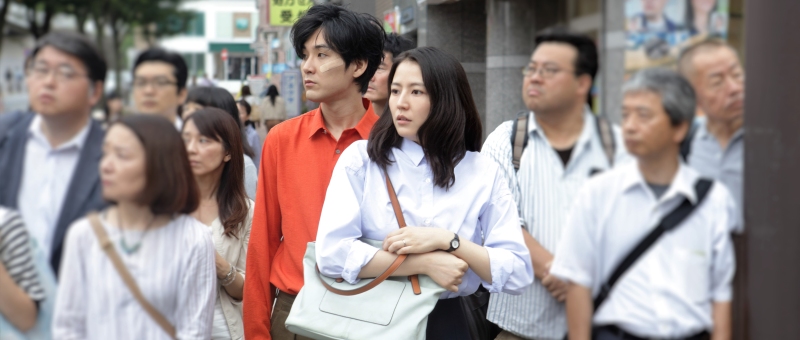
Strange events are afoot in Tokyo. A high school girl wanders home with a pair of goldfish in a plastic bag before brutally murdering her entire family, gazing at the scene of carnage with a beatific smile. Meanwhile, the estranged wife of Shinji Kase (Ryuhei Matsuda), Narumi (Masami Nagasawa), has been sent for to claim her presumably amnesiac husband from a medical facility. Shinji was brought in after wandering the streets cluelessly and seems to have lost certain sections of his memory. The doctor’s diagnosis is uncertain but leans towards some kind of temporary psychotic break or early onset Alzheimer’s. In any case, he is now Narumi’s responsibility, much to her consternation. Across town a down on his luck journalist (Hiroki Hasegawa) covering the brutal family murder finds himself the designated “guide” to another strange young man, Amano (Mahiro Takasugi), who seems to have done something very untoward to his parents.

These three “strangers” are really invaders from outer space – something which they freely confess to anyone who will listen, only everyone assumes they are joking. Exactly why they want to destroy the Earth is never revealed, nor is the the reason for the strange mission undertaken by the three researchers acting as the vanguard for the upcoming invasion. These three have been tasked with a thorough investigation of “humanity” in which they must learn and acquire certain “concepts”. They do this by requiring the subject to visualise their thinking behind a word or phrase and then tapping the head to pinch it causing that concept to be removed from the person’s interior cosmology.

The aliens learn as much from the effect of removing the concept as they do from its explanation. This being Japan, it’s not surprising that the first concept Shinji removes is that of “family” which he takes from Narumi’s younger sister, Asumi (Atsuko Maeda). Asumi had decamped to Narumi’s after an argument with her parents over their railroading her into a mainstream life she doesn’t really want. The removal of the concept of family means Asumi no longer needs to be bound by hollow obligation but her sudden coldness towards her sister immediately invites a series of other questions as to the true nature of their relationship. Similarly, Shinji removes a concept of “possession” from a young man. The young man does not immediately lose understanding of the word, but the concept ceases to be important to him. He is, in a sense, freed from the burden of materialism. Paying an unexpected visit to Narumi’s workplace and meeting her boss who, it seems, has just belittled her work on an important project after she rebuffed his attempt at sexual harassment, Shinji removes his concept of “work” leading him to play aeroplanes all around the office like an overexcited child.

There are positive effects of losing some of these centrally held ideas even if their loss seems tragic or painful on the surface. They are, however, what make us human whether that be attachment to family or an irrational desire to devote all to work and ceaseless acquisition. The final, most elusive concept is that of love – something alien and fascinating to the visitors which they find impossible to harvest due its essentially nebulous nature. Despite being part of a uniform hive mind, the invaders have each developed unique personality traits as a consequence of their “human” lives – the schoolgirl craves violence and destruction, Amano fatherly friendship, and Shinji something close to love with his own “guide” in the form of Narumi whose love for her husband apparently endured despite his betrayal.

Far from the gloomy nihilism of Pulse in which death is eternal loneliness, Before We Vanish suggests that what will survive of us is love. Salvation does, however, require a sacrifice which provokes the film’s romantic conclusion in which the absence of love becomes the “eternal loneliness” promised by Pulse but is tempered by patience and devotion. A gleefully absurdist exploration of the human soul, Before We Vanish finds Kurosawa at his most optimistic affirming the power of the human spirit at its most indestructible.


Screened at the London East Asia Film Festival 2017.

International trailer (English subtitles)

Night’s Tightrope (少女, Yukiko Mishima, 2016)

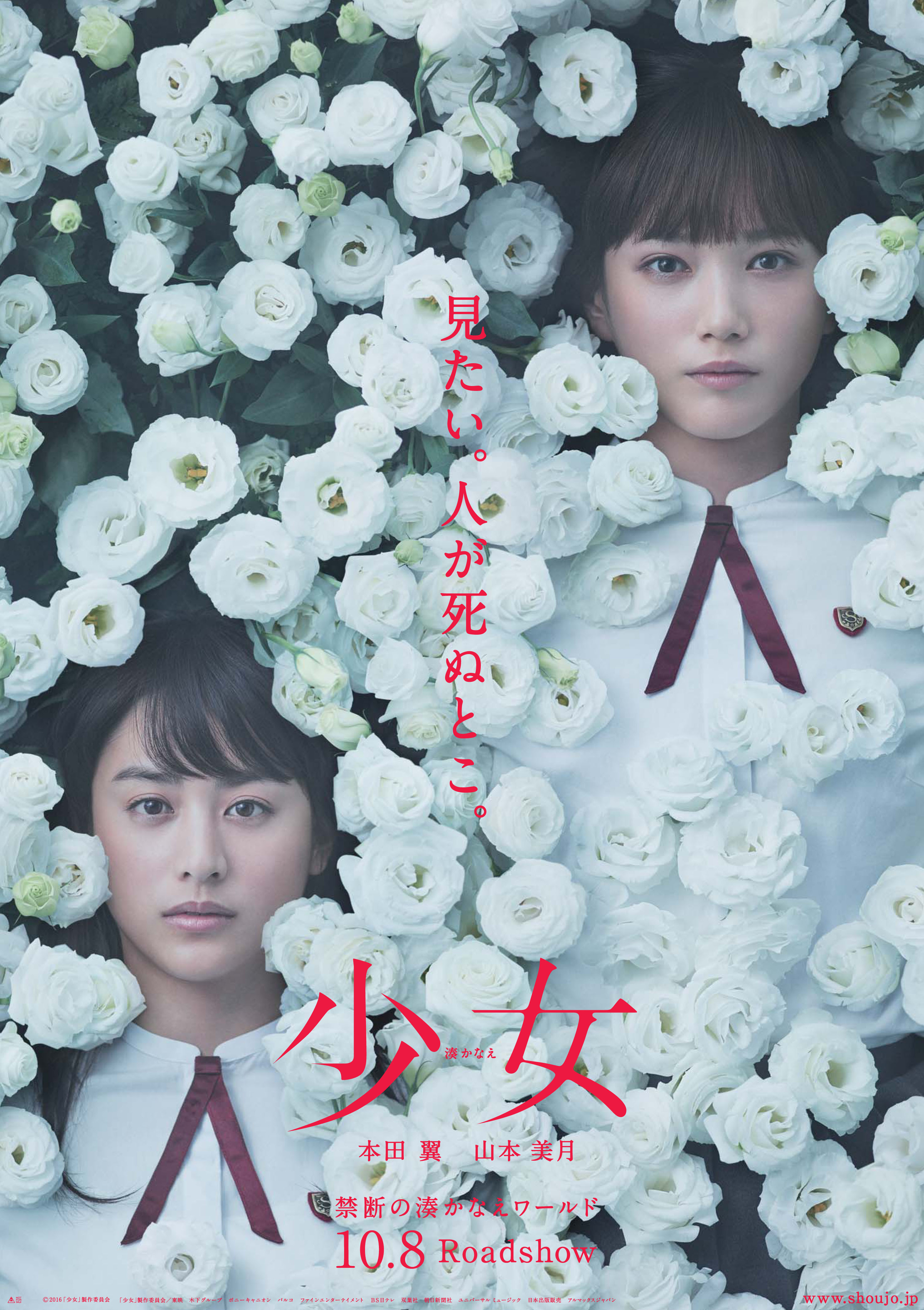
night's tightrope japanese posterKanae Minato is known for her hard-hitting crime stories from Confessions to Chorus of Angels, The Snow White Murder Case, and Penance but in adapting her second novel, Shojo (少女), Yukiko Mishima has moved away from the mystery for a no less penetrating look at the death of childhood in the story of two best friends each dealing with traumatic pasts and presents. Childhood is a place of tightly controlled powerlessness, but adulthood offers little more than corruption and selfishness with its predatory teachers, abusive parents, and dirty old men so obsessed with school uniforms they barely see the girl inside them. Adolescent anxiety provokes a fascination with the idea of death which perhaps reflects this transitionary stage, but at its centre is the fracturing of a friendship which has endured all else.

The film opens with a strange avant-garde play being performed in a church by a group of girls in austere school uniforms. The monologue offered by the collective reads like an instruction booklet for the birth of fascism with its calls for genetically engineered test tube babies and universal childcare in which each child is “equal” and receives “exactly the same” education and resources. The girls are students at a strict Christian fundamentalist school where they’re also expected to participate in strange rituals including dancing round the maypole (incongruous as that may seem).

Atsuko (Mizuki Yamamoto) – a former kendo champion with a limp, and Yuki (Tsubasa Honda) who has a large scar across her hand resulting from domestic abuse, have been lifelong friends but have recently begun to drift apart. Given the overriding survival of the fittest atmosphere in the school, it’s not surprising that the other girls have turned on Atsuko and proceeded to make her life a misery by telling her to die either in person, on line, or in one particularly grim episode by shoving a sanitary towel into her locker with the message written on it in blood. Yuki is trying to help her but doesn’t know how and has taken to writing everything down in a book instead.

The world of teenage girls can often be a vicious one but there’s a strange kind of mania in the way Atsuko’s schoolmates set about pushing her towards the edge. Formerly a top kendo player, Atsuko has vivid, panic attack inducing flashbacks to her life changing accident in which she recalls her teammates prentending to comfort her but secretly hurling accusations under their breaths while Yuki looks on in horror from the stands.

Yuki has been writing their story in the form of a novel she calls Night’s Tightrope but the completed manuscript goes missing. The girls’ teacher who has longstanding dreams of literary stardom steals it, sends it to a magazine, and even wins a prestigious literary prize for brand new novelists. Yuki’s revenge is swift but has terrible, unforeseen consequences which add to her obsession with death and dying, eventually culminating in the worrying desire to see someone die in order to fully understand the nature of the “phenomenon”.

While Yuki develops a friendship with a boy she met in a library while she was destroying copies of the teacher’s stolen story, Atsuko goes in a different direction by falling under the spell of troubled transfer student Shiori (Ryo Sato). Recently witnessing a dead body herself, Shiori is just as death obsessed as the other girls but her vision is darker. Shiori introduces Atsuko to her world of blackmail and exploitation, pulling her into a high school girl scam in which they accuse a nearby salaryman of groping them and then blackmail him. Shiori may think she’s taking revenge on venal older men who lust after school uniforms – there are plenty of these on offer from skeevy old men luring school girls to abandoned houses and then trying to get them to do laundry, to teachers visiting love hotels with their students – but actions have consequences and ramifications can be severe.

The girls are caught in a kind of limbo, walking a tightrope into adulthood but doing it blind and alone. Splitting up they take similar paths with Atsuko volunteering at an old people’s home, and Yuki spending time with terminally ill children but soon enough their death obsession changes form as their twin causes eventually overlap. Stepping away from Minato’s sometimes nihilistic pessimism, Night’s Tightrope leaves a space for hope in the reconciliation of the protagonists who rediscover their shared pasts once the message buried in the novel is finally delivered. The adult world may be mired in the dark of night but the girls have recaptured the sunlight, taking solace in the depth of their friendship and stepping off the tightrope and into the world of adulthood hand in hand.


Original trailer (English subtitles)