The Lost Alibi (黒い画集 あるサラリーマンの証言, Hiromichi Horikawa, 1960)

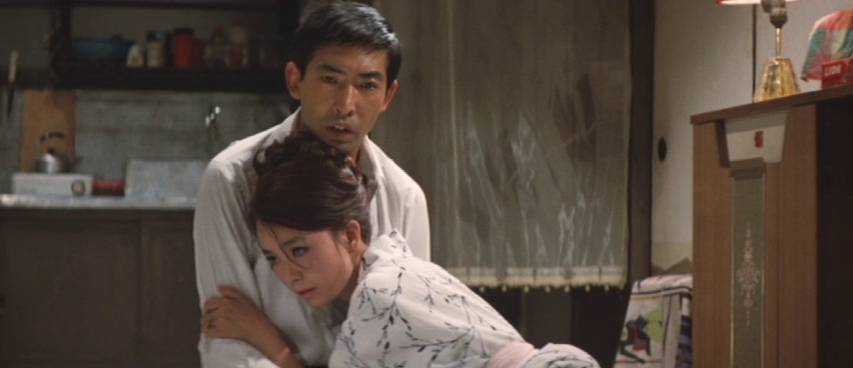
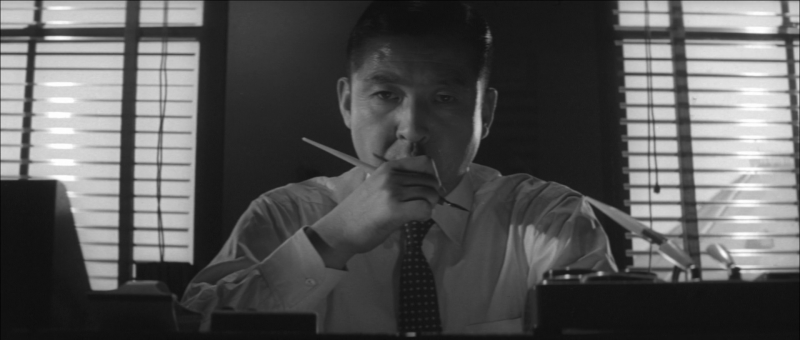
“What did I do to deserve this?” the hero of Hiromichi Horikawa’s The Lost Alibi (黒い画集 あるサラリーマンの証言, Kuroi Gashu: Aru Sarariman no Shogen) ironically asks himself, as if he assumed the answer to be “nothing at all”. Adapted from one of Seicho Matsumoto’s “Black Album” novellas, as in much noir fiction even small transgressions can have drastic consequences and even a step out of line can seriously derail an otherwise ordinary life. Ishino’s (Keiju Kobayashi) dilemma is that he knows if he speaks the truth he may damn himself and ruin the “boring, routine” life he’d built, but if he says nothing another man may pay with his life for a crime he didn’t commit. 

The film’s Japanese title is “testimony of a salaryman,” and that’s really want Ishino is giving in his opening voice over. He explains that he’s a high-ranking executive on a good salary living a fairly successful life working not at the top company in his field but the second best, which he’s fine with. He gets on with his boss precisely because he’s not interested in his job and is even hopeful he could stay on past retirement if he wanted to for that exact reason. But on the other hand, he’s 42 and has 13 years until he’s able to retire. He has no more ambition and his life is essentially on autopilot. All he has to do is stay the course for the next decade or so and everything will be fine.

But when he leaves the office, Ishino doesn’t go straight home as he tells his colleague he will when refusing an invitation, but hangs out in the city drinking and playing pachinko before going to see his mistress, Chieko (Chisako Hara), one of the secretaries working in his office. The affair may be a way of rebelling against his ordinary life or of playing with fire knowing that he could lose everything if his sexual transgression were exposed. Then again, he tells his wife he’s been to the cinema on his own, which in some ways isn’t all that different from having an affair seeing as he’s still skipped out on his domestic responsibilities and left her home alone to look after the children.

The film is mildly critical of this modern salaryman tendency in drawing a direct link between a series of murders of women who were home alone, as if their men had left them vulnerable by vacating the domestic space. Ishino’s wife Kuniko (Chieko Nakakita) even says that she feels a little afraid seeing as she’s home on her own all day while the children are at school and Ishino at work. Ishino suggests they get a dog and in the back of his mind wonders if he should get one for Chieko too. It’s not immediately clear what she is getting out of this affair, though it seems fairly likely that Ishino is paying for her upkeep which is why it’s so easy for him to force her move after they’re unwittingly dragged into the spotlight when the accused man, Sugiyama (Masao Oda), tries to use Ishino as an alibi after bumping into him in the street leaving Chieko’s apartment.

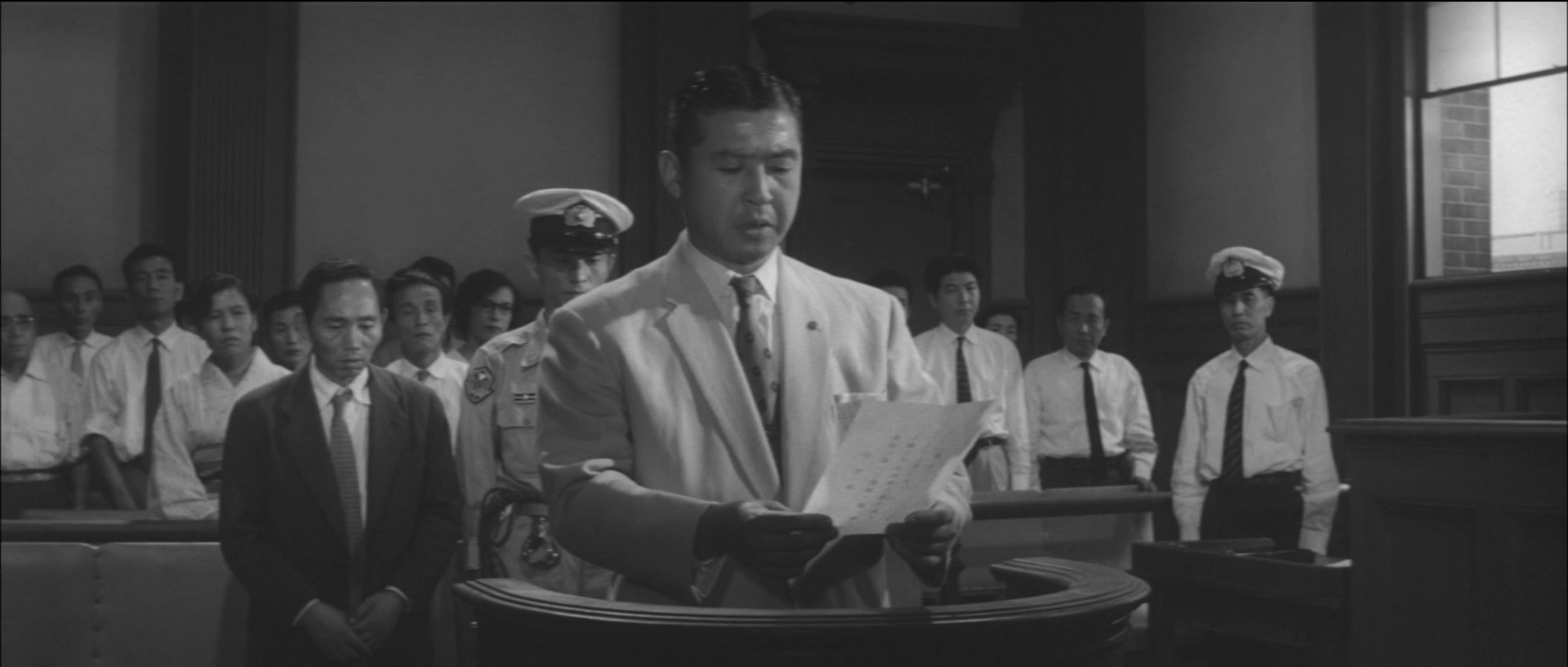
Sugiyama is his neighbour and Ishino only knows him on nodding terms, but he’s immediately worried that he may expose him. After all, he regards this as a low-class area he had no real reason to visit and does not want to have to explain what he was doing there. It doesn’t occur to him that his neighbour may not have wanted to either, if he not been accused of murder. The situation looks quite bad for Sugiyama given that the police have a lot of circumstantial evidence against him, though Ishino alone knows that Sugiyama didn’t do it because he really did see him at a time that makes it difficult to place him at the scene of the crime. But Ishino denies that he was ever there. Those around Ishino seem to condone the idea that he should just keep quiet. He’s under no obligation to help Sugiyama and it’s really nothing to do with him, anyway.

But the irony is that as things spiral out of control even Ishino seems to believe in the absolute power of a confirmatory witness. When he imagines himself talking to the police, the policeman doesn’t believe him because he lied the first time and the information is inconvenient to his case. He tells Ishino that his confession isn’t worth anything without a secondary witness to back it up, meaning he’d have to produce Chieko. It doesn’t really occur to Ishino that if he had told the truth to begin with the police might have been discreet about it. After all, admitting you were with another person whose reputation you do not wish to compromise seems to work well in crime novels. When he finds himself blackmailed by a student living in Chieko’s building, he too tries to get the student’s friend to come as a witness, bizarrely thinking that having someone else there ought to provide security seeing as he could also go to the police and accuse him of extortion if something went wrong never quite thinking that the friend might simply lie just as he did. 

A kind of comparison is indeed being drawn between Ishino and Matsuzaki (Tatsuyoshi Ehara), the student, who is painted as someone with a bad character who has got himself into debt not solely because of his economic circumstances but greed and an irresponsibility with money. Matsuzaki also behaves in an inappropriate way with Chieko in making passive-aggressive romantic overtures and becoming angry when she brushes them off, later basically forcing himself on her having just threatened blackmail. They are each in their way symptoms of post-war moral decline in their intense selfishness. Ishino has achieved the salaryman dream, but now he feels hemmed in by it and empty inside. Matsuzaki, meanwhile, is greedy and amoral, desperate enough to resort to loan sharks and blackmail while chasing the dream that Ishino has already achieved all too easily. 

But the truth is that Ishino had done a lot to deserve this, and got off fairly lightly in the end. A single moral transgression can snowball, and it’s true enough that none of this would have happened if he hadn’t had the affair in the first place. If he’d only told the truth about it, Sugiyama may not have had to go to trial and it would never have come out. If Sugiyama had been executed for this crime, Ishino would be a murderer, and maybe twice over as the person who killed the woman, and maybe several others, may have gone on to kill again until someone finally caught them, if ever. He’s endangered his wife and family, quite literally in physical terms, but also their future and wellbeing given the possibility of his reputation being ruined leading to losing his job while his children would suffer the stigma of his disgrace. He felt conflicted, chased to the brink and even considering suicide knowing his cowardice could condemn Sugiyama to death, but still chose the path of extreme selfishness which seems to be that which defines the post-war era. Even when all’s said and done, he can’t help thinking it’s all a little unfair. All he did was cheat on his wife and lie about it, why is he the one losing everything? But in the end, that’s exactly why. He cheated the salaryman dream, and the retribution was swift. Only too late did he realise the value of his “boring, routine” life of easy comfort in the increasingly compromised post-war society.


Trailer (no subtitles)

Bonds of Love (愛のきずな, Takashi Tsuboshima, 1969)

On a rainy night, a salaryman trapped in a loveless marriage and unsatisfying career chances on a beautiful woman dressed in kimono waiting by the side of the road. He decides to double back and offer her a lift, which she ill-advisedly accepts, but as it turns out he is actually the one in danger. Adapted from the Seicho Matsumoto short story Tazutazushi, The Bonds of Love (愛のきずな, Ai no Kizuna) has underlying misogyny that paints the woman at its centre as a sort of elemental spirit who bewitches men and leads them to their doom even while the hero himself is selfish and insecure, mired in an inferiority complex and incapacitated by wounded male pride.

The fact that Ryohei (Makoto Fujita) is already married comes as a bit of a shock, abruptly revealed as it is by the nameplate on the suburban home he returns to after a date with Yukiko (singer Mari Sono) having told her that he lives alone at the company dorm. It seems obvious that he’s dissatisfied with his domestic life and fed up with his overly materialist wife Sanae (Chisako Hara) whose constant gripes only seem to needle at his sense of inadequacy. Today, she’s misplaced an expensive ring he’d used his annual bonus to buy her and when he notices it simply sitting next to the sink, she remarks that it’s not all that nice anyway. Ryohei at least feels that she resents him for not being more successful and having the financial power to buy her the frivolous gifts and status symbols she clearly desires. The power dynamic is in any case unbalanced because Sanae is the daughter of his boss which means she in effect has total control over his career. One word to her father, and he’s toast, but at the same time she can only help him so far with his advancement despite nagging him constantly about his future prospects. Meanwhile, the other men at the office make fun of him. They describe Ryohei as an idiot who’s only in his position by virtue of being the boss’ son-in-law. 

This of course further needles at his wounded male pride, but dating Yukiko, who adores him completely, on the side restores his sense of masculinity. After he claims to have been staying out late playing mahjong, Sanae cautions him that one of his colleagues is being transferred because of his gambling and womanising habits. At his leaving do, Miyata (Sachio Sakai) lays into Ryohei and says he’s the one who taught him how to pick up women and pretend to be single as if this is the way they overcome their sense of impotence while under the company’s thumb. Ryohei appears not to like him, perhaps because he reflects the qualities in himself he is least proud of. The news of his transfer therefore spooks Ryohei knowing that the same fate may befall him if his affair with Yukiko is exposed. 

But when Sanae does eventually suspect he’s cheating on her and complains to her mother, the boss rings Ryohei and basically tells him not to worry about it because a man’s not a man if he doesn’t play around. The conflict that Ryohei has is essentially one of conflicting masculinities, the one in which he is effectively emasculated but defines his status through a hierarchical relationship with other men within the corporate structure, and the other in which he defines it through romantic conquest which also represents a kind of freedom. But being a fairly conventional man, in the end Ryohei cannot bear to have his salaryman persona ripped away from him and will do whatever it takes to maintain his relationship with his wife and by proxy his boss to preserve his career.

Realising Yukiko poses a threat to that, he decides the only solution is to kill her but it’s also true that he’s confronted by a much more robust vision of masculinity in the form of her estranged husband Kenji (Makoto Sato) who went to prison after stabbing another man in a jealous rage. It’s clear that Ryohei is afraid of Kenji and definitely doesn’t want to end up getting stabbed. His “love” for Yukiko does not stand up to that kind of scrutiny and it’s her assertion that she’s going to tell Kenji all about their affair and ask for a divorce that shifts him into crisis mode. After all, he’s in flight from domesticity. Leaving Sanae, and with it destroying his career might not solve his problems even if what he eventually chooses is just that, to be free of the burden of the salaryman dream and move to a small town to open a shop with a woman who is in thrall to him and therefore continually submissive and loving in contrast to Sanae who only ever makes him feel small.

Yet, we can’t actually be sure how much of what happens later is actually real or just Ryohei imagining things because of his guilty conscience and continuing sense of inadequacy. Essentially, he gets a second chance to make better choices and finally gains the courage to abandon his salaryman persona only to be immediately confronted by both his transgressions and violent masculinity. Tsuboshima crafts an atmosphere of malevolence and noirish dread coupled with a spiritual sense of retribution born of the constant rains and gothic thunderstorm that heralds the final confrontation in which Yukiko is herself a harbinger of death leading weak willed men towards their doom to which they go all too willingly. 


Hit and Run (ひき逃げ, Mikio Naruse, 1966)

The contradictions of the contemporary society drive two women out of their minds in Mikio Naruse’s dark psychological drama, Hit and Run (ひき逃げ, Hikinige, AKA A Moment of Terror). Scripted by Zenzo Matsuyama and starring his wife Hideko Takamine in her final collaboration with the director, Naruse’s penultimate film takes aim at the persistent unfairness of a post-war society already corrupted by increasing corporatisation while caught at a moment of transition that leaves neither woman free to escape the outdated patriarchal social codes of the feudal era. 

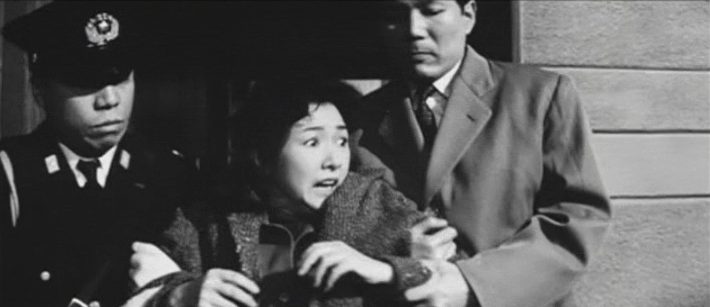
The two women, both mothers to five-year-old boys, are mirror images of each other. Kuniko (Hideko Takamine), the heroine, is a widow working in a noodle bar and continually exasperated by her energetic son Takeshi who keeps escaping kindergarten to play pachinko which is not a suitable environment for a small child. Kinuko (Yoko Tsukasa), meanwhile, is mother to Kenichi and married to a high ranking executive at Yamano Motors, Kakinuma (Eitaro Ozawa). These two worlds quite literally collide when Kinuko, emotionally distressed and driving a little too fast, knocks over little Takeshi while he is out playing with some of the other neighbourhood boys. As she is with her lover, Susumu (Jin Nakayama), she decides to drive on abandoning Takeshi to his fate but discovers blood on the bumper of her shiny white convertible on returning home and thereafter decides to tell her husband everything aside from revealing her affair. Kakinuma covers the whole thing up by forcing their driver to take the rap to protect not his wife but the company along with his own status and success fearing that a scandal concerning his wife driving carelessly may have adverse consequences seeing as Yamano Motors is about to launch a new super fast engine that will make them worldwide industry leaders. 

Perhaps in a way the true villain, Kakinuma cares about nothing other than his corporate success. Kinuko states as much in complaining that he’s never once considered her feelings only his own and that their marriage was a failure from the start, little more than an act of exploitation in which she was traded by her father for money in return for political connections. For these reasons she seeks escape through her extra-marital affair but is unable to leave partly in the psychological conflict of breaking with tradition and partly because she has a son whom she would likely not be permitted to take with her even if it were practical to do so. Another woman says something similar in disparaging Kuniko, implying that her life is in some ways over as few men would be interested in marrying a widow with a child. 

Takeshi’s loss is therefore additionally devastating in severing Kuniko’s only lifeline. A brief flashback reveals that Kuniko was once a post-war sex worker, she and her yakuza brother Koji war orphans who lost their parents in the aerial bombing. When she married and had a child she thought the gods had smiled on her but in true Narusean fashion they gave only to take away leaving her a widow and finally robbing her even of her child. To add insult to injury, they try to put a price on her son’s life, a mere 500,000 yen for a boy of five hit by a car. When the driver stands in the dock, he gets off with only a 30,000 yen fine for the death of a child. Then again on visiting his home, there appears to be a boy of around five there too, perhaps you can’t blame him for taking the money having been robbed of his youth in wartime service. 

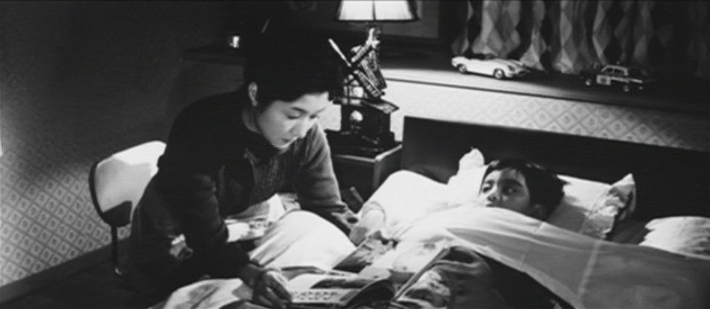
Still, on hearing from an eye witness that it was a woman who was driving, Kuniko quickly realises that Kinuko must have been responsible. Quitting her job she joins a maid agency in order to infiltrate the house and gain revenge later settling on the idea of killing little Kenichi, who takes an instant liking to her, to hurt his mother in the way she has been hurt only to be torn by her unexpected maternal connection with the boy. The conflict between the two women is emotional, but also tinged with class resentment that a wealthy woman like Kinuko should be allowed to escape justice with so little thought to those around her while Kuniko is tormented not only by her grief but the persistent injustice of the cover up. 

As in all things, it’s the lie that does the most damage in ironically exposing the truth of all it touches. Kinuko’s escape route is closed when her lover reveals that he’s lost faith in her, unable to trust a woman who’d run away from the scene of a crime and allow someone else to take the blame, while Kakinuma’s emotional abandonment of his social family for the corporate is thrown into stark relief by his immediate decision to further exploit their driver just as he will later their maid. Driven out of her mind, Kuniko has white hot flashes of lustful vengeance as she imagines herself engineering an accident for Kenichi, throwing him off a rollercoaster or coaxing him into traffic, only to regain her senses unable to go through with it so pushed to the brink of madness is she that no other action makes sense. 

Even so the conclusion is brutally ironic, Kuniko accused of a crime she did not commit but half believing that she must have done it because she wanted to so very much. Kakinuma gets a minor comeuppance, encouraged by his servant to make clear what actually happened and exonerate Kuniko thereby walking back his total commitment to the corporate (then again it seems his dream project was itself under threat from a potential plagiarism scandal) though the damage may already have been done. This societal violence of an unequal, increasingly corporatised and unfeeling society, eventually comes full circle bringing with it only death and madness as the two women seek escape from their internal torment. Naruse experiments with handheld camera and canted angles to emphasise the destabilisation of the women’s sense of reality along with blow out and solarisation in the visions that plague them, but curiously ends with a set of motor vehicle accident stats as if this had been a roundabout public information film to encourage careful driving. Then again perhaps in a way it is, a cautionary tale about the dangerous curves of untapped modernity and the cruelties of the nakedly consumerist era.  


Too Young to Die (死ぬにはまだ早い, Kiyoshi Nishimura, 1969)

Perhaps more or less forgotten for reasons we’ll come to later, Kiyoshi Nishimura was for a time a successful director associated with Toho’s line of noirish B-movie action dramas. When the Japanese cinema industry entered its decline in the 1970s, Nishimura shifted into similarly themed TV drama and was well respected for his ability to turn in on time and on budget. None of that mattered however when he was engulfed in scandal in 1987 after being caught operating spy cams in the female only area of a public bathhouse bringing his career to an abrupt end. Directing a few more projects under the name Yusai Ito, he sadly took his own life a few years later in 1993 at the age of 61. 

Nishimura’s 1969 debut Too Young to Die (死ぬにはまだ早い, Shinu ni wa Mada Hayai), however, is a masterclass in high tension filmed with shaky handheld set largely in a single location and imbued with a singular irony replete as it is with cosmic coincidences as a collection of customers at a roadside bar are taken hostage by a crazed criminal with a gun intent on finding the lover of the girlfriend he claims to have murdered for her infidelity. The heroes, however, are ennui-filled couple Matsuoka (Koji Takahashi) and Yumiko (Mako Midori) who are in fact not married, or at least not to each other, but carrying on an extra-marital affair which may be on the cusp of fizzling out. A former racing champ who claims he just got bored with the sport one day and now works for a company selling accessories for toy cars, Matsuoka is supposed to drive Yumiko home where she’s expecting a call from her controlling husband, away on a business trip, at 1am. These are all reasons they are unusually nervous about a police checkpoint searching for an armed fugitive, deciding to stop off at a roadside bar for a stiff drink and something to eat. Only, shortly after their arrival a young man (Toshio Kurosawa) in denim enters giving each of the other men intense side eye before shooting a policeman who comes in to make enquiries about the fugitive. 

The unnamed young tough takes the entire bar hostage intent on finding his lover’s lover, overcome with a sense of cosmic irony when Matsuoka calmly points out he may have arrived too early and the man he’s looking for had not yet arrived when he put the place in lockdown. Before the gunman’s arrival, Nishimura introduces us to each of the other customers via the handy device of two teenage girls apparently stranded and asking around for a lift back to the city. A middle-aged doctor (Chuzaburo Wakamiya), apparently a regular, eventually offers to take them but is dissuaded by the barman (Kazuya Oguri) who reminds him he’s been drinking too heavily to take passengers, while a taxi driver (Shigeki Ishida) who seems to be feeling unwell flat out refuses. The other customers are a suspicious looking man in a trenchcoat (Daigo Kusano) sitting in the corner piling matchsticks, and a newlywed couple who we later learn saved up for their wedding for three years, the wife (Nami Tamura) already going through her accounts book irritated by her friends’ decision to graffiti their car and wondering how much it’ll cost to get it cleaned up while the husband (Tatsuyoshi Ehara) disappoints her by wanting to rush home because he’s planning to return to work the next morning ahead of schedule. 

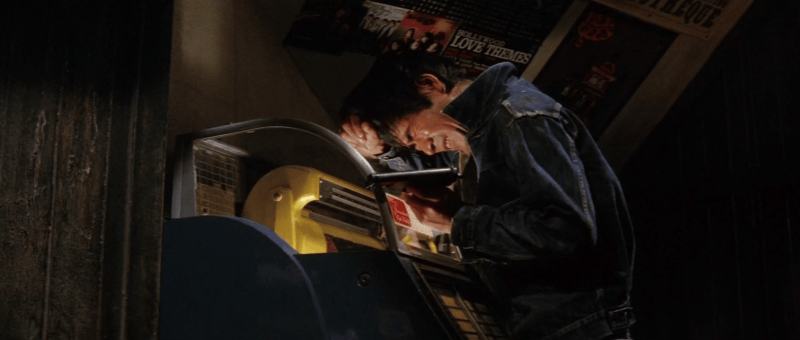
The relationships of the two couples are often directly contrasted, Matsuoka and Yumiko unsure of their connection as adulterous lovers while the newly married couple also seem be under strain even before the traumatic events about to take place. Apparently brokenhearted, the gunman collapses over the jukebox playing a series of melancholy songs about lost love, Matsuoka later darkly musing that perhaps he was only able to kill his lover because he loved her so much. Unlike the other customers, Matsuoka appears entirely unperturbed by their predicament calmly talking to the gunman and even ringing the police to ask them to temporarily stand back so they can evacuate a hostage in need of medical treatment. The gunman sends Matsuoka and the newlywed husband to take the injured party out, taking Yumiko hostage as security while she fears Matsuoka does not value her enough to return though both men do in fact come back rather than abandon their respective women. The newlywed husband, however, later fails a test of manhood when the enraged gunman goes off on a misogynistic rant and tries to force the doctor to rape the newlywed wife to prove that all women are faithless “whores”, the husband reduced to a gibbering wreck cowering in the corner unable to protect his new wife or challenge the gunman’s authority as Matsuoka later does when he orders Yumiko to remove her clothes in front of the other hostages. 

Though Yumiko had feared the affair was on its way out, ironically describing Matsuoka as not so different from her husband while lamenting that their connection seemed to have dwindled, the traumatic experience seems to reinforce the reality of their love as something more than a casual extra-marital fling even as Matsuoka forgives her for not trusting him because their relationship is not founded on the same idea of “commitment” as the married couple. The question for the other customers is how much the lives of others they’ve only just met really mean to them, the two teenage girls deciding to attempt escape while the gunman takes Yumiko hostage to use the bathroom, the doctor edging round the sides as Matsuoka tries to stop them to protect her while the newlyweds similarly waltz towards the door. All the while the TV crackles with an inane variety show complete with its cheerful advertisements while the police apparently have the place surrounded ironically convincing the gunman he has no way out and therefore nothing to lose. A tense meditation on interpersonal relationships, Too Young to Die is not without its share of ironies in strange number of coincidences and misapprehensions as the siege eventually draws to an unexpected close sending our conflicted lovers back into the night if perhaps a little more alive for their brush with death. 


Evil of Dracula (血を吸う薔薇, Michio Yamamoto, 1974)

Evil of Dracula posterThe first two of Michio Yamamoto’s “vampire” movies for Toho made a valiant attempt to repurpose the idea of the bloodsucking ghoul to explore something other than their usual reason for being. In The Vampire Doll, the vampiress at the centre was a knife wilding, grudge bearing ghost of vengeance in keeping with the familiar image from Japanese folklore. In Lake of Dracula, Dracula was (uncomfortably) a bearer of bad blood and a symbol of the destructive capabilities of a repressed memory. Evil of Dracula (血を吸う薔薇, Chi wo Su Bara) takes us back to source as this time Dracula really is a sex crazed, bloodsucking maniac with a sideline in strange ambitions which include being the headmaster of an all girls’ high school in a no horse town somewhere in the frozen north.

Professor Shiraki (Toshio Kurosawa) gets off the train in a tiny provincial town but there’s no welcoming party there to great him. The station seems to work on an honour system and he drops his money in the box, but when Shiraki walks past the ticket office there is an employee, only he seems to be allergic to customers. The attendant gruffly explains that there are no busses running today and goes back to his paper, leaving Shiraki to wonder what to do next. Someone from the school he’ll shortly be working at eventually comes to fetch him but Mr. Yoshii (Katsuhiko Sasaki) is a bit strange too. It’s nothing, however, next to his new employer (Shin Kishida) whom, he learns, was widowed a few days ago when his wife died in a terrible car accident. In fact the headmaster’s wife is still at rest in the cellar – a “local custom” apparently demands holding off on burial for seven days while praying for the deceased’s “resurrection”. Shiraki is surprised to learn from the headmaster that he is being groomed as a potential successor which is why he asks him to stay over so they can get to know each other better. Whilst there, however, Shiraki has a “dream” in which he’s attacked by (he presumes) the headmaster’s wife and another much younger woman dressed in blue…

Evil of Dracula situates itself neatly in the middle of the girls’ school exposé, upping the camp factor with its overexcited adolescent girls apparently chomping at the bit for a little male attention. Shiraki is the new psychology teacher and one would expect him to be a paragon of ethics and an astute judge of character. He is, however, very much of his time and has a distinctly ‘70s approach to sexual politics. When the girls, flirting with him while he (refusing to deflect) appears flattered, complain to him about the “creepy” Mr. Yoshii who keeps leering at them from behind chainlink fences, he tells them Yoshii can’t be blamed because the girls are all so pretty to which they giggle and turn coy. Of course, they’ve all instantly fallen in love with Mr. Shiraki but unbeknownst to them there’s much more going on with creepy guys at the school than they could ever have guessed.

Shiraki finds out a girl recently went missing (apparently that’s something that happens often enough that no one thinks much of it), and can’t get it out of his mind that that’s the girl he saw in his “dream” even though he obviously didn’t know what she looked like. Meanwhile another of his charges, Kyoko (Keiko Aramaki), has turned pale and entered a semi-catatonic state. Her friends have agreed to stay behind and look after her while everyone else goes on vacation but Shiraki remains worried, especially as the school’s folklore obsessed doctor (Kunie Tanaka) has told him what happened to his predecessor.

Yamamoto goes back to source in partially blaming the girls for being led to destruction, allowing their nascent sexuality to pull them into the path of a supernatural evil rather than remaining chaste and innocent as schoolgirls should, punishing them for being flattered when Shiraki (with a slightly condescending air) tells them they can’t be annoyed by men looking them because that’s their fault too in being so very “pretty”. This time around the vampires like to bite their prey above the heart which takes us into the artier realms of exploitation as blood drips salacious from the girls’ bared breasts, though Yamamoto does his best to mitigate the sleaze factor by pushing a heavily romanticised gothic aesthetic complete with innocent white roses which ultimately turn a violent blood red once the vampires have had their way.

Once again, the “corruption” is foreign born though this time it has a Japanese catalyst, as folklore expert Dr. Shimomura explains. Long ago, a European washed up in Japan after a shipwreck, but he was a Christian when Christianity was illegal. He was persecuted, they made him betray his god and it turned him into a bloodsucking demon whose rage has lived on through a succession of Japanese hosts for more than a century. Why he particularly wants to be the headmaster of an elite girls boarding school in the middle of nowhere is never explained but it does at least seem to give him ready access not only to young and innocent victims, but also to weak willed minions.

The police, deciding vampires aren’t in their remit, declare themselves disinterested leaving Shiraki all that stands between the innocent young girls and the bloodsucking predator. The atmosphere is florid in the extreme, each frame filled with a macabre beauty as bodies fall artfully and vampires move with the elegance of dancers, but Yamamato also gives free reign to Hammer-inflected camp humour as hands almost wave from an open coffin behind the still unsuspecting Shiraki and the headmaster comes to a sticky end on the point of his own poker. Repeating the death motif from the second film which itself echoed Christopher Lee’s demise in the 1958 Hammer classic, romanticism is where Yamamoto chooses to end as his vampires decay, melting into skeletons but together, caught in one last gesture of an oddly eternal “love”.


Evil of Dracula is the third of three films included in Arrow’s Bloodthirsty Trilogy box set which also includes extensive liner notes by Jasper Sharp detailing the history of vampires and horror cinema in Japan.

Original trailer (no subtitles)

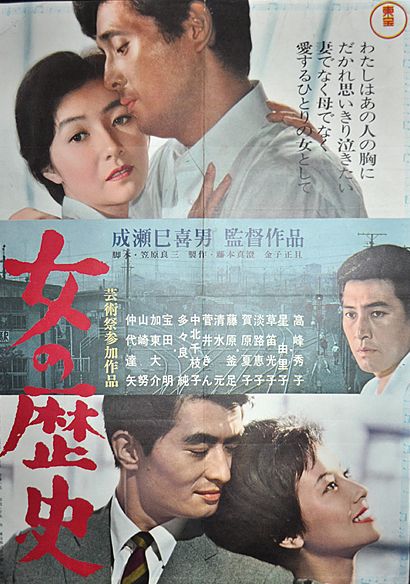
A Woman’s Story (女の歴史, Mikio Naruse, 1963)

woman's storyMikio Naruse made the lives of everyday women the central focus of his entire body of work but his 1963 film, A Woman’s Story (女の歴史, Onna no Rekishi), proves one of his less subtle attempts to chart the trials and tribulations of post-war generation. Told largely through extended flashbacks and voice over from Naruse’s frequent leading actress, Hideko Takamine, the film paints a bleak vision of the endless suffering inherent in being a woman at this point in history but does at least offer a glimmer of hope and understanding as the curtains falls.

We meet Nobuko Shimizu (Hideko Takamine) in the contemporary era where she is a successful proprietor of a beauty salon in bustling ‘60s Tokyo. She has a grown up son who works as a car salesman though he’s often kept out late entertaining clients and has less and less time for the mother who gave up so much on his behalf. Her life is about to change when Kohei (Tsutomu Yamazaki) suddenly announces that he wants to get married – his lady love is a bar hostess to whom he’s become a knight in shining armour after saving her from a violent and persistent stalker. Needless to say, Nobuko does not approve both for the selfish reason that she isn’t ready to “lose” her son, and because of the social stigma of adding a woman who’s been employed in that line of work to the family.

All of this is about to become (almost) irrelevant as tragedy strikes leaving Nobuko to reflect on all the long years of suffering she’s endured up to this point only to have been struck by such a cruel and unexpected blow. An arranged marriage, her husband’s infidelity, the war which cost her home, possessions and also the entirely of her family, and finally the inescapable pain of lost love as the man who offers her salvation is quickly removed from her life only to resurface years later with the kind of pleasantries one might offer a casual acquaintance made at party some years ago. Life has dealt Nobuko a series of hard knocks and now she’s become hard too, but perhaps if she allows herself to soften there might be something worth living for after all.

Women of a similar age in 1963 would doubtless find a lot to identify with in Nobuko’s all too common set of personal tragedies. They too were expected to consent to an arranged marriage with its awkward wedding night and sudden plunge into an unfamiliar household. Nobuko has been lucky in that her husband is a nice enough man who actually had quite a crush on her though there is discord within the household and Nobuko also has to put up with the unwelcome attentions of her father-in-law. This familial tension later implodes though fails to resolve itself just as Japan’s military endeavours mount up and Nobuko gives birth to her little boy, Kohei. Husband Kouichi becomes increasingly cold towards her before being drafted into the army leaving her all alone with a young child.

All these troubles only get worse when the war ends. Though Kouichi’s former company had been paying his salary while he was at the front, they care little for his widow now. Left with nothing to do but traffic rice, Nobuko comes back into contact with her husband’s old friend, Akimoto (Tatsuya Nakadai), who wants to help her but is himself involved in a series of illegal enterprises. Nobuko is molested twice by a loud and drunken man who accosts her firstly on a crowded train (no one even tries to help her) and then again at a cafe where she is only saved by the intervention of Akimoto, arriving just in the nick of time. Nobuko sacrifices her chances at happiness to care for Kohei, caring about nothing else except his survival and eventual success.

Of course, Kohei isn’t particularly grateful and feels trapped by his mother’s overwhelming love for him. Nobuko’s sacrifices have also made her a little bit selfish and afraid of being eclipsed in the life of her son. It’s easy to understand the way that she later behaves towards Kohei’s new bride, but if she wants to maintain any kind of connection to the son that’s become her entire world, she will need to learn to allow another woman to share it with her.

Naruse is a master at capturing the deep seated, hidden longings that women of his era were often incapable of realising but A Woman’s Story flirts with melodrama whilst refusing to engage. The awkward flashback structure lends the film a degree of incoherence which frustrates any attempt to build investment in Nobuko’s mounting sorrows, and the voiceover also adds an additional layer of bitterness which makes it doubly hard to swallow. This is in no way helped by the frequently melodramatic music which conspires to ruin any attempts at subtlety in favour of maudlin sentimentality. The endless suffering of mid-twentieth century women is all too well drawn as grief gives way to heartbreak and self sacrifice, though Naruse does at least offer the chance to begin again with the hope of a brighter and warmer future of three women and a baby building the world of tomorrow free of bombs and war and sorrow.