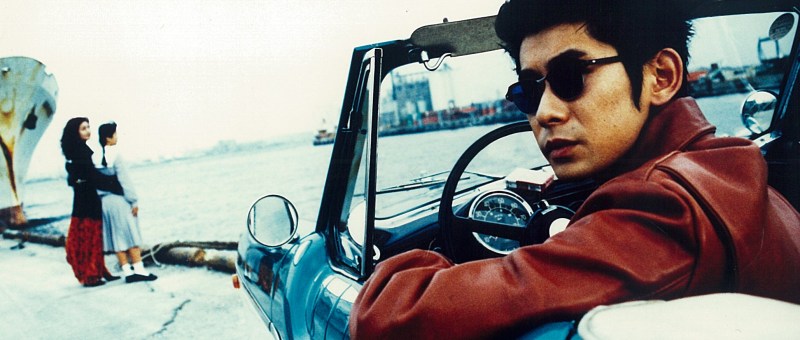

If The Most Terrible Time in My Life was channeling Nikkatsu Noir, Stairway to the Distant Past (遙かな時代の階段を, Harukana Jidai no Kaidan wo) sees Hayashi channel Fukasaku for a full-on confrontation with the legacies of the post-war era just as PI Maiku (Masatoshi Nagase) is forced to confront and attempt to cure the corrupted legacies of his own origins all while trying to save the city of Yokohama from drifting off to “another hell.” This time shooting in colour, Hayashi conjures a sense of mythic dread in the purple haze that hangs over a hidden city and the eerie blue of the path to get there.
But before all that, Maiku has fallen on such hard times his beloved car’s been repossessed and he’s stuck finding lost dogs for wealthy yet eccentric clients. Meanwhile, leader of New Japs gang Kanno (Shiro Sano) is running for political office while two of his underlings decide to freelance in order to take over the lucrative river trade which no one, not even the Taiwanese gang otherwise apparently in the ascendent, has ever dared to touch in fear of the mythic “White Man” who’s controlled the area since the post-war era with a ruthless efficiency that has seen any man challenge him not live to tell the tale. In the midst of it all is bigoted, and apparently pretty corrupt, policeman Nakayama (Akaji Maro) who first blackmails Maiku into helping him investigate a theft and smuggling ring on the river then apparently makes a deal with the White Man’s underlings who in turn blackmail him over his gambling debts but also claim they can make him chief of police if he chooses to play along.
Nakayama is a symbol of the rot in the contemporary city though he is in fact merely spineless, greedy, unpleasant and prejudiced. He asks Maiku for help because he’s hamstrung by the rules of policing which prevent him from doing the nefarious things he asks Maiku to do all of which leads to some pretty tragic consequences and a pair of orphaned children. The New Japs are perhaps a sign of further corruption still to come as Kanno tries to go legit as a politician but only as a means of increasing his influence and earnings.
The river becomes a kind of nexus, the shore line between contemporary Japan and the “distant past” of the post-war era. Nakayama discovers that no one is technically policing it because it’s outside of everyone’s jurisdiction, while the White Man seems to have been in a position of unassailed power for half a century. As he later says, he’s the only one “living in the past” and perhaps quite literally so as Maiku has to transcend a literal stairway while guided by some kind of local prophet in order to travel to his world and finally risk his life to confront him. At the same time, Maiku is threatened by his own point of origin in the unexpected return of his mother, a now middle-aged stripper known as Dynamite Sexy Lily (Haruko Wanibuchi), who abandoned him and his sister and when he was just a child.
Her name, along Maiku’s own, are perhaps hangovers from the Occupation era now even more out of place in a changed Japan. Making full use of the colour palate, Hayashi repeatedly flashes back to a pair of Lily’s red shoes as if signalling the unreality of the hidden city and the superimposition of past and present. His flashbacks to the late 1940s echo the cinematography of Fukasaku’s jitsuroku epics with their frenetic chases through black markets, but towards the conclusion the canted angles make it through to our era too and most particularly in the White Man’s lair, a blue-tinged industrial labyrinth that recalls the post-apocalyptic visions of a city still in ruins.
“Yokohama’s changed a lot,” Lily is told on her return and in fact several times after that. She likes it a little better now, the White Man no so much complaining that this city no longer has a place for him as if foreseeing his own eclipse and the oncoming end of an era. But then again, perhaps only the names have changed. All we’re left with is new gangsters with no code, and the White Man did at least stick to the rules even if he did so with ruthless authority. As for Maiku, his passage to the underworld seems to have brought him new clarity. His outfit now a little more sophisticated and mature, less an affectation borne of watching too many movies than an expression of himself. Nevertheless, Yokohama remains a small-town city, a cosy place with a generally friendly and easy going population albeit one with darkness hovering around the edges.
The Stairway to the Distant Past screens 18th/19th October at Japan Society New York.
Original trailer (no subtitles)
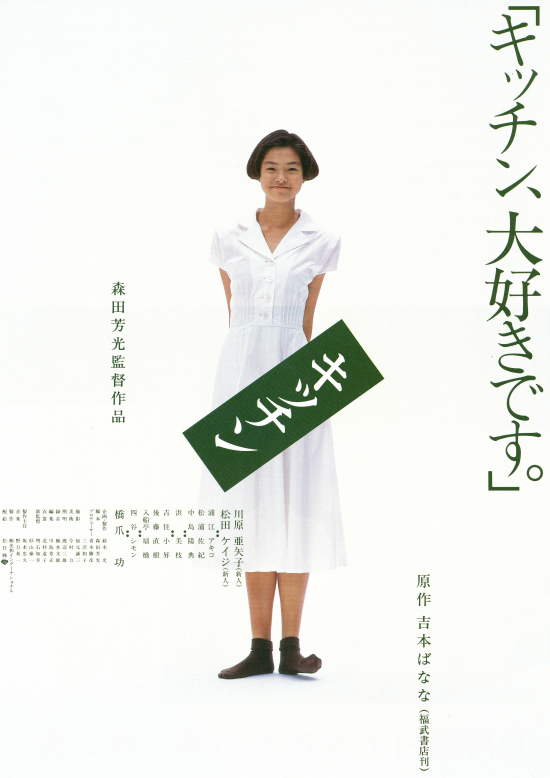 Banana Yoshimoto’s debut novel Kitchen was first published in 1988 and instantly became a publishing phenomenon. The first film adaptation came not long after with the identically titled Kitchen (キッチン) directed by Yoshimitsu Morita in 1989. Like most of Yoshimoto’s work, Kitchen deals with people learning to live with grief and cope with the aftermath of tragedy. However, though Morita’s script sticks closely to the novel for the first half of its running time, he later deviates into a conventional romantic youth drama much like his more populist offerings of the time.
 Windows on Worlds