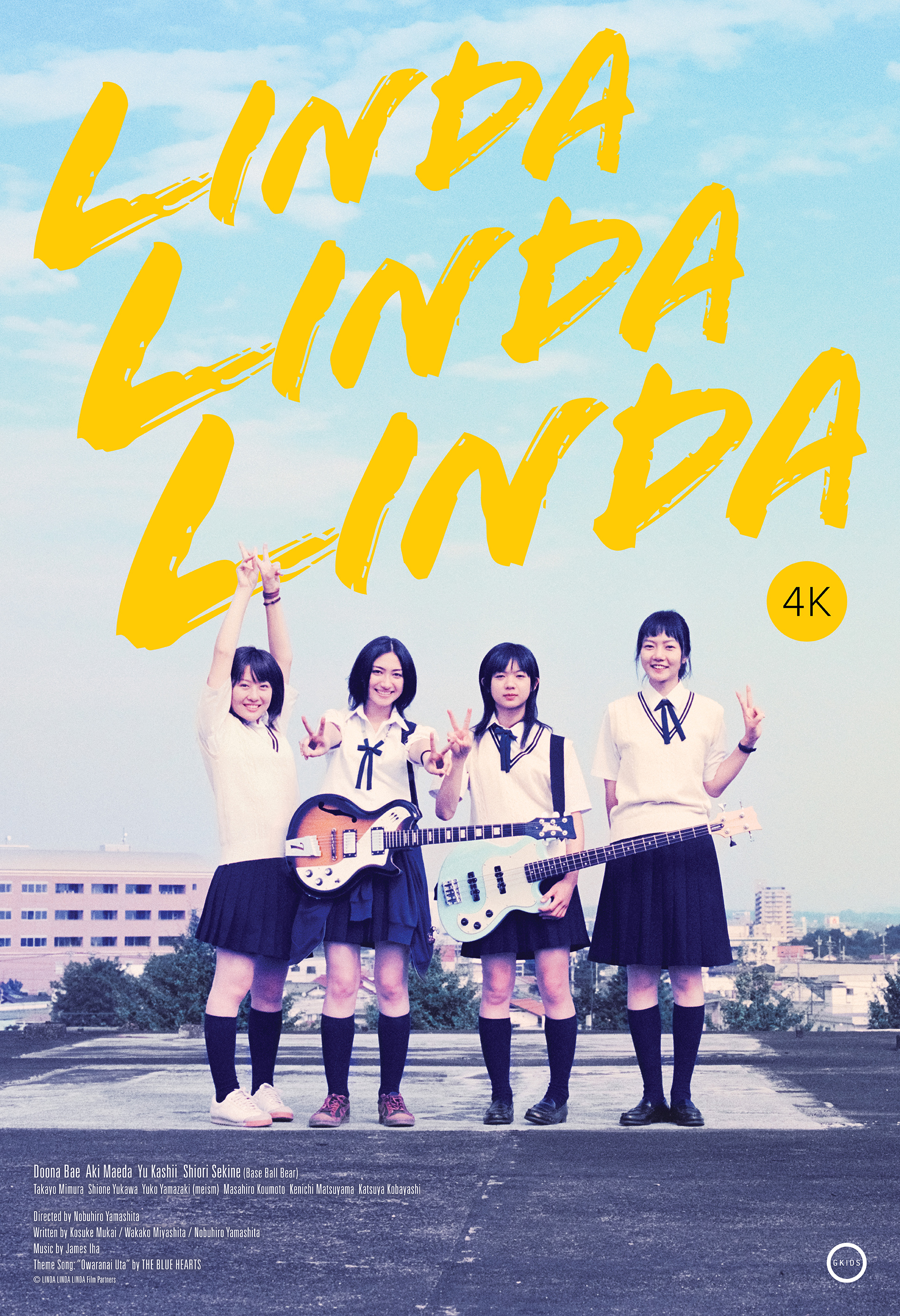
Linda Linda Linda (リンダ リンダ リンダ, Nobuhiro Yamashita, 2005)

“We’ve only got a little more time to be the real us,” according to a young woman making a promo video for the upcoming school festival, but who really is the “real us”? Now celebrating its 20th anniversary, Nobuhiro Yamashita’s wistful high school dramedy Linda, Linda, Linda (リンダ リンダ リンダ) is in many ways about the process of coming into being along with the anxieties of what comes next. “We won’t end here,” the girl later adds, “We won’t let our high school days become a memory,” yet they already are in a kind of contemporaneous nostalgia and elegy for idealised youth.

Or at least, there’s already a kind of reaching back taking place as the tracks the girls pick for a replacement act are by The Blue Hearts, a 1980s punk band that has become a kind of cultural touchstone echoing a sense of youthful alienation and rebellion. “Linda Linda” is the kind of song everyone knows, and even if for some reason they don’t or don’t even speak Japanese, can at least join in with the riotous chorus. It’s this sense of universality that eventually gives it its power as torrential rain brings the entire school inside just in time to see the girls’ belated act and find themselves captivated by its infectious energy and an identification with their own sense of insecure anxiety.

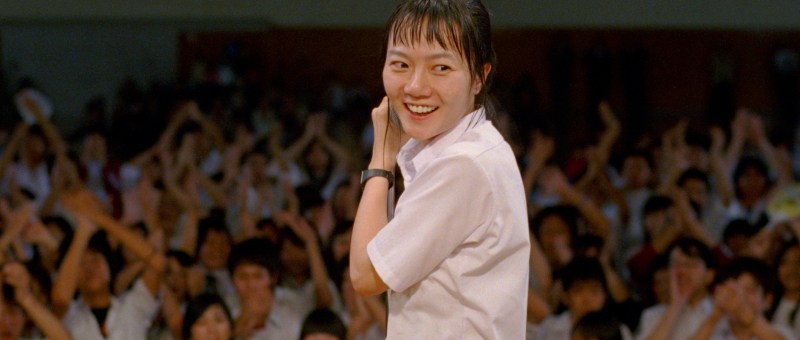
It’s also the serendipitous rain that allows lonely songstress Takako an opportunity to perform having previously declined to do because it’s no fun playing on your own and all her former bandmates graduated the previous year. Moe, the girl who broke her fingers playing basketball in PE leaving the original band members unable to take the to the stage, also gets an opportunity to sing having otherwise been denied a moment of closure in being prevented from taking part in her final school festival. While Moe feels intensely guilty about rendering all their time spent rehearsing somewhat pointless, it’s really the drama between founding members Kei and Rinko that leads to the band’s demise in Rinko’s conviction that it’s “meaningless” to continue while the others decide to go ahead anyway asking Korean exchange student Son (Bae Doona) to be their vocalist because she just happened to come down the stairs at the right moment and said yes because she didn’t really understand what they were saying.

Prior to her involvement with the band, Son had been a rather isolated figure trapped in the “Japan-Korea Culture Exchange Exhibit” which seems to have been more her teacher’s idea than her own and in any case gets no actual visitors. Her Japanese is a bit limited and most of her interactions are with a little girl who lends her manga to help her learn quickly, but becoming part of the band allows her to find her voice both literally and figuratively in taking the lead as the vocalist. A boy who claims to have fallen in love with her (Kenichi Matsuyama) goes to the trouble of learning a long speech in Korean to convey his feelings, yet a bemused Son replies to him in Japanese that she’s pretty indifferent to his existence before switching to Korean to explain that she’s leaving because she’d rather be hanging out with her friends with an expression that implies she’s only just realised that’s what they are. By contrast, she has a bilingual conversation with guitarist Kei (Yu Kashii) in which they seem to understand each other perfectly and each express how glad they are that they got to be in the band together. 

Similarly, it’s the concert itself that seems to heal rifts with a simple “Are you alright?” from Rinko (Takayo Mimura) to Kei whose friendship might, as someone says, essentially be too close for them to really get along. Drummer Kyoko (Aki Maeda) decides to declare her feelings for a longstanding crush before the concert. In the end she doesn’t manage it, but it doesn’t quite matter somehow because their performance is itself a kind of coming into being in which “the real us” comes into focus if also in a moment that itself becomes romanticised or idealised as an encapsulation of youth. Yamashita travels through the school festival as if it were a passage from one state of being to another, from the noodle stalls and crepe stands to haunted houses and the boy creating his own moment through encapsulating them on film, before ending with an unending song “so we can laugh tomorrow,” and the “real us” lives on.


Linda Linda Linda opens in US cinemas 5th September courtesy of GKIDS.

Trailer (English subtitles)
Twilight Cinema Blues (銀平町シネマブルース, Hideo Jojo, 2023)

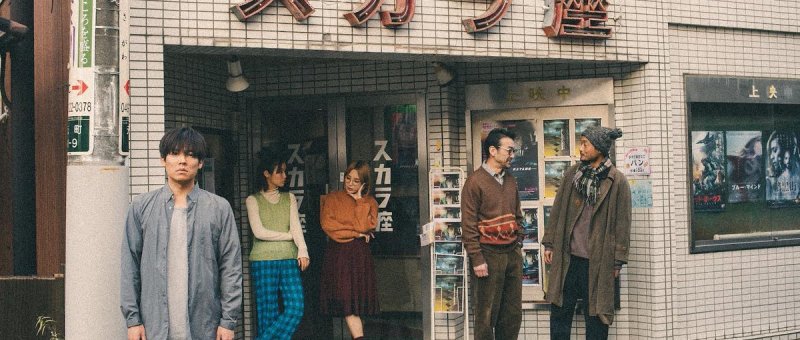
Japan’s mini theatres have been in a status of crisis since the pandemic. Already struggling under the weight of changing times the immediate restrictions pushed many over the edge unable to entice older regulars back into screens or find a new audience among the young. This is doubly bad news for the industry as a whole as it’s mini theatres that allow indie films the platform they need to succeed and without them there is little avenue for films produced outside of the mainstream. Like Lim Kah-Wai’s Your Lovely Smile, Hideo Jojo’s Twilight Cinema Blues (銀平町シネマブルース, Ginpeicho Cinema Blues) similarly extols the virtues of the mini theatre which is not just somewhere to watch films but a place to belong that has room for anyone and everyone that wants to be there.

That’s more than true for Takeshi (Keisuke Koide), a struggling man approaching middle age who’s become near destitute and is almost sucked into a welfare scam targeting the homeless by a pair of shady yakuza claiming they run an NPO. At the orientation he runs into Kajiwara (Mitsuru Fukikoshi ), the owner of a mini theatre who declines to join the gangsters’ scheme but offers Takeshi the opportunity to bunk in his storeroom while working part-time little knowing that to Takeshi this particular mini cinema is like a return to source allowing him to rediscover his love of film.

But the mini cinema itself is also struggling. They simply don’t get bums on seats and Kajiawa is behind on paying his staff. Though they have a small collection of regulars, they aren’t enough to keep the lights on on their own. Even the projectionist is thinking he’ll probably retire along with the machine. Unable to afford new films, Kajiawara relies on cheap and easily licensable classics such as old favourite Casablanca but is largely unable to see away out of his situation while feeling guilty over ending what was effectively a family business and local landmark. The building’s 60th anniversary, 60 being a symbolic number in Japanese culture as it represents a full turn of the Chinese zodiac and literal new start, presents an opportunity to both Kajiawara and Takeshi to begin to move forward by renewing their faith in cinema.

The faith of Takeshi’s homeless friend Sato (Shohei Uno) needed no renewing. Though he had nothing, the ability to see a film twice a month made him feel human while the community at the cinema is perhaps the only one that still accepts him. He offers a small prayer after every film, and instructs Takeshi that he should the same. But his openhearted faith is also his undoing, allowing him to fall for the yakuza scam little realising they’ll force him to work for them taking half of the social security payments they helped him sign up for in the process. In the outside world, men like Sato find only exploitation and prejudice with cinema their only refuge.

Then again, filmmaking isn’t easy. A young woman who desperately wanted her debut film to play in her hometown cinema has based her first feature on the life of her father, a failed film director who drank himself to death (in a neat allusion to Oshima’s Cruel Story of Youth, her film’s title literally translates as “cruel story of a director”). Similarly, the suicide of a much loved assistant director has prevented those around him from moving on, preoccupied with the shock his death caused them in its suddenness and lack of obvious cause. They blame themselves sending their lives into a downward spiral that results in crushing financial debts and the end of a marriage. In some ways, the film is an ode to the ADs who keep everything running, including on occasions the director, and are in a sense the custodians of filmmaking.

Still, it’s clear that not everything can seamlessly repaired. Times have moved on even if some have been left behind and you can’t always simply reclaim what you’ve lost, but you can always start again with another spin of the wheel and make the most of what you’ve got. It won’t be the same, but that doesn’t mean it won’t be good. Jojo’s heartwarming tale of cinema has an undercurrent of darkness and despair running beneath, but also suggests that the silver screen can be a beacon hope when the world is at its bleakest and not least for those whose existence largely lies behind it.


Screened as part of this year’s Japan Foundation Touring Film Programme.

Original trailer (English subtitles)

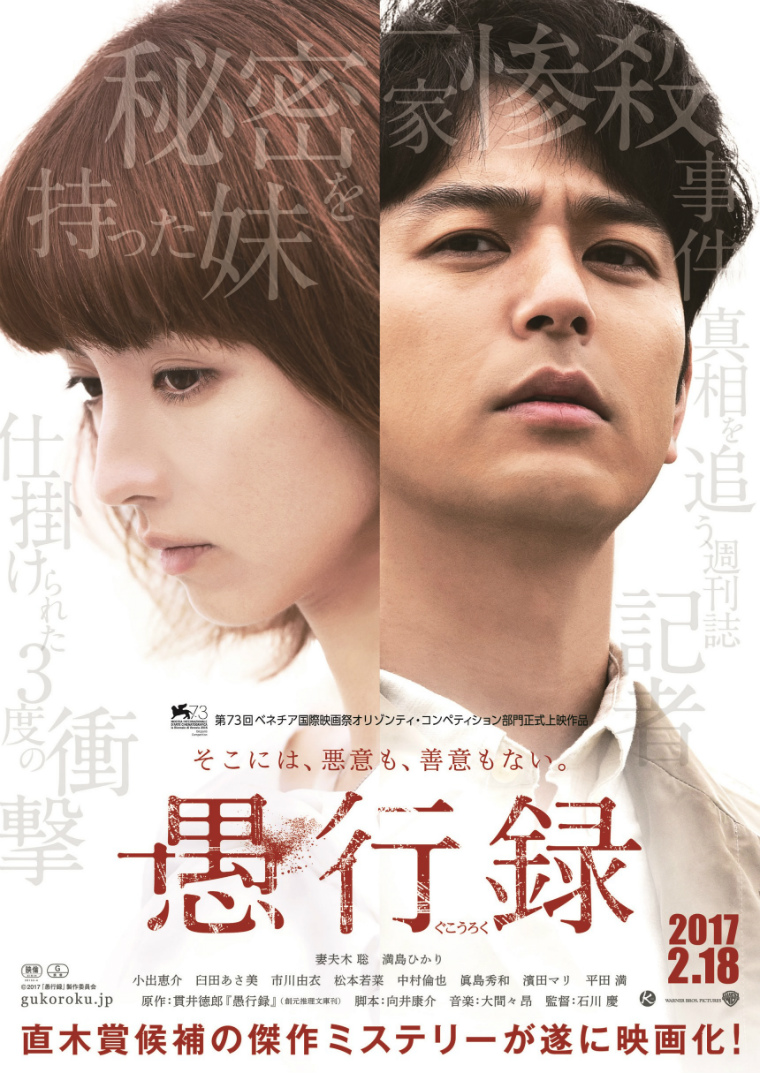
Gukoroku – Traces of Sin (愚行録, Kei Ishikawa, 2017)

gukoroku posterGenerally speaking, murder mysteries progress along a clearly defined path at the end of which stands the killer. The path to reach him is his motive, a rational explanation for an irrational act. Yet, looking deeper there’s usually something else going on. It’s easy to blame society, or politics, or the economy but all of these things can be mitigating factors when it comes to considering the motives for a crime. Gukoroku – Traces of Sin (愚行録), the debut feature from Kei Ishikawa and an adaptation of a novel by Tokuro Nukui, shows us a world defined by unfairness and injustice, in which there are no good people, only the embittered, the jealous, and the hopelessly broken. Less about the murder of a family than the murder of the family, Gukoroku’s social prognosis is a bleak one which leaves little room for hope in an increasingly unfair society.
When we first meet Tanaka (Satoshi Tsumabuki) he’s riding a bus. Ominous music plays as a happy family gets off but the real drama starts when another passenger irritatedly instructs Tanaka to give up his seat so an elderly lady can sit down. He snorts a little but gets up only to fall down next to the steps to the doors and subsequently walk off with a heavy limp. The man who told him to move looks sheepish and embarrassed, but as soon as the bus passes from view Tanaka starts walking normally, an odd kind of smirk on his face in thought of his petty revenge.

In one sense the fact that Tanaka faked a disability is irrelevant, the man did not consider that Tanaka may himself have needed a seat despite looking like a healthy man approaching early middle age. Perhaps, he’ll think twice about making such assumptions next time – then again appearances and assumptions are the lifeblood of this mysteriously complicated case.

Tanaka has a lot on his plate – his younger sister, Mitsuko (Hikari Mitsushima), has been arrested for neglecting her daughter who remains in intensive care dangerously underweight from starvation. In between meeting with her lawyer and checking on his niece, he’s also working on an in-depth piece of investigative reporting centring on a year old still unsolved case of a brutal family murder. Tanaka begins by interviewing friends of the husband before moving onto the wife who proves much more interesting. Made for each other in many ways, this husband and wife duo had made their share of enemies any of whom might have had good reason for taking bloody vengeance.

The killer’s identity, however, is less important than the light the crime shines on pervasive social inequality. As one character points out, Japan is a hierarchical society, not necessarily a class based one, meaning it is possible to climb the ladder. This proves true in some senses as each of our protagonists manipulates the others, trying to get the best possible outcome for themselves. These are cold and calculating people, always keeping one eye on the way they present themselves and the other on their next move – genuine emotion is a weakness or worse still, a tool to be exploited.

The key lies all the way back in university where rich kids rule the roost and poor ones work themselves to the bone just trying to keep up. There are “insiders” and “outsiders” and whatever anyone might say about it, they all secretly want in to the elite group. Here is where class comes in, no matter how hard you try for acceptance, the snobby rich kids will always look down on those they feel justified in regarding as inferior. They may let you come to their parties, take you out for fancy meals, or invite you to stay over but you’ll never be friends. The irony is that the system only endures because everyone permits it, the elites keep themselves on top by dangling the empty promise that someday you could be an elite too safe in the knowledge that they only hire in-house candidates.

Gradually Tanaka’s twin concerns begin to overlap. The traces of sin extend to his own door as he’s forced to examine the legacy of his own traumatic childhood and fractured family background. The reason the killer targeted the “happy” family is partly vengeance for a series of life ruining wrongs, but also a symbolic gesture stabbing right at the heart of society itself which repeatedly failed to protect them from harm. Betrayed at every turn, there’s only so much someone can take before their rage, pain, and disillusionment send them over the edge.

Despite the predictability of the film’s final twist, Ishikawa maintains tension and intrigue, drip feeding information as Tanaka obtains it though that early bus incident reminds us that even he is not a particularly reliable narrator. Ishikawa breaks with his grim naturalism for a series of expressionistic dream sequences in which hands paw over a woman’s body until they entirely eclipse her, a manifestation of her lifelong misuse which has all but erased her sense of self-worth. There are no good people here, only users and manipulators – even the abused eventually pass their torment on to the next victim whether they mean to or not. Later, Tanaka gets on another bus and gives up his seat willingly in what seems to be the film’s first and only instance of altruism but even this small gesture of resistance can’t shake the all-pervading sense of hopeless loneliness.


Gukoroku – Traces of Sin was screened at the 17th Nippon Connection Japanese film Festival.

Original trailer (no subtitles)

Hatsukoi (First Love) (初恋, Yukinari Hanawa, 2006)

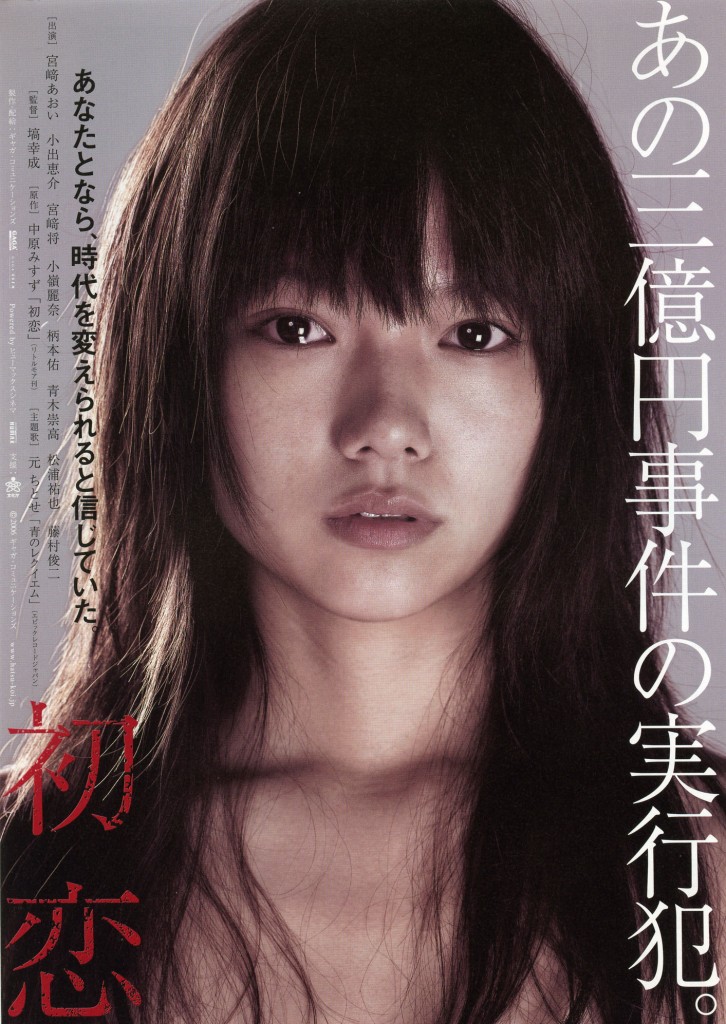
hatsukoiThe 300 Million Yen Affair is one of the most famous and intriguing unsolved mysteries in Japan, not least because the missing cash has been lying dormant somewhere, apparently untouched, ever since that fateful day back in 1968. Seeing as the true story has never been discovered, the crime has taken on legendary status and become the focus of many kinds of fiction. Misuzu Nakahara’s fictionalised autobiography is just one of these as she retroactively claims responsibility for the robbery as a teenage girl in love with a detached revolutionary.

Misuzu (Aoi Miyazaki) begins her tale a couple of years before the crime as she lives a lonely and introverted life in the house of her uncle, her father having died and her mother apparently absconded with her older brother in tow but leaving her behind. It’s her 16th birthday, but no one cares. Soon enough she starts hanging around a shady jazz bar before another woman convinces her to come inside and join their group of layabout beatniks – a group which is actually lead by her estranged older brother, Ryo (Masaru Miyazaki). These are the heady days of students protests – against the old order, against the ANPO treaty, against the war in Vietnam, against just about everything. Misuzu grows closer to one of their number, the quiet and mysterious Kishi (Keisuke Koide), who has a proposition for her….

Hatsukoi (AKA First Love, 初恋) is a film which is thick with period detail from the authentically smokey, sweaty jazz bar and its counterculture denizens to the nostalgic atmosphere and 1960s street scenes. However, evoking Misuzu’s own sense of ennui, director Yukinari Hanawa opts for a detached, dispassionate tone which is entirely at odds with the otherwise searing, youth on fire tension of the time period. Misuzu is always on the edges of things, younger than the other members of the group she feels as if she’s merely being permitted to stay and listen rather than invited to participate. Nevertheless, even if it’s the case that Misuzu is a by nature a passive person, the film pushes the intense nature of the social revolution going on all around her into mere background, squandering its power to bring out the sense of passion that the film feels as if it needs.

At heart, the robbery is something of a mcguffin as the real story is the true love tragedy hinted at in the title. Misuzu and Kishi grow closer through their plotting of the crime which is born of his desire to commit a different kind of revolutionary act. The money is intended to pay the bonuses of Toshiba employees and Kishi feels the best way to make a protest against economic inequality and the power of large corporations is to hit them in the finances. Misuzu plays her part well enough and the robbery comes off OK despite minor hitches allowing only a brief honeymoon period for its would be Bonnie and Clyde before history begins to move forward and eventually rips them apart. For Misuzu the robbery becomes the defining event of her youth and the birth of the love that she seemingly cannot let go. After this the jazz club is over, the protest movement dies as do some of the protestors, or else they move on to more conventional lives. Not quite a coming of age, but a death of youth before it had hardly begun.

Some injuries never heal, says the kindly old man who teaches Misuzu how to drive. A prescient remark if ever there was one. Misuzu seems locked within this brief period of her youth, before her friends died, left, or disappeared once the turbulent atmosphere of protest and revolution gave way to the consumerist 1970s and everyone forgot about the necessity for social change in the hurry to make money.

Hatsukoi becomes less a about the first love itself than about the period that surrounds it. The love was lost, but so was the bubble in which Misuzu had begun to define herself as a young woman. What Hatsukoi lacks is a sense of personal tragedy, of a soul crushing, spiritual death which locks each of the group members into their own tragic fates and seems somehow dictated despite their insistence on defining themselves in the new, youth centric world. Often beautifully photographed, Hatsukoi’s air of desolation and cold, detached tone weaken its ability to engage making its painful end of youth journey all seem rather dull.


Hatsukoi was released with English subtitles on blu-ray in Taiwan, and on DVD in Hong Kong though both editions now appear to be OOP.

Unsubtitled trailer:

https://www.youtube.com/watch?v=k-HTlxRwQPg