A Fine, Windy Day (바람 불어 좋은 날, Lee Jang-ho, 1980)

Lee Jang-ho returned to filmmaking after a short hiatus having been temporarily banned for the possession of marijuana in 1980 with a fresh new approach focussing on the social issues of the day as Korea found itself in the midst of confusion following the assassination of president Park Chung-hee. Though many hoped for a new era of long-awaited democratisation, those hopes were soon dashed by another military coup and the continuation of oppressive dictatorship under Chun Doo-hwan. During his time away from the film industry, Lee had run a bar with his mother and it was there that he became more acquainted with the struggles of ordinary people.

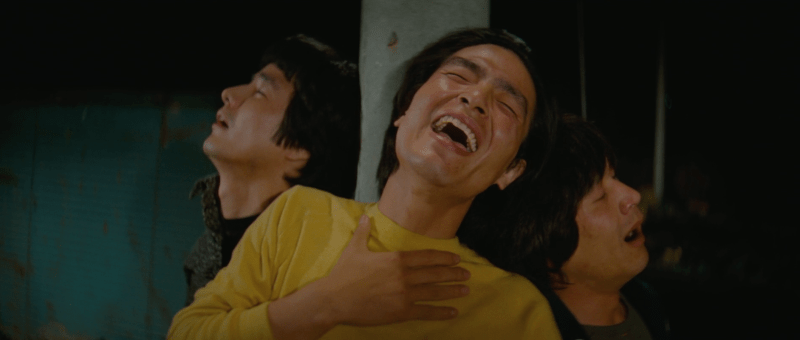
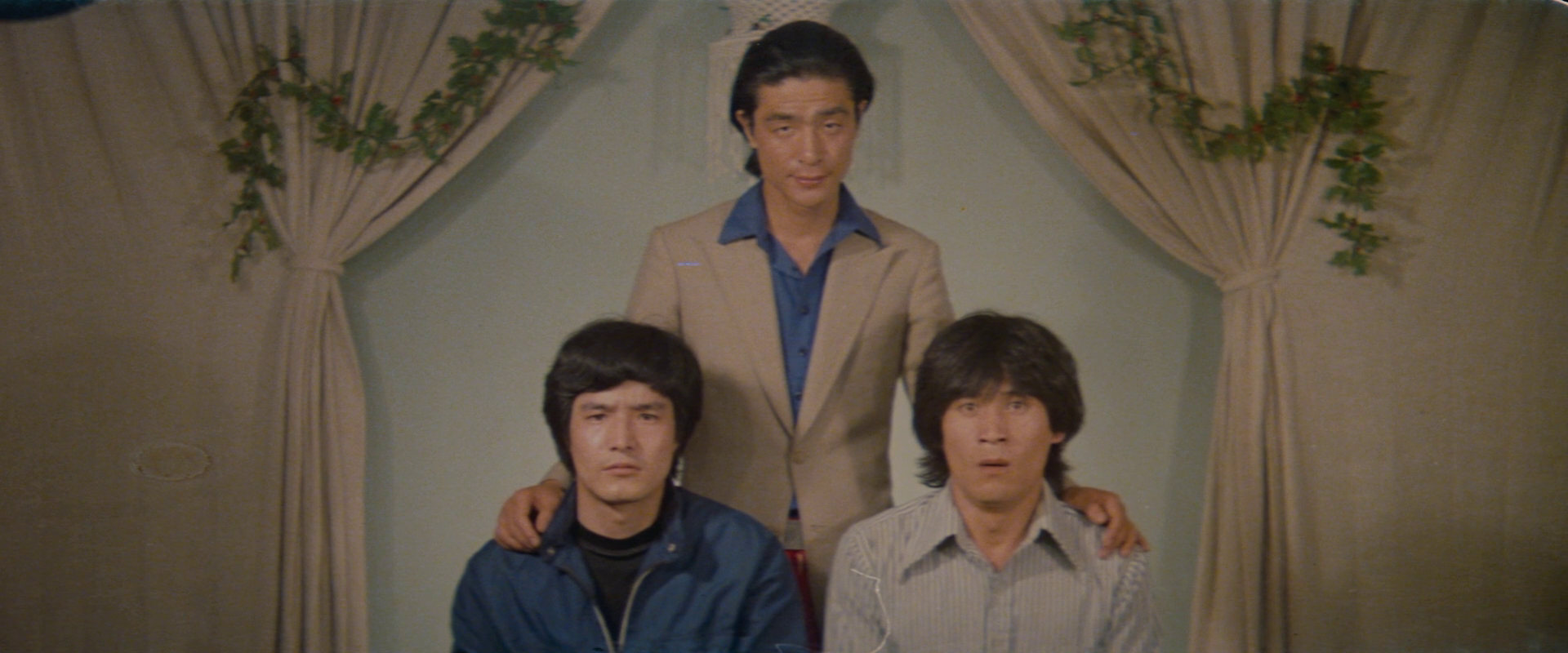
Adapted from a novel by Choi In-name, A Fine, Windy Day (바람 불어 좋은 날, Barambuleo Joheun Nal) follows three young men who have migrated from the countryside to Seoul in wider movement of urban migration. The sister of one of the men who later joins them remarks that there are no young people left in the countryside and her brother agrees that there is no longer any future in farming. Yet as the opening of the film makes clear in its idealised vision of pastoral life, it is really the expansion of the cities which has displaced the men and destroyed the natural habitats they once inhabited. The film often aligns the three with stray dogs who’ve come scavenging in the city because they can no longer survive in their rural hometowns. 

“It’s as if I’ve been taking a beating for two years straight from some invisible person” delivery boy Deokbae (Ahn Sung-ki) remarks during the film’s conclusion of his life in Seoul which does indeed seem to have been one long and bloody battle that had forced him into submission. As he tells equally naive country boy Suntae, he never stuttered before he came to the city but is now cowed and anxious all too aware of how the native Seoulites treat men like him. Daughter of a wealthy family, Myung-hee (Yu Ji-in) drives her own car around town, knocking over school children and not even bothering to stop until challenged by Deokbae for ruining the food he was currently in the middle of delivering. He later gets a telling off from his boss and his pay docked while she wraps her expensive scarf around his neck and promises to send compensation money to the restaurant where he works. 

Deokbae knows that Myung-hee is merely playing with him, her strangely childish glee like a little boy pulling the wings off a fly, yet he continues to associate with her. She laughs at him when he sits on the floor instead of the sofa after she ordered from the restaurant to get him to come to her house, and then tries to kiss him before becoming angry and pushing him away. Her posh friends later invade the restaurant and are drunk and rowdy, refusing to leave until a fight develops and they’re all carted off to the police.

But it’s only one of several degradations the men suffer at the hands of a new aristocracy not so different from the feudal elite. Chunsik (Lee Yeong-ho) works at a hairdresser’s where he is smitten with the pretty stylish Miss Yu (Kim Bo-yeon) who is being more or less sold by her ambitious boss and thereafter coerced into a compensated relationship with a sleazy businessman, Mr Kim, who was himself once a country boy but got rich quick through property speculation having cheated the old man who appeared in the film’s opening out of his ancestral land which has since been turned into the half-built slum inhabited by the three men. He is about to open a new shopping centre where the barber hopes to gain a prime position thanks to providing access to Miss Yu. The old man rails around the town demanding the return of his land, decrying that heaven will punish Mr Kim for what he’s done, and finally commits suicide in the newly completed building almost as it he were cursing it. 

The old man’s body is laid out on the last remaining stretched field where a shamanistic funeral song plays as a lament for the now ruined pastoral idyll which has been taken from each of the men and replaced with internecine capitalism in which wealth comes at the exchange of humanity. At the Chinese restaurant where Deokbae works, the wife of the dying boss had been carrying on an affair with the manager whom she hopes to marry once her husband has gone, while he expects to take over the shop though as is later revealed he is already married with children and technically performing a long con on her. The third man, Gilnam (Kim Seong-chan), works in a motel while saving money to open a hotel of his own but unwisely gives his savings to his girlfriend who runs off with them leaving him with nothing. He is then drafted for military service, receiving another blow from the contemporary Korea.

The man who spars with Deokbae who takes up boxing after his altercation with the rich kids is also wearing a shirt that reads “Korea” on the back and we watch as he is mercilessly beaten but this time refusing to give up reflecting only that he’s learned how to take a hit which is it seems the only way to survive in the Seoul of the early 1980s. The tone that Lee lands on is however one of playful irony, particularly in the meta-quality of the closing narration along with its victory in defeat motif as Deokbae acknowledges the need to roll with the punches which is also a subversive admission of the futility of his situation in which it is simply impossible to resist the system. A lighthearted but also melancholy chronicle of the feudal legacy repurposed for a capitalist era the film encapsulates itself in its bizarre disco scene as a confused Deokbae dances like a shaman, forever a country boy lost in an increasingly soulless and capitalistic society.
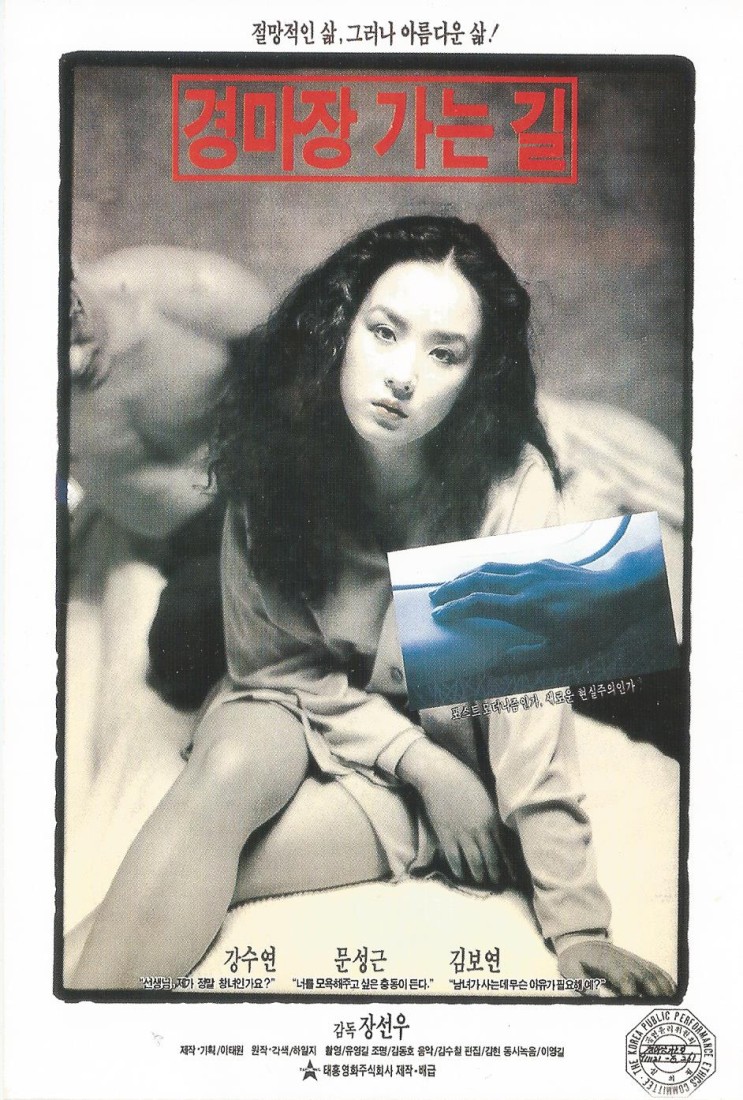
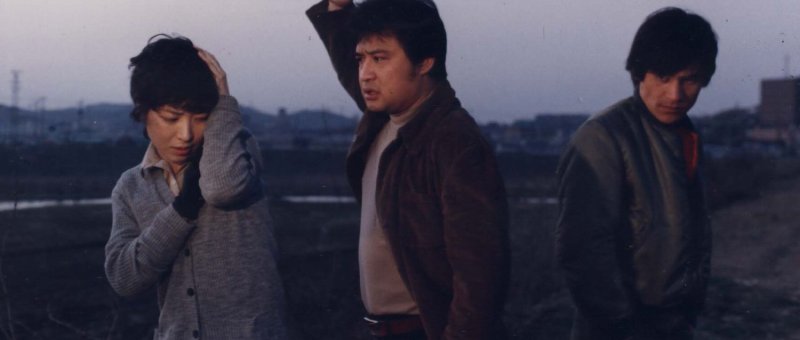
The Road to the Racetrack (경마장 가는 길, Jang Sun-woo, 1991)

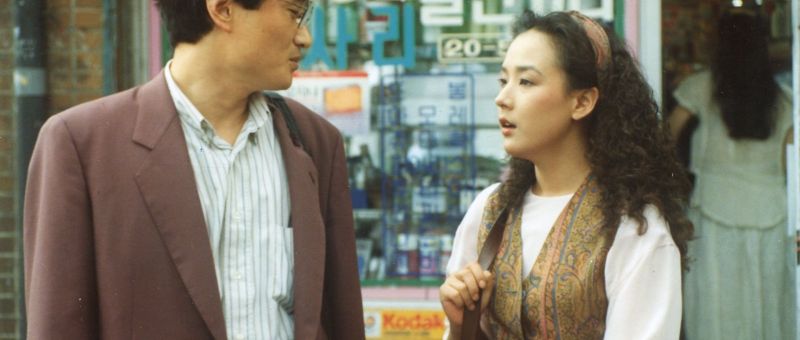
A pompous scholar returning home after five years living abroad in France struggles to adapt himself to a changed Korea in Jang Sun-woo’s literary drama, Road to the Racetrack (경마장 가는 길, Gyeongmajang Ganeun Kil). Hoping to rekindle an affair with a fellow student with whom he lived for three and a half years, the man known only as R (Moon Sung-Keun) finds himself frustrated by the same patriarchal norms which he manipulates in an attempt to dominate and control his former lover while little realising that it is she who truly has the upper hand as he pathetically follows and entreats while begging her to sleep with him. 

J (강수연), as the woman is known, shows little desire to pick up where they left off and roundly refuses to sleep with R who can speak of little else. She tells him that things are different in Korea and hints that the cause of her reluctance is that R is still married and in fact has two children. While J had (seemingly) been content to live with R as his “wife” in France, in Korea she feels a need to be married herself and obviously cannot marry R as his wife will not divorce him. Old-fashioned in her thinking, R’s wife (Kim Bo-yeon) assumes the cause of the discord in their marriage is that she was not a virgin when they married though it seems clear that since obtaining his PhD in France, R has begun to look down on his humble family and no longer wishes to associate with his uneducated spouse. An ironic soap opera scene precedes one of their conversations in which a husband cooly tells his wife that he will do as he pleases and has no intention of granting her a divorce fully highlighting R’s hypocrisy though his own wife is depicted more or less like the one on screen eventually screaming at him and refusing his demands to end their marriage. 

Though R had told his wife that the fact she had lovers before they married is not a factor in his desire for a legal separation, discovering that J has met someone else and is thinking of marrying him sends R into a tailspin of jealously. Badgering J into sex, he is ultimately unable to perform and complains that the “shadow” of the other man is putting him off his stride. He demands that she makes a choice and encourages her to tell her new man all about their time in France whereupon he might like R abruptly dump her for being an impure woman. Meanwhile, R complains that she’s treating him “like a rapist”, which is ironic because that is exactly how he is behaving. She cries and refuses, asking him if they “really have to” and still he pushes on violently pulling at her clothes until she gives in. He can’t seem to understand why it’s “different in Korea” when they lived together for three years in France, as if a single instance of consent has eternal permanence. 

J always returns to him if for unclear reasons in the increasing toxicity of their relationship. She addresses him as “doctor”, while he repeatedly insults her and calls her stupid, mocks her middle-class background in an attempt to deflect the class difference between them, implies she’s useless without him and that all her achievements are really his own. He claims to have written her PhD thesis for her, and is irritated that she’s had some success since returning to Korea having completed her studies a year before him. He reads an essay she’s written and while he may have a point about an ambiguous turn of phrase, further insults her by claiming that the only good bits are the bits she ripped from an old essay of his, but is clearly annoyed that she’s managed to get an essay published after showing it to another man who further edited it for her. Suddenly he explodes in rage and claims he feels exploited, insisting that J pay him monetary compensation for his emotional pain. 

The relationship only begins to work again once it becomes transactional perhaps hinting at a societal change in an increasingly capitalistic society. As J is unable to pay the sum he asked for, R insists she work off the amount by becoming his personal prostitute. Though effectively constrained by his wife’s refusal to divorce him, he thinks that he controls J and is reasserting his patriarchal authority. But then he is clearly the one in thrall to J following her around and refusing to let her go while her decision to continue meeting with him seems like it may partly be born of fear and a sense of inadequacy if also a delight in wielding her power. His contribution to J’s PhD leaves her feeling underconfident and a fraud, fearing he’s right and she’s not much of a scholar just a girl with rich parents who could send her France to study. But she’s also tied to him in service to outdated patriarchal social codes that were not in play in France in which he is both husband and not. When he strikes her, she immediately apologises.

The contrast between the two cultures is clear on R’s arrival as he wonders at the thousands of neon crosses that now colour the nighttime skyline of Seoul, remarking that’s as if he’d found himself in a European war cemetery. Both he and J seem to be adrift in a new society, aimless and with no particular place to go. Hoping to rekindle their love, R tries to force J to go abroad again but she refuses and declines to give an explanation. Incredibly frank in its sexual language, the file presents an otherwise bleak view of the toxic relationship between the former lovers who inhabit a series of seedy motels and are seemingly unable to escape the destructive cycle of their love while the pompous hero can only comment on his inability to orient himself in a changing city by recording the number of steps from each direction to the racetrack as if trying to reassure himself of the geographical integrity of the landscape of his memory.


The Road to the Racetrack screened as part of this year’s London Korean Film Festival.

People in the Slum (꼬방동네 사람들, Bae Chang-ho, 1982)

People in the slum still 2The Korea of the early ‘80s was not an altogether happy place. One dictator fell in 1979, but hopes of returning to democracy were dashed when general Chun Doo-hwan staged a coup and instigated martial law, brutally suppressing a large scale democracy protest in Gwangju in 1980 (though the news of the incident was also suppressed at the time it took place). People in the Slums (꼬방동네 사람들, Kkobangdongne Salamdeul), adapted from the best selling novel by Lee Dong-cheol, is not an overtly political film but takes as its heroes those who have lost out in the nation’s bold forward march into the capitalist future. Opening with a voice over from the author himself, the film dedicates itself to “the memory of neighbours of bygone days”, remembering both the hardships but also the fierce sense of community and warmth to be found among those living at the bottom of the heap.

Myeong-suk (Kim Bo-yeon), a still young-ish woman with a young son, lives in a slum outside of the city with her second husband, Tae-sub (kim Hee-ra). Nicknamed “Black Glove” because of the glove she always wears on her right hand, Myeong-suk is about to open her own business – a small grocery store serving the local residents, but her happiness is tempered with anxiety. Tae-sub, despite his promises, steals money from Myeong-suk to go drinking and gambling, is occasionally violent, and does not get on with her son, Jun-il, who refers to him as Mr. Piggy. Jun-il is also a constant worry because he’s picked up a habit of stealing things and generally causing trouble around the neighbourhood. When Myeong-suk’s former husband and the father of Jun-il, Ju-seok (Ahn Sung-ki), catches sight of her by chance one day, the past threatens to eclipse the small hope of her future.

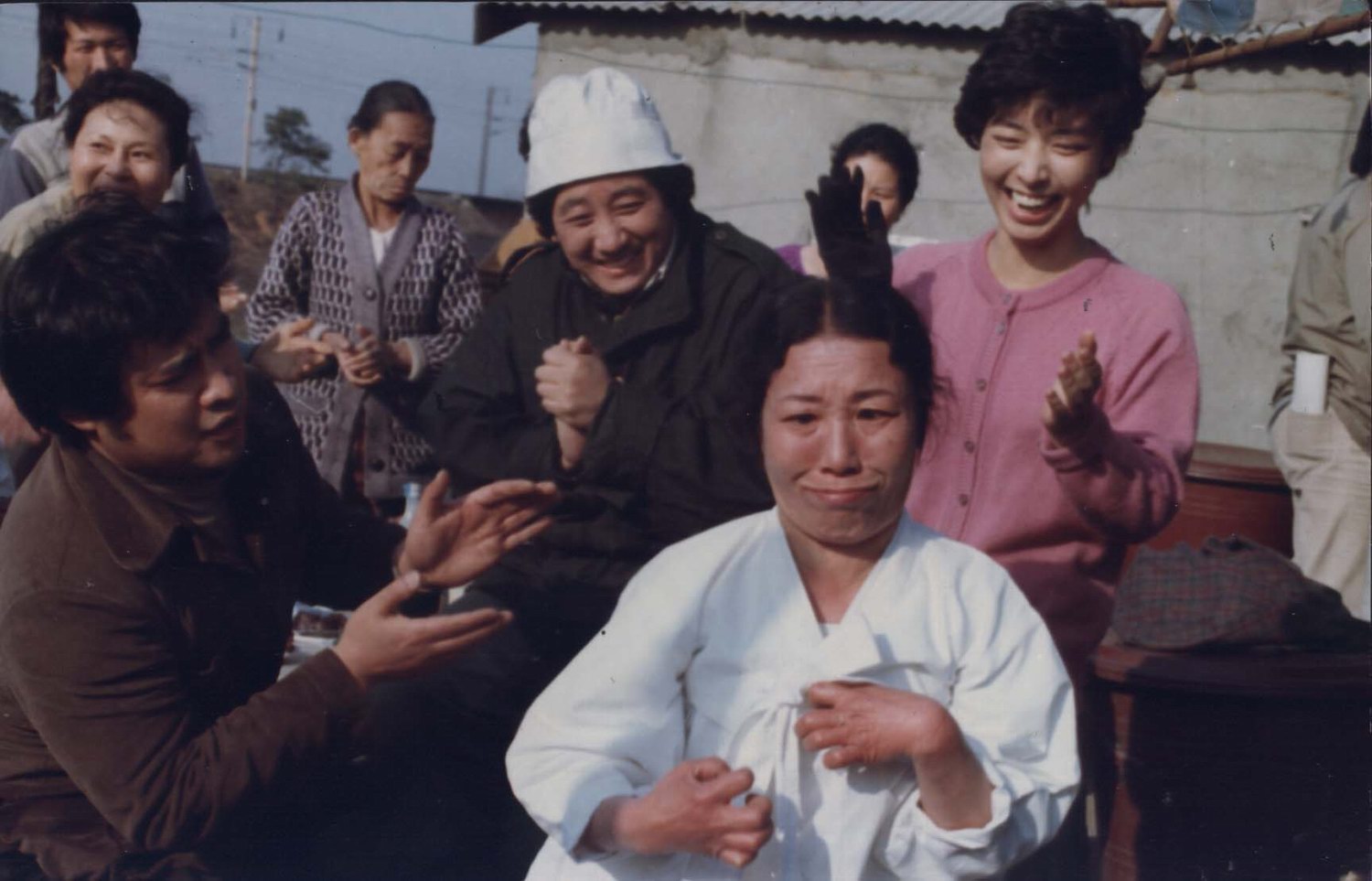
Life in the slums is not easy. There are few resources, few people are working and there are lots of children with no money to feed and clothe them. Fights are frequent but often unserious. The community pull together to support each other, turning out in force for the grand opening of Myeong-suk’s shop or the 60th birthday celebration of a fellow resident. Besides Myeong-suk, her second husband, and son, the slum is home to a collection of unusual characters from a widow who dresses in white and does strange dances to entertain the locals, to the pastor who does his best to help where he can. A poor drunken woman makes a fool of herself all over town, nursing a crush on the pastor but seemingly unable to move past her dependency on alcohol and whatever it is that caused it and landed her in the slum.

Myeong-suk’s early life would not have suggested her current trajectory, as Bae reveals in Ju-seok’s flashbacks of his courtship to the woman who would become his wife. Ju-seok, a pickpocket, spotted Myeong-suk on a bus and it was love at first sight. Eventually he married her but never revealed his illicit occupation until he was finally arrested. For the sake of his wife and child, Ju-seok attempts to go straight but his efforts are frustrated by bad luck, temptation, and unforgiving policemen. No matter how hard Ju-seok tries to be a decent, hardworking, family man, the economic instability of late ‘70s Korea will not allow him to do it.

Myeong-suk waits for him, but there comes a point she cannot wait anymore. Her second husband is no better than her first and, just like Ju-seok, is hiding something from her. Tae-sub is a bully and a bruiser who is only using Myeong-suk as a convenient place to hide. She cannot rely on him for affection, protection, or financial stability. Ju-seok, at least, did love Myeong-suk even if that love was the very thing which kept leading him back into a life of crime which then took him away from her. Once again love is a luxury the poor cannot afford .

Where the general atmosphere may seem destined for a tragedy for the resilient, suffering Myeong-suk, her damaged son, and reformed taxi-driver former husband, Bae gives them hope for a warmer, if not a better, future. As Myeong-suk prepares to leave the slum, the pastor, encircled by the residents, reads out a passage reminding the locals that a neighbour’s suffering is one’s own suffering while the drunken woman who previously hated children appears to have sobered up and happily hugs a child. Myeong-suk makes a selfless gesture of atonement and solidarity in giving the money from selling her shop to another single mother whose youngest three all have different fathers, perhaps indicating the difficulty of her life since the father of her eldest passed away. Tae-sub too reforms, decides to face the past he’s been running from and make amends for his former life, facilitating a possible reunion for the star-crossed lovers Myeong-suk and Ju-seok. The future suddenly looks brighter, but it remains uncertain and who knows if love and a taxi-driver’s salary will be enough to keep Ju-seok on the straight and narrow as a responsible husband and father in turbulent ‘80s Korea.


People in the Slum screens as part of the London Korean Film Festival 2017 which is hosting a mini Bae Chang-ho retrospective of three films at each of which the director will be present for a Q&A.

The film was also recently released on all regions blu-ray courtesy of the Korean Film Archive. In addition to English subtitles on the main feature, the blu-ray also includes English subtitles for the commentary track by Bae Chang-ho and film critic Kim Sungwook, and comes with a bilingual booklet featuring essays by Jang Byung-won (programmer for Jeonju International Film Festival), Lee Yong-cheol (film critic), and Chris Berry (King’s College London).

You can also watch the entirety of the film legally and for free courtesy of the Korean Film Archive’s YouTube Channel.