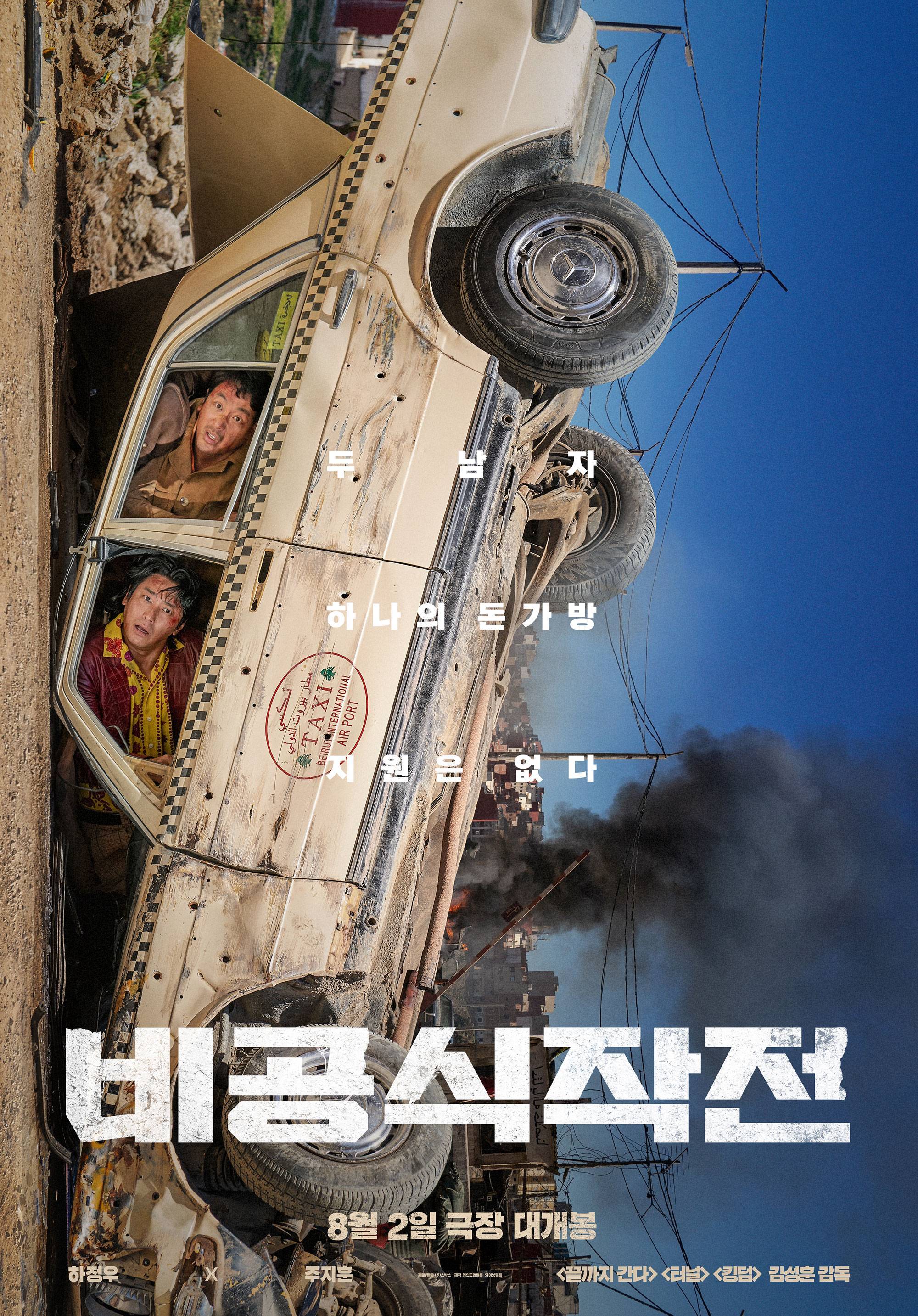
Ransomed (비공식작전, Kim Seong-hun, 2023)

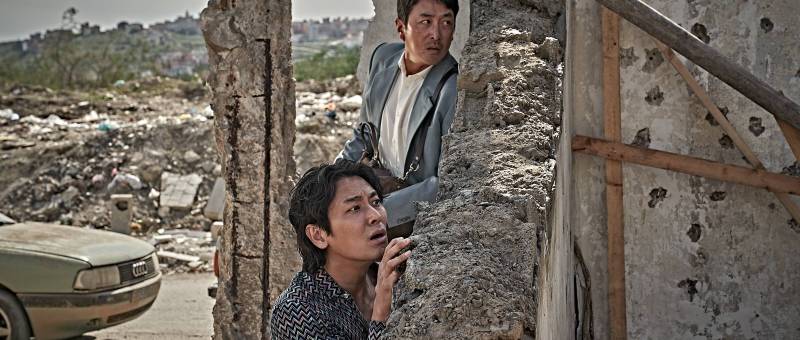
A jaded diplomat finds himself caught between competing factions both at home and abroad while trying to rescue a kidnapped colleague in Kim Seong-hun’s action dramedy, Ransomed (비공식작전, Bigongsigjagjeon). Inspired by true events, the film ironically echoes the recent Chinese hit Home Coming which was itself at least incredibly indebted to Escape from Mogadishu in praising the efforts of a civil servant who braved a war zone to rescue a stranded colleague but received little support from his conflicted government.

During the time the film takes place, Korea is caught in a moment of transition technically still under the military dictatorship of Chun Doo-hwan but with the first democratic elections already scheduled and the 1988 Olympics in the offing. Diplomat Oh Jae-seok (Lim Hyung-guk) is kidnapped in during the civil war in Beirut in 1986 and believed dead after efforts to retrieve him fail. Nearly two years later, jaded Foreign Office Middle East specialist Lee Min-jun (Ha Jung-woo) picks up a call and hears a message in morse code including a special diplomatic password and the claim the that it comes from Jae-seok who is alive and requesting rescue. The problem is that both the Foreign Office and the KCIA are on the fence about taking action, each wanting the glory of bringing Jae-seok home but fearful of being professionally embarrassed if it turns out that the call is a hoax and they pay a ransom for a man who’s already dead. 

Min-jun finds himself caught between the two while essentially forced to set up a secret covert operation through former US CIA officer Carter (Burn Gorman) and a wealthy Swiss businessman with connections in Lebanon. The irony is that both he and Pan-su (Ju Ji-hoon), a Korean taxi driver he inexplicably runs into in Beirut, only want to go to the US, Min-jun desperate for a more prestigious positing to advance his diplomatic career while Pan-su, technically undocumented, seeks a better life in a more stable environment. As such, Min-jun’s motivations for rescuing Jae-seok are only partly a sense of responsibility as a fellow diplomat and the man who took the call that Jae-sook was alive, hoping to prove himself to his superiors only agreeing to the job on the promise of a transfer to a major US city resentful of having been passed over for a position in London in favour of an elite graduate of Seoul University. 

The irony is that once in Beirut he’s faced with a further series of kidnap threats, another random militia hot on Min-jun’s trail hoping to capture at least one Korean in the hope of a major payout though Min-jun’s problem is that the government only agrees to send more money after each step has been completed endangering the efficacy of the rescue mission while leaving him at the mercy of the militia leader the government has secretly and perhaps questionably agreed to pay to broker the negotiations to secure Jae-seok’s release and passage out of the country. Caught between competing militias in Beirut, Min-jun is also a victim of the push and pull between the waning influence of the KCIA and the Foreign Office with his fate decided largely by political infighting while in the end it’s his colleagues who eventually take a stand each chipping in three months’ salary to fund his rescue out of a sense of solidarity in the reflection that their job is only really possible given their government’s assurance of protection when they undertake dangerous work overseas for the national good. 

As expected, Min-jun soon rediscovers his sense of duty as does shady taxi driver Pan-su though more thanks to the shaming of his Lebanese girlfriend who points out that it’s not a good look to run off with millions of dollars intended to save to save a man’s life. Despite the constant precarity of the situation, what arises is an awkward brotherhood between the two men brokered by an uneasy trust and genuine fellow feeling as they try to rescue Jae-seok while evading the militia trying to kidnap them along with the wider civil war. Undercutting the seriousness of the situation with a healthy dose of irony and black humour, Kim lends his otherwise grim tale of citizenry held hostage by a bureaucracy in flux a degree of positivity if only in proving the power of the individual over a dysfunctional system. 


International trailer (English subtitles)
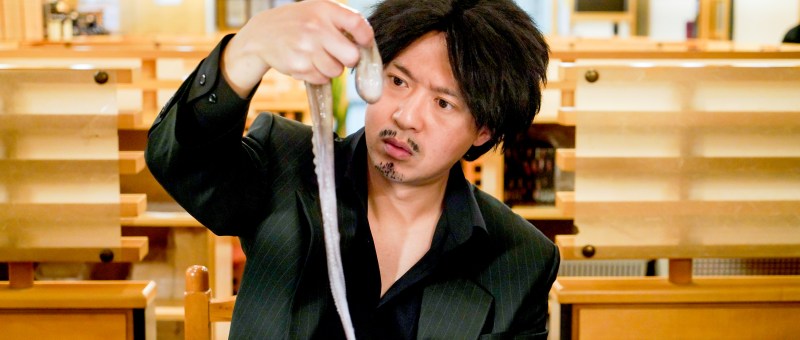
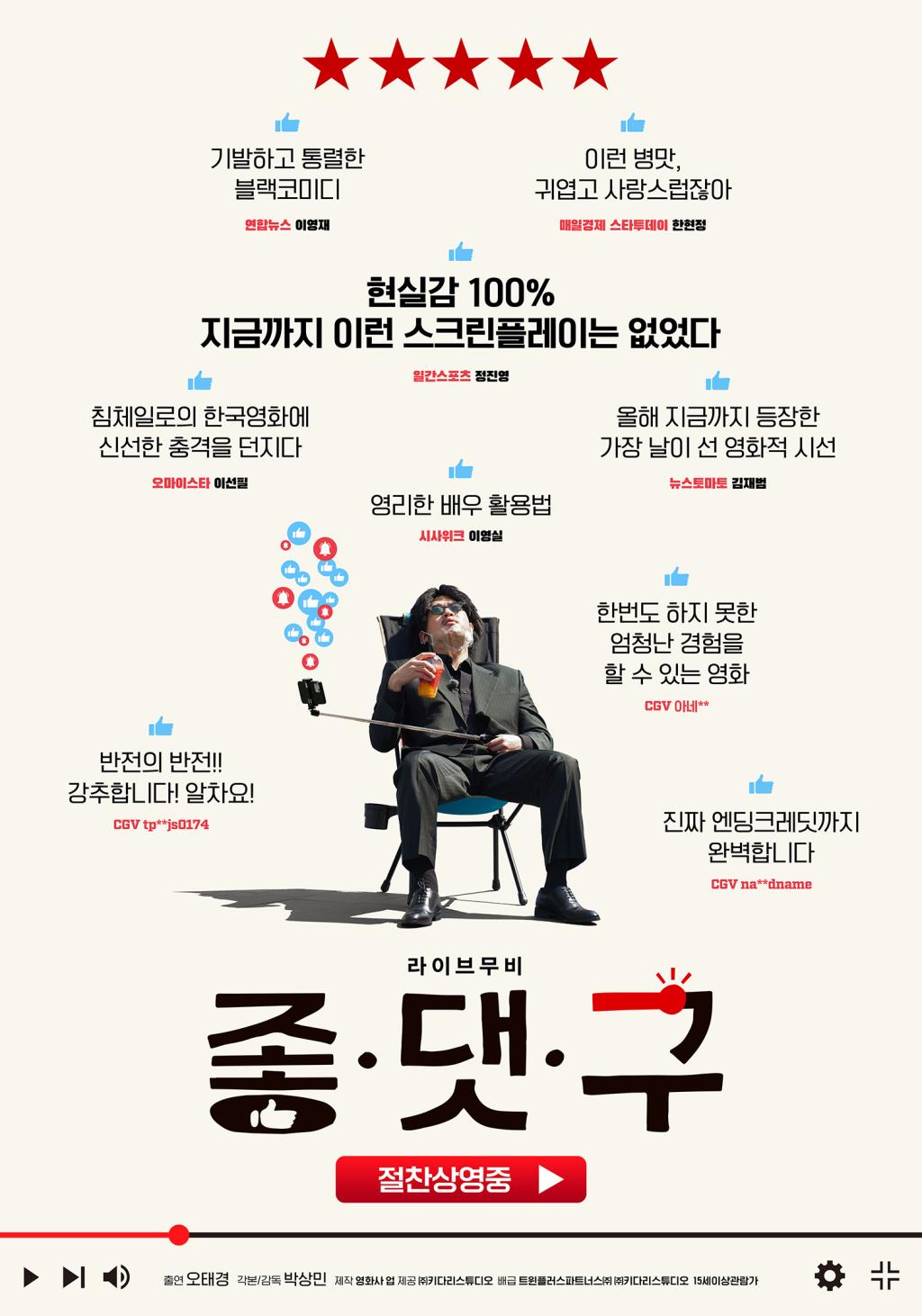
I Haven’t Done Anything (좋.댓.구, Park Sang-min, 2022)

The central irony of Park Sang-min’s meta comedy I Haven’t Done Anything (좋.댓.구, Joh.Daes.Gu) is that a man who remains defiantly silent generates much more interest than the one desperately chasing YouTube success. Adopting a “screen life” aesthetic in which much of the action is told through social media and video screens, the film asks a series of questions about our petty obsessions, online authenticity, media manipulation, and the impossibility of escaping a predetermined image as its embattled hero strives to reinvent himself by his inhabiting most famous role.

Actor Oh Tae-kyung plays a version of himself who is struggling to maintain his career as an actor having begun as a child star with his most high profile roles including that of the younger Oh Dae-su in Park Chan-wook’s Oldboy. With work thin on the ground, he turns to YouTube but fails to make an impact with content that commenters describe as old hat such as “mukbang” eating videos and unboxings. It’s then that he comes up with the idea of rebranding as “Li’l Oh Dae-su”, dressing up as the protagonist of Old Boy and accepting viewers’ challenges which at one point include him taking revenge on a gang of class bullies by hitting them on the head with a plastic mallet while mimicking the famous corridor fight scene from the landmark drama.

But then, someone else has already shared their screen with us. Going under the name “Bulldog”, a viewer asks Tae-Kyung to solve the mystery behind a man who’s been standing silently in the square with a large sign reading “I Haven’t Done Anything”. Tae-kyung reasonably wonders why Bulldog didn’t just ask the guy himself, but as he explains “Picket Man” refused to answer him. Given the large amount of money Bulldog has pledged for this seemingly simple request, Tae-kyung accepts the challenge but Picket Man continues to ignore him no matter the silly stunts he pulls an attempt to break his concentration. 

Bulldog’s apparently strong desire to know the truth, willing to offer up vast sums of money just to satisfy his curiosity, hints at our own petty obsessions. After all, the cryptic quality of the sign is intriguing. What exactly is Picket Man trying to say, what didn’t he do and who says he did it? Of course, in another way, Tae-kyung also feels he hasn’t done “anything” with his life and stuck in a career morass unable to shed the image of himself as a child actor and young Dae-su in particular. Every time someone offers him another role, he worries that the baggage of his early career follows him and he’s simply not credible as a hardened gangster, for example, if everyone only sees him as the eldest of six siblings in a much loved TV drama or the little boy who grow up to become the schlubby captive Oh Dae-su. 

When the skit becomes an accidental viral hit, Tae-kyung begins to worry that perhaps he’s doing Picket Man a disservice and this kind of publicity isn’t really what he was after though it’s puzzling that he himself refuses to speak about what it is he hasn’t done. What he realises is that Picket Man is much like himself and he’s done to him what others have done to Tae-kyung in reducing him to a single image. How will anyone ever see this otherwise anonymous person as anything other than “Picket Man” now? Tae-kyung has unwittingly exploited him for his own ends and possibly ruined his life in the same way that anyone who becomes a meme is robbed of an identity. 

Then again, in this very meta tale not everything is as we think it is and we ourselves, like the YouTube commenters, are being manipulated by unseen forces. As Picket Man becomes the latest social media phenomenon, other content creators start arbitrarily jumping on the hashtag, randomly mentioning Picket Man to boost their own views while unscrupulous forces also exploit the meme potential to run scams featuring Picket Man’s image. Park carries the meta quality through to interrupting the film with fake YouTube ads and product placement from sponsors that remind us we are being sold something whether we realise it or not and that we might not even realise what the product is or who’s selling to us as the final reveal implies. Nevertheless, there’s a sense of triumph in the success of this heist that’s been pulled on us in the winning self-deprecation of dejected former child star Tae-kyung and his great master plan to shed himself of an otherwise inescapable image. 


I Haven’t Done Anything screens 5th November as part of this year’s London Korean Film Festival.

Original trailer (English subtitles)

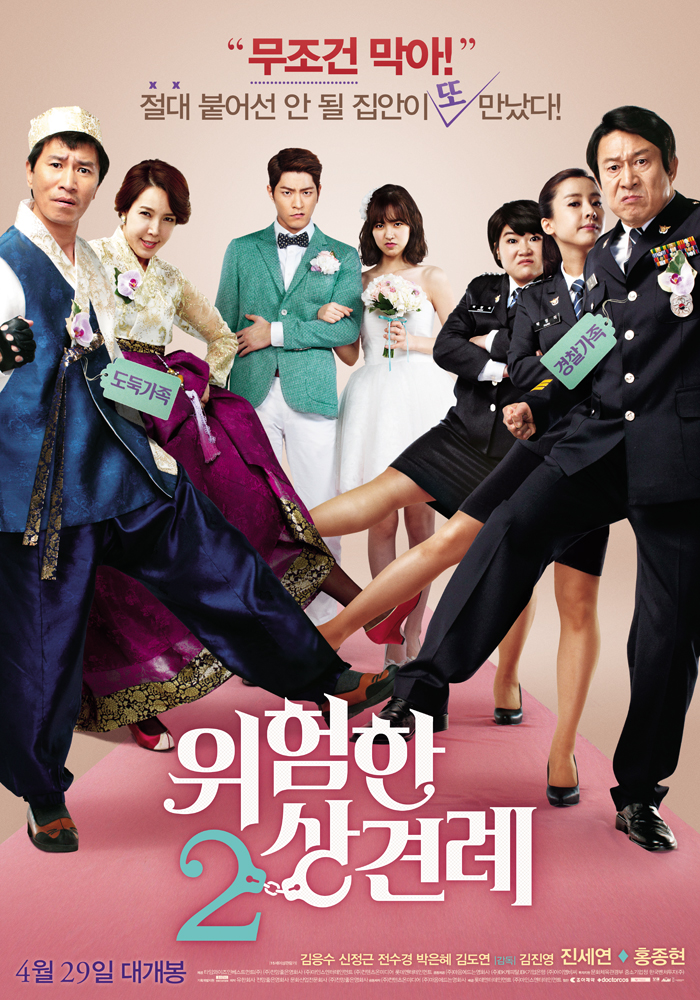
Enemies In-Law (위험한 상견례 2, Kim Jin-young, 2015)

enemies in-law posterIt’s tough when parents don’t approve of their children’s romantic partners, but fortunately most realise there’s nothing they can do about it so the best thing is to feign civility (and avoid saying I told you so when it all goes wrong). Unfortunately the older generation of Kim Jin-young’s Enemies In-Law (위험한 상견례 2, Wiheomhan Sanggyeonrye 2), a kind of follow up to his 2011 effort Meet the In-Laws, are of a very much more hands on mindset. One side is a police family in which literally everyone for generations has worked in law enforcement, and the other is headed by a pair of international artefacts thieves determined to live life on their own terms. You might think this is a situation ripe for comedy, and it is. Only, in a very strange and not altogether successful way.
Park Young-hee (Jin Se-yeon) and her fellow Olympian sister Young-sook (Kim Do-yeon) are on the way back from a fencing competition when their policeman father, Man-choon (Kim Eung-soo), gets into a car chase with the son of the two criminals he’s been trying to catch for years. Chul-soo (Hong Jong-hyun), a high school student with an expensive sports car, comes out on top but displays unexpected heroism when he notices the Park family car is on fire and someone is still trapped inside. Dousing himself with water he valiantly rescues Young-hee just before the car explodes and the pair fall in love at first sight.

Man-choon most definitely does not approve of this union, but Chul-soo vows to leave the criminal world behind and join the police like the rest of the Park family. Seven years later he’s still trying to pass the police exam and in a committed relationship with the now successful policewoman (and former Olympic gold medallist) Young-hee. As it looks like Chul-soo is about to achieve his goal, both the Parks and his parents Dal-sik (Shin Jung-geun) and Gang-ja (Jeon Soo-kyung), become increasingly worried about the marriage of crime and justice. Accordingly they form an unlikely alliance to break the pair up at all costs.

Enemies In-Law has its share of oddness, but remains disappointingly conventional in its comedic approach. The most objectionable aspect manifests itself in a persistent layer of fat jokes, mostly at the expense of Olympian judoist Young-sook whose weight is the constant butt of every joke in which she is derided as unattractive, greedy, lazy, and mannish. Despite the fact that the sisters seemingly each hold high offices in the police force, the overriding tone is a socially conservative one, even shoehorning in a bathing beauty sequence in which policewoman Young-hee is forced to dance lasciviously in a red bikini followed by her sister in a much frumpier one in another predictable and unfunny joke, as part of an odd sequence investigating a “secret” hostess bar. The jokes are at least mitigated by the fact Yuong-sook could not care any less what anyone thinks about her and is fine with both her appearance and anything anyone might have to say about it.

The major crisis point in the relationship comes when Chul-soo becomes fed up with the situation and captures his parents, presenting them to Man-choon tied up like two prize turkeys. This, he hopes, will be enough to get them to give in and accept him as a son-in-law, but he makes a rookie mistake. Young-hee, disappointed in him and getting the impression she’s become the subject of a “trade”, resolutely rejects Chul-soo’s attempt to buy her hand in marriage from her father with a slap to the face and a swift exit. The women have been bypassed as Chul-soo attempts to deal directly with Man-choon and the decision of the two men to view their relations as objects to be exchanged is rightly criticised in its effect of almost ending the entire endeavour and causing a possibly permanent rift with Young-hee.

Things also take a darker turn with the ongoing investigation the sisters are working on which involves a number of rapes and murders of well to do single women. In contrast with Chul-soo’s parents whose criminal enterprise is apparently successful, the police are depicted as blithering idiots who couldn’t catch a chicken in a supermarket. Using such a serious and unpleasant crime spree for comic value seems in poor taste even given the obvious throw away quality of the film, though it does provide the final plot motivation to bring everyone together as the master criminals have to step in to point the police in the right direction, even if Chul-soon’s mother has to pretend to be President Park Geun-hye to do it.

For a film which involves the ability to talk to dogs as a major device, Enemies In-Law never fully embraces its absurdism, leaving it with a curiously uneven tone which might have benefitted from even more silliness. Shifting from romantic comedy to police procedural in an interesting series of straight to camera monologues with re-enactments, Enemies In-Law takes its cues from popular TV dramas and pushes them in a more interesting direction but the jokes are never really big enough to pay off. Amusing enough, at times, but poorly pitched and uneven, Enemies In-Law is not the film it claims to be, but fails to be much of anything else either.


Original trailer (English subtitles)

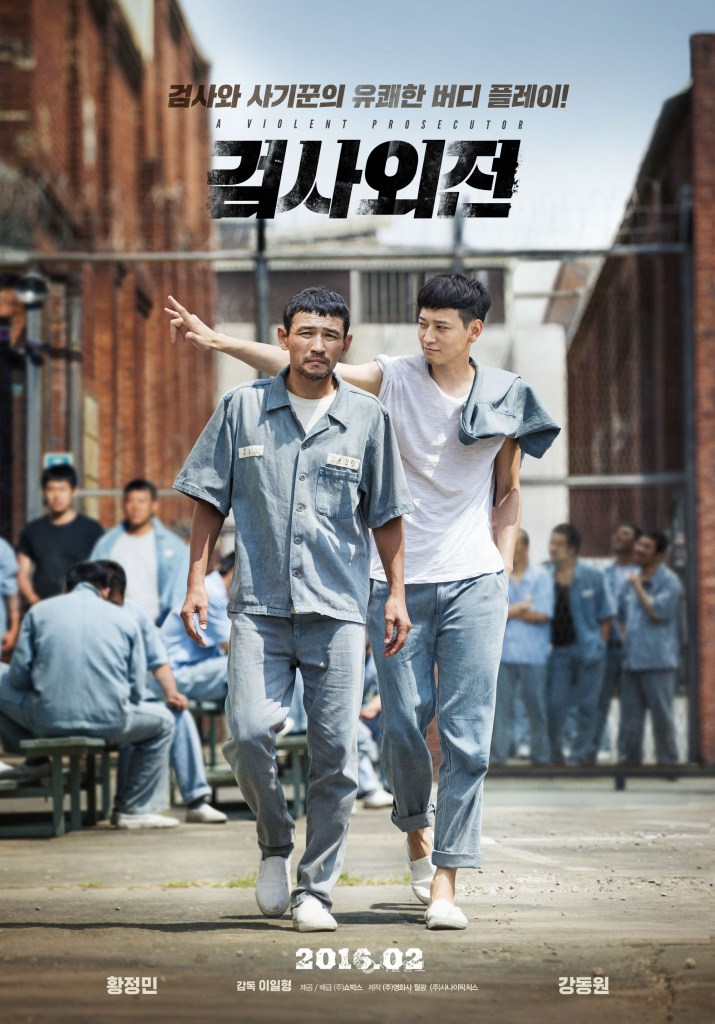
A Violent Prosecutor (검사외전, Lee Il-hyeong, 2016)

112997_47166_106Review of Lee Il-hyeong’s A Violent Prosecutor first published by UK Anime Network.
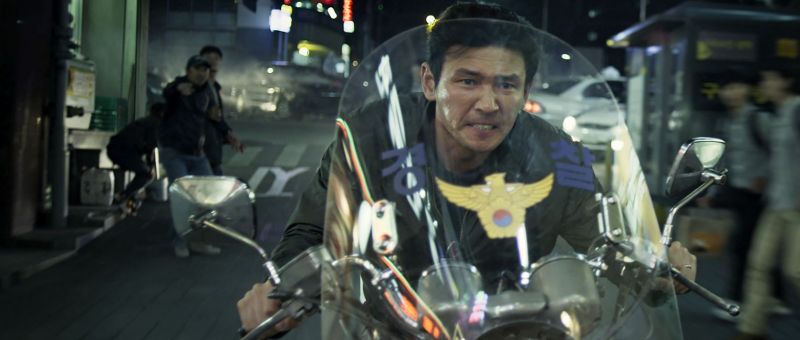

Police brutality is something of a hot button issue at the moment, so it’s a little disconcerting to see a film like A Violent Prosecutor (검사외전, Geomsawejeon) casting a rogue cop with a penchant for forced confessions as its hero. Then again, the theme plays into the obvious retro charm on offer and the film does, at least, make it plain that violence should have no place in law enforcement. The debut feature from director Lee Il-Hyeong, A Violent Prosecutor has a distinctly ‘70s vibe from its quirky credits sequence to the carefully managed tone which manages to be both serious and not at the same time.

Hwang Jung-min plays hardline prosecutor Byun Jae-wook, feared more than respected because of his willingness (or perhaps eagerness?) to indulge in physical violence in the name of justice. Already known as a trouble maker, Byun’s maverick status is an exploitable weakness and so when he kicks up a fuss trying to expose an obvious cover up, he’s framed for wrongful death after a witness dies in police custody.

Sent to prison among many of the men he helped to put there, Byun quickly finds his feet by providing free legal advice to the guards. Five years later, Byun has become the one of the prison’s top dogs but he’s still intent on clearing his name and nailing the guys who did this to him. Enter suave conman Chi-won (Gang Dong-won) and Byun sees an opening…

Aside from Byun’s problematic approach to his work, he’s definitely one of the good guys as justice, politics, and business have all come together in a whirlwind of mutually beneficial corruption. The whole mess begins during an environmental protest against an industrial complex which is about to be built right next to a bird sanctuary. The evil corporate bozos don’t want any delays so they pay a bunch of gangsters to infiltrate the protest and start a riot to make the environmentalists look like crazed, violent, loonies. Unsurprisingly, public opinion about the development improves following the unpleasant actions of the protestors. The police were just supposed to go along with this (police in Korean films never seem very interested in solving crimes after all), but Byun is different, he smells a rat and he’s not going to roll over and let powerful corporations abuse justice.

Unfortunately, his dedication is not matched by his colleagues who are more interested in their own careers than abstract concepts like truth or justice. Receiving pressure from above and realising Byun can’t be talked down, they decide to take drastic action. One of Byun’s bosses, Kang (Kim Eung-soo), later decides to move into politics, having solidified support through this alliance with the money guys, and is then interested in nothing other than his own success – lying, cheating, and smiling his way to the top. Corruption stemming from the power of monied corporations has become a constant theme in recent Korean cinema and A Violent Prosecutor makes good use of its cinematic background even if treating the subject matter in a necessarily light way.

Essentially, A Violent Prosecutor is a buddy comedy in which the two guys at the centre are kept apart for much of the film. Byun uses his hard won legal knowledge to fight his way out of prison by playing by the book, learning the error of his ways in the process. More often than not, he’s the straight man to Chi-won’s constant scamming as the charming conman comes up with one zany scheme after another trying to keep himself out of trouble whilst also helping Byun enact his plan of revenge. Actor Gang Dong-won is on fine form as the slippery but somehow loveable Chi-won whose main line of work is scamming chaebol daughters out of their inheritances by convincing them he’s a Korean-American Penn State business school graduate, peppering his speech with Americanisms but clueless when challenged on his English. He also deserves bonus points for subverting the “escape from prison dressed as a guard” trope by trying to escape from a corridor full of thugs by blending in with the very men sent to capture him.

Ending in a spectacular, if ridiculous, courtroom finale in which Byun defends himself by forcing a confession in a new, more acceptable way, A Violent Prosecutor delivers the necessary “justice” to all who seek it. Byun learns the error of his ways and accepts that his own violence was at least partly to blame for the way the situation developed, but also ensures that he gets justice for everyone else so that the rich and powerful can’t be allowed to ride roughshod over the people with no one to defend them. A smart buddy comedy, A Violent Prosecutor isn’t exactly the exploitative action fest the title seems to promise but is undoubtedly influenced by the bad cop movies of the ‘70s and excels at finding humour even in the strangest of places.


Reviewed at the 2016 London Korean Film Festival.

Original trailer (English Subtitles)

https://www.youtube.com/watch?v=_Cb-tYIsESg

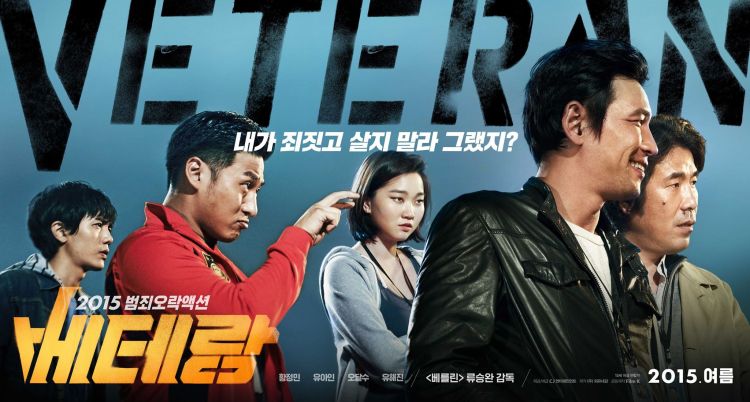
Veteran (베테랑, Ryoo Seung-wan, 2015)

1439210220_베테랑1Review of Ryoo Seung-wan’s Veteran (베테랑) – first published on UK Anime Network.


One of the top Korean box office hits of 2015, Ryoo Seung-wan’s Veteran is a glorious throw back to the uncomplicated days of ‘80s buddy cop crime comedy thrillers. A little less than subtle in its social commentary, Veteran nevertheless takes aim at corrupt corporate culture and the second generation rich kids who inherit daddy’s company but are filled with an apathetic, bored arrogance that is mostly their own.

Seo Do-cheol (Hwang Jung-min) is, as one other officer puts it, the kind of police officer who joined the force just to beat people up. He loves to fight and isn’t afraid of initiating a little “resisting arrest” action just to make things run a little more smoothly. However, when he strikes up a friendship with a put upon truck driver and his cute as a button son only to miss a crucial telephone call that eventually lands said truck driver in the hospital, Do-cheol’s sense of social justice is inflamed. After trying to join a trade union, Bae, the truck driver, is unceremoniously let go from his company. On taking his complaint directly to the head of Sin Jin Trading, play boy rich kid Tae-oh, Bae is subjected to the most cruel and humiliating “interview” of his life before apparently attempting to commit suicide after having realised the utter hopelessness of his situation. Incensed on his new friend’s behalf, Do-cheol is determined to take down these arrogant corporatists what ever the costs may be!

Veteran makes no secret of its retro roots. It even opens with a joyously fun sequence set to Blondie’s 1979 disco hit, Heart of Glass. Like those classic ‘80s movies, Veteran manages to mix in a background level of mischievous comedy which adds to the overall feeling of effortless cool that fills the film even when things look as if they might be about to take a darker turn. The action sequences are each exquisitely choreographed and filled with sight gags as the fight crazy Do-cheol turns just about any random object that appears to be close to hand into an improbable weapon.

Make no mistake about it either, this is a fight heavy film. Though Veteran has a very masculine feeling, it is to some degree evened out by the supreme Miss Bong whose high class high kicks can take out even the toughest opponents and seem to have most of her teammates looking on in awe, and the withering gaze of Do-cheol’s put upon wife who seems determined to remind him that he’s not some delinquent punk anymore but a respectable police officer with a wife and child who could benefit from a little more consideration.

Indeed, Tae-oh and his henchmen aren’t above going after policemen’s wives in an effort to get them to back off. Though this initial overture begins with an attempt at straightforward bribery (brilliantly dealt with by  Mrs. Seo who proves more than a match more the arrogant lackeys), there is a hint of future violence if the situation is not resolved. Tae-oh is a spoiled, psychopathic rich kid who lacks any kind of empathy for any other living thing and actively lives to inflict pain on others in order to breathe his own superiority. Probably he’s got issues galore following in his successful father’s footsteps and essentially having not much else to do but here he’s just an evil bastard who delights in torturing poor folk and thinks he can do whatever he likes just because he has money (and as far as the film would have it he is not wrong in that assumption).

He also loves to fight and finally meets his match in the long form finale sequence in which everything is decided in a no holds barred fist fight between maverick cop and good guy Do-cheol and irredeemable but good looking villain Tae-oh. Veteran never scores any points for subtlety and if it has any drawbacks it’s that its characterisations tend to be on the large side but what it does offer is good, old fashioned (in a good way) action comedy that has you cheering for its team of bumbling yet surprisingly decent cops from the get go. Luckily it seems Veteran already has a couple of sequels in the pipeline and if they’re anywhere near as enjoyable as the first film another new classic franchise may have just been born.


Reviewed at the first London East Asia Film Festival and the London Korean Film Festival.