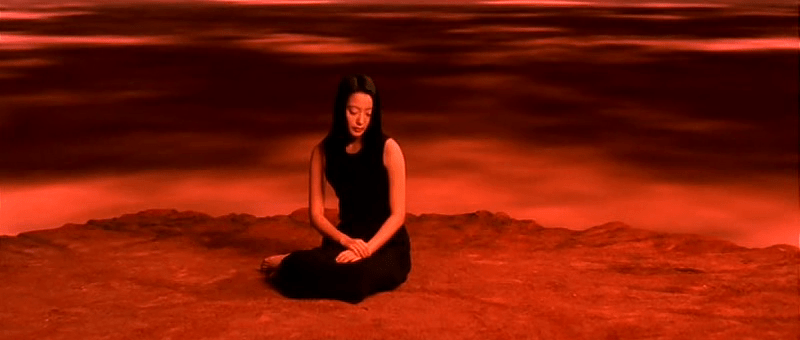
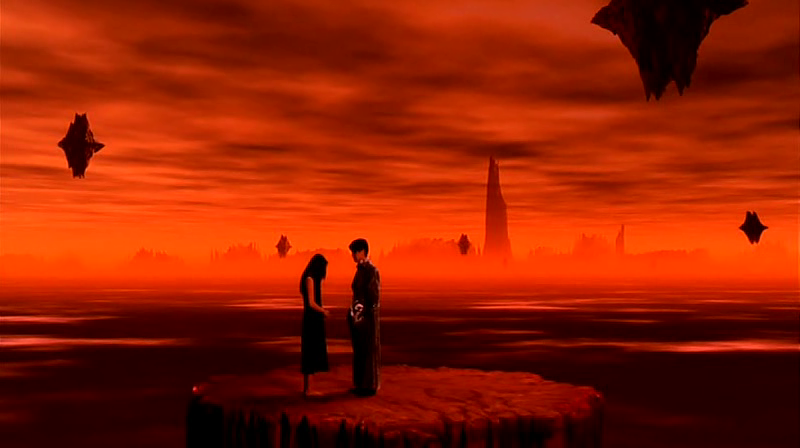
Ghost in Love (자귀모, Lee Kwang-hoon, 1999)

Caught in limbo, a young woman finds herself torn between the desire for revenge and letting go in Lee Kwang-hoon’s supernatural drama, Ghost in Love (자귀모, Jagwimo). Is love really what Chae-byul (Kim Hee-sun) was in, or is it more the sense of humiliation that’s she’s carried into the afterlife while obsessing over her cheating ex-boyfriend who was two-timing her with the boss’ daughter? Her colleague Kantorates (Lee Sung-jae), by contrast, had a love that was purer and reminds her that though it’s painful, if she really loved him, she’d be rooting for her ex’s future happiness rather than plotting how to mess up his life. 

Then again, the Korean title is “Suicide Ghost Club” and refers to the group into which Chae-byul is press-ganged after two of its grim reaper agents help her on her way having overheard her say she wanted to die because of all the romantic drama in her life. This literal purgatorial space located between heaven and hell is run like an exploitative company/cult in which the only metric of success is claiming more members. Chae-byul is warned that she doesn’t really have any choice but to join them, because otherwise she’ll become a vengeful spirit and lose all her memories, though she’s drawn to a mysterious presence known as Pale Face who does indeed become a terrifying spirit of vengeance, taking revenge primarily on the men who gang raped her while her fiancé, who later dumped her, looked on helplessly.

There is a kind of misogyny that’s most obvious in the afterlife but exists in the real world too. The film opens with a woman about to take her own life because of persistent fat shaming. She’s fat shamed by the grim reapers too and on into the afterlife, though in ghost form it’s revealed that she could be skinny if she wanted but is happiest in herself like this. Meanwhile, the grim reappears make other suggestive comments, leering over Chae-byul and remarking that a girl should have nice hips. Pale Face took her own life because of the trauma of her rape, the stigma of being a rape victim, and the betrayal of her fiancé who she says broke up with her because he thought that she was tainted. Even in the afterlife, she’s constantly washing in an attempt to make herself clean which is why she’s become so pale. 

Despite being told primarily from Chae-byul’s perspective, the film more or less normalises her boyfriend’s sexist views and behaviour in which he sees nothing really wrong with two-timing each of the women. Chae-byul tries to confront him, but he tells her Hyun-ju (Kim Si-won) was only visiting “to check on her stock transactions,” and shifts the blame onto Chae-byul for being paranoid and unreasonable. He says he liked her because she was “nice and comfortable,” but now she’s changed, so if she’s going to carry on “nagging” him like this, he may as well break up with her. HIs domineering attitude and characterisation of Chae-byul as a crazy girlfriend have the desired effect of causing her to back down and apologise to him. He may be a bit pathetic and materialistic in dating the boss’ daughter solely for advancement claiming it was his only chance to get on, but his behaviour isn’t really regarded as being particularly negative while Chae-byul’s desire for vengeance is, belittled in part because it involves disrupting not only his bright future but pointlessly harming Hyun-ju too.

Then again, perhaps these attitudes are intrinsic to the latent authoritarianism of the afterlife which is governed by the mysterious “messengers” who punish the transgressions of wandering ghosts. One grumpily rants about now having to work for a living, unlike in the old days in which some people would even try to bribe them for a longer life which they don’t do anymore in an allusion to Korea’s recent democratisation. The Messengers From Hades have a serious whiff of the KCIA mercilessly pursuing those who threaten to destabilise the system and then “disappearing” them. Nevertheless, Chae-byul eventually begins to come around to Kantorates point of view while quietly falling for him even as he struggles to move on from his own lost love. He knows he can’t be with her any more, but needs to find a way to tell her to move on so that he can do the same. A strange twist of fate gives them another chance at life and at love to live without wanting to die and try to find happiness even in a world of financial anxiety where consumerist desire has replaced spiritual fulfilment.

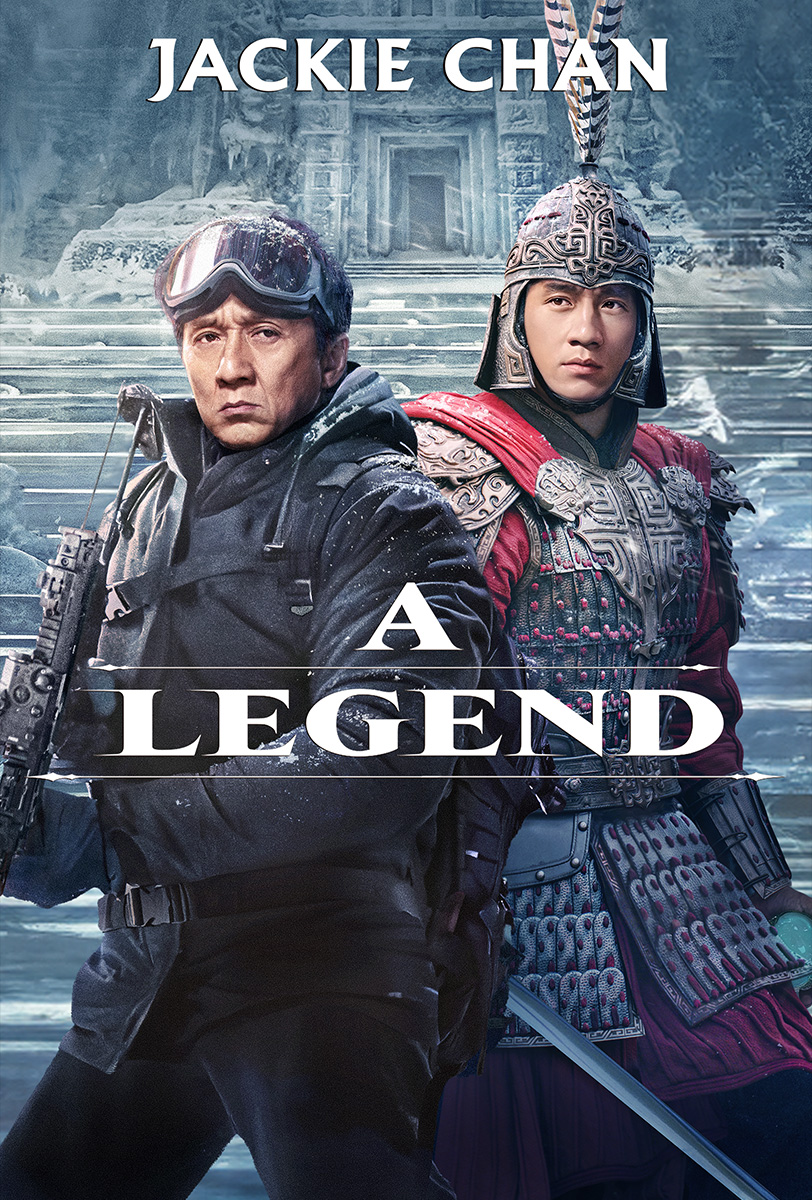
A Legend (传说, Stanley Tong, 2024)

The funny thing about the strangely generic title of Stanley Tong’s latest Jackie Chan vehicle A Legend (传说, chuánshuō) is that it’s at least partly in reference to its now ageing star rather than the tragic love story at the film’s centre which at least tries to echo the epic romances of historical fiction. That might in part explain the rather dubious decision to use AI de-aging technology to cast Chan as the tragic lover in addition to his role as a veteran archeologist researching the gravesite of a Han general’s horse. 

While de-aging Chan robs an age-appropriate actor of the opportunity, it’s equally true that it adds another note of uncanniness to the historical scenes contributing to their rather lifeless quality and otherwise becoming a frustrating distraction given that more often than not the actor’s face simply appears odd and doesn’t particularly look like a young Chan anyway any more than casting a younger actor with a physical resemblance might have done. In any case, despite the frequent discussions of history among Chan’s team, the historical scenes have a fantastical quality that’s much more like contemporary video games than classic wuxia. This may be deliberate given that a new addition to Professor Fang’s team is a video game developer who wants to create a game set in this era and is keen to get Fang on board as a consultant, though the aesthetic mostly detracts from the setting in the jarring use of CGI. Heroine Mengyun (Gülnezer Bextiyar) performs what is intended to be an impressive Hun sword dance, but as the sword is CGI it has no sense of skill or danger. It aligns clumsily with her physical movements like that in a video game cutscene and has a disturbingly weightless quality. The same phenomenon also mars the film’s action scenes which sometimes have an odd quality as if CGI has also been used to impose an actor’s face on that of a stunt double or somehow alter their movements. 

Aside from that, there is some nice cinematography that captures the majesty of the Chinese landscape though even this is sometimes drowned out by the syrupy score which is again quite reminiscent of a video game. Supposedly a spiritual sequel to The Myth and Kung Fu Yoga, the central conceit of the film is that through a jade pendant found in the grave, Fang and his assistants become part of a collective dream which is a flashback to the distant past while it later transpires that they’re being manipulated by a malevolent force in the present who wants to rob China of its historical treasures by finding a secret sanctuary built by the Huns to store the gold statues they stole from the Hans to use as objects of worship. Accordingly, there’s some pointed commentary about how it’s illegal to steal or traffic historical artefacts which should be protected as symbols of China’s essential culture. It’s no coincidence that the villains have Western accents and begin speaking to each other in English as they wilfully blow up a newly discovered historical site.

The modern scenes do, however, have an awkward kind of comedy going on in the form of in jokes between Fang’s team such as the non-love story between assistants Xinran (Xiao Ran Peng) and the clueless Wang Jing (Lay Zhang Yixing) who completely misses all of her hints and seems to be unaware of the subtext of phrases such as “come in for coffee” or that “incredibly expensive bracelet would really suit me.” Chan also gets rescued from drowning by a family inexplicably ice fishing in this really remote place who take quite a long time to realise he’s not some kind of weird talking fish. Though Chan does get his own action sequence at the film’s conclusion, it’s fairly incongruous for a professor of archeology to possess these kinds of skills which are otherwise out of keeping with the fatherly, professorial character Chan plays up to that point even if there is a distinct hint of Indiana Jones in the instance that all of this should be a museum. The little boy who found the pendant even gets a pat on the head for reporting it to the authorities rather than trying to sell it or keep it for himself. Nevertheless, it speaks of something that the digressions into historical legend are often more interesting than the retelling of the legend itself which never really takes flight despite the flying arrows and charging horses of world in which the heroes can only dream of the supposedly peaceful and harmonious society that exists far in the future.


A Legend is released in the US on Digital, blu-ray, and DVD 21st January courtesy of Well Go USA.

Trailer (English subtitles)

Wanee & Junah (와니와 준하, Kim Yong-gyun, 2001)

What marks adulthood more than giving up on idealised first love? For the heroine of Wanee & Junah (와니와 준하) the time has come to grow up but the choice she faces is more complicated than that between the emotional safety of an unrealisable attachment and the risk of real connection because her love comes bundled with guilt tied to its potential inappropriateness and a traumatic loss which was its result. Yet Kim’s film, gloriously forgiving and open hearted, is less about the breaking of a taboo than it is an acceptance that choosing to move on is not a betrayal of romantic idealism but a very necessary path towards maturity.

26-year-old animator Wanee (Kim Hee-sun) has been in a relationship with 27-year-old aspiring screenwriter Junah (Joo Jin-mo) for the past year but though the pair live together and are happy enough, something seems to be missing. A phone call from Wanee’s mother begins to poke at what that might be when she reveals that Wanee’s step-brother, Young-min (Cho Seung-woo), is about to return (temporarily) from an extended stay in Europe where he has been studying abroad.

The news of Young-min’s possible return comes as something of a shock to Wanee, who perhaps feels she has betrayed him by beginning a relationship with Junah. As inappropriate as some may feel it to be, Wanee remains unable to let go of her love for her step-brother who returned her feelings and asked her to run away with him only to leave alone. Confessing her feelings to a third party, however, turned out to have terrible consequences which have surely made their love an impossibility no matter what barriers may have already been in place against it.

Meanwhile, the past is further resurrected by the return of Wanee’s high school best friend, So-yang (Choi Kang-hee), who is also still harbouring feelings for the absent Young-min. As teens, the three were always together and happy in each other’s company, seemingly not allowing possible romantic drama to ruin their easy connection though So-yang seems to have known that Young-min had someone else in his heart even if she doesn’t quite want to spell it out. She tries to warn Junah not to get too attached, that he clearly loves Wanee much more than she loves him and that Wanee may not find that an attractive quality. Wanee, indeed, does not – snapping at Junah when he buys a TV without discussing it with her not only for the usual reasons that he’s spent a lot of money on something frivolous rather than something he actually needs for his work, but because she thinks he probably bought it “for” her as a kind of comfort.

Junah, himself a little lost and lingering at a crossroads, “wavering between love and separation” like the hero of his “uncommercial” screenplay, seems to make these kinds of thoughtful gestures often, later reprogramming the TV to come on in time for Wanee to come home so that it won’t be dark and scary if there’s no one there. Wanee may originally find his solicitous attention claustrophobic, but eventually begins to see it for what it is while dwelling on the continued absence of Young-min. So-yang’s arrival completes the triangular symmetry of both relationships, signalling the distances travelled and not from their carefree youth.

While So-yang claims to have hit a period of insecurity in her chosen career as a photographer, Junah vacillates in defending his artistic integrity and Wanee repeatedly refuses a promotion, claiming to be just fine where she is. There is something about Wanee which is always waiting, arrested in that youthful summer longing for Young-min’s return. If she wants to move on, she’ll have to make a choice. Kim’s vistas are however broad and forgiving, he doesn’t condemn Wanee for an attachment which may be confused or misplaced and which others would brand inappropriate, only for her failure to embrace present love rather than past longing. Meanwhile he shows us other instances of successful barrier crossing love aside from the still unusual co-habitation of Wanee and Junah that sees So-yang brand her friend as “brave” in Wanee’s boss and his policeman boyfriend, and the easy camaraderie of the office where sign language is a fully integrated part of everyday life. A beautifully mature romance and an ode to letting go of old love, Wanee & Junah is a surprisingly affecting slow burn coming-of-age story in which two lost youngsters find themselves in finding each other in a mutual process of self actualisation.


Singapore release trailer (English/Chinese subtitles)