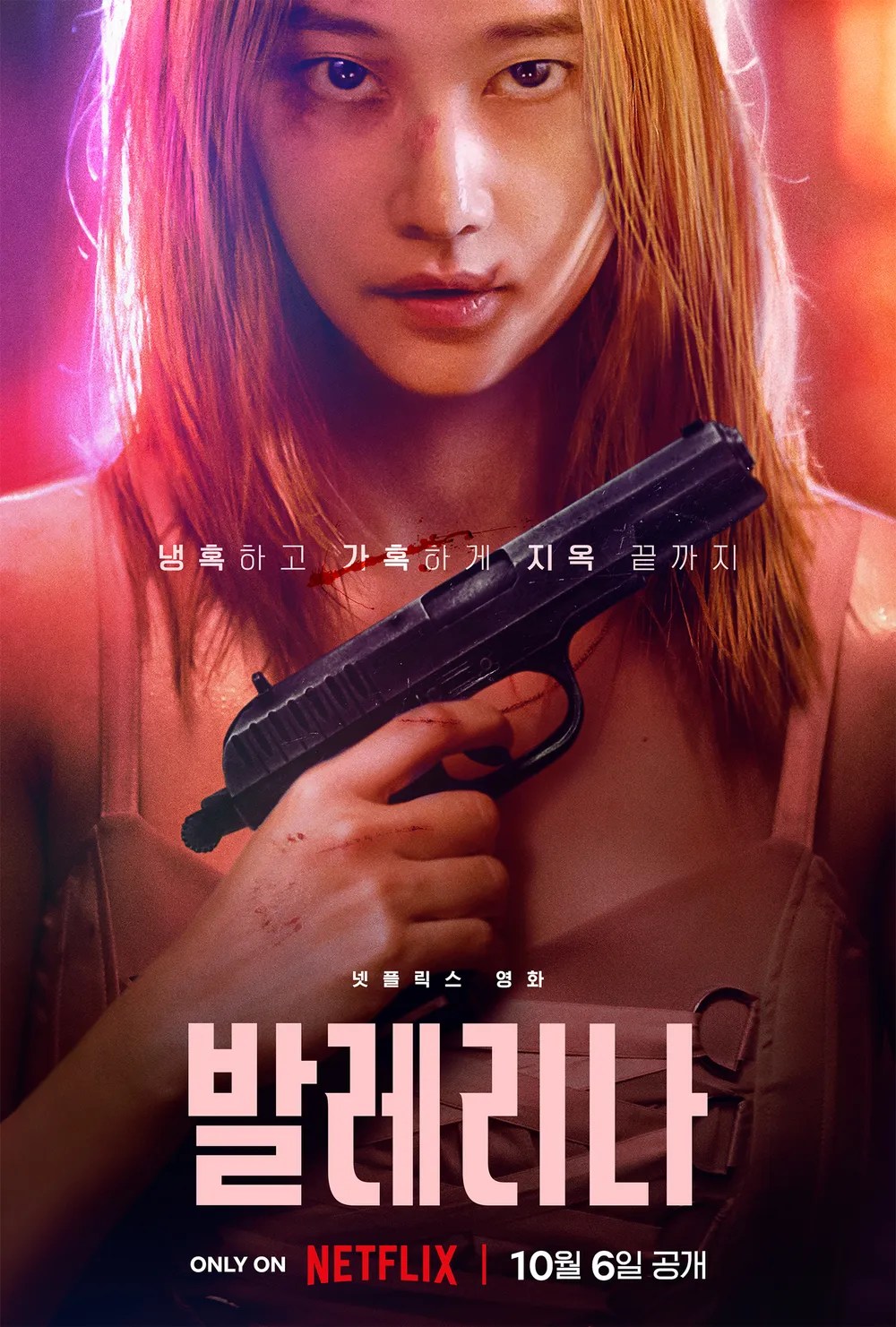
Ballerina (발레리나, Lee Chung-hyun, 2023)

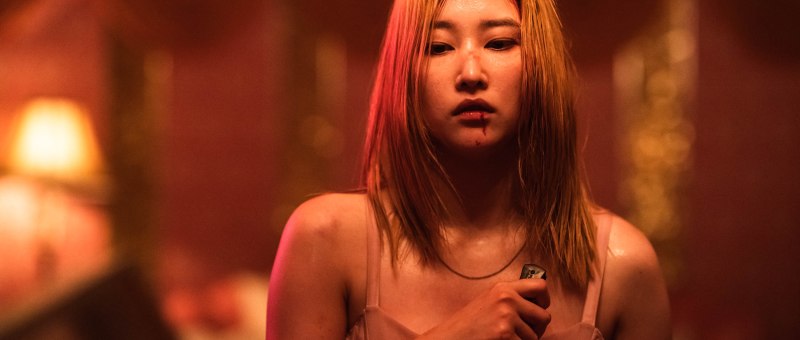
“You’ve blown things way out of proportion,” according to a man who still doesn’t think he’s done anything to deserve dying for. But as his boss told him, though they may exploit women, sell drugs, and kill people, they have rules. Lee Chung-hyun’s pulpy action thriller Ballerina (발레리나) sees a former bodyguard go after the gangster who drugged and raped her friend with the consequence that she later took her own life.

In recent years there have been a series of real life scandals involving women being drugged in nightclubs and sexually assaulted with videos either uploaded to the internet or used as leverage for blackmail often to force women to participate in sex work. Ballerina Min-hee (Park Yu-rim), seemingly the only friend of bodyguard Ok-ju (Jeon Jong-seo), was raped by drug dealer Choi (Kim Ji-hoon) and thereafter quite literally robbed of the ability to dance. Preoccupied with her trauma, she missteps and injures herself ruining her dance career and leaving her with nothing. There is something quite poignant in the fact Choi sells the drugs in the small, fish-shaped bottles that usually house soy sauce in pre-packed sushi given that Min-hee later says that she wants to come back as a fish in her next life and live in the ultimate freedom of the sea. Dance to her seemed to be a means of finding a similar kind of free-floating freedom, but the trauma of Choi’s assault has taken that from her.

Meanwhile, the loss of Min-hee has robbed Ok-ju of something similar. On first re-connecting with her former high school friend, Ok-ju says she worked as some kind of corporate bodyguard but the organisation is clearly larger than that and involved with some additionally shady stuff that suggests her job may actually have involved some sort of spy and assassin work. In any case, it had left her feeling empty as if she were slowly dying inside. Only on meeting Min-hee does she finally start to feel alive again and has apparently left the organisation she was working for in order to live a more fulfilling life though she may not actually have achieved that just yet. There is nothing really to suggest there is anything more between the two women than friendship, though the intensity of Ok-ju’s feelings suggests there might have been.

Even so, there’s more to Ok-ju’s mission than simple revenge as she finds herself taking down the entire organisation in order to make her way towards Choi. She’s aided by another young woman dressed as a high school student (Shin Se-hwi) who looks to her for salvation, explaining that she has a plan, she’s just been waiting for someone like Ok-ju to show up and help her while the former handler Ok-ju turns to in search of support is also a woman making her mission one of female solidarity against ingrained societal misogyny. “You thought we were easy prey,” Ok-ju challenges Choi making it clear that he made a huge mistake though he continues to taunt her about Min-hee and deflect his responsibility insisting that he hasn’t done anything to warrant this kind of treatment because the abuse and trafficking of women is not something he regards as a big deal.

Ok-ju and the girl obviously feel differently. There’s something very satisfying about the way Ok-ju methodically cuts through a host of bad guys without granting them any kind of authority over her. The action sequences are often urgent and frenetic while showcasing Ok-ju’s skills and the lack of them in the male henchmen, but there’s also a fair bit of humour such as her using tins of pineapple to block knife attacks in the convenience store opener. The film indeed has its share of quirkiness such as the geriatric couple who arrive to supply Ok-ju with weapons but mainly have buckets full of revolvers that look like something out of the wild west before grabbing a flamethrower from the back, while the aesthetic also has a stylish retro feel with its purple and yellow colour palette. Pulpy in the extreme, the film’s stripped-back quality provides little background information and keeps dialogue to a minimum but more than makes up for it in its visual language and often beautiful cinematography.


Trailer (English subtitles)
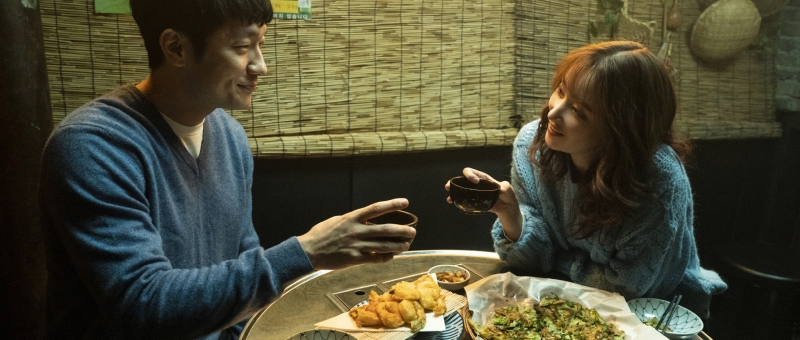
Nothing Serious (연애 빠진 로맨스, Jeong Ga-young, 2021)

Through her first three features in which she also played the lead, Jeong Ga-young had established herself as a provocative indie voice casting herself as an often unsympathetic if transgressively frank heroine contending with the vagaries of the modern society. Nothing Serious (연애 빠진 로맨스, Yeonae Bbajin Romance), by contrast, marks her debut as a commercial film director and perhaps softens some of her harsher edges but nevertheless maintains her characteristic saltiness and often witty dialogue in what is otherwise closer to Nora Ephron than Hong Sang-soo. 

Though played by Jeon Jong-seo rather than the director herself, 29-year-old Ja-young is a classic Jeong heroine transgressively frank in terms of her sexuality and finding herself in something of a tailspin as she approaches her 30th birthday as a single young woman drowning in debt with neither career nor relationship success to boast of. Meanwhile across town nerdy magazine staff writer Woo-ri (Son Suk-ku) finds himself having to write almost all of the magazine himself in part he suspects as punishment for having helped a friend leave to start up their own online publication. His particular problem is that his boss has asked him to take over his friend’s sex column which is really not his thing especially as he’s in an on again off again non-relationship with colleague Yeon-hee (Lim Sun-woo) who has just informed him she’s getting engaged to her old boyfriend. 

Inevitably the pair end up meeting through dating app Love Bridge to begin with just for a no strings New Year one night stand only to inconveniently realise they quite like each. Even so, their personal issues continue to overshadow the relationship, those being Ja-young’s hurt and anxiety on hearing that an old boyfriend who treated her badly and broke her heart is getting married, and the fact Woori signed up to Love Bridge mainly to find inspiration for his column which becomes an unexpected hit with readers who prefer the slow-burn tease of their romance to the X-rated content of Woo-ri’s predecessor. 

While not really “dating” the couple continue to share their relationship woes with each other, Ja-young continually fed up with her attempts to meet “normal” men who don’t invite their mother on dates, turn out to be married, or are just plain odd. Her previous boyfriend branded her an insanely jealous “alcoholic nymphomaniac” while she simply tells it like it is as a sexually liberated young woman who refuses to feel ashamed for feeling desire but is also in her own way lonely and looking for companionship as perhaps is Woo-ri while conflicted in his betrayal of her even if he is careful not to use any identifying details in his column. 

Along with their romantic woes, the pair also share a sense of hopelessness about the future, Woo-ri disappointed in himself for his lack of success as a serious writer and Ja-young staking her hopes on a career in podcasting after being forced to leave a job at a radio station because of the awkwardness between herself and a colleague she’d previously dated. Interviewing her grandmother and a series of other women she fears were denied the right to become the protagonist of their own lives, always someone’s wife or mother looking after children or in-laws, she wonders if she’s managed it herself or if things are really as different now as she had thought them to be while she continues to struggle drowning in debt and loneliness with very little hope for the future. 

Jeong’s prognosis is, however, a little more hopeful than in her previous films Ja-young and Woo-ri each flawed but basically good falling in love despite themselves only to see their connection undermined by its superficial inauthenticity. If nowhere near as caustic, she retains her sense of playfulness, even throwing in a reference to her first film Bitch on the Beach not to mention the tiny animated heads emerging from the pair’s phones, through sophisticated dialogue instantly capturing a sense of the everyday life of the average 20-something in the contemporary society longing to overcome their sense of cynicism and believe in a genuine romantic connection. Strangely charming in its breeziness, Jeong’s commercial debut loses none of her wit but gains a little in warmth as these crazy kids learn to put their anxieties aside and give love a chance even if it turns out to be nothing serious after all. 


Nothing Serious screens at UltraStar Cinemas Mission Valley, San Diego April 23 as part of this year’s SDAFF Spring Showcase.

International trailer (English subtitles)

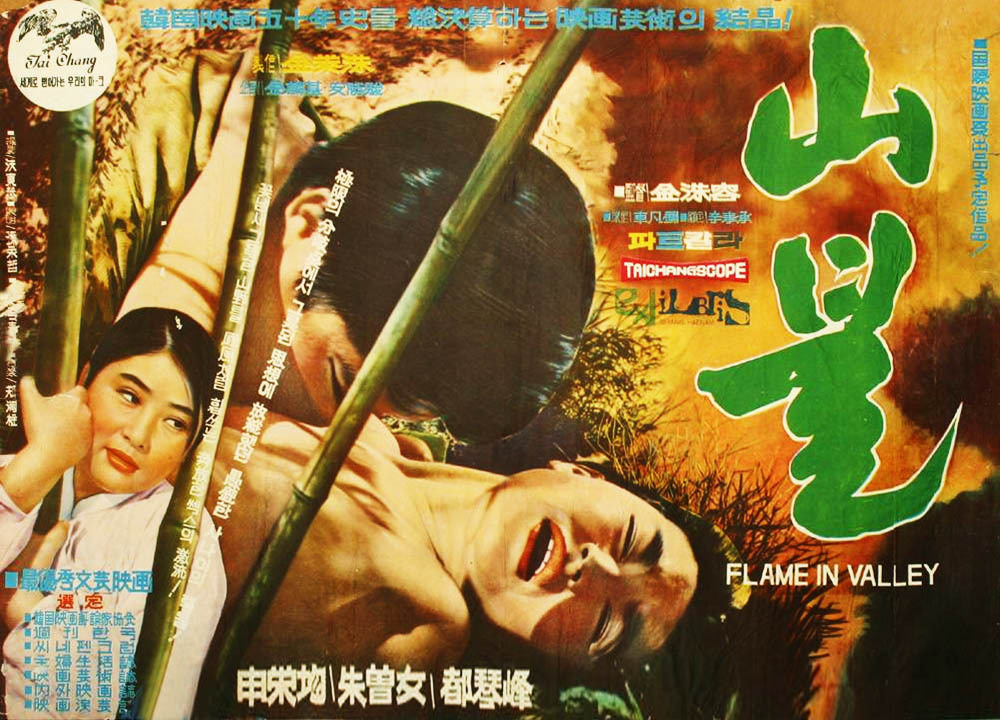
Burning Mountain (山불 / 산불, Kim Soo-yong, 1967)

Burning Mountain still 1In his 1965 film The Seashore Village, Kim Soo-yong had presented a broadly positive vision of a community of women who had learned to survive without men by supporting each other. 1967’s Burning Mountain (山불 / 산불, Sanbul, AKA Flame in the Valley) revisits a similar theme but with much less positivity. This time around, the women have been deprived of their men not because of nature’s cruelty, but because of man-made corruption. Set during the Korean War, Burning Mountain finds a collection of wounded, lonely women condemned by patriarchal social codes and hemmed in by political strife not of their making struggling against their baser instincts as they determine to survive in an often hostile environment.

A small village near Jirisan has lost all of its men. Pressed by communist guerrillas for food, the lone women are hungry and afraid. Consequently, they are often at each other’s throats and united only in a shared futility of waiting for men they are almost certain will never return, either because the war has taken them or they have taken the opportunity to seek a better kind of life. The drama begins when Jum-rye (Ju Jeung-ryu) discovers a communist deserter, Kyu-bok (Shin Young-kyun), hiding in the bamboo grove and is seduced by him, satisfying her long repressed desire and escaping her loneliness through a transient bond with a captive man.

Unlike the fishwives of The Seashore Village, the women of Burning Mountain are a more conservative bunch though they too are largely unafraid to talk plainly of their unanswered desire in the absence of men. Rather than embracing each other as the fishwives had, the mountain women allow their sexual frustrations to make them bitter and irritable, forever at each other’s throats and unable to let go of past grievances. They dwell on the possibility of escape, but do not believe it to be real. One of the younger, unmarried women, talks of going to the city to find work as a maid but is confronted by a world of checkpoints and soldiers which restricts both her movement and her freedom in ways she is ill-equipped to understand.

The village stands as a tiny enclave, caught between North and South, part of both and neither as if lost in some eternal netherland. The bamboo grove represents the innocent natural freedoms which have been taken from the villagers by civilisation and by later by the folly of men and war. It’s in the bamboo grove that Jum-rye first encounters Kyu-bok in a meeting which begins as rape but ends in seduction as Jum-rye surrenders herself to a rough stranger in desperation and loneliness. The affair continues and relations between herself and the other women improve until Sawol (Do Kum-bong), a woman with whom she’d been on bad terms because their absent husbands had been on different sides, discovers Kyu-bok’s existence and blackmails the pair into allowing her to make sexual use of him in order to ease her own frustration.

Roles interestingly reversed, Kyu-bok takes exception to his new status as a kept man, resenting the feeling that he is nothing more than a pet, breeding stock kept to scratch an itch. Nevertheless, he stays while the women, increasingly conflicted, urge him to turn himself in to the authorities sure that if he explains himself they will not treat him harshly. Already emasculated in having been forced into the mountains against his will, Kyu-bok remains impotent in all ways other than the sexual, pleading with Jum-rye that she let him stay in the bamboo grove “until the world gets better”.

Sadly, the world shows little sign of doing that, though thanks to their shared transgression a strange kind of camaraderie arises between former enemies Jum-rye and Sawol, now disposed towards female solidarity having eased their own frustrations. They want to trap Kyu-bok and keep him for themselves, but at the same time they dwell on the idea of the unseen woman waiting somewhere for him just as they are waiting for their menfolk and know they cannot have him for long. Where the constant refrains of “we are all the same” had rung somewhat hollow, they ring true now in the two women’s commitment to a woman they don’t know who is, in some senses, their rival.

Yet, the liminal space of the bamboo grove cannot be allowed to stand in the increasingly straitened future. Already subversive in his frank depiction of female desire, Kim subtly undercuts the austerity of the times in making accidental villains of the South Korean army who arrive to burn the bamboo grove down to smoke out the guerrilla fighters, taking from these women the symbol of their freedom in the natural pleasure of the forest. The cowardly communist, while fulfilling the demands of the censors’ board, is both passive victim of his times and a representative of the frustrated masculinity which has caused them in the first place. The corruption of the war has come to the bamboo grove and set light to the last vestiges of hope in taking from these already impoverished women their very source of life. A sorry tale of despair and futility, Burning Mountain spins a tale of weak men and resilient women whose solidarity is bought through a mutual satisfaction cruelly ended by an austere and unforgiving regime.


Burning Mountain is available to stream online via the Korean Film Archive’s YouTube Channel.

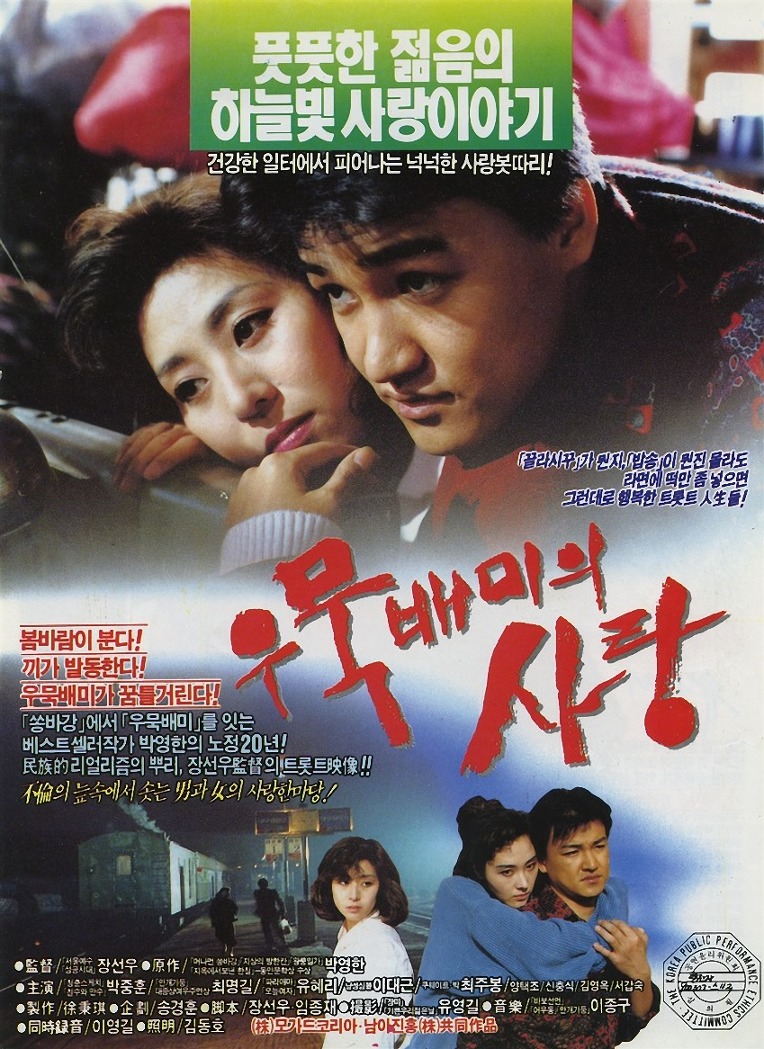
Lovers of Woomuk-Baemi (우묵배미의 사랑, Jang Sun-woo, 1990)

The Lovers of Woomook-baemi posterJang Sun-woo, a former political activist and underground filmmaker, is best remembered for formal experimentation and pointed social commentary, but his third feature The Lovers of Woomook-Baemi (우묵배미의 사랑, Umukbaemi Eui Sarang), stands out in his filmography in its fiercely naturalistic portrayal of working class life on the margins of a society in flux. Based on a novel by Park Yeong-han, The Lovers of Woomook-baemi, is a classic melodrama with infidelity at its core but it’s also a story of futility, the destructive effects of patriarchal social codes and toxic masculinity, and the frustrated promises of a new era for those excluded from its various benefits.

Jang begins his tale in the middle as Bae Il-do (Park Joong-hoon), a frustrated husband, returns home late to a troubled “wife” (Yoo Hye-ri) who promptly kicks him out again. Complaining furiously, Il-do dreams of another woman, Gong-ryae (Choi Myung-gil), with whom he had a brief affair, idly thinking that he might have been happy if he hadn’t got his current partner pregnant and got himself stuck with her for life even if they aren’t technically “married” in the legal sense.

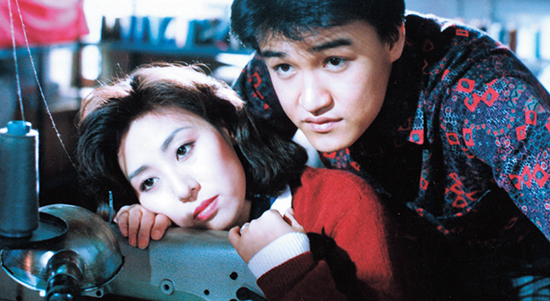
Moving backwards, we see Il-do, having failed in Seoul, returning to his home village with his common-law wife Sae-daek and infant child after an offer of work in a small seamstressing firm. The only man among a room full of mostly elderly women, Il-do is something of a novelty but is also taken by the woman on the machine next to him, Gong-ryae, who he later learns is also unhappily married and intensely lonely in her small-town existence. After some initial indecision, the pair embark on an affair, (still illegal at the time of the film’s release) but their prospects for future happiness seem slim given the restrictive quality of their lives.

The world that Jang depicts, for all its naturalistic flair, is intensely misogynistic. Il-do’s early recollections of Gong-ryae revolve around her bad marriage to an impotent man (Lee Dae-Geun) who mercilessly beats her. Indeed, we later see Gong-ryae turning up for work after suspicion has arisen about her relationship with Il-do with a black eye and bruises on her face while the other women giggle over the obviously awkward gossip. Domestic violence is, however, just a part of life in the village and the older women in particular view it as a sign of a healthy marriage. One woman even exclaims that she wishes she had a man to beat her, but thinks she’s unlikely to find anyone given her age and the fact that she already has numerous children.

Il-do, by contrast, proves somewhat popular among the ladies at the shop because of his relative lack of machismo. Like Gong-ryae, Il-do is also a victim of domestic violence. His wife beats, slaps, and attacks him verbally, later even dragging him home by the testicles along a very public walk of shame. He is not above violence or aggression, but as in much of Jang’s work, male violence is a sign of weakness rather than strength and each of Il-do’s violent episodes is more to do with defeat and repressed emotion than it is about strength or conquest. This also seems to be true for Gong-ryae’s husband whose violence and jealously is perhaps a reaction to his impotence, but when we later meet him we find a man much like Il-do. Chastened, Gong-ryae’s husband politely asks the man who bedded his wife if he knows where she is and if he sees her to please tell Gong-ryae that he’s sorry and wants her to come home.

As he does with Gong-ryae’s husband, Jang plays with our sympathies and allegiances, switching perspective to reveal to us that villains and victims are often one and the same. Sae-daek originally seems like our villain, a shrewish, henpecking “wife” who won’t let our hero go despite the evident toxicity of the pair’s non-marriage, but seen from her point of view we understand her plight. After running away from a violent home environment she winds up a bar hostess in the city where she builds up a spiky relationship with Il-do which goes south when he gets her pregnant. Despite this being the age of illegal adultery, it’s not so much a marriage certificate that binds a man and a woman together for good or ill but a child. As a neighbour puts it, a woman might leave her husband, but what sort of woman leaves a child? Sae-deok cannot care for her child alone and she cannot abandon it with Il-do and so she must keep him no matter how much personal suffering she must endure as the common law wife of a no good philandering ne’er do well.

Il-do likes to drift off into philosophical reveries in which he idly remarks on the futility of his existence, but in a very real sense he’s not wrong. He tried life in the city but it didn’t want him and he came home. Sae-deok, oddly enough, likes it in the village with its sense of community especially among the other put upon and oppressed women who attempt to support each other (whilst accidentally supporting the mechanisms which continue to oppress them), but there’s no pretending there’s anything more to life in Woomuk-Baemi than work and drink. Il-do knows this, as does Gong-ryae, and it’s their mutual sense of existential ennui which finally forces them together in an impossible attempt to rebel against the futility of their existence through transgressive sex and an attempt at emotional connection.

In the end, Il-do is dragged (by the short and curlies) back into the past, literally, as Sae-deok takes him back to his mother’s house to complain about the terrible way she’s been treated. Creating a scene outside, Sae-deok eventually manages to get through to her mother-in-law who had previously rejected her because of her lowly peasant background and history of sex work, enabling the two women to bond in their shared disappointment with Il-do who has now failed as a “man” on every possible level. Briefly reuniting with Gong-ryae in the greenhouse in which they used to meet, now reduced to ruins, Il-do declares that his love is like a mummy, wrapped so well it will endure for thousands of years without decay, but it’s already too late. Choices have been made, implicitly, which cannot be reversed. Jang leaves his protagonist where he started, frustrated and inert, suffering without hope in an oppressive environment which he knows, in his heart, he does not possess the courage to resist.


Available on region free blu-ray courtesy of the Korean Film Archive which also includes an audio commentary in English from film scholars Darcy Paquet and Marc Raymond, and Tony Rayns’ documentary The Jang Sun-woo Variations, as well as a 36 page bilingual booklet featuring essays by Rayns and film critic Lee Yeon-ho. Also available to stream via the Korean Film Archive’s YouTube Channel.