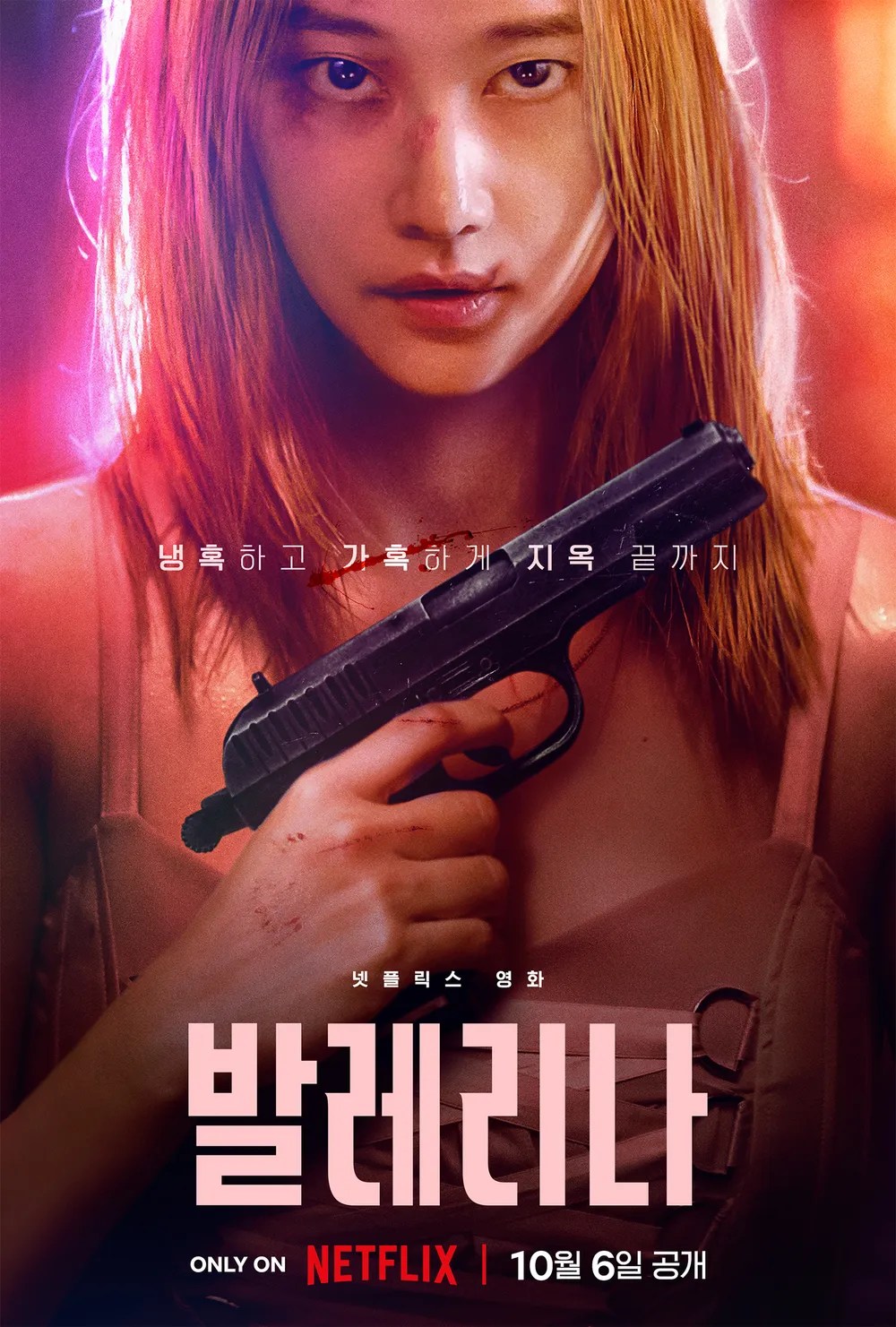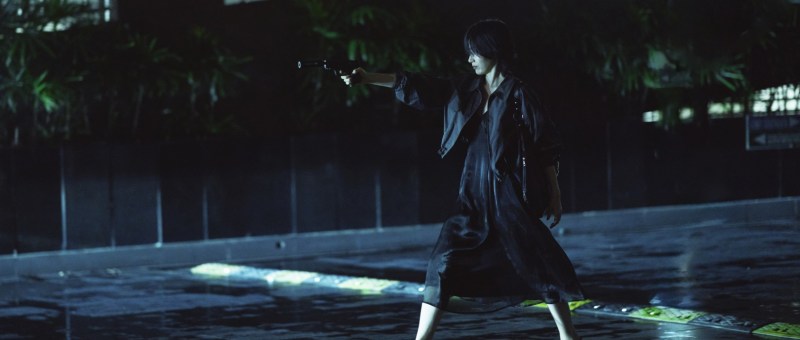
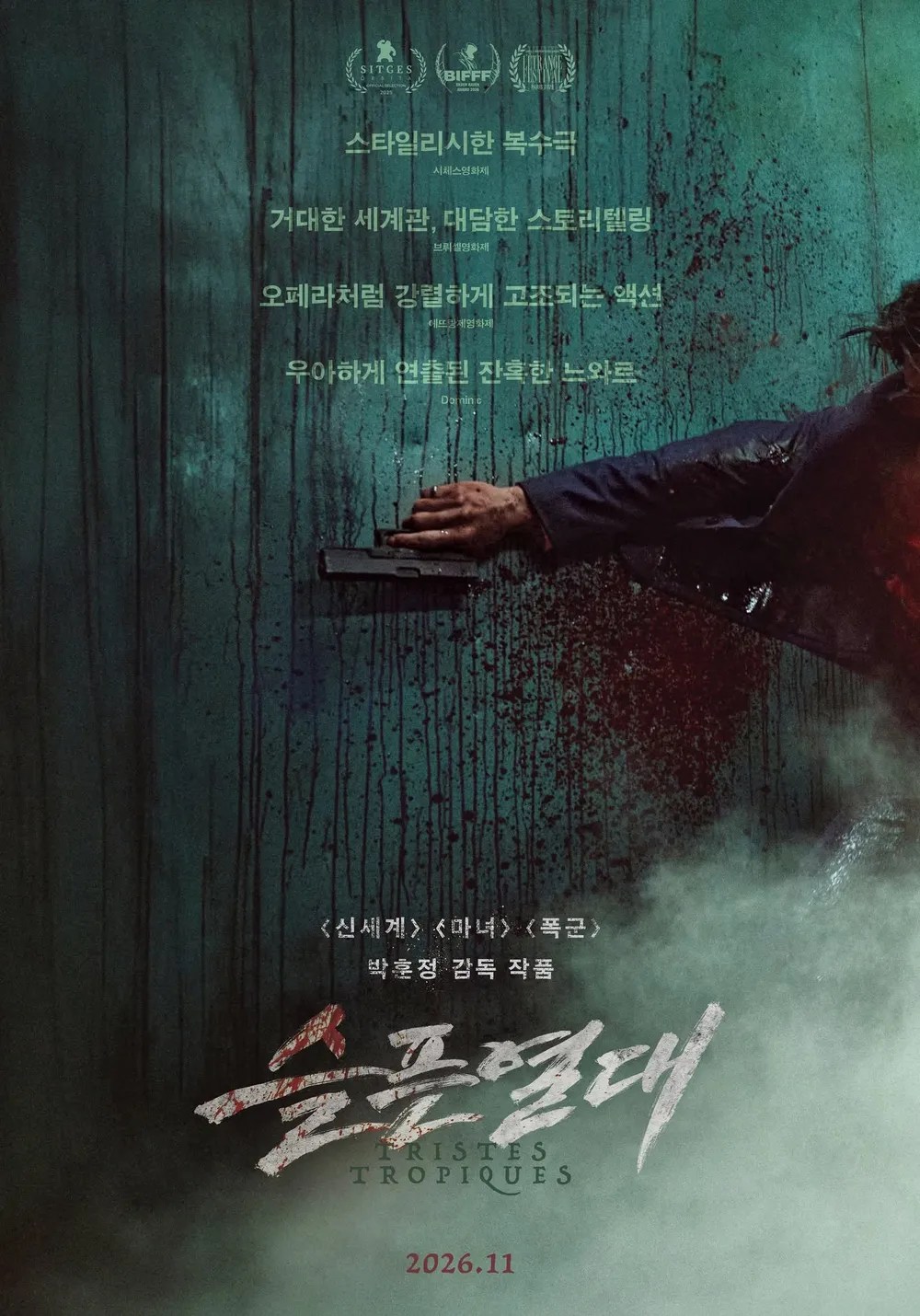
Tristes Tropiques (슬픈 열대, Park Hoon-jung, 2025)

Taking its name from the memoir by Claude Lévi-Strauss, Park Hoon-jung’s Tristes Tropiques (슬픈 열대, Seulpeun yeoldae) examines the legacy of violence as a collection of orphans raised as assassins attempt to deal with the apparent death of their “Master” (Kim Myung-min). Reminiscent of the work of Lee Myung-se and particularly Nowhere to Hide along with mid-90s Hong Kong action cinema, Park’s dark noir seems to suggest, on one level, that violence may be something that cannot be escaped, but if one is to escape it, salvation may lie in family.

Then again, when Master tells Roo (Lee Shin-young) he sent Jojo (Park Yu-rim) to kill him but she couldn’t do it, Master remarks that he knows Roo would have killed her without a second thought. Roo has been deaf and mute since birth and was adopted by Master after his birth mother sold him. Though he cannot speak, it’s his internal voice over that narrates much of the film. He describes himself as a bit slow and suggests that, in a way, he’s the baby of the group who is doted on by his brothers and sisters. This conception of him is somewhat bolstered by Master’s decision to give him a year’s holiday living normal life in a Thailand-esque South East Asian nation where he works in a coffeeshop and is quite excited about learning how to make the coffee.

But as weak as Park makes him seem with his propensity for tears, it’s clear that Roo also has as good or better skills as his brethren and is a killed a skilled fighter fully capable of defending himself. The trouble starts when Master is apparently murdered by someone unknown which creates a power vacuum in the local Chinatown that gang boss’ son Na is perfectly primed to exploit. Roo and siblings were raised according to the law of the jungle by a man whose life was warped and defined by violence, but this supposedly more enlightened, urban environment may in fact be far more violent than the straightforward nature of nature red in tooth an claw.

Nevertheless, despite attempts to erase their humanity, the children seem to have a least a degree of affection and fellow feeling. Master raised them to speak their native languages, speaking to them in English while they reply in a Japanese, Mandarin, Korean, or in Roo’s case Korean sign language. It seems that this was partly in order to foster a sense of division between them, but it doesn’t appear to have worked. Master too must have had some pity. Roo wondered why he looked sad when he named them Tristes Tropiques, only later realising that he knew he would sacrifice them someday.

In way, this is the tragedy of Master’s violence in that leaves him a perpetually lonely figure secretly longing for connection but unable to achieve it. They are all looking for a family, but are prevented from finding it because of the codes of violence. But there’s also a strange poignancy to the idea that instead of “dying” in a physical sense, you could instead kill everyone who ever knew you and be reborn. Identity and sense of existence are reflective, created through just these kinds of bonds, suggesting an underlying sense of humanity which cannot really be fully erased or sublimated.

The same could be said to be true of Roo who at critical moment rejects the idea of returning to his “holiday” and implicitly of living a “normal” life to embrace his familial legacy. Even so, he is also told that whatever choice he makes won’t matter, we all end up in the same place, anyway. Park pulls out all the stops with a series of elaborately choreographed and beautifully filmed action sequences which might, in some senses, undermine the central theme in presenting the beauty violence as Roo tries to fight his way to survival. Imbued with a deep sense of nihilism, the film nevertheless finds a kind of hope in the younger generation overcoming its programming while motivated more by human emotion such as love and brotherhood rather than hate or greed.


Tristes Tropiques screened as part of this year’s London Korean Film Festival.
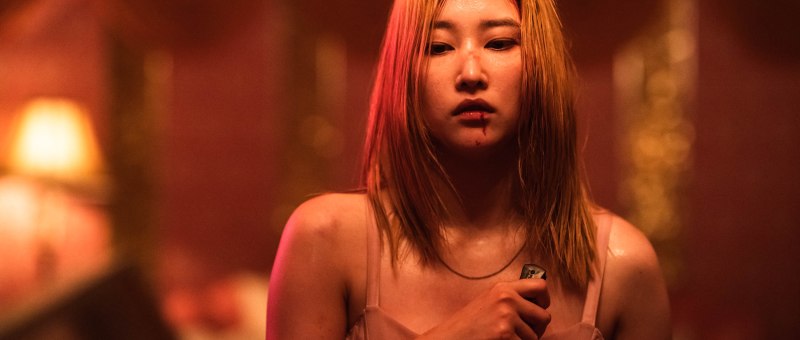
Ballerina (발레리나, Lee Chung-hyun, 2023)

“You’ve blown things way out of proportion,” according to a man who still doesn’t think he’s done anything to deserve dying for. But as his boss told him, though they may exploit women, sell drugs, and kill people, they have rules. Lee Chung-hyun’s pulpy action thriller Ballerina (발레리나) sees a former bodyguard go after the gangster who drugged and raped her friend with the consequence that she later took her own life.

In recent years there have been a series of real life scandals involving women being drugged in nightclubs and sexually assaulted with videos either uploaded to the internet or used as leverage for blackmail often to force women to participate in sex work. Ballerina Min-hee (Park Yu-rim), seemingly the only friend of bodyguard Ok-ju (Jeon Jong-seo), was raped by drug dealer Choi (Kim Ji-hoon) and thereafter quite literally robbed of the ability to dance. Preoccupied with her trauma, she missteps and injures herself ruining her dance career and leaving her with nothing. There is something quite poignant in the fact Choi sells the drugs in the small, fish-shaped bottles that usually house soy sauce in pre-packed sushi given that Min-hee later says that she wants to come back as a fish in her next life and live in the ultimate freedom of the sea. Dance to her seemed to be a means of finding a similar kind of free-floating freedom, but the trauma of Choi’s assault has taken that from her.

Meanwhile, the loss of Min-hee has robbed Ok-ju of something similar. On first re-connecting with her former high school friend, Ok-ju says she worked as some kind of corporate bodyguard but the organisation is clearly larger than that and involved with some additionally shady stuff that suggests her job may actually have involved some sort of spy and assassin work. In any case, it had left her feeling empty as if she were slowly dying inside. Only on meeting Min-hee does she finally start to feel alive again and has apparently left the organisation she was working for in order to live a more fulfilling life though she may not actually have achieved that just yet. There is nothing really to suggest there is anything more between the two women than friendship, though the intensity of Ok-ju’s feelings suggests there might have been.

Even so, there’s more to Ok-ju’s mission than simple revenge as she finds herself taking down the entire organisation in order to make her way towards Choi. She’s aided by another young woman dressed as a high school student (Shin Se-hwi) who looks to her for salvation, explaining that she has a plan, she’s just been waiting for someone like Ok-ju to show up and help her while the former handler Ok-ju turns to in search of support is also a woman making her mission one of female solidarity against ingrained societal misogyny. “You thought we were easy prey,” Ok-ju challenges Choi making it clear that he made a huge mistake though he continues to taunt her about Min-hee and deflect his responsibility insisting that he hasn’t done anything to warrant this kind of treatment because the abuse and trafficking of women is not something he regards as a big deal.

Ok-ju and the girl obviously feel differently. There’s something very satisfying about the way Ok-ju methodically cuts through a host of bad guys without granting them any kind of authority over her. The action sequences are often urgent and frenetic while showcasing Ok-ju’s skills and the lack of them in the male henchmen, but there’s also a fair bit of humour such as her using tins of pineapple to block knife attacks in the convenience store opener. The film indeed has its share of quirkiness such as the geriatric couple who arrive to supply Ok-ju with weapons but mainly have buckets full of revolvers that look like something out of the wild west before grabbing a flamethrower from the back, while the aesthetic also has a stylish retro feel with its purple and yellow colour palette. Pulpy in the extreme, the film’s stripped-back quality provides little background information and keeps dialogue to a minimum but more than makes up for it in its visual language and often beautiful cinematography.


Trailer (English subtitles)