Immersion (忌怪島/きかいじま, Takashi Shimizu, 2023)

Technological anxiety was at the heart of millennial J-horror, but perhaps the more things change the more they stay the same. Takashi Shimizu’s latest ghost story Immersion (忌怪島/きかいじま, Kikaijima) sees a grudge-bearing spirit cross over from the virtual world neatly suggesting we take our monsters with us into our simulacra and to that extent the brave new world is not so new at all. Then again, the hero thinks he desires a private world but paradoxically wants to share it and eventually discovers that what he craves is connection.

Tomohiko (Daigo Nishihata) has accepted a job as a programmer helping to build a new virtual world exactly replicating a remote island. He is greeted by his boss, Ide, in the digital space, but shortly after his arrival discovers that she died some time previously along side a man she may have been experimenting on in a project exploring brain syncronicity. When Tomohiko enters the virtual world he is confronted by strange and dangerous visions which suggest there’s a threatening bug in the system. Soon enough, the data breaks loose and somehow awakens in our world.

What no one knows is how a vengeful ghost got in the machine in the first place, though a shinto priestess later likens the new digital space to the “over there”, a perfect simulacrum of our world existing on another plane where spirits and their victims gather. Then again, it seems the problems are mainly on this side with an old man mocked by children and shunned by society because his mother suffered some kind of mental illness and was filled with a lust that was taboo at the time. The man’s mother is linked to the legend of Imajin, a slave raped by her master whose wife then took against her causing her to become a vengeful spirit who drove people out of their minds.

The purpose of the new world Tomohiko is creating isn’t clear, but it’s certainly very well resourced. The implication seems to be that the virtual is already haunting us and we can’t be sure of what we’re “really” experiencing and what we’ve been primed to experience. Tomohiko increases “the reality” of the virtual space by coding to it to activate “real” sense memories such as the smell of the sea or the feel of the sand. He can’t be sure if he’s the ghost in this world or the other while remaining aloof and diffident, unable to communicate effectively with his teammates. Tamaki, the estranged daughter of the dead man asks him if he doesn’t like people, to which he has no real answer though she replies that she doesn’t really like them either. What he realises is that doesn’t really want a world of solitude, but to be with others though it seems it might not matter whether in a “real” or virtual space.

But in contrast to all this modernity, the island is a traditional community with a strong interest in shamanistic lore and ritual. Tomohiko says he doesn’t really believe in any of that stuff, but is still prepared to go along with the shamaness’ advice in order confine the vengeful spirit to another world even if it means sacrificing the virtual space they are trying to build. Perhaps the message is that this kind of technological advance is dangerous and hubristic, unleashing forces we are ill-equipped to understand and would not be able to quell. As the shaman implies, you have to close the door from this side and not the other, which is a serious problem for the engineers who find themselves struggling to destroy the portal of a Torii gate in both spaces while the ghost continues to wreak watery vengeance.

Shimizu conjures an atmosphere of lurking dread in which digital ghosts haunt us in reflections of the ancient past even as our reality is destabilised by the overlay of the virtual. Tamaki reflects that the island is like a ghost town with few figures on the streets save themselves though they too sometimes appear like lingering spirits. What they discover may be a kind of refuge or escape, but perhaps not in the way we might expect while vengeful ghosts aren’t quite so easy to exorcise as they might once have been.


Immersion screened as part of this year’s London East Asia Film Festival.

Original trailer (no subtitles)
Yamabuki (やまぶき, Juichiro Yamasaki, 2022)

The lives of a series of dejected souls in a moribund quarry town intersect in unexpected ways in a poetical drama from Juichiro Yamasaki, Yamabuki (やまぶき). The film takes it name from a colourful mountain flower which as someone later comments grows in the shade where no one can see, much like the sullen teenage girl whose mother named her after it because as she says “sunflowers face the sun but you don’t have to”. A tale of finding a place to root oneself in a rocky landscape the film has an understandably melancholy atmosphere but nevertheless eventually finds hope in perseverance or as one of the heroes finally sighs, “ask and ye shall receive”.

“This is my family” former Korean equestrian Chang-su (Kang Yoon-soo) beams on visiting a local ranch where his girlfriend’s daughter Uzuki is learning to ride. Chang-su explains that he was forced to give up horse riding after his father’s business went bust, implying at least that he’s from a formerly wealthy family in Korea with whom he seems to have few emotional ties. We see him send money abroad which seems to be intended to pay off loan sharks, presumably his father’s debts unwisely incurred by his failing business and perhaps the reason why Chang-su has come to Japan to work a manual job in a quarry. Most of the other workers are also economic migrants, many of them from the same area and conversing with each other in their own shared language though Chang-su seems to be the only Korean. After receiving the news that he’s to be made a regular employee rather than a casual worker, he starts to think that his life is back on track allowing him to once again ride a horse. 

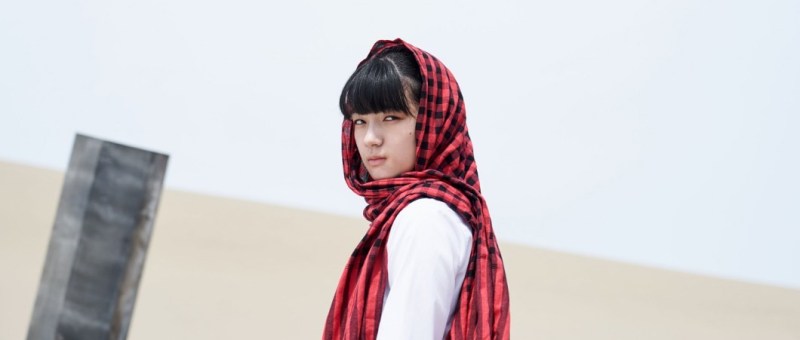
But his hopes are suddenly dashed when his car is hit by falling rocks dislodged by police detective Hayakawa (Yota Kawase) trying to uproot a yamabuki flower to take home with him while his teenage daughter, Yamabuki (Kirara Iori), rolls her eyes and storms off. Reeling from the death of her war reporter mother in a Middle Eastern combat zone, Yamabuki is at odds with her father and searching for her own identity. She has begun hanging out with a group of protestors who stand silently at the roadside with prominent signage though their protests seem to take on many forms with no particular focus. One moment it’s the consumption tax and the next American presence in Okinawa or racism in contemporary Japan. This last one is met with a counter protest by a man shouting at them to go back where they came from, echoing the kind of othering and displacement felt by Chang-su who is let go from the quarry after the accident.

Just as Chang-su tries to anchor himself with his new family, Hayakawa tries to remake his in the absence of his wife while carrying on a kind of relationship with a Chinese sex worker equally displaced by the modern society and looking for a place to belong. As she points out, her mother came to Japan because at that time it looked like the future, but like the quarry town it now seems like the past. Her mother returned to the economic powerhouse of Shenzhen and has apparently become wealthy, though her half-Japanese daughter struggles to find a place for herself. As Chang-su reveals, “yamabuki” was also the name given to gold coins offered as bribes in the feudal era, lamenting the money-oriented nature of the contemporary society just as Yamabuki herself concludes that she wants her life to mean something and to feel present in every second of her existence. Her father had objected to the protests, but eventually tells her that she should be preparing for her independence and learning to be accountable to herself for her actions. She must have the courage of her convictions, as he lays out in a scene shot in the manner of a political rally and echoing Soviet realist cinema, so she can’t regret it later even if she one day changes her mind.  

They are all, in their ways, like the yamabuki rooting themselves in rocky ground and growing in the shade each discovering something new that allows them to continue despite the continual disappointment of their lives. Shot in a grainy 4:3 16mm, the film emphasises the aura of impossibility that enshrouds the town as if it were somehow trapped in the past, but equally lends it a kind of elegiac quality peppered with the colourful yellow of the yamabuki flowers which suggest that it is possible to blossom even under the constant gloom of a continually uncertain existence.


Yamabuki screens at New York’s IFC Center on Feb. 10 & 11 as part of ACA Cinema Project’s New Films From Japan. Director Juichiro Yamasaki will be present at each screening for a Q&A.

Original trailer (English subtitles)

It’s a Summer Film! (サマーフィルムにのって, Soshi Matsumoto, 2020)

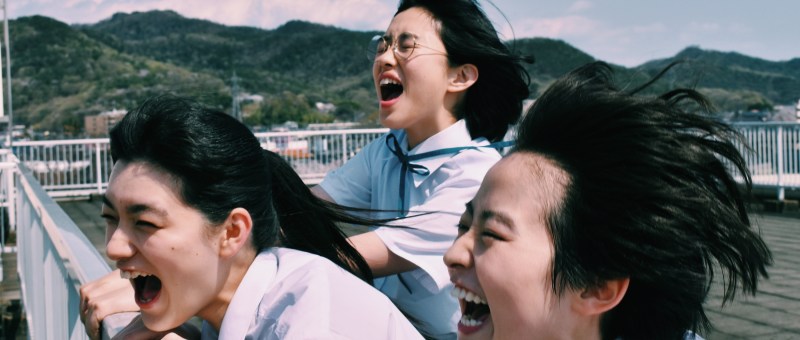
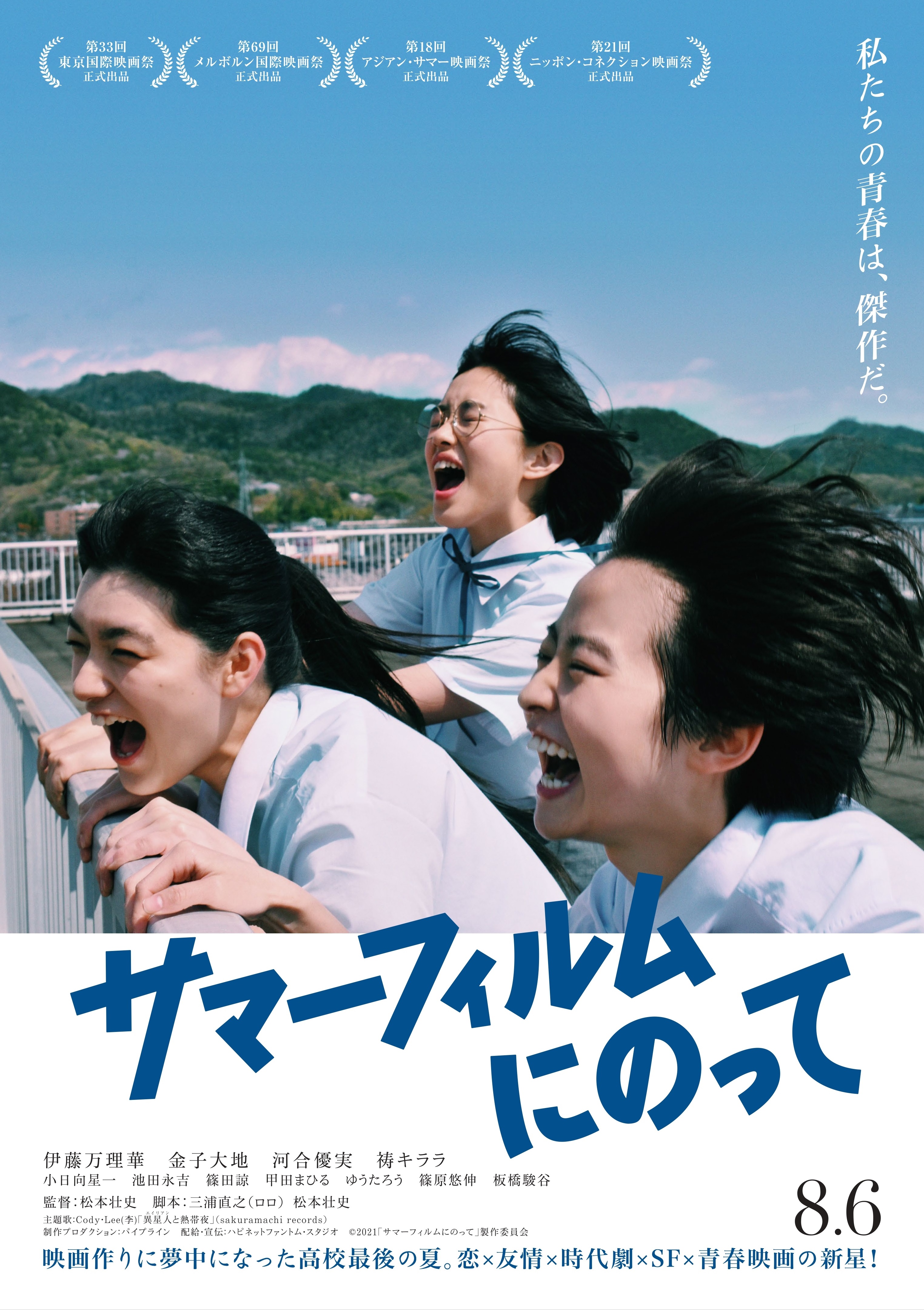
“Movies connect the present with the past through the big screen” according to the jidaigeki-obsessed heroine of Soshi Matsumoto’s charming sci-fi-inflected teen movie It’s a Summer Film! (サマーフィルムにのって, Summer Film ni Notte). True to its title, Matsumoto’s whimsical drama very much belongs to the grand tradition of high school summer movies as its youthful heroines contemplate eternity, romantic heartbreak, and artistic fulfilment while secretly plotting to best their vacuous rival by filming their very own teen samurai movie ready in time for the all-important school cultural festival. 

Aspiring director Barefoot (Marika Ito) is completely obsessed with classic samurai movies, arguing with her similarly devoted friends about who is hotter Shintaro Katsu or Raizo Ichikawa. She is a key member of the school movie making club, but intensely resentful of star player Karin (Mahiru Coda) who won the tender to make the film for this year’s cultural festival with a sappy teen romance which mostly seems to involve repeated scenes of the central couple loudly declaring their love for each other. Barefoot thinks a film should convey love without words and has written a script for a teen samurai movie in which adversaries become too emotionally invested in each other to engage in the expected final confrontation. All she’s lacking is a star and after spotting a handsome guy apparently as moved by a local rep screening as she is decides she’s found her man. What she doesn’t know is that Rintaro (Daichi Kaneko) is a secret time traveller from a future in which she has become a renowned master filmmaker but film itself sadly no longer exists. 

Being from the future and all explains Rintaro’s reluctance to star in the film, dropping accidental hints that he’s from another place as in his amusement that humans still staff removal companies and total mystification by the word “Netflix”. Yet he too is completely obsessed with classic jidaigeki from the heyday of the genre which had largely gone out of fashion by the early 1980s. As many point out, Barefoot’s hobby is slightly unusual, though she learned her love of chanbara from her grandma, receiving messages from the past she hoped to pass on to the future. Gathering most of the other rejected, outsider teens from a boy who looks about 40 to a pair of baseball nerds who can correctly guess the player from the sound of a ball hitting a glove and a bleach blond biker, she assembles a team to make her movie dreams come true as if to prove there’s something more out there than the, as she sees it, vacuous high school rom-coms favoured by the likes of Karin. 

Among the series of lessons she finally learns is that Karin need not be an adversary but could be a friend if only she look beyond her snootiness and resentment of the popular crowd even if Karin’s all pink, needlessly extravagant and egotistically branded crew shirts don’t do much to dispel Barefoot’s perception of her as entitled and self-obsessed. Another lesson she learns is that she’s not as disinterested in romance as she thought she was, though falling for Rintaro leaves her with a secondary dilemma realising that he’ll eventually have to return to his own times while also contemplating what the point of the future even is if they don’t have movies there. What she’s going to do with the rest of her life if the art of cinema is already obsolete? 

With some ironic help from Karin, what she realises is that even if something is destroyed it doesn’t disappear, films live on in the memories of those who saw them who can then take their memories with them into the future. Where her first draft had ended with an emotional anti-climax that saw her heroes too emotionally involved to engage in conflict, she now realises that samurai movies are love stories too and that “killing is a confession of love” in a slightly worrying though not altogether inaccurate take on the homoerotic subtext of the chanbara. A charmingly whimsical coming-of-age tale filled with meta touches from the constant references to classic jidaigeki to the heroine’s sci-fi-obsessed sidekick who seems to have an unrequited crush on her best friend idly reading The Girl Who Leapt Through Time, It’s a Summer Film! more than lives up to its name in its cheerful serenity as the teenage old souls defiantly learn to claim their own space while connecting with each other as they contemplate love and transience in the eternal art of cinema. 


It’s a Summer Film streamed as part of this year’s Nippon Connection.

Original trailer (English subtitles)