Heat Wave Island (かげろう, Kaneto Shindo, 1969)

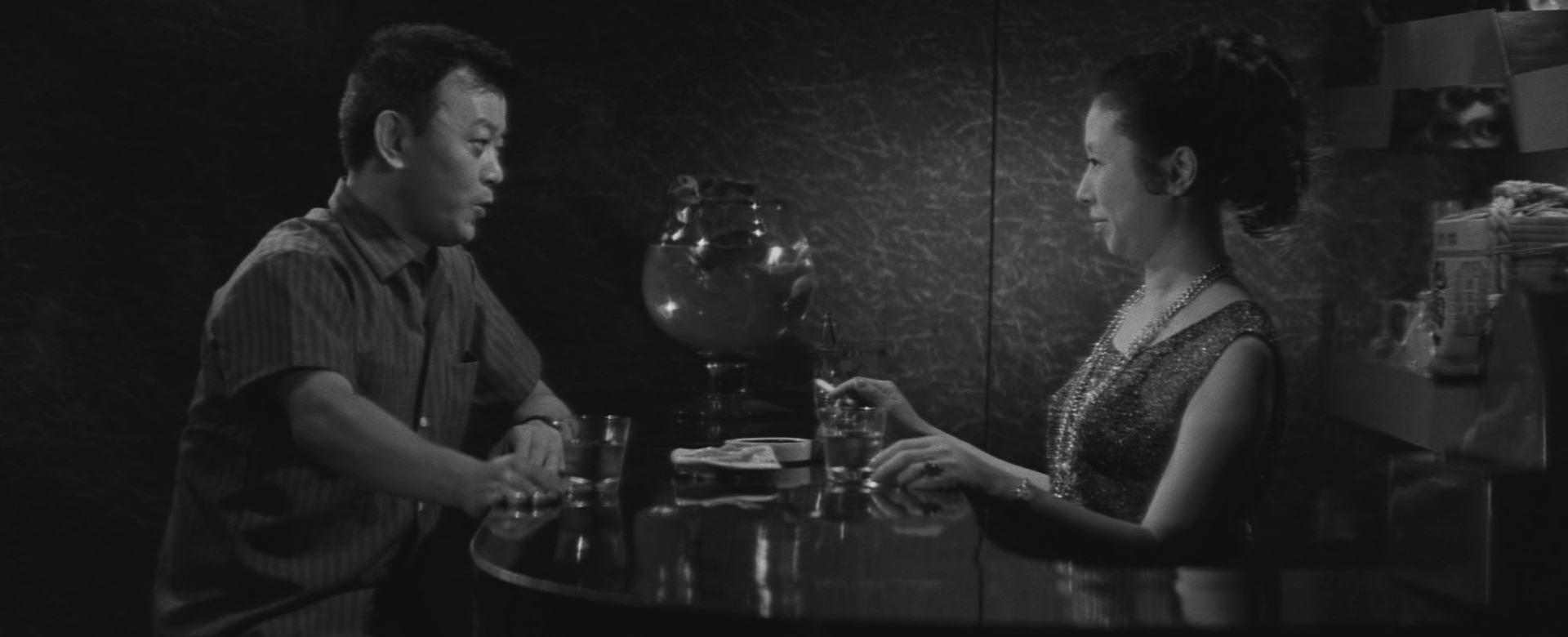
The death of a bar owner in Onomichi sparks a complex investigation into the condition of the islands surrounding the Seto Inland Sea in Kaneto Shindo’s darkly ironic crime drama, Heatwave Island (かげろう, Kagero). Produced by Kindai Eiga Kyokai, the independent production company founded by Shindo, Kozaburo Yoshimura, and the ubiquitous Taiji Tonoyama, the central thesis is that industrialisation has poisoned the waters surrounding the Japanese heartland, but also that the collection of weird islands had their share of darkness to begin with.

Indeed, having solved the crime, unusually chipper detective Oishi (Rokko Toura) states that it was the island that killed her. “Your traditions turned an island woman’s life to ruin,” he tells the very compromised village chief (Taiji Tonoyama) who refused to let a woman leave the island to seek medical treatment for her baby because of a taboo about setting sail on the night of a shipwreck. That’s not so much a supernatural fear or practical concern as much as a pact between islanders who have been killing shipwreck survivors and looting their boats. Nevertheless, the woman is eventually forced off the island when the men who killed her husband begin fighting over her body. The village chief tells her she has to go to preserve the “unity” of the island while her child, who survived but with brain damage, will be cared for by the other islanders.

Yet all the woman wants is to return to the island to live with her child after gaining the money to build a big house where everyone can see it. Some justification is given for the island’s cruelty in that it has essentially been starved out by post-war industrialisation. The fishing industry is dying, and the island terrain is only suited for growing wheat and potatoes, making farming unviable as a commercial enterprise. A man from another island says that as the salt fields were closed down factories arose in their place and leaked pollution into the surrounding seas, killing off all the fish. He is now bedridden due to industrial illness having worked on Poison Gas Island during the war. His wife now works in one of the “enemy” factories. “That’s how we survive,” he laments of the faustian pact between rural communities and large corporations. 

In any case, most of the young people have been forced into the cities in one way or another where they often lack the skills to find well-paying work and end up in crime and the nightlife industry. The late bar owner, Otoyo (Nobuko Otowa), was herself once from an island village, as was her bar girl Michiko (Toyama Masako). Both of them are dreaming of better lives while filled with a sense of futility. A young man who gave up on fishing to work in factories is injured in a workplace incident and is prevented from leaving hospital until he can pay his extortionate medical bills which the company evidently isn’t going to cover.

The irony is that Oishi is from a farming background too. Rich kids don’t become detectives, Otoyo points out. A poor man’s son commits a crime, and a poor man’s son will catch him, she adds signalling the ways in which the poor work against each other rather than their common enemies such as the exploitative corporations which have ruined the beautiful natural scenery of Japan’s islands along with their traditional communities. Then again, Oishi is a slightly compromised figure in other ways too. He probably shouldn’t be investigating this case given that he used to drink in Otoyo’s bar and seems to have a crush on her, which interferes with his ability to accept some of the less pleasant things they begin to find out about her past. He also has more than a fatherly interest in young Michiko and is unwilling to accept she could be involved with the crime having taken out a sizeable advance on her salary to care for her father who is also bedridden following a stroke.

The implication is that these murders are more like earthquakes, an inevitable result of friction between people caused by conflicting societal forces. Oishi concludes his investigation, but it only seems to result in a further fracture that severs the connection between the islands and the mainland, leaving another woman in a state of limbo waiting for someone who may or may not return. The convoluted, island-hopping mystery taking place under the blazing sun of a sticky summer has its degrees of absurdity, from the weirdness of these retreating cultures to the poignant presence of the dog, who alone seemed to want justice for Otoyo, who, whatever her other faults may have been, was always kind to him when others often weren’t.

The Long Darkness (忍ぶ川, Kei Kumai, 1972)

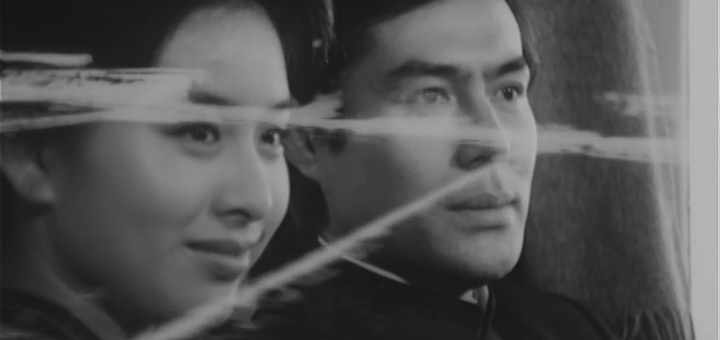
Golden age Japanese cinema is generally resistant to the idea of romance as salvation. There may be a romantic happy ending, lovers uniting despite the mounting odds, but their happiness is often overshadowed by the anxieties of the world in which they live. Adapted from the novel by Tetsuo Miura, Kei Kumai’s post-war romance The Long Darkness (忍ぶ川, Shinobugawa) meanwhile insists that it’s love that will save you in the end as its dejected, insecure heroes find the courage to go on living precisely because of the strength and validation they discover in loving and being loved.

The hero, Tetsuro (Go Kato), feels himself to be cursed, overcome with a sense of shame and anxiety because of the dark shadow that hangs over his once prosperous family. His oldest sister committed suicide for love on his sixth birthday, while another sister then took her own life some time later out of guilt for having contributed to her death. His oldest brother whom he describes as sensitive and eccentric disappeared in grief, while the next oldest took a job at a Tokyo lumber yard and supported him as a student but later disgraced the family by running off with money he’d fraudulently accumulated in the name of opening his own company. Tetsuro is convinced that there is something genetically wrong with the family line and is intensely anxious that it will one day consume him too. 

That might be why he’s unexpectedly bashful for a man of 27 in courting the pretty waitress of a local bar, Shino (Komaki Kurihara), whom he first met while celebrating the graduation of some other students after making a belated return to university. Shino too is carrying her own burdens which lead her to feel unworthy of happiness in that she was raised in the red light district and her family, evacuated to rural Tochigi during the war, is now impoverished and living in a shrine. The proprietress at her restaurant has pressured her into an engagement with a prosperous car salesman whom she doesn’t like but feels unable to refuse on the grounds that he will take care of her sick father. The car salesman tries to rape her so she’ll have to marry him which, as her father points out, does not speak well for his character or the prospect of a happy marriage. Her father is clear, he wants his daughter to be happy and in this age a woman’s happiness does largely depend on the man she marries. He tells her to find a man she loves more than life itself and marry him without a moment’s thought. 

The forces which divide them aren’t so much to do with class, politics, money, or custom but with internalised shame and the deeply held belief that they are “bad” people who do not deserve to be happy. “Can I go on living?” Tetsuro’s only remaining sister tearfully asks him, burdened both by her traumatic family history and by a visual impairment that further convinces her she cannot expect to be a part of regular society and has no prospect of a happy future. He almost turns away after noticing her crying but realises that’s what his absent siblings might have done and resolves to behave differently, reforging his his familial bonds with love and compassion in place of the gloominess and futility that had long overshadowed his family home. Just as Shino’s father had anointed Tetsuro a “good person” he could entrust his daughter to, Tetsuro’s sister and mother affirm that Shino too is “good” and her presence brings light and laughter back into their lives after years of lonely suffering. 

“We’ve spent our whole lives worrying about appearances” Tetsuro declares, “it’s time we stop”. Affirming that her new in-laws are also “all good people”, Shino too admits that she realises the “uselessness” of her old life “never saying what I want or don’t want, going along with everything”, liberated by the transcendent power of love that allows her to overcome her fear and insecurity to claim her own agency, the jingling bells of a farmer’s horse cart echoing from below as if in celebration. Shooting in a classic 4:3 monochrome with occasional intertitles and voiceover, Kumai emphasises the literary quality of the tale spanning the rundown lumberyards of post-war Tokyo to the frozen north of Tetsuro’s frosty home but finally argues for the freedom and possibility to be found in the contemporary era by making an active choice for happiness rather than submitting oneself to a fated misery out of misguided obedience to austere and oppressive social codes. “Everyone’s jealous of you” an old woman cackles catching sight of the newly-wed couple on the train to their new life, and you can well understand why. 


Original trailer (no subtitles)

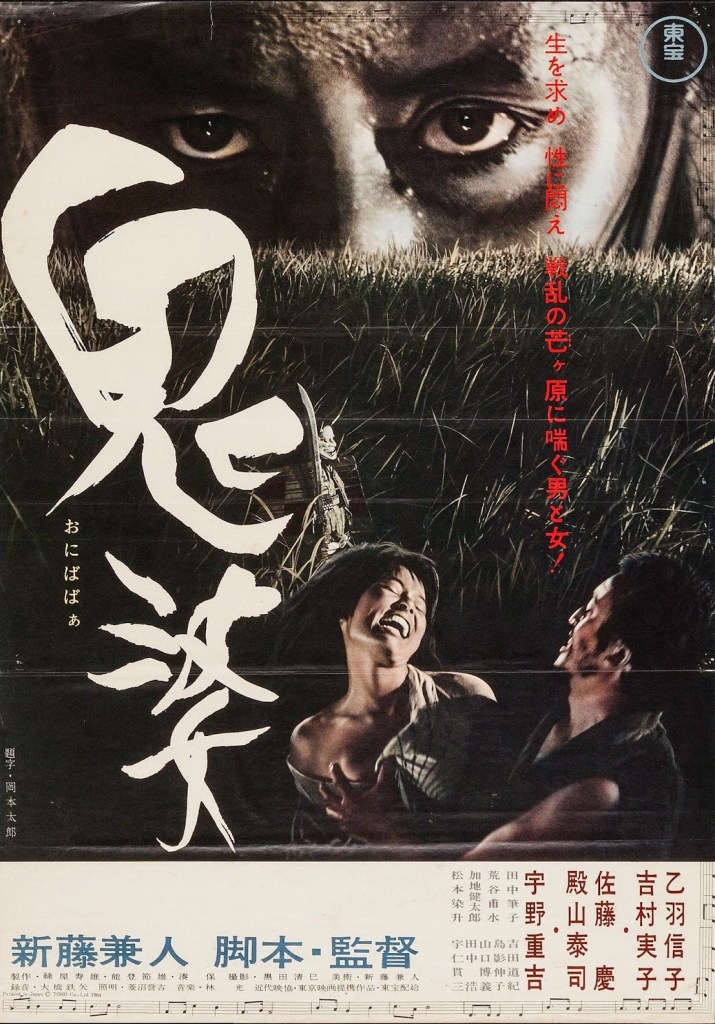
Onibaba (鬼婆, Kaneto Shindo, 1964)

How do you go on living in a world turned upside-down? It may be the central theme of post-war cinema, but few have tackled it in such a direct if allegorical way as Kaneto Shindo, repurposing a Buddhist parable about the perils of duplicity as a lesson in the dangers of the age, defined by a cruel hunger which could not be satisfied by bread alone even if there were bread to satisfy it. Onibaba (鬼婆), as the title implies, makes a villainess of an old woman driven to extremes by her chaotic times, but perhaps suggests that the times make villains of us all.

Deep in the war-torn country of 14th century Japan the imperial capital of Kyoto has been razed, a horse is said to have given birth to a cow, and the sun rose black in the sky leaving day as dark as night. With farmers dragged away from their fields to fight in a war they barely understand on behalf of distant lords, the grain basket of the nation is close to empty. An old woman (Nobuko Otowa) and her daughter-in-law (Jitsuko Yoshimura) have learned to make ends meet by hunting battle-weary samurai, stripping them of their armour, and throwing their bodies into a gigantic pit sitting right in the middle of the tall grass like a gravitational black hole of human compassion. The old woman has been patiently waiting for the return of her son, Kichi, who was taken away by the samurai, certain that everything is going back to normal when the war is over. Kichi, however, will not be returning. Hachi (Kei Sato), another young man from the village taken along with him, brings the sad news that the old woman’s son was beaten to death by a mob of farmers much like herself resentful of the war’s intrusion onto their land. 

Everything becomes food, Hachi explains, a sentiment extremely familiar to those who lived through the chaos of the immediate post-war era. Pointing at a baseline problem in the feudal economy, the war starves the poor and makes the wealthy hungry. The fields run wild with no men to tend them, as if symbolising the madness of the times. Lost in the tall grass, samurai and peasant alike search for an exit but are drawn only towards that black pit of human cruelty, more beasts than men driven by the need to survive alone. 

Without her son, the old woman is unable to farm, and without her daughter-in-law she is unable to survive through killing. She knows that these are times without feeling and that if Kichi will not return there is no reason for her daughter-in-law to stay. Ushi (Taiji Tonoyama), the broker for the looted samurai armour, makes an indecent proposal of extra millet for sexual favours but the old woman defiantly turns him down, perhaps not quite realising the offer was likely not intended for her. Which is to say that Hachi is not the only man in town, but is perhaps the only “desirable” one. Such desires that there are apparently cannot be satisfied by a crusty old man like Ushi, but are there all the same. Hachi presents a triple threat. The old woman knows her survival depends on the younger one, but also that she has no means to keep her now that her son is dead. She offers Hachi her body instead but he, as she did Ushi, baulks at the idea of slaking his lust on such an old woman. 

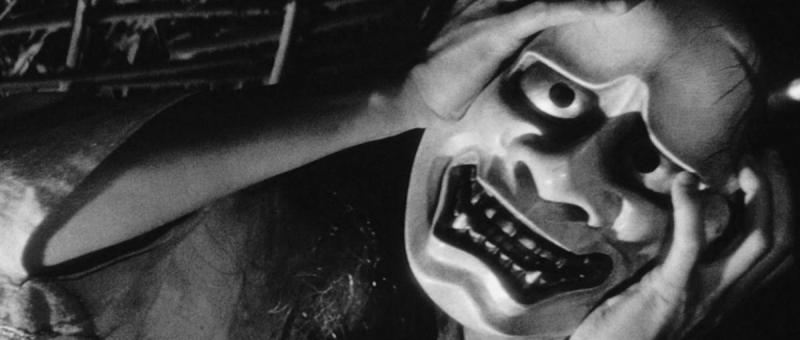
When a strange samurai wanders into her hut and orders her at the point of his sword to lead him out of the tall grass a solution presents itself. The old woman lures him to the black pit and prises away the ornate oni mask which he claimed he wore to protect his beautiful face from the ravages of war. Despite the fact that the samurai appears to have suffered from some kind of aggressive skin disease, the old woman unwisely decides to put the mask on her own face, convincing her daughter-in-law that her relationship with Hachi is sinful and appearing out of nowhere dressed as a demon to remind her that she’s going to hell. The mask’s crazed expression becomes fused with her own face, cementing her transformation into a “demoness” which it seems had already begun with stretch of white disrupting the uniformity of her hair and the kabuki-esque exaggeration of her eyebrows. Running desperately through the tall grass she cries out that she’s human, but this world has made demons of them all. The black pit of hunger knows no fill, and there can be no satisfaction in a world so devoid of human feeling.


Onibaba is currently streaming on BFI Player as part of the BFI’s Japan season.

Original trailer (dialogue free)

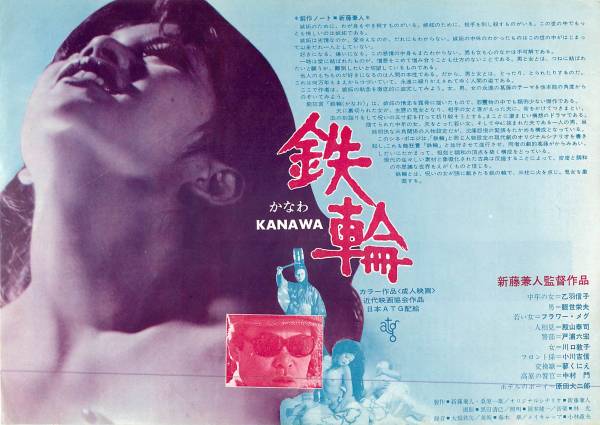
The Iron Crown (鉄輪, Kaneto Shindo, 1972)

iron crownFemale sexuality often takes centre stage in the work of Kaneto Shindo but in the Iron Crown (鉄輪, Kanawa) it does so quite literally as he refracts a modern tale of marital infidelity through the mirror of ancient Noh theatre. Taking his queue from the Noh play of the same name, Shindo intercuts the story of a contemporary middle aged woman who finds herself betrayed and then abandoned by her selfish husband with the supernaturally tinged tale of a woman going mad in the Heian era.

The film begins in a theatrical sequence in which Shindo’s wife and muse Nobuko Otowa appears in traditional dress and declares that she going to pray at a shrine to request vengeance on the lying, cheating husband who’s ruined her life. As part of this, she asks to be turned into a vengeful demon so that she may properly enact her revenge. However, after a while Shindo interrupts the action to return to the contemporary era and a man and woman in bed who keep being disturbed nuisance phone calls which turn out to be from the man’s wife (also played by Otowa) standing in a phone box outside.

The husband and his mistress – a much younger, sexually liberated woman, are given no respite from the unsettling phone calls. Haunted by the unseen figure of the betrayed wife, the couple eventually attempt to move around to avoid her ending up in a strange, otherworldly hotel. They become convinced that the wife has followed them and is telephoning from within the hotel itself despite having been told that they are in fact the hotel’s only guests. In the final sequence of the Noh play, the wife, who is now a demon, finds herself unable to enact her revenge in the way that she would like but vows to await another chance though her demonic powers eventually desert her, leaving her as an invisible ghost with only her voice remaining.

Shindo operates on three interconnected layers each radiating from the original Noh play. First of all there’s the central contemporary story of the adulterous husband, his mistress and the betrayed wife which is intercut with scenes from the Noh play but this is divided too – into a “realistic” depiction as in the wife fleeing through the forest and of outwardly “theatrical” scenes in which the entire stage apparatus is visible with enclosed walls and the musicians seated to the side of the stage area.

In one sense, it’s true that the position of the Heian era wife in this instance in a much harder one to bear than that of her modern counterpart who faces less of the stigma of the divorced woman and probably does have much more possibility of rebuilding her life even if she has made large sacrifices and wasted her youth on an unworthy man. However, just in the Noh play the hurt and resentment born by the unnamed modern woman is enough to develop into a supernatural force in its own right which pursues the new couple not only through the direct means of her phone calls but even begins to haunt them causing a degree of hysterical paranoia in the quite cowardly husband who even starts to see the “ghost” of his wife standing accusingly before him.

The real and the dreamlike theatre of vengeance blur into each other becoming evermore indistinct. By the time the adulterous couple have arrived at the hotel they’ve already entered another realm. Though the real world pokes through occasionally, the hotel itself takes on an ethereal quality with its staff each wearing the white makeup of the Noh theatre and spouting strange, oddly straightforward dialogue. Yet the couple themselves don’t seem to be able to detect the oddness around them or even be able to tell it apart from that which is recognisably part of their world, so caught up are they in the guilt and torment brought about by the unseen presence of the abandoned wife.

Shindo adopts a complicated, experimental structure to explore what is at heart a simple idea – the timeless quality of a woman’s jealousy. Hell hath no fury like a woman scorned and even if not physically present, the spectre of the former wife becomes a disruptive force in the husband’s intentions of leaving her behind to pursue other opportunities with a younger woman. Fascinating yet elusive, The Iron Crown is perhaps best considered with a firm knowledge of the original Noh play in hand, yet its haunting imagery and experimental take on form make it an intriguing entry into Shindo’s diverse filmography.


Unsubtitled trailer: