
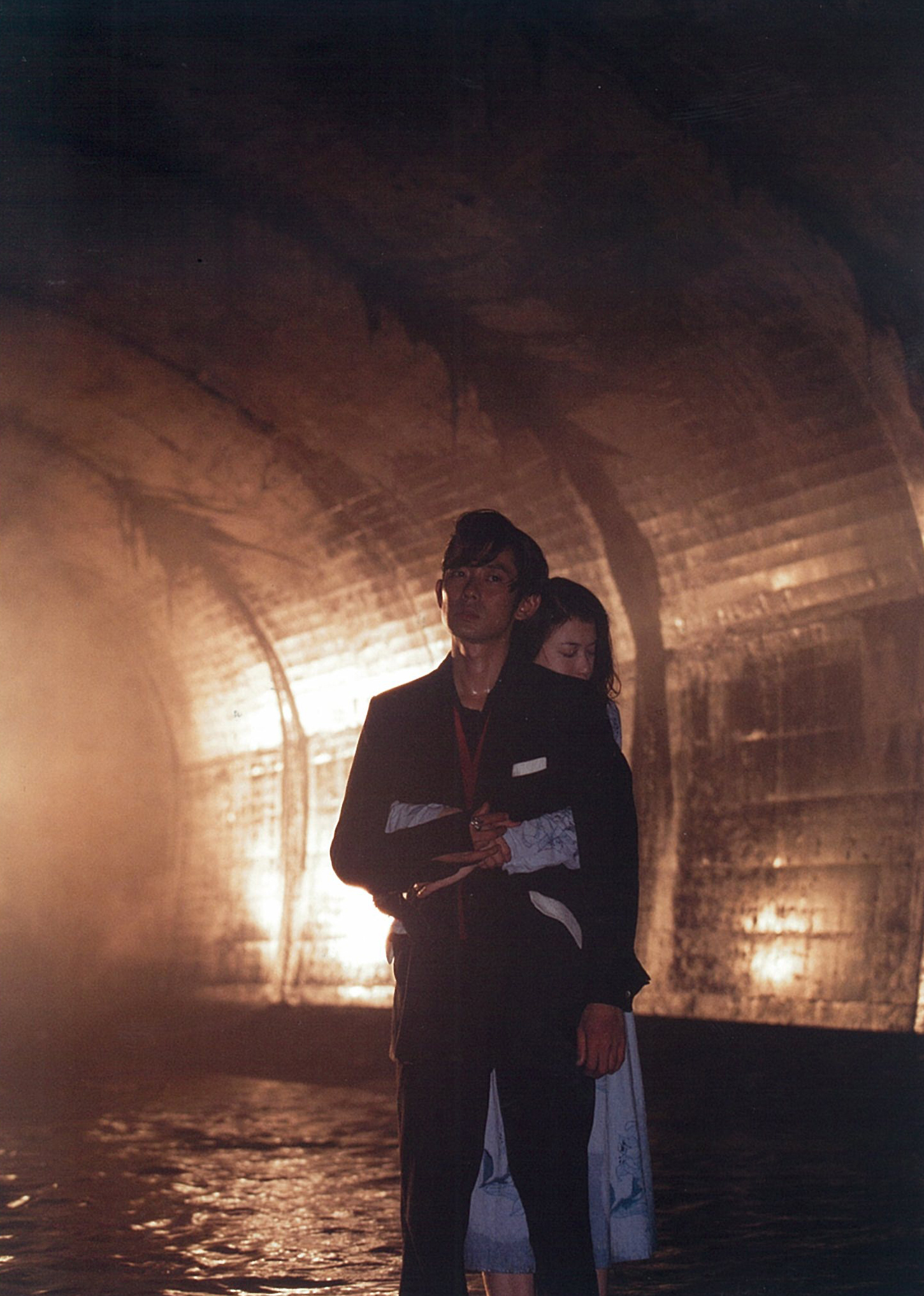
At the beginning of the final instalment of the Maiku Hama trilogy The Trap (罠, Wana), a strange-looking man dressed in a long overcoat and wearing a mask to hide a facial deformity tries to hire Maiku (Masatoshi Nagase) to look for himself. It’s a decidedly odd moment, and it seems that Maiku, who takes every job that comes, turns the man down because it’s just too weird though in a way his refusal to grant his request may contribute to the unfolding tragedy. If previous instalments saw Hayashi in Nikkatsu Noir and Fukasaku territory, this time around he seems to be channeling Seijun Suzuki in his intensifying surrealism and bold use of colour.
Indeed, in one sense, this is a tale of doppelgängers. We first see the strange man lurking outside the cinema standing so still that until he slowly turns his head we assume he is a statue. What we later realise is that he wanted Maiku to look for someone who was making use of his identity along with perhaps returning to him his own. Nagase too is playing a double role and Maiku is also searching for himself eventually confronted by the fact the man he’s been looking for has his own face.
Nevertheless, as the film opens Maiku is riding high. He’s doing very well financially after making a name for himself saving a child from a burning building. His sister Akane has got into a prestigious college, and he’s fallen in love with a woman from the post office, Yuriko (Yui Natsukawa), who is mute but can hear. By contrast, box office lady Asa remarks that nothing good’s happened since Maiku got his police commendation for saving the child adding to the sense that things are going far too well for Maiku and probably quite likely to plunge the other way. There’s currently a serial killer on the loose who’s abducting young women, drugging them, and posing their bodies in public places. Unfortunately, Yuriko becomes a target for the killer(s) after a moment of kindness to someone who was being bullied in a park.
An orphan raised in the church, Yuriko seems to be the embodiment of an otherwise absent purity. She tells Maiku off for gambling and generally tries to improve him as a person while he later acknowledges her willingness to sacrifice herself for others perhaps even at the cost of her own life. Her forgiving nature might help her overcome the fact that Maiku and the detectives effectively use her as bait on two separate occasions swooping in to save her only in the nick of time. This moral dichotomy reinforces a sense of tension in the city in which good and evil co-exist on different planes just as past and present had in the previous film and further transforms Yokohama into a mystical, haunted place of ever present dangers.
The sense of surreality is further heightened by the casting of actor Tetta Sugimoto who starred in Stairway to the Distant Past as the man in red but here seems to be playing an idealistic rookie cop, again countering the cynicism of detective Nakayama (Akaji Maro) who just wants to cut corners and get the job done rather than get it done right. Thus when Maiku is framed as the killer, Nakayama indulges in his long standing grudge against him and is determined to nail Maiku despite rookie Kozu’s insistence that he couldn’t have done it because they were together at the time. When even fingerprints can be faked, there is no such thing as reliable evidence.
Hayashi once again makes fantastic use of colour from the expressionistic storm to the eerie, dreamlike closing sequence in which Maiku must face himself and battle his demons before being saved by the angelic Yuriko. Taking place in an atmospheric sewer tunnel, the climax has an oneiric atmosphere and surrealist edge as Miku confronts this man who has his own face only to lose the image of him at the critical moment and thereafter seemingly disappear himself. The moments after also have an unreal quality, a poster for the film we’re watching, The Trap, positioned behind Asa at the counter and Hai-Ping’s letter from the first film seemingly playing as part of the film screening in the cinema causing us to wonder if this too is a dream or fabricated future for one who will not return. Dark and disturbing in its implications, coloured by the real terror of living of Japan in the mid-90s which had just experienced a devastating earthquake and unprecedented terror attack, the film nevertheless displays the warmth of the Yokohama we’ve come to love with its cast of charming characters and cheerful atmosphere despite the eerie emanations at its centre.
The Trap screens 19th October at Japan Society New York.
Original trailer (no subtitles)


 Windows on Worlds