The People Upstairs (윗집 사람들, Ha Jung-woo, 2025)

A moribund marriage finds itself haunted in the reflective image of the couple upstairs in Ha Jung-woo’s take on the Spanish film, Sentimental. A very ’70s sex farce, the film is, in other ways, a refreshingly modern examination of contemporary relationships that ultimately comes down on the side of sexual freedom and personal fulfilment rather than encouraging its unhappily married protagonists back into a socially conformist cage of merely settling for an unsatisfying existence.

You can tell Jeong-ah (Gong Hyo-jin) is unsatisfied by the way she accidentally embarrasses the life model at the art class where she teaches part-time to the point he feels he has to cover himself up even though it defeats the purpose of him being there. Her work as a temporary art teacher is also a symbol of her defeated hopes having given up on her creative practice to focus on more practical concerns while her husband, Hyun-soo (Kim Dong-wook), is a struggling film director who is currently on the 48th draft of a project to turn an unsuccessful film pitch into a TV drama that he’s been working on for the last four years. 

Neither of them are getting much sleep because the rambunctious nightly lovemaking of the couple upstairs keeps them up at night, but these days Hyun-soo sleeps on a fold up mattress in his office which is full of empty boxes of instant ramen like some student bachelor pad. Though they’re only in adjacent rooms, they communicate through Kakao talk and are otherwise leading separate lives. That might be why Jeong-a is drawn to the self-help YouTube channel run by Soo-kyung (Lee Hanee), her upstairs neighbour, which assures that no one can cure the loneliness inside you and the fastest way to better relationships is to stop expecting too much from other people. 

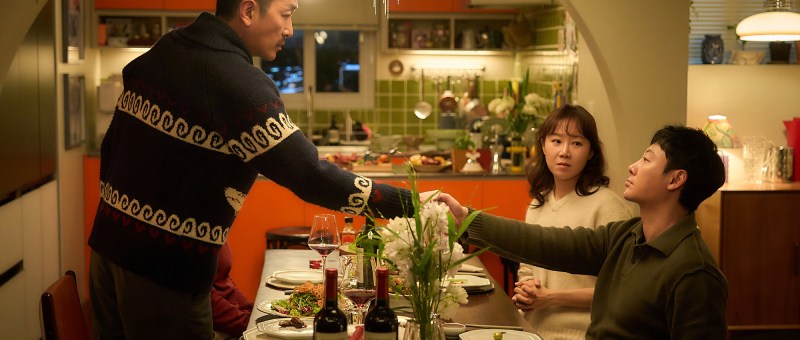
But it’s clear that Jeong-a, at least, is looking for something more which is likely why she decides to invite the upstairs neighbours over for dinner. Hyun-soo isn’t keen on the plan and tries to force her to cancel, then only agreeing to stay an hour while making passive-aggressive comments and veering close to telling the Kims that they can hear everything that’s going on upstairs and they don’t like it. Soo-kyung and her husband Mr Kim (Ha Jung-woo) are, however, the inverse of Jeong-a and Hyun-soo in their hyper-sexualised relationship and apparently solid marriage. They’ve come with something to say too, but while Jeong-a is increasingly receptive to their entreaties and open about her dissatisfaction, Hyun-soo is rude and indignant, resentful of what he sees as a perverse intrusion into his otherwise very “normal” life.

Indeed, part of this is that Mr Kim keeps making subtle digs at his masculinity in needling him about his lack of career success and inability to get this TV drama off the ground after apparently working on it for four years. This is also the root of Hyun-soo’s own insecurities and withdrawal from Jeong-a, unable to see himself as a man in the wake of his dissatisfying career. But Mr Kim is also a contradictory picture of masculinity. A teacher of Chinese characters who really wanted to be a calligrapher, he cuts a fairly authoritarian figure, but is otherwise a modern new man who is domesticated and open with his feelings. The Kims bring a dish to the dinner that Mr Kim has made while he orgiastically tears into pomegranate and suggestively squeezes lemons. He fixes drinks, makes tea, and gets out of the way while his wife does her work. 

But at the same time, the film seems to dial back on the inherent queerness of the Kims’ sexual practice by eliding the homoeroticism between Hyun-soo and Mr Kim who is keen to recruit him because his apparently explosive essence. This internalised homophobia is also a manifestation of Hyun-soo’s conventionality and desire for middle-class properness to bring order to his life, if only superficially, by continuing to live in a simulacrum of a marriage that leaves husband and wife unhappy. The recently remodelled flat is full of the signs of aspiration from the posh china to elegant modern decor. But it’s a row about the curtains that most obviously signals the cracks in their relationship. Jeong-a doesn’t want any because she wants a more open and transparent marriage, while Hyun-soo can’t live without them because he craves repression and can’t understand a life without it.

In any case, during their incredibly weird evening with the Kims, the couple hit rock bottom that is also a kind of epiphany liberating them from their misconceptions and the inertia of their married life. Hyun-soo, finally, begins to realise that Jeong-a is right when she says he uses sarcasm to run away from his problems and if he wants to save his marriage, he’ll have to be a little more emotionally honest and open to compromise. Despite his squeamishness, the film seems to come down on the side of the Kims who are living happy and fulfilling lives in embracing their sexuality, while it is Hyun-soo, by contrast, who must learn to open up even if he’s not quite ready to get in the lift.


The People Upstairs screened as part of this year’s LEAFF.

Trailer (no subtitles)

Alienoid: Return to the Future (외계+인 2부, Choi Dong-hoon, 2024)

Choi Dong-hoon’s hugely entertaining sci-fi-inflected fantasy adventure Alienoid ended with a classic cliffhanger promising resolution only in an as then unscheduled sequel. Part two arrives almost two years later and thankfully opens with a brief recap before delving straight into the ongoing drama as the older Ean pursues the Divine Blade that will allow her to stop humanity from being wiped out in a toxic gas attack by fugitive aliens.

Thus the majority of the first half takes place in the 14th century past as various parties vie over the blade in the manner of a wuxia serial. Ean is also on a quest to recover Thunder and get back to the crashed spaceship in order to get back to the future and stop the world being destroyed. But in some ways, she’s also now an orphan of time. She’s spent half her life back in the feudal era and will return to 2022 ten years older than she should be. Reuniting with Muruk (Ryu Jun-yeol), she finally figures out his identity and is more well disposed towards him, but also decides it would be better for them to head in different directions given the possibility that Muruk is a possible host for the missing Controller, the leader of a resistance movement among the alien criminals who have been imprisoned in the minds of humanity. 

Once again, the key to salvation lies in the past as we discover that Gae-lin (Lee Hanee) is a descendent of a blind swordsman who left very specific instructions for what to do during the alien attack. Ultimately, the aliens can only be defeated by a perfect integration of past and present as the Joseon team end up in 2002 complete with their magical weapons to fight a decidedly scientific threat. Though it’s true enough that the lines between science and magic are often thin and defined by a perspective on knowledge, it’s clear that Joseon magic continues to work in our world as the two bumbling shamans fight back with minor and pipe and Muruk pulls an incredibly heavy sword out his fan. 

Ean tells him that no matter if he may have a monster inside, Muruk is still Muruk guiding him on his journey towards an acceptance of himself as someone useful with genuine talent rather than just a hack. Choi throws in a series of twists and turns over who may be hosting the Controller at any given moment along with the true identities of several others as Ean attempts to handle her own baggage while tracking down Thunder and attempting to restore his energy levels so they can get back to the future and save the world. In order to defeat the aliens, they must all be united, past and future, coming together to defeat an alien threat.

Yet like the first film, we can see that this moment is both ending and beginning. Following a surprisingly poignant closing sequence the possibility of a new opportunity to set the past to rights is raised if on a more personal level that would allow orphans Ean and Muruk to unite in new time thereby closing a circle which otherwise remains open. In any case, the looping, elliptical quality of the cycling narrative eventually becomes clear and we understand where each of these disparate heroes belongs in the grand plan apparently orchestrated by Thunder and the now absent Guard. That’s not to say the rich lore underpinning the intricate world building is completely exposed and there is a sense that there are many other stories to be told in this madcap universe of scientists and magicians in the high tech present and feudal past.

In any case, Choi ups the ante with large scale sequences including a train chase that culminates in a derailment, while in the Joseon era the heroes leap from rooftop to rooftop and run through idyllic forests while pursued by mystical forces. Every bit as charming as the first instalment, the film builds on the existing relationships between its vast list of characters and generates a sense of warmth and familiarity that also has its melancholy as er really these two worlds cannot remain bridged forever but must eventually separate whether the alien threat prevails or not.


Alienoid: Return to the Future is out now on DVD & blu-ray courtesy of Well Go USA.

International trailer (English subtitles)

Killing Romance (킬링 로맨스, Lee Won-suk, 2023) [Fantasia 2023]

A once famous actress sets out to reclaim her autonomy from an abusive, controlling, billionaire husband in Lee Won-suk’s hilariously off the wall comedy Killing Romance (킬링 로맨스). Partly a satire on the extreme power of wealth, social inequalities in contemporary South Korea, toxic masculinity and rampant patriarchy, along with the stigma of failure and loserdom, the film is also an inspirational rallying cry to break of oppressive social codes and embrace your authentic self even if others don’t quite understand. 

It’s a sudden fall from grace for top star Yeo-rae (Lee Hanee) that causes her to rethink her career goals when a sci-fi movie she starred in becomes a cult hit for all the wrong reasons leaving her a national laughing stock derided for her poor performance. Deciding to get out of the spotlight for a while, she travels to the remote island of Qualla but is immediately mugged by locals and rescued by mysterious Korean billionaire environmentalist Jonathan (Lee Sun-kyun) who sees them off with a well placed Taekwondo neck chop. One has to wonder if Jonathan had that set up, but in any case Yeo-rae soon falls in love with her handsome suitor and the pair marry. 

But seven years later it’s clear the marriage has not been a success. Yeo-rae is miserable, trapped in the ostentatious house Jonathan has had built in Seoul which is covered in oversize pictures of himself in muscle poses. He controls everything in her life right down to what she eats because he likes her at a certain weight and even goes so far as to cancel a job offer on her behalf telling the director of a movie she wanted to star in that she’s mentally ill while pelting her with tangerines for daring to envision a life as anything but a doll for him to play with. 

His control over her is born of a sense insecurity that his money cannot cover. Attempting to strike an alpha male persona, Jonathan wears a fake moustache and struts around in ostentatious outfits but is also always accompanied by his well-built bodyguard Bob while waited on hand and foot by twin servants he refers to as “The Susans”. The romantic song he uses to control Yeo-rae through a kind of brainwashing isn’t even his own but a pop hit from 1997, while Yeo-rae tries to recover herself by singing her own iconic hit Yeo-raeism (a repurposed version of the classic hit by Rain, Rainism) with its defiant chorus of “I’m gonna be a bad girl” in her attempt to shake off Jonathan’s patriarchal programming. 

Jonathan’s bid for hyper masculinity, his hatred of losing, is subverted in the the softness of Yeo-rae’s top fan Bum-woo (Gong Myung) who is perpetual student on his fourth attempt to get into Seoul University in the hope of fulfilling familial expectations. On realising his new next-door neighbour is none other than his favourite idol, Bum-woo figures out that she’s trapped and abused by Jonathan and is determined to rescue her even if it means killing him but is in reality too nice to carry it through. A bizarre series of assassination plots using paper aeroplanes and Jonathan’s personal kryptonite peanuts along with an attempt to steam him to death in a sauna flounder when a remorseful Bum-woo saves him at the last second potentially swayed by Jonathan’s promise to “change his life” in gratitude. But in the end neither he nor Yeo-rae are fully capable of actually killing him or escaping his control. After all, “Jonathan is above the law” as Yeo-rae laments.

Then again, even he seems to be a little swayed by her song as do his yellow-clad henchmen slowly moving to the music persuaded by her beat over his. The battle ends in a huge sing-off in which Yeo-rae is joined by her ever supportive fan club and finally gets to dance to her own tune accompanied by a cohort of “losers” fighting back against sneering chaebol oppression though vengeance eventually comes from an unexpected source. Quirky in the extreme, Lee plays with a retro ‘70s aesthetic framing the story as a fairytale performed Log Lady-style by an old woman for a TV children’s book hour while throwing in constant references to ostriches and tangerines along with zany karaoke and musical sequences in a deadpan fantasia of self-actualisation that is quite simply sublime.


Killing Romance screened as part of this year’s Fantasia International Film Festival.

International trailer (English subtitles)

Phantom (유령, Lee Hae-young, 2023)

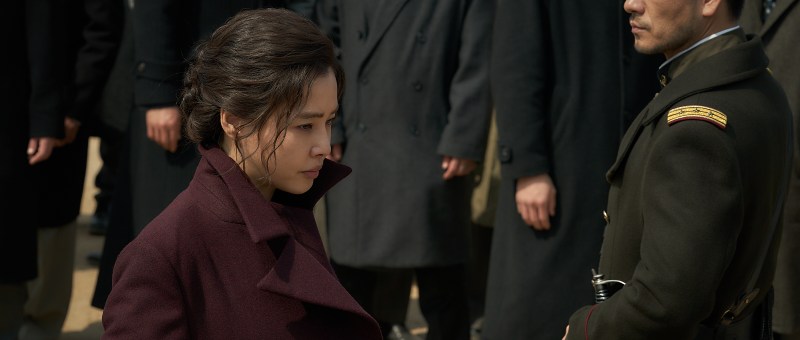
Neatly subverting the drawing room mystery, Lee Hae-young’s intense colonial-era spy thriller Phantom (유령, Yuryeong) positions female solidarity as the roots of resistance towards oppressive militarist rule. Inspired by Mai Jia’s novel Sound of the Wind which focused on Chinese resistance towards the Japanese puppet government in Nanking, the film does indeed begin with the suggestion that one of the people in this room is a spy but soon encourages us to wonder if they all may be or some other game may be being played by an infinitely corrupt authority in the midst of a constant series of betrayals and reversals.

Opening in Kyungsung (modern day Seoul) in 1933, the film both begins and ends with a radio broadcast in Japanese reporting on the actions of “terrorist” group known as the “Shadow Corps” which has been conducting “organised crime” through a network of spies known as “Phantom”. An assassination attempt has recently been made in Shanghai on the new Korean governor and all members of the organisation are reported as dead following shootout with the Japanese authorities, though that obviously turns out not to be the case and we are quickly introduced to operative Park Cha-kyung (Lee Hanee) who works in the intelligence division of the colonial government and utilises a local cinema permanently screening Shanghai Express to communicate with her handlers. New instructions are boldly announced in plain sight through coded messages on cinema posters including one for Tod Browning’s Dracula. 

The group plan to assassinate the new governor when he visits a Japanese shrine in the city. A young woman dressed as a Shinto shrine maiden using a pistol concealed in a tray manages to wound but not kill him. She makes an escape but is shot by an unseen hand that could have come from either side. Following, Cha-kyung witnesses her death but can do nothing other than make a swift disappearance before the authorities arrive. Cha-kyung is often depicted as a shadow presence, disappearing phantom-like from the scene both there and not there as she tries to maintain her cover, but Lee also imbues her with an additional layer of repression in that the assassin, Nan-young (Esom), had been her lover. The two women meet briefly outside the cinema in an emotionally charged scene in which they can display no emotion as they must appear to be two strangers exchanging a match on the street though it’s clear that something much deeper is passing between them. 

The exchange of cigarettes itself becomes repeated motif standing in for deepening intimacy in an atmosphere of intense mistrust. The box of matches that Cha-kyung had given to Nan-young as a parting gift and means of buying a few seconds more, blows their operation in leading investigating officer Takahara (Park Hae-soo) to a bar opposite the cinema where he figures out their code. Seemingly unsure as to who is the “Phantom”, he rounds up five suspects and takes them to a clifftop hotel where he encourages them to identify themselves or else they will be interrogated the following day. Along with Cha-kyung whom we already know to be “a” if not “the” Phantom is a police officer against whom Takahara bears a grudge (Sol Kyung-gu), the governor’s flapper secretary Yuriko (Park So-dam), codebreaker Cheon (Seo Hyun-woo) who is very attached to his cat, and terrified mailroom boy Baek-ho (Kim Dong-hee). 

Lee keeps the tension high and us guessing as we try to figure out what’s really going on, who is on which side, and if there’s to this than it first seems. Cha-kyung too seems uncertain, unable to trust any of her fellow suspects who obviously cannot trust her either while trying to maintain her ice cool cover. With sumptuous production design evoking the smoky, moody elegance of the 1930s setting, Lee drops us some clues in focussing on footwear particularly Cha-kyung’s ultra-practical boots and Yuriko’s totally impractical high heels and fancy outfits which as it turns out may have their uses after all when the simmering tension finally boils over and all hell breaks loose at the combination luxury hotel and state torture facility. In any case, as we gradually come to realise, the real “Phantom” the title refers to may be Korea itself, the resistance fighters accused of clinging on to the ghost of a nation which no longer exists while themselves rendered invisible, forced to live underground until the liberation day arrives. 


Phantom screens July 30 as part of this year’s New York Asian Film Festival.

International trailer (English subtitles)

Images: ⓒ 2023 CJ ENM Co., Ltd., THE LAMP.ltd ALL RIGHTS RESERVED

Extreme Job (극한직업, Lee Byeong-heon, 2019)

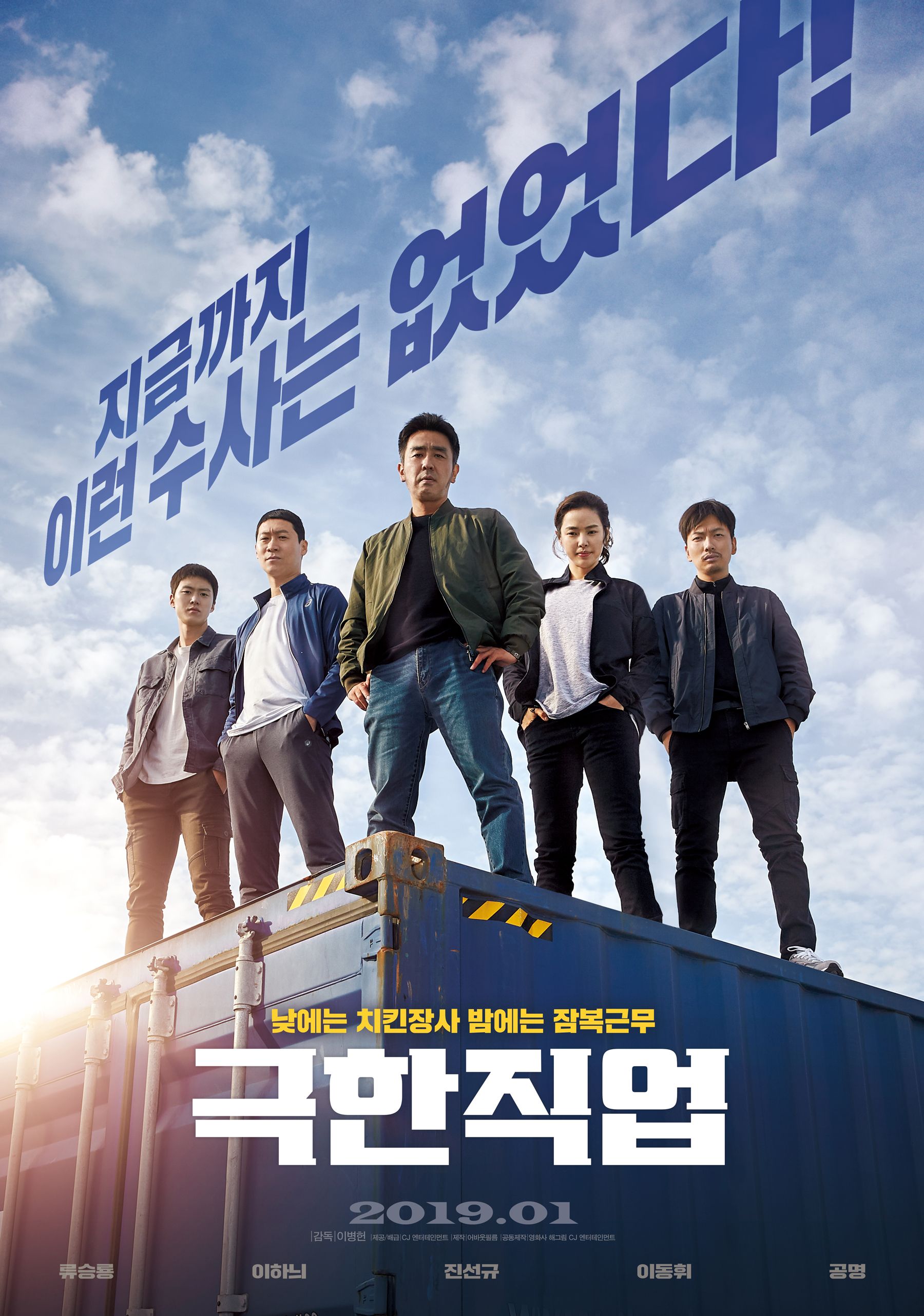
Extreme Job poster 2Another in the increasingly popular trend of multi-territory simultaneous productions, Twenty director Lee Byeong-heon’s Extreme Job (극한직업, Geukan Jigeop) shares its premise with recent Chinese hit Lobster Cop but swaps low budget zaniness for the kind of high concept comedy that dominated Korean cinema in the 2000s. Where the Chinese version was perhaps bold in making its law enforcers look like idiots, the Korean version is very much in the long tradition of idiotic but sincere policemen eventually making good, if perhaps more by accident than design.

The film opens with Chief Go (Ryu Seung-ryong) dangling on a window washing wire and making small talk with his quarry who then manages to get away leaving Go quite literally spinning in the wind. The rest of the team give chase, but the guy eventually ends up in a bad way with the gang’s exploits causing a multi-car pileup and a significant amount of public damage for which Go and his team are now responsible. Facing the threat of disbandment, the team senses opportunity when they get a lead on the Korean HQ of a notorious international drug gang and vow to break the case before a rival squad to prove their worth as police officers.

Bedding in for a 24-hr stakeout, Go & co hole up in a small fried chicken restaurant which happens to be right next to the bad guys’ hide-out only to discover the moribund eatery will soon be closing. The good news is the property is up for sale and Chief Go, borrowing the life savings of rookie Jae-hoon (Gong Myung), decides it’s worth the investment to crack the case. The only problem is, despite having been the only visitors for days, the guys keep getting interrupted by potential customers and are forced to open the chicken shop for real as a cover with the secretly excited officer Ma (Jin Seon-kyu) as chief fryer. Ma’s family recipe rib sauce proves an unexpected hit with chicken lovers and so a new food sensation is born, which is an inconvenience when you’re trying to balance running a restaurant with taking down a drug den.

Like Lobster Cop, Extreme Job satirises modish internet success as something as down to earth and ordinary as fried chicken becomes the latest foodie sensation. So taken with their success are they, that the guys begin to forget about the drug dealers in order to facilitate their chicken business all the while conveniently forgetting that they’re technically moonlighting even if it’s in service of an active investigation (albeit one they weren’t actually assigned to). Deciding that they’ve gone too far the guys raise the price to extreme levels, but that only makes the problem worse as does an attempt to rebuff the attentions of a foodie TV programme who then take against them and attempt to ruin their reputation at the worst possible moment.

Meanwhile, Go’s loyal wife is pleased with the extra money coming in but also suspicious. She doesn’t really like him being a policeman – mostly because his nickname is “zombie” on account of all the times he’s nearly died, but she probably wouldn’t want to be married to a chicken shop manager either. For some reason, owning a chicken shop seems to be a shameful occupation that everyone is embarrassed about, though through his unexpected business success Go eventually learns to embrace his inner chicken man and become a better police officer because of it.

The one officer intent on watching the bad guys finds himself excluded from the group as the others regard him as a shirker for not helping out with the chicken business. Nevertheless, in true cop comedy fashion, it’s team work that counts as the guys come to understand their complimentary strengths and start working together as a unit so they can take down the drug dealers if in bumblingly idiosyncratic fashion. As if to ram the point home, Lee closes with Leslie Cheung’s iconic theme from A Better Tomorrow running in the background to remind us that this has all been about brotherhood, togetherness, and holding the line as much as it’s been about fried chicken success. Slapstick laughs collide with ironic familial comedy and a dose of mild social commentary as the bumbling cops eventually make good by embracing their inner chicken men and reclaiming their dignity in the process.


Extreme Job was screened as part of the 2019 Udine Far East Film Festival.

International trailer (English subtitles)

Heart Blackened (침묵, Jung Ji-woo, 2017)

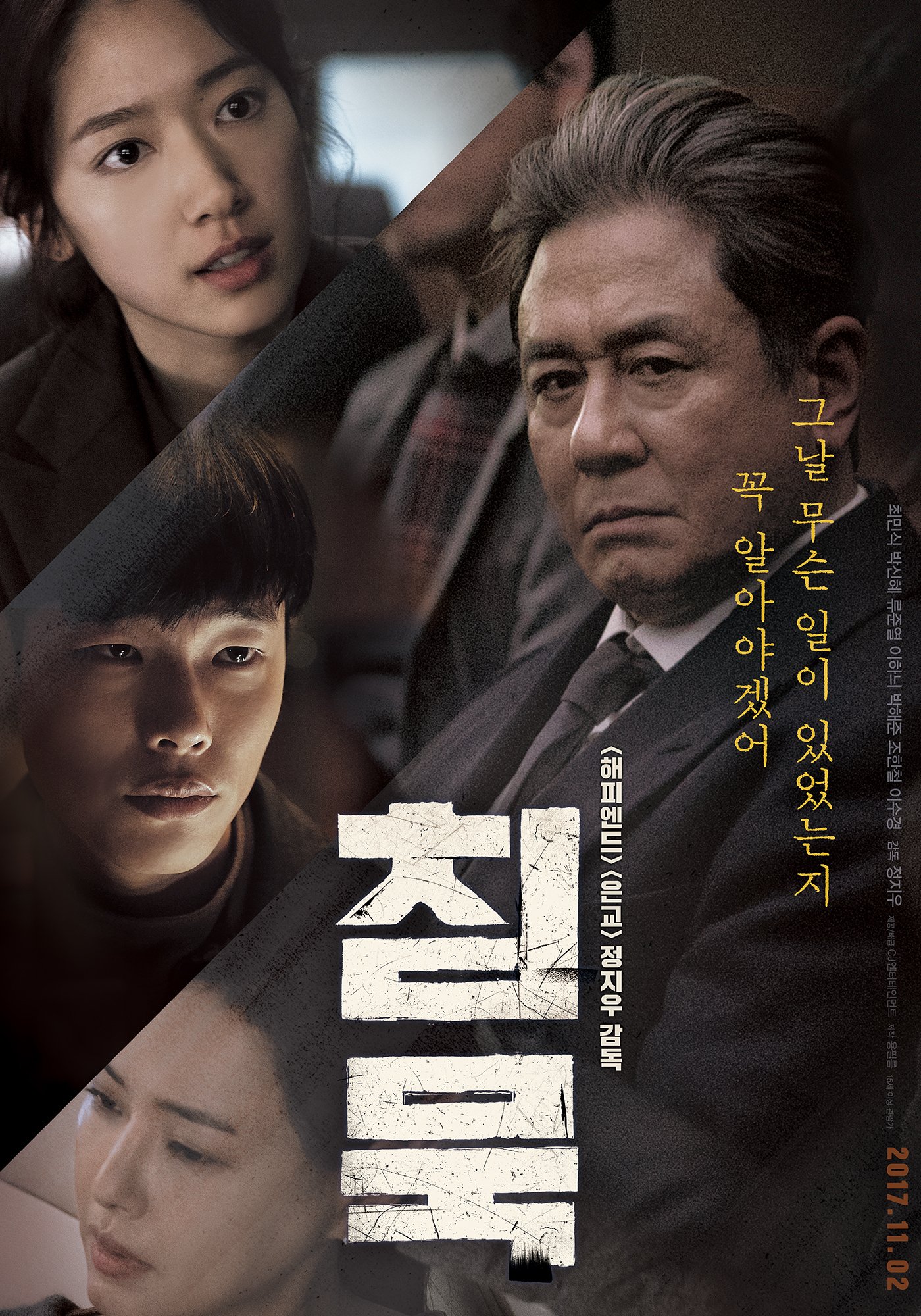
Heart Blackened posterMost of us like to kid ourselves that you can become rich and successful by working hard and playing by the rules, but it takes a certain kind of ruthlessness to climb the chaebol tree. Corrupt CEO Yim Tae-san (Choi Min-sik) is about to have his mettle tested in Jung Ji-woo’s Silent Witness remake Heart Blackened (침묵, Chimmuk). Wealth, money, power, networks of control and manipulation – Tae-san has all these, but a crucial failure to keep his house in order is about to bring it all crashing down. Unless, of course, he can find an acceptable way out. There are some difficult choices to be made but nothing is quite as it first seems in this world of interpersonal gamesmanship and high stakes machinations.

A widower, Tae-san is in a seemingly happy relationship with famous singer Yuna (Lee Honey). His dreams of familial bliss, however, hit rocky ground when his grown-up but still young daughter refuses to accept his new love. Despite Yuna’s attempts to win her over, Mira (Lee Soo-kyung) hates her potential step-mother with unusual intensity. Matters come to a head when some of Mira’s friends alert her to a sex tape going viral on the internet recorded some years previously and featuring Yuna with an old boyfriend. Mira demands a conference and Yuna dutifully comes, hoping for a rapprochement but getting a tirade of abuse. The next morning, Yuna is discovered close to death in the car park underneath her apartment building where a fire has been set presumably to destroy crucial evidence. Mira is arrested but can’t remember anything about the night in question. Tae-san hires an old friend of Mira’s, Choi Hee-jeong (Park Shin-hye), who has now become a defence attorney, in an attempt to get her some moral support from a compassionate lawyer.

Tae-san’s motivations remain opaque and inscrutable. He appears to think his daughter did it, so why does he hire a friendly but second rate, relatively inexperienced lawyer to defend her when he could use his vast wealth to hire the best of the best or even have the case thrown out altogether? As might be expected for someone in his position, Tae-san is a corrupt businessman with a shady past. He has a history with the prosecutor working on this case who has an interest in trying to get at him through his daughter but Tae-san tries buying him off anyway. To Tae-san money is everything. There is nothing which cannot be bought, nothing which cannot be done by a man with “means”, and no trap which cannot be sprung by a man in total control. So why is he letting his daughter go through all this when he could have found a way to pull her out of it?

As it turns out, there are things money can’t buy (but in a round about way, you might be able to make a cash sacrifice in order to prove how much you want them). As part of their investigations, Tae-san and Hee-jong rub up against creepy super fan Dong-myeong (Ryoo Joon-Yeol), otherwise known as “Cableguy”, who’s been stalking Yuna for years and has secret cameras installed all over her apartment building meaning he may have crucial footage of the incident. To Dong-myeong, however, money is “worthless” in comparison to love, family, and friendship (or so he says). Taking the stand, Tae-san amps up his fascistic chaebol survival of the fittest rhetoric in reiterating that “not all lives are equal” and that saying there’s nothing to be done is only the defeatist excuse of the perpetual failure. If he believes the things he says, then Tae-san is indeed a “vile man” as the prosecutor brands him, but then again Tae-san’s relationship to the “truth” is not altogether a faithful one.

Tae-san believes that “money fixes everything” and whatever else he may have done, it’s hard to argue with his final assessment. What Tae-san is experiencing may well be karma for his life of corporate machinations, but it’s not quite of the kind you might expect. Mira, the archetypal chaebol child – spoiled, entitled, selfish, and arrogant, has in a sense been ruined by her father’s failure to teach her there are things more important than money and it’s a lesson both of them will find hard to learn. A chaebol chastened, Tae-san is a man brought low by his own ideology but it’s hard not to feel sorry him as he finds himself back on the path to righteousness having lost everything even if the real villain is the world which blackened his heart to such an intense degree.


Heart Blackened was screened as part of the 2018 London Korean Film Festival.

International trailer (English subtitles)