
Dark Nuns (검은 수녀들, Kwon Hyeok-jae, 2025)

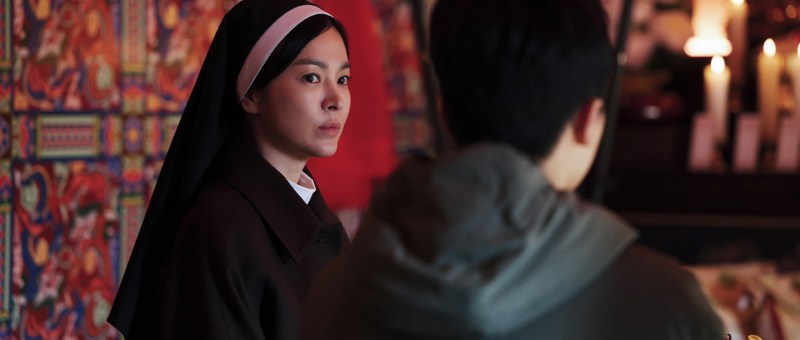
Large organisations have a tendency to gloss over inconvenient truths, but is it really in keeping with the teachings of the Church to ignore a confirmed case of demonic possession and allow a boy to die rather than admit that demons are real and members of the clergy are conducting successful exorcisms? According to Sister Giunia (Song Hye-kyo), a chain-smoking nun with a penchant for vulgar language, it is not, but she is largely hamstrung because of the ingrained misogyny of the patriarchal superstructure of the Catholic religion.

A spin-off from 2015’s film The Priests, Dark Nuns (검은 수녀들, Geomeun Sunyeodeul) goes in hard for the Church’s hypocrisy. As Giuna squares off against a powerful demon when taking over from two priests who’ve botched an exorcism on a teenage boy, it taunts her that the blood of all the demons she has slain will echo in her womb like a drum. There’s a suggestion that the existence of a nun is itself is an affront to God, as if a woman who has rejected her maternity and remained celibate is an aberration suggesting that a woman’s only proper role lies in motherhood. The fact that Giuna is later diagnosed with uterine cancer implies the same, as if she has cursed herself in her decision to serve God and become a bride of Christ. In her final confrontation with the demon, it tells her again that she will die of the tumour in her womb, a fact she already knows, but Giunia counters that she will exorcise the demon from this boy and use her womb to imprison it. Which is to say, she will kill him with her maternity and thereby fulfil her ideal role by becoming a “mother” to this demon, and symbolically to Hee-joon (Moon Woo-jin) the possessed boy, before condemning them both to the flames. 

This fact itself is ironic, as the council at the Church refused her request to conduct an exorcism because she is not ordained and “only” a nun. Of course, a woman cannot be ordained in the Catholic Church and the priesthood is open only to men. Her powerlessness within the organisation makes it easy for them to dismiss what she is saying while writing her off as a crazed devotee of the weird teachings of Father Kim, the priest from the earlier film. When they finally do give permission for an “unofficial exorcism” after Giuna has contacted the Rosicrucians in Rome to borrow some holy artefacts necessary for the ritual, the council inform her that the exorcism will be performed by Father Paolo (Lee Jin-wook). A sceptic who believes demonic possession is a psychological phenomenon not a spiritual one, Father Paolo is an odd choice but there is something quite moving and transgressive when in he fact takes off his priestly robes and places them over Giunia’s shoulders, ordaining her and acknowledging both that what she has said is true and that she is the only person who can carry out this exorcism. 

This is doubly true as Father Paolo had also tried to use the teachings of the Church to press another nun, Sister Michela (Jeon Yeo-been), by leading her to believe that her own spiritual awareness was a psychological illness that she should struggle to overcome through faith and medicine. It seems that Michela and other women like her may have found themselves retreating within Catholicism to reject the destiny of becoming a shaman while she herself was placed in a Catholic orphanage as a “cursed” child born between a human and a demon. Giuna had friend who was once a fellow nun but has now left to assume her true calling as a shamaness. The two remain good friends and often work together while Giuna is open to the presence of other gods and other forms of spiritual divination such as Michele’s talent with the Tarot. As such, all of these practices exist within a wider spiritual universe which is another challenge to the Church’s oppressive rigidity in its denial of folk beliefs and ancient traditions. After all, there is no real gender bias in shamanism, or if there is, it runs the other way for the majority of shamans are women. 

In any case, beating the demon requires everyone to work together for a common goal using, as the Rosicrucian father says, “all available means”. Through participating in the exorcism, Sister Michela begins to accept her own identity later continuing to work with Deacon Choi to track down the remaining 12 Manifestations while accepting Sister Giuna as a mentor figure. They are each in a way freed from the Catholic Church while simultaneously remaining inside of it as they progress with their mission of quieting the demonic forces at large in the world and protecting the innocent from their rippling evil. 


Dark Nuns is released digitally in the US July 15 courtesy of Well Go USA.

Trailer (English subtitles)
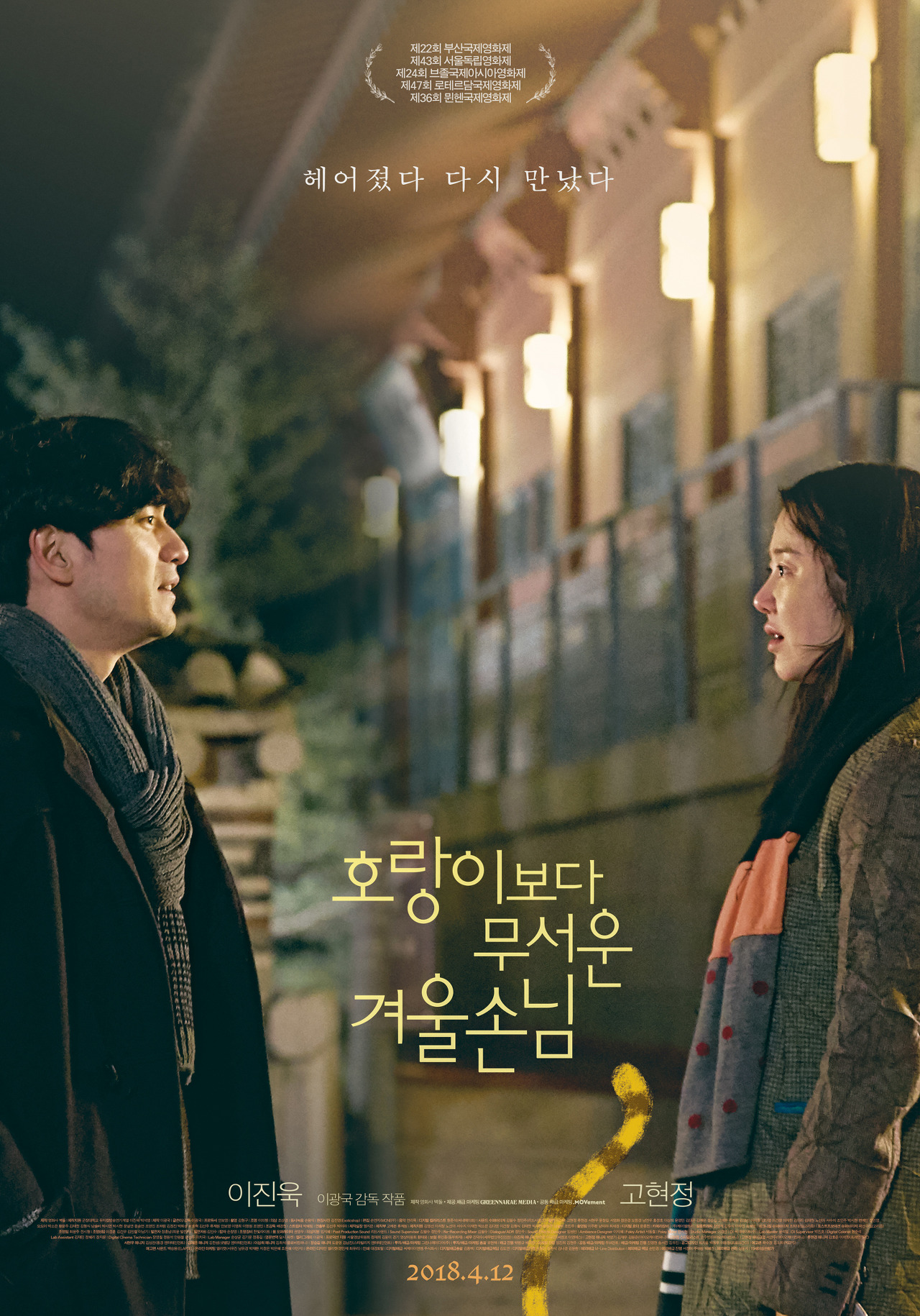
A Tiger in Winter (호랑이보다 무서운 겨울손님, Lee Kwang-kuk, 2018)

Tiger in Winter poster“Life just keeps getting harder” sighs a weary policeman charged with extracting a coherent statement from an accidental hero who only wants to talk about a tiger. Lee Kwang-kuk’s third feature, A Tiger in Winter (호랑이보다 무서운 겨울손님, Horangiboda Museoun Gyeoulsonnim), is in some ways a more conventional exercise in comparison with the time bending reflexivity of his earlier work, but the journey he takes us on is similarly circular as a melancholy young man finds himself chased out of his natural habitat and cast adrift, outside of his comfort zone too resentful to crawl back into a familiar cage but too afraid to embrace his freedom. 

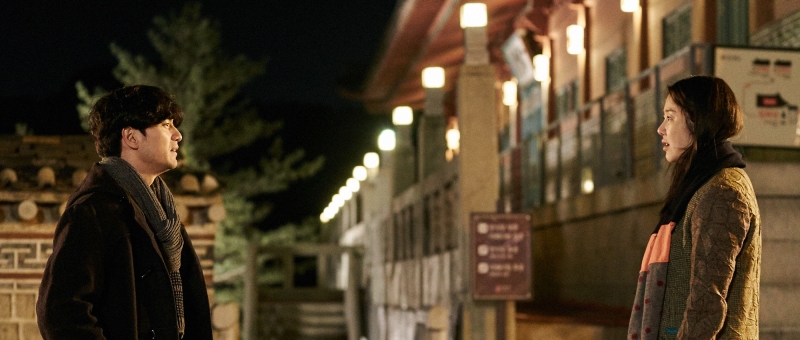
On the day a tiger escapes from the zoo, Gyeong-yu (Lee Jin-wook), a failed writer, “loses” his day job and has to temporarily vacate his apartment because his girlfriend’s parents are coming to visit and she evidently hasn’t told them she is “living in sin”. Gyeong-yu offers to stay and meet them, but bristles when his girlfriend wonders if he’s ready to make a firm a commitment. He packs and leaves, planning to return in a few days’ time when the coast is clear. Decamping to a friend’s place, Gyeong-yu continues his night “job” as a designated driver which brings him into contact with an old girlfriend – Yoo-jung (Ko Hyun-jung), who is also a writer and apparently successful but suffering from an extended bout of writer’s block and has descended into a self destructive spiral of alcohol fuelled existential desperation.

After reconnecting with Gyeong-yu, Yoo-jung pulls down a book he once gave her from her well stocked bookcase – a Korean translation of Hemingway’s The Old Man and the Sea. Hemingway’s hero fights his age as manifested in a powerful marlin and dreams of youth in the lions of Africa. The film’s English title, “A Tiger in Winter”, is perhaps a mild pun on “The Lion in Winter” which again tells of a once proud old man struggling to deal with his bodily decline, only Gyeong-yu is still young even if he feels himself diminished and brought low by life. Unlike the old man, he has stopped fighting and accepted his defeat. He no longer writes and flounders aimlessly, running away from the things that frighten him without aim or purpose. The loosed tiger is a manifestation of the fears Gyeong-yu refuses to fight which render him both physically and artistically impotent.

Writing, or perhaps art of any kind, becomes its own kind of vice – a dangerous addition, a need which must be sated or displaced without which the rest of life remains hollow. Unable to satisfy her need for creation, Yoo-jung has crumbled under the pressure of her own expectations and retreated into the comforting world of the permanently tipsy even whilst knowing that the alcohol itself inhibits her ability to create and forever separates her from that which would make her whole. She wants to stop, throws away her soju, but can’t move past her inability to face herself and resolve her creative doubts. Yoo-jung wants the quick fix, and like any addict, she is past caring about the harm she might do to herself and others in the pursuit of it.

Gyeong-yu, meanwhile, almost wallows in his degradation as he allows himself to be belittled by the customers who call for his services and insist on treating him like a servant. Designated driving doesn’t seem like a particularly safe arrangement for either party – many of Gyeong-yu’s customers are extremely drunk and willingly allowing a man they don’t know to drive them somewhere in their own car while they are barely conscious, while conversely many refuse to pay or accuse Gyeong-yu of damaging the car while berating him for acting in an insufficiently humble manner. Yet it’s not humiliation that knocks Gyeong-yu out of his stupor but trauma and a direct confrontation with someone else’s despair.

Tigers lurk everywhere, though when Gyeong-yu finally learns to look his in the eye it’s a very cute and non-threatening sort of tiger which perhaps makes him feel foolish for having evaded it for so long. Lee may not be playing with time in his usual fashion, but he sends Gyeong-yu retreating into the past all the same in an attempt to hide from his fears only to discover you can’t walk backwards into the future. An exploration of the destructive power of the creative urge, the soul crushing inertia of artistic block, and the continuing rootlessness of a life lived in flight, A Tiger in Winter is another beautifully poetic character drama from Lee whose world weary optimism loses nothing in its seeming simplicity.


A Tiger in Winter was screened as the final teaser for the London Korean Film Festival which will open on 1st November with Microhabitat. The full programme for this year’s event is now available on the official website – tickets on sale soon!

International trailer (English subtitles)

Miss Granny (수상한 그녀, Hwang Dong-hyeok, 2014)

131212-001_1401140436597Review of Hwang Dong-hyeok’s age swap comedy Miss Granny (수상한 그녀, Soosanghan Geunyeo) up at UK Anime Network.


Miss Granny is something of a departure for Korean director Hwang Dong-hyeok whose previous two films have both explored fairly weighty subjects firstly in The Father which, based on a true story, features an American adoptee looking for his father only to find him languishing on death row, and more recently in Silenced (also known as The Crucible) which depicted the harrowing, and again true, events that occurred at the Gwangju Inhwa School for the Deaf in which pupils were routinely abused by teachers and staff. So far as we know, Miss Granny is not based on a true story and is a more mainstream comedy in which a “difficult” old lady suddenly finds herself transformed into her 20 year old self.

At the beginning of the film, Oh Mal-soon is a bad tempered 74 year old woman who terrorises everyone around her into submission including her middle aged daughter-in-law who eventually lands up in the hospital with a heart condition that may in part have been brought on by Mal-soon’s constant criticism. Mal-soon’s son faces an impossible choice, ship his mother off to a home and give his wife some peace or risk losing either his marriage or his wife by keeping his mother around. Heartbroken at the thought her son maybe about to abandon her, Mal-soon wanders around the city before deciding to enter a mysterious portrait photographers and dolling herself up for a “funeral photo”. However, when she emerges she’s mysteriously transformed into a lithe and pretty 20 year old! Suddenly young again with potentially a whole life in front of her, what sort of choices will Mal-soon make this time around?

Much of the comedy of Miss Granny centres around the young Mal-soon, renamed Oh Doo-ri after her favourite actress, Audrey Hepburn, speaking and acting as if she really really were a 74 year old woman with all of the freedoms (and the invisibilities) that age grants you. Snapping away in her thick rural dialect and handing out unsolicited advice in the way only a nosy old woman can, Doo-ri is a very strange, and perhaps a slightly frightening, young woman. Undoubtedly, as we find out, Mal-soon has had a difficult life – starting out as an upperclass woman before becoming a young, penniless single mother dependent on the kindness of others and doing everything in her power to ensure that her son will grow up a fine man. Life has made her hard and in turn she makes things hard for all around her.

As a young woman she’s initially much the same yet comes to understand something of who she was and who she is. In her younger days she dreamed of being a singer and even as an old woman was well known for her fine voice. After unexpectedly jumping up to sing at a senior’s event in order to best another old lady rival, she’s “discovered” by a producer who’s tired of all the soulless idol stars who walk across his stage. Doo-ri is exactly what he’s been looking for, a young and pretty face with a voice that’s full of a lifetime’s heartbreak. Here is the real coup of the film – the younger actress, Shim Eun-kyung, reinterprets these classic pop songs from 40 years ago beautifully with exactly the right levels of pain and regret perfectly matching the montage flashbacks to Mal-soon’s youth. Becoming young again, experiencing everything again as if for the first time – opportunity, romance, friendship, Mal-soon finally begins to soften as if some of the harsh years of her original young life had been smoothed away.

Of course, nothing lasts forever and Mal-soon eventually has to make a choice between her newly returned youth and something else precious to her. She comes to understand that however hard it was she’d do it the same all over again because the same things would always have been the most important to her. Though it’s far from original and drags a little in the middle, Miss Granny still proves a warm and funny tale that walks the difficult line between serious and funny with ease and throws in a pretty catchy soundtrack to boot.


Reviewed at the London Korean Film Festival 2015.

Also here is one of the musical sequences in the film – I think this is a famous song from the ’70s (?) called White Butterfly. ‘Tis quite beautiful (mild spoilers for the film as it includes a montage of Mal-soon’s youth in the ’60s).