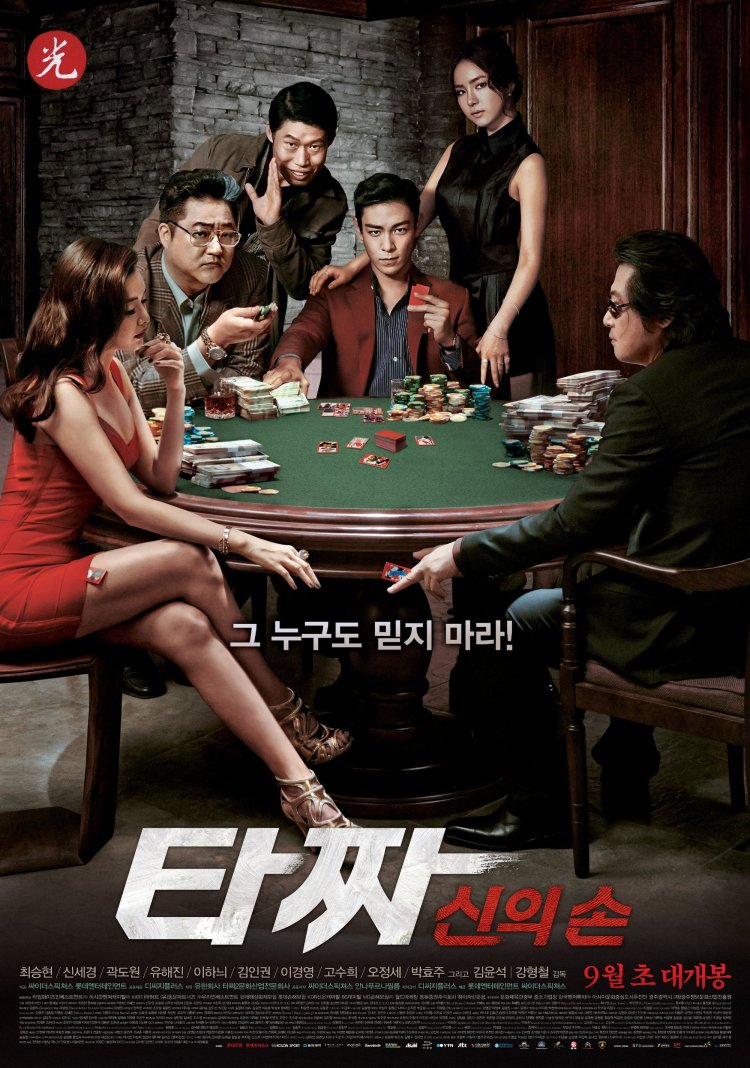
Tazza: The Hidden Card (타짜-신의 손, Kang Hyung-Chul, 2014)

tazza posterYou gotta know how to hold ‘em, know when to fold ‘em, know when to walk away and know when to run. Apparently these rules of the table are just as important in the cutthroat world of the Korean card game Hwatu as they are in the rootinest tootinest saloon bar. Like most card games, having the winning hand is less important than the ability to play your opponent and so it’s more a question of who can cheat the best (without actually breaking the rules, or at least being caught doing so) than it is of skill or luck. A second generation sequel to 2006’s Tazza: The High Rollers, The Hidden Card (타짜-신의 손, Tajja: Shinui Son) is a slick, if overlong, journey into the dark, underground world of gambling addicted card players which turns out to be much more shady than the shiny suits and cheesy grins would suggest.
Wisecracking kid Dae-gil (T.O.P) comes into contact with the first film’s fast talking hustler Go (Yu Hae-Jin) and realises he has a talent for trickery. As a young man he gets himself into trouble trying to save a family member from a gangster whom he winds up stabbing meaning he has to go on the run and leave the girl he’s fallen head over heels for, Mina (Shin Se-Kyung), far behind him with only the promise to come back for her when he’s made something of himself. With nothing to fall back on Dae-gil ends up working for cardsharping gangsters in what is really a series of high level con operations. His first problem occurs when he temporarily forsakes the memory of Mina for the attentions of the alluring Mrs. Woo (Lee Honey) who becomes both his secret girlfriend and the gang’s latest mark.

Things do not go to plan and Dae-gil is left carrying the can for the gang’s heavy losses. Getting into trouble with another mark who turns out to be a high level gangster himself, Dae-gil finds out Mina has been sold into prostitution as payment for a family debt but also winds up losing a kidney as recompense for his mounting gambling debts. Now Dae-gil is out for revenge against pretty much everyone, hoping to rescue Mina and win her heart in the process but his adversaries are old hands at this sort of thing and it’s going to take more than a rigged deck to beat them at their own game.

Taking over from the first film’s Choi Dong-hoon, Kang Hyung-chul opts for a slick and charming Oceans 11 inspired aesthetic full of quirky humour and tricky slight of hand photography. With retro musical choices from a smooth cover of Spooky to the ‘80s synth pop kicking in for an exciting car chase, Kang piles on the nostalgia as Dae-gil rides high as a wisecracking conflicted member of this underhanded outfit. Taking inspiration from its manwha roots, The Hidden Card maintains its breezy tone even whilst the atmosphere darkens as Dae-gil taps out with this gangster credit, beaten up, drugged and waking up in a filthy room with a bandaged hand and a crude scar across his abdomen where his kidney used to be. Apparently making a quick recovery from serious surgery, Dae-gil’s discovery of Mina’s fate is likewise another addition to his quest narrative rather than more evidence of the savagery of this trick or be tricked world.

The Hidden Card’s biggest problem is an unavoidable one given its genre – the sheer structural repetitiveness of moving from one card game to another. Lack of familiarity with Hwatu itself is not exactly a problem even if mildly frustrating, but the nature of the way the game is played means that a great deal of screen time is occupied with watching people watching each other, moodily, only to be left unsure of what’s going on or who’s won at the end of it. This is all the more true of the film’s final showdown which brings back a major player from the first instalment in which the stakes have been raised supposedly to “prevent” cheating, but only really aim to make it more “challenging”. Still, away from the gaming table there are enough high octane fist fights and a lengthy car chase to break up the more cerebral thrills.

Undeniably slick and filled with a host of likeable characters offering snappy dialogue and silly humour, Tazza: The Hidden Card is far too long at two and a half hours. Uneven pacing does not help the feeling of scale and a similarly unbalanced plot structure produces a misleading sense of progression. Still, keeping one step ahead of the card sharks is fun in itself and even if the action drags here and there, there is enough character driven drama and ironic comedy to keep things moving right up until the consciously cool finale.


International trailer (English subtitles)

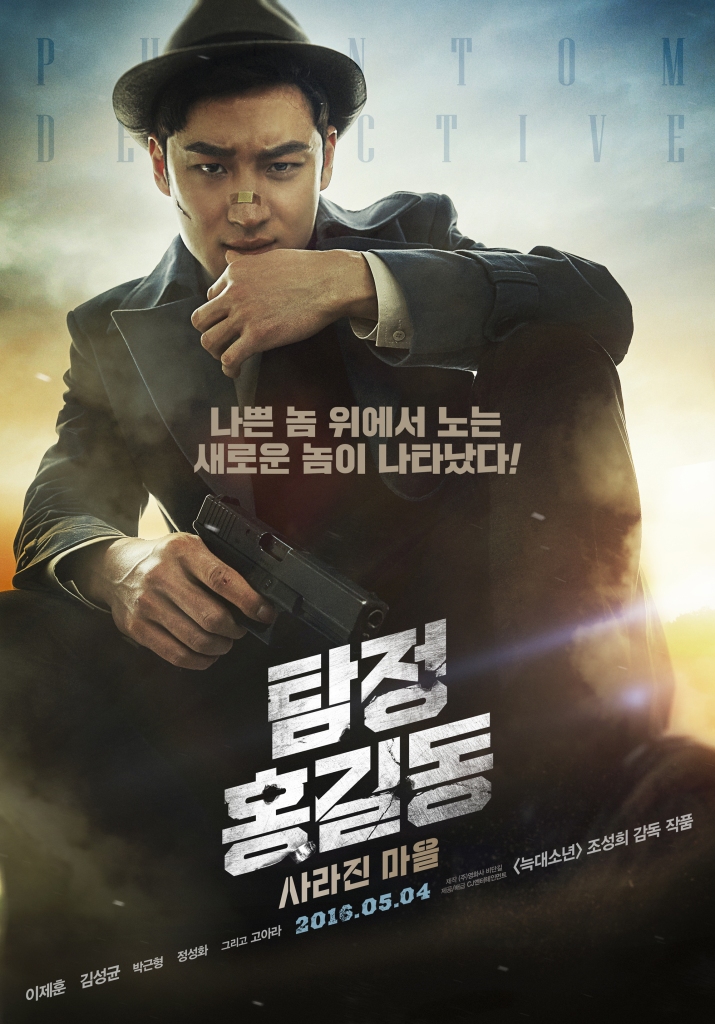
The Phantom Detective (탐정 홍길동: 사라진 마을, Jo Sung-hee, 2016)

su0mhpqReview of Jo Sung-hee’s The Phantom Detective (탐정 홍길동: 사라진 마을, Tamjung Honggildong: Sarajin Maeul) first published by UK Anime Network.


Comic books and film noir are, in many ways, a match made in heaven. Tough guys lurking in the shadows, larger than life villains and an ever present sense of the strangeness of criminality, lend themselves particularly well to the extremes of both genres which is why the combination is not exactly an uncommon one. In The Phantom Detective , director Jo Sung-hee adds an extra layer of meta textuality in naming the amnesiac hero Hong Gil-dong which is both the Korean “John Doe” and the name of a legendary Robin Hood figure from the 16th century. Like his namesake, this Hong Gil-dong is a preternaturally gifted detective with a faultless memory and an almost supernatural ability to stay ahead of the game, but he’s also a classic film noir hero with a damaged past and hollow heart…

In an alternate 1980s Korea, Hong Gil-dong (Lee Je-hoon) is an ace detective about to break a trafficking ring, which is righteous enough, but he also has another motive – these men may be able to offer him a clue to tracking down a target he’s been chasing for over 20 years. A one eyed man, Kim Byung-duk (Park Geun-hyung), contributed to Gil-dong’s origin story by murdering his mother right in front of him. At least, he thinks so – Gil-dong can’t remember anything about that day save for the visions he sees in his nightmares. In fact, he doesn’t even know his real name or who he really is.

When he finally gets to Byung-duk’s location, Gil-dong discovers he’s already been kidnapped by someone else leaving his two young granddaughters, Dong-yi (Roh Jeong-eui) and Mal-soon (Kim Ha-na), all alone. Taking off with the kids in tow, Gil-dong vows to track down “grandpa” but still has revenge in his heart. As the investigation progresses Gil-dong finds himself getting involved with the strange residents of a tiny town who may be about to fall victim to a dastardly doomsday plan engineered by a shady cult leader…

Ever since his mother’s death, Gil-dong has been unable to sleep thanks to constant nightmares and has lost the capacity for fear and empathy (qualities which serve him well in his line of work). Fiendishly clever, Gil-dong also has a sweet tooth and a sarcastic personality but despite his protestations, usually does the just thing when comes down to a straight choice. Byung-duk’s adorable granddaughters pose something of a problem for him as he begins to warm to their straightforward earnestness, yet his revenge rests in killing their beloved grandfather to avenge his mother’s death. The kids quickly take to Gil-dong, for some reason believing in his essential goodness. Dong-yi follows him around like a deputy detective, meticulously noting everything down in her notebook, whereas Mal-soon has figured out Gil-dong’s talent for deception but hilariously almost blows the gang’s cover on several occasions through her total lack of investigatory acumen.

Through investigating his lead on Byung-duk, Gil-dong hopes to recover his own memories of his early life and the mother he only remembers in his nightmares. The path he finds himself on is a dark one leading straight towards a powerful cult populated by fascism fetish sociopaths. Sure that the “New World is Coming”, the cult have planned a large scale event which threatens the lives of most of the residents of a small, strange town. Now Gil-dong has several reasons to get to the bottom of this long standing mystery ranging from his own desire for answers and revenge to saving the lives of these ordinary people and making sure no one else comes under threat.

Taking inspiration from the comic book world, The Phantom Detective makes use of highly saturated color schemes and deliberately artificial looking backgrounds. Though the approach remains bright and colourful for much of the film which adds to its slightly surreal atmosphere, there’s still ample room for noir with faces cast in shadow, light striking glasses so as to eerily block out the eyes, and Gil-dong’s classic detective outfit and occasional weary voiceover. The pulpy plot doesn’t worry too much about internal consistency, but blusters along well enough on its own even if coasting on Gil-dong’s wisecracking tough guy antics as he unexpectedly bonds with the two plucky little girls temporarily in his care. Cute and funny but also filled with innovative action sequences, The Phantom Detective acts as a worthy secondary origin story for its titular hero whose return will be eagerly awaited!


Reviewed at the 2016 London Korean Film Festival.

International trailer (English subtitles)

The Yellow Sea (황해, Na Hong-Jin, 2010)

yellow sea korean posterReview of Na Hong-Jin’s The Yellow Sea (황해, Hwang Hae, AKA The Murderer) – revised form of a piece first published by UK Anime Network in March 2012.


Gu-Nam (Ha Jung-Woo) is a taxi driver with a gambling problem. If the gambling wasn’t enough to get him into trouble, he’s also in debt to some gangsters over the money for his wife’s passage to South Korea. His wife was meant to be sending the money she’d make there back to him and their daughter to help pay off the debt, but no one’s heard from her in months. The obvious assumption is that she’s made a new life for herself and doesn’t want to be found, but Gu-Nam can’t quite bring himself to believe it. As a Joseonjok – a Chinese Korean from the Yanbian Korean Autonomous Prefecture, Gu-Nam had little chance of living an honest and prosperous life. Disowned by both China and Korea, many Joseonjoks are forced to resort to criminality in order to survive.

Just as it seems things are about to hit a crisis point, Gu-Nam receives an interesting job opportunity. Myung-ga (Kim Yun-Seok), the dog seller at the market, suggests Gu-Nam go to South Korea, kill a prominent businessman, look for his wife and return back to China (with the businessman’s thumb for proof). Assuming all goes well, Gu-nam will receive the pin number for an account with 57,000 Yuan, maybe return with his wife in tow or at least find out once and for all what the situation is between them, and finally get these gangsters off his back.

Still, sneaking into South Korea and committing a murder – it’s a big ask, and first off Gu-Nam rejects the idea out of hand but one conversation with his decidedly tough mother later and Gu-Nam has accepted. However, when he gets to Korea he finds things aren’t as simple as Myung-Ga made out. There seems to be a much bigger game in play than Gu-nam bargained for and it’s not long before he’s running from the police, gangsters, and just about everyone else.

If there’s one thing there’s a lot of in this film, it’s running. It’s difficult to think of another film that manages to make a good old fashioned foot chase quite so exciting. The set pieces are astonishing – multi-car pile-ups, police driving into and over each other, an extended chase sequence through a cargo boat – the list goes on, all with Gu-nam running desperately towards the camera. Propelled by pure survival instinct and later an intense need for revenge and an explanation, Gu-nam keeps running no matter what is coming for him.

One of those things is, of course, Myung-ga who’s now got a total mess on his hands that’s threatening to derail all of his current business arrangements (well, except the dog selling – something to fall back on). If there’s another thing there’s a lot of in this film, it’s stabbing (and later axing). Luckily for him, it seems Myung-ga is something of an expert at this as we find out in one scene where we see him, badly wounded, enter a room full of angry gangsters – the camera cuts away and we return to find all of the gangsters seemingly dead with very little fuss. He even tries to kill someone with a lamb bone at one point! Myung-ga is certainly not someone one would want to be meeting on a dark night (or ever buy a dog from). He is though, one of the most compelling film villains of recent years.

Speaking of stabbings, The Yellow Sea is a very violent and extremely bloody film. If you’re well versed in Korean crime dramas, you might be aware that South Korea has very tight gun laws, so much so that not even the toughest gangsters carry guns. Consequently what you have here is a lot of people sneaking around trying to get the drop on each other to stick the knife (or occasionally, hatchet) in. Obviously, it’s much quieter than gunfire but also much messier and much more physical. The only guns in the film are those which belong to the police, who are largely depicted as bumbling idiots who can’t tell one end of a gun from the other.

This Bounty Films release (distributed by Eureka in the UK) is the shorter 140 minute ‘Director’s Cut’. There is, however, some controversy about whether it really is a director’s cut or an international version prepared by the film’s co-producers Fox International. For the record, it runs about sixteen minutes shorter than the version seen in Korea. Despite being the shorter version, The Yellow River does still feel a little long at times and really pushes the ideal running time for a thriller of this kind. Nevertheless it does manage to keep the momentum going throughout and even has a streak of morbid humour running right through it.

A sad meditation on the futility of life, particularly for those who find themselves at the bottom of the pile and are forced to scrap like dogs for the little other people have left behind, The Yellow Sea is an exciting addition to the recent wave of Korean crime thrillers. Following on from his impressive debut The Chaser, The Yellow Sea certainly catapults director Na Hong-jin right into the top tier of Korean cinema.


The Yellow Sea is available on DVD and blu-ray from Eureka in the UK and on DVD from 20th Century Fox in the US.