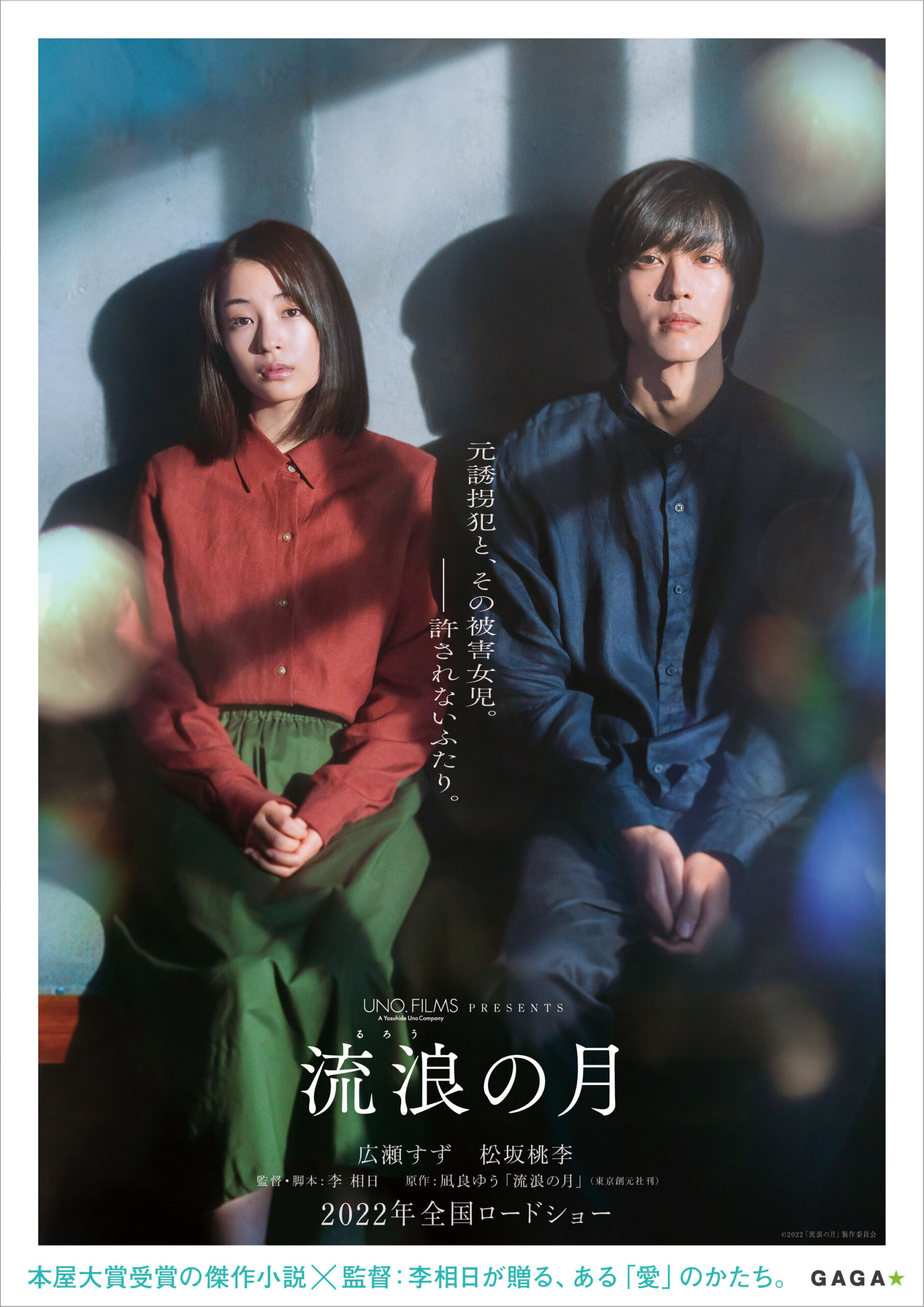
Wandering (流浪の月, Lee Sang-il, 2022)

The fact that “people only see what they want to see”, as one character puts in Wandering (流浪の月, Rurou no Tsuki), has a been a minor theme in the work of Lee Sang-il for whom nothing is ever really as black and white as it might seem. Adapted from a novel by Yu Nagira, the film asks some characteristically difficult and necessarily uncomfortable questions while otherwise contemplating the toxic legacy of parental abandonment and the cycle of abuse.

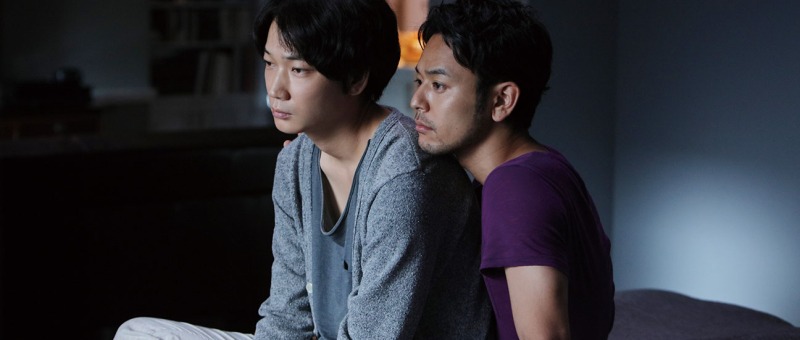
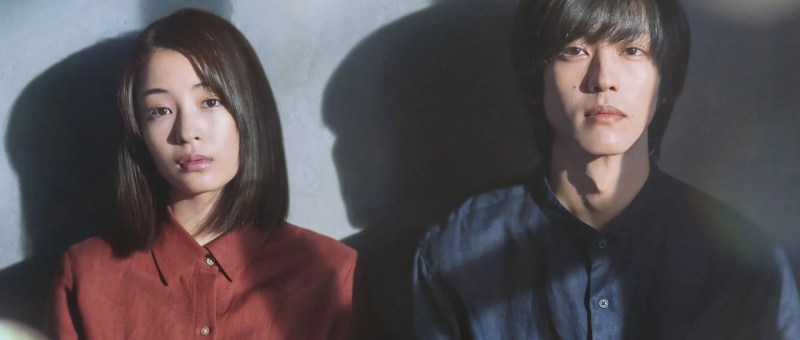
On a rainy day in 2007, a 19-year-old student, Fumi (Tori Matsuzaka), extended an umbrella to a lonely nine-year-old girl, Sarasa (Tamaki Shiratori), sitting out in the rain because she didn’t want to go home. He invites her to come back to his place and she agrees, later asking him if she can stay which she does for a couple of months until the police tear her away from Fumi’s side after tracking them down to a local lake. Fifteen years later, Sarasa (Suzu Hirose) has a job at a diner and is engaged to successful salaryman Ryo (Ryusei Yokohama) but though her life may look superficially perfect there are deep-seated cracks in the foundations. Ryo is a brittle and volatile man who is controlling and possessive, though Sarasa can’t seem to decide if she ought be “grateful” for the life she has or find away to break of Ryo before it’s too late.  

Many of Ryo’s problems are apparently a result of latent trauma caused by his mother’s abandonment. Shortly before paying a visit to his family, Ryo had become violent with Sarasa and though his family notice the bruises they choose to say nothing until his sister, less out of compassion than a kind of spiteful gloating, explains that he’s done this sort of thing before and often picks vulnerable young women with disordered familial histories in the knowledge that it will make it much more difficult for them to leave. Sarasa had herself been abandoned by her mother who palmed her off on an aunt after her father’s death from cancer to run off with another man. The irony is that Fumi is accused of kidnapping her but is the only person to have shown her kindness while giving her the confidence to reassert her autonomy. Nevertheless he is branded a paedophile, while the relative who had sexually molested her while she was living with her aunt is allowed to go free.

Then again, it seems that Fumi does, in fact, have an attraction to young girls though he never behaved in a harmful way towards Sarasa and appears to have taken her in for otherwise altruistic reasons. The film asks the uncomfortable question of how we should respond to a person who identifies themselves as a paedophile but knows that to act on it would be wrong and therefore does not do so. Lee often frames Fumi in Christ-like fashion, cutting to his bare feet on the water of the wooden pier and later in the closing scenes catching him in a crucifixion pose with his legs slightly bent and his arms outstretched all of which emphasises his suffering and mental anguish in being afflicted with these unwelcome desires which after all he did not ask to be burdened with. 

But this framing is further complicated by a final revelation that Fumi is suffering with a medical condition that prevented him from passing through puberty. His body is therefore not sexually mature and he feels himself to be, in this sense, a “child”. Most often what he says is that he is someone who cannot love an adult woman, which is most obviously a way of articulating that he cannot fulfil the sexual dimensions of an “adult” romantic relationship. Sarasa, meanwhile, comes to feel something much the same, explaining that she does not enjoy physical intimacy because of the trauma of her abuse which is recalled to her in Ryo’s aggressive and one-sided love making. 

These are not distinctions which occur either to the police or the gutter tabloid press. The young Fumi had tried to explain to the detectives that Fumi had not harmed her, but they didn’t listen, while the pair later become fodder for malicious gossip when they re-encounter each other by chance and it is salaciously suggested there is something unseemly in their relationship. The gossip ends up costing Sarasa her job, while the notoriety of her past as a kidnapping victim had also been used against her by Ryo not to mention the casually biting remarks of some of her workplace friends. As she says though more of her hopes for her relationship with Ryo, people only see what they want to see and are often unable to look past their biases and preconceived notions.

As it turns out, Sarasa did have other people around her who cared for and supported her such as the sympathetic boss who tried to protect her both from her increasingly paranoid boyfriend and the judgemental guys from HR. She’d forgotten what Fumi had told her in that she was the only person who could own herself and she shouldn’t allow other people to bend her to her will, restoring to her the confidence and independence which had been taken from her by toxic familial history. Sarasa in a sense returns the favour, Fumi also burdened by a sense of rejection likening himself to a weak sapling his mother ripped from the soil before it had a chance to mature, as reflected in the poignant scene of Fumi fast asleep mirroring that of herself when she first arrived at the cafe. Poetically lensed by Hong Kyung-pyo, Lee lends the melancholy tale a poetic quality as the heroes eventually find a home in each other if only to be condemned to a perpetual wandering.


International trailer (English subtitles)
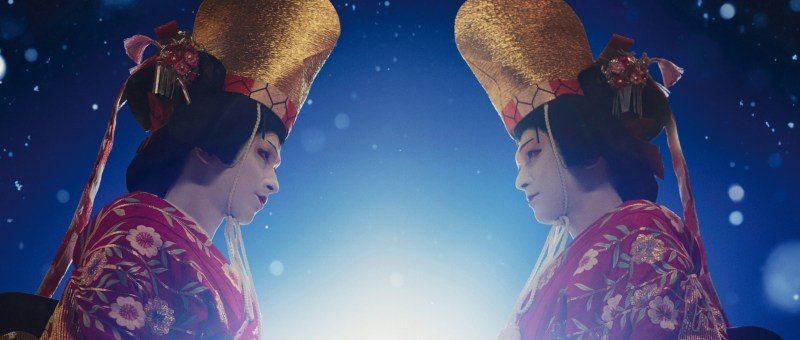
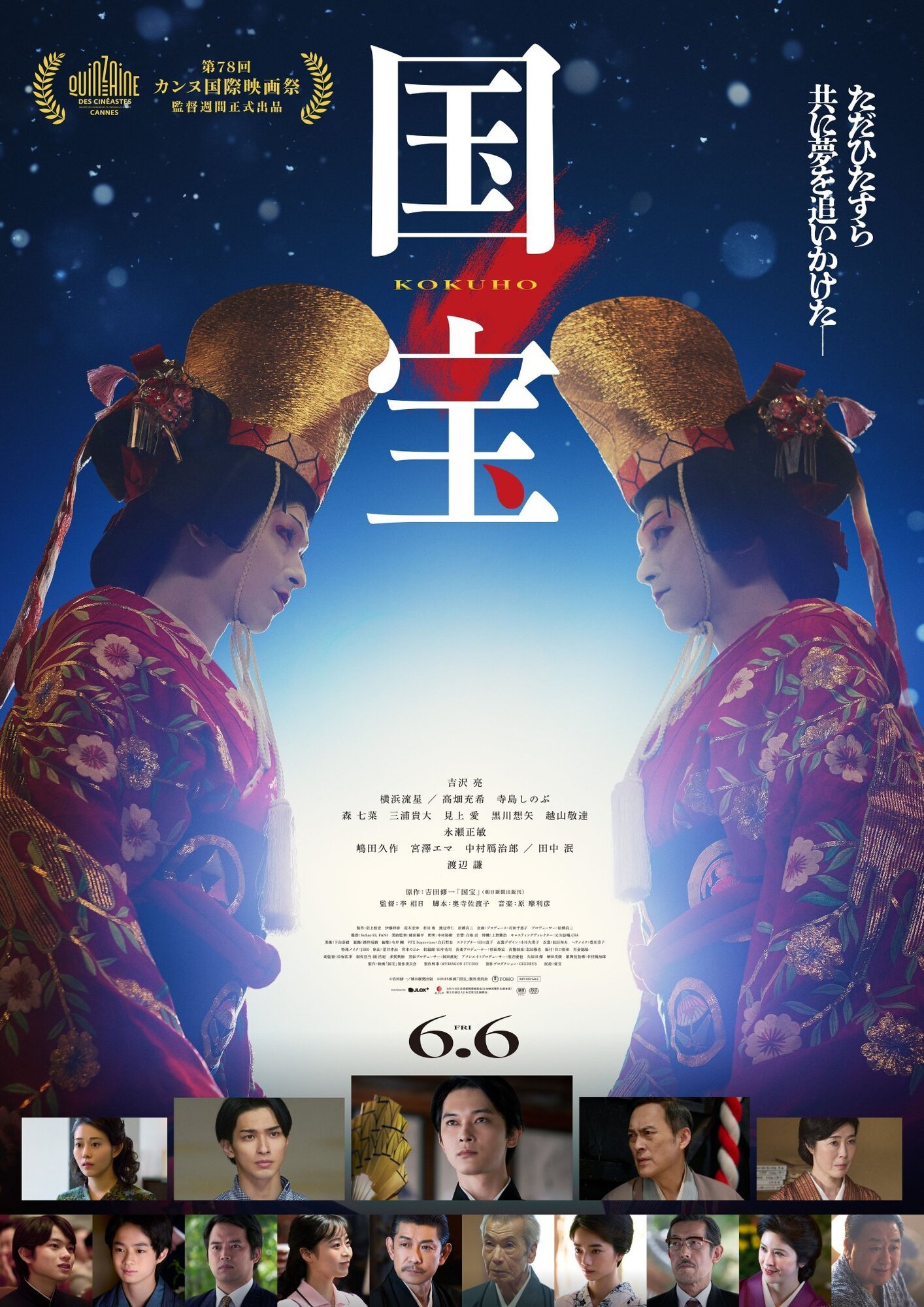
Kokuho (国宝, Lee Sang-il, 2025)

What does it mean to commit yourself so entirely to your art that you become it and effectively cease to exist? Playing the role of Ohatsu in Chikamatsu Monzaemon’s Love Suicides at Sonezaki, Kikuo (Ryo Yoshizawa) asks if Ohatsu’s lover Tokubei is really resolved to die for their love. The scene is intercut with his brother and rival Shunsuke leaving the theatre, led away by Kikuo’s girlfriend Harue (Mitsuki Takahata), just as Ohatsu leads Tokubei towards their mutual fate, as if Shunsuke were agreeing that he is not resolved to give his all to art in the way Kikuo evidently feels himself to be, at least in this moment.

The roles between them are reversed several times before they eventually perform the play again, but each of them are, in effect, in a love suicide with the art of kabuki, though kabuki itself is destined to live on. In any case, the “kokuho” of the title is a living national treasure and one who has indeed embodied their art. We’re introduced to one early on, Mangiku (Min Tanaka), an ageless onnagata, or player of female roles, who has a quasi-spiritual quality and warns the young Kikuo that though his face maybe beautiful, it could also be a barrier to his art and, in the end, consume him. It is said of Mangiku that all he will leave behind him is his art. The words are spoken with pity, but this is really what it means to be a kokuho and the highest compliment that might be paid to an artist. Mangiku himself would likely approve, casting an eye around his spartan room and declaring himself unburdened. 

But Kikuo is only half-joking when he says he cut a deal with the devil to make him the best kabuki actor in Japan. As a woman he abandoned later scolds him, all his sacrifices were made by others. Actors are greedy, another laments, and it’s true enough that Kikuo feared little in his need for success. The irony is that he too was an heir, only to a yakuza dynasty to which he could not succeed. His was father was gunned down in front of him while preparing to draw his sword, while Kikuo’s rebound tattoo does him no favours in the end and his attempt to avenge his father’s death apparently fails. Nevertheless, he vies for the approval of his surrogate father and kabuki master Hanjiro (Ken Watanabe) who values his skills above those of his biological son Shunsuke (Ryusei Yokohama) who alternately resents having his birthright stolen from under from him and acknowledges that Kiku has an innate talent with which his bloodline can’t compete.

Nevertheless, there’s a genuine and enduring brotherhood between the two men that never quite slips into hate or acrimony even as circumstances conspire against them. They both want what the other has. In the kabuki world, bloodline is everything and Kikuo is viewed as a interloper usurping Shunsuke’s rightful position, while Shunsuke wants the raw talent he knows he lacks and no amount of training and commitment can buy. Yet it is in a way about resolve, or at least the willingness to give your life to the stage and die in the pursuit of art. Kikuo’s signature piece is the Heron Maiden, in which a heron falls in love with a young man and becomes a young woman. But her love is unrequited. She goes mad, and can only show her love for him by dancing until she dies. This is, in effect, Kikuo’s dance with kabuki, a waltz to the death as he yearns for the “scenery” he as been searching for and eventually finds the apotheosis of his art in the moment of the heron’s demise.

Like Lee Sang-il’s previous films Villain and Rage based on a novel by Shuichi Yoshida, the film is a poetic meditation on the price of the pursuit of art that revels in its sumptuous production design and the intricacies of the kabuki world. With shades of Farewell, My Concubine, it frames its central dynamic not quite one of straightforward rivalry but a brotherhood between two halves of one whole who each know that neither of them can really win, while becoming a kokuho is an endless pursuit of artistic perfection in which one must be resolved to kill the self and die on stage in a lover’s suicide with a forever elusive kabuki.


Kokuho screened as part of this year’s LEAFF.

Trailer (English subtitles)

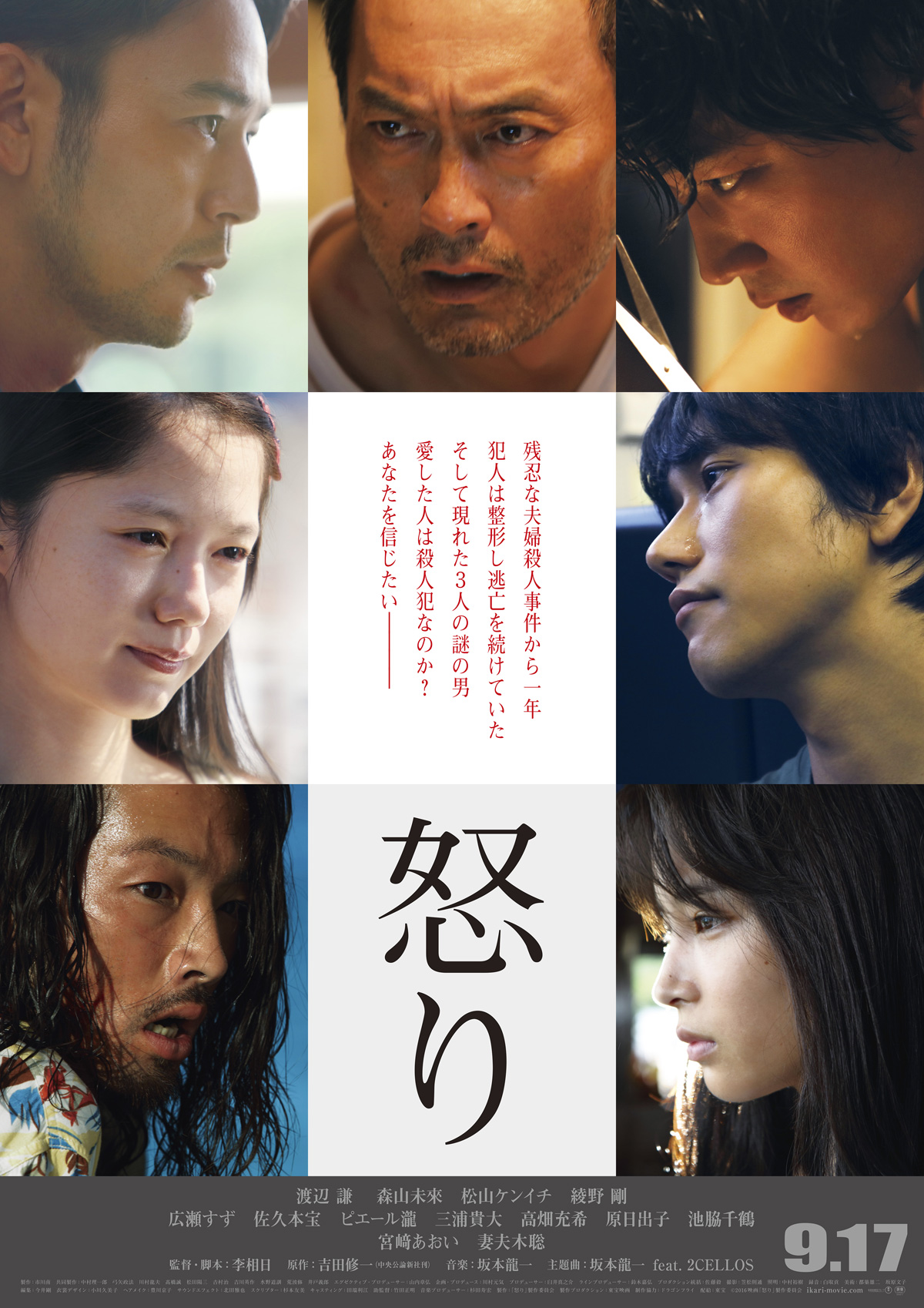
Rage (怒り, Lee Sang-il, 2016)

rage posterVillain, Lee Sang-il’s 2011 adaptation of a novel by Shuichi Yoshida, used a crime story to investigate the wider effects of social stigma and emotional repression – themes which are recurrent in the author’s work. Rage (怒り, Ikari) attempts to do something similar but its aims are larger, reflexively tacking the vicious cycle of social oppression and emotional repression in a society which actively suppresses the desire for expression in the aim of maintaining an illusion of harmony. A brutal, senseless killing has occurred and three suspects present themselves. The killer could be any one or none of them, but the fact of the matter is that when you cannot speak the truth, you cannot truly believe in anything or anyone.

In the blazing summer heat with its noisy cicadas and uncomfortable humidity, a young couple has been brutally murdered in their Hachioji home. There are few clues to be found save that the killer has painted the kanji for “rage” in blood on the wall. The police do, however, come up with a suspect and circulate a photofit which is anonymous enough to look like any youngish man who might make you feel uncomfortable for a reason you can’t articulate.

Meanwhile, a middle-aged man from Chiba, Maki (Ken Watanabe), anxiously wanders around Kabukicho until someone finds him and takes him to a brothel where his runaway daughter, Aiko (Aoi Miyazaki), has been working and has been very badly injured through her “eagerness to please her clients”. The father, trying to comfort his daughter who seems cheerful enough despite her ordeal, inwardly seethes with rage and is both relieved and worried when she begins a relationship with a secretive drifter, Tashiro (Kenichi Matsuyama).

Back in Tokyo, Yuma (Satoshi Tsumabuki) visits a gay bathhouse and roughly forces himself on a nervous man hunched in a corner. Despite the slight unpleasantness of their meeting, the two men eat dinner together and Yuma invites his new friend, Naoto (Go Ayano), to live with him in his well appointed apartment despite knowing nothing more about him.

Further south, a teenage couple enjoy a day out on what they think is a deserted island but the girl, Izumi (Suzu Hirose), discovers a backpacker, Tanaka (Mirai Moriyama),  living in some local ruins. Strangely drawn to him, Izumi keeps meeting up with Tanaka but an encounter in the city turns sour when her friend, Tatsuya (Takara Sakumoto), works himself into a jealous rage. Trying to get the drunken Tatsuya to the ferry, Izumi is raped by GIs from the local military base.

The Okinawan episode is, in many ways the key. Tetsuya invites Izumi to see a movie in Naha but they’re really going to observe a protest about the continued presence of the US military bases. Tatsuya wanted to be there to see it but pressed for an answer he doubts protest will achieve anything. Izumi, after her brutal encounter, says the same thing. She doesn’t want anyone to know. “Protesting won’t change anything”. No matter what she says, nothing will be done, no one would listen, nobody really cares.

Or, perhaps they simply care about the wrong things. Aiko gets home from her horrible ordeal in the city but everyone knows what she did there; her “sordid” past is the talk of the town. Her father says nothing, because like Izumi he knows it will do no good, but still he berates himself for it and his internalised anger grows.

Izumi does not want the stigma of being a rape victim, and Aiko does not want the stigma of being a “fallen woman”, their secrets are already out, but Yuma is jealously guarding his – living as a cautious gay man with his life strictly divided, his true nature walled off from his professional persona. Too afraid to be open about his sexuality, he projects his sense of unease and discomfort onto Naoto – first going overboard by inviting someone he just met and knows nothing about to live with him and then refusing to let him in all the way. Yuma asks Naoto not to attend his mother’s funeral despite the fact they had been friends because he doesn’t want the awkwardness of deciding how to introduce his boyfriend to a set of relatives he doesn’t really know. What he doesn’t do is ask any questions about Naoto’s past, jumping to conclusions and angrily slinging accusations when he thinks he’s caught Naoto out in a lie but his reaction and subsequent behaviour only bear out his own insecurities in his inability to trust the man the loves.

Each of the trio begins to doubt their friends or lovers with little more to go on than a police photofit which only superficially resembles them. The suspicion, however, is reflexive. It’s born of a society in which one is obliged to keep secrets and emotional honesty is frowned upon. No one speaks the truth because no one wants to hear it – it will only bring more suffering with additional social stigma. Sooner or later, when all of these unexpressed emotions reach a critical mass, they will explode. Such crimes could so easily be avoided were it easier to live a more open, less fearful life, but as long as it is impossible to trust oneself, there can be no unguarded trust between people.

Neatly in line with the self-centred narrative viewpoints, Izumi’s rape is relegated to a plot device as she herself disappears from the screen only to return briefly in the final coda. The effects of the rape are then explored as they impact on Tetsuya and Tanaka whose self images of masculinity are (seemingly) damaged by their failures to protect her. Izumi’s rape is viewed as something that happened to the men, as if she were a car that was scratched or a jacket torn. Self-involved as this is, it plays into the central theme – no one cares very much about anybody else’s feelings until those feelings are visited upon them by means of violence.

The murder occurs essentially because of a betrayal followed by unbearable, unexpected kindness. A woman felt sorry for a man, and so she trusted him and was betrayed. Two parties fail to trust the one they love because of a failing in themselves, their own sense of personal inadequacy will not allow them to believe in the other person’s faith in them, while another misplaces his trust in his need to find an ally and confidant to feel less alone and powerless. Prevailing social stigmas, selfishness, and a need to maintain the status quo have left all running scared, craving connection but too afraid to engage. When the system won’t let you be, violence, of one sort or another, is an inevitable consequence.


Original trailer (English subtitles)

Tazza: The Hidden Card (타짜-신의 손, Kang Hyung-Chul, 2014)

tazza posterYou gotta know how to hold ‘em, know when to fold ‘em, know when to walk away and know when to run. Apparently these rules of the table are just as important in the cutthroat world of the Korean card game Hwatu as they are in the rootinest tootinest saloon bar. Like most card games, having the winning hand is less important than the ability to play your opponent and so it’s more a question of who can cheat the best (without actually breaking the rules, or at least being caught doing so) than it is of skill or luck. A second generation sequel to 2006’s Tazza: The High Rollers, The Hidden Card (타짜-신의 손, Tajja: Shinui Son) is a slick, if overlong, journey into the dark, underground world of gambling addicted card players which turns out to be much more shady than the shiny suits and cheesy grins would suggest.

Wisecracking kid Dae-gil (T.O.P) comes into contact with the first film’s fast talking hustler Go (Yu Hae-Jin) and realises he has a talent for trickery. As a young man he gets himself into trouble trying to save a family member from a gangster whom he winds up stabbing meaning he has to go on the run and leave the girl he’s fallen head over heels for, Mina (Shin Se-Kyung), far behind him with only the promise to come back for her when he’s made something of himself. With nothing to fall back on Dae-gil ends up working for cardsharping gangsters in what is really a series of high level con operations. His first problem occurs when he temporarily forsakes the memory of Mina for the attentions of the alluring Mrs. Woo (Lee Honey) who becomes both his secret girlfriend and the gang’s latest mark.

Things do not go to plan and Dae-gil is left carrying the can for the gang’s heavy losses. Getting into trouble with another mark who turns out to be a high level gangster himself, Dae-gil finds out Mina has been sold into prostitution as payment for a family debt but also winds up losing a kidney as recompense for his mounting gambling debts. Now Dae-gil is out for revenge against pretty much everyone, hoping to rescue Mina and win her heart in the process but his adversaries are old hands at this sort of thing and it’s going to take more than a rigged deck to beat them at their own game.

Taking over from the first film’s Choi Dong-hoon, Kang Hyung-chul opts for a slick and charming Oceans 11 inspired aesthetic full of quirky humour and tricky slight of hand photography. With retro musical choices from a smooth cover of Spooky to the ‘80s synth pop kicking in for an exciting car chase, Kang piles on the nostalgia as Dae-gil rides high as a wisecracking conflicted member of this underhanded outfit. Taking inspiration from its manwha roots, The Hidden Card maintains its breezy tone even whilst the atmosphere darkens as Dae-gil taps out with this gangster credit, beaten up, drugged and waking up in a filthy room with a bandaged hand and a crude scar across his abdomen where his kidney used to be. Apparently making a quick recovery from serious surgery, Dae-gil’s discovery of Mina’s fate is likewise another addition to his quest narrative rather than more evidence of the savagery of this trick or be tricked world.

The Hidden Card’s biggest problem is an unavoidable one given its genre – the sheer structural repetitiveness of moving from one card game to another. Lack of familiarity with Hwatu itself is not exactly a problem even if mildly frustrating, but the nature of the way the game is played means that a great deal of screen time is occupied with watching people watching each other, moodily, only to be left unsure of what’s going on or who’s won at the end of it. This is all the more true of the film’s final showdown which brings back a major player from the first instalment in which the stakes have been raised supposedly to “prevent” cheating, but only really aim to make it more “challenging”. Still, away from the gaming table there are enough high octane fist fights and a lengthy car chase to break up the more cerebral thrills.

Undeniably slick and filled with a host of likeable characters offering snappy dialogue and silly humour, Tazza: The Hidden Card is far too long at two and a half hours. Uneven pacing does not help the feeling of scale and a similarly unbalanced plot structure produces a misleading sense of progression. Still, keeping one step ahead of the card sharks is fun in itself and even if the action drags here and there, there is enough character driven drama and ironic comedy to keep things moving right up until the consciously cool finale.


International trailer (English subtitles)