Strawman (稻草人, Wang Tung, 1987)

The literal “strawman” at the centre of Wang Tung’s colonial era satire is a scarecrow who occasionally narrates the events of this small village where, he laments, almost all the young men have been sent off to die in small corners of South East Asia in the name of the Japanese emperor. All of this sounds quite absurd to A Fa (Chang Po-Chou) and Big Mouth (Cho Sheng-Li), two brothers who’ve evaded the draft because their mother cleverly smears cow dung in their eyes while they sleep so they won’t get taken by the Japanese like everything else in the village.

The brothers are caught in a clash of imperial powers and changing times yet are busy just trying to live their ordinary lives. They each have several children, so many the scarecrow quips that they can’t remember all their names, which might be why the most recognisable two are nicknamed “doo-doo” and “stinky head,” and struggle to support themselves by farming sweet potatoes on the land that turns out to be owned by their pro-Japanese brother-in-law. Not really wanting to admit that the war is all but lost, the brother-in-law is planning to sell the farm and move his family to Japan, meaning the brothers will be displaced from their land and lose their livelihood with few other prospects for making a living. 

Though things carry on as normal in the village, it’s clear that the Japanese are essentially looting and exploiting them. Not only do they take the young to die for the emperor, but later come for the brothers’ cows too, insisting that they need them for “taxes” because men are starving at the front. This clash of cultures is obvious in the opening scenes as a Japanese soldier returns the ashes of men who fell in battle to their families while reading out a formal speech in his own language that the villagers do not really understand. While their brass band plays the ironically Westernised sounds of militarism, the villagers drown them out with their traditional instruments as they start their own set of death rituals. These two communities are essentially incompatible and effectively living separately. The soldiers turn around and walk in one direction, while the villagers walk in the other releasing the tension born of this oppositional meeting.

Indeed, the villagers all speak Taiwanese (though Wang was ironically, and anachronistically forced to use Mandarin at the time of release) and exist in a slightly different world to the Japanese-speaking soldiers. A Fa is annoyed with Doo-doo for asking if he should take a Japanese name but subsequently asks if he can have one too on learning that he’ll get better sugar rations. The brother-in-law mixes Japanese and Taiwanese in the same sentence while his wife mainly answers in Taiwanese when her children exclusively speak Japanese. The sight of the children’s traditional Japanese geta wooden sandals scandalises and confuses the brothers’ children, while the cousins mock them in Japanese knowing they won’t understand. Only the slightly bumbling local Japanese official straddles the two worlds by conversing mostly in Taiwanese with the villagers and Japanese with his bosses.

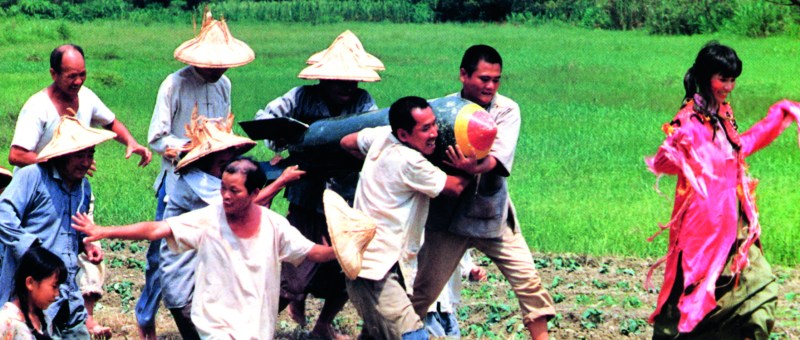
As good citizens of the empire, the children are asked to participate in metals collection and are given rewards for their finds. Doo-doo gets extra again when he picks up shrapnel from an American bomb which sets up a more complex relationship with American imperialism that will arrive after the war when the island is essentially recolonised by the arrival of the KMT and a large influx of mainlanders fleeing the communist take over. When a bomb lands on the brothers’ land but doesn’t go off, they think it’s manna from heaven and determine to take it to the main police station in the town in the hope of a large reward, while the official is convinced he’s going to get a big promotion for this tremendous find. 

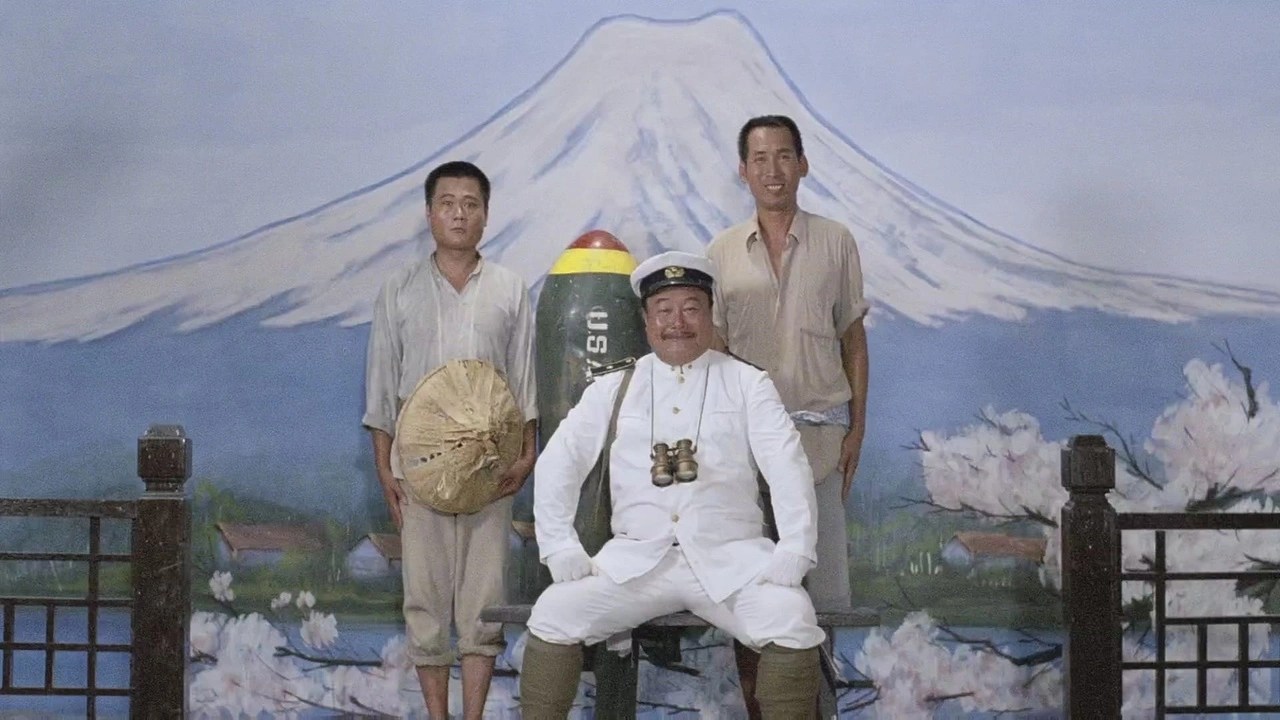
Everyone is so fixated on the economic potential that they’ve forgotten this is a bomb and even if it seems like a dud, there’s still a chance it could go off any second and this could all quite literally blow up in their faces. In this, the film seems to be satirising an over dependence on America who were the main backers of the KMT regime. The film was released shortly after the end of martial law during which there had been an attempt to rewrite the history of the island, preventing open discussion of the fact that Taiwanese men had died fighting for Japan and that the island had been bombed by the Americans. So impressed with themselves are they that the brothers and the official have their photo taken with bomb in-between and Mount Fuji backdrop behind as if signalling this complex network of relationships.

Still, even after the prize turns out not to be great riches after all but a hefty supply of fish, the Doo-doo and his grandmother cheer on the bombings hoping for more of the same in the future. The kids even put buckets out in the field waiting for the next raid hoping they can catch some of the shrapnel while forgetting that bombings are actually dangerous, rather than just lucrative, until being caught in one. Small moments of terror and sadness such as the brothers’ finding a frightened deserter hiding in their shed who doesn’t want to go to war because his wife’s pregnant and his family’s economically dependent on him, interrupt what is otherwise a warm and humorous depiction of rural life. A Fa and Big Mouth might be strawmen too, living their lives knowing little of the geopolitical situation but just trying to keep the crows off the grass long enough to get a little to eat before that too is taken away from them.


Strawman screened as part of the BFI’s Myriad Voices: Reframing Taiwan New Cinema.

Trailer (Traditional Chinese / English subtitles)

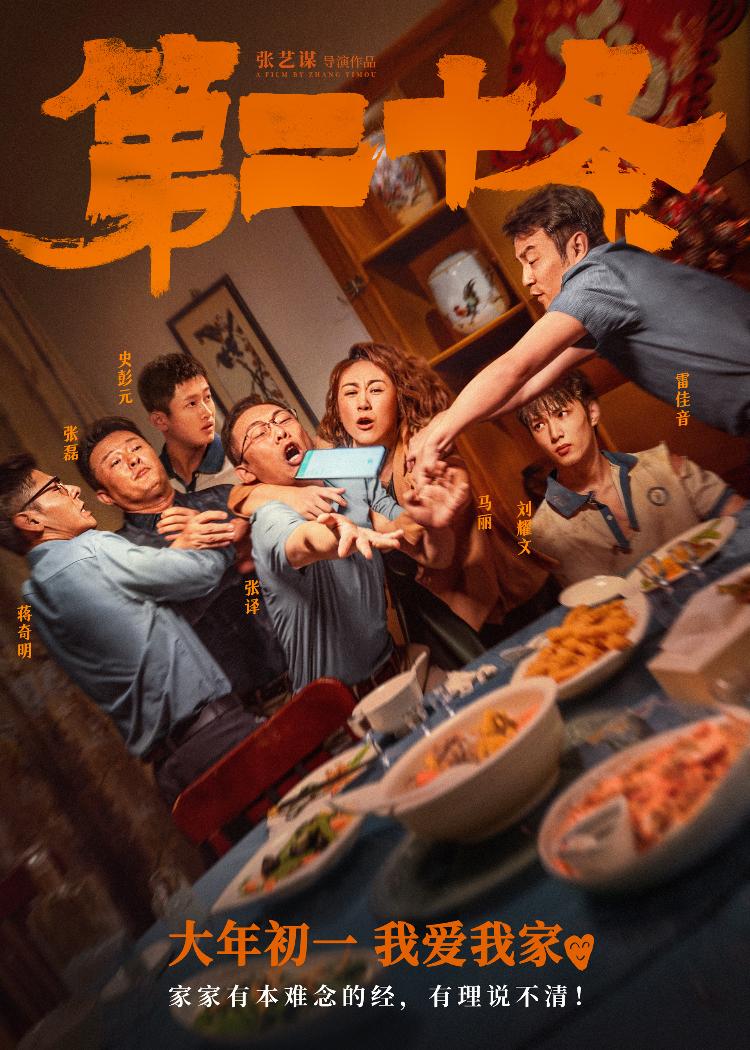
Article 20 (第二十条, Zhang Yimou, 2024)

There’s something quite strange going on in Zhang Yimou’s New Year legal dramedy Article 20 (第二十条, dì èrshí tiáo). Generally speaking, the authorities have not looked kindly on people standing up to injustice in case it gives them ideas, yet the film ends in an impassioned defence of the individual’s right to fight back in arguing that fear of prosecution should not deter “good” people from doing “the right thing” such as intervening when others are in danger. Nevertheless, the usual post-credits sequences remind us that the legal system is working exactly as it should and the guilty parties were all caught and forced to pay for their crimes.

In this particular case, the issue is one akin to a kind of coercive control. Wang (Yu Hewei) stabs Liu 26 times following a prolonged period of abuse and humiliation. After taking out a loan to pay for medical treatment for his daughter who is deaf and mute like her mother Xiuping (Zhao Liying), Wang was terrorised by Liu who chained him up like a dog and repeatedly raped his wife. Prosecutor Han Ming (Lei Jiayin) eventually argues that his attacking Liu qualifies as self defence under Article 20 of the constitution because even if his life was not directly threatened at the time it was in the long term and he did what he did to protect himself and his family from an ongoing threat.

Han Ming becomes mixed up in several different cases along the same lines only with differing levels of severity. Some years ago he’d worked on the case of a bus driver who was prosecuted after stepping in to help a young woman who was being harassed by two louts. His problem was that he got back up after they knocked him down and returned to the woman which makes him the assailant. Zhang has spent most of his life since his conviction filing hopeless petitions in Beijing. Meanwhile, Han Ming’s son, Chen (Liu Yaowen), gets into trouble at school after stepping in to stop obnoxious rich kid and Dean’s son Zhang Ke from bullying another student.

Now jaded and middle-aged, Chen first tells his son that he should he give in an apologise to get the boy’s litigious father off his back though Chen is indignant and refuses to do so when all he did was the right thing in standing up to a bully. Bullying is the real subject of the film which paints the authoritarian society itself as a bully that rules by fear and leaves the wronged too afraid to speak up. The choice Han Ming faces is between an acceptance of injustice in the pursuit of a quiet life and the necessity of countering it rather than live in fear while bullies prosper.

The thesis is in its way surprising given that the last thing you expect to see in a film like this is encouragement to resist oppression even if the idea maybe more than citizens should feel free to police and protect each other from the immorality and greed of others. It is true enough that it’s those who fight back who are punished, while the aggressor often goes free but according to Han Ming at least the law should not be as black and white as some would have nor be used as a tool by the powerful, or just intimidating, to oppress those with less power than themselves. 

Other than the theatrical drums which play over the title card, there is curiously little here of Zhang Yimou’s signature style while the film itself is not particularly well shot or edited. It also walks a fine line between the farcical comedy of Han Ming’s home life in which he perpetually bickers with his feisty wife (an always on point Ma Li) who worries he’s too interested in his colleague Lingling (Gao Ye) who turns out to be an old flame from his college days during which he too was punished for standing up to a bully by being relegated to the provinces for 20 years. A minor subplot implies that the justice-minded Lingling is largely ignored because of the sexist attitudes of her bosses who feel her to be too aggressive and often dismiss anything she has to say in what amounts to another low level instance of bullying. The film ends in a rousing speech which seems more than a little disingenuous but even so ironically advocates for the right to self-defence against a bullying culture while simultaneously making a case for the authorities having the best interests of the citizen at heart which would almost certainly not stand up particularly well in court.


Article 20 is on limited release in UK cinemas courtesy of CMC.

International trailer (English subtitles)

The Love Eterne (梁山伯與祝英台, Li Han-Hsiang, 1963)

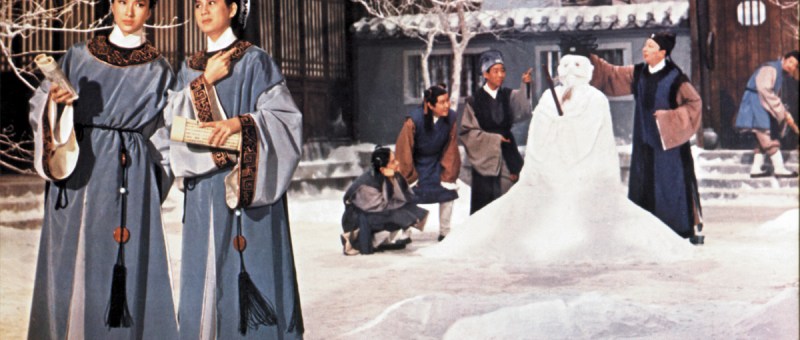
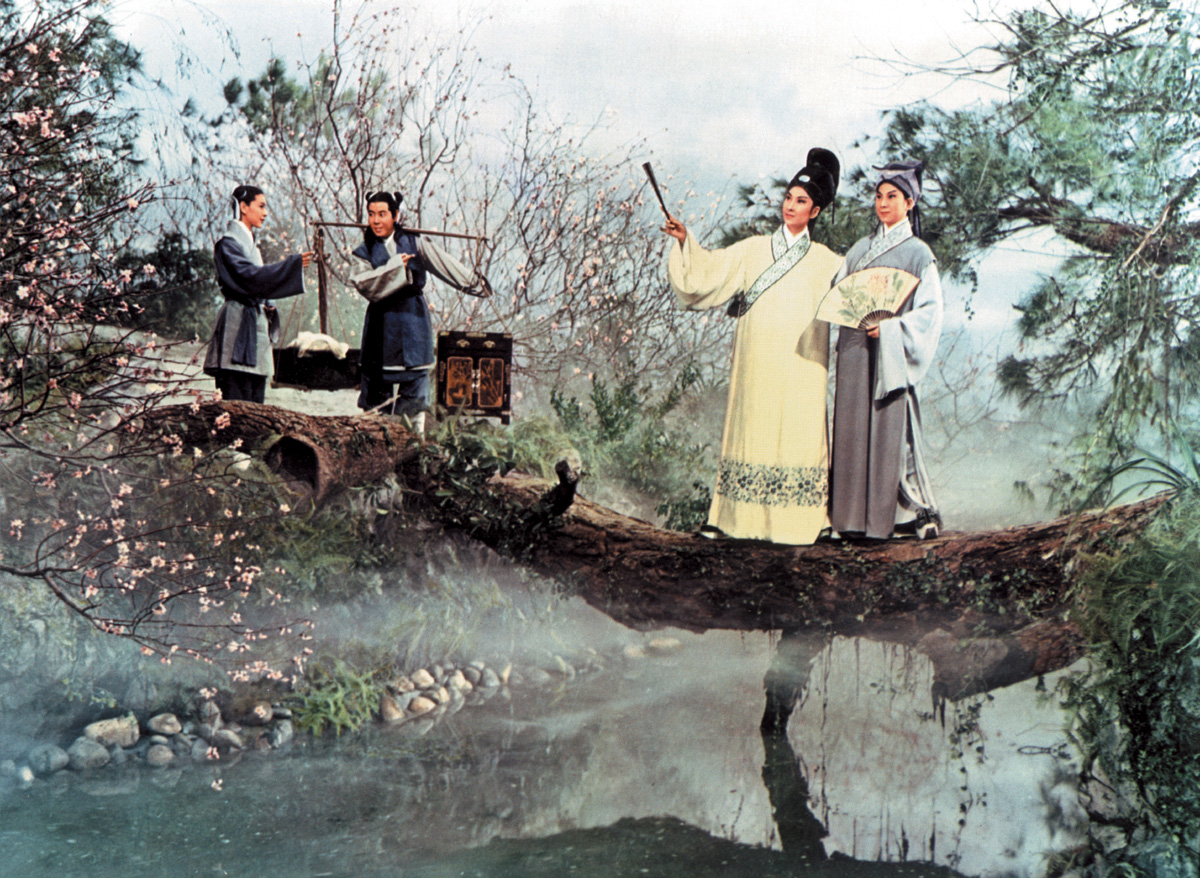
“We two have chosen ourselves. Others don’t recognise it.” “Even though others don’t recognise it, I still want to live and die with you.” This exchange occurs fairly late into Li Han-Hsiang’s retelling of the classic legend of the butterfly lovers, The Love Eterne (梁山伯與祝英台, Liáng Shānbóyǔ Zhù Yīngtái). One of several Huangmei opera films Li made at Shaw Brothers, where he was regarded as a pioneer and master of the genre, the film is despite its seeming traditionalism defiantly progressive not just in the undeniably queer undertones of its central love story but in its all but total rejection of patriarchal Confucianist thinking. 

Nowhere does Li make this more clear than in a brief cutaway in which birdcage hangs on a wall next to a tattered orange poster bearing the “double happiness” Chinese character synonymous with marriage. Marriage is the cage the heroine cannot escape. Her father tells her that she must marry and the choice not to do so does not belong to her, but neither does she have the right to choose a husband for herself for to do so would be to contravene the codes of filiality. Finally she is unable to go against her father’s wishes and agrees to sacrifice her pure love for a poor scholar to save her father’s reputation by marrying the son of a wealthy and influential family who is otherwise known to be a “playboy” unlikely to treat her well. 

The forces that separate noblewomen Ying-tai (Betty Loh Ti) and lowly student Shan-bo (Ivy Ling Po) are those of class and patriarchy, but the film invites another reading in their yearning to have their impossible love accepted by the world around them. In contrast to other tellings of the tragedy of the butterfly lovers, Li casts actresses in each of the leading roles one playing a woman who dresses as a man to acquire knowledge otherwise denied her because of her gender, and the other simply a woman playing a man. The romance between them is played with ironic coyness and good humour that deepens the tragedy that is to come in the incredible denseness of Shan-bo who takes none of the hints Ying-tai attempts to give him that she is really a woman but otherwise develops what occurs to him to be a deep yet platonic and brotherly love he only later comes to recognise as romantic on learning the truth. 

Nevertheless, it is impossible not to read their doomed romance as an attack on social conservatism and an advocation for romantic freedom. Though the final symbolism of flowers blossoming under a rainbow bridge is not one which would have occurred to a contemporary audience, the love between Ying-tai and Shan-bo is most transgressive because they have dared to choose it for themselves in the face of social hostility and if they cannot have it they will have death because to live without it is all but the same. Ying-tai’s response is to turn her wedding into a funeral and to marry in death, but the film does not present this as an inevitable tragedy of a love that cannot be but its reverse. The Heavens open and take pity on the lovers, condemning the world that would not allow them happiness in life by granting it in eternity. 

Rather than “women” as he would have it, the film places the blame firmly and directly on Confucianist thinking with the disguised Ying-tai directly challenging the teachings of the university where she is asked to recite the tenets that women are “insolent and ungrateful” while “charming girls make good companions”. It is Ying-tai’s father (Ching Miao) who is the true villain in caring little for his daughter’s feelings, firstly nearly letting her die in a hunger strike over not being allowed to go to school, and then refusing to listen to her rejection of his chosen suitor preferring to trade her for the social kudos of having married his daughter off to the most eligible of bachelors content to use her as a tool for his own advancement while indifferent to her prospects for future happiness. Li begins with his heroine “worried and confused” and captures something of the sense of constraint even within the sumptuous environment of her gilded cage before granting her freedom in the expanse of the natural world which thinks nothing of the “absurd rules of man”. 


The Love Eterne screens at the Barbican 25th April as part of this year’s Queer East in collaboration with Hong Kong Film Festival UK.

Trailer (no subtitles)