Kakashi (案山子, Norio Tsuruta, 2001)

There’s a village in Japan that’s mostly inhabited by scarecrows. One of the last remaining residents began creating them to replace something that had been lost, fashioning effigies of those who had passed away and immortalising them as if clinging to a distant past long before the shadows of rural depopulation were cast over the village. In a way, it’s an expression of grief or at least a lament for a loss of community and a sense of increasing loneliness and isolation. 

Adapted from Junji Ito’s manga, Norio Tsuruta’s Kakashi is also in its way about grief and the way in which it can consume those left behind so that they too have no more desire to live. Dr Miyamori (Kenzo Kawarasaki) later explains that in the village they co-exist with death and he returned to his home town in the hope that he could save his daughter, Izumi (Ko Shibasaki), through its peculiar magic of resurrecting the deceased as human scarecrows. As he freely admits, he could not accept his daughter’s death and so has chosen to stay here in the village though alive himself rather than attempt to remake his life without her.

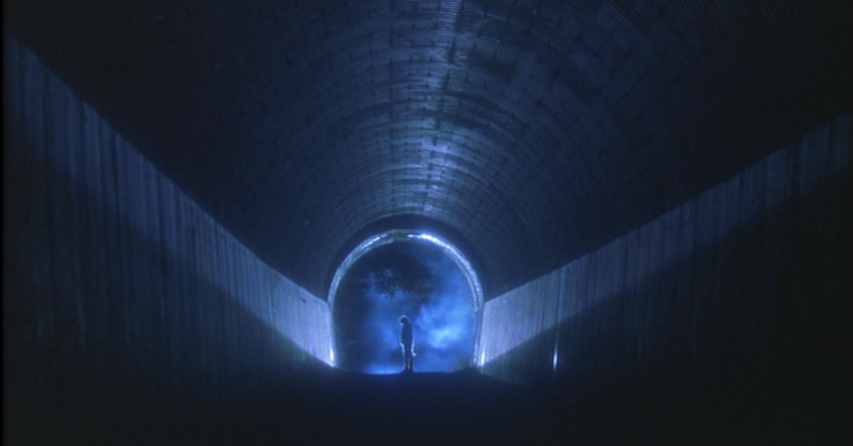
The village itself appears to exist slightly outside of the mortal realm as Kaoru (Maho Nonami) discovers on encountering the long tunnel that leads to its entrance. Her car breaks down half-way through signalling her liminal status as one who does not yet belong on either side. It’s not quite grief that’s brought her here but still a nagging sense of foreboding in that she’s come in search of her missing brother, Tsuyoshi, after discovering a letter from an old school friend, Izumi, next to his telephone. Kaoru appears confused as to why the letter should be there and travels to the village hoping for answers, assuming that Tsuyoshi (Shunsuke Matsuoka) may have travelled there in search of Izumi.

As the landlady lets her into his empty flat, Kaoru explains that she is his only family and there’s a suggestion that her attachment to him is unnatural, bordering on the incestuous. A policeman taking a look at the photo Kaoru hands him remarks that they look like a couple, which they do, leading her to stuff the photo back in her pocket as if she were embarrassed. To that extent, she’s come to reclaim Tsuyoshi, not just from death, loneliness, grief, and depression, but from Izumi or at least the spectre of her. In life, she feared that Izumi would take him away from her and at least in Izumi’s mind frustrated their romance out of romantic jealously. Dr Miyamori implies it was this sense of despair that contributed to her death and it’s clear that Izumi’s mother also blames Kaoru while Izumi accuses Kaoru of being forever in her way.

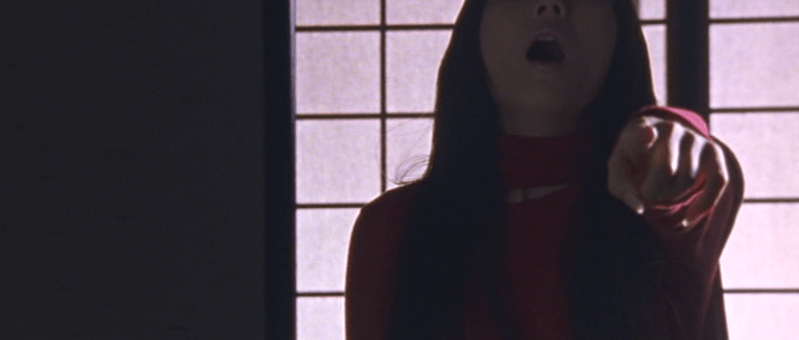
But then again, she did not bring Kaoru to the village and is not targeting her personally out of vengeance. Rather, she has moved beyond that as she finally’s about to become “herself” thanks to the village’s dark magic and the following day’s scarecrow festival, and therefore no longer needs to care about the resentments of her mortal life even if her father says that her evil spirit has empowered the town. There is definitely something quite creepy in this weird village with its shades of the Wicker Man in its strange ritual and humanoid effigies where improbable numbers of children softly blow pinwheels under a large windmill that seems to be moving time itself. Tsuruta even borrows a particularly eerie shot from Don’t Look Now and emphasises the liminal qualities of the village in Dr Miyamori’s advice that Kaoru leave as soon as her car is fixed otherwise she may no longer wish to.

The village is apparently full of those like him who are trapped but wilfully so because they no longer desire to leave. Kaoru attempts to help one of them, a young living woman from Hong Kong unable to let go of the memory of her late father whose scarecrow eventually tells her to go. It’s a place for those who have no other place to go to because they cannot let go of their grief and despair. Thus Kaoru is pulled towards the edge of the tunnel, not so much to free her brother as, in a way, herself by allowing her grief to consume her and consenting to live this empty life alongside death rather than allow herself to accept her loss.


Trailer (no subtitles)

The Asadas! (浅田家!, Ryota Nakano, 2020)

There’s a kind of irony at the centre of Ryota Nakano’s The Asadas! (浅田家!,Asada-ke!) in that its photographer hero makes a name for himself photographing his family yet at times neglects them or appears curiously insensitive, perhaps even selfish in the pursuit of his dreams. Inspired by the life of photographer Masashi Asada, the film is at once a celebration of the family and an advocation for the tangibility of a photograph as a repository of memory that can bring comfort even in the absence of its subject.

The first part of the film is narrated from the perspective of Masashi’s (Kazunari Ninomiya) much more conventional older brother Yukihiro (Satoshi Tsumabuki) who is generally exasperated by and a little resentful of the family’s indulgence of Masashi, a seeming free spirit who acts on impulse and gives little thought to the consequences of his actions. People frequently describe both Masashi and his father Akira (Mitsuru Hirata) as “not normal,” and there is something unconventional in their family setup with Akira a househusband in a small town in the 1980s while his wife Junko (Jun Fubuki) supports the family with her career as a nurse. It’s Akira who first gives Masashi a camera and his dream of becoming a photographer which he eventually achieves through taking amusing pictures of his family in various scenes casting them as firemen, racing drivers, or even gangsters. 

Masashi attempts to get the photos published as a book, but is quickly dismissed and told that no one wants to buy his personal family photo album. Though the publisher may have a point that in general people value photos of their own family but not those of others, the family photo itself is treated as a triviality as if it had no real worth. The same could be said of Masashi’s work, that some do not take it seriously because the subject is his own family. Yet Masashi finds new value in it in his ability to capture the essence of a moment in family life through a staged photograph such as that he designs for the family of a little boy who is dying of a brain tumour.

In the back of his book, eventually published by an eccentric woman who runs a small press and decides to take a loss because she found the photos so funny, Masashi pledges to travel anywhere to take similar photos for other families which of course means he is often separated from his own whom he then rarely photographs much to his father’s disappointment. After leaving for university, he had barely contacted them for two years while after travelling to the zone of the 2011 earthquake and tsunami he abruptly drops out of contact with his long suffering girlfriend Wakana (Haru Kuroki) after becoming immersed in the task of cleaning up the orphaned photos found among the wreckage. 

Of course, there are those who object to his work thinking that there are more important things to do while so many people are still missing, but as he discovers recovering the photos gives people a sense of comfort and healing as if they were getting back a little bit of the past that had been taken from them and most particularly if the people in the photographs are no longer here. A little girl who’s lost her father is alarmed and resentful that she can find no photos of him, realising that he was rarely in the ones they took as a family and wondering if that meant he didn’t really love them hinting at an ironic sense of parental absence in that parents often take the photos of their children so do not appear themselves but still leave their imprint in a sense of absence in which every photograph also contains the invisible presence of the photographer.

And then sometimes the reverse is true. A grandmother comes looking for pictures of her grandchildren, but ironically finds pictures only of herself. The triviality with which the family photo was regarded seems almost offensive for something that can offer such comfort and warmth in a time of profound grief as a tangible link to a past that will never return. Masashi makes his family’s unrealised dreams come true through his photos, bringing them joy if also a little anxiety in a creating a perfect record of their unconventional family while Nakano does something similar capturing of the essence of a happy family life filled with equal parts laughter and tears.


The Asadas! screens Feb. 24 as part of Family Portrait: Japanese Family in Flux

Original trailer (Traditional Chinese / English subtitles)

Roleless (宮松と山下, Masahiko Sato, Yutaro Seki, Kentaro Hirase, 2022)

Ever felt like a bit player in your own life? For the hero of Masahiko Sato, Yutaro Seki and Kentaro Hirose’s Roleless (宮松と山下, Miyamatsu to Yamashita), it’s more like he lives ten thousand lives if only for an instant in his life as an extra and may have, in a way, cultivated an image of himself as a blank canvas who no longer exists in an absolute form. In a way you could call it multiverse living, but when confronted with a possible point of origin, a lost selfhood he may have forgotten or wilfully rejected, it presents him with an existential question not so much of who he wants to be but if he wants to be at all. 

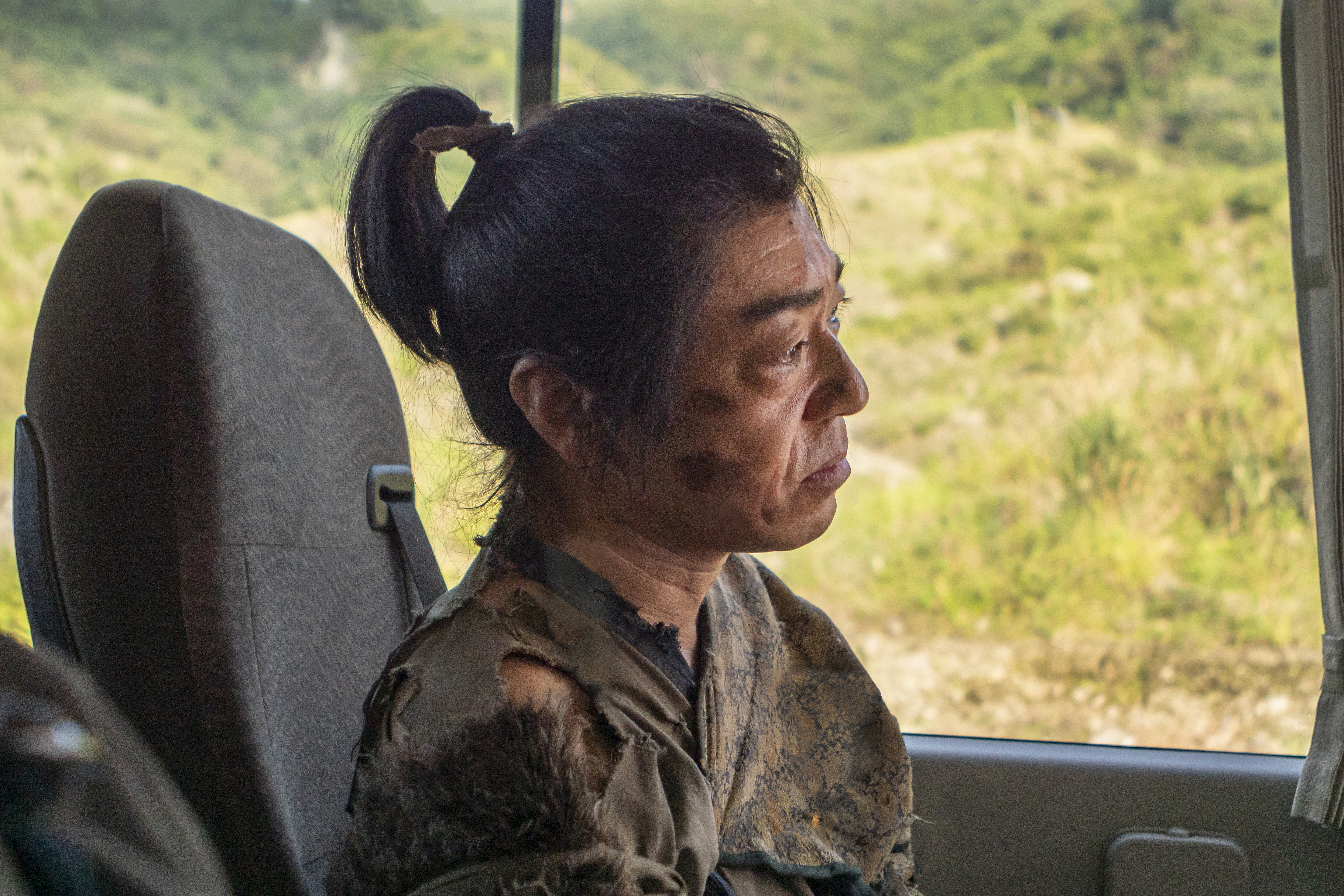
We first encounter him as an unlucky retainer in a jidaigeki who is quickly cut down only to rise again and run around the back to give his name as “Miyamatsu, a samurai” to the prop girl who gives him a different hat so can he go back out there and die a second time. Miyamatsu has an air of perpetual blankness in his often vacant expression as if he were both there and not. The film often wrong foots us and we can never be sure what is “real” and what part of a movie, except that it all obviously part of the movie we ourselves are watching. We see what we think are moments from Miyamatsu’s private life only to realise that the camera was rolling all along when someone shouts “Cut!” and it becomes apparent that Miyamatsu was not its main focus. 

Along the way he gives hints of his loss of selfhood, earnestly replying that he doesn’t know when a fellow extra quizzes him on the watch he’s wearing and how he got it but his discomfort could stem from several places and it’s never quite clear how much of an interior life Miyamatsu creates for his various roles, whether he really does just see them as performers of an action, is playing “himself” as he peers over a police cordon at a crime scene, or is a fully fledged person with an individual history. Later he tells a colleague who admires the way he fills in forms at his part time job working at a cable car that he’s always enjoyed the process of filling in a predetermined frame but also that he likes the floating sensation the cable cars give him. 

All of which might explain why he’s so destabilised when a man (Toshinori Omi) approaches him claiming that they worked together as taxi drivers more than a decade earlier and that his name is Yamashita. He apparently “disappeared” after sustaining a head injury and has been “missing” ever since. The man takes him back to the home of his much younger sister, Ai (Noriko Nakagoshi), who has since married and appears to be incredibly relived to see him even if it seems she might also be hiding something. He wonders if it’s suspicious that there are no photos of him in their family home, but is reminded that with the age difference he hadn’t lived there while she was a child and only came back after their parents died to take care of her because she was still in high school. Her husband, Kenichiro (Kanji Tsuda), seems to be constantly needling him though again, it isn’t always clear whether he actually wants him to remember or suspects that he already does and is choosing to pretend not to. 

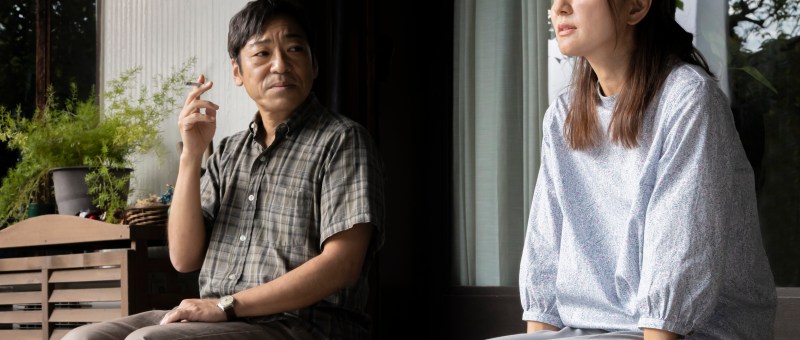
Even so, Miyamatsu slides into the life of Yoji Yamashita as easily as any other role finding his way back into the character with unexpected moments of connection such as the muscle memory that grants him a perfect baseball swing, or the strangely familiar taste of cigarettes to a non-smoker. Then again, there’s obviously something sinister going on, a darkness underlying his “personal” history that might have made him want to absent himself from himself or else an oppressive sense of bullying that is reflected in Ai’s hesitant answer when Yamashita remarks on what a good husband Kenichiro seems to be. Miyamatsu claims that he’s ever only played one “real” role, and in a way this is it as he begins to claim something like a backstory even if it’s one he may not ultimately want that nevertheless renders him a little less vacant. Mysterious and unsettling, the film asks some probing questions about the nature of identity, whether it is self-defined or gifted, but also discovers a kind of serenity in Miyamatsu’s free floating life of transient realities.


Roleless screened as part of this year’s Nippon Connection

Clip (no subtitles)