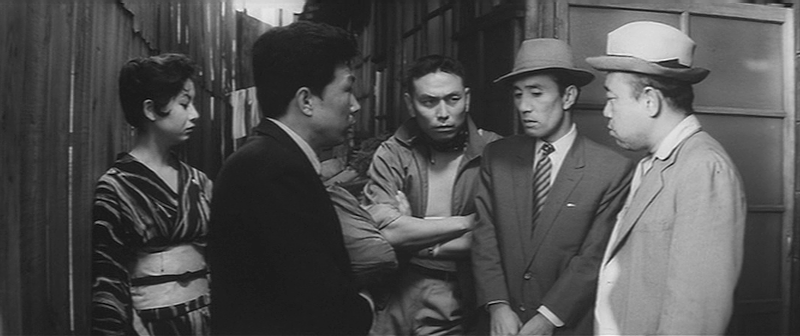

In the noir films of the immediate post-war era, the protagonists are often haunted by an inescapable past that prevents them from moving on into the new democratic Japan. But in Shohei Imamura’s Endless Desire (果しなき欲望, Hateshinaki Yokubo) the situation is ironically reversed as a group of former soldiers who on the surface of things at least seem to have made moderately successful lives for themselves reunite to dig up buried treasure from the dying days of the war greedy for a little more glamour than the world has seen fit to show them.
Their venal amorality is directly contrasted with the bumbling earnestness of Satoru (Hiroyuki Nagato), a young man who fears his childhood sweetheart, butcher’s daughter Ryuko (Sanae Nakahara), is going to marry another man because he is unemployed and cannot find a job in the still difficult if steadily improving post-war economy. As such, he’s incredibly excited by the opportunity to get into the real estate business, wandering around town dressed in a suit and carrying a briefcase to scout properties or otherwise doing odd jobs for the gang, which is a shame because unbeknownst to him the business is a sham set up as a front by the crooks who’ve rented a vacant shop from Satoru’s land shark dad so they can tunnel their way to the treasure which they think is buried under Ryuko’s butcher’s shop.
The changing nature of the times is rammed home by the fact that the shopping district, which stands atop the site of the former military hospital where the gang buried a barrel full of stolen morphine at the end of the war ten years previously, is itself about to be torn down. Effectively a post-war shantytown, the area is now ripe for redevelopment with the economy beginning to bounce back thanks to the stimulus of the Korea War. The post-war era is not quite “over”, but it’s definitely on its way out which makes the gang’s determination to recover the stolen morphine all the more ironic especially as the market for hard drugs may not be as a lucrative as it once was not to mention to the logistical difficulties of turning it into cash.
Nevertheless, the desire for it immediately sets the gang against each other. The problem is that the lieutenant, Hashimoto, who set the whole thing up has apparently died and extra person has turned up to claim some of the loot despite the gang members having been told there should only be three of them. They were not particularly close in the war and cannot exactly remember each other while Hashimoto had them all work separately without knowing who else was on board so they don’t even know which one of them is the potentially uninvited guest. Meanwhile, the presence of a woman, Shima (Misako Watanabe), who claims to be Hashimoto’s sister sets them all on edge with masculine jealously as she sometimes gleefully plays the femme fatale later even trying to seduce the innocent Satoru, convincing him she’s a victim of domestic violence in need of rescue in an attempt to quiet his concerns over what might be going on at the shop.
The fact is that none of the gang members can really claim to be desperate, all are simply greedy and selfish silently plotting to keep all the money for themselves rather than share it. One of them is eventually crushed under the barrel, an embodiment of their insatiable desire, but with their dying breath insists it’s theirs and no one else can have any. As old man later says, this kind of greed only leads to a bad end unlike the greed he’s patiently practiced over decades which seems to be taking a little here and there where you find it such as asking Shima for some extra money for “helping” her before asking the police about a reward and turning her in anyway.
Even Satoru’s dad is “greedy”, renting the crooks a shop he new would soon be knocked down and then complaining when his tenants try to take the tatami mats and shoji doors they’d paid for themselves out of his property. Greed maybe the way of the world, at least for those who unlike the diffident Satoru do not lack for self-confidence, but endless desire has only one reward. Darkly comic and often deeply ironic, Imamura plays with a noirish sense of fatalistic retribution but finally returns to a sense of childish innocence in the bumbling courtship of Satoru and Ryuko who may be her own kind of femme fatale playing two suitors against each other while refusing to be dominated by any man but nevertheless riding off into the sunset on her bicycle with a diffident Satoru chasing along behind her.

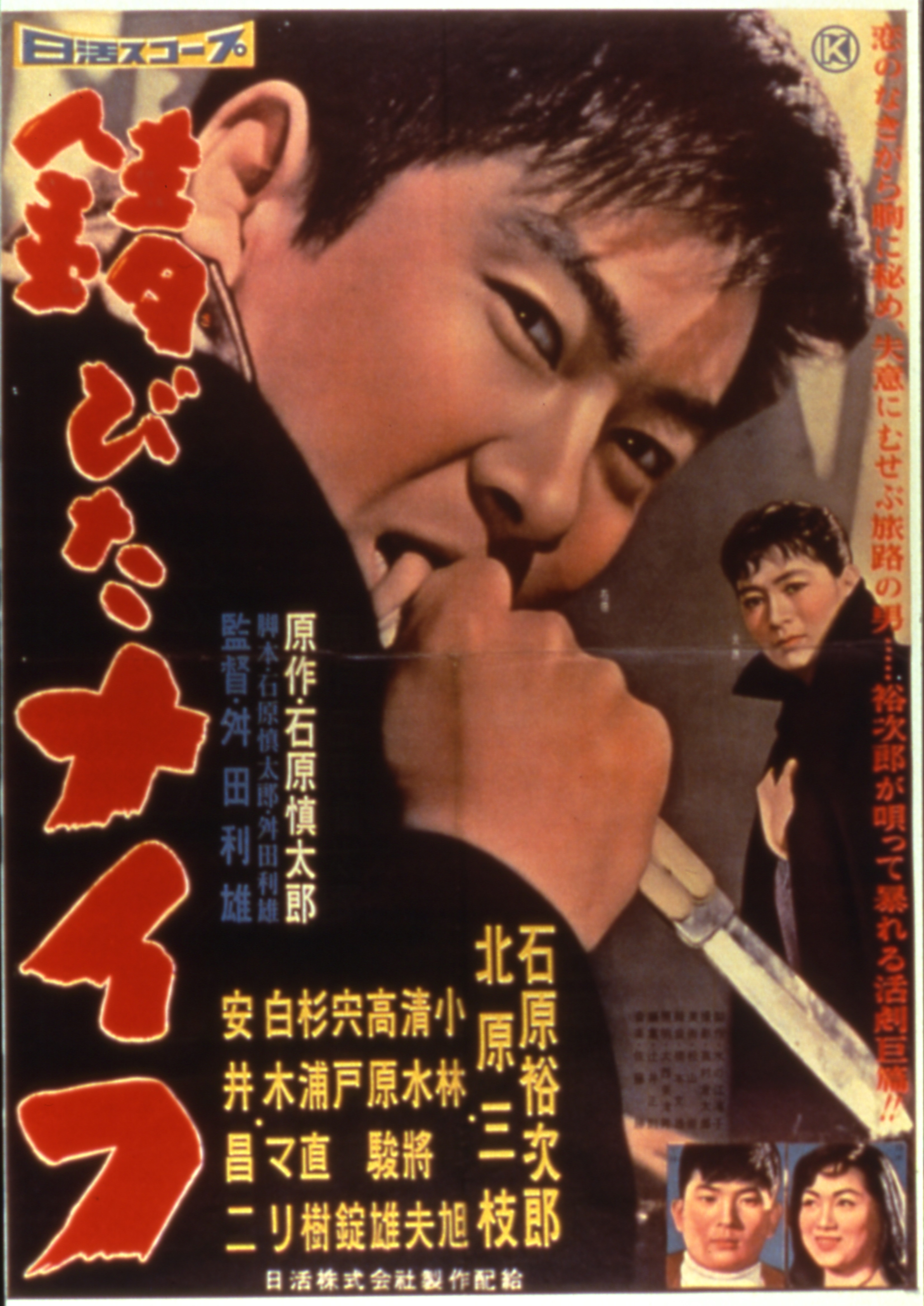 Post-war Japan was in a precarious place but by the mid-1950s, things were beginning to pick up. Unfortunately, this involved picking up a few bad habits too – namely, crime. The yakuza, as far as the movies went, were largely a pre-war affair – noble gangsters who had inherited the codes of samurai honour and were (nominally) committed to protecting the little guy. The first of many collaborations between up and coming director Toshio Masuda and the poster boy for alienated youth, Yujiro Ishihara, Rusty Knife (錆びたナイフ, Sabita Knife) shows us the other kind of movie mobster – the one that would stick for years to come. These petty thugs have no honour and are symptomatic parasites of Japan’s rapidly recovering economy, subverting the desperation of the immediate post-war era and turning it into a nihilistic struggle for total freedom from both laws and morals.
  Windows on Worlds