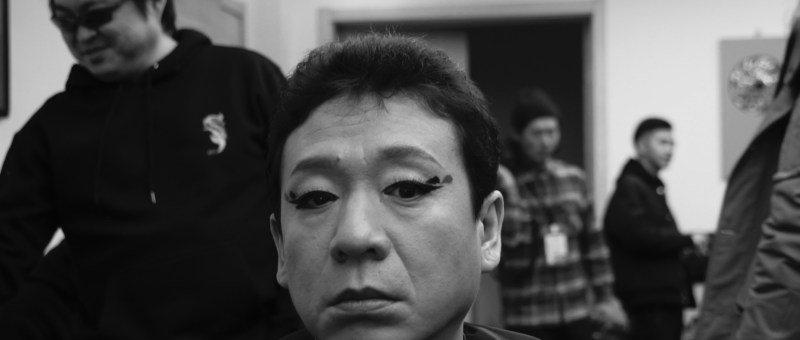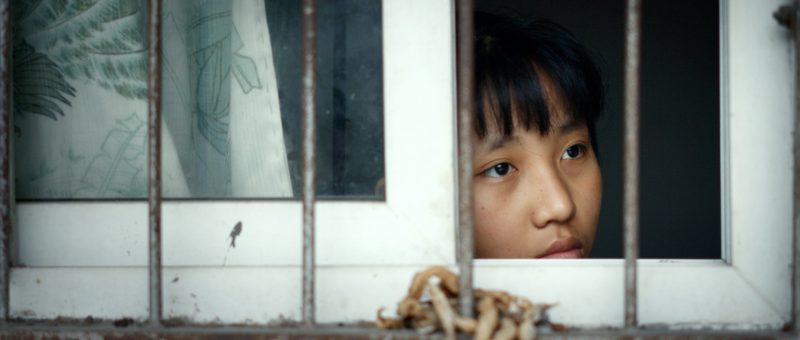
Increasing Echo (修行, Chienn Hsiang, 2021)

Marriage is a curse from which there is no cure in Chienn Hsiang’s horror-inflected pandemic-era social drama Increasing Echo (修行, xiūxíng). Though the English-language title may hint at the spiralling quality of the shared resentment between a husband and wife no longer, if they ever had been, happy with each other, the Chinese reflects on the heroine’s spiritual journey as she searches for a release from her internalised imprisonment but finds it increasingly difficult to “become a little bird and fly away”. 

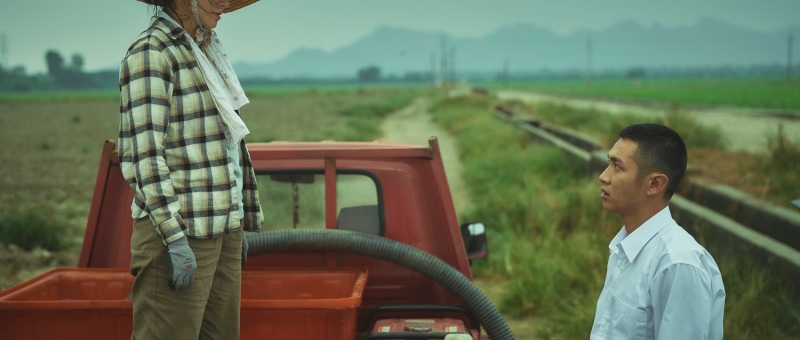
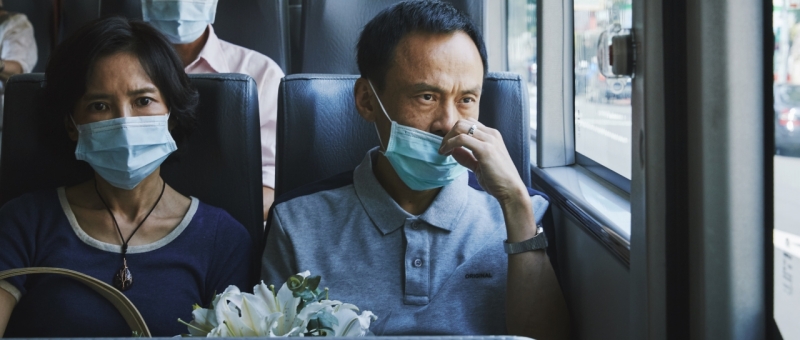
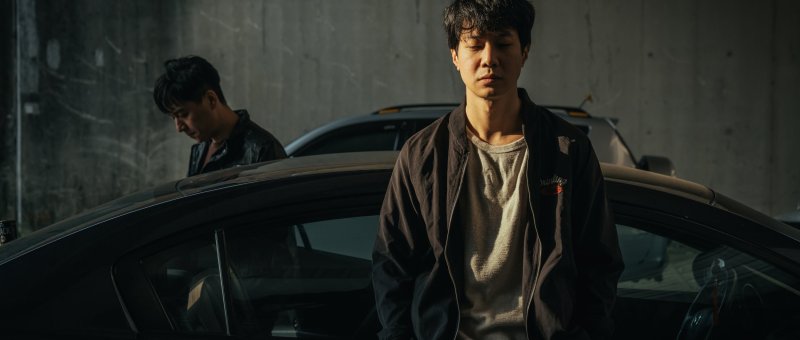
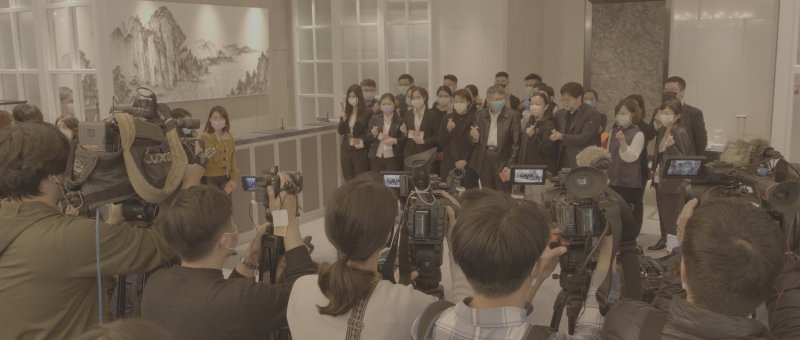
Reuniting with Exit’s Chen Shiang-chyi, Chienn opens the film with a surreal scene of a collection of people dressed in white stumbling around zombie-like in a park while some kind of guru instructs them to listen to the voice inside which will guide them towards their own tree. One of the blindfolded devotees, Mrs Yan (Chen Shiang-chyi) eventually embraces a trunk but subsequently faints after a cicada lands on her arm. Encounters with the natural world will prove increasingly ominous, yet we can infer from Mrs Yan’s distress that even if she has managed to find her own tree or at least a solid trunk to hang on to it has not given her the sense of release that she is seeking. With her son about to be married, she finds herself trapped in a loveless relationship with her equally depressed husband Fu-sheng (Chen Yi-Wen) who sips from a hip flask all day at the office, ignores his wife’s calls, and sits in a depressing convenience store cafe every evening to delay having to go home. 

As we later discover the major source of discord between the pair is Fu-sheng’s infidelity, Mrs Yan having discovered his affair with his secretary, Ke-yun (Huang Rou-Ming), some years previously after hiring a private detective. Never really healed, the wound is reopened when Mrs Yan receives a surprise phone call from Ke-yun’s sister who is stuck abroad due to COVID-19 and wants Fu-Sheng to visit his former mistress who has been living in a nursing home for some years having sustained some kind of brain injury that has left her largely unable to communicate. Though originally outraged, Mrs Yan pays a visit to Ke-yun herself and then goads Fu-Sheng into accompanying her though whatever it was she intended the event only forces Fu-sheng into revolt taking off with the dog in tow leaving her all alone in the family home. 

For his part, Fu-sheng quite clearly identifies with the family dog, Terry, surreptitiously feeding him junk food in the park after being admonished for giving him salty table scraps. Where Mrs Yan would prefer to keep him safely at home, Fu-Sheng keeps letting Terry escape to wander freely with the result that he ends up with a canine venereal disease. The vet advises Mrs Yan have him neutered, but this is obviously something Fu-sheng can’t countenance himself feeling fairly emasculated and trapped within his marriage. In this the film perhaps leans uncomfortably leans into patriarchal social codes in implying that Mrs Yan is at fault for limiting her husband’s sexual freedom with even the private detective she hires to find him telling her that it’s good to let him stay out a little and that he’ll come home once he’s got bored and had enough which sounds like statement more applicable to a randy dog like Terry or a child who’s wandered off in a huff than a cheating husband indifferent to his wife’s feelings and willing to risk his relationship with his son by not showing up for any of the wedding prep. 

The implication that Mrs Yan has brought this on herself is further deepened by her gradually fracturing sense of reality born of the array of pills we see her taking each morning and her investment in a cult-like new age religious practice which is later betrayed when she returns to her spiritual home and discovers someone’s put it up for rent. Her world is full of eeriness and ominous symbols from the pigeons which seem to follow her around, to the ghostly corridors at the hospital to which Ke-yun has been consigned with Mrs Yan perhaps also harbouring a sense of guilt though each of them is themselves imprisoned if in an obviously different sense. In this age of social distancing, Mr and Mrs Yan appear to have had a lengthy head start, their alienation from each other later leading towards an act of violence which provides no sense of release only further constraint. Broken by the anxious knelling of Buddhist prayer bells, Increasing Echo hints at the radiating legacies of emotional betrayal but paints the marriage of Mr and Mrs Yan as a kind of maddening curse for which there is no cure only perpetual misery amid the impossibility of separation. 


Increasing Echo screens in Chicago April 9 as part of the 14th season of Asian Pop-Up Cinema.

Original trailer (Traditional Chinese / English subtitles)

You Have To Kill Me (我是自願讓他殺了我, Chan Chun-Hao, 2021)

An earnest policeman discovers nothing is quite as he thought it to be in Chan Chun-Hao’s adaptation of the novel by Feng Shi, You Have to Kill Me (我是自願讓他殺了我, wǒ shì zìyuàn ràng tāshā le wǒ). Drawn into a dark web of intrigue which eventually points to abuse of power and a low regard for human life, he is forced into a realisation that even as a law enforcement officer he can never be certain of what is real and what is not while caught in the middle in a battle of between parents each trying desperately to protect their sons. 

About to propose to his live-in girlfriend Kai (Janel Tsai), Shing’s (Cheng Jen-shuo) world comes crashing down when he and his partner Ye-ze (Xue Shi Ling) are dispatched to the mountains and discover that she is the victim of the homicide they’ve been sent to investigate. Shing apprehends the apparent killer, Li Zi-jian (Snoopy Yu), running away from the scene, but the situation is complicated when it turns out that Zi-jian is the son of a local politician, Chairman Li (Yin Chao-Te), and while he admits to the killing claims that he did it at the instigation of Kai who was suffering from terminal cancer and wanted him to help her escape her suffering. A look at Kai’s medical records bears out his story, but on closer examination Shing realises the documents don’t add up. His suspicions are confirmed when Kai’s parents, whom he had seemingly never met, arrive and fail to identify the body claiming instead that it is another woman who had been harassing their daughter, Lin Jing. 

Shing is forced to accept that he might not have known the woman he wanted to marry and that their relationship was founded on a lie, uncertain how much of any of it might have been real. Meanwhile he runs into a series of bureaucratic roadblocks as the chairman continues to disrupt the investigation in order to protect his son, eventually having Shing taken off the case leading him to investigate all alone discovering even more uncomfortable truths that cause him to question his reality. Leaving aside the minor plot hole that it seems unusually easy to live under an assumed name in contemporary Taiwan even if you’re involved in activities which would generally require an extensive background check, Shing has good reason to be confused as he dives ever deeper into an amoral morass in which those with power are prepared to manipulate it for their own ends without much thought for the lives of others. “That’s how much a person is worth” the chairman baldly states signing a settlement agreement over something else his son may or may not have done, later claiming that it doesn’t matter if he caused someone’s death “accidentally” and he’d do it all again to save his son. 

Even so, the chairman may have limits in that his attempts to manipulate the system are bureaucratic in nature and seemingly unnecessary at least it seems as if there would be easier ways to achieve his aims without directly harming others even if they would risk lives indirectly. Meanwhile his accomplice is also seemingly involved in order to protect their family, willing to compromise themselves morally to protect their elderly relatives while believing nothing that bad would come of their actions. Then again, Shing finds himself on the receiving end of further recriminations accused of having failed to protect the woman he knew as Kai from herself leaving her with only a dark path to ensure that justice would be done and corruption exposed. 

While Zi-jian feared he was a burden to his father feeling himself unloved even as he went to such drastic lengths to protect him, Kai/Jing was also afraid to fully trust Shing fearing she’d one day disappoint him unable to move on from her traumatic past without putting it to rest. Taking aim firmly at the societal corruption that allows the rich and powerful to misuse their position for their own gain while ordinary people suffer Chan’s noirish drama situates itself in a murky world of constant uncertainty in which even an earnest policeman can be largely oblivious of the lives of those around him while the purest of motivations can lead to only darkness and misery.  


You Have To Kill Me streams in the US April 4 – 10 as part of the 14th season of Asian Pop-Up Cinema.

Original trailer (English subtitles)

No Man is an Island (沒有人該成為孤島, Jay Chern, 2022)

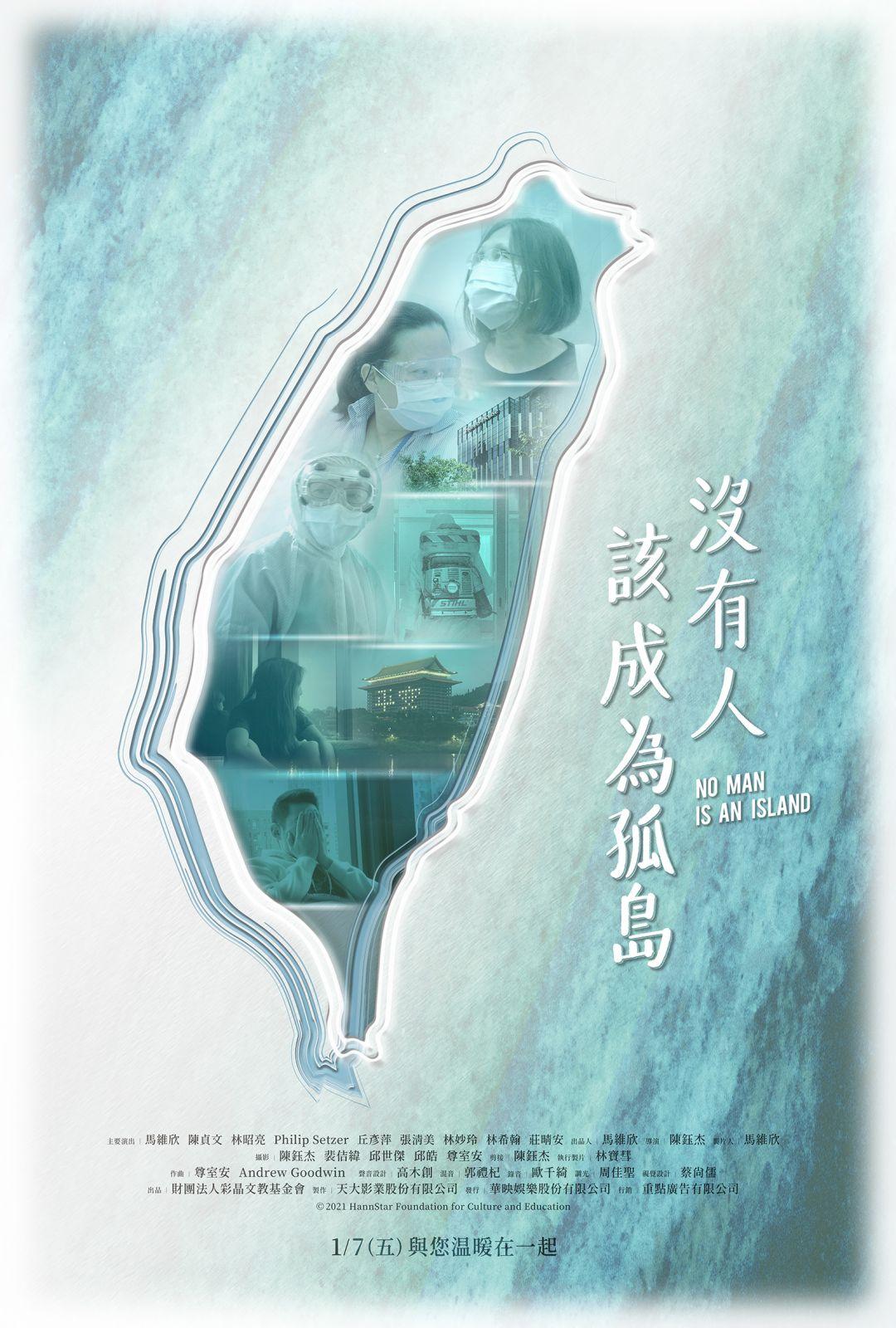
For much of the pandemic, Taiwan was regarded as a success story having largely managed to avoid mass infections through a well formulated public health programme that meant for many life could carry on more or less as normal. Jay Chern’s documentary No Man is an Island (沒有人該成為孤島, méi yǒurén gāi chéngwéi gūdǎo) focusses on the sometimes forgotten frontline workers that made that sense of normality possible while losing their own in situating itself in a small hotel which agreed to become a quarantine facility for travellers arriving from overseas. 

Chern spends much of his time with the hotel’s manager, Rebecca Ma, who at one point describes the decision to house those needing to quarantine as the biggest mistake of her life but also something she ultimately felt was the right thing to do, that it would be wrong to refuse when they had the capability to help. Nevertheless, she makes clear that her greatest responsibility was to her staff, negotiating with the government that they’d only agree to offer quarantine services if they’d be provided with full PPE while we can also see the extensive procedures they must take to keep the the guests and themselves safe disinfecting rooms after guests leave and allowing several hours before deep cleaning them while running UV disinfectant lamps throughout the building. 

Meanwhile, they also face some pushback from the local community upset by the close proximity to those who may be carrying COVID-19 only to be reminded that if they weren’t quarantining at the hotel they’d have to go somewhere else and could even be staying in the apartment below theirs so the point is in many ways moot. Even within the hotel Ma is well aware of how boring and distressing being trapped in quarantine could be even in a hotel as nice as hers fully preparing herself for a series of picky complaints from guests with quite literally nothing else to do taking out their frustrations on the front desk team. Meanwhile, others forget that it’s not a holiday, they’re in quarantine, and want access to normal hotel services around the clock not always taking kindly to being reminded that certain things may not be possible. 

With that in mind, it’s genuinely touching to see the level of care that the hotel staff have for those staying with them taking note of their mental health as well as the physical. Ma recounts personally preparing a meal for the first few quarantiners and is often seen organising special treats for the guests particularly in the holiday periods so that they don’t feel alone as if the hotel staff is their family even gifting pretty flowers and cupcakes for mother’s day as well as small toys to keep children entertained. She herself has been living away from her family in the hotel to keep everything running smoothly while further members of staff move in later during the stricter lockdowns put in place after the situation intensifies ironically because of lax quarantine processes at another hotel which allowed airline personnel to leave earlier than otherwise recommended. 

Mindful of her responsibilities, Ma makes a point of leading by example never asking anyone else to do something she wouldn’t or put themselves in harm’s way unnecessarily. One employee reflects that she was so frightened that she wrote her will and explained to friends what to do with her ashes should the worst happen, but in general the atmosphere among the staff seems cheerful and upbeat, Ma giggling that she feels like a naughty child ringing people’s doorbells and then running away to let them know their meals have arrived. Privately she admits that the situation can be stressful because no mistakes can be made, it is quite literally a matter of life and death, but also a job she just needs to keep doing to the best of her ability. 

Chern also speaks to a few of the quarantiners one of whom is his own mother returning from the US to care for his bedridden grandmother, while others have returned to be closer to their families or because it is simply safer in Taiwan than wherever they were before, allowing each of them to chronicle their experiences in their quarantine diary as they try to stave off cabin fever and the anxieties of their long journeys home. Hanns House has become for them a small safe haven until they’re able to go back out into the world. “Sometimes life isn’t about what we want or if you’re ready, but rather if it’s necessary” Ma adds, later reflecting that the pandemic is turning into a never-ending marathon, “If you can’t run, crawl to the very end”.  


No Man is an Island streams in the US April 4 – 10 as part of the 14th season of Asian Pop-Up Cinema.

Original trailer (English subtitles)

Journey to the West (宇宙探索编辑部, Kong Dashan, 2021)

An eccentric middle-aged man’s search for alien contact sends him on a quest for enlightenment in Kong Dashan’s deadpan epic Journey to the West (宇宙探索编辑部, Yǔzhòu Tànsuǒ Biānjí Bù). Inspired by the classic Chinese tale of the monk Tang Sanzang who journeyed west in order to bring true Buddhism to China in the company of the anarchic monkey king Sun Wukong, Kong’s comical adventure finds its awkward hero longing for connection in contemporary China his search for the extraterrestrial a means of provoking the next great human evolution in the belief that on the discovery of alien life humanity would immediately abandon its petty disagreements and live in perpetual harmony. 

Kong opens however with some VHS footage from 1990 in which UFO-obsessive Tang (Yang Haoyu) is interviewed for a documentary before flashing forward 30 years to the present day in which Tang has made little progress. The magazine which he edits, Universe Exploration, is on the brink of bankruptcy with his exasperated boss Mrs Qin (Ai Liya) already holding tours for prospective sponsors none of which go particularly well. As we later discover, Tang’s obsession has dominated his life resulting in the breakdown of his marriage while his daughter later died by her own hand it seems in part because of the same despair he too feels in his inability to understand the purpose of human existence. His quest is partly one for answers, though his theories often sound unhinged as he patiently explains about messages in the white snow of a detuned analogue television or pays visits to psychiatric institutions believing that psychopaths whose brains are wired differently may be better able to receive extraterrestrial signals. 

On the other hand, his way of life is not perhaps that different to that of his namesake Tang Sanzang in his wilful aestheticism insisting that the desire for better food along with sex for reasons other than procreation is merely a consumerist trap actively blocking the path towards human evolution which he believes he will discover in contacting extraterrestrial life. In his theory, if the Earth is like a grain of sand in the desert of the universe then it’s illogical to assume there are not other beings out there whom he assumes will be far advanced not only in technological terms but also in morality. But then, as a poet he later meets on his journey west into the mountains eventually asks him what if the aliens don’t have any answers either and have in fact come to Earth in order to ask the exact same question for which Tang seeks the solution?   

Inevitably, the conclusion that he comes to is that the answer lies within, that humanity is the universe and each person a single word in a great poem centuries in the making that might in its conclusion allow us to understand why we live if only we can go on connecting with each other to form new sentences in the great unfinished journey towards enlightenment. Then again, Mrs Qin hints at the mean spiritedness of the contemporary society in her conviction that if there are aliens out there who want to come to Earth it’s probably to rob it, while out on the road Tang is taken in by a bizarre scam involving the body of an alien in a freezer you can only see if you are the chosen one which requires the willingness to pay $99.99 to man running the alien embassy on Earth though it does at least result in Tang receiving a mysterious bone which does seem to be crucial to his quest once he runs into monkey king stand in Sun Tiyong (Wang Yitong) who wears a saucepan on his head and claims to have received a mission to retrieve a stone ball stolen from a lion statue’s mouth from a mysterious alien entity. 

Ever mindful of the contemporary realities, Kong throws in several ironic nods to the censors board Tang repeatedly reminded that he must always find a “scientific” explanation for bizarre phenomena rather than succumbing to “superstition”. Travelling west with Sun and a small team including his drunken friend and a young woman the same age as his daughter would have been if she’d lived, Tang does indeed undergo a kind of vision quest culminating in the apotheosis of Sun into Wukong while a strange man in a red hat riding a tiny UFO-like cart always seems to be one step ahead of them. Shot in a faux documentary style complete with direct to camera interviews and occasional breaking of the fourth wall, Kong’s hilariously deadpan, absurdist epic sees Tang journeying west in search of the meaning of life only to be confronted by the vastness of the universe and discover himself, and the answer he seeks, already in its embrace. 


Journey to the West screened as part of Osaka Asian Film Festival 2022

Clip (English subtitles)

A New Old Play (椒麻堂会, Qiu Jiongjiong, 2021)

“A new play always tells an ancient tale” according to an intertitle a little more than half way into Qiu Jiongjiong’s three-hour Brechtian epic of mid-20th century Chinese history as witnessed by a Sichuan Opera performer, A New Old Play (椒麻堂会, Jiāo Má Táng Huì). Inspired by the life of his grandfather, Qiu’s absurdist drama is a cradle to grave journey through turbulent times but also a questioning of the nature of art at the intersection of politics and commerce, its uses and misuses in a constantly evolving society. 

As the film opens a pair of grim reapers kick start a pedal bike rickshaw and deliver a summons from the King of Hell to Qiu Fu (Yi Sicheng), now in his 70s one of the finest clowns of the Sichuan Opera. Qiu Fu does not want to accept that he is dead and tries to run away but running away from death will always be a futile endeavour. Oxey and Horsey will escort him to the Ghost City and the afterlife where he will be relieved of all his pain and suffering after drinking Mother Meng’s Soup of Oblivion. But if it all just disappears in the end, what was the point of it all? Two young lovers discuss between them their immediate fate and decide to stay on in limbo where they still remember their love. Qiu Fu wonders how he’s supposed to perform Sichuan Opera for the King of Hell if all his memories and long years of perfecting his craft have been taken away, but is told that each of us has a “secret code” that can never be erased his presumably being clowning. When everything else is gone, Sichuan Opera will survive. 

Then again Qiu Fu has found himself playing many different roles in the course of his life beginning with plucky orphan, convincing former nationalist soldier turned stage performer Pocky (Qiu Zhimin) to train him up as an apprentice. Pocky meanwhile will turn out to be on the wrong side of history, a Nationalist loyalist quickly outmanoeuvred by the times in which he lives. One moment, the troupe is performing pro-Nationalist patriotic fare with titles such as “The Patriot Beggar” and “Behead Ma Miao” crying “down with traitors” in front of signs which say “save the nation fight communism” only to find them replaced by those which read “save the nation down with Chiang Kai-shek”. A fearful Pocky sends the troupe to Taiwan but discovers Sichuan Opera doesn’t travel as well as he’d assumed, the actors quickly reduced to begging and finding even that somewhat competitive. 

Qiu Fu’s greatest performance may even have been when dragged onstage by the communists as an example during a lecture on opium addiction having been forced to endure going cold turkey, claiming that his Lenin suit is far superior to the fine robes he once wore as an opium addict. The “theatre of joy” is now “the people’s theatre” but the promised new era almost immediately disappoints. Red brick buildings sit incongruously amid the traditional houses with their ornate tiled roofs while Oxey and Horsey lurk forever in the shadows waiting to escort those succumbing to the famines provoked by the Great Leap Forward though even they are afraid to use their rickshaw in this age of austerity. No longer the representatives of a new world, the troupe finds itself on the wrong side of the Cultural Revolution, Pocky branded a reactionary warlord while others are forced to wear signs reading “theatre tyrant” or “gangster” only for Qiu Fu to turn his humiliation into a show clowning for the local children who giggle at them in their funny hats as they stand in the courtyard in front of the theatre displaying their sins for all to see. Before too long Qiu Fu is forced to brick himself up inside a pig sty while his wife (Guan Nan) is encouraged to divorce him testifying to his faults before a judgemental panel of ideological purists. Once rehabilitated he must once again play the beggar, cast as a villain forevermore. 

Qiu Fu’s memories seems to end soon after the Cultural Revolution though he must have lived on a little longer, the story of his life told to a series of ghosts caught up in a kind of bureaucratic hell apparently undocumented in the land between life and death. Now you see him, now you don’t, Qiu Fu’s life both eternal and gone an instant. Using a series of deliberately theatrical stage sets, Qiu’s beautifully ethereal production design is somewhere between Roy Andersson and Arthur Rackham’s Brothers Grimm in its oneiric mists and pale-faced ghosts, Qiu Fu always sporting a bright red nose and gnome-like little red beanie accompanied by a pair of oversize glasses to remind us of his age. Imbued with an ironic sense of humour, the tale is sometimes broken by a series of Brechtian intertitles written in the rhythms of Sichuan Opera the techniques of which Qiu repurposes to fantastic effect, boats travelling on seas of silk, or small boys floating away on clouds above model cities and armies at war. Is it life or death that’s a dream? Both or neither perhaps it’s all the same a cyclical opera to be performed in perpetuity telling an old story in a new way from here until eternity. 


A New Old Play screens in New York March 18 as part of Museum of the Moving Image’s First Look 2022

Original trailer (English subtitles)

Detective Chinatown 3 (唐人街探案3, Chen Sicheng, 2021)

Cerebral sleuth Qin Feng (Liu Haoran) and his larger than life uncle Tang Ren (Wang Baoqiang) are back on the case in the third instalment in the Detective Chinatown franchise (唐人街探案3, Tángrénjiē tàn àn 3) picking up as promised in Tokyo as the duo take on another locked room mystery on the invitation of dandyish local investigator Hiroshi Noda (Satoshi Tsumabuki). This time around, the mystery is only tangentially connected to a Chinatown though the solution in itself does indeed lead back towards the Mainland and the complicated relations between China and Japan, while Qin in particular finds himself confronting the idea that oligarchy is in fact the “perfect crime”. 

Hired by a yakuza boss, Watanabe (Tomokazu Miura), accused of offing a Thai rival, Su Chaiwit, following a dispute over development rights in the local Chinatown, Qin and Tang Ren quickly find themselves hamstrung by their own discovery of evidence which further implicates their client and brings them to the attention of top cop Tanaka (Tadanobu Asano) who wastes no time telling them to mind their own business. Meanwhile they are also being pursued by muscly Thai detective Jaa (Tony Jaa) working for the other side. In a new high tech motif, the guys are each handed a simultaneous translation earbud which allows the Japanese and Chinese guys to converse with each other in their own languages though Hiroshi often chooses to speak directly in Mandarin instead while the Thai contingent exclusively use English. Unlike previous instalments the duo do not venture into the local Chinese community and Chinatown itself is merely territory contested by Japanese yakuza and South East Asian gangsters. 

Even so Qin and Tang Ren find themselves at a nexus of cross-cultural conflict caught between the cops, yakuza, and Thai gangsters each looking not so much for the truth but some kind of advantage for their side all of which culminates in a hilarious series of mixups at a morgue. Once again, Tang Ren falls in love with a local woman, in this case Su Chaiwit’s secretary Anna Kobayashi (Masami Nagasawa) who is certain Watanabe is guilty and later apparently kidnapped by a crazed serial killer (Shota Sometani) just by coincidence. Of course, all this cycles back towards the franchise’s growing mythology, Qin pursued and manipulated by the mysterious entity known only as “Q” which, as we learn, is as obsessed with the idea of the perfect crime as Qin largely in that they think they’ve perfected it in the stranglehold placed over civilisation by a shady elite. 

In this, the film may be taking aim at hidden oligarchy and the immorality of growing social inequality, but in its Japanese setting Chen is also freer to take potshots at contemporary Chinese society such as in Tang Ren’s confusion that they can’t simply bribe the police to get Qin out of jail when he is wrongfully arrested. “Justice and equality require sacrifices” Qin explains after solving a grim riddle only to be asked some difficult questions about the nature of justice and his own role within it by a manipulative villain, but in a classically censor-friendly move ends the movie with a brief monologue declaring that “justice always prevails and light overcomes darkness”, he and his team recommitting themselves to fighting “vices”, and presumably the shady elitism fostered by Q, wherever they arise. 

Like Detective Chinatown 2’s New York setting, the vision of Japan on display is deliberately stereotypical from an Akihabara cosplay carnival to tasks involving masked kendo fighters and a sumo wrestler, not to mention bumbling comedy yakuza forever threatening to cut off their fingers, the Shibuya Scramble set piece, or a playful homage to Phoenix Wright: Ace Attorney. Meanwhile, Chen continues his taste for huge ensemble action such as the complex slapstick routine that opens the film and now traditional end credits sequence featuring the cast dancing to theme tune “Welcome to Tokyo” dressed in the classic green detective mac worn by Qin. Truth be told, the solution to the central mystery is heavily signposted and slightly unsatisfying though Chen’s visualisations of Qin’s deductions are expertly rendered even as the hero’s growing confidence as a crimefighter unbalances his relationship with the increasingly silly if goodhearted Tang Ren. Boasting a host of A-list Japanese acting talent, the film also makes space for an unexpected cameo from one of the most recognisable faces in Sinophone cinema before teasing a further instalment to take place in London, home to the greatest consulting detective of them all. 


Detective Chinatown 3 is available to stream in the UK via iTunes, Google Play, Amazon Prime, Microsoft, Sky, and Virgin Media courtesy of Cine Asia.

Original trailer (English / Simplified Chinese subtitles)

A Song for You (他与罗耶戴尔, Dukar Tserang, 2020)

A resentful musician is confronted with the corrupting influences of modernity while trying to make it as a singer in the directorial debut from Dukar Tserang, A Song For You (他与罗耶戴尔, tā yǔ luó ye dài’ ěr) . Guided by the goddess of music, Ngawang travels from his home in the desert to the city and then still further while holding fast to the purity of his traditional art but perhaps begins to discover that evolution is not always betrayal while learning a little something from those he meets along the way even if his elliptical journey ends in its own kind of tragedy. 

The son of a prominent musician in his home community, Ngawang (Damtin Tserang) longs to prove himself as a singer but is also rigid and uncompromising, getting into a fight with a friend of a friend who mocks him for stubbornly playing his traditional Zhanian zither when others have long since moved on to mandolin. Lhagyal sings the praises of popular musician Samdrup who seems to be something of a sore point to Ngawang, kickstarting a rant in which he accuses him of corrupting the art of Amdo singing with his modern evolutions such as drum machines and electronic backing. Lhagyal meanwhile argues that Samdrup has in fact saved their art and without his innovations no one would be at all interested in folk singing to begin with. The two men butt heads, but it’s Ngawang who ends up looking like a prig especially after he fails to place in the singing competition in which he’s come to perform after having arrogantly boasted of his talent. 

It’s at the concert that he first lays eyes on a mysterious woman, another singer singing of the birth of Amdo music. Ngawang later comes to believe she is some kind of incarnation of the goddess of music, Loyiter, owing to the similarity she bears to an icon revealed once he accidentally breaks open a talisman his father had given him after having a tantrum that it clearly doesn’t work because he didn’t win the competition. The nameless woman advises that the reason Ngawang’s talent was not appreciated was because no one takes you seriously if you don’t have an album which is why he ropes in his feckless friend Pathar to help him get to Xining where it seems records are made.

It’s in the cities where he begins to feel his most severe pangs of culture shock, taken to a bar where he again spots the mysterious woman but this time she’s a rock singer named Yangchen who again begins helping him meet the right people to further his musical ambitions. The contrast between his songs which sing of the beauty of the natural world, and the highly corporatised, technologically advanced world of the music business couldn’t be more stark. Ngawang could not understand the words of Yangchen’s song even though he appreciated the melody because it was in Mandarin, while the design shop he uses for a poster ends up making an embarrassing typo in the Tibetan script which they are unable to read. Ngawang just wants to sing, but finds himself roped in to making a “video album” with an over zealous director who accuses him of having no presence and a lack of expression that make him unfilmable as a performer. 

In any case, it isn’t just in the cities that modernity has begun to seep into the traditional. Stopping off on their road trip to deliver the sister of a man who ambushed them and then gave them a brief musical lesson to a monastery, Ngawang encounters a little boy begging in the street who seems to be homeless and alone. Noting the oversize Zhanian on his back he asks the boy for a song, which he sings in a melancholy rendition of life’s unfairness that some children have wealthy parents, some poor, and some none at all. Ngawang is embarrassed to realise he only has large notes, but the boy cheerfully pulls out a lanyard with a QR code Ngawang could have scanned to pay him via WeChat if only he had his phone. Throughout his wanderings Ngawang comes to a new understanding of the world around him which softens his rigidity while informing his music with a greater sense of openness even as he fails to notice a note of foreshadowing in Yangchen’s troubles only later realising he’s been away from home too long and there is always a price to be paid even if you serve the goddess of music. A light hearted musical odyssey and brief tour of the Tibetan plains, Dukar Tserang’s soulful road movie is an ode to singing for the love of it but also to openness and friendships, no matter how brief, made along the way. 


A Song for You screened as part of this year’s New York Asian Film Festival.

Trailer (English subtitles)
The Old Town Girls (兔子暴力, Shen Yu, 2020)

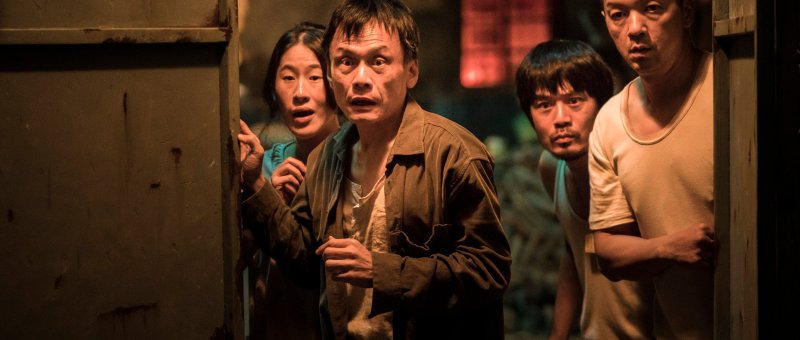
The left behind children of decaying industrial China find themselves at the mercy of a corrupted parental legacy in Shen Yu’s neo-noir tragedy The Old Town Girls (兔子暴力, Tùzi Bàolì). Each longing for escape but living in defeat, the three young women at the film’s centre search for signs of possibility in a world they fear has already rejected them but encounter only darkness and futility brokered by the broken adults apparently unable or unwilling to parent or protect them from the world their indifference has forged. 

Beginning at the narrative’s conclusion, Shen introduces us to a frantic woman, Qu Ting (Wan Qian), an anxious man Shui Hao (An Shi), and the confused Ma (Pan Binlong) as they desperately search for their missing daughters apparently kidnapped for a ransom none of them could ever hope to be able to pay. Fed up with the whole thing, Shui Hao determines to go to the police while Qu Ting is reluctant, fearful that the kidnappers will kill their daughter Shui Qing (Li Genxi), Ma simply going along with it. At the police station, however, they receive a call to say the girls are safe and Shui Qing is already at home but there’s more going on here than we first assumed other than Ma’s sudden heart attack on being told that his daughter Yueyue (Zhou Ziyue) has simply gone to visit a friend in another town. 

Flashing back some days before the climactic night, we realise that Shui Hao and Qu Ting are long separated and Shui Qing is living a miserable life rejected by her stepmother who coldly tells her to stay out a little longer because her parents are visiting and they don’t want any “outsiders” at dinner. At an open air noodle stand, she happens to catch sight of the radiant Qu Ting realising her mother has returned but unsure if she recognises her. The two women awkwardly reconnect, Qu Ting making it clear that she will be leaving in a few days and isn’t keen on having a teenage girl cramp her style, but gradually bond as they begin to spend more time together. 

What immediately becomes clear is that Qu Ting is somewhat arrested and emotionally immature, hanging out with Shui Qing’s high school friends Jin Xi (Chai Ye) and Yueyue as if she were a teenager but inappropriately allowing them to drink wine at dinner as if they were on a girls’ night out. Lonely and rejected by her stepmother Shui Qing longs for approval, but also to save her mother who is currently living in an abandoned theatre and seemingly desperate for money she claims is for a “project”, later implying that when it’s over she may start a business and be with her daughter full time but soon enough Shui Qing is pulled into an urban world of gangsters and loansharks governed by rules she is ill-equipped to understand. 

Her friends, meanwhile, have their own problems. Rich kid Jin Xi carries self harm scars on her arms and seems to be the only one at school not wearing a uniform. Her wealthy parents work away in the city and so Jin Xi is largely left alone as abandoned and fearful as Shui Qing but also filled with resentful anger. Yueyue perhaps has the opposite problem in that she feels trapped by her controlling, abusive father, Ma. Raised by wealthy relatives until her father returned, Yueyue longs to be free of him but he refuses to let her go even though the relatives are keen to adopt her and can obviously promise a more comfortable way of life and better opportunities for the future than the impoverished Ma. 

“Everyone’s looking for a carefree paradise” according a mournful pop song heard on the radio and it’s certainly true of the three girls and Qu Ting each looking for something more if unsure exactly of what it is or how to get it. Shui Qing yearns for maternal approval but ends up playing mother while Qu Ting finally accepts her corrupted maternity only in the most tragic of maternal sacrifices in attempting to protect her daughter from the radiating darkness her return has cast over her life. “It doesn’t matter if our dreams sink they’ll just be floating bottles” the girls cheerfully uttered, but each of them find themselves unanchored longing for the security of parental affection and dependability but left largely alone quasi-orphaned by the demands and contradictions of the modern China. Shen’s melancholy neo-noir is a stark coming-of-age tale which finds little place for innocence in the contemporary society relegating it only to the space of memory a casualty of parental disconnection and adolescent futility. 


The Old Town Girls streamed as part of this year’s New York Asian Film Festival.

Original trailer (English subtitles)
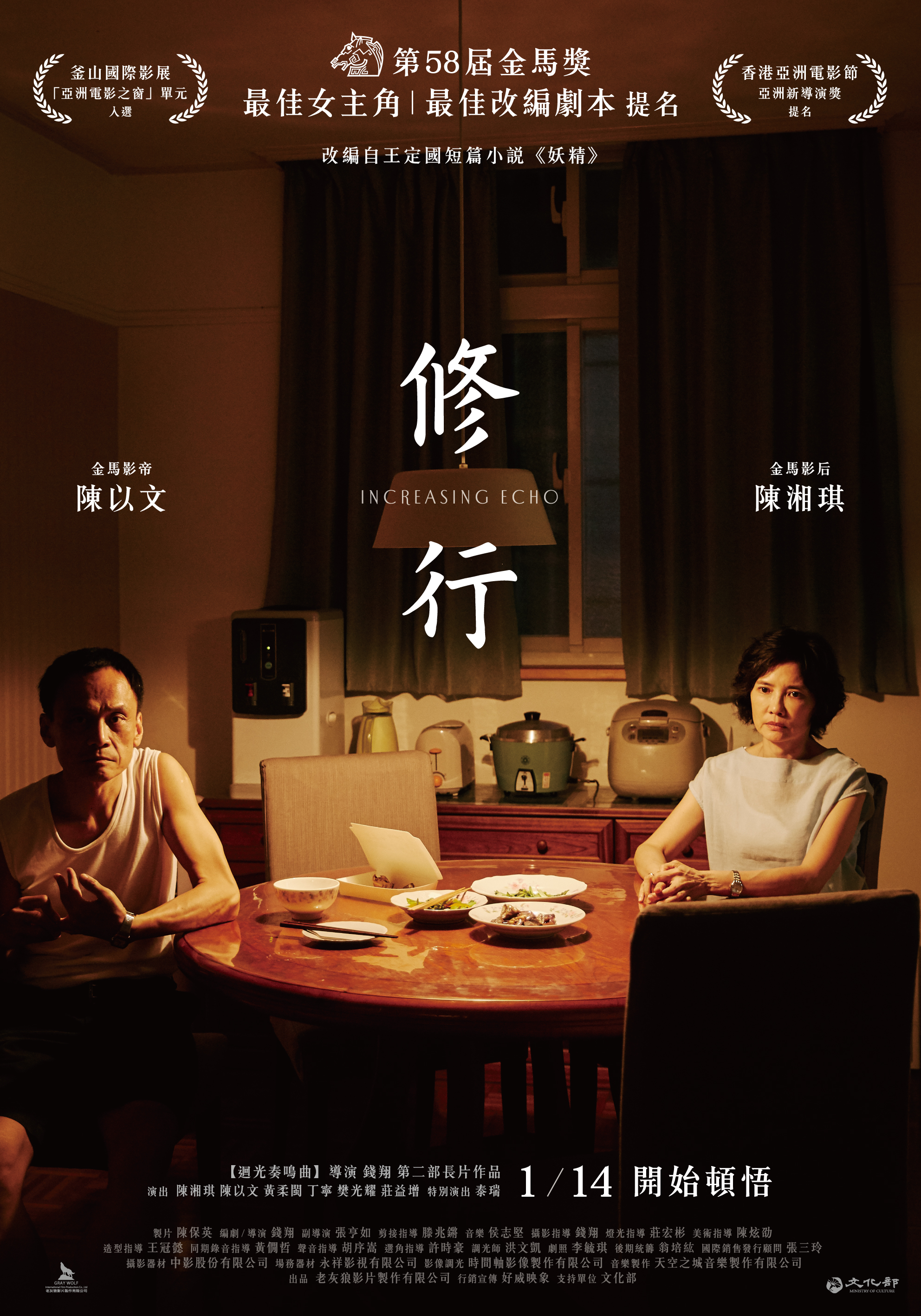
The Monkey King: Reborn (西游记之再世妖王, Wang Yun Fei, 2021)

Sun Wukong comes to believe in his own soul while standing up to a cruel and oppressive reincarnated demon king intent on destroying the world in Wang Yun Fei’s anarchic family animation The Monkey King: Reborn (西游记之再世妖王, Xīyóujì zhī zài shì yāo Wáng). Reborn is in a sense also what Sun Wukong becomes in Wang’s defiantly egalitarian adventure which sees the regular crew from Journey to the West becoming temporary guardians to an adorable ball of anthropomorphised qi while The Great Sage Equal to Heaven contemplates what it is to be a “demon” and if he’s necessarily as “bad” or “evil” as some seem to believe him to be. 

As usual, Wukong (Bian Jiang) is travelling with the monk Tang Sanzang (Su Shangqing) and fellow demons Bajie (Zhang He) and Wujing (Lin Qiang) heading to India to retrieve Buddhist scriptures to bring back to China. On the way, they stop off at a temple where Wukong and his friends end up causing a ruckus by eating some of the temple’s treasured manfruit from a tree which only produces 30 every 1000 years. 1000 years doesn’t seem so long to Wukong so he thinks little of it but is later caught out by two snooty monks, grows indignant, and gets into a fight with an immortal eventually destroying the tree in temper only to realise that he’s accidentally released Yuandi (Zhang Lei), the ancestor of all the demons sealed within the tree thousands of years previously by a Buddhist monk who sacrificed all of his qi to do so. Threatened with being re-imprisoned himself and determined to rescue Tang who has been kidnapped, Wukong has no choice but to stop Yuandi before he reassumes his full strength in around three days time. 

Meanwhile, the trio is joined by a tiny manfruit-like ball of qi Wukong nicknames “Fruity” (Cai Haiting), originally reluctant to take him with them but advised that his qi is the best weapon against Yuandi. As the film opened, Wujing had been contemplating what it means to have a soul, Tang reassuring him that when he feels he has one it will be there. Following through on the egalitarian message, he later says something similar to Yuandi, certain that all sentient creatures are equal, but the moody Wukong remains sullen and resentful constantly insulted as an “evil” demon while internally convinced he can’t be anything else. Yet despite himself he takes on a paternal role while looking after Fruity who later explains to him that there are good demons and bad and that he has a kind soul. 

Yuandi by contrast merely rolls his eyes when most of his demon minions are cut down, lamenting that they had become weak and the weak do not deserve to live. In the process of searching for his own soul, it’s this cruel and oppressive worldview that Wukong and the others must finally resist, protecting Fruity while battling the darkness with the confidence of self knowledge as their best weapon. Meanwhile, it’s clear that the Buddhist world is not exactly free of corruption either, the two snooty monks instantly looking down on Tang ironically because of his unostentatious attire uncertain why they’re expected to share their treasure with someone so seemingly undeserving. Then again, when they’re sent off to petition the Jade Emperor quite the reverse is true as they’re kept waiting outside while heaven’s border guard painstakingly fills out paperwork in only the best calligraphy while insisting each petition should be treated impartially no matter who it comes from even though the monks had quite clearly expected to jump the queue. 

Selling a positive message of self-acceptance and universal equality The Monkey King: Reborn also boasts a series of thrilling and elegantly drawn action sequences as the trio face off against the forces of darkness, along with some zany humour and Wukong’s characteristically anarchic energy not to mention the unbelievably cute yet somehow profound Fruity who can’t bear all the senseless carnage and depletes himself to cure the innocent townspeople of their demonic corruption. In the end it’s not only Wukong who is reborn as he realises that nothing’s ever really gone forever, just altered in form, while it is possible to repair damage done with humility leveraging the power of self-acceptance against a dark and selfish desire for destruction. 


The Monkey King: Reborn is released in the US on DVD & blu-ray Dec. 7 courtesy of Well Go USA in an edition which includes both the original Mandarin-language voice track with English subtitles and an English dub.

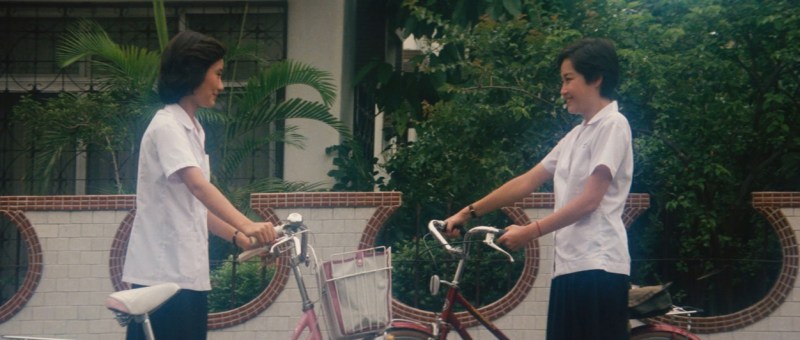
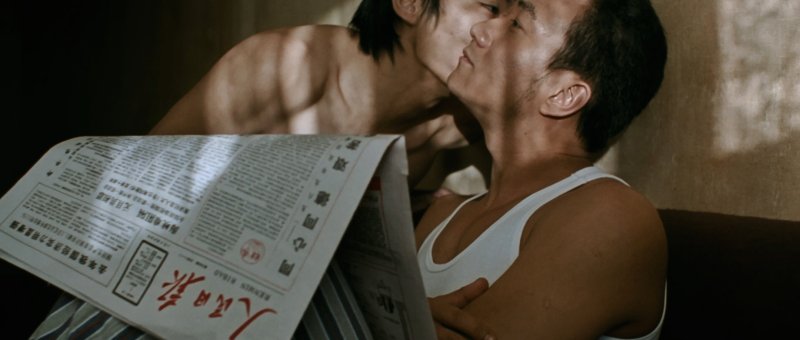
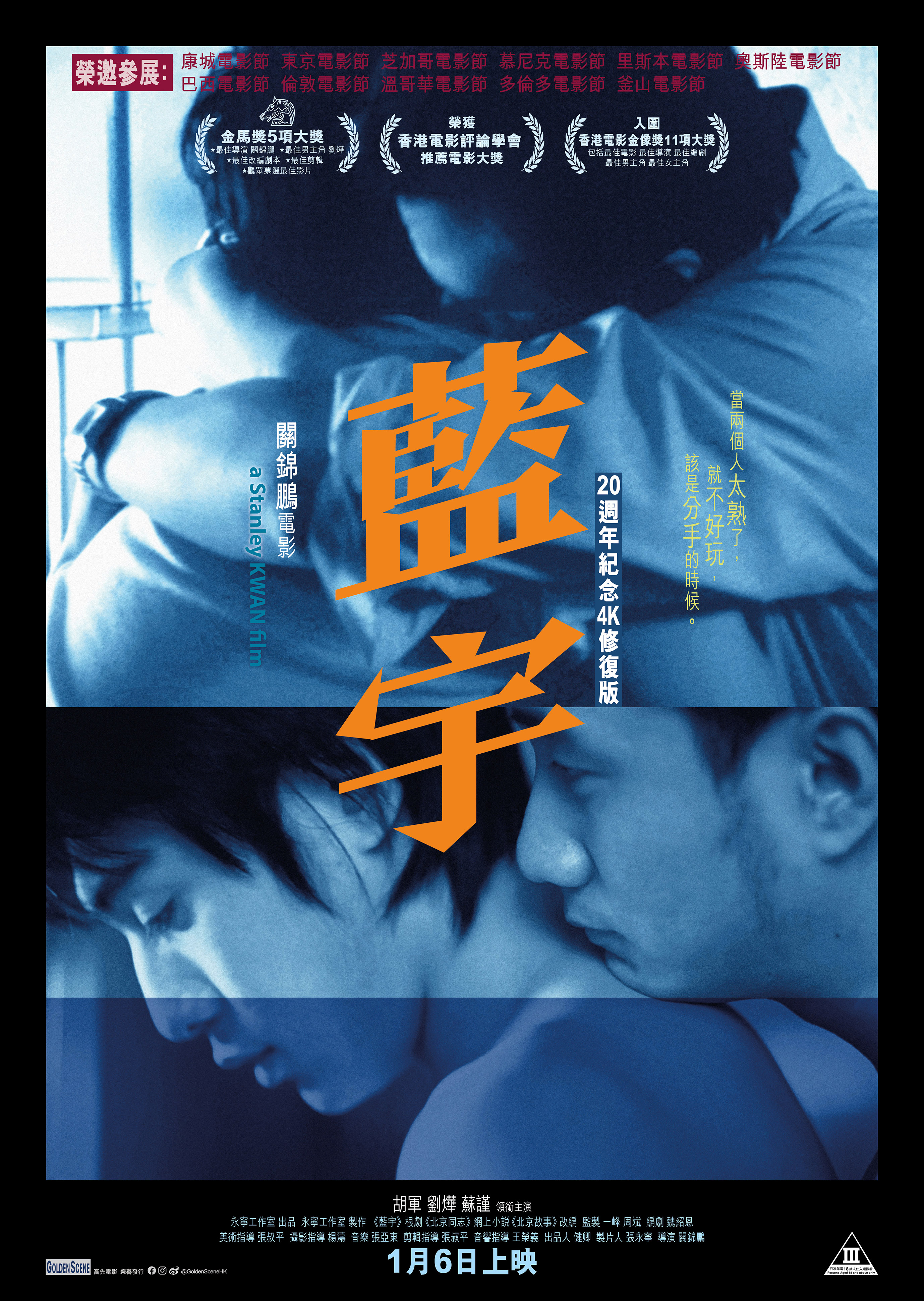
Eternal Summer (盛夏光年, Leste Chen, 2006)

A trio of emotionally displaced teens find themselves swept into an awkward love triangle while longing to escape their loneliness in Leste Chen’s melancholy youth drama Eternal Summer (盛夏光年, Shèngxià Guāngnián). Each in someway marginalised and searching for acceptance, the teens struggle to define themselves as the world changes itself around them while bound by the paradoxical qualities of their circular relationships, their unspoken secrets continually driving them apart even as they continue to long for the intimacy born only of sharing their authentic selves. 

A quiet, studious boy, Joseph Kang (Ray Chang) is asked to befriend his deskmate Shane (Jopseph Hsiao-chuan) who has ADHD and has been labeled disruptive in the hope that creating social relationships with other children will help calm him down. The arrangement in a sense backfires, Joseph’s academic achievement falling while his friendship with Shane only grows in strength and intensity. By the time they are teenagers, the pair are inseparable but Joseph has also fallen in deep, unrequited love with his best friend, a secret he is afraid to share with anyone and ironically cannot share with the one person to whom he is supposed to be able to tell anything. The friendship is further disrupted by the sudden introduction of transfer student Carrie (Kate Yeung Mei-ling) who has returned to Taipei to live with her mother after years of living with her father in Hong Kong. Carrie first develops a fondness for Joseph while working with him on the school paper, but later figures out that he’s secretly in love with Shane and decides to support him as a friend while in another irony Joseph’s ongoing internal crisis eventually forces his friends together, Carrie secretly dating Shane while each of them knows on differing levels how their relationship may hurt Joseph when he eventually finds out. 

In 2006 Taiwanese society was perhaps not quite as accepting as it would become, yet Joseph’s anxiety in his sexuality in compounded by the desire not to lose his friendship with Shane fearing not just that his feelings are not returned but that he may reject him altogether just for being gay. While Shane, a high school sports star with terrible grades, eventually blossoms academically after Carrie makes the ironic promise to go out with him in the unlikely event he gets into uni, it’s heavily implied that Joseph’s previously high level of achievement is damaged because of his preoccupation with his sexuality shockingly failing his uni entrance exams and thereafter further separated from his friends as they move on and he remains in cram school limbo hoping for better luck next year. Meanwhile he finds himself in potentially dangerous situations cruising in parks trying to verify his homosexuality while privately consumed by shame. 

For Shane, meanwhile, his problem is that he feels rejected by the world around him because of the way his ADHD was treated as a child. Regarded as a disruptive troublemaker none of the other kids would play with him save Joseph, meaning that he too is desperate to maintain the friendship in fear of his inescapable loneliness even while finding a similar connection with Carrie who is herself longing for love seemingly having strained relationships with each of her divorced parents while geographically and culturally displaced in having spent much of her life in Hong Kong. Carrie is, however, the only one to know the whole truth frustrated with the two men in her life that they can’t simply clear the air by voicing the secrets that continue to erode their relationship. 

Then again perhaps what they really fear is “change”, afraid of an uncertain adulthood in which their childhood connection will necessarily weaken. “We will lose each other in the future?” a conflicted Shane wonders, uncertain if his co-dependency is entirely healthy or fair on his friends but fearing becoming alone or having to make a choice unable to lose one or both of his essential connections. At heart a mood piece, Chen’s melancholy drama is filled with the strange canted angles of a world out of kilter and poignant reflections of the past in the midst of present torment, both elegiac and nostalgic for a particular moment in time which must in some way pass even if his parting words are painfully ironic in their cutting intensity.


Eternal Summer streams in Poland until Nov. 29 as part of the 15th Five Flavours Film Festival.

4K restoration trailer (Traditional Chinese subtitles only)