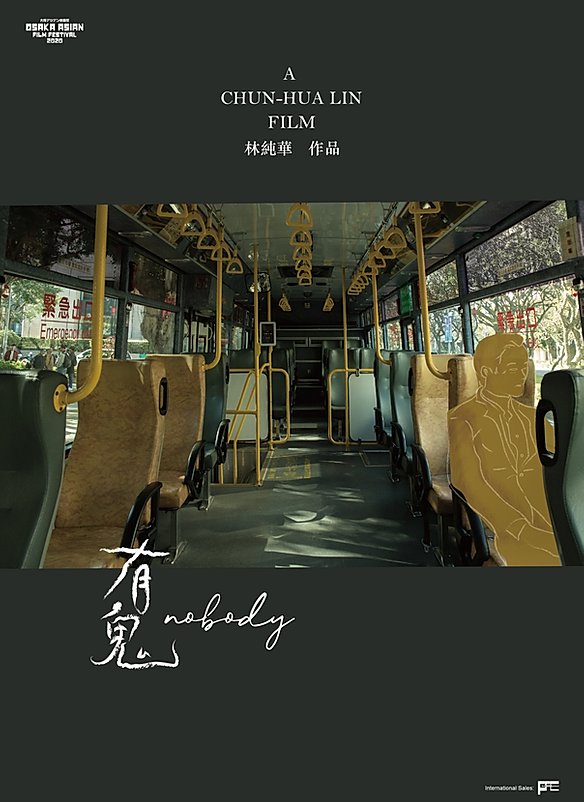
Nobody (有鬼, Lin Chun-hua, 2020)

“Everyone has secrets that they don’t want others to know” according to the hero of Lin Chun-hua’s Nobody (有鬼, Yǒu Guǐ). He is indeed quite correct, everyone is in one sense or another living a lie, pretending to be something they’re not and often for quite complicated reasons which make them unhappy but convince them that their unhappiness is a kind of victory. Yet, there is no true connection without vulnerability and the sharing of a secret can be the most profound of intimacies, even if the connection itself is, perhaps wilfully, misunderstood by others. 

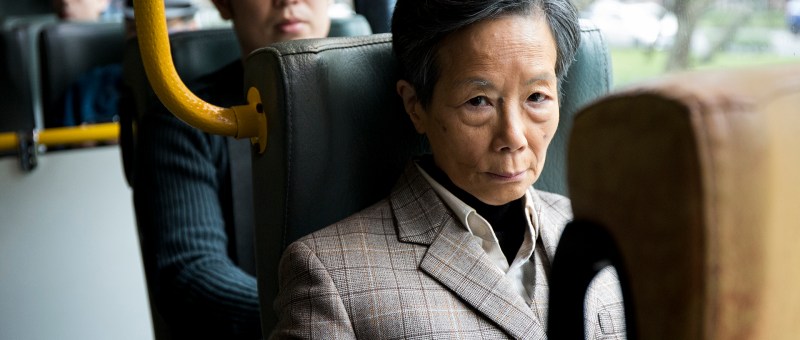
Credited only as “Weirdo” (Jian fu-sang), an old man lives in an illegally occupied attic space on top of an old-fashioned apartment building that he now finds difficult navigate due to his increasing mobility issues. For unclear reasons, he spends his days riding the bus to the hospital but making sure to spit somewhere along the journey, a habit which has made him the bane of bus drivers across the city. Thoroughly fed up, one particular driver decides to throw Weirdo off his bus by force despite his old age and relative frailty, causing him to sustain an injury to his head.

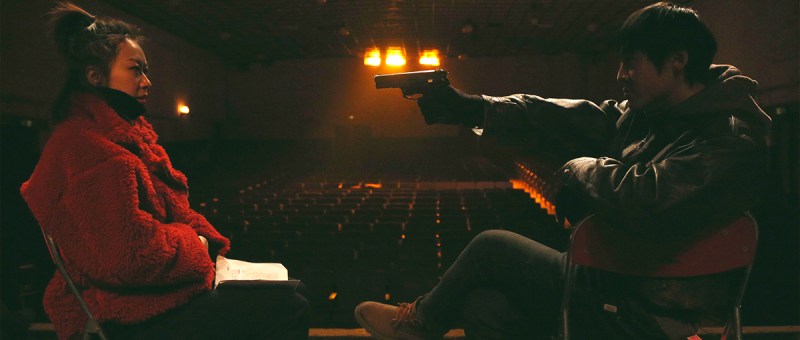
When he gets back to his apartment, Weirdo finds an unexpected intruder – teenager Zhenzhen (Wu Ya-ruo) who has snuck in in order to spy on the apartment opposite where her father meets his mistress. Zhenzhen is from a wealthy though conservative home where her mother, Yuping (Huang Jie-fe), is the perfect housewife but makes a point of prioritising her husband and son, leaving Zhenzhen feeling innately inferior simply for being female. Determined to be allowed to use the apartment to spy on her dad, Zhenzhen starts following Weirdo around, mostly trying to bully him into submission but Weirdo treats her the way he treats everyone else, simply ignoring her as if she didn’t exist. 

The original Chinese title means something more like “haunted” or more literally “there are ghosts” and in some senses it’s tempting to think of Weirdo as a ghost himself as he deliberately attempts to walk through the world as if he existed in a different plane. He is however haunted by lost love and a terrible sense of guilt that keeps him alone in his attic dressing the same way he dressed forty years previously though his hands are now too weak to be able to tie his tie. And then there are those secrets, things he feels obliged hide in the most literal of ways because others simply wouldn’t understand. 

What Zhenzhen discovers is that her family is full of secrets, but exposing them might cause more harm than good. She videos her father with another woman intending to expose him to her mother, but Weirdo tries to warn her that she’s the one that will probably end up hurt if she tries to use other people’s secrets against them. On the surface her family is a vision of upper-middleclass respectability, but her father’s having an affair, her mother is desperately unhappy, and her golden boy brother has secrets of his own. Challenged, Zhenzhen’s father resents her intrusion and points out that he provides for them as if his family life is just for show while he satisfies his desires outside of it, shutting down his wife’s admiration for her sister’s career as a pop idol manager by reminding her that she has a husband, home, and children while her sister has “nothing” because she is a single career woman and in his view an unsuccessful one. Yuping meanwhile is a taut, repressed, and unfulfilled middle-aged housewife actively lashing out at her daughter while sweetly supporting her husband and son, but tries to exorcise her own desires by teaching piano on the side and finding unexpected pleasure in flirtatious banter with one of her sister’s handsome idol stars. 

Nobody is exactly being honest, but it’s the way we live our lives because like it or not secrets are the lifeblood of civility but also an impermeable barrier to connection. Unable to bond with her prim and proper mother, Zhenzhen finds support from Weirdo who begins to open up despite knowing that Zhenzhen’s superficial niceness was only a ploy to get into the apartment, perhaps connecting with her sense of loneliness and betrayal as a young woman discovering that to one extent or another everyone lives a lie. Yet sharing the truth if only with one person can be its own kind of salvation, allowing youth and age to save each other from a world riddled with hypocrisy. 


Nobody made its World Premiere as part of this year’s Osaka Asian Film Festival.

Original trailer (English / Traditional Chinese subtitles)

Spring Tide (春潮, Yang Lina, 2019)

Toxic motherhood takes on strangely subversive, allegorical tones in Spring Tide (春潮, Chūn Cháo), Yang Lina’s painful examination of the relationships between three generations of Chinese women, each in different ways victims of the times in which they live. It’s true enough that the folk tunes sung so happily are often odes to the “motherland” which betray none of the eeriness of their propagandistic intentions in their full hearted endorsement of nation as family, but the darkness is inescapable as we see their metaphors made flesh in a woman destroyed by her sense of disappointment in life and in turn destroying her daughters literal and metaphorical in a pathological attempt to give her life meaning. 

30-something Jianbo (Han Lei) is a socially conscious investigative journalist whose refusal to let sleeping dogs lie is a constant thorn in the side of her more conservative editor. At home, meanwhile, she’s mother to nine-year-old Wanting (Qu Junxi), who, we later realise is being raised by Jianbo’s feisty mother, Minglan (Elaine Jin Yan-ling), while she splits her time between the family’s backroom and a bed in a student dorm with occasional nights spent with an intense yet silent musician. 

Aside from the obvious emotional disconnection, the fracture lines between mother and daughter are also ideological. Jianbo is a post-80s generation woman, she wants to hold mother China to account because she wants her society to be better than it is. She unroots scandal and corruption and brings them to light through the power of the press, trying to create real social change through shaming the populace into better patterns of behaviour. But her mother Minglan lived through the Cultural Revolution, because of all she’s suffered she thinks that things are fine the way they are and criticising the beneficent state is like scolding the person that raised you. Caught in the middle, Minglan’s fiancé Zhou (Li Wenbo) espouses contradictory views, at once proud to have Jianbo as a daughter because “journalists are the conscience of a country”, but also grateful for the iron rice bowl system that gave him a steady job, not to mention a pension and the old person’s flat that’s allowed him to meet Minglan. 

Minglan’s life has indeed been full of suffering, though it is perhaps surprising how casually she and her friends remark on the terror they experienced during their youth while continuing to sing the old patriotic songs. “My motherland and I can’t be apart for a moment”, according to patriotic hit My People, My Country (我和我的祖国), but its tones suddenly seem sinister in their breeziness as we’re forced to consider the icy Minglan as a stand-in for China as a toxic mother, insisting that she must be respected and that her children must repay their debts to her, no matter how abusive she has been and may continue to be. To her friends in the retirement community, Minglan is a warm and caring woman, running the choir and organising local events, but she’s also blindsided by the suicide of a friend who took her own life because of an entirely different kind of filial disappointment coupled with existential loneliness. Minglan can’t understand why she did it, but in characteristic fashion largely makes it all about herself in lashing out at Jianbo when she points out that Mrs Wang was not as happy about their (read: Minglan’s) potential retirement plan as Minglan had believed her to be. 

“When were you going to realise this was a family and not a battlefield?” Jianbo asks her mother knowing that she can make no further reply. The tug of love over motherhood of Wanting is, in many ways, a tussle over the future of China. Minglan digs her nails in, telling Wanting a few hurtful truths about her mother while insisting that you really can’t trust anyone anymore but that’s OK because grandma loves you, while Jianbo remains powerless to reassume her maternity knowing that her only weapon is to avoid unduly antagonising her mother in the hope that she won’t end up alienating Wanting in the same way Minglan alienated her. All that exists between them now is a torrent of resentment, Minglan seeing her daughter only as the symbol of all her frustrated desires, and Jianbo knowing she’s become a sad and lonely woman solely because her mother refused to love her in the way she wanted to be loved. Jianbo is determined that she won’t let Minglan’s “vanity and hypocrisy” corrupt her pretty, sensitive daughter, pushing her towards an “ignoble and ridiculous life”. She wants Wanting to be free of this chain of abuse and all its authoritarian gaslighting, but has no mechanism to free her other than distance. 

Wanting, by contrast, is cheerful and kind. She has absolutely no filter and is entirely unafraid of asking difficult questions, but is also brave and strong, willing to stand up for others. A little girl in her class who happens to be from the Korean minority is criticised for her “poor” Mandarin and ordered to switch seats but her new buddy refuses to sit with her because he claims not to be able to understand what she’s saying. Wanting immediately pipes up that she understands perfectly, instantly becoming the girl’s best friend and visiting her home which appears to be one of immense harmony and happiness where her dad whirls her round while proudly singing Arirang, standing in stark contrast to Minglan’s joyous yet somehow self-involved recitals. China as an authoritarian mother may be losing its grip on power, while Jianbo’s generation struggles to free itself from the trauma of toxic parenting, but there is perhaps hope for Wanting as she and her friend decide to leave the patriotism showcase to follow the spring tide right out into a wide river of joy and freedom.


Spring Tide was screened as part of this year’s Osaka Asian Film Festival.

Wisdom Tooth (日光之下, Liang Ming, 2019)

A young woman rides the waves of changing times in Liang Ming’s Wisdom Tooth (日光之下, Rìguāng Zhīxià). Perhaps innocence is something slightly painful you’re better off without, but awakening to life’s light and shade can be a difficult process. Gu Xi (Celeste Lv) is suffering with a dull ache in her jaw and the solution is, apparently, merely pain killers but you can only numb yourself so long before you have to make a choice of whether to go on living with the pain, or free yourself from it. 

A young, if slightly immature woman, Gu Xi has a job in a local hotel and lives alone with her half-brother, Gu Liang (Wu Xiaoliang), who, until recently, has eked out a living as a fisherman. A recent oil spill revealed to have occurred some time ago but covered up by the authorities has put paid to that, while Xi also finds her job under threat because she has an undocumented status and there is shortly to be some kind of inspection. Having grown up without a mother and entirely ignorant of who her father might have been, Xi feels acutely anxious about her circumstances and is dependent on Liang for a sense of security. It is therefore unsettling for her when he develops an interest in the sophisticated Qingchang (Wang Jiajia), daughter of local mob boss Zhou (Chen Yongzhong) and a recent returnee from South Korea where she had been living with her mother. 

A mirror image of Xi, Qingchang is everything she she’s not. Xi is well known for wearing her brother’s clothes, dressing like a tomboy for reasons that are a combination of poverty and affection, where Qingchang has wardrobes full of the latest fashions brought back with her from overseas including a beautifully crafted Hanbok featuring an elaborate embroidered design. As much as she’s resentful and intimidated, Xi can’t help admiring the slightly older woman, captivated by her sense of self assuredness, and eventually develops a sisterly bond with her even while fearing that she may steal her brother away. 

A further intrusion, however, disrupts their tentative familial bonding. A fisherman found dead and floating on the sea hints at a burgeoning turf war between local bosses Zhou, Qingchang’s father and Liang’s employer now that he’s taken a job as a security guard at the docks, and Jiang (Tao Hai), a melancholy Christian who owns the hotel where Xi had been working. Though warned by others that Jiang seemed “creepy”, Xi feels indebted to him because her job at the hotel was saved after she approached him to intervene. Her habit of recording the conversations around her to listen to later presents her with a problem when she discovers that Zhou may have bumped off the fisherman himself and is planning to frame Jiang for the crime. Jiang, it seems is also receiving protection money to ensure the fishermen’s safety, apparently a promise he wasn’t able to keep. Xi is pulled three ways. She loses confidence in Qingchang who is now both tainted by association and a figure of mild discomfort, while fearful that if she reveals what she knows, serves justice and repays a debt by clearing Jiang, she will ruin her brother’s happiness and risk his rejection. 

Trapped in he realms of childhood, what she most wants is to preserve her status quo. Liang is everything to her – brother, father, and somewhat uncomfortably a figure of romantic impossibility. Her feelings towards Qingchang are mired in complexity, a nascent attraction perhaps underlying her sense of jealousy either misdirected through her complicated feelings for her brother or simply finding its anchor for the first time. An angry speech at her brother’s birthday party during which she inappropriately reads out a semi-explicit passage from a lesbian novel hints at an attempt to resolve an attraction she feels is taboo, though it is unclear for whom it is directed. As with most young people, she must come to an accommodation with the fact that her world is changing. A childhood promise that she and her brother would never marry, preserving their family of two forevermore, was always unrealistic but she struggles to let go of the idea of permanence in a childish sense of familial security. Like the oil polluting the seas, her world is coloured by uncertainties but like anyone else she discovers that her agency is limited and whatever choice she makes others will make their choices too. That dull ache in her jaw is a reflection of the ills of the world around her, an inconvenient tooth that needs to be plucked out and discarded leaving only the cold comfort of adult wisdom behind in its place. 


Wisdom Tooth screens on March 11/14 as part of this year’s Osaka Asian Film Festival.

The River in Me (大河唱, Ke Yongquan, Yang Zhichun, He Yuan, 2019)

Can the old arts survive in the modern world or are they destined to fade away with the passing of time? Folk singer Su Yang is determined to preserve them, if only by assimilation, blending traditional folksong with Western rock to bring it into the modern era. While some complain that Su’s singing is inauthentic, he argues that authenticity, in that sense at least, isn’t the point. The only thing that matters is whether people like it and can feel something of themselves and of ages reflected in the ancient rhythms. 

Now a successful musician, Su is not originally from the country but moved to rural Yinchuan, Ningxia in Northwest China with his parents when he was seven. He later says it was the music of Yinchuan which touched him not because it is the greatest of cities but because it’s the one which most intersected with his life. Through his travels, Su meets up with a series of other practitioners of traditional arts mostly also from Ningxia and the surrounding area as he and they dwell on survival. 

Itinerant singer Liu Shikai makes a living playing the Sanxian, but fewer and fewer people are interested in listening while in private he feels himself lonely as a twice widowed father of three, especially as his youngest daughter has now married leaving him at home alone. Su laments something similar, reflecting that there’s no New Year for him. His festivities will consist of working and drinking, while his family can see him on TV from the comfort of their homes. Su’s brother complains endlessly about the annual Spring Gala (while watching it anyway), finding the show totally lacking in any kind of substance and becoming more boring by the year. His astute daughter, however, points out that his criticism is unfair or at least stating the obvious because the Spring Gala reflects “youth culture” which is perhaps flashy and superficial but equally is not intended to appeal to middle-aged men. Su appears on the program himself but might agree, seeing as it’s his mission statement to put a little soul back into the mainstream by bringing the rhythms of the Yellow River to contemporary society. 

Back in the country, meanwhile, folksongs are serving the same purpose they always have, expressing joy in the natural world and bringing communities together through choral solidarity. Then again, Hua’er singer Ma Fengshan, sometimes finds himself at odds with his. A member of the muslim minority, his house is filled with religious texts that he is unable to read because they are in Arabic which he doesn’t speak. Some have told him that he should spend more time on religious study, but all he wants to do is sing, while others actively oppose Hua’er for its “salacious” qualities, aware the songs can be used as a form of flirtation and convinced that they have the potential to cause marital breakdown and infidelity. In spite of everything, Ma keeps singing and is eventually joined by other members of his community wearing traditional dress to celebrate Hua’er music. 

For puppeteer Wei Zongfu, however, the future seems far less bright. Now ageing himself, he’s accepted that his descendants won’t want to succeed him and there are few people interested in learning shadowplay. The leather puppets crafted by his grandfather are so precious to Wei that he didn’t even want to take them to use in Su’s showcase of traditional arts in fear they might be damaged or stolen, opting for a safer paper play instead, but is now contemplating what’s best to do with them after he dies and if the art itself can survive when there is no one to perform it. 

That’s a problem also faced by Zhang Jinlai, the harangued head of a Qinqiang Opera troupe frequently at odds with his co-star wife who berates him for employing too many actors when they aren’t making any money. With economic factors to consider, he finds it hard to keep his troupe together and is pushed towards making “innovations” that might appeal to a younger audience but wishes to remain “authentic”. Su’s suggestion, by contrast, is that in the end you can only move forward, the old arts may have to adapt or die. Some may not approve of his modern take on the traditional, but in his own way he’s saving Hua’er song and helping to pass it on to future generations, in his own words extending the rhythms of the Yellow River to all corners of the world. 


The River in Me screens in Amsterdam on March 4/8 as part of this year’s CinemAsia Film Festival.

Original trailer (English subtitles)

Detention (返校, John Hsu, 2019)

“Have you forgotten or are you scared of remembering?” a mysterious supernatural force seems to ask the heroine of John Hsu’s ironically named Detention (返校, Fǎn Xiào). In fact, the Chinese title means something close to “back to school”, hinting at its central message which uses the, it argues forgotten, tyranny of the “White Terror” to remind us that freedom is hard to win but harder still to keep. An unfortunately timely message given the assaults on democracy across the world but even more so given the recent protests in Hong Kong which have found support in Taiwan as it too looks back on its complicated history.

Based on a popular survival horror video game, Detention’s first hero is idealistic student Wei Zhong-ting (Tseng Ching-hua) who we quickly learn was picked up and tortured by the military police for reading books banned by the regime as part of an underground club run by two of his teachers – mild-mannered artist Zhang (Fu Meng-po) and stern musician Yin (Cecilia Choi Sze-wan). Set in 1962, the film finds itself at the height of the “White Terror”, a period of martial law which lasted for 38 years, during which any resistance real or perceived towards Chiang Kai-shek’s Kuomintang government was brutally suppressed with thousands tortured, imprisoned, or killed by the regime.

Wei finds himself in a lucid nightmare, trapped in his school building which has become derelict and seemingly abandoned while cut off by a raging flood. Gradually he starts to piece together memories of what must have happened, realising that his fellow club members seem to be absent and something must have happened with the military police. While in the school he runs into a fellow classmate, Fang Ray-shin (Gingle Wang Ching), though she doesn’t quite seem to remember him. Having apparently fallen asleep and woken up in this nightmare world, Fang seems even less clear about what’s going on than Wei but desperately wants to find their teacher, Zhang, with whom, we learn, she has fallen in love. 

Plagued by horrifying visions that maybe repressed memories or simple nightmares, the pair are chased by giant monsters dressed in KMT uniforms standing in for the terror of living under an authoritarian regime. Only, these particular nightmare soldiers are literally “faceless” in that their hollowed out skulls, which themselves sit on fetid, rotting corpses, are filled only by a mirror making plain that the faces of the “faceless” regime are our own. Fang and Wei become convinced that someone has betrayed them by giving one of the illicit books to arch militarist teacher Inspector Bai, but they can’t be sure who it was, finally doubting even themselves in their inability to remember the exact circumstances which brought them here. 

Flashing back to the “real” world, we discover that one sort of oppression cannot help but lead to others. Fang’s father is a respected soldier and supporter of the ruling regime, but he’s also abusive towards his wife, enforcing a rule of fear and violence even within his own home. Her mother has taken to religion in order resist him, regretting her marriage and furiously praying that he will soon be “gone for good”. “Gone for good” becomes a kind of mantra for others straining to free themselves from obstacles to their desires. Fang learns all the wrong lessons from her parents, allowing herself to be corrupted by their twin failures – her father’s in being a willing participant in the oppression of others, and her mother’s in subverting the world in which she lives in an attempt to free herself from violence. 

Yet, as Zhang later tells her, no one is really at fault because they are all victims of the oppressive rule of the KMT. The ruined schoolhouse becomes a kind of repository for the orphaned memories of a forgotten past. You can tear it down and build a fancy apartment complex over the top, but the ghost of authoritarianism is always lurking on the horizon, and capitalist success will not safeguard your freedom. Those left behind have to tell the story so  this never happens again because those who fail to learn from history are doomed to repeat it. Zhang imagined himself a narcissus, living in his own world without caring what other people thought and claiming that the solidarity of silent understanding is the best cure for loneliness, but he lived in times in which he had no freedom in which to live, sacrificing his own future to become the selfless roots of emancipation blooming only for those who will come later.


Detention screens in Amsterdam on March 5/7 as part of this year’s CinemAsia Film Festival. It will also screen in Chicago on March 26th as part of the 10th Season of Asian Pop-Up Cinema.

Original trailer (English subtitles)

Two Sisters (姐妹, James Lee, 2019)

The family home is supposed to be a place of safety, but what can you do when it’s also a source of trauma? The young women at the centre of James Lee’s psychological horror Two Sisters (姐妹, Jiěmèi) are each trying to put their houses back in order but find that their pasts are full of locked doors, crying women, and things which go bump in the night. In the end the past is the one thing you can’t protect yourself from, but not knowing can also be its own kind of hell, an inescapable puzzle that forever corrupts the image of the self. 

Elegant and successful, Mei Xi (Emily Lim) has just published her first book – a horror novel about a woman with multiple personality disorder which is, she tells her fans at a reading, a metaphor for the dual lives many women are forced to lead because of the pressures of living under the patriarchy. Meanwhile, her home life appears to be chaotic. We see her swallow a selection of pills before a one night stand cheerfully leaves her well-appointed apartment, only for her manager, John, to interrogate her after she’s late for an appointment wondering what she was doing the night before which prevented her from answering any of his calls. She reminds him that that’s none of his business. They may have slept together once but it meant nothing to her and anyway he’s a married man. Xi hopes they can keep their relationship “professional” going forward, attempting damage control on a possibly self-destructive business move. 

The main issue, however, is that her father has recently died and she’d like to sell the family home but needs the consent of her younger sister, Yue (Lim Mei Fen), who has been in a mental institution for over a decade. The doctors tell her that Yue has made good progress and they think it might be time to discharge her from the hospital so that she can start trying to reintegrate into mainstream society. Xi agrees to take custody of her, but there is an understandable distance between the two women. Yue is uncertain that Xi will be there when she needs her, partly because she neglected to visit her in the hospital on her last birthday and had apparently seen her only infrequently, Xi claims because she was busy with her book. Meanwhile, Yue is still unable to recall any of her childhood and is determined to move back into their family home in the hope of finally finding the truth behind whatever it was that happened to her. 

As expected, not everything is quite as it seems. A locked door is never a good sign, especially when there are multiple locks to unpick, but as soon as the women try to open it their shared reality begins to crumble. “What’s the point in knowing the truth?” Yue eventually asks an increasingly confused Xi, “it’s too late to change anything now”. The two women are each haunted, literally and metaphorically, by the ghost of their mother who died when they were small in circumstances neither of them are able to remember. 

The real horror lies in the family home. Badly let down by parental betrayal, the sisters attempt to rescue each other from shared trauma but are each trapped by the inescapability of the house. “I’ll always be by your side” Xi offers as words of protection, but is entirely unable to protect herself from the traumatic past. Yet Lee ends on a note of discomfort which sees Xi apologise to her mother for something that is in no way her fault, as if she had in some way betrayed her when quite the reverse is true. Xi’s words at the book reading prove truer than she knew them to be. She herself has her dualities, as did her mother, as a victim of patriarchal oppression which in this case has a sadly literal quality. The women of the Mei household struggle to free themselves from male violence and are perhaps destroyed by its memory which manifests itself in the ominous spectre of the family home which, rather than a place of love and mutual support, is a kind of prison filled with locked doors and dark secrets. 


Two Sisters screens in Amsterdam on March 6/7 as part of this year’s CinemAsia Film Festival.

Original trailer (English subtitles)

Stand By Me (陪你很久很久, Lai Meng-jie, 2019)

“Teenage days we all need a romance that hurts” exclaims a rejected teen, too shy to declare her crush directly but trying to achieve a kind of closure by literally shouting it from the rooftops in Lai Meng-jie’s charming teenage rom-com, Stand By Me (陪你很久很久, Péi Nǐ Hěn Jiǔ Hěn Jiǔ). For Jiu-Bing (Mason Lee), however, his romance has gone on a little longer than just his teenage years. He’s been silently in love with Bo-he (Ivy Shao Yu-Wei) since he was 12, but their relationship has remained at the innocent level of childhood friendship. Nevertheless, all of his subsequent decisions have been taken with one aim in mind, being at Bo-he’s side to protect her. Now that they’re grown, he’ll have to come to terms with the fact that their relationship is inevitably going to have to change in one way or another. 

As with most youngsters, those changes arrive as they set off for university (he’s enrolled in the same one as her for that reason alone). No matter how close you are, it can be quite claustrophobic having someone buzzing around you all day and Bo-he is beginning to get fed up with Jiu-Bing’s continuing immaturity. He’s promised to “protect” her, but often ends up in trouble himself and needs her to rescue him. It’s Bo-he that finds him a place to stay after he accidentally blows up his new student dorm and gets kicked out, only it turns out to be half of a teenage girl’s bedroom above a family bakery, rented out by high schooler Xia-Tian (Tsai Jui-Hsueh) without her father’s (Chu Chung-heng) permission as an enterprising way to get a little more pocket money. Meanwhile, Bo-he has fallen for a handsome, heroic classmate, Mai-zi (Edison Song Bai-Wai), who is, in every stereotypical way, the perfect man. 

In an ironic twist, Jiu-Bing’s part-time job is as a “pacer”, supporting other runners as they make their way towards the finish line but eventually dropping back himself. He takes pride in being there for people, protecting and encouraging them, but still struggles to accept the fact that his chosen role inevitably means he’ll spend his life celebrating the successes of others rather than his own. Jiu-Bing eventually has this fact thrown in his face when a romantic rival describes him as nothing more than a rebound guy, implying that Bo-he only sees him as a fallback she can rely on when some other boy breaks her heart but will never really want to be with in the long term. 

On one level, Jiu-Bing is fine with that. He really does just want Bo-he to be happy even if it’s with someone else, but still struggles with the decision of whether to speak his feelings out loud and risk ruining their friendship or keep silent and live with the pain of being just her friend forever. As one of his eccentrically nerdy friends puts it, companionship is the “dark matter” that supports a relationship, but the jury’s still out on whether companionship alone is enough to go the distance. Meanwhile, he remains entirely oblivious to the fact that Xia-Tian is beginning to develop feelings for him that place her in exactly the same place as he is with Bo-he. Maybe he just thinks of Xia-Tian as a crazy little sister, and maybe Bo-he just thinks of him as a troublesome little brother who will always need looking after despite his constant protestations that all he wants is to be able to “protect” her. 

What Jiu-Bing learns however is that being a pacer is no bad thing. It’s much better to run with someone than to run alone, but there are times when you just need to set a pace for yourself so you can figure out how far you can run. There are more ways to love than just the romantic, though maybe that’ll come in time but perhaps not from the direction you’d expected. “Being heard and accepted is nothing we can decide” Xia-Tian adds, and what is teenage romance other than coming to an acceptance that sometimes you love people who don’t love you back? But then sometimes they do, and if you never say anything you’ll never know. Jiu-Bing has some growing up to do, and a few decisions to make so he can figure out where it is he ought to be – supporting from the sidelines or waiting with flowers near the podium. Either way, Lai Meng-Jie’s charming teenage rom-com is a refreshingly progressive take on the genre which allows it’s “nice guy” hero to find solace in the authenticity of his generosity while its heroine embraces her own sense of agency entirely independent of her romantic destiny. 


Stand By Me screens at Chicago’s Gene Siskel Film Center on Feb. 17 where the full lineup for the upcoming 10th season of Asian Pop-Up Cinema will also be unveiled. Director Lai Meng-jie will be in attendance for an introduction and post-screening Q&A.

Original trailer (English/Traditional Chinese subtitles)

Zone Pro Site: The Moveable Feast (總舖師, Chen Yu-hsun, 2013)

In these high speed days, it’s sometimes difficult to remember that “cooking means something” or at least it should do according to “Doctor Gourmet” Hai (Tony Yang). A warm tribute to the Taiwanese tradition of bandoh outdoor banquets, Zone Pro Site: The Moveable Feast (總舖師, Zǒng Pù Shī) positions the figure of the chef as a kind of conduit bridging the gap between people through the art of well cooked food. Heroine Wan (Kimi Hsia Yu-chiao), however, thoroughly rejected the ambitions of her top chef father and determined on a life in the city with her heart set on becoming a famous model, actress, and celebrity. 

Life in Taipei is however hard. Career success is hard to come by and duplicity lurks round every corner. Wan learns this to her cost when two shady guys turn up on the pretext of delivering a birthday cake only to explain to her that her boyfriend, whose loans she’s unwisely co-signed, has skipped town and left her with the bill. Confused and afraid, Wan decides to skip town herself, planning to head back to her hometown and ask her mother for help. What she discovers however is that her mother is on the run too after losing the family restaurant partly through her subpar cooking skills which could never match those of her late husband, and partly through the betrayal of his apprentice who poached all their best customers and set up on his own. Despite being “in hiding”, the only way Puffy (Lin Mei-hsiu) has been able to make ends meet is by putting on an impromptu dance show in the central square to promote her small noodle stall. Luckily for them both, Wan makes a chance encounter on the train with a nice young man, Hai, who turns out to be a “Doctor Gourmet” specialising in “fixing” failing restaurants.

His arrival comes at just the right moment as Wan and her mother get a visit from potential clients – a sweet older couple who first met 50 years previously at a wedding catered not by Wan’s father Master Fly Spirit, but by his now departed mentor. Wan’s mother was going to turn the request down because neither she nor Wan know how to make the traditional dishes the couple are looking for, but Wan makes an impromptu decision to try and make their wedding dreams come true, warning them that it might take a little extra time and not quite match up to their romantic expectations. 

Wan’s problem is that she always hated her family’s restaurant. She resented the heat and the smell and the grease, often placing an empty box over her head and retreating into a fantasy world to escape the chaos. Her father wanted her to take over, leaving her a notebook filled with his recipes which was unfortunately stolen by a homeless man who mugged her at the station, but she was dead set on escape and becoming a “someone” in the city. Unlike her mother, however, she has real talent for cooking and is equally skilled at using her good looks and sweet nature to get things done. Soon after her arrival at the noodle stand, she’s already got herself a gang of geeky groupies calling themselves “Animals on Call” who are ready to do pretty much anything she asks of them. 

That comes in handy when Puffy persuades her to enter a national cooking competition where her rival is none other than Tsai, the apprentice who betrayed them, backed up another famous ex-chef Master Ghost Head (Hsi Hsiang) who has a fiery temper and spent some time in prison which might be why he still dresses like an ultra cool motorcycle guy from the ‘70s. There were apparently three great masters, the other being the eccentric  Master Silly Mortal (Wu Nien-jen) who is later discovered living in a subway tunnel where he keeps the art of bandoh alive through a literal underground restaurant where his regulars bring him a selection of ingredients before sitting down to enjoy a communal meal. It’s Silly Mortal whose food is said to evoke human feelings who guides Wan towards a series of epiphanies about the nature of “traditional” food. According to him, there are no rules about what goes together, and having a “traditional” heart is really about embracing the true nature of bandoh. Only by having a heart full of joy can you make good food. 

Equally eccentric in some respects, Hai takes a back seat after reminding Wan that cooking is really a way of sending a coded message to its intended target. The two goons eventually join the team, working together earnestly to prepare for the biggest banquet of all which is both the old couple’s wedding celebration and the competition’s finale. Master Ghost Spirit talks about taking the “grief” out of meat through fine cutting, while Master Silly Mortal is all about putting positive emotions in, but the missing piece of the puzzle is Master Fly Spirit who sends his final message to Wan only after death as she rediscovers him through his recipes. Not quite giving up on her celebrity career, Wan embraces her inner chef, happy with the idea of making lunchboxes to sell at the station with her new friends and family rather than chasing money through oddly nihilistic cuisine as Tsai had done. In the end, it’s all about joy and togetherness, sharing tasty food in the open air where anyone and everyone is welcome to bring whatever they have to the table.


Zone Pro Site: The Moveable Feast screens in New York on Feb. 16 as part of this year’s New York Asian Film Festival Winter Showcase.

International trailer (English subtitles)

Someone in the Clouds (真愛神出來, Gary Tseng & Mitch Lin, 2019)

“True love is your own choice, you have to love unconditionally” the cynical fortuneteller at the centre of Someone in the Clouds (真愛神出來, zhēn’ài shén chūlái) is told by Venus herself during an impromptu intervention. Is love fated or a matter of choice? Both, it would seem. At least, that special person might be out there, but you won’t know unless you fully commit. Another in the ongoing series of charming romantic comedies from Taiwan, Someone in the Clouds tackles the divination of love in more ways than one as its romance-averse heroine is forced to look at love from all angles. 

The daughter of a fortune telling family, Hsaio-Pei (Jian Man-shu) makes a living as a tarot reader mostly offering romantic advice to women suffering in love while she herself does not really believe in “the one”. Hsiao-Pei’s cynical, flighty mother declares that the most loveable love letter is a credit card and has been in a constant cycle of failed relationships since divorcing Hsaio-Pei’s father for the crime of working too much. In any case, the drama begins when Hsiao-Pei is spotted by in the subway by cocksure student Chiung-nan (Austin Lin Bo-hong) who tracks her down, walks into her uni tarot club, and wields the cards asking for a date. Not given much opportunity to refuse, Hsiao-Pei goes with it and the two have a beautiful, adolescent romance only for petty insecurities to end up getting in the way. 

According to Venus, all romances begin with “coincidence” but there is no “coincidence” in love. The goddess can guide the way, but the truth, apparently, is that true love is a free choice which is why Venus finds Hsiao-Pei’s mother so particularly annoying seeing as she always backs off when the going gets tough. Thus, Venus guides Chiung-nan to the tarot club for the meet cute, but Hsiao-Pei has to agree to the match. Venus’ parting wisdom is that true love, in a sense, is actually self love in that once you’re happy in yourself and can love unconditionally without expecting anything in return you will find “true love” without even realising it. 

Yet Hsiao-Pei’s path towards such a realisation requires a fair amount of intervention from the increasingly exasperated goddess. A moment of jealousy about some texts from an old girlfriend threatens to bring the whole thing crashing down while Hsiao-Pei relives her climactic moments Sliding Doors style trying to decide what might have been if different things had been said or done. Meanwhile, she continues reading the future for others and “punishing” Chiung-nan by punishing herself in a grim mirror of Venus’ central philosophy. 

Alternatively, as her grandpa claims, all you need to do to be happy is be kind and generous in the knowledge that life is short. This is a life lesson he imparts to Chiung-nan’s buxom cousin, a super popular online glamour model currently engaged to a wealthy Singaporean air steward who was originally taken by the idea of annoying his conservative parents with a surprise marriage to a modern girl but is now waking up to the major implications of his reckless decision. More words of wisdom come from Hsiao-Pei’s friend Panhai who takes a cheating ex back because she feels he needs her, replying to Hsiao-Pei’s criticism that need is not love with the reasoning that not everyone can tell the difference. 

True love is, according to the goddess at least, as simple as deciding to be happy. She can point the way, but in the end it’s up to the individual to claim their right to happiness or dwell in cynical misery for evermore. A whimsical coming-of-age romance, Someone in the Clouds finds that love is fate and free will in equal measure in which there are no “coincidences” only brief moments of transition standing in for destiny. What Hsiao-pei learns is that in order to achieve romantic happiness she’ll have to put her cards on the table for someone else to read while resolving to accept another interpretation in order to make a “free” choice with the spirit of kindness and generosity which allows her to forgive both herself and others. 


Someone in the Clouds was screened as part of the 2019 New York Asian Film Festival.

Original trailer (Traditional Chinese subtitles only)

Present.Perfect. (完美現在時, Zhu Shengze, 2019)

Live streaming has become big business in China. Locked out of the nation’s burgeoning economy, many youngsters have pinned their hopes online, seeking internet fame as a pathway towards a life less disappointing. Recent documentary People’s Republic of Desire showed us how cynical and exploitative the industry could be, how it often betrayed both viewers and stars in selling false connection and manufactured acceptance. Present, Perfect (完美現在時, Wánměi Xiànzài Shí), however, assembled from hours of live streamed content artfully regraded in crisp monochrome, shows us something else – the everyday bloggers who aren’t really in it for the money or the fame, but crave visibility and validation. 

Zhu Shengze opens with a literal crane shot, scenes of construction and deconstruction as if symbolising the rapid reorganisation of the modern China. Rather than the more familiar chats, we see silent scenes of people working – men shifting bags from lorries, construction workers, later a farmer who does talk in order to tell us about his desire to found an ecological farm and invite us to experience his new “agritainment” facility. Eventually we arrive at a factory where a young woman who will recur throughout the film patiently sews underpants while chatting to her livestream followers, apparently free to do so though she admits that it decreases her productivity which is a minor problem because she’s paid by the unit. A divorced mother of a three-year-old, later seen clinging to her arm at the factory, she patiently answers repetitive questions about boyfriends and hopes for the future. 

One of many marginalised in modern China, the seamstress finds a sense of validation in the appreciation of the fans hanging out in her “showroom” and occasionally shooting her various presents by way of thanks. Not everyone is quite clear, however, about what services are exactly on offer. A dancer resists the pleas of a caller offering big bucks for a private chat hoping to persuade him to dance in the nude. The dancer offers him a different kind of ill-defined service, but encourages him to try another channel which might be more open to his particular needs. 

That kind of potential exploitation is a definite threat, but so is the callous maliciousness which all too often defines internet communication. A lonely dancer experiences trouble in the real world as a belligerent older gentleman angrily forbids him from filming in his chosen spot, but later offers a melancholy monologue about his many haters who, for some reason, are keen to insult him when all he’s ever tried to do is make them smile. The final scene of the movie finds him surrounded by a small crowd and attempting the famous Gangnam Style dance routine while the bystanders look on in silent bemusement, their eyes mostly fixed not on him but on the camera. 

Yet for all that, for those who’ve found themselves exiled from mainstream society online communication can provide an essential lifeline. One young man calmly explains that his genitals have been removed and, as a consequence, he never went through puberty and has become a 30-year-old with a child’s body. Bullied at school, he holed up at home playing video games until they too bored him. Though declaring himself “not gay”, he tells us that a crush on a male vlogger showed him a way out, that becoming a live streamer himself gave him the confidence to go out and explore the world, eventually leading a more independent life with a job in a local factory. Another man we’re introduced to was badly burned in a fire, losing his hand and sustaining significant facial scarring, itself something that attracts relentless trolling and inappropriate questions. 

In these brief windows into everyday life, what we discover is a kind of reverse voyeurism as the streamers offer up their reality in hope of connection. They are careful to remind viewers that they rely on presents, and the money comes in handy, but they aren’t planning on becoming famous or deluded into thinking they can strike it big. Some are just in it for the fun, goofing off for the camera moonwalking and sad no one seems to be interested, dancing alone to a Mandarin cover of classic ‘80s hit Dancing Hero, enlivening dull and repetitive tasks by presenting them as a kind of teaching exercise as they chat amiably with friendly strangers, calling out their names as they flash up in the showroom as if they’d just walked into a familar neighbourhood bar. Others crave a sense of validation, but all are looking for a kind of escape from a rapidly changing society built on a tenuous link to invisible strangers craving exactly the same. 


Present.Perfect. screens at the ICA from 24th January courtesy of ICA Cinema.

Festival trailer (English subtitles)