Crossing a Dawn (今晚正好, Zhao Badou, 2026)

“Beijing is Beijing, no need to romanticise it,” according to the practically minded heroine of Zhao Badou’s romantic odyssey, Crossing a Dawn (今晚正好, jīnwǎn zhènghǎo). A little less zany than 2012’s similarly themed Lacuna, the heroes of Zhao’s tale of city serendipity are in their own ways yearning to believe in something beyond urban cynicism with its lack of affordable housing, dissatisfying dating app romance, scammers, and pressure to conform to socially defined notions of success.

In their own ways, Qiu (Ma Sichun) and Yuzhou (Edward Chen) are each displaced people struggling to get a foothold in the city. They spend the entire night wandering around in part because they can’t find anywhere to hook up. For various reasons that only will be disclosed in a final moment of mutual vulnerability, neither than take the other one home while they’re kicked out of a hotel when a receptionist figures out what they were planning on doing there. An attempt to borrow a friend’s apartment is also frustrated, firstly by nosy neighbours and the need to avoid waking her roommate, and then by the friend coming home unexpectedly after catching her boyfriend with another girl. Tinting (Lv Xingchen) hadn’t wanted to move in with him to preserve her own space and independence, only for him to complain it made him feel “insecure”.  

Qiu may seem cynical and materialistic, but in another way she is trying to exert a degree of control by asserting dominance over her dating life. Perhaps bearing out the superficiality of dating app culture, she seems to go for conventionality handsome men but is generally disappointed. This one wants to meet her in a supermarket, for some reason, but turns out to have been using an outdated photo. Qiu feels as if she’s once again been “scammed” by this duplicitous city, though her would be date may have an ironic point about ageism. He complains that he’s done a lot of interesting things in his life and is still the fun-loving and adventurous person he was in his youth, but no one gives him a chance. Qiu is saved from this encounter by Yuzhou, in the supermarket in search of somewhere to return his power bank, though their criticism of him turns out to be somewhat hypocritical given the extent to which both he and Qiu are misrepresenting themselves. After all, as Qiu later reflects, who can resist the temptation to make out their lives are a little more impressive than they really are if it’s just going to be for one night?

It’s clear that Qiu isn’t really looking for anything more than that. Her constant references to making money may seem cynical but also hint at the extent to which money is the only thing that can be relied on in this environment, even if others may try to con it out of you. Her desire to own her own apartment is symbolic of that root herself in this city and carve out a domestic space that’s hers alone. Yuzhou, meanwhile, says he prefers renting because it offers more freedom. In contrast to Qiu’s straightforward practicality, he is more soulful and romantic, countering Qiu’s desire for ownership by suggesting that the place doesn’t matter as long as you get to live with the person you love. 

Qiu may not, however, be quite as cynical as she seems so much as she is afraid to trust in this moment of city serendipity. Beijing beats you down, she says, like the woman still looking for a dog who went missing a year ago driven out of her mind by loneliness and disillusionment. Yuzhou has been here two years, but feels as if he’s achieved less than nothing. Their long walk through the city takes them from walk-up, multiple occupancy apartments to a vast, unoccupied mansion full of unused rooms watched over by one of Qiu’s previous hookups whose name she never found out. He too is experiencing romantic drama with a free-spirited young woman equally afraid to face her feelings. As the night wears on, the pair begin to generate a kind of intimacy that paves the way towards emotional authenticity. Whether this one magical night in the city, or the beginning of something more, they have at least crossed their own kind of dawn, now less guarded and more open to the possibilities of the world around them.


Trailer (Simplified Chinese & English subtitles)
Wisdom Tooth (日光之下, Liang Ming, 2019)

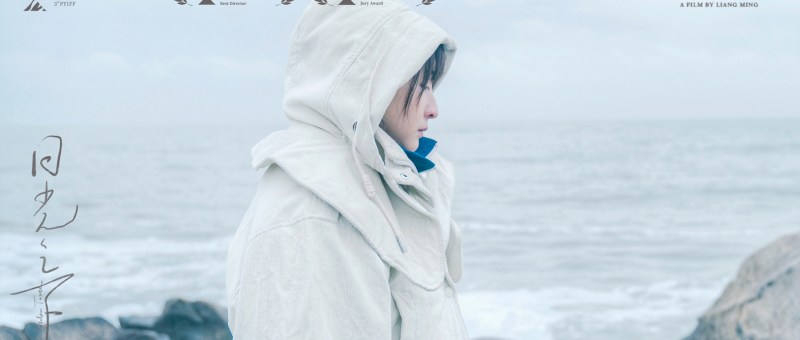
A young woman rides the waves of changing times in Liang Ming’s Wisdom Tooth (日光之下, Rìguāng Zhīxià). Perhaps innocence is something slightly painful you’re better off without, but awakening to life’s light and shade can be a difficult process. Gu Xi (Celeste Lv) is suffering with a dull ache in her jaw and the solution is, apparently, merely pain killers but you can only numb yourself so long before you have to make a choice of whether to go on living with the pain, or free yourself from it. 

A young, if slightly immature woman, Gu Xi has a job in a local hotel and lives alone with her half-brother, Gu Liang (Wu Xiaoliang), who, until recently, has eked out a living as a fisherman. A recent oil spill revealed to have occurred some time ago but covered up by the authorities has put paid to that, while Xi also finds her job under threat because she has an undocumented status and there is shortly to be some kind of inspection. Having grown up without a mother and entirely ignorant of who her father might have been, Xi feels acutely anxious about her circumstances and is dependent on Liang for a sense of security. It is therefore unsettling for her when he develops an interest in the sophisticated Qingchang (Wang Jiajia), daughter of local mob boss Zhou (Chen Yongzhong) and a recent returnee from South Korea where she had been living with her mother. 

A mirror image of Xi, Qingchang is everything she she’s not. Xi is well known for wearing her brother’s clothes, dressing like a tomboy for reasons that are a combination of poverty and affection, where Qingchang has wardrobes full of the latest fashions brought back with her from overseas including a beautifully crafted Hanbok featuring an elaborate embroidered design. As much as she’s resentful and intimidated, Xi can’t help admiring the slightly older woman, captivated by her sense of self assuredness, and eventually develops a sisterly bond with her even while fearing that she may steal her brother away. 

A further intrusion, however, disrupts their tentative familial bonding. A fisherman found dead and floating on the sea hints at a burgeoning turf war between local bosses Zhou, Qingchang’s father and Liang’s employer now that he’s taken a job as a security guard at the docks, and Jiang (Tao Hai), a melancholy Christian who owns the hotel where Xi had been working. Though warned by others that Jiang seemed “creepy”, Xi feels indebted to him because her job at the hotel was saved after she approached him to intervene. Her habit of recording the conversations around her to listen to later presents her with a problem when she discovers that Zhou may have bumped off the fisherman himself and is planning to frame Jiang for the crime. Jiang, it seems is also receiving protection money to ensure the fishermen’s safety, apparently a promise he wasn’t able to keep. Xi is pulled three ways. She loses confidence in Qingchang who is now both tainted by association and a figure of mild discomfort, while fearful that if she reveals what she knows, serves justice and repays a debt by clearing Jiang, she will ruin her brother’s happiness and risk his rejection. 

Trapped in he realms of childhood, what she most wants is to preserve her status quo. Liang is everything to her – brother, father, and somewhat uncomfortably a figure of romantic impossibility. Her feelings towards Qingchang are mired in complexity, a nascent attraction perhaps underlying her sense of jealousy either misdirected through her complicated feelings for her brother or simply finding its anchor for the first time. An angry speech at her brother’s birthday party during which she inappropriately reads out a semi-explicit passage from a lesbian novel hints at an attempt to resolve an attraction she feels is taboo, though it is unclear for whom it is directed. As with most young people, she must come to an accommodation with the fact that her world is changing. A childhood promise that she and her brother would never marry, preserving their family of two forevermore, was always unrealistic but she struggles to let go of the idea of permanence in a childish sense of familial security. Like the oil polluting the seas, her world is coloured by uncertainties but like anyone else she discovers that her agency is limited and whatever choice she makes others will make their choices too. That dull ache in her jaw is a reflection of the ills of the world around her, an inconvenient tooth that needs to be plucked out and discarded leaving only the cold comfort of adult wisdom behind in its place. 


Wisdom Tooth screens on March 11/14 as part of this year’s Osaka Asian Film Festival.