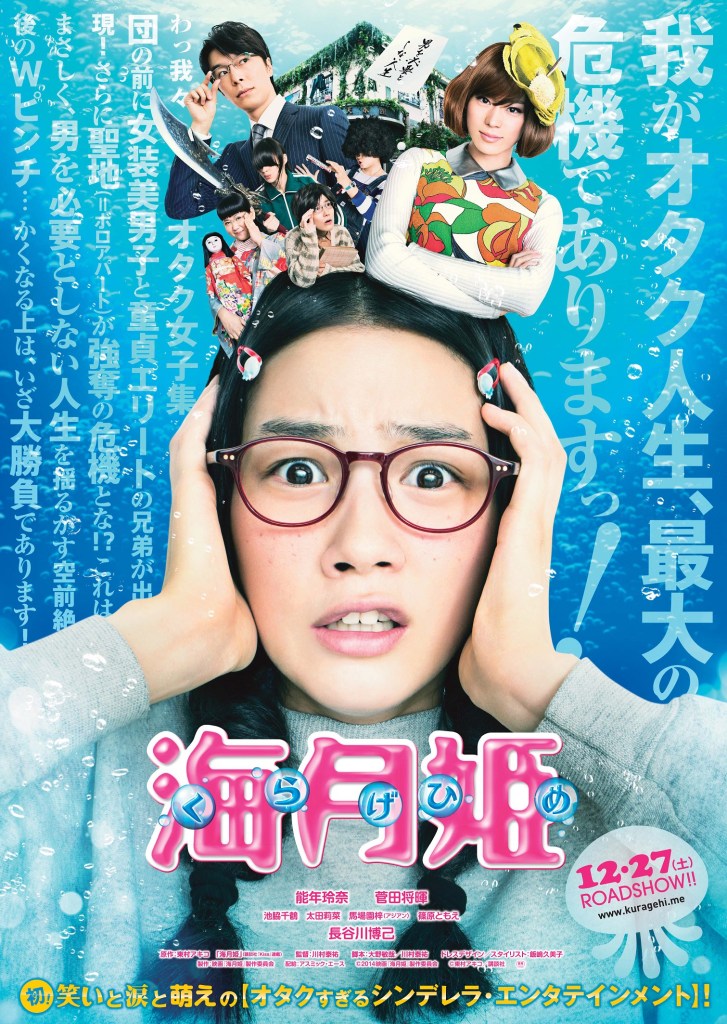
Princess Jellyfish (海月姫, Taisuke Kawamura, 2014)

b7dec6a631e5ad87baf2ff601d6b4872Originating as an ongoing manga series by Akiko Higashimura which was also later adapted into a popular TV anime, Princess Jellyfish adopts a slightly unusual focus as it homes in on the sometimes underrepresented female otaku.

Tsukimi is an extremely awkward young woman who has an all encompassing obsession with jellyfish. Luckily for her, she’s managed to find a group of likeminded women of a similar age to room with. That is, they aren’t all as crazy about jellyfish as she is, but they all have their particular order of special interest, are fairly socially awkward with an extreme fear of “fashionable” women, and no formal form of employment. At the Amamizukan boarding house, the girls can all enjoy their otaku lives together (well, kind of separately) and, crucially there are no boys allowed!

However, one day Tsukimi finds herself at a crisis point when she notices one of the jellyfish she likes to visit at a nearby pet shop is in danger! The idiot shop boy has only gone and put a Moon Jelly in with a Spotted Jelly – does he just not know how dangerous that is?! Tsukimi will need to act fast to save her friend, but the guy behind the counter is a clueless pretty boy – absolutely the worst case scenario for Tsukimi. Despite her extreme anxiety she valiantly marches into the shop yet her confused mini lecture on jellyfish keeping only succeeds in convincing the shop boy that she’s some kind of nutcase. On being expelled from the shop, Tsukimi finds herself at the feet of an extremely glamorous looking woman who comes to her defence. What kind of strange parallel world is this? Tsukimi’s universe is about to undergo a sea change!

Though based on a manga and intended as a comedy, crucially, Princess Jellyfish casts its series of “different” heroines (and hero) in a favourable light – they are never the butt of the joke and sympathy is always placed with those who experience difficulty in their lives because they feel themselves to be different. Each of the girls is so deeply involved in their own particular obsession that they find it difficult to fit into the regular world and particularly to cope with conventional femininity. Tsukimi herself finds it particularly difficult to talk to men and the fact that no men are permitted at Amamizukan makes it clear that she is not alone in her fears.

This brings us to her new friend who is apparently a fashionable young woman – the sort who would never usually be seen dead talking to the likes of Tsukimi. However, this one not only acknowledges Tsukimi’s presence as another human of equal standing, but even lends her confidence and power as an attractive woman to Tsukimi’s predicament. There is, of course, more to this mysterious saviour than there might seem at first sight. In addition to being a fabulously well dressed lady, Kuronosuke is also a boy. This is something of a problem for Tsukimi as she only realises after letting him stay over at the strictly no boys allowed residence. The ruse also has to be maintained a little longer when Kuronosuke decides to stick around, eventually becoming known as “Kuroko”.

The situation intensifies as the girls’ secret haven comes under threat when a gang of ruthless developers want to buy up most of the town and redevelop the area. The group home is owned by one of the girl’s mothers who is also an otaku only her obsession is with top Korean actor Lee Byung-hun and she’s skipped off to Korea to be able to stalk him better. There’s no telling what she might do if it brings her closer to the object of her affections and things are looking a little desperate. Eventually a possible solution is found which plays to everyone’s strengths and offers the faintest glimmers of hope for the girls (and boy!) of Amamizukan.

Princess Jellyfish is the ultimate tale of acceptance, both in personal and societal terms. The residents of Amamizukan may be a little different, but that doesn’t mean they have nothing to offer the world and there’s no need for themselves to maintain a position of self imposed exile if the only reason is a belief in their own inferiority. This is a lesson taught to them by the exuberant rich boy and politician’s son with a traumatic past of his own, Kuronosuke. Truly unafraid to be who he is, Kuronosuke teaches the girl’s that almost any obstacle can be overcome with a combination of forthrightness and sincerity.

Though it runs a little long and gives in to some very over the top performances and melodramatic plotting, Princess Jellyfish is an enjoyably offbeat manga inspired tale. Very much not interested in demonising anyone other than those who seek to suppress individuality, it’s a cheerful celebration of the value to be found in difference offering plenty of laughter and warmth along the way. Perhaps not for those who prefer their cinematic experiences on the subtle side, Princess Jellyfish is nevertheless a fun filled film which carries its message of universal acceptance right into the closing credits.


The anime adaptation of this is actually really fun too.


Otakus in Love (恋の門, Suzuki Matsuo, 2004)

koi no monReview of Suzuki Matsuo’s Otaku’s in Love (恋の門, Koi no Mon) first published on UK Anime Network in February 2014.


The word “otaku” is a difficult one to pin down. In the West, it’s often come to be a badge of pride and respect, a label that many fans of what most people would perceive as a niche subculture actively identify with and eagerly apply to themselves. However, the roots of the term are much darker and in its native Japanese, “otaku” can be far from a nice thing to call another person. Of the central couple in this film perhaps only one can be thought of as a traditional “otaku” the other being more of a “tortured artist” whose eccentric behaviour makes it difficult for him to survive in the real world. Well, to be honest finding a base line for “normal behaviour” in this film is a pretty tall order, we run into bizarre anime conventions, cosplay obsessives, broken hearted ex-mangaka (manga) bar owners and a bizarre cult like office environment where the only rule is you must be “happy!” all the time. Otakus In Love is an endearingly odd film that is jam packed full of in jokes and meta references that knows its audience very well and never fails in the humour stakes as a result.

Mon is a down on his luck, in fact totally broke, manga artist. Well, he calls himself a “manga artist” but his work isn’t exactly what most people would expect. In a touch of the avant garde, Mon makes his manga out of rocks. Mon’s “manga” are, in fact, a collection of rocks painted with a single kanji character and arranged inside a custom made wooden box. Needless to say each of Mon’s works is a one off piece and his sales record is not exactly going to get him on the best seller list. He can’t seem to hold down a part time job either due to his extreme reactions to people not taking his art seriously and his strange appearance which is something like a seventies guru come glam rock god whose ragged clothes have an oddly deliberate look to them. One fateful day he has an interview for Tsugino Happy Inc which turns out to be a cult-like office environment which seems to advocate happiness through total subjugation. He lasts about an hour at this job before punching his new boss in the face for failing to appreciate his artistic qualities.

However, on the way there about to pick up a particularly fine looking rock, he meets Koino who turns out to be a colleague of his at Happy Inc. The two go out for drinks which ends up at Koino’s apartment where upon Mon wakes up the next morning to find out he’s been a victim of forced cosplay! Unwittingly dressed up as Koino’s favourite character from Soul Caliber II, he’s quickly posed by Koino for her cosplay wall and dragged into a world of doujinshi, comiket, cosplay and all things geeky. Koino is an amateur manga artist who claims to have made a small fortune selling her home made manga at conventions and is well and truly an otaku. Can two such different people really find love? There’s only one way to find out!

Otakus in Love is based on Jun Hanyunyuu’s manga Koi no Mon (also the original Japanese title of the film) and as such carries over various extremely clever meta visual references. Directed by well known actor Suzuki Matsuo (Ichi the Killer) the film is often about as close as you could get to being a live action manga as Matsuo manages to make standard manga tropes like reaction shots and surreal action scenes work in a totally believable way. In the course of the film we’re treated to full on musical sections and ridiculous comic motifs that resurface at fairly predictable moments which could all end up just being far too much, but under Matsuo’s steady hand the film comes out on the right side of crazy and is never anything less than totally zany fun.

The film isn’t afraid to wear its otaku badge on its sleeve, either. Jam packed with references from video games, anime, and manga, Otakus in Love gets its audience completely and trusts it to understand all of its allusions and homages without needing to repeatedly bash the viewer over the head with tie-ins. It also takes an affectionate side swipe at fan culture with some bizarre interactions with cosplay, conventions and ani-singers which any anime fan can probably relate to. The film also has a fair few cameos from such well known personages as Hideaki Anno, Shinya Tsukamoto and Takashi Miike to name but a few.

At a 114 minutes it does run a little long and occasionally feels like it’s going to run out of steam but for the vast majority of its running time Otakus in Love is a genuinely hilarious, truly bizarre, romantic comedy. Full of warmth and exuberance, it’s difficult to image anyone not being swept away by its surreal humour and though it’s certainly on the broader side of comedy it never feels particularly over the top (or at least not in a bad way). Otakus in Love is a romanic comedy that no self confessed otaku should miss out on seeing.


Reviewed at the Japan Foundation Touring Film Programme 2014.

Midnight Diner (深夜食堂, Shinya Shokudo, Joji Matsuoka, 2015)

mainvisualYaro Abe’s manga Midnight Diner (深夜食堂, Shinya Shokudo) was first adapted as 10 episode TV drama back in 2009 with a second series in 2011 and a third in 2014. With a Korean adaptation in between, the series now finds itself back for second helpings in the form of a big screen adaptation.
Midnight Diner is set in a cosy little eatery which only opens between the hours of midnight and 7am. Presided over by the “Master”, a mysterious figure himself with a large unexplained scar running down one side of his face, the restaurant has only one regular dish on its menu but Master is willing to make whatever his customers want provided he has the ingredients. Regulars and newcomers mingle nightly each with their own, sometimes sad, stories while Master offers them a safe place to think things through coupled with his gentle, all knowing advice.

The big screen movie plays just like a series of connected episodes from the television drama yet manages unify its approach into something which feels consistently more cinematic. Keeping the warm, nostalgic tone the film also increases its production values whilst maintaining its trademark style. The movie opens with the same title sequence as its TV version and divides itself neatly into chapters which each carry the title of the key dish that Master will cook for this segment’s star. A little less wilfully melodramatic, Midnight Diner the movie nevertheless offers its gentle commentary on the melancholy elements of modern life and its ordinary moments of sadness.

Fans of the TV drama will be pleased to see their favourite restaurant regulars reappearing if only briefly, but the film also boosts its profile in the form of some big name stars including a manager of another restaurant in town played by Kimiko Yo who seems to have some kind of history with Master as well as a smaller role played by prolific indie star of the moment Kiyohiko Shibukawa and the return of Joe Odagiri whose character seems to have undergone quite a radical change since we last saw him.

The stories this time around feature a serial mistress and her dalliance with another, poorer, client of the diner; a young girl who pulls a dine and dash only to return, apologise and offer to work off her bill; a lovelorn widower who’s come to Tokyo to chase an aid worker who probably just isn’t interested in him; and then there’s strange mystery of a mislaid funerary urn neatly tieing everything together. Just as in the TV series, each character has a special dish that they’ve been longing for and through reconnecting with the past by means of Master’s magic cooking, they manage to unlock their futures too. As usual, Master knows what it is they need long before they do and though he’s a man of few words, always seems to know what to say. One of the charms of the series as a whole which is echoed in the film is that it’s content to let a few mysteries hang while the central tale unfolds naturally almost as if you’re just another customer sitting at the end of Master’s counter.

Shot in more or less the same style as the TV series favouring long, static takes the film still manages to feel cinematic and its slight colour filtering adds to the overall warm and nostalgic tone the series has become known for. Once again offering a series of gentle human stories, Midnight Diner might not be the most groundbreaking of films but it offers its own delicate insights into the human condition and slowly but surely captivates with its intriguing cast of unlikely dining companions.


Assassination Classroom (映画 暗殺教室, Eiichiro Hasumi, 2015)

photo_4First Published on UK Anime Network in November 2015.


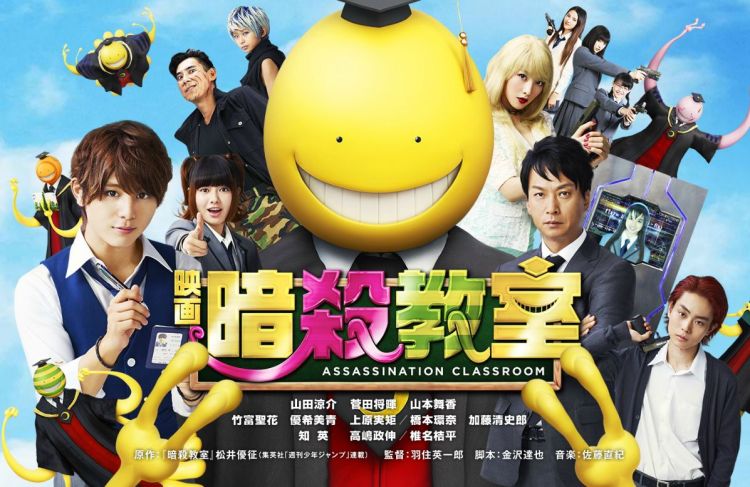
You might make the mistake of thinking that the E in class 3E just means it’s the 5th 3rd year class, or that it stands for “elite” and contains some of the top students in the school. You’d be wrong, “E” stands for “end” because these are the no hoper kids that everyone’s already written off as having no future. However, it’s precisely these kids that a mysterious extraterrestrial being insists on becoming the teacher of in return for not destroying the Earth (just yet). Nicknamed UT (unkillable teacher), the giant yellow octopus-like creature has already destroyed 30% of the moon just for kicks and has now set the challenge that if the boys and girls of class 3E fail to assassinate him before graduation he’ll destroy the Earth too.

The ironic thing is, UT is the best teacher they’ve ever had, but to pass the course (and save the world) they have to kill him. The high schoolers are also under the tutelage of a self defence forces officer for their military training and a sexy assassin who randomly ends up becoming their English teacher (and giving them one of the least appropriate English lessons ever recorded on film). Every morning they bow and then pull out their various kinds of firearms as UT takes the register whilst flitting about dodging bullets. Despite wanting to destroy the Earth, UT is 100% committed to training his students both in the arts of assassination and in the more regular subjects. Because of his super speed and ability to be in several places at once he has time for everybody and is quick to work out each of his charge’s specific weaknesses and help them work on those to become better people as well as ace students.

Still, the students are supposed to kill their teacher and there’s a little bit of sadness creeping in as they inevitably grow closer to UT and his quirky antics. Up ’til now everyone has given up on them and now they’re supposed to kill the one person who’s actually trying to help. Of course, even while this surreal situation is going on these are just regular high school kids undergoing regular high school stuff like wanting to sneak into the girls’ changing rooms or having a crush on someone who hasn’t even noticed you. Despite the impending end of the world, the kids of Class 3E are just enjoying their time trying to work out ever more complex ways of trying assassinate their seemingly invincible teacher.

UT himself is strangely adorable with his giant yellow smiley face style head and bizarre little laugh. He also changes color according to his mood and has a tendency to go off on tangents with one notable example which turns into a long form ‘80s style melodrama about abandoned single mothers before being politely shut down by the bored students. Assassination Classroom is undoubtedly bizarre, surreal and full of absurd humour but all the better for it. It’s just very silly but has an undeniably clever and very witty script that proves near impossible to resist.

To put it mildly, Assassination Classroom is just heaps of zany, crazy fun. It also manages to be genuinely heartfelt as we come to care for this rag-tag bunch of no hopers but also for UT himself as we start to hope the kids will somehow fail and succeed at the same time so we can save both the world and UT. The film drops us a few hints about UT’s backstory but stops short of offering a full explanation for the crazy goings on. Thankfully a sequel, Assassination Classroom: Graduation Day is already in production and even if it doesn’t offer any answers, Assassination Classroom is already one of the most enjoyably absurd offerings to come out of Japan this year.


Assassination Classroom receives its UK premiere at the Leeds International Film Festival on 15th November 2015.

Look out for a review of Tag which is also playing at the festival as it Happy Hour, and Our Little Sister.


Rurouni Kenshin 2: Kyoto Inferno (UK Anime Network Review)

ruruoni_kenshin_the_kyoto_inferno_still(saito’s just so cool!)

Review of the first Rurouni Kenshin sequel, Rurouni Kenshin 2: Kyoto Inferno up at UK Anime Network.


At the end of the first Rurouni Kenshin live action film, you might have been forgiven for thinking that this once wandering warrior had finally found a place to hang up his (reverse blade) sword for good. As fans of Nobuhiro Watsuki’s much loved manga and its anime adaptation will know, there’s no such luck for Himura Kenshin or the long suffering Kaoru as once again Kenshin will be called upon to put his unique skills to use and this time the very survival of Japan’s new era of modernism and equality is at stake!

Having successfully seen off would be drug baron Kanryuu and the false Battosai Jin-e, once remorseless killer Kenshin (Takeru Satoh) has moved into the dojo run by Kaoru (Emi Takei) and made a seemingly joyful life alongside Kaoru’s only pupil, the boy Yahiko (Kaito Oyagi), the doctor Megumi (Yu Aoi) and loud mouth Sanosuke (Munekata Aoki). However, the happy family’s peace is about to be rudely interrupted as an envoy from the Home Minister arrives and requests a private meeting with Kenshin. It seems an old enemy once believed dead has been discovered to be alive and currently plotting terrible vengeance against the new government in Kyoto. Shishio’s skills are matched only by Kenshin and so the government wishes to make use of his services once again to stop this new threat to the development of the modernising Japan. However, Kenshin has laid down his sword and dedicated his life to atoning for the lives he took as a warrior – will he really return to the life of a wandering swordsman? Originally reluctant and very much against the wishes of Kaoru, a tragic event finally convinces Kenshin he has no choice but to stop Shishio whatever the cost!

Even more so that the first film, Rurouni Kenshin 2: Kyoto Inferno is set against the backdrop of a Japan in the middle of earth shattering cultural shifts. The age of the Shogun is over, there are no more samurai or feudal loyalties to fulfil. This fresh new world of possibilities has no place left in it for the men who fought so bravely to bring it into being. Some, like Kenshin, hung up their swords and set themselves into atoning for the violence of the past by vowing to build a better, kinder, future. Others, however, like Shishio, were left with nothing other than the desire to return to a world where their skills mattered – the familiar world of lords and castles and glorious battles. Kenshin and Shishio are two sides of the same coin – light and shadow. Having been assassinated and thrown on a funeral pyre before miraculously surviving thanks to a fortuitous fall of snow, Shishio has made fire his very own symbol and primary weapon of attack. This new world is a hell for him and along with his bandage clad gang of followers, he’s about to plunge all of Japan into a fiery abyss too.

The first instalment was also notable for its fairly high production values and if anything, Kyoto Inferno even improves upon the original film’s impressive aesthetics. Fire in particular has often proved something of a bug bear for the modern action film and as you might expect from the title Kyoto Inferno is jam packed with flaming action. From its extremely striking opening scene, Kyoto Inferno lays on some of the most complex and beautifully filmed action sequences to be seen in a Japanese film in quite some time. Where it falls down slightly is bound up with its nature as the first part of a two part film as it is does begin to pile on the sub plots and risks becoming overloaded while the original gang (and particularly Yu Aoi’s doctor Megumi) end up with relatively little to do. Likewise, as with the first film the more manga-like elements such as some of the overly broad comedy or a couple of characters who are just the wrong sort of outrageous don’t quite fit with the otherwise classical feeling of the film though fans of the manga franchise may appreciate this attempt at remaining faithful to the source material.

In many ways the Rurouni Kenshin movies are just fluffy mainstream action films (not that there’s anything wrong with that) but Rurouni Kenshin 2: Kyoto Inferno is that rarest of beasts in that it manages to build on the foundations of the first film to become something greater with the result that it even helps to elevate the original. Of course, this largely hinges on how well the last part of the trilogy, appropriately entitled The Legend Ends will fare but suffice to say the first two thirds have stood it in very good stead. Action packed but with a tightly plotted storyline, convincing characters, good performances and high production values Rurouni Kenshin 2: Kyoto Inferno offers everything that’s good about blockbusters without any of the drawbacks. In fact the only real problem that the film presents is the likely long wait until The Lengend Ends finally arrives!


This is out in UK cinemas from Friday 28th November 2014 when it’ll play all these cool places:

  • Cineworld Enfield
  • Cineworld Crawley
  • Cineworld Sheffield
  • Cineworld West India Quay
  • Cineworld Glasgow RS
  • Cineworld Cardiff
  • Cineworld Stevenage
  • Cineworld Bolton
  • Vue Piccadilly (London)

Well worth seeing on the big screen, might even be better than the first one!

Thermae Romae

THERMAE ROMAE-T

Lucius ambulat in Tokyo? Review of improbable time travel comedy Thermae Romae up at UK-anime.net.


Pop quiz – what do modern day Japan and Ancient Rome have in common? Fish sauce? Emperor worship? Sandals? More than you thought, wasn’t it? Well, the correct answer is public bath houses and sure enough the people of modern day Tokyo still love going to the public bath even though they enjoy the luxury of being able to bathe at home! Of course, bath house culture with all its social and political uses and divisions was one of the things the Roman Empire took with it wherever it went. However, there must have been a time when some Romans began to feel their baths were getting a bit stale and in need of a new ‘modern’ twist, but what to do? What if they could leap forward in time and learn from the 21st century bath culture of modern Japan! Enter down on his luck architect Lucius who suddenly finds himself in a strange land full of strange looking people who seem to have taken bath technology to its very zenith.

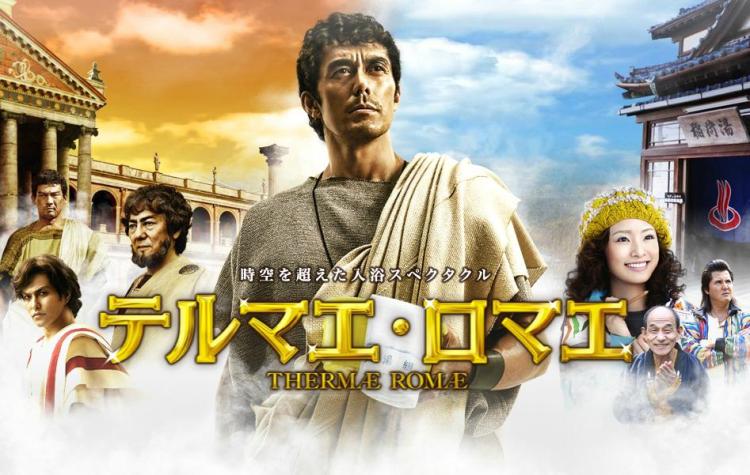
Lucius Modestus (Hiroshi Abe) is a once successful bath architect with a case of serious designer’s block. Replaced on a prime project because he’s been unable to come up with any ideas he decides to go for a soak at the local bath house but whilst clearing his head underwater he finds himself sucked through a passage way only to reappear in a very strange looking place – it’s a bath house alright, but not as we know it! As they’re speaking a strange language he doesn’t understand, Lucius assumes the elderly men bathing here must be slaves and he’s been sucked into the “slaves only” part of the baths. Some of this stuff is kind of cool though – what are these funny spigot like things for, and these handy little buckets? Wait – they have baskets for their clothes?! We could do with some these in our bit! And so Lucius experiences the wonder of public bathing in Japan to the extent that it makes him cry with joy at which point he returns to Ancient Rome and begins to put some of these techniques to use in his designs. Travelling back and fore, Lucius always seems to run into the same Japanese girl who wants to make him the star of a manga and group of kindly old men. Can Lucius finally build the bath house of his dreams and stop a conspiracy against his beloved Emperor Hadrian at the same time?

Based on Mari Yamazaki’s manga of the same name (which also received an anime treatment from DLE), Thermae Romae sticks fairly closely to a fish out of water format for the the first half of the film as Lucius becomes by turns confused and then entranced by the various pieces of modern bathing technology he encounters on his travels. As a Roman encountering other people who are obviously not Roman, he of course adopts a superior attitude and assumes these people are either slaves or ought to be and so is extremely bewildered that their advancements seem to have eclipsed those of his own beloved Rome. These situations obviously provide a lot of room for humour as Lucius encounters various things that seem perfectly normal to us but strange and alien to him – his pure joy at discovering the wonder of the multifunctional Japanese toilet being particularly notable. It does though become fairly repetitive as Lucius finds himself in different situations which are essentially the same joke in different colours but then when the plot element begins to kick in later in the film it too fails to take off and feels a little too serious when taken with the wacky time travelling antics we began with.

Aided in his quest Lucius meets several amusing supporting characters including the group of elderly men from the baths who didn’t really need the help of an improbable ancient Roman to get themselves in trouble and Mami who functions as a kind of love interest who’s cast Lucius as the hero in her next manga. Mami begins learning about the Roman Empire and takes a course in Latin which helps a lot when she too finds herself in Ancient Rome and facilitates a kind of cross cultural exchange as she steals ideas from Rome for her manga as Lucius stole for the baths. However, the romantic comedy element never really comes together and even as Mami continues to pine over her noble Roman, Lucius remains aloof in the universal belief that all non-Romans are inferior. Though he does come to grudgingly acknowledge that the ‘flat faced people’ as he calls them have particular strengths such as their willingness to work as a team and put collective success ahead of personal gain, he never quite sheds his Roman arrogance.

It’s all very silly but undeniably quite funny if often absurd. We hear everyone in Rome speaking in Japanese and Lucius continues to think in Japanese wherever he actually is but obviously once he gets to Japan he can’t understand what anyone’s saying and attempts to communicate with them in Latin (whilst still giving his interior monologue in Japanese). Likewise, when Mami learns Latin she uses it to communicate with Lucius in Japan but once they get to Rome, all their ‘Latin’ is Japanese too which causes problems when the old men arrive because they’re speaking the same language as everyone else yet can’t understand anyone or be understood – which might be why they don’t get to say very much other than to Mami. It’s all quite strange and disorientating but kind of works as does the largely Puccini based score which screams 19th century Italy much more than Ancient Rome but helps to give the film the air of classical pomposity it’s aiming for. Big, ridiculous, silly fun – no one could accuse Thermae Romae of having any kind of serious message but it does provide genuinely entertaining silliness for the majority of its running time.