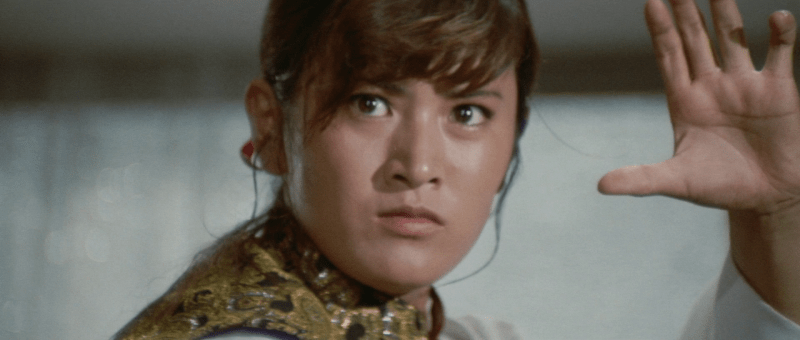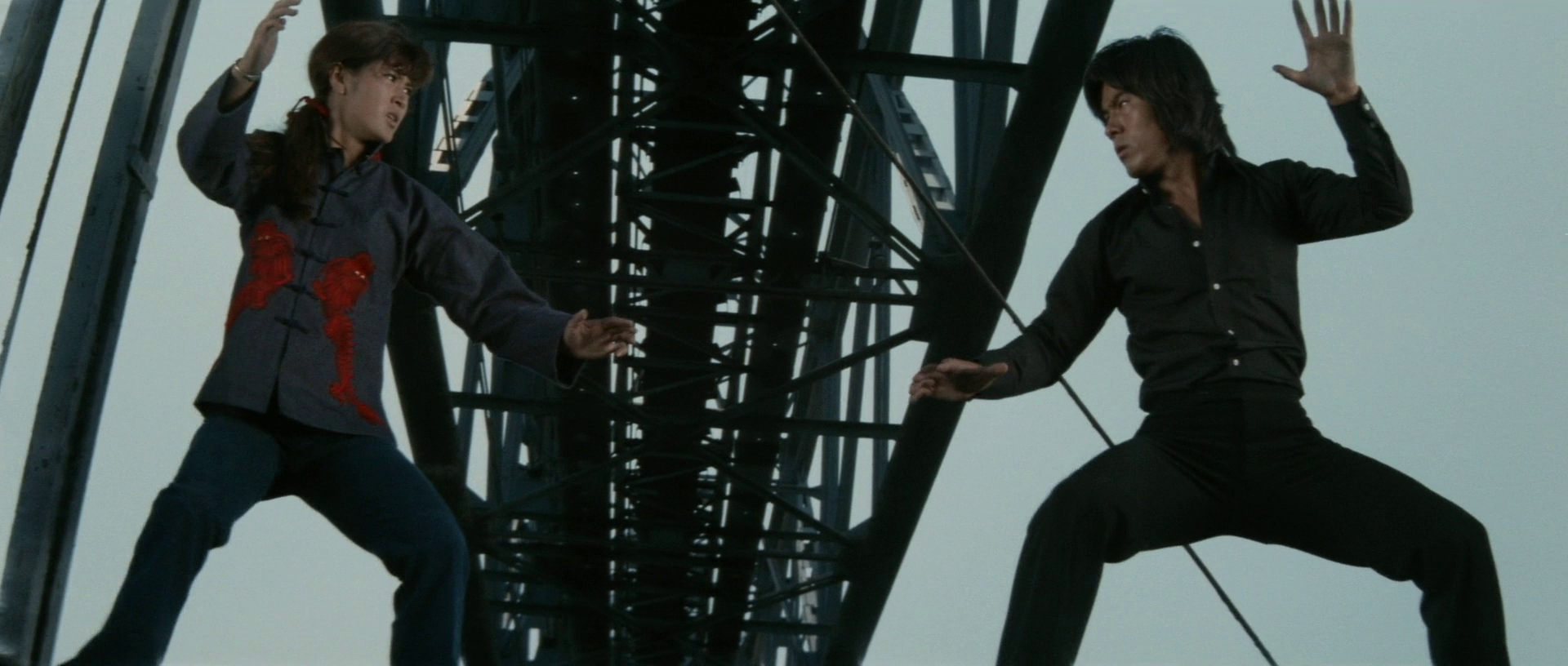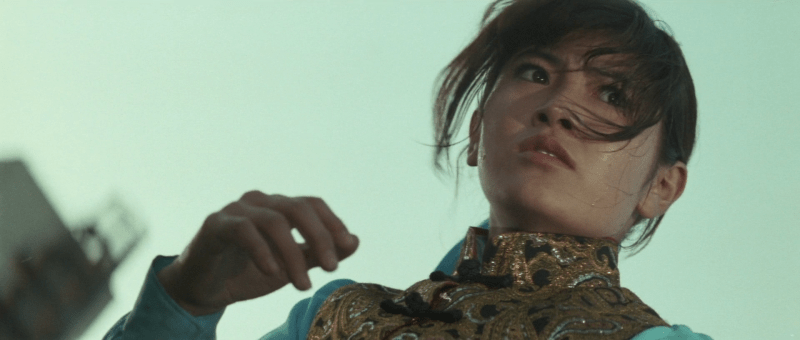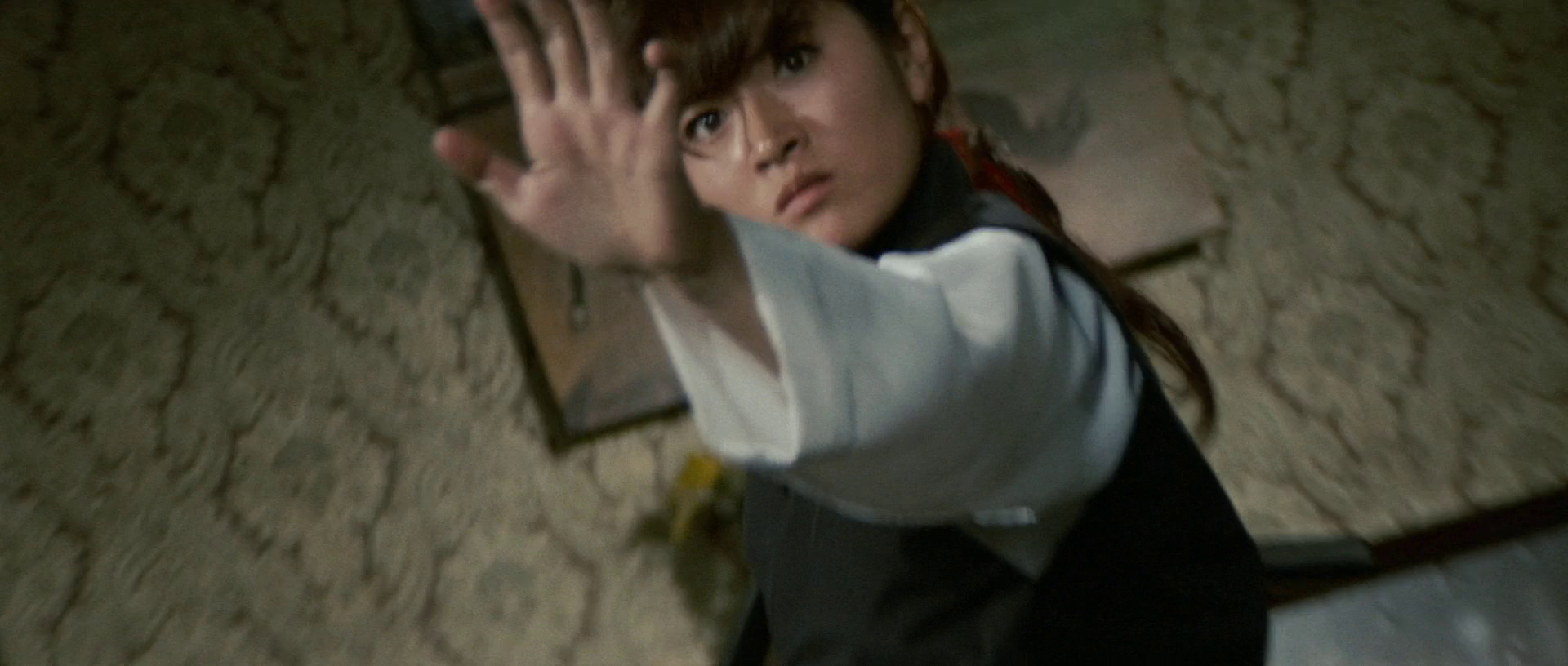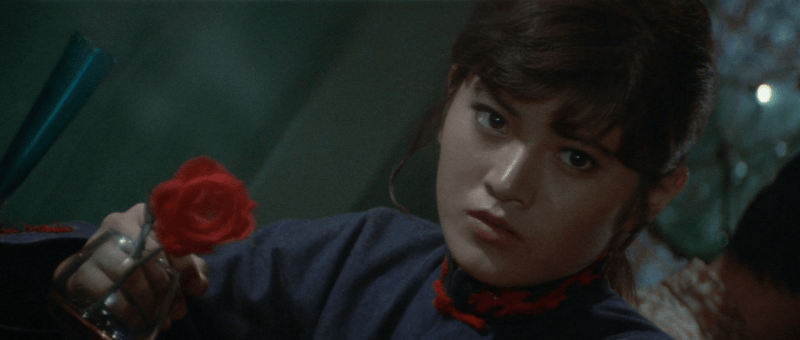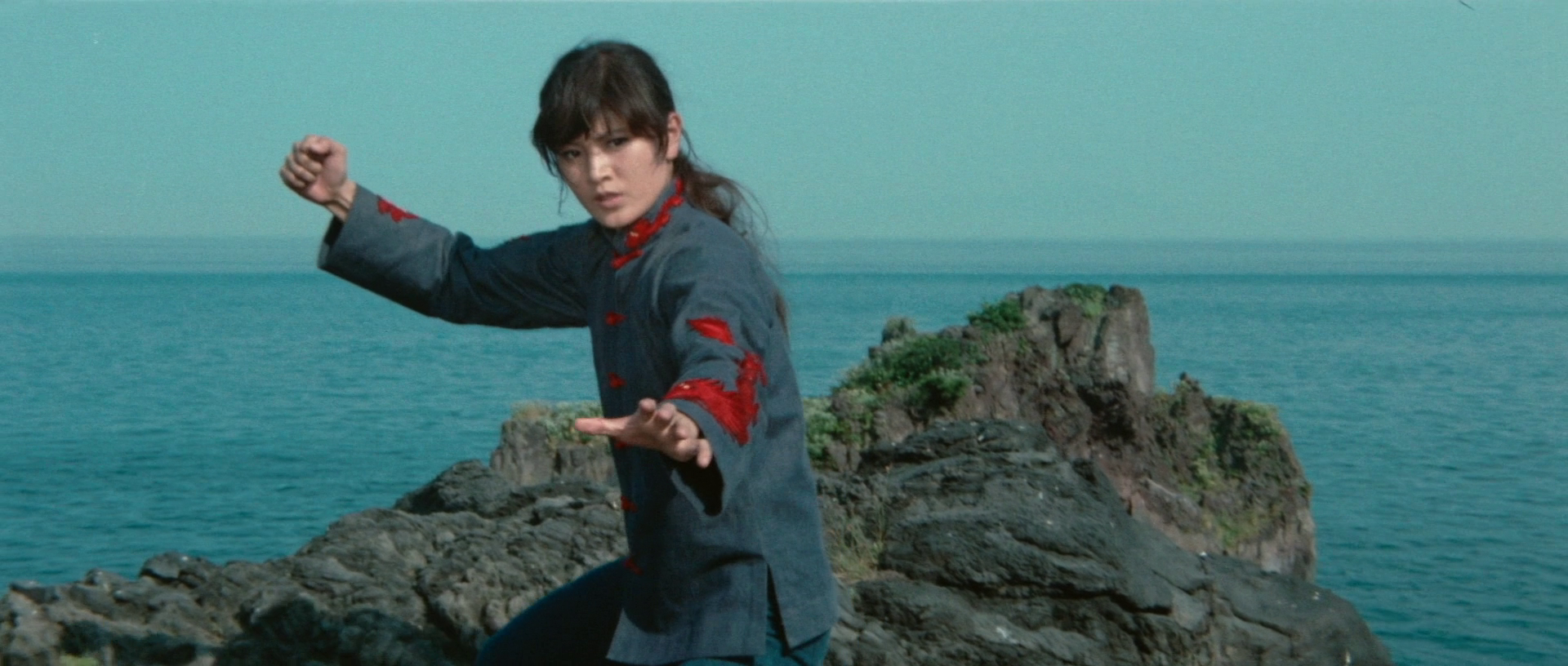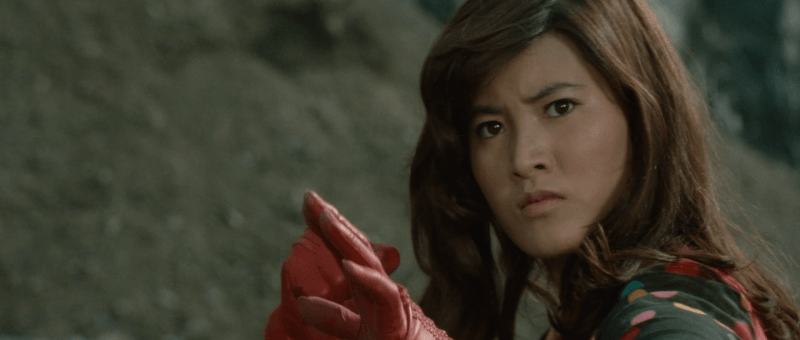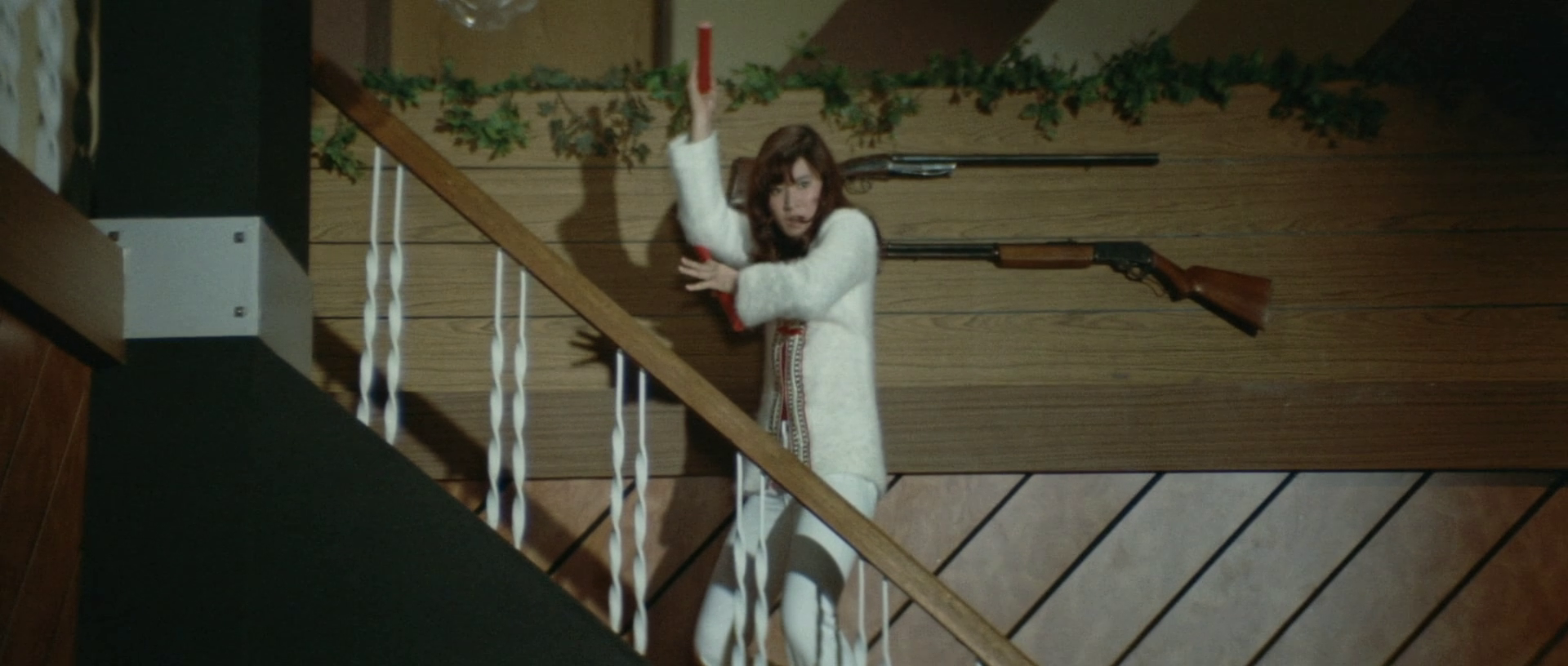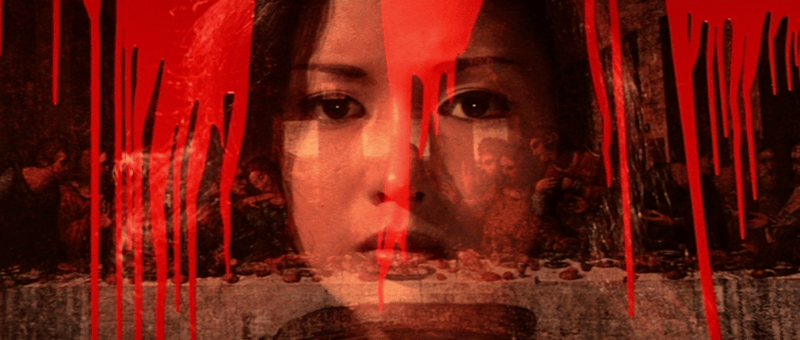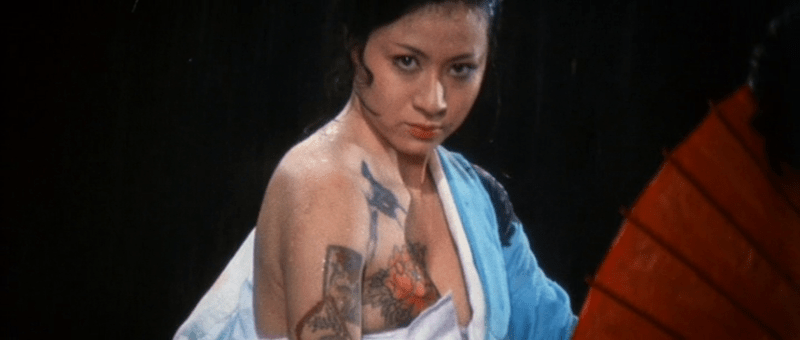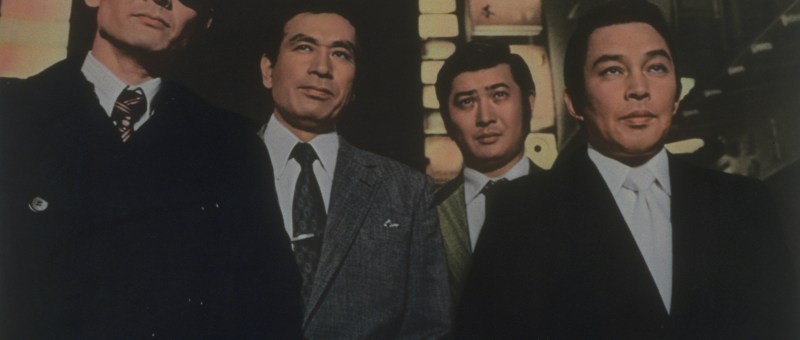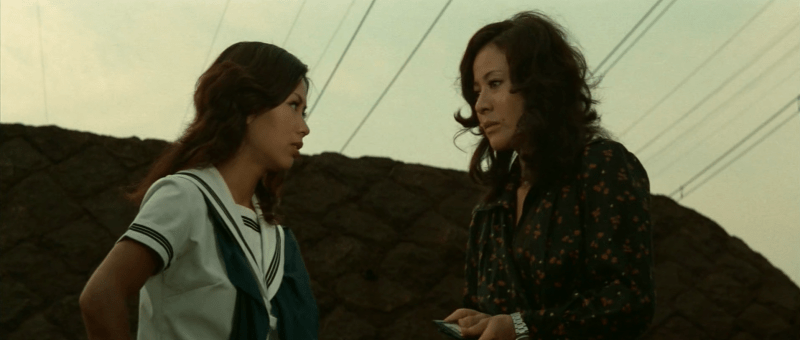
The Return of Sister Street Fighter (帰って来た女必殺拳, Kazuhiko Yamaguchi, 1975)

First it was drugs, then diamonds. This time, it’s gold. Even by this third and final, in the official trilogy at least, instalment in the Sister Street Fighter series, Return of the Sister Street Fighter (帰って来た女必殺拳, Kaette kita onna hissatsu ken) the gangsters still haven’t come up with a good way of smuggling. These ones have hit on the bright idea of dissolving gold in acid and importing it as if it were Chinese liquor. 

In any case, following the same pattern as the other two films, Return begins in Hong Kong with a friend of Koryu’s (Etsuko Shihomi) being murdered by thugs right after asking her to go to Japan and look for her cousin Shurei (Akane Kawasaki) who has gone missing leaving her little girl Rika (Chieko Onuki) behind. Hoping to track down her sister Reika in Yokohama, Koryu once again heads to Japan with Rika in tow only to discover that Shurei has been forced to become the mistress of the shadow boss of the Yokohama China Town, Oh Ryumei (Rinichi Yamamoto). 

Though the film maybe following a pattern, it’s also, in a sense, diverging in that it, perhaps uncomfortably, attempts shift Koryu into a more maternal space in essentially leaving her responsible for Rika because of all of her other relatives are for one reason or another unavailable. This is, after all, the implication of the closing scenes, that Koryu will be giving up her life of martial arts and fighting crime to look Rika. Even so, as we’ve seen throughout the trilogy, Koryu is not much good at protecting those around her. All of her friends and relatives generally end up dead, leaving the screenwriters having to make up more for the next instalment. Family is a liability for the sisters too, as Shuri and Reika try to save each other from the clutches of Oh, who once again tries to control them with drugs and familial bonds, but ultimately fail.

But then Oh is on a different level even to the admittedly eccentric villains of the first two films. He appears to use a wheelchair and dresses in a stereotypically Chinese outfit (as does Koryu, to be fair). Even his name is obviously Chinese even if uses the Japanese readings of the kanji which literally mean “King Dragon Bright”. Yet when he’s eventually unmasked, it seems that he was actually a member of the Kempeitai, or military police, in Manchuria during the war, where he committed atrocities against the Chinese people and finally stole bunch of gold bullion which has fuelled his post-war Chinatown empire. It’s likely also what sparked his obsession with all things gold. Even his prosthetic hand turns out to be made of it, ironically moulded into a grasping motion. 

Oh behaves like some kind of Roman Emperor, sitting on his Dias and holding gladiatorial contests to find new henchmen. He declares he that neither capitalism nor communism can beat gold and he’s hedging his bets on both in an ultimate bid for behind-the-scenes power. Embodying the toxic legacy of militarism, he mistakenly underestimates Koryu declaring that that’s what happens to people who depend too much on their physical abilities, thinking her to be dead. His weird henchmen include a man with a lewd-looking and infinitely symbolic snaking sword, but, of course, they’re no match for Koryu who once again discovers an unexpected ally at a critical moment. 

Even so, the film’s approach to it’s Chinese themes is very much of its time. Once again, it uses some offensively stereotypical music to introduce the Hong Kong setting, and the friend who went to Japan with Shurei is actually called “Suzie Wong”, as in “The World of”. The world surrounding Oh ought to be quite dark what with the constant presence of acid, the people trafficking, and the weird henchmen but somehow the film maintains its cheerful tone, no doubt bolstered by Koryu’s ability to take the gangsters down, even if her way of doing it isn’t all that efficient and more often than not gets all her friends killed. Nevertheless, this time around it seems she’s fighting for the sisterhood against the evil gangsters who control and abuse women, but even so, her final transition to mother-in-waiting feels a little like a rebuke, as if even little dragons have to cool their fire one day just as her brother in the first instalment had wanted her to settle down and live a “normal life” doing typically feminine things rather than mastering martial arts and shutting down the warped and amoral gangsters currently smuggling their greed and weirdness into a changing Japan.


Trailer (English subtitles)

Sister Street Fighter: Hanging by a Thread (女必殺拳 危機一, Kazuhiko Yamaguchi, 1974)

Li Koryu (Etsuko Shihomi) returns to fight crime in Japan in the second in the Sister Street Fighter series, Hanging by a Thread (女必殺拳 危機一, Onna hissatsu ken: Kiki ippatsu). The first film apparently tested so well so that studio execs ordered a second one right away to fill a big New Year slot. That might in one sense explain why the film is pretty much the same in terms of narrative, yet this one does go a little further while swapping the drugs subplot for diamonds.

Koryu comes to the aid of a man being attacked by thugs in a Hong Kong marketplace and is somehow completely unfazed when he plucks out his false eye with instructions to give it to Professor Enmei (Hideaki Nagai) who is also known to Koryu because he’s the father of her old school friend, Birei (Hisako Tanaka). Unfortunately, the false eye contains microfilm that suggests Birei has been kidnapped by vicious Japanese gangsters. The professor therefore sends her to Tokyo on a rescue mission and we discover that she also has an older sister, Byakuren (Kanya Tsukasa), who was never mentioned in the earlier film, who is living in Japan having chased her dream of becoming a jewellery designer.

This time around, it’s diamonds not drugs, but the gangsters still haven’t cracked this smuggling business and have come up with the very weird idea of hiding them in the bum cheeks of attractive young women. Meanwhile, they also force the women into sex work. Osone’s (Hideo Murota) female business partner Mayumi, played by Madam Joy, a drag queen who starred in several Toei films in the mid-70s, films them from a distant window to get material for blackmail. Nevertheless, she only cares about the diamonds, unlike the boss and several of the gang which once again includes a rival martial arts outfit who have in it for the Shorinji temple. 

Shinichi Chiba does not appear in the film, but Koryu does gain a kind of sidekick in the form of Tsubaki (Yasuaki Kurata), a sleazy-looking guy whose intentions are permanently unclear. The film goes a little bit further with its awkward orientalism opening in a Hong Kong marketplace with some offensively stereotypical music and a bunch of fire crackers, even if once again in trends in the opposite direction from most films of the time in that the crooks are all Japanese and it’s a half-Chinese woman who’s coming to sort them all out. The gangsters have apparently been trafficking the women abroad for sex work, then bringing them back with the diamonds in their bums which seems like a plan with a lot of potential problems even if they hadn’t made the huge mistake of kidnapping a friend of Koryu and then later her sister. 

But then again, Koryu’s cases seem to be fairly isolated. Once she takes out these bad guys, that’s it. There’s no wider conspiracy save a general sense that the world itself is corrupt and indifferent to human suffering. Osone has a strange love of taking people’s eyes, which might be a way to stop them seeing who he really is. He has, after all, already taken the stars from Byakuren’s along with her dreams of a new life in Japan finally becoming the jewellery designer she always dreamed of being. Despite her determination to save her sister, Byakuren soon realises that Osone is most definitely not a man of his word. His curiously old-fashioned outfits and demeanour suggest he’s seeking a place with the elites of an earlier time while indulging in some fairly odd behaviour. 

Once again, Koryu squares off against his equally weird henchmen who start attacking her the moment she lands in Japan, and eventually ends up stabbing someone with the severed arm of another enemy still holding his knife. Still, the tone is generally cheerful and upbeat despite the strangeness of the tale and series of losses Koryu experiences including a challenge to her pride when she’s bested by one of the martial arts goons. In this continually uncertain and increasingly surreal world, Koryu’s fists, it seems, are one of the few things that can absolutely be relied upon along with evil smugglers and their bizarre new plans for circumventing the law of the land out of nothing other than lust and greed.


Original trailer (English subtitles)

Sister Street Fighter (女必殺拳, Kazuhiko Yamaguchi, 1974)

As the Japanese cinema industry continued to decline in the face of competition from television, there was perhaps paradoxically more space available for small-scale genre films. Shinichi Chiba had ushered in a new age of unarmed combat with his Bodyguard Kiba karate movies. The Street Fighter series followed hot on its heels and was enough of a hit for the studio to take notice. They suggested a new spin-off line that would feature a female action star with Chiba appearing in a supporting role and so Sister Street Fighter (女必殺拳, Onna hissatsu ken) was born.

Producers apparently first wanted Taiwanese-born Hong Kong actress Angela Mao who had starred with Bruce Lee in Enter the Dragon by which the film is clearly influenced. Angela Mao was, however, unavailable, which is what led them to take a chance on Chiba’s then 18-year-old protégé Etsuko Shihomi. Shihomi had joined his Japan Action Club out of high school to study stunts, martial arts, and gymnastics and had only limited acting experience but soon proved up to the challenge of carrying a movie as a female action lead. 

Koryu is the sister of a martial arts champion who has gone missing in Japan. She then finds out from his boss that he was actually an undercover narcotics agent trying to break a Japanese drug ring. As Koryu’s mother was Japanese and she still has family in Yokohama, the police inspector thinks she’d be a perfect fit to head out there, find out what’s happened to her brother Mansei (Hiroshi Miyauchi), and maybe take out the drug dealers too. 

In some ways, it’s an interesting subversion of the Sinophobia often found in Japanese films of this era that this time it’s a half-Chinese woman squaring off against Japanese drug dealers. Her brother was apparently so upset about not being able to stop the drugs flooding Japan that he decided to do something reckless that directly led to his disappearance. The Hong Kong police also have a second operative, a woman, working inside the gang but have lost contact with her. In contrast to Koryu, Fang Shing (Xie Xiu-rong) has been sent in as a classic honey trap to use her femininity as a weapon by becoming the boss’ mistress to get the lowdown on the gang. But as a consequence, Fang Shing has also become addicted to drugs which the boss uses as a means to control her. 

Koryu, by contrast, immediately stands up against male patriarchal control by beating up a bunch of guys that were trying to hassle her in a bar. Nevertheless, Mansei’s martial arts master says that her brother was hoping she’d get married and have a “normal life”, which does seem like quite a chauvinistic thing to say and especially to the martial arts-obsessed Koryu. Even so, he introduces her to another young woman, Emi, who got into Shorinji Kempo when Mansei saved her from being raped. These skills do after all give them the means to defend themselves against an often hostile and violent society along with granting them a greater independence than they might otherwise have.

Still, there are a selection of strange villains on show with death by blowgun and ex-priests along with the Amazon Seven team of Thai kickboxers and “Eva Parrish”, apparently the karate champion of the Southern Hemisphere. The action is quite obviously influenced by Hong Kong kung fu films and most particularly Enter the Dragon, though to a lesser extent Shaw Brothers in the warring schools subplot that sees the Shorinji Kempo love is power philosophy challenged by the gang’s very own martial artist, who feels he must wipe them out to overcome his humiliation in being defeated. Nevertheless, Koryu effortlessly takes out the bad guys as she battles her way towards saving her brother, whom the gang have started experimenting on in an effort to acquire more complex data about tolerance and safe levels for consumption of drugs. The bad guys have a full on lab in their basement where they’ve come up with an innovative solution to the smuggling issue by using wigs! It’s all quite surreal and cartoonish even when it starts getting grim, but rest assured Koryu is here to sort it all out, and sort it out she will.


Original trailer (English subtitles)

The Great Chase (華麗なる追跡, Norifumi Suzuki, 1975)

What about if you rebooted the Bannai Tarao series, but the hero was a female spy who is also a champion race driver and martial artist? Norifumi Suzuki did actually make a Bannai Tarao move in 1978 starring Akira Kobayashi, but the heroine of The Great Chase (華麗なる追跡, Karei-naru Tsuiseki) certainly loves a disguise or two and like the famous man of a thousand faces seems to have no trouble pulling them off as she infiltrates a gang of evil traffickers led by a furry which has come up with an ace new plan of packing heroin into coffins and having them shipped to nuns!

Oh, and the gang were also behind the death of her father who “committed suicide” in prison after being framed for drug smuggling. The Great Chase takes place in a world of pure pulp which somehow maintains its sense of cartoonish innocence even after Shinobu (Etsuko Shihomi) has infiltrated the heart of darkness and seen most of her associates killed by sadistic gang boss Inomata (Bin Amatsu). But at the same time, it delves into a deep sense of ‘70s paranoia as it becomes clear that the authority figures are all corrupt. Inomata has become a politician, while Shinobu’s father’s murder was orchestrated by the prison warden who was working with him in return for financial gain. The man who framed her father was a friend of his, implying that no one can really be trusted when there’s money to be made.

In a roundabout way,as this sense of anxiety is only reinforced by Shinobu’s role as some sort of secret agent working for the spy ring run by her uncle which is currently hot on the trail of the drug dealers even if they haven’t yet figured out who their boss is. Conversely, her home life is as wholesome as it could be with her two adopted siblings who run a florist’s along with Shinobu’s fan club. Her status as a kind of race car idol lends Shinobu a particular kind of ‘70s cool and turns her into some sort of superhuman figure capable of triumphing over any kind of adversity like a superhero worthy of any kid’s lunchbox. The siblings, Nagi (Fujika Omori) and Shinpei (Naoyuki Sugano), were taken in as orphans by her father which once again signals his goodness in contrast to the greed and selfishness of the gang that had him killed to cover up their crimes. 

That they peddle in drugs marks them out as a force of social disruption, but they’re also actively heretical in hiding behind the shield of the church. Suzuki frequently uses religious imagery in his films and here again echoes the romanticism of School of the Holy Beast with the use of red roses to decorate the coffin of the unfortunate young woman who has been turned into a vessel for smuggling drugs and has for some reason been laid out otherwise entirely naked. When it comes to retrieving the merchandise, we can see that many of the habits are being worn by men while Inomata himself masquerades as a priest. Then again, perhaps he is merely indulging his love of costume play seeing as he also has a hobby of wearing a furry bear suit to attack and rape women in his living room. 

Inomata’s claws then seem to represent something else, a rapacious, grasping sense of patriarchy in which he also uses drugs to bind women to him. Shinobu’s childhood friend Yukiko (Hisako Tanaka) has apparently fallen victim and laments that she is possessed by him body and soul to the point that the old Yukiko is dead which is why she hasn’t been able to step in and help Shinobu and is doing so now fearing that it may cost her her life. Suddenly, it’s all quite grim with the basement sex cult, whipping and torture, but Shinobu maintains her plucky spirit and is somehow able to lure Inomata towards a cable-car-based showdown. With a cameo from real life wrestler / singer Mach Fumiake, the film enters a kind of meta commentary on a real-life Shinobu (though she was not, as far as anyone knows, one of Japan’s top spies), but otherwise remains within the realms of pulp in which the heroine is able to pull off her difficult mission with the help of her talent for disguises before dramatically unmasking herself as the woman who’s going to take them all down. Camp to the max and incredibly surreal, the film never drops its sense of silliness even as the grim events enveloping Shinobu lead to tragic consequences that she barely has time to deal with before barrelling straight into the next duel with the forces of corruption.


*Norifumi Suzuki’s name is actually “Noribumi” but he has become known as “Norifumi” to English-speaking audiences.

School of the Holy Beast (聖獣学園, Norifumi Suzuki, 1974)

“Why is sex wrong?” a rebel nun enquires, hinting at the hypocritical atmosphere of the convent which comes to stand in for the patriarchal superstructure of the contemporary society. That it does so might in a way be surprising given that Christianity has relatively little cultural relevance in Japan save its stance as a persecuted religion during the feudal era. Director Norifumi Suzuki jumps on the nunsploitation bandwagon but does so with a baroque romanticism mixed with punkish youthfulness as two young women find themselves rebels in the house of God.

They are both there for reasons largely unconnected to religion. 18-year-old Maya (Yumi Takigawa) is searching for the truth behind her birth and her mother’s death, while Sister Ishida (Emiko Yamauchi) claims she’s been sent there by a wicked stepmother. Ishida also kicks up a stink during a class by questioning the truth of immaculate conception which is quite odd for someone who wanted to become a nun, while otherwise punished for drinking whisky in the middle of the night. Punishment does seem to be the main thrust of their religious practice with the transgressions of “adultery”, which includes all impure thoughts, murder (!), and theft taken the most seriously. On her first night at the convent Maya is woken by the sound of another nun furiously whipping herself though in fairness there just isn’t much else to do. 

Suzuki rams home the erotisicm of ritual in the baptism Maya undergoes during her initiation as a nun in which she is totally nude and instructed to stand with her arms out as if on the cross in front of the altar. She must then bend to kiss the crucifix before receiving her veil as a bride of Christ. The nuns talk of lives of eternal virginity while burying themselves in asceticism in an effort to deny their natural desires but have to a degree sublimated their lust in violence. The most common form of punishment is whipping, while Maya is later tortured with thorns and artfully battered by roses. When one nun steals money in guilt for having abandoned her impoverished family to begin her spiritual journey to Christ, she confesses herself to a priest who offers her the same amount so that she can help her family and ease her conscience by returning it. But in reality the priest has tricked her. He resents that she feels as if her sin has been forgiven and she may forget her guilt, cruelly telling her that she will never hear the voice of God before going on to violate her. 

The act of betrayal, of himself breaking the code to which he should subscribe, is only a echo of an societal corruption which allows men to abuse their power often with the complicity of the women around them such as the abess who has long been in love with him. Kakinuma (Fumio Watanabe) is a man whose faith has been shaken. He bears the scars from exposure to the atomic bomb in Nagasaki which is centre of Christianity in Japan. After telling Hisako (Yayoi Watanabe) that God will not see her, he asks if anyone has actually seen him and why he does nothing when his people suffer. 

Both he and the abbess are trapped in a hell of their own making, though as the girls both say the convent is akin to a prison. When Hisako’s sister visits her they talk to each other through glass as if she were a prisoner, though in many ways she is oppressed by her own repressed desires while those of the other nuns have begun to drive them quietly out of their minds and into sadomasochistic fury. This peculiar madness is only deepened by the arrival of a new Mother Superior who returns from Europe insistent on rooting out “witches” in league with the devil. Suzuki signals the absurdity by playing a chorus of elation when a tortured nun wets herself over a tablet featuring a crucifix in the inversion of a bizarre Edo-era ritual designed to identify secret Christians who were at that point illegal. 

To break free of the covent and return to her liberated life in contemporary Japan as seen in the cheerful opening sequences of her date with Kenta (Hayato Tani), Maya must also free her mother’s ghost and the souls of her sisters by forcing Kakinuma to reckon with his crimes if in the most ironic of ways. Suzuki shoots with febrile romanticism, the pastel colours of the church lending it a hellish glow even before the resurrection of a ghost enacts karmic revenge in a feverish atmosphere of romantic jealously and masochistic repression.


Original trailer (no subtitles)

*Norifumi Suzuki’s name is actually “Noribumi” but he has become known as “Norifumi” to English-speaking audiences.

Female Yakuza Tale (やさぐれ姐御伝 総括リンチ, Teruo Ishii, 1973)

Having completed her quest for revenge, Ocho (Reiko Ike) returns in Female Yakuza Tale (やさぐれ姐御伝 総括リンチ, Yasagure anego den: Sokatsu Lynch) once again swept up in intrigue after being framed for a bizarre series of murders. With Teruo Ishii taking up the reins from Norifumi Suzuki, the film has a slightly more realistic aesthetic making frequent use of handheld particularly in the narrow backstreets of the late Meiji Society while eventually taking a bizarre detour into the cruel world of an early 20th century mental health institution. 

In any case, Ocho’s troubles start when she’s met at Kobe harbour by a woman who says she’s come to fetch her. On arrival at her destination, Ocho is chloroformed and sexually assaulted by three men who evidently think she’s think she’s someone else and decide to get rid of her after realising their mistake. She wakes up next to the dead body of another woman and is in danger of becoming the prime suspect in a series of murders the subtitles don the “crotch-gauge” killings. After managing to escape, she sets about trying to find out who set her up and what’s going on while getting involved in a succession crisis in the Ogi in which the old boss who was once good to her has been killed. 

Though with much less political subtext, the film nevertheless indulges in the Sinophobia common in many similarly themed dramas in revealing a Mr Lee of Yokohama to be a major player in a drug trafficking scam in which women are forced to smuggle drugs in their vaginas after the gang gets them hooked to manipulate them. Besides Ocho, another woman dressed eerily like Sasori in a black wide brimmed hat and loose dress known as “Yoshimi of Christ” is also on their tail and seeking revenge while echoing some of the religious themes of the first film. She later teams up with recently released yakuza Jyoji who is looking for the daughter of the old boss who has gone mysteriously missing while he is also convinced that present boss Gondo had something to do with it along with the old man’s death. 

This is however mainly a tale of female revenge, Ocho’s being on the yakuza who cut off the Old Boss’ finger after he stood up for her as a teeanger whens she was caught cheating at a gambling den. Nevertheless, what eventually emerges is a sense of female socildairy as Ocho, Yoshimi, and the other women abused by the gang come together to free themselves from its grasp in a strange orgy of violence utilising eerie green lighting to lend it an almost supernatural dimension even if in the end the final blow is struck by a man and not without a little irony. 

This sense of unreality otherwise out of keeping with the immediacy of Ishii’s handheld camera is also seen in the mental institution to which the film eventually travels, a foggy gothic building echoing the Western mansion in the first film but similarly filed with oppressed and abused women sent mad by a patriarchal society or perhaps merely sent there to become so by men who wanted them out of the way. Gondo himself seems to be a regular visitor bringing along his own electroshock machine but finally resorting to using his bare hands in order to tie up a loose end and preserve his own position as head of the clan. 

Ocho is not above using her sexuality to manipulate him, while Ishii maintains the naked sword fights from the first film both from the balletic opening of Ocho and her parasol to the chaos of the final sequence as the women come together to take their revenge as one. Perhaps strangely there isn’t an awful lot of gambling in the film, but Ocho nevertheless makes good use of her trademark hanafuda cards while in a moment of symmetry it’s the wife of her target who eventually settles the matter in a more diplomatic fashion by subjecting herself to the same humiliation to which Ocho had been subjected to bring the circle to a close. Having once again stood up against corrupt crooks and greedy men, Ocho later takes her sisters with her as she walks off this time into the sunset rather than the dark. 


Original trailer (no subtitles)

Sex and Fury (不良姐御伝 猪の鹿お蝶, Norifumi Suzuki,1973)

An orphaned daughter takes revenge against the corruptions of the late Meiji society in Norifumi Suzuki’s pinky violence classic Sex and Fury (不良姐御伝 猪の鹿お蝶, Furyo anego den: Inoshika Ocho). As the opening voiceover explains, the Japan of the early 1900s is already stoking imperial ambitions closely linked with the ideas of “modernisation” and “civility” it is seeking though in reality it is very much a gangster society as the three villains the heroine searches for have come to dominate the new Japan. 

This moment of schism is depicted in the opening sequence set in 1886 in which the little girl who will later take the name Ocho witnesses the murder of her policeman father by three unseen assassins who steal from him evidence of a scandal they then use for their own gain. The murder takes place in a shrine, the young Ocho rolling her paper ball onto a discarded charm that reads “misfortune”, while the film then jumps on to 1905 through a series of historical images prominently featuring the emperor Meiji along with a host of patriotic symbols that seem to signal the wrong path that is being taken. 

As for Ocho (Reiko Ike), she has survived by living on her wits as an excellent pickpocket and gambler but is otherwise uncorrupted continuing to dress in kimono and giving off an air of refined elegance that belies her toughness. In the course of her revenge, she is met by her opposite number, Shunosuke (Masataka Naruse), whose father was also killed by the same three duplicitous yakuza and is dragged into geopolitical intrigue by means of plot by the British to turn Japan into the site of the second opium wars using a spy disguised as a dancer played by Swedish starlet Christina Lindberg who is really in Japan for Shunosuke with whom she fell in love abroad only to be cruelly abandoned. 

Somewhat contradictorily, it’s these Western intrusions that are being resisted with Ocho the representative of an older Japan, and the gangsters that of a newer, largely amoral society of burgeoning militarism. Arch villain Kurokawa (Seizaburo Kawazu) lives in a huge Western-style mansion and is preparing to transition into national politics in the post-feudal society insisting that he and his organisation will soon control “everything”. His underling Iwakura (Hiroshi Nawa), who travels by motorcar, will also be handling the construction of Tokyo Harbour. When the girls from Ocho’s adopted family are kidnapped, they are taken to dance hall Panorama which is bedecked both with Christmassy tinsel and signs celebrating the victory in the Russo-Japanese conflict, while in an anachronistic touch scenes of the war are projected inside. Just to ram the point home, the man who throws a knife at Ocho is wearing stereotypical Chinese dress, while Kurokawa is later seen to have at his disposal a secret attack squad of nuns armed with switchblades and has Ocho whipped, by British spy Christina, in front of a large mural of Christ in some kind of underground chapel. 

In taking her revenge, Ocho is also in a sense attempting to right a historical wrong in removing these usurping men and their accomplice from power while fighting their perversion with her sexuality over which only she is master going so far as to kill one with poison rubbed on her own skin. In accidentally having exposed the equally duplicitous practices in a gambling hall, she is attacked while in the bath but instantly leaps into action entirely in the nude in a strangely beautiful sequence of elegant violence and poetic bloodletting that echoes the film’s conclusion in finally moving out into the snow. Eventually captured, she is bound tightly with rope and tortured but manages to cut herself free using only one of her trademark hanafuda cards which also symbolise her skill as a gambler even if her climactic game with Christina is played with Western cards for casino chips over a dining table. 

Suzuki signals the chaotic nature of this early 20th century world in his riotous use of colour and frequent anachronisms along with canted angles and a spinning top shot that seems to echo the world spinning out of control as Iwakura breaks a sacred promise between gamblers and rapes a young woman he had agreed to spare if Ocho was victorious in her bout with Christina. He saves his most expressionistic technique for the film’s closing moments in which Ocho singlehandedly puts a stop to Kurokawa’s corruption, another picture of Emperor Meiji looking down at her as she launches her final attack, and then stops to purify herself in the snow before wandering off into a storm of hanafuda cards with only darkness ahead of her.


Original trailer (English subtitles)

*Norifumi Suzuki’s name is actually “Noribumi” but he has become known as “Norifumi” to English-speaking audiences.

The Insatiable (現代ポルノ伝 先天性淫婦, Norifumi Suzuki, 1971)

History repeats itself in Norifumi Suzuki’s erotic drama The Insatiable (現代ポルノ伝 先天性淫婦, Gendai Porno Den: Sentensei Inpu). The film’s Japanese title, Modern Porno Tale: Inherited Sex Mania, better hints at its true intentions in essentially repurposing a sense of class anxiety and moral conservatism as familiar from classic melodrama to fit Toei’s line of erotically charged movies but eventually offers little judgement of the heroine’s surrender to her fate (after gaining her revenge) in putting on her mother’s kimono to follow the path set down for her.

That was not, however, what Yuki’s (Reiko Ike) mother (Yoko Mihara) originally wanted. Hoping to save her from the life of a bar hostess with terrible taste in men, she sent her to a religious boarding school in Tokyo which has given her a toxic sense of shame in her sexuality. Sharing a bed with a classmate, she relates her fear and horror of sleeping with men which she assumes she is expected to do in time, though goes on to explore herself sexually with the other girl who feels much the same despite the warning from their lesson books that looking at another woman with desire is no different from adultery. 

Nevertheless, on returning to her mother’s home in Kyoto Yuki is later raped by her mother’s latest boyfriend who is for some reason a bowling enthusiast. His sensibility is emblematic of that of most men in the film who see Yuki merely as an object to be conquered. Following this violation, Yuki quits school and spends all her time in clubs in Shibuya unable to reconcile herself with her sexuality and living as good time girl if resenting herself when others see her as a sex worker. Sucked into the world of sleazy clubs, she becomes a kind of pass around for wealthy men while also cared for by a besotted yakuza who has been quite literally emasculated by his love for her, leaving Yuki unable to fully return his affections because he can no longer satisfy her sexually.

Eventually she meets handsome architect Yoichiro (Hiroshi Miyauchi) with whom she falls in a more wholesome love, but continues to believe that she cannot really be with him because of her sordid past. She then realises that not only does he have unfinished business with a French woman he met while studying abroad (Sandra Julien), but that his father, Matsumura (Tatsuo Endo), is the seedy loanshark who’s been trying to get his hands on her through middleman Akihito (Fumio Watanabe) who is connected with her mother’s new partner Tomoguchi, and also Yoichiro’s brother-in-law.

Akihito is really the villain of the piece, though mostly for his attempt to wage class warfare by taking over Matsumura’s business. His wife, Ayano (Miwako Onaya), has turned away from him knowing that her father brought him into the family for his ruthlessness while exclaiming that she hates self-made men. In much the same way that Yuki was attempting to escape her mother’s legacy, Akihito is also trying to overcome his impoverished background to catapult himself into the upper classes though Matsumura himself appears to have earned his wealth in dubious ways. In any case, he rejects Yoichiro’s decision to marry Yuki not only because he wants her himself but because he claims he wants to find a more appropriate wife for his son presumably as he found Ayano a husband who would benefit himself. 

In any case, Yuki is drugged and abused much like her mother turned into a plaything for men. Yuki resents her only momentarily for her role in her rape and sickening attempt to placate her boyfriend after having stood up for Yuki and confronted him about his betrayal. The two women later reconcile and find solidarity in their maternal relationship even if her mother can never escape the pattern of behaviour that keeps her dependent on bad men which is something Yuki may have overcome in the film’s closing moments as she in turn, wearing her mother’s kimono, opens a bar under her own name living as an independent woman. 

To get her revenge, she manipulated the men around her by using her sexuality against them only to be backed into a corner by Akihito’s chilling claim that she was now his slave. Her salvation at the hands of another man who damns himself in her defence and the defence of their love as something pure despite having cruelly rejected Yuki as a “whore” perhaps undercuts the message but also in the film’s eyes redeems her from her wandering life as an insatiable sex addict now free of her sense of shame and the lingering trauma of her rape. In this patriarchal and classist society, all men are animals driven only by destructive influences, while Yuki is even able to bond with Yoichiro’s French former lover with whom she also shares a sexual encounter. Suzuki films with characteristically romantic imagery and a wry sense of humour but nevertheless allows his heroine to find her way out of a world of beasts while refusing to shame her even as she embraces her mother’s legacy. 


*Norifumi Suzuki’s name is actually “Noribumi” but he has become known as “Norifumi” to English-speaking audiences.

Violent Streets (暴力街, Hideo Gosha, 1974)

“Nothing’s like it used to be anymore” sighs a woman who’s had to betray herself but has tried to make break for it only to discover there is no way back. Hideo Gosha’s Violent Streets (暴力街, Boryoku Gai) is like many films of its era about the changing nature of the yakuza in an age of corporatised gangsterdom. Now “legitimate businessmen” who claim to no longer deal in thuggery, their crimes are of a more organised kind though a turf war’s still a turf war even if you’re fighting from the boardroom rather than simply getting petty street punks to fight it for you in the streets. 

In a touch of irony, former yakuza Noboru Ando stars as a man who’s tried to leave the life behind but is pulled back into underworld intrigue when his former foot soldiers mount an ill-advised bid for revenge against the clan they feel betrayed them. After serving eight years in prison for participating in the last turf war, Egawa was given flamenco bar Madrid on the condition that he dissolve his family and attempt to go straight as a legitimate businessman. The Togiku gang has since gone legit and distanced itself from most of its old school yakuza like Egawa. But now a yakuza conglomerate from Osaka is moving in on their old turf and the Togiku want the Madrid back as a bulwark against incursion from the west which is why they’ve been sending the boys round to cause trouble in the bar. 

Egawa is the classic ex-gangster who wants to turn himself around but is largely unable to adapt to life in a changing society. He is technically in a relationship with a bar hostess who has a severe drinking problem in part exacerbated by his inability to get over his former girlfriend who left him and married the boss, Gohara, while he was in prison. His former foot soldiers attempt to convince him to get the gang back together and take revenge, resentful of having been used and discarded, but he tells them to let it go, that they’ve all got “honest jobs” and that they should try to live as best they can. Like him, the guys are ill-equipped to make new lives in the consumerist society and cannot move on from the post-war past. Hoping to engineer a turf war between the Osaka guys and Togiku, they kidnap a popular TV personality/pop singer (Minami Nakatsugawa) attached to a station which Togiku controls and frame a rival affiliated with the Osakans for taking her. 

This just goes to show the various ways in which newly corporatised yakuza have expanded their business portfolio, heavily participating in the entertainment industry moving beyond bars, clubs, and the sex trade into mainstream television and idol stars. Egawa’s old friend Yazaki (Akira Kobayashi) is his opposing number, just as caged but trapped within the confines of the new gangsterdom, reprimanded by his boss for raiding the rival studio’s offices and undoing the gang’s attempt to rebrand themselves as legitimate businessmen rather than violent street thugs. “I can’t stand being humiliated” he explains as Gohara points out he’s stepped right into their trap now giving the Osakans an excuse for retaliation. “The Togiku group is a defanged, domesticated dog” Yazaki barks, “I can’t pretend to be an obedient company employee forever and do nothing”. 

Neither man is able to progress into the new era of rising prosperity, both little more than caged animals thrashing around trying to break free but continually crashing into the bars. Just as Egawa’s old guys had tried to engineer a turf war hoping that the two gangs would take each other out and leave a vacuum they could fill, arch boss Shimamura (Tetsuro Tanba) flies above the city in a helicopter as the “worms fight among themselves” and observes the chaos below as he completes his silent conquest of the contemporary economy like some modern day Nobunaga of corporatised gangsterdom. 

Taking over the Togiku through a process of corporate infiltration and gradually ridding themselves of all the old school yakuza ill-suited to the shady salaryman life, the contrast between the world of cabaret bars and back street dives and Shimamura’s smart suits and helicopters couldn’t be more stark. A slightly sour note is struck by the use of a transgender assassin (Madame Joy) who performs a lesbian floorshow by day and kills by night while working with a bald sidekick who carries a parrot on his shoulder, her coldness bearing out the tendency of yakuza movies to associate queerness with sadistic savagery. Gosha rams his point home with the otherwise surreal scene of a pile of abandoned mannequins by a swamp that becomes a popular yakuza kill site homing in on the emptiness of their eyes and the uncanniness of dismembered bodies, mere empty shells just like the men who die in this literal wasteland. Egawa perhaps feels himself to be a man already dead long before being pushed towards his act of futile rebellion, somewhere between sitting duck and caged dog fighting for his life between the chicken coops of a moribund small-town Japan. Marching to a frenetic flamenco beat of rising passions and barely contained rage, Violent Streets leaves its former foot soldiers with nowhere to go but down while their duplicitous masters continue to prosper riding the consumerist wave into a new and prosperous future.


Violent Streets opens at New York’s Metrograph on Dec. 16 as part of Hideo Gosha x 3

Trailer (English subtitles)

Orgies of Edo (残酷異常虐待物語 元禄女系図, Teruo Ishii, 1969)

Orgies of Edo poster“Pinky Violence” is a strangely contrary genre, often held up both as intensely misogynistic but also proto-feminist in its vast selection of vengeful heroines who seemed to embody the rage of several centuries of inescapable oppression. Teruo Ishii, at the very forefront of Toei’s attempts to graft pink film sensibilities onto its house style of manly yakuza drama, had a definite love for the perverse but, perhaps unusually, a consciousness of the implications of his world of surrealist violence. The Japanese title of Orgies of Edo (残酷異常虐待物語 元禄女系図, Zankoku Ijo Gyakutai Monogatari: Genroku Onna Keizu) translates as something like “a genealogy of the women of the Genroku Era” and concerns itself with three tales of misused women each of whom meets a grim end at the hands of faithless men who seem to embody the decadence of their prosperous times.

Ishii’s three tales of increasing madness and brutality travel from the streets to the palace in locating each scene of mounting debauchery within the shifting circles of prosperous Genroku era Edo. Our guide, positioned to the side of each of the tales, is a conservative doctor (Teruo Yoshida) who diagnoses his society as morally sick and hovering on the edge of a decadent abyss. Tellingly, each of episodes with which he becomes involved is presaged by his inability to access foreign knowledge in the wilfully isolated nation, slowly stagnating even in the midst of unprecedented prosperity.

His first patient is a young woman in the middle of a painful miscarriage caused by a beating intended to end her pregnancy. Abroad they know of an operation to avoid this sort of misery, the doctor muses, but he has no way of helping her. The young woman, Oito (Masumi Tachibana), like many in the tales of old Edo, got into debt and then was seduced by a handsome young man who posed as a saviour but only ever meant to misuse her. Hanji (Toyozo Yamamoto), a gangster, presses her into prostitution and eventually betrays her by taking up with another woman but neither of them are free of their respective captors be they the Yoshiwara or the gangster underworld.

The doctor’s second case is more extreme and calls upon him to make use of his knowledge of the Western notion of psychiatry in trying to cure a young noblewoman of her perverse fetish for the physically deformed. Ochise’s (Mitsuko Aoi) tastes stem back to a traumatic teenage incident during which she was abducted, held prisoner, and repeatedly raped by a man with a ruined face. Her loyal servant, Chokichi (Akira Ishihama), has long been in love with her but the pair remain locked in a one sided sadomasochistic relationship in which he knows that she can never return his love not because of their class difference, but because of his “perfection”. Pinching an ending from Tanizaki’s Shunkinsho, Ishii sends the frustrated lovers in a less positive direction in which a woman’s defiant insistence on pursuing her own desires is met only by the violence of a male need for possession which eventually leads to mutual destruction.

Mutual destruction is a final destination of sorts. The doctor’s third unrealisable request is for an untimely caesarian section – another piece of Western medical knowledge he has only vague awareness of. This unusual situation unfolds at the court of a lascivious lord whose perverse proclivities are quickly becoming the talk of the town. Drawn to a young woman, Omitsu (Miki Obana), who greets his attempt to fire his arrows at her while angry bulls with flaming horns charge at his other concubines with excitement, the lord is dismayed to hear of another of his ladies, Okon (Yukie Kagawa), enjoying the attentions of her pet dog and therefore somehow sullying his own bedroom reputation. The lord has Okon painted gold and thrown in a hall of mirrors for a slow and painful death of multiplied suffocations but she wins a temporary reprieve by promising to introduce him to untold pleasure if only he lets her live. This will all end in flames and ashes, but the lord hardly cares because it is only the natural end for his hedonistic endeavours.

The doctor performs his miracle and emerges with a child in whom lies the legacy of this immoral time. Yet the doctor wants to “save” it. Even if it’s a “beast” the child is innocent, he intones, insisting that he must live despite this burden in order to resist the madness. Like the strange butoh inspired performance art which opens the film, these are times of madness and confusion in which women, most of all, suffer at the hands of men who care only for their own pleasure. The doctor tries to cure the “sickness of the soul” that he sees before him, but knows that cannot be excised so much as tempered. Still he walks forward, away from the wreckage, with the future in his arms and resolves to live whatever the cost may be.


Orgies of Edo is available on blu-ray courtesy of Arrow Films.

Original trailer (no subtitles)