Children of the Great Buddha (大仏さまと子供たち, Hiroshi Shimizu, 1952)

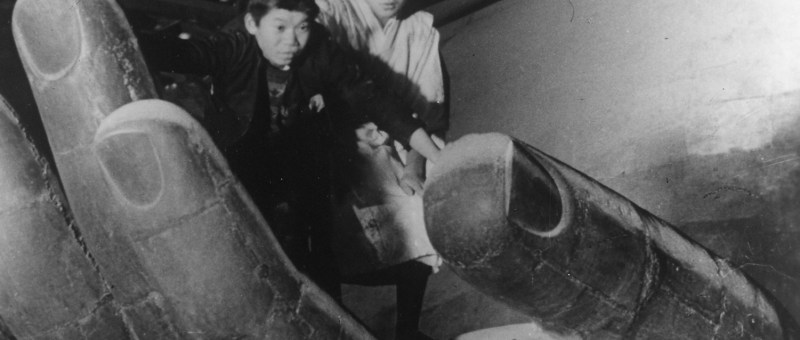
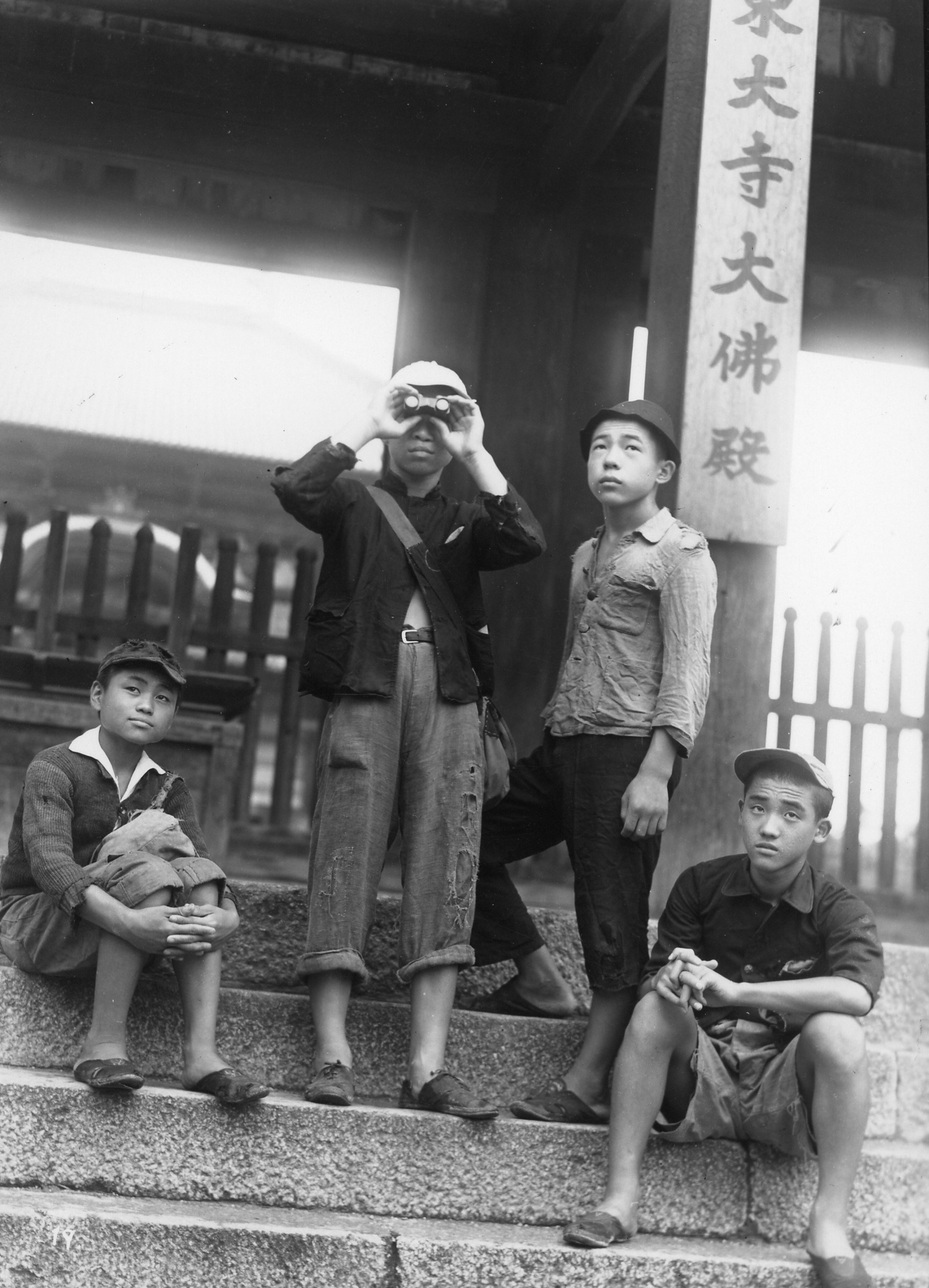
Following Children of the Beehive, and Children of the Beehive What Happened Next, Hiroshi Shimizu completes the trilogy with Children of the Great Buddha (大仏さまと子供たち, Daibutsu-sama to Kodomotachi) this time taking place n Nara and focussing on war orphans who remained alone but are trying to make new lives for themselves as tour guides around the temples of the ancient capital. The existence of tour guides in itself implies a change in circumstances in a resurgent tourist industry while it’s also true that Nara is one of the few cities to have escaped the war largely unscathed and free from the destruction seen in industrial centres such as Tokyo or Osaka or that seen in Hiroshima or Nagasaki. 

There is indeed a particular contrast between the ragged children and the guests they escort who appear generally well dressed and seem to have employed them partly out of a sense of pity. The oldest of the boys, Ko, is later gifted some better clothing but doesn’t wear it explaining that he couldn’t get customers dressed like that so he’s put the nice clothes away in a box. The film never really makes it clear where the boys sleep though they can assumed be homeless or otherwise that the temples themselves are their home. Ko has been able to save up some vouchers and sent away for a pair of binoculars putting the Nio guardian statues down as the addressee. He takes his job very seriously and is slightly put out when he discovers part of his patter is inaccurate, made up by his mentor, Ichuin, who has since been adopted by a temple as a novice monk, to better entertain the customers. 

Ichiuin tells a sculptor the boys collectively refer to as “Mr Failure” that his superiors at the temple are quite upset about this new trend in tourism, that they fear people only come to admire the statues as pieces of art rather than to worship Buddha. The fact that people now have money and time for travel signals that the age of post-war privation is coming to an end though those who arrive from outside Nara also talk of destruction and a sense of displacement. A demobbed soldier remarks that it’s only in Nara that he feels he’s come “home” hinting at a concept of Japaneseness that’s survived in the ancient capital but not elsewhere. Meanwhile, Ko is charged with escorting a Japanese-American woman travelling alone in a rented car having returned to visit her grandparents’ graves. The woman, who the boys refer to as “Miss Second Generation,” treats them warmly and includes them in her picnic which itself is quite elaborate and made with rare and expensive foodstuffs. Later her purse goes “missing,” leading Ko to assume some of the other boys have taken it. He’s right, they have. But they were too frightened to spend any of the money because there was such a lot of it expressing this new idea of America as a land of plenty in contrast to Japan at the end of the Occupation.

When Ko takes the money back to her she buys him new clothes, leading the other boys to incorrectly assume she’s going to adopt him and he’ll be leaving for a better life in America. Despite the sense of solidarity that’s arisen between the orphans, they continue to long for more conventional families or at least to be adopted as Ichiuin has been by the temple. Genji, Ko’s friend, has longing for a small statue of Buddha from a local shop only to end up heartbroken on learning it’s been sold. But the woman who buys it unexpectedly offers to adopt him, aligning Genji himself with the statue and explaining that she had a son his age but he died. Genji originally seems reluctant, saying he will stay with Ko perhaps partly out of guilt but is later persuaded though Ko declares that he will always be at the temple. Caught in a kind of limbo, he religiously listens to the missing person programmes for news of his father whose whereabouts, like many even so many years after the war, are still unknown. 

This may be one reason behind the hope that the orphans of Japan could sleep in the lap of Buddha if in a more literal sense, that they maybe embraced by a more spiritual entity in a society that otherwise appears indifferent to their fate. In any case, Shimizu spends a lot of time with the statues capturing them in a documentary style as if we ourselves were receiving this tour and becoming acquainted with the picturesque environment of the ancient capital somehow free from the corruptions of the war itself or the post-war era and in its own way accepting of these orphaned children to whom it offers a home in Buddha’s palm if not quite so literally.


Children of the Great Buddha screens at Japan Society New York on 1st June as part of Hiroshi Shimizu Part 2: The Postwar and Independent Years.

The Sand City in Manchuria (砂漠を渡る太陽, Kiyoshi Saeki, 1960)

A pure hearted doctor stands strong against the forces of imperialism if somewhat ambivalently in Kiyoshi Saeki’s wartime drama The Sand City in Manchuria (砂漠を渡る太陽, Sabaku wo Wataru Taiyo). “Why isn’t there just one country? I don’t want a country” a young Chinese woman exclaims towards the film’s conclusion in what is intended as an anti-war statement but also invites the inference that the one country should be Japan and that China is wrong to resist the kind of “co-existence” that the idealistic hero is fond of preaching. 

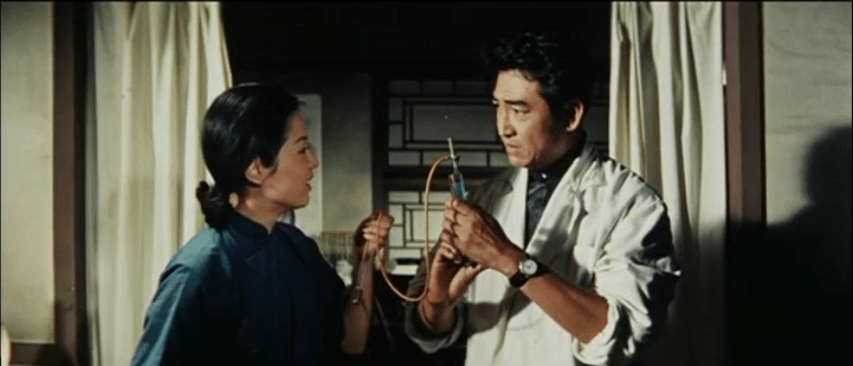
Dr. Soda (Koji Tsuruta), known as Soh, has been in Manchuria for two years running a poor clinic in a trading outpost on a smuggling route through the desert. He came, he later tells another Japanese transplant, after being talked into it by a pastor who told him about US missionaries who endured hardship in the Gobi desert and lamented that no Japanese people had been willing to take on such “thankless” work in the midst of the imperial expansion. There is a kind of awkwardness in Soda’s positioning as the good Japanese doctor which perhaps reflects the view from 1960 in that he objects to the way the Japanese military operates in Manchuria and most particularly to Japanese exceptionalism which causes them to look down on the local Chinese community as lesser beings, but within that all he preaches is equality and co-existence which suggests that he sees nothing particularly wrong in Japan being in Manchuria in the first place while implying that the Chinese are expected to simply co-exist with an occupying force to which they have in any case been given no choice but to consent. 

Nevertheless, it’s clear that the Japanese are in this case the bad guys. Soda is at one point accosted by a drunken soldier who takes against his choice to adopt Chinese dress while rudely refusing to pay his rickshaw driver. The animosity of some in the town is well justified as we hear that their mother was murdered by a Japanese soldier, or that they were raped by Japanese troops and now have nothing but hate for them to they extent that they would withhold vital medical treatment from a child rather than consider allowing Soda to treat them. Soda’s main paying job is working at an opium clinic hinting at the various ways imperialist powers have used the opium trade to bolster their control over the local population, while it later becomes clear that one of the Chinese doctors has been in cahoots with a corrupt Japanese intelligence officer to, ironically, syphon off opium meant for medical uses and sell it to addicts in a truly diabolical business plan. 

Though Soda is well respected in the town because he offers free medical treatment to those who could never otherwise afford it, he is sometimes naive about their real living conditions. Outraged that a young woman has been sold into sexual slavery, he marches off to the red light district to buy her back but is confused on his return realising her family aren’t all that happy about it because they cannot afford to feed her and were depending on the money she would send them because the father has become addicted to opium and can no longer work. The girl, Hoa (Yoshiko Sakuma), becomes somewhat attached to Soda but he is largely uninterested in her because she is only 17, while her affection for him causes tension with the daughter of an exiled Russian professor which is only repaired once they all start working together for the common good after the town after it comes under threat from infectious disease. 

In an echo of our present times, it seems not much has changed in the last 80 years or so, the townspeople quickly turn on Soda once it become clear that he’s putting the town on lockdown to prevent the spread of infectious meningitis after a Russian soldier stumbles in and dies of it. The disease firstly exposes the essential racism even among those Japanese people who have lived in Manchuria longterm such as the mysterious Ishida (So Yamamura) who remarks that diseases like that only affect the Manchurians and they’ll be fine because they are “more hygienic”, while simultaneously painting the infection as a symptom of foreign corruption delivered by the Russian incursion. Soda visits a larger hospital to get the samples confirmed but is told that the disease has not been seen in Manchuria before and so they have no vaccine stocks leaving him dependent on the smuggling network to get the supplies he needs. As the town is a trading outpost whose entire economy is dependent on the business of travellers just passing through, the townspeople are obviously opposed to the idea of keeping them out fearing that they will soon starve going so far as to tear down Soda’s quarantine signs while throwing stones at his house. 

In another irony, it’s Ishida’s pistol that wields ultimate control immediately silencing the mayor’s objections in a rude reminder of the local hierarchy. Many of the townspeople including inn owner Huang (Yunosuke Ito) and Hoa’s sister Shari (Naoko Kubo) are involved with the resistance to which Soda seems to remain quite oblivious and in any case adopts something of a neutral position but gains a grudging respect from Huang thanks to his humanitarianism that eventually saves him from brutal bandit Riyan (a rare villain role for a young Ken Takakura). In any case, as the corrupt Japanese officials pull out to escape the imminent Russian incursion, Soda decides to stay in part to atone for the sins of the Japanese in an acceptance of his responsibility as a Japanese person if one who has not (directly) participated in the imperialist project even if he was in a sense still underpinning it. Essentially a repurposed ninkyo eiga starring Koji Tsuruta as a morally upright man surrounded by corruption but trying to do the right thing to protect those who cannot protect themselves, there is an undeniable awkwardness in the film’s imperialist ambivalence but also a well intentioned desire to look back at the wartime past with clearer eyes and a humanitarian spirit.