At the end of Female Prisoner Scorpion: Jailhouse 41, Matsu – the “Scorpion” of the title, had enacted parts of her revenge but lost even more friends and allies along the way. Still filled with an intense rage, she wandered away from her imprisonment towards the dawn and a free, if uncertain, future. It’s here we find her at the beginning of Beast Stable (女囚さそり けもの部屋, Joshu Sasori – Kemono Beya) – a fugitive from justice, but a seemingly calm one. Until, that is, she is cornered.
Beginning in an extremely memorable opening sequence, the film zooms in on Matsu riding a subway train like any other young woman when she gets spotted by a couple of policemen who decide to try and take her in. Whipping out her knife from under her coat, Matsu slashes away but is almost caught when one of the policeman handcuffs her. She reacts to this situation in a typically direct way by simply hacking the policeman’s arm off and running away with it.
Hiding out in a graveyard and gnawing at her macabre bracelet in an attempt to get it off, Matsu strikes up an improbable friendship with prostitute Yuki (Yayoi Watanabe). Yuki is harbouring a dark secret in that she keeps her brain damaged brother locked up in a back room where she is forced to satisfy his sexual urges lest he attack other women.
While working as a seamstress, Matsu becomes more and more involved with the underworld and its collection of pimps and madams, each eager to profit from the weakness and misfortune of others. Eventually, after becoming too much of a problem, Matsu is locked up again – but this time inside the birdcage of a dangerous and eccentric yakuza mama-san, Katsu (Reisen Lee), with the corpse of a less fortunate victim on the other side of the bars. New names are about to appear on Matsu’s ever growing grudge list as the wrongs done to others begin to outweigh the pain of those enacted on herself.
Beast Stable differs from the first two films in the series as it mostly takes place in the “free” world until it reenters the prison environment for the final stretch. Matsu may be out of jail but she’ll never be truly free and her intense inner rage might give her away if it weren’t for her the fact her face is plastered all over the city adorning wanted posters in every conceivable location. With no particular target for her vengeful spirit, Matsu is in survival mode but her growing alliance with Yuki and the cruelty of the underground sex industry quickly awaken her old fire.
This time the big bad is another woman – a cruel madam, willing to protect her investment to the max. When she finds out one of her girls has been hiding a pregnancy, she insists on an abortion even though the baby is six months or so along. Kicking and screaming, the pregnant woman is subjected to a horrific procedure conducted by a drunken doctor which is neatly contrasted with another abortion which is carried out with a much higher level of medical care. Needless to say, Matsu cannot let this one go and makes another of her daring and mysterious escapes to enact her revenge. As she leaves, she’s become a fury of vengeance once again – her face pixelated by the surgery window, shaving her of her identity.
Though more grounded in reality than Jailhouse 41, Beast Stable is still selling the ballad of Matsu as she continues her trajectory into legendary heroine status. Always playing a long game, Matsu has the uncanny ability to escape from any holding pen save the one that burns inside her mind. Having satisfied her personal desire for revenge, Matsu moves on to the cruelties of the wider world and those that bully and misuse already vulnerable people. Her sense of greater responsibility grows as her humanity begins to return through her friendship with Yuki which eventually becomes a deep alliance between two equally trapped women.
At the end of the film we’re told that Matsu served her prison sentence and was released, but no one knows what happened to her after that. Her apotheosis is complete as she becomes the legend – a wandering heroine, meeting out justice in a cruel and indifferent world. Kaji continues to excel in her performance of the near silent Matsu, burning with rage and resentment in every scene. Beast Stable would be Ito’s final contribution to the series and acts as a suitable conclusion to the trilogy as Matsu finally becomes Scorpion in our imaginations and, strangely, our hearts.
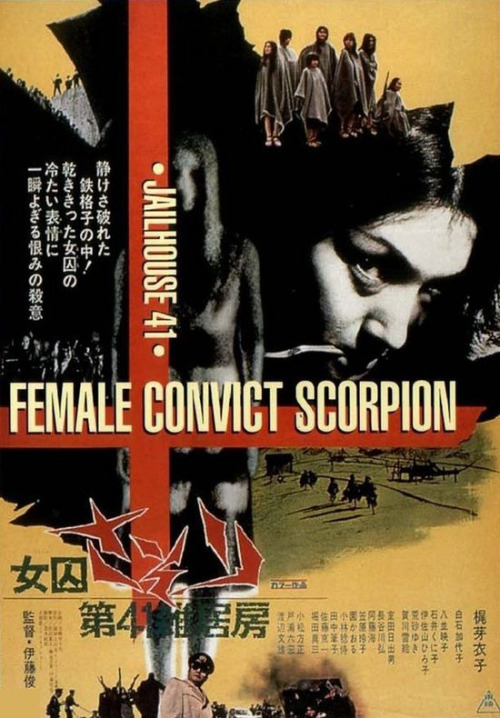
Female Prisoner Scorpion: Jailhouse 41 (女囚さそり第41雑居房, Joshu Sasori – Dai 41 Zakkyobo) picks up around a year after the end of Female Prisoner #701: Scorpion and finds Matsu (Meiko Kaji) tied up in a dingy prison basement, apparently left bound and in solitary confinement for the entire interval. Once again directed by Shunya Ito, the second instalment in the Female Prisoner Scorpion series is another foray into the women in prison field but Ito resolutely refuses to give in to the exploitative genre norms, overlaying his tale of individualistic rebellion with an arthouse sensibility that has a much wider scope than its ordinary vengeance driven narrative may suggest.
Matsu may have been lying bound and gagged in a dingy underground hole for the best part of a year but today is a special day and sadistic prison warden Goda (Fumio Watanabe) is going to let her out to be shown off in front of a visiting inspector who’s paying a final visit before Goda is promoted to a top job in Tokyo. When Matsu makes a lunge for Goda, the inspector is so afraid that he wets himself, sending the other woman into a frenzy and resulting in a riot. Once again the entirety of the prison is punished, but this time Matsu is singled out for a public punishment gang rape by Goda’s goons. This kind of humiliation is too much for her fellow prisoners who instantly turn on her, but their violence provides an opportunity for escape and before long Matsu is on the run, again.
At the end of the first film, Matsu had accomplished her first round of vengeance – against the man who orchestrated her downfall and the men who secured it, but ultimately she wound up a female prisoner once again. Though Goda may have had her hidden away because of her habitual escapism, Matsu had not given up as we see from her attempts to scrape the floor away with her spoon held tight in her mouth. Barely speaking, Matsu is an unstoppable column of pure rage but an elegant one, supported by her self contained restraint.
Her anger this time is directed towards Goda himself, especially after his despicable organised punishment rape that was designed both to break her own spirit once and for all and also to damage her in the eyes of her fellow inmates who are intended to see her defeated and destroyed. The guards are a stand in for society at large, using sexual dominance and social position to keep their women in line. The visiting prison inspector makes a point of telling Matsu that “they” don’t hate her personally – they’re there for her, to help her “recover” and become a functioning member of society. Which is ironic because Goda does hate her personally as he holds her responsible for the damage to his eye sustained in the previous film. His last act before moving on is one against Mastu – an attempt by the forces of authority to crush her individual rebellion and use their victory as a coercive tool to force others to conform.
In this way, Matsu’s position as a member of a subjugated class is less important than her status as an agitator but these are women who have each suffered at the hands of men. As an extremely theatrical sequence sung in the traditional form informs us, the women who escaped with Matsu committed their crimes out of love or jealousy. Poisoned rivals, dead lovers, even children murdered to get back at their philandering father in some Medea level psychotic rage which ruins the perpetrator even more than the intended victim.
Later while the women are enjoying their brief taste of freedom, one of them is brutally raped and murdered by a troupe of feral men who boast about the wartime atrocities they committed before descending on a lone woman like a pack of rabid dogs. The others take their revenge for their friend, but also for all the women who have met a similar fate inflicted by a male dominated society which sees them as something to be controlled and then made use of, little more that cattle hemmed in and milked until dry.
As in the first film Ito makes use of expressionist techniques and strange angles to give his film a more elevated feeling that might be expected but this time he adds in a surrealist, spiritual dimension as with the old woman who sings the stories of our heroines and then dies only to bury herself in leaves and disappear into the ether, like some forgotten deity of misused women. Likewise, when one of the prisoners is raped and murdered, the men throw her body into a nearby river like an empty beer can but the waterfall behind her suddenly runs with blood as an expression of the violence which pollutes the natural world. A bus suddenly splits in two, separating our subjugated women from the violent men who mentally sentence them, given free reign simply because of their sex. Ironically enough, our last glimpse of of Matsu takes place in the reflection of Goda’s glasses and then in his false eye when she is suddenly rejoined by her compatriots for a triumphant dance of freedom on a city rooftop.
Even stronger than in the original Female Prisoner #701 Scorpion, Jailhouse 41 further advances its ideology of free individuals battling the conformist authority of the state all filtered through the prism of the patriarchy. Matsu’s vengeance is personal, she keeps her distance from the other women who do not seem inclined to band together to oppose the forces which oppress them so much as seek a wary, temporary alliance of necessity, but seeing them all reassembled in spirit at the end brings a larger dimension to Matsu’s victory which now seems much less like solving a practical problem than a deliberate strike at a wall which was solely designed to keep a certain group of people in their place. The jail is broken, all that remains is to choose to escape its restraints.
Meiko Kaji had already become a familiar face in Nikkatsu’s genre output when she took on the role that would come to define her career at only 25 years of age. Toei’s Female Prisoner #701: Scorpion (女囚701号/さそり, Joshu Nana-maru-ichi Go / Sasori) would launch a series of similarly themed films and create a national pop culture icon in its central character. Based on a manga by Toru Shinohara, Female Prisoner #701 Scorpion is, at heart, a women in prison film and a cornerstone of the pinky violence genre but first time director Shunya Ito has more on his mind than salacious thrills and offers up a noticeably nuanced approach to his material filled with impressive art house flourishes.
701 is the number printed on the back of the prison uniform worn by inmate Nami Matsushima (Meiko Kaji). She makes a valiant escape attempt with a fellow prisoner, Yuki (Yayoi Watanabe), but the pair are caught and put into solitary confinement where they experience torturous treatment both at the hands of the guards and their fellow prisoners. Mostly known as Matsu but also given the nickname of “Scorpion”, Prisoner #701 is not exactly popular with the other ladies in the joint who seem to resent her escape attempts and quiet dignity, annoyed by her above it all demeanour.
Matsu has just one mission in life – vengeance, on the man who wronged her, on the society that allowed her to be wronged, and on the prison system with its sadistic guards and turncoat inmates. Once an ordinary, law abiding woman, Matsu had the misfortune to fall in love with a vice cop who convinced her to go undercover in a yakuza club to get some vital info he needs to bust it. However, Sugima (Isao Natsuyagi) turns out to be the biggest crook of them all and was merely using her to try and take out the local yakuza to get in with a bigger yakuza boss and key into a slice of the drugs trade. Matsu is brutally gang raped after her cover is blown and ends up being sent to prison after making an attempt to ice her former lover with the desire to get out and complete her mission the only thing that’s keeping her going.
Ito begins with an ironic scene in which one of the prison guards is receiving a commendation for his honourable service, Japanese flag flying proudly behind above, until the occasion is interrupted by the escaped prisoner alarm. Later Ito puts the yakuza boss in a building bearing the large banner “Beautiful Soul and Harmony of Japan” and he even adds in an expressive moment as Matsu surrenders her virginity to Sugima, staining her white sheets with a large red circle. Society is corrupt everywhere from Sugima’s bent copper to gang raping yakuza and the prison system itself.
The guards are effectively running their own little empire, cut off from mainstream law enforcement and left to their own “corrective” impulses. Ito gives us salacious shower scenes and women being marched around in the nude but he places us in the place of a voyeur, making it plain that the prison guards are sating their lust for power through humiliating their charges in sexual dominance and violence. Divide and rule is the name of the game as a top tier of prisoners are “employed” in various prison tasks earning them a different colour uniform and a status bump. These ladies are even worse than some of the male guards and are responsible for much of the cruelty inflicted on Matsu and Yuki during their time in solitary.
Inter-prisoner conflict is not the central theme of the film as Matsu continues to plan for her eventual escape and revenge on the man who has ruined her life. A slight spanner is thrown in the works when an inside woman is recruited to take Matsu out, but Matsu is painted as a the ultimate vengeful warrior. Barely speaking (the bulk of her dialogue is actually voice over for her flashback scene), Matsu waits silently, observing and plotting. Biding her time she manages to take an extremely skilful and poetic revenge against her solitary abuser despite her hands and feet being bound, and when a police mole is placed in a cell with her Matsu sees through the ruse straight away. Seducing her new cellmate, Matsu neutralises the threat with ease maintaining her trademark intense elegance all the way through.
Though the synopsis smacks of cheap and nasty exploitation Ito doesn’t see it that way and films with an art house aesthetic rather than a salacious eye. Matsu’s flashback takes a very theatrical form with a rotating set and Matsu remaining present in the corner as she narrates. Her rape scene is grotesque and nightmarish, shot through a see-through floor as her attackers grin and gurn away at her like fairytale monsters. Likewise, when Matsu traps another prisoner in her own scheme, the woman turns into a classic ghost creature, face white and staring, broken glass firmly gripped manically in front. The acting style is broad and absurd. Policeman laugh loudly and for too long, blood is an artificial kind of red, gloopy like paint, and pantomimeish grotesquery is everywhere. Ito’s backgrounds are expressionist rather than realist but always perfectly pitched.
You can tell a lot about a place from the way it treats its prisoners and when its as bad as this, you start to wonder which side of the bars you’re really on. The guards are only a representation of a consistently exploitative society, but they can at least be outsmarted. “To be deceived is a woman’s crime”, says Matsu, but it’s one she fully intends to atone for – in blood, settling not just her own score but those of all her fellow prisoners caught in the patriarchal trap of hollow promises and abused honour.
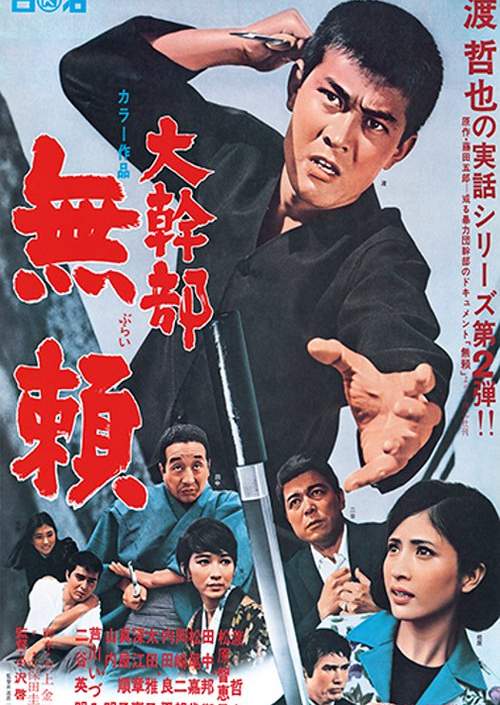
So, as it turns out the end of Outlaw: Gangster VIP was not quite as final as it might have seemed. Outlaw Gangster VIP 2 (大幹部 無頼, Daikanbu Burai) picks up not long after the end of the first film when Goro (Tetsuya Watari), having recovered from his injuries, takes a train to go and find Yukiko (Chieko Matsubara) with the intention of starting an honest life with her away from the temptations of the big city. However, as often happens, his past follows him.
Like the first film, Outlaw: Gangster VIP 2 also begins with a black and white flashback sequence reminding us of Goro’s childhood only this time with a voice over from Goro himself who goes on to include the first film’s events in his recap. Goro might have come to the country to get away from the gangster life but as soon as he steps off the train he gets himself into trouble with a local gang by interfering with a few tough guys who are trying to entrap a group of actresses and force them into their employ. One of the leading actresses is just as taken with Goro as Yukiko was in the first film and gives him her red scarf as a thank you. Goro is still very much with Yukiko though and trudges off through the snow to find her.
She and Yumeko, Sugimoto’s former girlfriend, are living in a small hut but Yumeko has fallen ill and is refusing to see a doctor out of fear of the expense. Goro gets a legitimate logging job but before long the company hits trouble and he’s let go. All the while Yumeko’s condition is weakening and the three are in desperate need of money. One of the local gangsters Goro runs into trouble with turns out to be an old friend who offers him a job. Goro was hoping to leave the Yakuza world behind forever but it seems it isn’t finished with him yet…
In many ways this second instalment in the Outlaw: Gangster VIP series is very much more of the same as noble outlaw Goro battles the ever more cruel and corrupt forces of the Yakuza underworld in defence of women folk and underdogs everywhere. Directed this time by Keiichi Ozawa the film is disappointing only where it begins to feel like a rehash by following the familiar story beats of the first film with its betrayed underlings and treacherous bosses yet still manages to feel fresh and exciting for most of the running time.
The action this time around takes place in the vast snowy expanses of Northern Japan and has a much more open feeling overall with greater use of location shooting rather than the studio bound atmosphere of the first film. Ozawa follows Masuda’s lead but angles for a few expressive sequences of his own such as attempting to cut a flamenco dance sequence (starring a young Meiko Kaji acting under her original name) with a potential stand off and less successfully by playing a high school girl volleyball game against the final fight to the death which is going on in the waterway below.
The concept of home and having a home town is once again emphasised as a recurring motif where the desire for a normal life and family can get a man killed – the recurrent message being that a yakuza is a man without ties to the normal world. Such relationships are now denied him by his bond to his gangster brothers and will not only place in danger those you most love, but will ultimately lead to your own downfall too. Once again Goro wrestles with his desire to build a more normal life with Yukiko and the self knowledge that his yakuza past will never let him rest and perhaps the best thing for her is to make her go.
Outlaw: Gangster VIP 2 can’t quite match the power of the first film’s finale and often feels as if it’s retreading the same ground yet it is quite interesting ground to retread. Even if there weren’t another four films in the series, one gets the feeling that fate hasn’t finished toying with Goro yet and even if the yakuza world continues turning in the same ancient cycles of violence and revenge, Goro at least will be standing on the side of right, perpetually and ironically fighting in an attempt to put an end to it all for good.
Outlaw: Gangster VIP 2 is the second of six films included in Arrow films’ Outlaw: Gangster VIP The Complete Collection box set (which is region free on DVD and blu-ray and available from both US and UK).
If you thought the story was over when Hirono walked out on the funeral at the end of Battles Without Honour and Humanity think again – we’ve barely scraped the surface of the post-war Hiroshima criminal underworld chaos. The aptly named Hiroshima Death Match runs in parallel with the events of Battles Without Honour taking place in roughly the same time, 1950-1955, but features a new protagonist relegating Bunta Sugawara’s Hirono to the sidelines where he appears as a weary observer of the cruel yakuza world. This time our hero, Yamanaka, is younger – too young to have offered his life as a kamikaze in the war as he apparently wanted to, and is one of the thousands of young men who’ve found themselves alone and without futures thanks to both the after effects of World War II and the ongoing Korean War.
Hiroshima Death Match ties itself into Battles Without Honour and Humanity quite neatly when the protagonist, Shoji Yamanaka (Kinya Kitaoji), is sent to prison after taking a knife to a room full of guys who accused him of cheating in a gambling den. There he comes into contact with the first film’s hero, Hirono (Bunta Sugawara), who offers him some food whilst in solitary but then disappears for the vast bulk of the film. When he gets out, Shoji finds himself in trouble again when he can’t pay for his meal in a restaurant and offers to work off the bill. The waitress, Yasuko (Meiko Kaji), refuses and tells him to just forget about the money and leave when he’s done but Shoji is insulted by her “charity” and things kick off between him and a gang of yakuza also in the restaurant at the time. Yasuko turns out to be the widowed niece of a yakuza boss and after recovering in her care Shoji agrees to join the Muraoka gang to get revenge on the guys who beat him up.
Whereas Battles Without Honour and Humanity took as its protagonists the young men who’d returned from the war to a ruined and defeated country, Hiroshima Death Match focuses on the generation below who were too young to fight themselves but have still been marked by the after effects of the conflict. At the beginning of the film Shoji has nothing, he’s ashamed of cheating and gets upset when caught which only fuels his youthful and violent anger. He doesn’t seem to have any family to help him or honest work to go to and so, of course, he ends up a yakuza. Once again, the yakuza take the place of a traditional family offering both a place to belong and a degree of emotional and financial support – for a price.
When Shoji inevitably falls in love with Muraoka’s widowed niece, he discovers his surrogate father’s love is not quite unconditional. Yasuko has a young daughter and was married to a man who died a kamikaze war hero. Muraoka does not want her to remarry lest she shame her husband’s memory unless he keeps it in the family by marrying her off against her will to her huband’s brother. Shoji’s affair with Yasuko continues to cause a rift with Muraoka and he’s torn between a desire for a peaceful future with the woman he loves and loyalty to his gang boss to whom he owes so much. Muraoka’s own morals are shown to be far from the traditional yakuza ideals and he’s not above using Shoji’s strained loyalties to his own advantage eventually with tragic consequences.
Like Battles Without Honour and Humanity, Hiroshima Death Match is shot in the same quasi-documentary style with a weary sounding narrative voice over and frequent freeze frame captions identifying the characters along with their gangs and positions as well as their dates of demise at the appropriate time. The ruined Atomic Bomb Dome (now the Hiroshima Peace Memorial) continues to loom large over the proceedings as we’re reminded at the end that this isn’t the only blood that’s been shed here. Even more so than with Battles, Fukasaku rams home the senselessness and futility of violence. The film ends with Hirono attending another funeral (though this time in a black suit and melancholic air) where the bosses reap in consolation money and gamble at the wake. He gives his old bosses a sideways look as they laugh and joke while a young man who they all now account as some kind of legendary yakuza hero lies dead for no reason at all. What does this sort of life amount to in the end? The only reward for a life of violence is a lonely grave.
Hiroshima Death Match is available on blu-ray in the UK as part of Arrow Video’s Battles Without Honour and Humanity: The Complete Collection box set.
Arrow double whammy up at UK Anime Network as I review both of Arrow’s recent Yasuharu Hasebe releases – Massacre Gun and Retaliation!
Tatsuya Fuji tests his gun out in Massacre Gun (and looks cool in the process)
Arrow have been turning up some hidden gems and neglected classics as they trawl through the world of the populist cinema from the Japanese golden age of the 1960s and 70s – they’ve already brought us the iconic Lady Snow Blood, the lesser known Blind Woman’s Curse, the anarchic Stray Cat Rock series and now, following on from their release of Seijun Suzuki’s famously crazy Branded to Kill they’ve turned their attention back to Nikkatsu Noir with Massacre Gun. The first of two releases from director Yasuhiro Hasebe who also directed three films in the Stray Cat Rock series (Retaliation will follow next month), Massacre Gun has everything any genre fan could wish for – depressed hit men, warring gangs, jazz bars, boxing clubs, stylish monochrome photography and the melancholic ennui that permeates all the best noir movies. Perhaps not quite as impressive as the greatest hits of Nikkatsu Noir such as the afore mentioned Branded to Kill or Nikkatsu’s other offerings like A Colt is My Passport, Massacre Gun is nevertheless another impressive entry in the studio’s short lived action output.
As the film begins, thoroughly dejected Kuroda has just been asked to carry out a hit on a woman who is in love with him – feelings which he may have have reciprocated but, but like any good lackey, Kuroda chose his boss over his heart and sent the love sick girl into a lake with a bullet in her chest. When Kuroda’s two younger brothers find out they do not approve and hot headed youngest brother Saburo who trains at a yakuza run gym hoping to become a a pro-boxer, decides to have a word with Kuroda’s boss, Akazawa. As might be expected things don’t go Saburo’s way and he’s brutally beaten to the extent his hands are all but crushed leaving him unlikely to box again. At this point, Kuroda wants out of the game – but for a yakuza hit man there is no out. His only option is to take down Akazawa’s empire and build one of his own.
Like most of Nikkatsu’s late ‘60s action output which would later retroactively become known as Nikkatsu Noir, Massacre Gun is heavily indebted to the American B-movie and particularly to the film noir. Its settings are those of “low culture”, Western bars and cafes where people drink expensive whiskey and wear sharp suits and sunglasses. In fact, the Kuroda brothers’ side business involves running a jazz bar with a half Japanese-half African American jazz singer playing piano in the corner and a pair of Western dancers doing some sort of scantily clad, artistic ballroom dancing routine in the middle. Most importantly it’s full of the classic Film Noir feeling of spiritual emptiness and existential ennui with the very depressed contract killer Kuroda at its centre.
A very male affair (perhaps the key missing element from a Film Noir is a femme fatale), the bulk of the film is the opposition between Kuroda on the one side and his former boss on the other. Other than the closeness with his two younger brothers and to a lesser extent the other workers at the club, Kuroda’s other most notable relationship is with his old friend Shirasaka who coincidentally married another woman Kuroda may have had feelings for. Though the two have enjoyed a close friendship up until now, Kuroda’s decision to leave Akazawa’s employ has meant Shirasaka has had to make a choice and he’s chosen Akazawa. The two are are now mortal enemies on opposing sides of a war – a fact which causes them both pain but which, nevertheless, cannot be otherwise.
Hasebe is best known for his striking use of colour which makes Massacre Gun a notable entry in his filmography as it’s the only one he made in black and white. Other than the perverse habit of sticking colours into the names of his leading characters and locations (the “Kuro” in Kuroda means “black”, the “Shira” in Shirasaka means “white” and the “Aka” in “Akazawa” means red making this one very complicated game of checkers), Hasebe still manages to make an oddly “colourful” film even in monochrome. Taking a cue from Suzuki, Hasebe has come up with a fair few arty and unusual compositions of his own though not quite to Suzuki’s absurd extremities and neatly retained the classic Nikkatsu Noir aesthetic in his superbly crisp black and white colour palate.
Coming as a late addition to the genre, Massacre Gun also takes a fairly unusual approach to violence with a far more explicit representation than would be expected from this period. Simply put – lots of people die in this film, many of them in quite exciting ways. Blood is everywhere and there are so many bullets fired you start to wonder if some one in the yakuza equivalent of the administration department isn’t having some kind of heart attack behind the scenes. Massacre Gun might not be the best entry in the Nikkatsu Noir series, but it is perhaps one of the most typical. Edgy and arty, exquisitely framed and perfectly photographed it brings out the effortless cool that came to symbolise Nikkatsu’s late ‘60s output. Aside from all that – it’s just fun as most of these films are. Another welcome release from Arrow who continue to root out these lesser known genre movies, Massacre Gun is a must see for fans of classic ‘60s action movies.
Jo Shishido smokes a cigarette in Retaliation (and looks cool in the process)
Arrow are back with another neglected classic of Japanese action cinema produced by Nikkatsu – Retaliation, a slightly later film from Yasuharu Hasebe director of Massacre Gun and three out of five of the Stray Cat Rock series. Unlike Massacre Gun (but like every other film Hasebe ever made), Retaliation is shot in colour and features Hasebe’s trademark use of it. Retaliation is very typical of its genre in someways and very not in others. It stands on something of a borderline seemingly symptomatic of Nikkatsu’s eventual slide into a producer of soft core pornography as their Roman Porno line of sex and violence based movies took over as their main production style. Not as strong as some of the other entries from around this time, Retaliation nevertheless marks itself out as an interesting addition to the genre.
Not one of the most exciting plots in yakuza movie history, Retaliation’s main mcguffin centres around trying to persuade some farming families to sell their ancestral land to developers who want to build a factory there. Having just been released from prison after taking the fall for gang murder, Jiro is offered the chance to head up his own group, however his patch is between two rivals and his best bet is to play the two off against each other as they both vie for this disputed farmland. One group is super old school and the other is the more modern type of thug who’ll do pretty much anything to get what they want – including abducting one of the farmer’s daughters and molesting her in the back of a car as a way to threaten her father. Jiro is given his own mini team to help out on his mission including an out of work actor and card shark, and another top yakuza guy who just happens to be the brother of the man he went to prison for killing and who has already vowed to killed Jiro in revenge. Jiro sometimes dreams of going straight and leading a different kind of life but gang loyalty still means something to him and those outside of the life aren’t always so understanding. Retaliation is the only way to stay alive in this new, empty yakuza world.
Retaliation starred three of Nikkatsu’s famed “Diamond Line” stars – Akira Kobayashi is the film’s lead leaving Jo Shishido playing second fiddle (his star had fallen a little at Nikkatsu and they didn’t see him as an actor who could carry a colour film as the leading man), and Hideki Nitani coming in third. Tatsuya Fuji and Meiko Kaji round out the almost famous section of the cast and each would soon find fame (or notoriety) in the new landscape of ‘70s Japanese cinema. There’s undoubtedly an air of everybody just doing what they do – it is after all what they’ve been employed for but at the same time no one’s really pushing themselves to do anything very notable. That said, you do have five of the biggest (or soon to be biggest) names of the time in one movie which gives it a feeling of a prestige project. However, in another move that anticipates the direction in which Nikkatsu was headed, the sex and violence quotient has been significantly upped.
Nikkatsu action films could already be shockingly violent for the time period, but Retaliation unfortunately adds a layer of sexualised violence against women which is undoubtedly being offered up as something for the viewer to enjoy. The early scene in which Meiko Kaji’s farmgirl is molested by a gang of thugs before being dumped at her parents’ house is unsettling on one level, but is shot with such a voyeuristic camera style that it’s difficult to not feel complicit in this fairly horrific act. There’s even another such sequence later in the film when one yakuza is forced to give up a girl he’s with so all his yakuza mates can have a go first which is again shot with a lingering camera often cutting back to the salivating gangsters. Of their time in one sense, these sadly salacious scenes of sexual violence against women filmed with an encouraging eye give the film an unwelcome sleazy quality from which it is hard to bounce back.
The other notable theme of the film is that it positions itself between the glamorous, modern samurai, gangster movies of the past and the grittier tales of modern thugs that were about to become the mainstream narrative. Jiro has been away for a long time, the yakuza world has moved on and his old clan would have died out if weren’t for another gang’s generosity. Jiro is the last of the honourable men who place loyalty above personal gain and seek to protect women and the put upon rather than exploiting them. Unfortunately, modern yakuza think differently and it’s no small irony that it’s a group of farmers they’re falling over themselves to ruin given that farmers are the very people old school yakuza, as the receivers of samurai values, would be expected to protect. Jiro and some of his cohorts still believe in these “old fashioned” ideas and are thought brave and noble. The other gangs who rape and torture women whilst forcing farmers off the land they’ve worked for centuries are not.
Again, it’s a fairly manly affair with women becoming little more than props to be used and abused throughout the film but the relationship between the two central guys Jiro and Hino takes on an oddly homoerotic context even ending with Shishido’s character getting rid of his girlfriend because he apparently falls in love too easily before telling Jiro that this is the first time it’s been with a guy. Considering their relationship began with Hino determined to kill Jiro, to end it with a quasi declaration of love (even half in jest) is a pretty steep character arc but one of the better things about the film.
Retaliation isn’t a perfect film, and it might not have the most exciting basis for its plot machinations but it certainly has its moments. Entertaining enough, the film is marred by its unpleasant treatment of women and takes a few dramatic missteps towards the end. The action is good however, as are the performances and production values. Perhaps not an essential Nikkatsu action movie but nevertheless a very interesting one from several different perspectives, Retaliation deserves a view from the genre’s committed fans.
Both available now in the UK on DVD & blu-ray from Arrow Films!
Review of the new high definition Stray Cat Rock box set up at uk-anime.net
The late ‘60s/early ‘70s was a fascinating time in terms of Japanese popular culture and cinema was certainly no exception. With studios becoming desperately worried by the rising popularity of television and a troubled political situation, they knew they’d have to find someway to bring back that all important youth audience. Ultimately, they resorted to the time old solutions of sex and violence to try and lure the increasingly disinterested viewers back to the cinemas. In the end, Nikkatsu would end up becoming a purveyor of soft core pornography as its Roman Porno line all but dominated its production. The films from this era represent a kind of bridge between the youth orientated “Sun Tribe” films of the ‘50s and the full on exploitation films of the ‘70s. There’s no denying that in many ways they are very much of their time, which is generally a good thing, but the Stray Cat Rock films are an essential snap shot of a moment of counter culture shift.
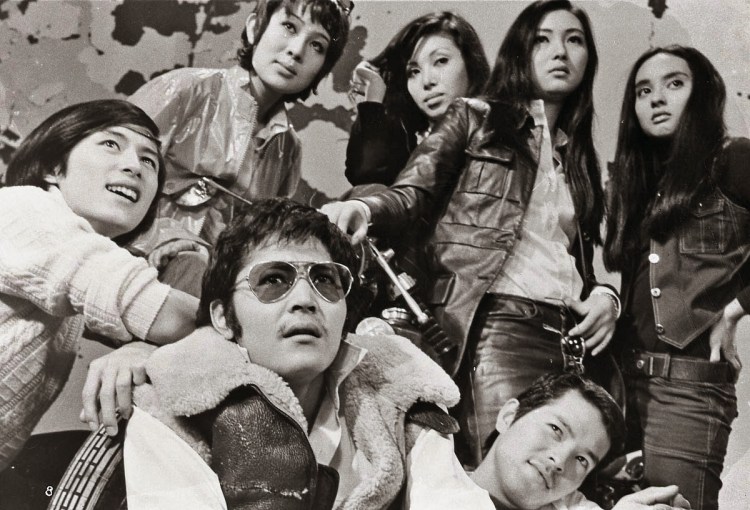
This new blu-ray box set from Arrow films includes all five films in the Stray Cat Rock Series: Delinquent Girl Boss, Wild Jumbo, Sex Hunter, Machine Animal and Beat ’71. Perhaps “series” is a misleading way to describe the films as they’re really more of a “cycle”. There is no plot through line, each film stands independently with its own distinct story which appears to have no obvious connection with any of the other films in the series save sharing a certain sensibility (though even this shifts slightly as the films go on). The same actors reappear in several of the films, notably Meiko Kaji who is most closely associated with the franchise and Tatsuya Fuji who appears in every film, but even the actors who appear frequently are playing different (though often oddly similar) characters. What links the films together is their focus on what some might see as ‘low’ youth culture – bars, clubs, motorcycle gangs, drugs, drink and sex! What’s being sold, essentially, is a subversion of femininity – strong women who do not require the assistance of men but even take on male roles themselves such as forming or running violent street gangs.
The first film the series, Stray Cat Rock: Delinquent Girl Boss was intended as a vehicle for leading lady Akiko Wada and as a rival to Toei’s Delinquent Boss series. However, it was Meiko Kaji who became the breakout star of the film and a number of sequels featuring her were quickly put into production. The first film tells a fairly typical story of gangland warfare, albeit that it’s girl gangs, but the second, Wild Jumbo, takes a detour by telling a somewhat tragic tale of a group of students who plan to rob a mysterious cult – with tragic consequences! The third in the cycle, Sex Hunter, is the best known, perhaps because of its more complicated plot and engagement with racial politics. Apeing a western, a mixed race young man comes to town looking for his long lost sister and wanders straight into the gang war between Kaji’s female gang the “Alleycats” and the male “Eagles” lead by Fuji who has a prejudice against people of mixed race as his younger sister was gang raped by a mixed race gang. After this instalment the heavy sex and violence themes begin to fizzle out slightly and the fourth film, Machine Animal, is the most political of the Stray Cat Rock films as it follows a group of guys trying to dodge the draft for the Vietnam war planning to fund their onward journey to Sweden by selling LSD. The fifth and final film, Beat ’71 takes this even further and replaces the ‘gang’ motif entirely with a story set around a hippy commune.
Always fairly liberal in tone (even if the characters meet a ‘bad’ end, the series feels more aspirational than morally critical), the Stray Cat Rock films present a world of hedonistic, counter cultural youth. They’re full of the popular music of the time with long ‘live’ music sessions set inside the clubs, sometimes even prominently featuring popular bands and the theme song for Machine Animal “Gamble on Tomorrow” is even sung by Kaji herself. The earlier films are also filled with psychedelic imagery and interesting directorial touches like unusual split screens, blue screen cut outs, brightly coloured title cards, dissolves and freeze frames. However, Machine Animal marks quite a big change from the three previous films as the gang themes start to take more of a back seat to the politics and by Beat ’71, the tone of which is much more whimsical, they are pretty much absent. Films one, three, and four were directed by Yasuharu Hasebe while two and five where direct by Toshiya Fujita (Lady Snowblood) and there are some pretty clear directorial differences with Hasebe’s films being slightly more avant-garde and adventurous in terms of shooting style while Fujita’s are a little more classical. However, there might be something in the statement made by Hasebe in the interview included on this disc that by the end the pop culture tone had shifted from violence to beauty – the more salacious content, and in particular the sexualised violence, reaches its peak in Sex Hunter and decreases as the films go on.
All five films were made extremely quickly and released between 1970 and 1971 – that’s five films made and released in under two years! Though the creative team may have envisioned them as low budget, fairly disposable cash grabs designed to give a much needed boost to a declining industry, the Stray Cat Rock films have gone on to have cult appeal which still has its devotees all these years later. Hugely enjoyable in their own right, the films are an interesting window into a relatively small period time which nevertheless saw fairly massive changes taking place. Though they anticipate the trend of salacious exploitation that was to come, they stop short of some its excesses but were also to prove hugely influential in the history of ‘70s Japanese cinema.
 At the end of Female Prisoner Scorpion: Jailhouse 41, Matsu – the “Scorpion” of the title, had enacted parts of her revenge but lost even more friends and allies along the way. Still filled with an intense rage, she wandered away from her imprisonment towards the dawn and a free, if uncertain, future. It’s here we find her at the beginning of Beast Stable (女囚さそり けもの部屋, Joshu Sasori – Kemono Beya) – a fugitive from justice, but a seemingly calm one. Until, that is, she is cornered.
 Female Prisoner Scorpion: Jailhouse 41 (女囚さそり第41雑居房, Joshu Sasori – Dai 41 Zakkyobo) picks up around a year after the end of
 So, as it turns out the end of
  If you thought the story was over when Hirono walked out on the funeral at the end of
 Windows on Worlds