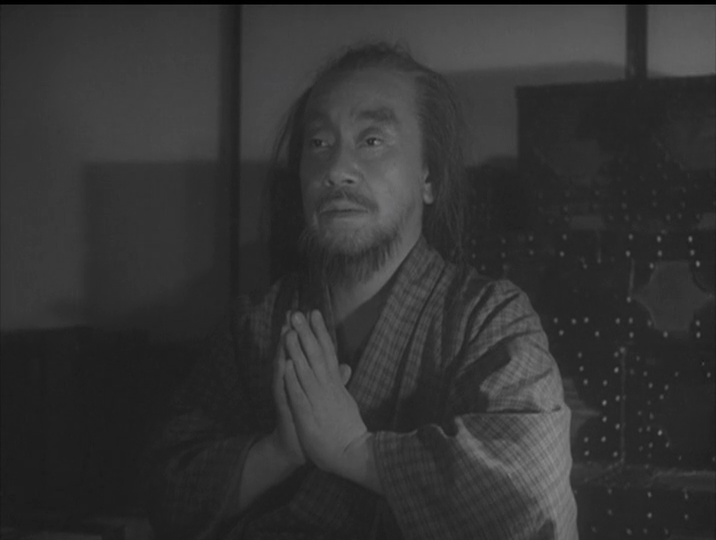
Undercurrent (夜の河, Kozaburo Yoshimura, 1956)

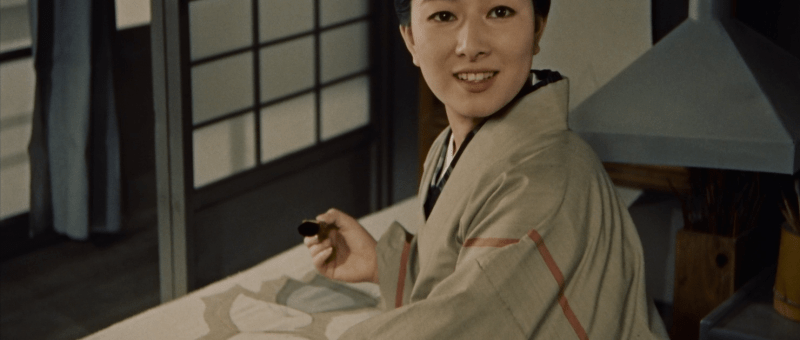
Is it possible to be both married and personally and artistically fulfilled? Marriage hangs over Kiwa (Fujiko Yamamoto) like a looming cage in Kozaburo Yoshimura’s sensuous melodrama Undercurrent (夜の河, Yoru no Kawa, AKA Night River). Scripted not by his regular writer Kaneto Shindo but frequent Mikio Naruse collaborator Sumie Tanaka adapting a novel by Hisao Sawano, the film finds its heroine caught between tradition and modernity while struggling to maintain her position as an independent woman and rightful heir to her father’s kimono dyeing business.

Everyone also keeps telling her that kimono itself is dying out, a relic of a bygone past now that everyone wears Western dress. Even Kiwa’s younger sister Miyoko (Michiko Ono) dresses exclusively in Western fashions and moves to Tokyo on her marriage. An ancient capital, Kyoto is the centre of historical elegance and the last bastion of these “outdated ideals”, yet several shops in their area have closed recently and people do things differently now. A wealthy woman comes to the shop with some fabric directly, cutting out the middlemen and haggling for a discount while cheerfully asking for her cab fare to be covered when Kiwa refuses the job. The young man they’ve taken in as an apprentice, Toshio, leaves to work in an electric factory complaining that “master” and “apprentice” are outdated concepts and that it’s against the Labour Law to force him to work overtime. Kiwa’s father Yujiro (Eijiro Tono), meanwhile, thinks this is just an expression of Toshio’s lack of commitment and that it’s only right that an apprentice should be applying himself to learning his craft every waking moment of the day. 

He was after all once an apprentice himself, but is both proud that his daughter has surpassed him in skill and guilty, fearful that Kiwa has sacrificed her own life and happiness to devote herself to kimono dyeing which is why she has never married. On one level, he’s happy if she’s happy and willing to leave marriage up to her, but also wary of the social censure of the neighbours including his kimono dyeing mentor who gives him a telling-off for his failure as a father to find a match for his daughter. When rumours arise that Kiwa has entered an affair with a married professor, the lady who helped Yujiro get started in business more or less tells him he should get her married to keep her in line. If hadn’t been for the war, she says, Kiwa would have been safely married off long ago and would probably have a gaggle of children to look after which would obviously prevent her from pursuing her art as a kimono dyer though the lady herself has obviously gone on working. 

Kiwa is drawn Takemura (Ken Uehara ) firstly because he’s wearing a tie that features one of her signature dyes which implies some kind of affinity between them. That the fact that he was touring a Nara temple alone with his daughter may have suggested he was a widower, though in truth Kiwa always knew he was married and that may have been a key part of what attracted her to him. She is after all, as Yujiro’s mentor said, a woman and experiences romantic desire even if the mentor is wrong to say that Kiwa sublimates her loneliness through art when in reality the reverse is true. After meeting Takemura even Yujiro remarks that she seems more like a woman, implying that her industry and forthrightness lend her a masculine quality as does her determination to get on in business. She first strikes up a business relationship with the sleazy Omiya (Eitaro Ozawa) whose wife is always watching him like a hawk though she manages to rebuff his attentions while establishing herself as business woman and in demand kimono designer. In pursuit of Takemura she is the one bringing him gifts and inviting him out for walks while Takemura remains somewhat conflicted and pulled along her wake.

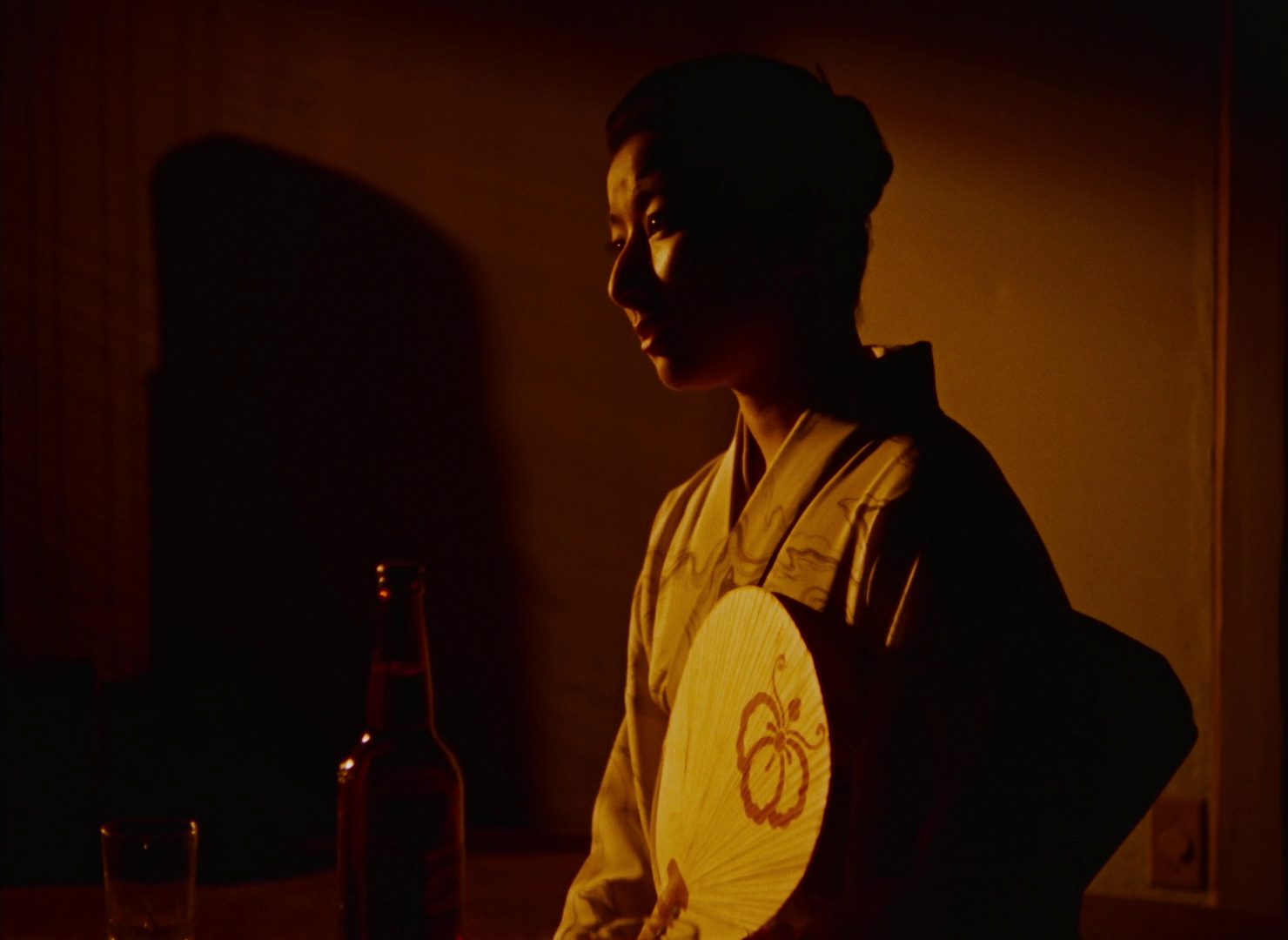
Yet for all that, none of her family members really question the fact that she’s been carrying on with a married man and rather seem slightly relieved that she’s discovered an interest in romance or perhaps just anything outside of kimono dyeing. Even Takemura’s daughter suspects they’re romantically involved and doesn’t seem to mind. Yujiro remarks on Kiwa suddenly using the colour red which she never previously liked and it does seem to echo her reawakening passion. Takemura is also researching red fruit flies, which is less romantic, but also hints his barely suppressed longing. The film seems to align him with yellow flowers and Kiwa with pink. When they’re caught in a rainstorm and refuge in an inn owned by Kiwa’s childhood friend, the entire room in bathed in the glow of the Daimonji fire festival as their passions finally, and perhaps unwisely, overtake them as Takemura announces he’s thinking of moving far away perhaps to avoid this forbidden romance or otherwise for the health of his ailing wife who has been a Kyoto hospital for the last two years.

It’s finding out about Mrs Takemura’s likely terminal illness that seems to implode Kiwa’s romantic fantasy. After they’d made love for the first time, she had told Takemura that if she became pregnant she’d raise the child alone without intruding on his family life, which is to say she wasn’t really envisaging one with him. Her horror is on one level framed as guilt, that she now sees she’s committed an act of betrayal and resents Takemura when he tells her “it won’t be much longer” as if he were counting down the days until his wife passed away. Or worse, that he or others suspected that Kiwa willed her dead. But in reality the reverse is true. Mrs Takemura’s death is an existential threat to Kiwa’s independence. She doesn’t want to get married, even if loves Takemura, because if she did she wouldn’t be able to maintain her independence or career as a kimono dyer. She really does mean it when she says that likes it best when it’s just she and her father in their “cramped” old-fashioned dyeing shop without even an apprentice. 

A tortured art student who seems to pine for her tells her as much, disappointed in her for her relationship with Takemura not out of moral censure but because he fears she’s betraying her art. Okamoto is much younger than her and she’s not interested in him romantically even if he’s painting slightly lewd interpretations of his mental image of her. At one point he appears with a bandage around his neck that implies he may have tried to take his own life and eventually announces he’s leaving Kyoto because he can’t secure his identity there. Ironically he’s happy that Kiwa and Takemura are now free to love each other when the opposite is now true. Now that he’s no longer a married man, Kiwa can no longer love him and is denied the possibility of having both romantic and artistic fulfilment. She is perhaps free in another way, backed by a deep red cloth hanging up to dry as she watches the May Day parade pass by with all of its waving red flags having embarked on a life that is defiantly of her choosing and fulfilled by the passion of art.


Trailer (no subtitles)
An Osaka Story (大阪物語, Kozaburo Yoshimura, 1957)

A man who tries to escape his poverty ends up imprisoning himself in Kozaburo Yoshimura’s tragicomedy An Osaka Story (大阪物語, Osaka Monogatari). Inspired by the work of Saikaku Ihara, Kenji Mizoguchi had intended to direct but sadly passed away before shooting started with Yoshimura appointed to take over. The broadly comic overtones may be at odds with Mizoguchi’s signature style but ultimately lend weight to the film’s ironic conclusion in which the hero finds himself essentially oppressed by his own wealth in being entirely unable to relate to other people or see the world in ways undefined by money. 

It may be possible to understand Omiya’s (Ganjiro Nakamura) mania as a reflection of his intense fear of poverty, that he is so terrified of possible destitution that he can never really have enough or allow himself to enjoy what he has in case there is no more to come in the future. Even as so his daughter later says, wealth changes him. As the film opens, Omiya is a peasant farmer with a bad harvest who can’t pay the onerous taxes demanded by his exploitative lord. He decides to flee to Osaka with his family but is soon rebuffed by the man he’s gone to see who has just become a samurai and wants nothing to do with him. Wandering around the city, the kids eventually discover a thin layer of discarded rice at a storage area they manage to sweep up giving Omiya a new idea of how to save their family. 

In some ways, his fate is foreshadowed when he alone is unable to slip through the fence while his wife and children mop up grains from the floor. The image of him on one side of the bars is repeated in the closing scene, while his loyalty to the family he tried so hard to save is weakened by the influence of money. Yoshimura shows us a world founded on exploitation. “Those who worked so hard to grow it won’t see a single grain,” Omiya bitterly laments watching workmen unload vast quantities of rice while the peasants starve. When the rest of the family have finished sweeping up what others so casually discarded, Omiya does not use the rice to feed them but sells it to a broker and gives them millet instead. His life is then ruled by the doctrine of good enough, living in painful, penny-pinching austerity even after becoming wealthy as a dodgy tea merchant/loan shark. 

Omiya is one of those people who know the price of everything but the value of nothing. Back at their farm, he’d firmly rejected his wife’s offer to sell herself into sex work to save the family, asking “How could I carry on happily knowing you were suffering for it?”, but this is exactly what he proceeds to do. Omiya no longer cares about his family’s feelings and thinks only abut money but simultaneously refuses to spend any of it. One has to wonder what the point of the money is when he’s living a life not all that different from a peasant farmer save being free of the anxiety of immediate starvation. The only person he has any kind of respect for is a widow much like himself who is equally obsessed with penny-pinching and maximising profits. 

The pair bond in their parsimonious natures, but the mutual desire to get a good deal necessarily comes between them especially when Omiya decides to marry off his daughter (Kyoko Kagawa) to Mrs. Abumiya’s foppish playboy son Ichinosuke (Shintaro Katsu) who has been secretly spending money in the red light district without her knowledge. He too is being exploited, in his case by a geisha who manipulates him into getting the money to buy out her contract by threatening suicide. Meanwhile, Omiya’s meanness means he’s never actually taught his son much about handling money. His invitation to the pleasure quarters by Innosuke eventually provokes his rebellion as he starts to question his father’s philosophy and what money is for if you still can’t live a comfortable life. 

HIs daughter Onatsu asks him something similar, pleading with him to learn to understand other people’s feelings before leaving the shop to be with a kindhearted clerk, Chunzaburo (Raizo Ichikawa), with whom she has fallen in love. So little does he care for people that Omiya doesn’t even bother to live up to the image of a wealthy man. The man who turned him away after becoming a samurai eventually racks up large debts and loses his title allowing Omiya to buy his house as an act of revenge despite his wife and daughter’s protestations that they already have “enough” and did not need more. He refuses contracts the previous owners had set up, throws out a hairdresser who comes to give the ladies a more class-appropriate haircut, and refuses a loan to the daimyo in incredibly rude fashion not to mention embarrassing just about everyone by refusing to serve any food at a wake. 

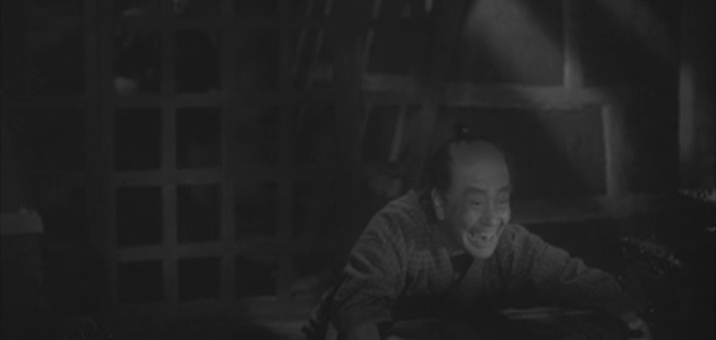
After ruining all of his personal relationships (except that with Mrs. Abumiya), Omiya experiences a kind of mental breakdown throwing himself over the chests of money in his vault and locking himself inside raving that everyone’s out to get their hands on his wealth. He’s just as much of a prisoner of this system as he was as a peasant farmer and has now imprisoned himself within a destructive delusion of capitalistic wealth. “Do what you have to do for a comfortable life,” Omiya’s son Kichitaro (Narutoshi Hayashi) had advised his sister, but this is what Omiya was trying to do too only for it massively backfire no matter what your personal definition of a “comfortable life” may be. Mrs. Abumiya tearfully wonders who’s going to inherit her money if not for her feckless son, but all Omiya can do is cackle wildly one like one possessed insisting that the money is his and his alone and not even death shall part him from it. In part a humorous take down of the contemporary society’s economic obsessions in a bid for ceaseless acquisition, the film is also a tragic tale of a man laid low by his addiction to money and the illusionary sense of comfort it provides him. 


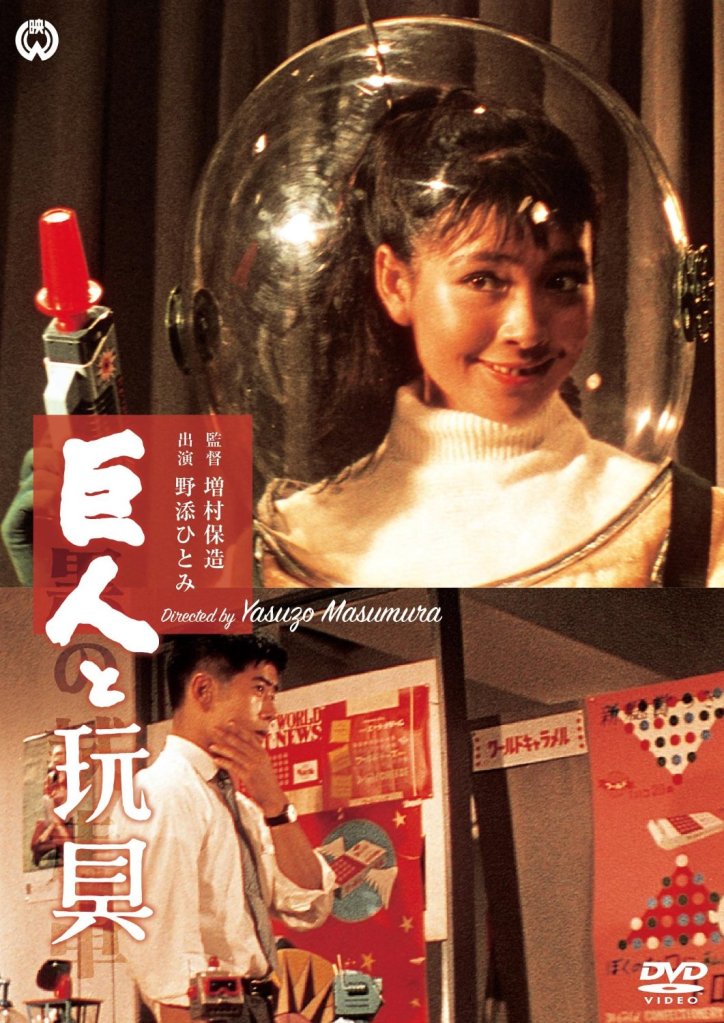
Giants & Toys (巨人と玩具, Yasuzo Masumura, 1958)

91C6JzGDYTL._SL1500_

Less acerbic than Masumura’s later Black Test Car, Giants & Toys (巨人と玩具, Kyojin to gangu) is an altogether more humorous, if no less piercing look at post-war consumerism. This time the battle ground is confectionary as the Japanese sweets industry laments the all powerful American candies taking over the Japanese landscape. Three sweet companies are duking it out for the hearts of Japanese consumers and the hard working salarymen in the PR & marketing departments are becoming ever more desperate to find the key to becoming Japan’s top selling sweet maker.

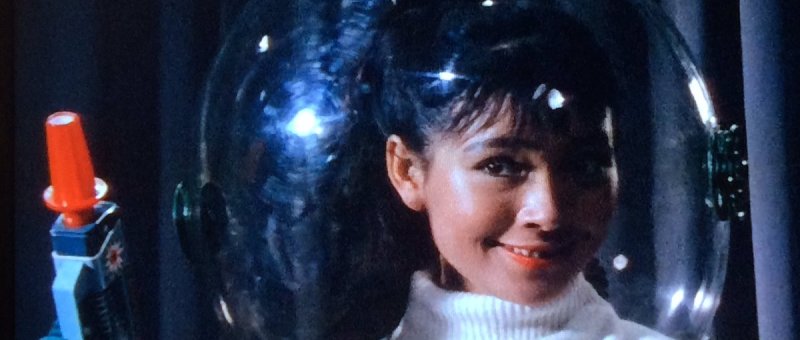
The three companies are Giant, Apollo and World, each of which is currently trying to come up with an advertising campaign which has a competition element that will really hook in the populace. Our main focus is with World whose top PR man, Goda, is currently stumped when he spots quirky hillbilly Kyoko in a bar and hatches on an idea to make her the central poster girl of his ad campaign. Kyoko is 18 with gap teeth and a childlike innocence that makes her a great fit for selling their confectionary products to the adult market. At the same time, Goda’s assistant Nishi meets an older female executive from Apollo who’s trying to shift a set of spacesuits. This fits in neatly with another of Goda’s space themed ideas and a suitably bizarre campaign is launched with the gangly Kyoko dressed up in a kitsch spacesuit and pointing a ray gun which is somehow supposed to encourage people to buy sweets. Kyoko is a hit! However, the more popular Kyoko becomes the more her innocent charms begin to dissipate. What will become of her, and of the campaign, as the competition mounts?

For an area that’s supposed to be so totally frivolous and cheerful, confectionary sales are serious business. Goda is working himself into an early grave just to sell sweets to grownups and old people. It’s advertising and marketing but like everything else in life it’s just so much spin. What they’re really trying to sell is frivolous fun and a return to childhood’s freedom all packed into a momentary suck on a salted caramel. In the Japan where “everyone works all the time” this may be quite an attractive idea, especially to the put upon members of the confectionary marketing board.

However, trivial as sweets are, they represent the fleeting unimportance of pop culture memes. During one of Kyoko’s recording sessions we meet one of the solitary female producers (labelled a “machine” by two of the other women waiting to be seen) who laments that a has been star keeps hassling her for work though her time has passed and no one’s interested. This is most likely how things will wind up for Kyoko, five minutes of being everywhere followed by a lifetime of being nowhere at all. After signing with World for their TV and radio advertising she becomes a break out personality attending events as a celebrity in her own right and later even becoming a pop star complete with a totally strange, South Pacific themed musical number referencing some kind of cannibalistic genocide where they’ll sell back the remains of the men they’ve killed to the native wives. Pointed satire in more ways than one.

Goda wants to build a kind of mass media dictatorship, cleverly controlling the public mood through all pervasive advertising (a prescient thought, if ever there was one). Having taken things too far, he’s taken to task by his underling, Nishi, who’s had a bit of a rethink following a series of heartbreaks involving friends and lovers. “I won’t sacrifice my dignity” he says, only to be shown doing just that a couple of minutes later as he himself dons the ridiculously camp space suit, takes the ray gun in hand and wanders out into the streets to be met by a series of bemused stares from the passersby. Eventually, the woman from Apollo with whom he’d been having an affair spots him and with an equally amused expression instructs him to “smile warmly”, at which point he grimaces before managing to turn it into a robotic grin.

Still oddly current, Giants & Toys is an absurdist’s guide to corporate politics where personal integrity is sacrificed on the altar of commerce. Everyone runs round in circles working hard to sell things no one really wants or needs to other hardworking people just to keep the wheel spinning. “Kanban Musume” come and go, one ridiculous meme follows another and we all just fall over ourselves to chase whichever unattainable ideal they pitch us. It would be nice to think the world has moved on since 1958, however…


Giants & Toys is available on R1 DVD with English subtitles courtesy of Fantoma.

Trailer

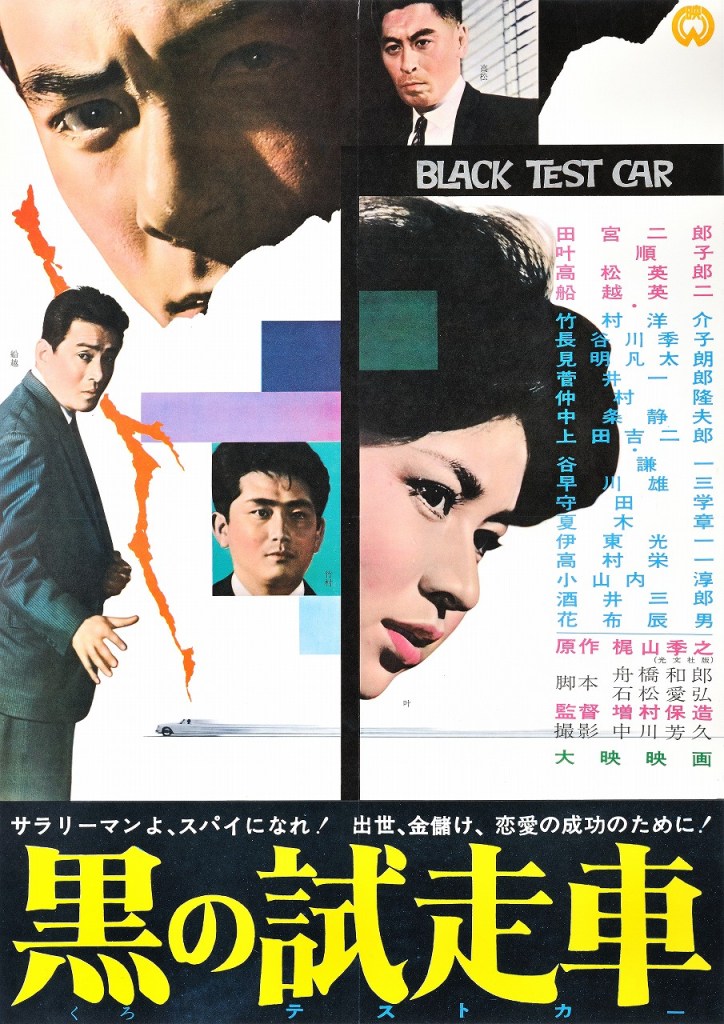
Black Test Car (黒の試走車, Yasuzo Masumura, 1962)

tumblr_n2w2l2mX1a1tvmqcgo1_1280The automobile business is a high stakes game. Do you want to play faster, shinier and sleeker, or safer, family friendly and reliable? Family cars are the best sellers – everyone one wants something that’s reliable for getting to work every morning, getting the grocery shopping done and that you won’t worry about taking your kids to the park in. However, it’s the 1960s and lifestyles are shifting, men (in particular) are marrying later and they want to have fun before they do – hence having quite a lot of disposable income they can blow on a flashy two-seater sports car with no wife to complain about it. Tiger have just finished a new prototype called the Pioneer they plan to launch as a revolution in commercial sports cars which is super speedy but with the convenience of an everyday sedan. However, the Yamato company are also set to launch a new car and it keeps looking suspiciously like the Pioneer – does Tiger have a mole?

Black Test Car (黒の試走車, Kuro no Test Car) begins with the prototype model of the Pioneer bursting into flames during a test run. Not the best start, but it’s early days and at least the driver wasn’t hurt. The guys at Tiger suspect sabotage as they can’t find anything wrong with car’s design. Onoda, the man who’s in charge of the project, has summoned some of his best employees to become the “industrial spying” department to flush out the mole. However, their first few plans fail and Yamato always seems to get there ahead of them. Yamato’s “chief of spying” is a slightly sleazy older man by the name of Mawatari who lost his wife and daughter during the Manchurian campaign (where he also may have been a more official kind of spy). Luckily (for some more than others), Onoda’s protege, Asahina, is dating a girl who works in the hostess industry and it’s suggested to him that he get his girlfriend to spy on Mawatari as he has a particular fondness for a certain hostess bar. The shady dealings only get worse from here on in, blackmail, bribery, pimping and prostitution – is this the yakuza or the automobile industry?

Yasuzo Masumura turns his cynical eye to big business and finds just as must drama as in your cold war spy epic. Onoda is a fanatical company man whose primary reason for living is his work. He barely comes home, rarely sees his children and views his precious Pioneer as his legacy. As such, he’s determined to find the man who’s betraying all his secrets and has become something of a petty dictator in the process. “We’re industrial spies!” he keeps declaiming, as if those words had any kind of authority. He’s not a policeman, he’s not a warrior for justice, he’s just a guy at a car firm who’s poured altogether too much of himself into a few scraps of metal.

His assistant, the up and coming Asahina, seems set to follow in Onoda’s footsteps. He’s young and ambitious, he wants to get the head of department job so he can marry his girlfriend who is still working as a bar hostess (which he doesn’t actually seem to mind about if she doesn’t mind about it either). The girlfriend, Masako, worries that work is changing him. When Asahina asks her to spy on Mawatari she refuses, but when he half jokes that he might not want to marry her she if won’t do as he says, she eventually agrees. Later he asks her for more than that which might just be enough to nip this young love story well and truly in the bud.

Having lost out several times already, the Tiger guys think they’ve got an angle and decide to launch the Pioneer way ahead of schedule to undercut Yamato’s price and release date. However, right away there is a scandalous accident which ends up all over the papers as the driver of the car (who survived unscathed, there were no serious injuries involved) drags the wreck all over town with a loud speaker to announce just how dangerous he believes the car to be. Of course, he’s a stooge, set up by Yamato and aided by another undiscovered mole in the Tiger camp. This incident is the last straw for those who still have a moral backbone at Tiger – culminating in violence and suicide, it leaves the fresh faced executives wondering whether they’re on the career ladder at a respectable firm or among the ranks of thuggish gangsters prepared to lie, cheat and extort to get along.

Shot in a noirish black and white with a moody jazz score, Black Test Car has its film noir overtones with the immorality of big business at its centre. At the beginning of the film everything is for the company – no one thinks of themselves or their own soul, they just want in and to climb the ladder while its there. Or so it seems because everyone is also taking kickbacks whilst blackmailing other people for doing exactly the same thing. There are spy cams interpreted by lip readers, undercover prostitutes masquerading as nurses and men in bushes with microphones – not a dignified way of doing business. At one point Onoda scoffs “you can’t get hung up on  morals. You’ll just have remorse” – this is the choice that presents itself, would you rather have the flashy sports car or retain your humanity?


Black Test Car is available on R1 DVD with English subtitles courtesy of Fantoma.

(unsubbed trailer)

http://www.youtube.com/watch?v=31_7Ve8SPJU