Disobedience (親不孝通り, Yasuzo Masumura, 1958)

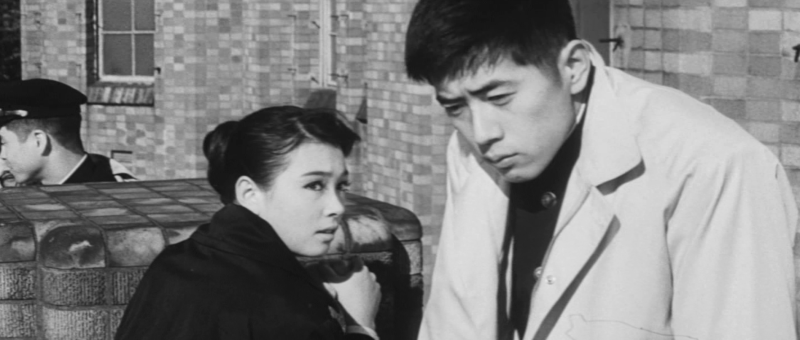
After finding out his older sister has had an abortion after her lover tells her he has no interest in marriage, a college student vows revenge in Yasuzo Masumura’s Disobedience (親不孝通り, Oyafuko Dori). The film’s Japanese title translates as something like “lack of filial piety street” and refers to an area where youth congregates to misbehave, bringing shame on their families with their debauched behaviour. It’s into this world that the cynical hero attempts to drag the sheltered heroine as part of his revenge plot while she apparently decides to stick with him even after he raped her during a college camping trip.

It is though notable that neither of them have much parental input to begin with. Kaneko’s (Hitomi Nozoe) mother has died and we’re told that their father spends all his time with a mistress and never comes home leaving her in the care of older brother Shuichi (Eiji Funakoshi), a salaryman. It’s not exactly clear where Katsuya’s (Hiroshi Kawaguchi) mother is, only that she lives somewhere else and occasionally writes while he is technically in the care of his older sister Akie (Yoko Katsuragi) who works as a tailor in a boutique store selling western fashions. Akie had been carrying on an affair with Shuichi she assumed would lead to marriage and was initially happy about the pregnancy only to be blindsided by Shuichi’s reaction. When he tells her that he has no intention to marry, she realises that the relationship is at a dead end and that an abortion is her only real option given the situation.

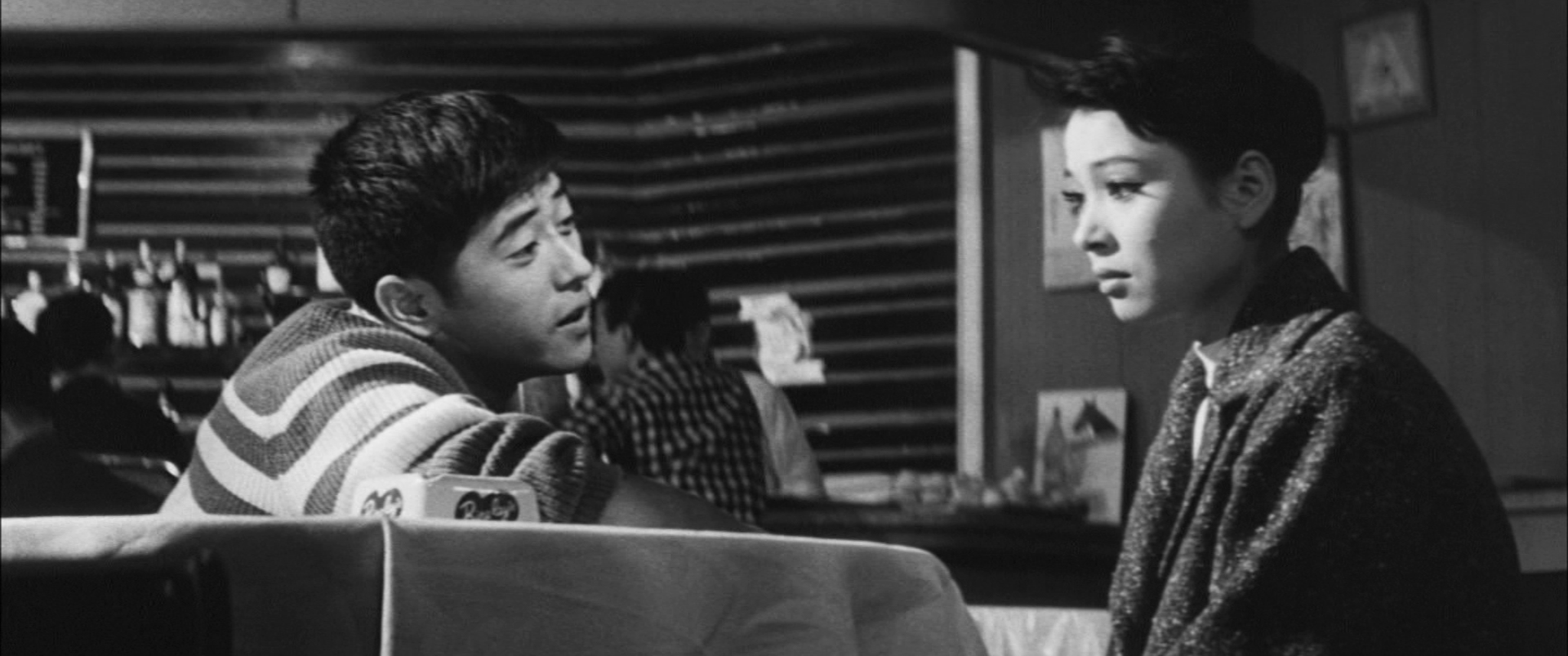
The irony is that Katsuya resents Shuichi for failing to take responsibility as a man and vows to take revenge by doing the same thing to his sister and seeing how he likes that. Though Akie points out that it’s nothing to do with Kaneko and tries to stop him, Katsuya is hellbent on playing the cad to make a point. Of course, he may also resent Shuichi, an executive salaryman, precisely because of the position he is in. There has been an economic downturn and he’s having trouble securing a job for after his university graduation. Some companies have halted recruitment entirely and another of Katsuya’s friends has already been through 11 unsuccessful interviews. Other young men have taken to politics, protesting new authoritarian legislation and investing in socialism. Katsuya and friends find this to be disingenuous, assuming it’s just another shrewd move to get on the ladder by finding employment in government or unions. The salaryman dream is a fairly new post-war invention, but it seems to be dying already and Katsuya can’t even really see what his education was for. He tells Kaneko that he only studies well enough to pass so that he can get a good job and the point of life is to figure out how to make money. If he can’t do that, then his life is meaningless and futile. That might be why he spends his time scamming entitled Americans (the only people with money), beating them at bowling, and hanging out in jazz bars. Though the Occupation is long over, the film has a strong but subtle sense of anti-Americanism as symbolised by the aeroplane flying above as Katsuya rapes Kaneko out in the mountains. 

But for Kaneko the situation is not much different. The young women complain it’s even harder for them to secure employment. Katsuya dismisses Kaneko’s university education by calling it a bridal academy, though most of the women lament that marriage is the ultimate job and perhaps the point of university for them is meeting a husband, just as it’s securing employment for Katsuya. Later, when he confronts Shuichi, Katsuya describes Kaneko as damaged goods now that she’s no longer a virgin and is currently carrying a child for which he accepts no responsibility. That may be one reason that she decides to stick with her rapist, realising that her situation is now impossible given it may be difficult for her to marry someone else while supporting herself financially as a single woman is not yet a viable option. By pursuing a relationship with Katsuya, she reasserts control over the situation along with the narrative of what happened between them on the mountains. 

On learning the truth, however, she makes a different decision from Akie in declaring that she will drop out of university and move to Osaka to live with an aunt and raise the baby alone there, declaring that she has decided to go on loving Katsuya no matter what he might think about it. Kaneko’s decision prompts a reversal of Akie’s thinking too. Though she had decided to be independent, starting her own business rather than planning for marriage, she returns to Shuichi and suggests they should get back together. To her the idea of running her own business and being married seem incompatible. Chastened by this whole affair, Shuichi’s thinking seems to have reversed too, to the extent that he decides to marry Akie after all, while Katsuya also decides to accept responsibility and go to Osaka with Kaneko where they will marry and stay together forever. It’s a strange “happy” ending, though it’s difficult to see how these marriages could ever really be happy given the circumstances that led to them and the discordant music that strikes over an ironic Merry Christmas sign as the film comes to an end suggests they probably won’t be. Nevertheless, the ending reverses a lack of filial piety in the shift toward conservatism through heteronormative marriages and the formation of new families as Katsuya, at least, takes responsibility for his paternity and exits the nihilistic world of clubs, bars, and bowling alleys in which his friends remain trapped.
Undercurrent (夜の河, Kozaburo Yoshimura, 1956)

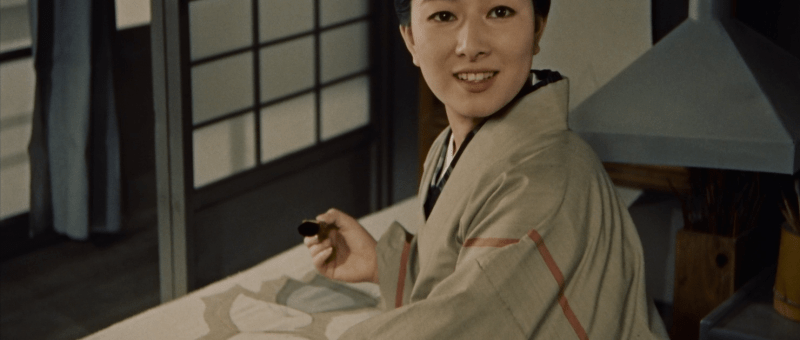
Is it possible to be both married and personally and artistically fulfilled? Marriage hangs over Kiwa (Fujiko Yamamoto) like a looming cage in Kozaburo Yoshimura’s sensuous melodrama Undercurrent (夜の河, Yoru no Kawa, AKA Night River). Scripted not by his regular writer Kaneto Shindo but frequent Mikio Naruse collaborator Sumie Tanaka adapting a novel by Hisao Sawano, the film finds its heroine caught between tradition and modernity while struggling to maintain her position as an independent woman and rightful heir to her father’s kimono dyeing business.

Everyone also keeps telling her that kimono itself is dying out, a relic of a bygone past now that everyone wears Western dress. Even Kiwa’s younger sister Miyoko (Michiko Ono) dresses exclusively in Western fashions and moves to Tokyo on her marriage. An ancient capital, Kyoto is the centre of historical elegance and the last bastion of these “outdated ideals”, yet several shops in their area have closed recently and people do things differently now. A wealthy woman comes to the shop with some fabric directly, cutting out the middlemen and haggling for a discount while cheerfully asking for her cab fare to be covered when Kiwa refuses the job. The young man they’ve taken in as an apprentice, Toshio, leaves to work in an electric factory complaining that “master” and “apprentice” are outdated concepts and that it’s against the Labour Law to force him to work overtime. Kiwa’s father Yujiro (Eijiro Tono), meanwhile, thinks this is just an expression of Toshio’s lack of commitment and that it’s only right that an apprentice should be applying himself to learning his craft every waking moment of the day. 

He was after all once an apprentice himself, but is both proud that his daughter has surpassed him in skill and guilty, fearful that Kiwa has sacrificed her own life and happiness to devote herself to kimono dyeing which is why she has never married. On one level, he’s happy if she’s happy and willing to leave marriage up to her, but also wary of the social censure of the neighbours including his kimono dyeing mentor who gives him a telling-off for his failure as a father to find a match for his daughter. When rumours arise that Kiwa has entered an affair with a married professor, the lady who helped Yujiro get started in business more or less tells him he should get her married to keep her in line. If hadn’t been for the war, she says, Kiwa would have been safely married off long ago and would probably have a gaggle of children to look after which would obviously prevent her from pursuing her art as a kimono dyer though the lady herself has obviously gone on working. 

Kiwa is drawn Takemura (Ken Uehara ) firstly because he’s wearing a tie that features one of her signature dyes which implies some kind of affinity between them. That the fact that he was touring a Nara temple alone with his daughter may have suggested he was a widower, though in truth Kiwa always knew he was married and that may have been a key part of what attracted her to him. She is after all, as Yujiro’s mentor said, a woman and experiences romantic desire even if the mentor is wrong to say that Kiwa sublimates her loneliness through art when in reality the reverse is true. After meeting Takemura even Yujiro remarks that she seems more like a woman, implying that her industry and forthrightness lend her a masculine quality as does her determination to get on in business. She first strikes up a business relationship with the sleazy Omiya (Eitaro Ozawa) whose wife is always watching him like a hawk though she manages to rebuff his attentions while establishing herself as business woman and in demand kimono designer. In pursuit of Takemura she is the one bringing him gifts and inviting him out for walks while Takemura remains somewhat conflicted and pulled along her wake.

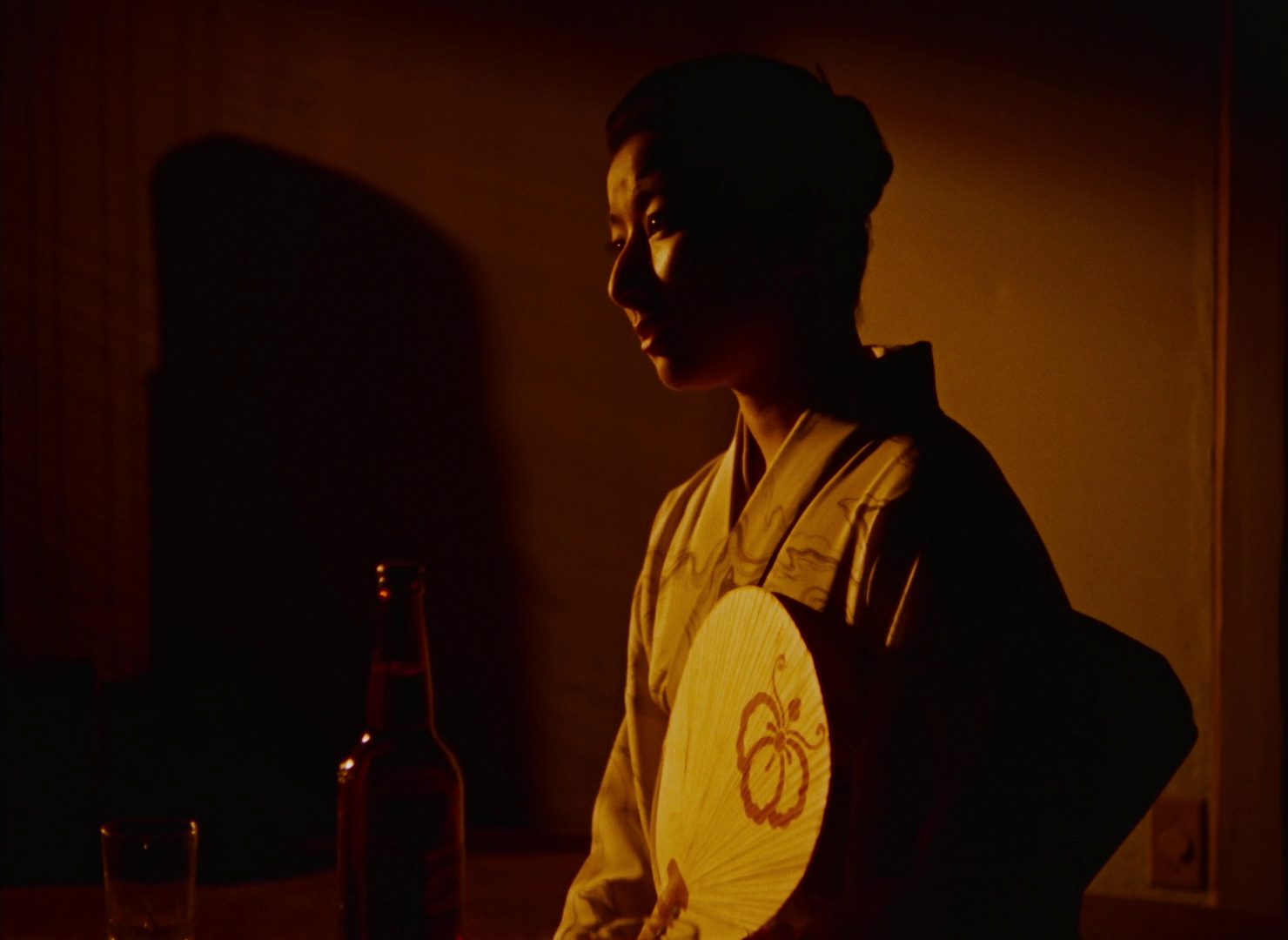
Yet for all that, none of her family members really question the fact that she’s been carrying on with a married man and rather seem slightly relieved that she’s discovered an interest in romance or perhaps just anything outside of kimono dyeing. Even Takemura’s daughter suspects they’re romantically involved and doesn’t seem to mind. Yujiro remarks on Kiwa suddenly using the colour red which she never previously liked and it does seem to echo her reawakening passion. Takemura is also researching red fruit flies, which is less romantic, but also hints his barely suppressed longing. The film seems to align him with yellow flowers and Kiwa with pink. When they’re caught in a rainstorm and refuge in an inn owned by Kiwa’s childhood friend, the entire room in bathed in the glow of the Daimonji fire festival as their passions finally, and perhaps unwisely, overtake them as Takemura announces he’s thinking of moving far away perhaps to avoid this forbidden romance or otherwise for the health of his ailing wife who has been a Kyoto hospital for the last two years.

It’s finding out about Mrs Takemura’s likely terminal illness that seems to implode Kiwa’s romantic fantasy. After they’d made love for the first time, she had told Takemura that if she became pregnant she’d raise the child alone without intruding on his family life, which is to say she wasn’t really envisaging one with him. Her horror is on one level framed as guilt, that she now sees she’s committed an act of betrayal and resents Takemura when he tells her “it won’t be much longer” as if he were counting down the days until his wife passed away. Or worse, that he or others suspected that Kiwa willed her dead. But in reality the reverse is true. Mrs Takemura’s death is an existential threat to Kiwa’s independence. She doesn’t want to get married, even if loves Takemura, because if she did she wouldn’t be able to maintain her independence or career as a kimono dyer. She really does mean it when she says that likes it best when it’s just she and her father in their “cramped” old-fashioned dyeing shop without even an apprentice. 

A tortured art student who seems to pine for her tells her as much, disappointed in her for her relationship with Takemura not out of moral censure but because he fears she’s betraying her art. Okamoto is much younger than her and she’s not interested in him romantically even if he’s painting slightly lewd interpretations of his mental image of her. At one point he appears with a bandage around his neck that implies he may have tried to take his own life and eventually announces he’s leaving Kyoto because he can’t secure his identity there. Ironically he’s happy that Kiwa and Takemura are now free to love each other when the opposite is now true. Now that he’s no longer a married man, Kiwa can no longer love him and is denied the possibility of having both romantic and artistic fulfilment. She is perhaps free in another way, backed by a deep red cloth hanging up to dry as she watches the May Day parade pass by with all of its waving red flags having embarked on a life that is defiantly of her choosing and fulfilled by the passion of art.


Trailer (no subtitles)