Raffles Hotel (ラッフルズホテル, Ryu Murakami, 1989)

An actress gradually dissolves into her own image while wandering around Singapore in search of lost love in Ryu Murakami’s adaptation of his own novel, Raffles Hotel (ラッフルズホテル). Ryu Murakami may generally be more associated with the extreme revolving around transgressive sex and violence, yet like its namesake the film is a more elegant affair indulging in its own sense of mystery tinged with a melancholy eeriness in its heroine’s apparent instability. 

Moeko (Miwako Fujitani) later admits that she is no longer an actress, and therefore no longer quite herself uncertain who it is she’s meant to be. In one sense perhaps that’s why she’s come to Singapore though in another it’s someone else she’s looking for though to begin with we may think she’s there to escape him, and it could be that too. “Maybe I’d feel better if he were,” she muses when her tour guide, Yuki (Masahiro Motoki), explains that there are no Japanese people near the gravestones she’s just been looking at trying to assure her that the man she’s seeking is not dead. She thinks she sees him everywhere, dropped into typical Singaporean scenes appearing as a durian seller or a man restoring a church while more literally haunted by the spectre of a friend who apparently died in Vietnam while covering the war. Kariya (Jinpachi Nezu) later tells her that he can’t forget the jungle while she asks to be taken there with him and travels to a mountain lodge where they hunt wild game with a crossbow. 

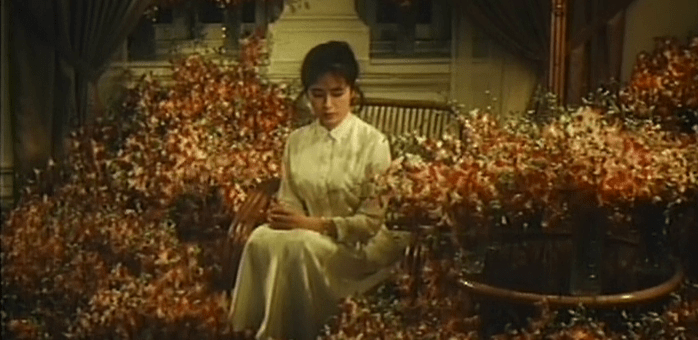
Yuki first becomes worried about her when her hotel room is filled with orchids she claims are from Kariya only to discover she ordered them herself when the orchid house contacts the hotel to complain that the bill has not been paid. Even so, she continues to believe they are from the man she’s looking for, even going so far as to thank him for them as if unable to process the gap between her realities. We often see her looking at photos from her photo shoots, while she later complains to Kariya that she wants to laugh when she wants to laugh and cry when she wants to cry as if making plain her disconnection with her self and desire to reassert her own identity over those she is forced to assume as an actress. 

This abstraction may also explain her words to Kariya that the sky is full of stars but that they are distant from each other and therefore the sky is only make-believe as if the image of Moeko that we see is only an illusion we’ve patched together from the various components available to us. It speaks of her alienation and loneliness, two qualities only deepened by her presence in an unfamiliar culture where she cannot speak the language. Acting as her guide, Yuki describes her as a polar opposite to his Singaporean girlfriend (Fawn Wong), the daughter of a wealthy family who is bold and confident, unafraid to chase her desires be they dancing or “Japanese hoods” as her father describes them. 

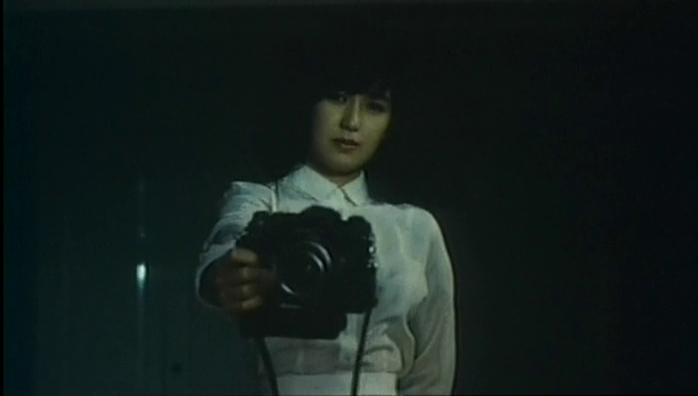
Murakami semi-exoticises Singapore if at times ironically in homing in on the portraits of famous authors in the bar and a man who always seems to be banging away on a typewriter. He sends Moeko all around the island and follows her as she takes in tourist sights, tries durian, and watches Chinese opera but lends an eerie quality to her place within the hotel implying finally that her room has in a way swallowed her as her name is added to the list of famous people who have stayed there even as she remarks that she feels as if the ceiling fan has become sentient in its movement. In any case, the camera is something that she both fears and craves as it both gives and takes her identity. She tries to pick it up herself but points it without looking, finally asking Kariya to take her picture only to find herself becoming one with her image just as Kariya is reduced to shadow as if her very essence had dissipated into the atmosphere as symbolised in a swimming pool full of orchids. “Lost in a fantasy” she may be, but so are we, led astray by a vision of a woman we can never really see. 

To Trap a Kidnapper (誘拐報道, Shunya Ito, 1982)

One of a number of films released in the early ’80s critical of the police force, To Trap a Kidnapper (誘拐報道, Yukai Hodo) draws inspiration from a real life case of child abduction but suggests that the police largely just get in the way and are only interested in apprehending the culprit rather than ensuring the boy’s safety. In any case, unlike the similarly themed High and Low, the film devotes most of its focus to the kidnapper’s desperation as a man apparently left behind by the rapidly rising tides of prosperity. 

Yet somewhat perversely the film opens with a scene of children playing and seven-year-old Hideyuki (Motoyoshi Wada) getting into trouble for flicking toy discs at his friend and deskmate Kaori (Kaori Takahashi). Hideyuki is then made to stand on his own in the playground as a punishment, though quickly makes things up to Kaori by gifting her the plastic discs he was playing with. Neither of them know it, but the children share a grim connection for it’s Kaori’s father Kazuo (Kenichi Hagiwara) who is responsible for kidnapping Hideyuki on his way home from school in the next town over.

Both Hideyuki and Kaori attend a prestigious private institution but are being raised in very different circumstances. Kazuo was once a successful cafe owner but was swindled out of his business and is now in massive debt to a shady loanshark named Moriyasu who’s sold his promissory note on to a third party debt collector. Hideyuki’s father, Noboru Mitamura (Fujita Okamoto), is a doctor though there’s nothing that suggests the family is anything more than financially comfortable and they aren’t immediately able to get the money together for the ransom. Noboru has to ring round all his friends, family, and random acquaintances begging for emergency loans but without really being able to explain why he needs the money. Just having seen it noted on a school register that Hideyuki’s dad was medical professional Kazuo assumed they’d be a good target for a kidnapping and is in any case resentful of their nice middle class life. 

His wife, Yoshie (Rumiko Koyanagi), is in turn resentful of Kazuo for their reduced circumstances later lamenting that they moved house, swapped their big car for a smaller one and are even going to rehome their dog but if Kazuo is really so deeply in debt, something he had kept from her, then nothing they do really matters because their lives will never improve. What she can’t understand is why Kazuo was so keen on keeping Kaori in a private school that he’d get himself into financial hell rather than make a more pragmatic decision to let her go somewhere else. The obsession perhaps hints at his class anxiety, wanting his daughter to stay in a more resolutely middle class environment otherwise in strong contrast to the hometown he later visits where his elderly mother operates a loom in a moribund fishing village which the youngsters are slowly leaving for jobs in factories in neighbouring towns. 

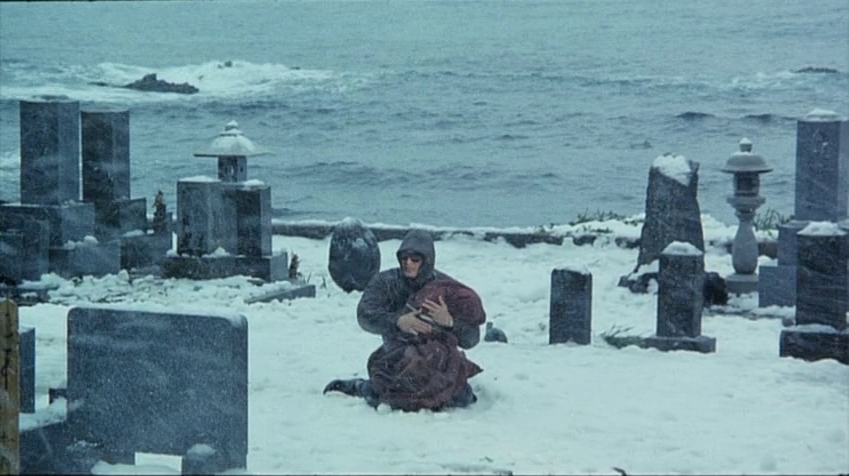
Perhaps in over his head, it at one point looks like Kazuo is about to dump Hideyuki’s body in the sea only to realise police divers are already searching the area. Despite himself, he begins to care for the boy though doesn’t really know what to do with him. He feeds him bread from convenience stores and keeps him tied up in the boot of his car wrapped in several blankets without really considering the possibility that he may die of cold or hypothermia left outside in the freezing winter. Realising the distraught parents have called in the police despite his warnings not to, he is too afraid to accept the ransom and is therefore at something of an impasse given he can’t very well give up the boy without getting the money.

Meanwhile, as the Japanese title implies the tale is alternately told from the perspective of the reporters at Yomiuri Shinbun who are originally quite annoyed by the police’s request for a news blackout to avoid panicking the kidnapper, suggesting it’s an infringement on their free speech if coming around in the acceptance that a child’s life is at stake. A rookie reporter, Kotaro (Shin Takuma) is involved in a dispute with his fiancée Tomo (Miwako Fujitani) who is having second thoughts because he’s always working while her parents are pressuring her to consider an arranged marriage. Kotaro refuses to write one of the dummy articles they’re putting together in the event that Hideyuki is killed describing it as morbid and irresponsible, but is very involved with the ongoing press investigation which simultaneously seems more rigorous than that of the police and accidentally gets in its way. A “suspicious car” that’s noticed outside a drop sport turns out to belong not to the kidnapper but a reporter on a stakeout wasting the police’s time.

Even they are eventually conflicted, the officer in charge on the ground later letting the Mitamuras leave on their own for the final drop empathising with them as a fellow parent and acknowledging the reason everything keeps going wrong is because the police got involved. Yet his boss orders him to follow them anyway, reminding him that the only job of the police is to catch the culprit seemingly indifferent to whether or not they rescue the hostage unharmed. Their tactics are quite naive, not considering that Kazuo will obviously realise that the Mitamuras are surrounded by undercover officers because they keep using the same ones and it’s odd to keep seeing that couple from the coffee shop everywhere they go. The big break in the case happens by accident just because a couple of traffic cops decide to ask a random car a few questions.

In any case, it’s Kaori who ends up suffering. She and her mother are also victims, unfairly hounded by the press and left with nowhere to go and no-one to turn to having had their lives turned upside down by her father’s desperate decision. He didn’t even know the kids were friends or the effect his actions would have on his daughter. Kazuo hadn’t really thought any of this through but acted only in jealousy and resentment, wanting payback against the Mitamuras for their nice middle class life and his own slice of the pie that he felt had been denied to him. In the end, the only winners are the press who can rejoice in selling their newspapers even if a remorseful Kotaro resents himself for taking a paparazzo photo of Yoshie and Kaori trying to leave town quietly. On seeing his article pasted on pillars at the station, even Tomo starts to change her mind reflecting that if he’s working on a story like this then perhaps working too much isn’t such a dealbreaker after all even if everyone seems to have forgotten about little Hideyuki in the headlong rush to dominate the newsstands by trying to lure a kidnapper into their trap.


Original trailer (no subtitles)

Sorekara (それから, AKA And Then, Yoshimitsu Morita, 1985)

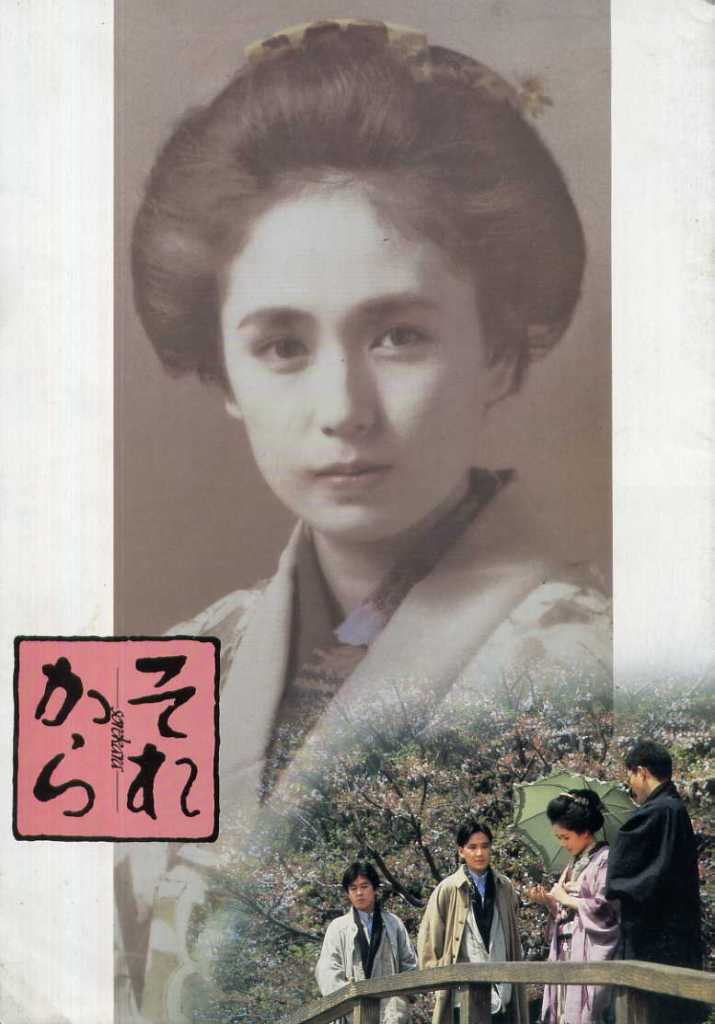
Sorekara PosterYoshimitsu Morita had a long and varied career (even if it was packed into a relatively short time) which encompassed throwaway teen idol dramas and award winning art house movies but even so tackling one of the great novels by one of Japan’s most highly regarded authors might be thought an unusual move. Like a lot of his work, Natsume Soseki’s Sorekara (And Then…) deals with the massive culture clash which reverberated through Japan during the late Meiji era and, once again, he uses the idea of frustrated romance to explore the way in which the past and future often work against each other.

Daisuke (Yusaku Matsuda) is a youngish man approaching early middle age. Thirty years old and a “gentleman” of leisure, he lives in a world of perpetual ennui where he even has to hold his hand to his chest to check that his heart is indeed still beating. His days might have gone on aimlessly had it not been for the unexpected return of an old friend from university, Hiraoka (Kaoru Kobayashi), who has been dismissed from his job following a series of problems with his superiors which has also landed him with a considerable debt to repay and no prospects of further employment. Adding to his sorrows, Hiraoka and his wife, Michiyo (Miwako Fujitani), have recently lost their infant child and have been told that due to Michiyo’s poor health they may not be able to have any more. Daisuke wants to help them, but he’s also facing a lot of pressure from his family to accept an arranged marriage which will further his father and brother’s prospects and is becoming conscious of the relative lack of freedom his life of dependent idleness entails.

Men of Daisuke’s era have perhaps had it hardest coming of age during a period of massive social change which is incomprehensible to the older generation. He’s a well educated man, an intellectual, who can speak several languages and is given to introspective contemplation, but he’s also inherited the worst of European classism as he’s come to believe that working for money is beneath his dignity as a gentleman. He’s completely unable to identify with his friend who needs to work to eat and enjoys none of the various safety nets which are provided by his own wealth and privilege. Nevertheless, he does want to try and help Hiraoka and is dismayed to discover just how little power he has do anything for him.

Hiraoka and Daisuke were part of a group of friends at university which also included another boy who, sadly, died of an illness and his sister – Michiyo, who eventually married Hiraoka. At the time, Daisuke himself had fallen in love with Michiyo but out of a misconceived idea of “chivalry” – another unnecessary adoption of European romanticism, he stepped aside in favour of his friend. This has proved to be a disaster all round and Michiyo and Hiraoka are trapped in an unhappy union which has made Michiyo physically weak and caused Hiraoka to spend the money he should be using to pay back his massive debts on drink and geisha so he can avoid going home. Daisuke’s adherence to a code of morality which is more affectation than anything else is shown up to be cowardice, another way of avoiding adulthood, as he uses his intellectual ideas to mask what is really a fear of rejection.

Daisuke later comes to believe what he did in not acknowledging his own feelings towards Michiyo was “a crime against nature”. He now finds himself at another crossroads as he faces the choice between conforming to the rigidity of his upperclass life in marrying the woman his father has chosen for him and continuing to be financially dependent, or embracing his individuality and striking out on his own to finally claim the woman he’s always loved (and, tragically, has always loved him). In choosing to make a life with Michiyo, Daisuke would be taking several transgressive actions – firstly acting against his own self image by entering the world of working men and secondly by stealing a married woman away from her husband which is no simple matter in the still relatively conservative Meiji era society.

Ultimately, the film is much more a story of Daisuke’s journey of self realisation than it is a melodrama with a love triangle at its centre though Sorekora certainly embraces these aspects too. Morita opts for a more classical tone here with a number of long, unbroken takes and static camera shots yet he also affects a strange, dreamlike tone in which the present and the past seem to co-exist, each drifting one into the other. He intercuts scenes which echo the film’s ending into the main body of the action as well as showing us the early days of Daisuke and Michiyo’s unresolved romantic connection which is poignantly brought out by an experimental technique in which the foreground appears almost like a freeze frame while the rain carries on falling behind them. At certain points there are also some surreal sequences in which Daisuke is travelling on a train but is surrounded by fellow passengers who suddenly each pull out a large sparkler or another where a gaggle of men all dressed just like him are crowded into the the other end of the train and looking at the moon through the open roof of the carriage.

A prestige picture, but one with a healthy dose of strangeness, Sorekara is an inexpressibly sad film full of the tragedy of wasted time and the regret that comes with not having acted in way which satisfies your authentic self. In order to live a life that’s true to himself Daisuke must finally learn to risk losing everything but the film’s ambiguous ending may ask whether the cost of following your heart may not be too heavy a one to pay.


Unsubtitled trailer: