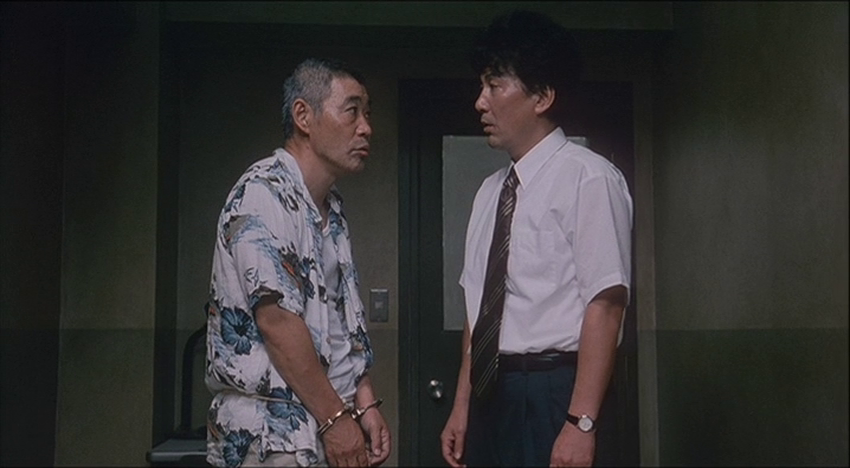
Wait and See (あ、春, Shinji Somai, 1998)

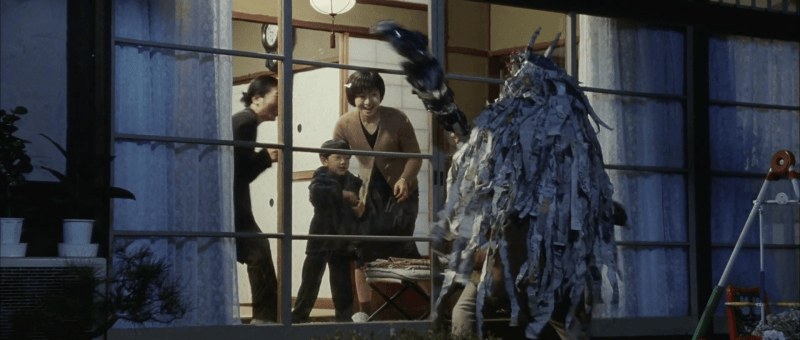
In the opening sequence of Shinji Somai’s Wait and See (あ、春,  Ah haru), a large grey cat growls as it creeps through a suburban home and out into the garden where it sits outside a henhouse and loudly miaows at the birds trapped inside. In many ways, this is exactly what’s about to happen to the Nirasakis when a prodigal father suddenly returns to disrupt the life of his incredibly dull and emotionally distant son. 

Hiroshi (Koichi Sato) is the epitome of the ideal salaryman and seems to be living a charmed life having married into his wife’s wealthy family but under the surface nothing is quite as it seems to be. His wife Mizuho (Yuki Saito) seems to be suffering with some kind of mental distress and Hiroshi often appears indifferent or even cold towards to her. At the memorial service for his late father-in-law, Mizuho’s mother (Shiho Fujimura) and aunt (Chisako Hara) reflect on the late patriarch in less than favourable terms remarking that “everything was half measures” with him. He didn’t commit himself fully to either his family or his career and consequently achieved success with neither. 

The implication is that Hiroshi is much the same, simply going through the motions whether at work or at home and largely closed off to his wife at one point even drawing a curtain and leaving her in the dark to escape a conversation. “He never tells you anything” Mizuho’s mother points out after reading in the paper that the company where Hiroshi works may be in financial trouble, while Mizuho too complains that he never discusses anything with her only announcing the results when it’s already finished. 

Hiroshi had always believed his own father to have died when he was five years old, so it’s quite a surprise when the gnomish Sasaichi (Tsutomu Yamazaki) accosts him in the street and claims to be his long lost dad. Like the cat outside the henhouse, he’s set to create a disturbance but not quite the one everyone assumes it will be. Hiroshi’s mother Kimiyo (Sumiko Fuji) warns him that his crass working class dad will only cause embarrassment in the refined elegance of the upper-middle-class family he has married into. Yet Mizuho and her mother actually find Sasaichi quite amusing for the first couple of days, the mother very impressed by Sasaichi’s unreconstructed manliness which she finds so in contrast to the comparatively meek Hiroshi. Sasaichi fixes the leaky bath and sticking door that Hiroshi never got round to symbolising his lack of regard and inability to care for his home, which is in a sense ironic because Sasaichi was never really able to take care of anything. 

Sasaichi later explains that he left because his business failed and he ended up with debts to loansharks so he divorced Kimiyo and moved away to prevent them coming after her money. A fatherless son, Hiroshi struggles to construct the image of himself as a father and cannot create intimate relationships with people, but has settled for fulfilling the role of a successful member of society who can support a family financially even though the sense of himself as a provider is an illusion as his wife’s generational wealth already guarantees them a comfortable existence. Even so, this being the difficult post-bubble economy Hiroshi lives with a sense of economic anxiety but buries his head in the sand refusing to listen to a more savvy friend who can see the writing on the wall and tries to convince him to take a job at another company where he’s just secured a position for himself. But Hiroshi is afraid of change and ironically clings fast to his corporate family even while fearing it will leave him. 

He desperately doesn’t want to think that he is like Sasaichi, that he may fail his family by failing in his career or that he too is an uncouth, unrefined country bumpkin incapable of taking care of himself let alone anyone else. The again perhaps they’re more alike that he’d like to think. Hiroshi and Mizuho object when they realise Sasaichi’s been teaching their son Mitsuru (Keita Okada) how to play craps, but as his friend points out stockbroking is also really just legitimised high stakes gambling. He too wanders around until late at night because he doesn’t want to go home and makes his wife worry so she has to take sleeping pills .

Yet there’s also a side of him that is still the gentle boy from the country as he painstakingly raises chicks in the back garden. In the end, it’s Sasaichi who shows them the maternal warmth they need to grow, gestating the eggs in a pouch inside his haramaki only for them to hatch at the most ironic moment. Hiroshi gives his son a brief life lesson in explaining that the chicks that hatch from these eggs will go on to lay their own in a circular process of renewal just as he is passing on knowledge from his childhood to the next generation. The film begins and ends with a ritual of mourning, though Somai takes us through the passing season moving from Setsubun to Hinamatsuri as Sasaichi continues to outstay his welcome while attempting to repair his corrupted paternity. “Don’t worry, life will go on,” Mizuho reassures a more open Hiroshi finally coming to terms with his anxieties and willing to share them with his family in full knowledge of who he is as a man and a father in a world that’s anything but certain.


Original trailer (no subtitles)

The Catch (魚影の群れ, Shinji Somai, 1983)

the-catch

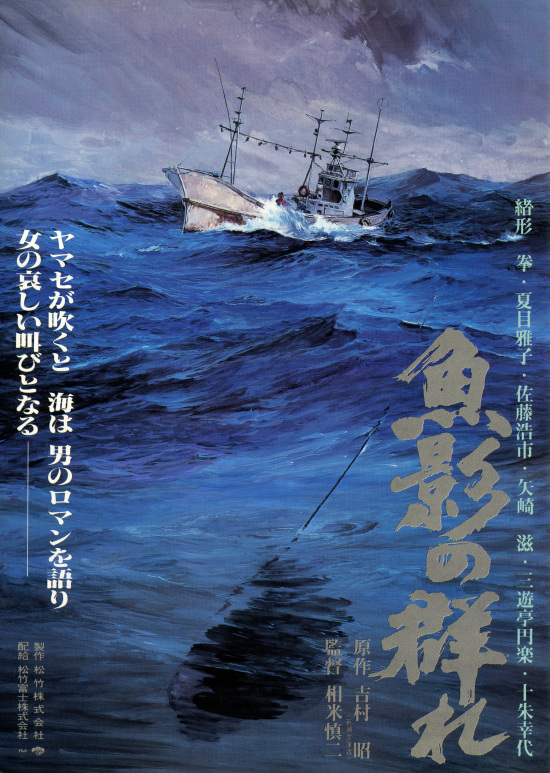
Some men become their work, the quest for success consumes them to the extent that there is barely anything left other than the chase. The Catch (魚影の群れ, Gyoei no Mure), Shinji Somai’s 1983 opus of fishermen at home on the waves and at sea on land is a complex examination of masculinity but also of fatherhood in a rapidly declining world filled with arcane ritual and ancient thought.

Fusajiro (Ken Ogata) is a middle aged man who looks old for his years. Man and boy he’s spent his life at sea, hunting down the elusive tuna fish which can be sold for vast amounts of money in the rare event that one is actually caught. This “first summer” as the title card refers to it, marks a change in his life as the daughter he’s been raising alone since his wife left him many years ago, Tokiko (Masako Natsume), has found a man she wants to marry. Her boyfriend, Shunichi (Koichi Sato), owns a coffee shop in town and Fusajiro has his doubts about a city boy marrying into a fisherman’s family. However, Shunichi isn’t just interested in Tokiko, he wants to set sail too. Though originally reluctant, Fusajiro eventually agrees to take Shunichi as a kind of apprentice but is dismayed when he gets seasick and seems to have no hint of a fisherman’s instinct.

Fusajiro is a legend among his peers – a big man of the sea, a true sailor and top hunter. He’s the one people turn to whenever anything goes wrong on the waves. However, he’s also a gruff man who speaks little and seems to prefer his own company.  In the rare event that he is speaking, it’s generally about tuna. When Shunichi first meets Fusajiro he remarks that he knew it must be him because he “smells of the sea”.

A later scene sees Fusajiro catch sight of a woman caught in the rain who immediately starts running away from him. Chasing her  just like one of his ever elusive tuna he eventually pins the woman down and takes her back to his boat to complete his conquest. The woman turns out to be his ex-wife, who left him precisely because of this violent behaviour. After momentarily considering returning to him, she realises that he hasn’t changed and accuses him of being unable to distinguish people from fish – he hooks them, reels them in, and if they don’t come willingly he hits them until they do so he can keep them with him. This overriding obsession with domination also costs Fusajiro his daughter when Shunichi is gravely injured on the boat and Fusajiro delays returning to port until he’s secured the tuna he was chasing at the time. Shunichi’s blood and the fish’s mingle together on the deck, one indistinguishable from the other, both victims of Fusajiro’s need to reign supreme over man and fish alike.

Fusajiro tried to warn Tokiko not to marry a fisherman, it would only make her miserable. Shunichi is warned that a fisherman’s life is a difficult one and the seas in this area less forgiving than most, but his mind is made up. Finally acquiring his own boat after selling his cafe, Shunichi, just like Fusajiro, starts to fall under the fisherman’s curse – endlessly chasing, living only for the catch. Unlike Fusajiro, however, Shunichi has little instinct for life at sea and fails to bring home his prey. Little by little, the mounting failures eat away at his self esteem as he feels belittled and humiliated in front of the other sailors culminating in an attempt to reinforce his manhood by raping his own wife. These men are little better than animals, consumed by conquest, permanently chasing at sea and on land. To be defeated, is to be destroyed.

Somai never shies away from the grimness and brutality of the work at hand. Ogata catches and spears these magnificent fish for real and the unfortunate creatures are then carved up right on the dockside before our very eyes. As we’re constantly reminded, physical strength is what matters for a fisherman and Fusajiro is a strong man, duelling with the tuna fish and straining to hold the line with all his might. Yet he’s getting old, his body is failing and like an aged toreador in the ring, his victory is no longer assured. The Japanese title of the film which translates as crowds of shadows of solitary fish expresses his nature more clearly, his fate and the tuna’s are the same – a lonely battle to the death. Unable to forge real human connections on land Fusajiro and his ilk are doomed to live out their days alone upon the sea wreaking only misery for those left behind on the shore.


Original trailer (No subtitles, graphic scenes of animal cruelty)

Kabei: Our Mother (母べえ, Yoji Yamada, 2008)

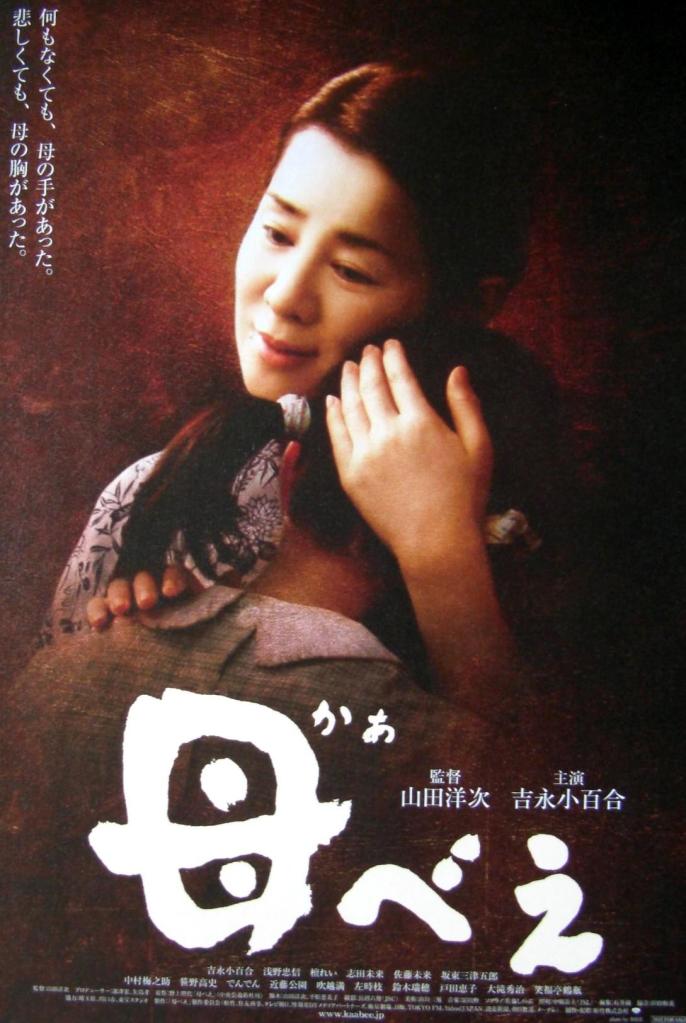
KabeiYoji Yamada’s films have an almost Pavlovian effect in that they send even the most hard hearted of viewers out for tissues even before the title screen has landed. Kabei (母べえ), based on the real life memoirs of script supervisor and frequent Kurosawa collaborator Teruyo Nogami, is a scathing indictment of war, militarism and the madness of nationalist fervour masquerading as a “hahamono”. As such it is engineered to break the hearts of the world, both in its tale of a self sacrificing mother slowly losing everything through no fault of her own but still doing her best for her daughters, and in the crushing inevitably of its ever increasing tragedy.

Summer, 1940. The Nogamis are a happy family who each refer to each other by adding the cute suffix of “bei” to their names. The father, Tobei (Bando Mitsugoro X), is a writer and an intellectual opposed to Japan’s increasing militarism and consequently has found himself in both political and financial difficulties as his writing is continually rejected by the censors. Eventually, the secret police come for him, dragging him away from his home in front of his terrified wife and daughters. After Tobei is thrown into jail for his “thought crimes”, the mother, Kabei (Sayuri Yoshinaga), is left alone with her two young girls Hatsuko and Teruyo (Hatsubei and Terubei in family parlance).

Though devastated, Kabei does not give up and continues to try and visit her husband, urging his release and defending his reputation but all to no avail. Thankfully, she does receive assistance from some of her neighbours who, at this point at least, are sympathetic to her plight and even help her get a teaching job to support herself and the children in the absence of her husband. She also finds an ally in the bumbling former student, Yamazaki (Tadanobu Asano), as well as her husband’s sister Hisako (Rei Dan), and her brother (Tsurube Shofukutei) who joins them for a brief spell but ultimately proves a little too earthy for the two young middle class daughters of a dissident professor.

The time passes and life goes on. The war intensifies as do the attitudes of Kabei’s friends and neighbours though the family continues its individual struggle, sticking to their principles but also keeping their heads down. By the war’s end, Kabei has lost almost everything but managed to survive whilst also ensuring her children are fed and healthy. A voice over from the older Teryuo calmly announces the end of the conflict to us in such a matter of fact way that it’s impossible not wonder what all of this was for? All of this suffering, death and loss and what has it led to – even more suffering, death and loss. A senseless waste of lives young and old, futures ruined and families broken.

Yet for all that, and to return to the hahamono, the Nogami girls turned out OK. Successful lives built in the precarious post-war world with careers, husbands and families. Unlike many of the children in the typical mother centric movie, Hatsuko and Teruyo are perfectly aware of the degree to which their mother suffered on their behalf and they are both humbled and grateful for it. Kabei was careful and she kept moving to protect her children in uncertain times. Seen through the eyes of a child, the wartime years are ones of mounting terror as fanatical nationalism takes hold. Bowler hatted men seem to rule everything from the shadows and former friends and neighbours are primed to denounce each other for such crimes as having the audacity to wear lipstick in such austere times. In one notable scene, the neighbourhood committee begins its meeting by bowing at the Imperial Palace, until someone remembers the paper said the Emperor was in a different palace entirely and they all have to bow the other way just in case.

Though the tale is unabashedly sentimental, Yamada mitigates much of the melodrama with his firmly domestic setting. We see the soldiers massing in the background and feel the inevitable march of history but the sense of tragedies both personal and national, overwhelming as it is, is only background to a testament to the strength of ordinary people in trying times. An intense condemnation of the folly of war and the collective madness that is nationalism, Kabei is the story of three women but it’s also the story of a nation which suffered and survived. Now more than ever, the lessons of the past and the sorrow which can only be voiced on the deathbed are the ones which must be heeded, lest more death and loss and suffering will surely follow.


Original trailer (English subtitles)