Between the Knees (무릎과 무릎 사이, Lee Jang-ho, 1984)

“We are all suffering from this Westernised lifestyle and way of thinking. They are not really meant for us,” according to a sympathetic doctor, played by the director himself, at the end of Lee Jang-ho’s erotic melodrama, Between the Knees (무릎과 무릎 사이, Muleupgwa muleupsai). The heroine does indeed find herself trapped between the Korea of the past and the modern society, but the film often seems confused in its central messages in its own use of the woman’s body as metaphor for that of the nation despoiled by foreign influence. 

This is most obviously the implication of Ja-young’s (Lee Bo-hee) flashbacks in which she is quite clearly molested by her flute teacher who is a bearded white man. When her mother walks in on the abuse, she blames Ja-young beating her and shouting what we would assume to be unpleasant words branding her as a seductress though she is a clearly a child. As is later explained, Ja-young’s mother is carrying her own baggage in that her own mother was the mistress of a married man and fearful of the same fate befalling her daughter, she has brought her up with problematic notions of bodily purity that have caused Ja-young to develop a complex surrounding her sexuality in which she is unable to process her desires as a young woman. 

She later says that through her “immoral behaviour and desire to sin” she has found “freedom” as if sexuality was her way of rebelling not only against her mother’s tyranny but social conservatism in general. However, she also characterises it as the extreme opposite, blaming her mother in insisting that her treatment of her has left her with no control at all over her sexuality. In the film’s problematic framing, she essentially allows herself to be raped by a series of men partly as an act of self-harm, partly as rebellion, and partly because she has no other way of permitting herself to satisfy her sexual desires. This is of course dangerous, portraying a woman who says no as one who is really saying yes but resisting out of shame, but there is also a completely paradoxical criticism of Korean men all of whom are rapists except for Ja-young’s sort of boyfriend Jo-bin (Ahn Sung-ki) who is so obsessed with traditional Korean culture that he has earned the nickname “antique”.

Jo-bin lives in a Korean-style home and spends his time playing the flute, training in traditional martial arts, and watching pansori in comparison to the pursuits of other young people such as Ja-young’s brother Ji-cheol who mimics Michael Jackson and spends all his time in discos. Towards the beginning of the film is seems that Ja-young will be torn between Jo-bin to whom she originally says “if you’re so old-fashioned I may have to run away with you” and an incredibly unpleasant fellow student who refuses to take no for an answer and in fact eventually rapes her during an expressionist rainstorm that violently awakens her sexuality. The battle then really becomes whether or not Ja-young will be able to accept it, despite the realisation that she is “no longer the kind of virtuous bride that Korean men expect.”

This hints at the pernicious double standard of the contemporary society in which men largely behave like animals, treating women like trophies to be conquered and then discarded while insisting on a “pure woman” for a wife. The discord in Ja-young’s home stems from patriarchal failure, not only that of the man that made her grandmother a mistress and not a wife, but her father’s in having fathered a child with a 17-year-old Korean War orphan he took into his home. Resentment over his betrayal has further embittered Ja-young’s mother and caused her to double down on her sexual conservatism while fiercely resenting her husband’s other daughter. Yet in the film’s final stretches, a degree of female solidarity arises between the women that largely excludes the father with Ja-young’s mother accepting Bo-young as another daughter and inviting her to live in their home now her still young mother has remarried. 

Violent male sexuality also rears its head in a subplot in which a mute man who had developed feelings for Bo-young’s mother while they were being raised in the same orphanage attacks Ja-young’s father for ruining her life, as he undoubtedly did even if he tried to take at least some responsibility for his transgression. Bo-young later says that her mother hated the mute man and did not want to be in a relationship with him anyway, though he too it seems could not take no for an answer. In any case, it is only the traditionalist, Jo-bin, who is willing to accept Ja-young for who she is. He knows all of her ordeal and does not reject her for her sexually active past, rather scoffing when she had described sex as being a sin with the perhaps mistaken implication that such things were not regarded as taboo in the Korea of the past even as, paradoxically, it appears that Jo-bin is drawn to Ja-young’s old-fashioned modernity in rejecting his mother’s constant attempts to set him up with an arranged marriage. 

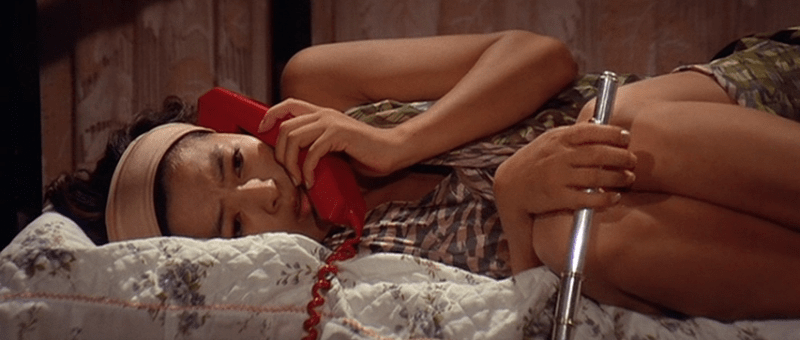
Of course, all of this is also very much informed by the climate of contemporary Korean cinema which had descended into an era of softcore pornography deliberately supported by the Chun regime as part of a bread and circuses social policy designed to distract the people from their democratic desires. Lee opens with sexually charged closeup of Ja-young’s lips on her flute, a phallic symbol also present in Ja-young’s forbidden fantasises as she idly fondles it after hearing heavy breathing on the telephone and experiences another moment of sexual crisis. Perhaps that’s paradoxical itself in that it’s learning to play this Western instrument that has led to her corruption in an allegory for a nation’s pollution by Western culture. In any case, Lee seems to imply that sexuality can be an act of resistance towards oppressive social codes but is otherwise unsure if that represents liberation or merely another form of oppressing one’s self.
Lee Jang-ho’s Baseball Team (이장호의 외인구단, Lee Jang-ho, 1986)

After finding huge success with his debut film, Lee Jang-ho soon became disillusioned with the film industry and was in fact temporarily banned after being found in possession of marijuana. After the assassination of Park Chung-hee in 1979, Lee returned with a new focus on socially conscious filmmaking only to be blindsided by the advent of an entirely new age of oppression following the coup of general Chun Doo-hwan in 1980. In contrast to Park’s regime, Chun’s embarked on a deliberate bread and circuses policy pushing sports, sex, and screen in which social commentary was out and softcore very much in. 

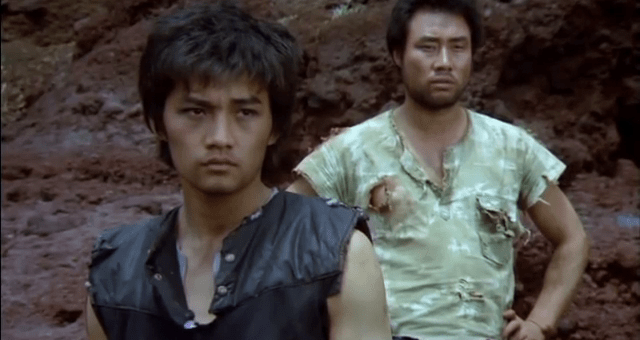
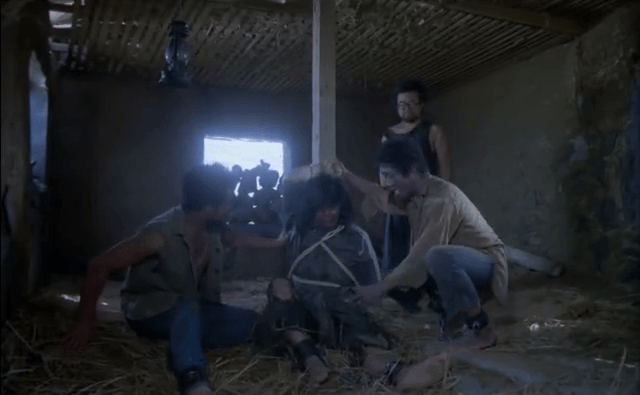
Lee had opened his nonsense film Declaration of an Idiot with a scene of himself committing suicide because no one cares about movies anymore, they only like sports which lends a note of irony to his incredibly strange and very of its time baseball film, Lee Jang-ho’s Baseball Team (이장호의 외인구단, Lee Chang-houi wingudan). Adapted from a popular sports manhwa, the film is ostensibly a much more commercial affair yet in its way is attempting to subtly attack the growing inequalities of the Chun era as its poor mountain boy hero, Hye-seong (Choi Jae-sung), squares off against posh boy rival Dong-tak (Maeng Sang-hoon) not only for sporting glory but the hand of his innocent first love Um-ji (Lee Bo-hee). 

As Dong-tak joins a top-rated team and is interviewed on television, Hye-seong returns to the mountains to train and is trying to dodge the train fare while travelling with his father to discuss joining a team. He eventually strikes a blow against Dong-tak by striking him out during a perfect game, but ruins his shoulder in the process with his baseball dreams then behind him, which is a problem because he’s devoted his entire life to fulfilling the promise he made to Um-ji when they were children to become a great baseball player. Hye-song repeatedly promises to do anything he can to make Um-ji happy even if it means accepting her relationship with Dong-tak, but Dong-tak openly laughs at him for being a nobody though there is something worryingly intense in his suddenly throwing all his letters from Um-ji, which he had in his bag, on the table describing them as written by a “goddess” and his “sacred place.”

As for Um-ji herself, she seemingly has little control over her life as the daughter of an upperclass family. She began dating Dong-tak before reconnecting with Hye-seong in Seoul and originally sticks to her class-appropriate match before being tempted by her innocent childhood connection and realising Dong-tak is an arrogant arsehole who didn’t show up to her birthday dinner because he forgot and went on a date with another girl. Even so, her family continue to pressure her into marrying Dong-tak despite his manly decision to ignore her until he’s accomplished his mission of achieving 100 consecutive hits at which point he’ll propose. Hye-song ironically makes a similar decision, taking off for a training session on a remote island which ends up lasting a whole year during which his completely insane mentor Coach Byeon-ho (Ahn Sung-ki) denies him permission to write to her. When he returns, Um-ji has ended up married to Dong-tak and is in a depressive state wandering through life in a daze of guilt and disappointment that she betrayed both herself and Hye-seong because of social pressure to conform and is now stuck in this emotionally unsatisfying relationship. Hye-seong rejects her on the grounds that the spark has gone from her eyes and she’s no longer the Um-ji of his youth though also accepting some responsibility for that. At the end of the film, Hye-song loses his sight which allows him to reunite with a changed Um-ji who has separated from the now loser Dong-tak, no longer able to see the change in her remembering only the Um-ji he fell in love with. 

The men who were with him on the island where they underwent bizarre martial-arts style training regimes, were whipped and shackled, and almost killed their one-armed teammate have similar problems returning to situations that are less satisfying than they hoped. A wimpy pitcher despised by his son returns to find him unimpressed, while another discovers his wife had temporarily left him, and an incredibly short man, Kyeong-do, who’d been bothering a bank employee so much she switched branches to avoid him discovers she’s engaged to another man. Kyeong-do refuses to give up, arrogantly telling her that he’ll be replacing her groom on the big day while continuing to behave like a massive creep but actually successful in the end because of his sporting and financial success though it looks more like a case of her giving in than actually falling for him and sends some very mixed messages about a woman’s agency in this still conservative age. 

The players brand themselves losers and outsiders, each of them in some way compromised and locked out of pro-baseball from Kyeong-do’s short stature to Hye-seong’s poverty though the decision to include a mixed race man which may have been intended as a progressive gesture seriously backfires by having a Korean actor perform in blackface while insensitively mimicking racial stereotypes. The coach, Byeong-ho is also an outsider by virtue of walking with a cane and purposefully creates a team of others like himself he can train with his cruel and bizarre methods to take on the Dong-taks of the world. Even so, others brand them “inhuman”, “beasts trained with whips”, and continue to resent their attempt to subvert the contemporary class order. 

On the surface, however, Lee has simply made a baseball film about a group of outsiders who triumph over adversity. He fills it with the spirit of the times, throwing in several sequences accompanied by contemporary pop songs along with an atmosphere of ridiculous excess not to mention inconsequentiality as if he were actively mocking the current direction of Korean cinema despite the occasional moment of artistry such as the gothic scene in which Um-ji realises Hye-seong has returned but the pair are separated by a billowing white curtain. An oddity, but perhaps one that speaks of the oddity of its times. 


The Age of Success (성공시대, Jang Sun-woo, 1988)

Age of Success still 3“Love only matters when you can sell it” in the nihilistic world of Jang Sun-woo’s The Age of Success (성공시대, Seonggong shidae). The Korea of 1988 was one of increasingly prosperity in which the recently democratised nation looked forward to a new era of freedom, hosting the Olympic Games as a calling card to the world stage. Like everywhere else in the ‘80s however it was also a time in which greed was good, time was money, and compassion was for suckers. Jang’s narcissistic hero worships Hitler and offers a nazi salute to a mockup of a high value note with his own face on it as he leaves for work every morning, but his relentless pursuit of “success” is destined to leave him empty handed when he realises the only commodity he can’t sell is sincerity.

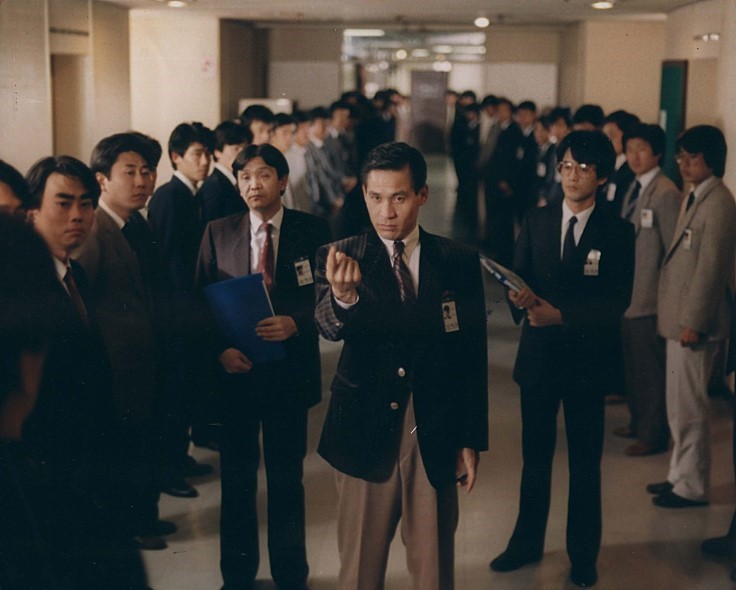
The executives of Yumi Foods, a subsidiary of Mack Gang (Mighty) corporation, are looking for a bright new face through a series of individual interviews. The panel asks each of the prospective new hires to prove their sales ability by convincing them to buy something inconsequential they happen to have in their pockets. Each of the young men fails, until the sharply suited Kim Pan-chok (Ahn Sung-ki), whose name literally means “sales promotion”, dazzles them with a show of intense charisma. He simply offers to sell them whatever is inside his clenched fist. Such is his conviction, the CEO finds himself emptying his wallet, pouring out his credit cards, and eventually borrowing from his friends until Pan-chok is satisfied he’s getting all he could possibly get at point which he opens his fingers and reveals his empty palm. The bosses are annoyed, but quickly convinced by Pan-chok’s explanation that what he’s sold them is “sales spirit” which is, after all, the most valuable thing of all (not to mention exactly what they were looking for). Pan-chok is hired.

Later, we find out that Pan-chok’s routine is an ironic inversion of his childhood trauma. A poor boy abandoned by a mother who became fed up with his father’s fecklessness, he waited alone every day for his dad to come home with something to eat. But his dad was an irresponsible drunkard who could never hold down a job. Like Pan-chok, he held out his fist and told the boy to open his fingers but he was always empty-handed. Hating his father’s incompetence, laziness, alcoholism, and violence, Pan-chok decided that he had to be strong. “Poverty makes you low and pathetic”, he insists. Love, pity, and mercy are for people with no power. “The important thing is to be strong, to win, succeed, possess, and to dominate. Only then will I be happy”.

Pan-chok is a corporate fascist wedded to ultra capitalist ideology in which the only thing that matters is strength and the ability to dominate. He lies, and cheats, and misrepresents himself to pull every underhanded trick in the book to try and get ahead. He goes to war, quite literally, with industry rival Gammi, intent on completely destroying them in order to dominate the market by whatever means possible. Coming up with signature product Agma, he irritably tells his development team that none of their work really matters because the quality of the product is largely irrelevant. Just as in his interview, all Pan-chok is selling is false promise wrapped up in marketing spin. His rival goes on TV to talk the value of tradition to defend himself against a smear campaign Pan-chok has engineered to suggest his products are a health risk, but eventually gets the better of him by playing him at his own game and making a late swing towards ultra modernity.

Pan-chok’s main gambit is seducing a local bar hostess, Song Sobi (Lee Hye-young), lit. “sexual consumption”, and using her as a spy to get info on Gammi’s latest products, but Sobi falls in love with him only to have her heart broken when she realises Pan-chok will discard her when he decides she is no longer useful. He tells her that love is only worth something when you can sell it, but is confounded when she later turns the same logic back on him after selling her charm to seduce the son and heir of the Gammi corporation as a kind of revenge.

Proving that he never learns, Pan-chok’s last big idea is that the only way to beat Gammi’s technological solution is to commodify nature, to repackage and sell back to the people the very things he previously rejected in human sensation. By this point, however, he is so thoroughly discredited that few will listen. His new boss has an MBA from an American university and no time for Pan-chok’s scrappy post-war snake oil salesman tactics. “Only success can set you free”, Pan-chok was fond of saying, but it belied a desperation to escape post-war penury. What he wanted was freedom from hunger, anxiety, and subjugation. He wanted to be a big man, not a small one like his father who always came home empty-handed, so that no one could push him around. What he became was a man without a soul, empty-hearted, consuming himself in pursuit of the consumerist dream. Korea, Jang seems to say, should take note of his lesson.


The Age of Success was screened as part of the 2019 London Korean Film Festival.