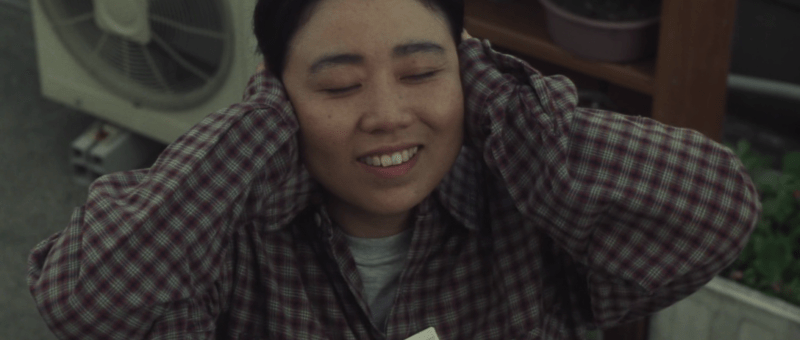
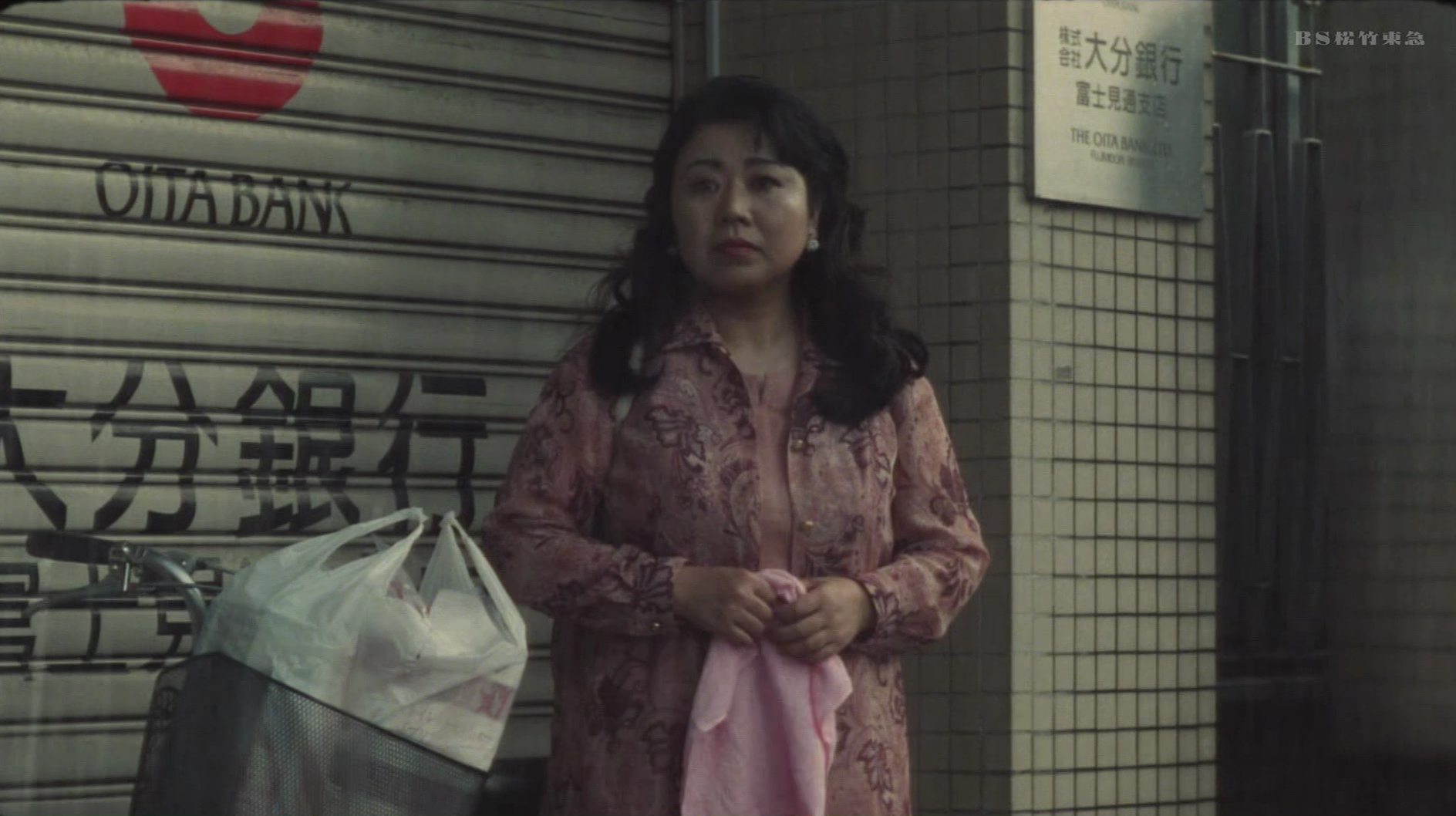
In some ways an innocent’s voyage through the nihilistic landscape of mid-90s Japan, Junji Sakamoto’s Face (顔, Kao) is also a character study of a woman who developed a fear of being seen, in large part because of social prejudice. In a heartbreaking moment, Masako (Naomi Fujiyama) reveals that her father, who left when she was 10, told her that she didn’t have to learn to swim or ride a bike if she didn’t want to. But Masako did want to learn, she just felt she couldn’t because people found her clumsiness “embarrassing”. It’s not completely clear whether Masako’s father said that because he felt bad seeing Masako being picked on by the other kids, or if he too felt ashamed that his daughter was evidently a little different from the other children.
It’s this sense of rejection and loathing that’s manifested in Masako’s bar hostess sister, Yukari (Riho Makise) who is exploitative of her, pressuring her to mend clothing belonging to one of her customers, and becoming physically abusive by tripping her when she refuses. Yukari lies that their mother agrees Masako should be institutionalised, provoking her into a rare trip out of her house running out into the snow in only her slippers and taking a round-trip on a train until Yukari’s gone. The two women are almost polar opposites, and in some ways Yukari’s cruelty may be motived by seeing in Masako’s face the elements of herself that she most fears and dislikes.
Nevertheless, when their mother dies and Yukari implies she plans to turn the family dry cleaner’s into a cafe evicting Masako in the process, Masako ends up snapping and strangling Yukari with her unfinished knitting. In killing Yukari she has, in a sense, freed herself from the oppressiveness of her hate and the inferiority complex it produced in her. Forced on the run on the eve of the Kobe earthquake, she believes the disaster to be her fault, but also takes advantage of the chaos to disappear into a crowd of other displaced persons making their way towards Osaka. It’s there she ends up getting a job at a love hotel under the name of new wave actress “Mariko Kaga,” but every time she starts to settle into a new life and blossoms when surrounded by more supportive presences, her new family quickly crumbles and she’s forced back on the run.
In an ironic twist, many of the ruined men she comes across, some of whom sexually assault her, take on the role of the father she never had. The manager at the love hotel (Ittoku Kishibe) tries to teach her how to ride a bike, though he is privately drowning in gambling debts and about to lose everything. Later she’s sold by a man trying to escape his life as a yakuza to a regular at a bar where she’s been working who bizarrely also begins to teach her to swim. The man who assaulted her originally had lost work because of the earthquake and tried to exorcise his sense of powerlessness by forcing himself on Masako. Her decision to hand him some of the funeral condolence money she stole before leaving is her way of reasserting power over the situation, paying him for this life lesson and shifting the stigma back onto him rather than accept it herself.
Hiroyuki (Etsushi Toyokawa), the former yakuza, may have sold her as a kind of revenge seeing as he seems to resent her for her difference, but also identifies with her seeing them both as “losers”, which is a label Masako no longer really agrees with. But unlike her, Hiroyuki can no longer escape his fate and the yakuza is not often an occupation you can just give up even if it were not for vague hints at trouble in the city that’s forced him back to pleasant onsen town Beppu on the southern island Kyushu. Even the man that Masako takes a liking to simply because he’s kind to her (Koichi Sato) has recently been made redundant. His wife has left him with their young son and he’s resorted to blackmailing his former employer to get what he’s owed. This breach of the employer-employee contract exemplifies the sense of betrayal among people of this generation who were promised jobs for life under the post-war salaryman model but have been chewed up and spit out by the post-Bubble economy.
Masako, however, is flourishing during her life on the run. Her family had treated her as if she had some kind of learning difficulties and had forced her into a kind of arrested development in which she feared the outside world and had poorly developed social skills. The scars of her trauma are literally manifested on her face after she falls off her bicycle, but it’s true enough that through her various experiences she is able to take on different personas only for her actual face to give her away in the end. Just as after she’d run away, Masako encountered a strange and possibly over-friendly woman in a cafe who is later revealed to be a fugitive, like her on the run for murder, modelled in the real life murderer Kazuko Fukuda who evaded the police for over 14 years through having repeated plastic surgery. Masako never alters her face, in fact it’s ironically her true face that becomes further exposed as she comes into herself thanks to those she meets, but is able to become various other people hinting at all the lives she was denied as Masako the despised sister hunched over a sewing machine. Though contemporary Japan may seem to be a bleak and hopeless place, denying Masako the romantic fulfilment and happy life she longed for, it’s she alone who wants to live, desperately swimming out to sea having been pushed all the way out of Japan but forever in search of new horizons.
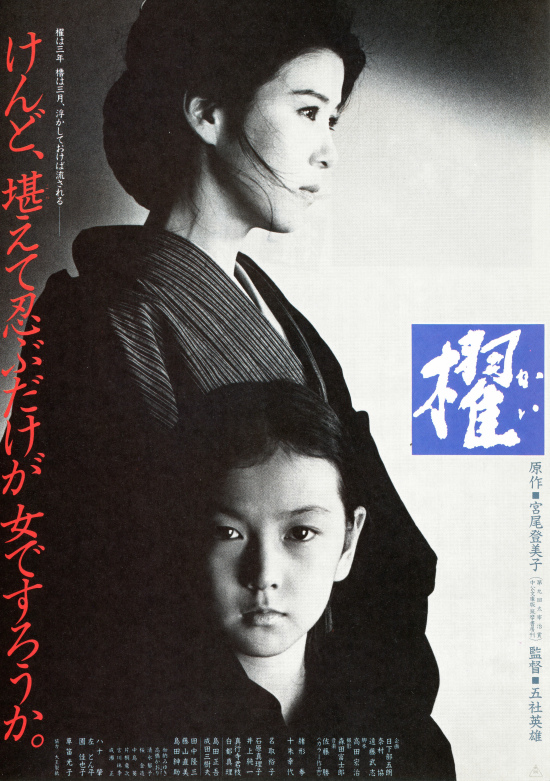 Until the later part of his career, Hideo Gosha had mostly been known for his violent action films centring on self destructive men who bore their sadnesses with macho restraint. During the 1980s, however, he began to explore a new side to his filmmaking with a string of female centred dramas focussing on the suffering of women which is largely caused by men walking the “manly way” of his earlier movies. Partly a response to his regular troupe of action stars ageing, Gosha’s new focus was also inspired by his failed marriage and difficult relationship with his daughter which convinced him that women can be just as devious and calculating as men. 1985’s Oar (櫂, Kai) is adapted from the novel by Tomiko Miyao – a writer Gosha particularly liked and identified with whose books also inspired
  Times change so quickly. The “danchi” was a symbol of post-war aspiration and rising economic prosperity as it sought to give young professionals an affordable yet modern, convenient way of life. The term itself is a little hard to translate though loosely enough just means a housing estate but unlike “The Projects” (団地, Danchi) of the title, these are generally not areas of social housing or lower class neighbourhoods but a kind of vertical village which one should never need to leave (except to go to work) as they also include all the necessary amenities for everyday life from shops and supermarkets to bars and restaurants. Nevertheless, aspirations change across generations and what was once considered a dreamlike promise of futuristic convenience now seems run down and squalid. Cramped apartments with tiny rooms, washing machines on the balconies, no lifts – young people do not see these things as convenient and so the danchi is mostly home to the older generation, downsizers, or the down on their luck.
 Windows on Worlds