The Killing Machine (少林寺拳法, Norifumi Suzuki, 1975)

“As long as somebody like you is around, there’s hope for Japan,” an oddly sympathetic prison warden says to the last patriot standing in post-war Osaka. The title of Norifumi Suzuki’s Sonny Chiba vehicle The Killing Machine (少林寺拳法, Shorinji Kempo) maybe somewhat inappropriate or at least potentially misleading as the film is deliberately constructed as a martial arts parable emphasising the spiritual philosophy of self-improvement and compassion that is inextricable from its practice.

To that extent, the hero, Soh Doushin (Shinichi Chiba), is trying to fight his way out of the miasmas of the immediate post-war era. As may be apparent, Soh has taken a Chinese name, though Soh was apparently his along and belonged to a former samurai family whose nobility has been crushed by militarism. As the film opens, however, he’s a Japanese secret service operative in Manchuria blindsided by the news of Japan’s surrender. Soh is it seems a nationalist and a patriot, but a fairly revisionist one who stands up to the abuses of the Japanese army. He later says that he protested the way that the local Chinese population were often treated and he does indeed raise a fist toward an officer who wants to sell a young Japanese woman to a Chinese soldier in return for a guarantee of their safe passage to a boat heading out of the country. The young woman’s mother protests that she is an innocent virgin, a fact that has some later relevance. Soh refuses to let the officers take her, though evidently separated from her later.

When he meets the young woman again in the bomb-damaged backstreets of Occupation Osaka, she is dressed in Western clothing as opposed to the smart kimono she wore in Manchuria and is about to become a “pan pan” or streetwalking sex worker catering to American servicemen. Of course, Soh can’t let this happen either, but as she later tells him, she was raped by Russian soldiers during the retreat and now feels herself to be despoiled. She never wears kimono again and becomes a kind of symbol for a despoiled nation that Soh is reluctantly forced to accept he cannot save in part because his philosophy, which is still uncomfortably rooted in the philosophy of militarism, only valued strength when it should have valued love. The kind of love that Kiku (Yutaka Nakajima) had for her brother that made her willing to sacrifice herself for his wellbeing. 

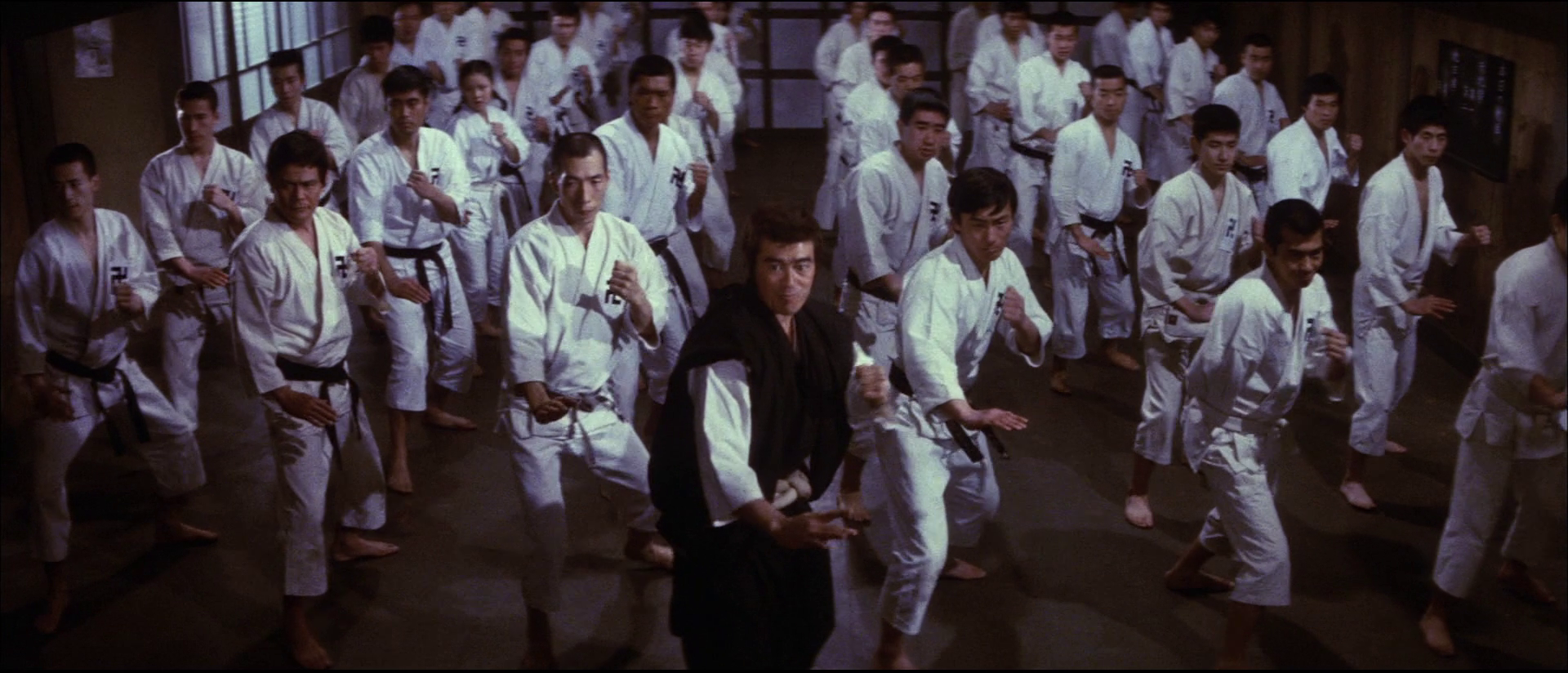
Even so, Soh is doing his best to issue a course correction by caring for a small group of war orphans and helping them support themselves by running a rice soup stall so they won’t end up becoming dependent on the yakuza or the black market. It’s the yakuza and their increasingly corporatising nature that become Soh’s chief enemies, though standing right behind them are the Occupation Forces. They are, of course, just the biggest gang, as we can see when one of the kids steals a few tins from the gangster’s crate which is marked with text making it clear it came from the mess hall at the American base. The backstreets are full of sleazy soldiers and pan pans or otherwise the starving and dejected, sometimes violent demobbed soldiers filled with despair. It’s these men that Soh wants to buck up, telling them to rediscover their fighting spirit and giving them the opportunity to do so through learning Shaolin martial arts.

Of course there are those who don’t want to learn Chinese kung fu in the midst of their defeat, but what Soh is advocating is something that has a greater spiritual application even than karate can also have. It’s a kind of humanitarian riposte to the futility of the post-war society that might sometimes fail to recognise the depths of the impossibility faced by many in insisting they can be faced by discipline and moral fortitude but at the same time is not really judgemental except toward those who have deliberately abandoned their humanity, such as the trio of goons who rape a school for amusement (the girl is later seen among the students at Soh’s school along with the children from Osaka). The girl’s father reports it to the police, but the police and the gangsters are in cahoots, so nothing gets done. Soh cuts the guy’s bits off so he won’t be doing that again. Strength without justice is violence, he realises. But justice without strength is inability. Strength and love like body and mind should never be separated. The closing shots show an entire mountain covered in white-clad figures practising Shaolin kung fu and joining the humanitarian revolution rather than the cruel and selfish one represented by the gangsters with their red-light districts and black markets. It may be a simplistic solution, but it is in its way satisfying and at least a rejection both of the militarist past and the capitalistic future.


*Norifumi Suzuki’s name is actually “Noribumi” but he has become known as “Norifumi” to English-speaking audiences.

Father of the Kamikaze (ゝ決戦航空隊, Kosaku Yamashita, 1974)

By the mid-1970s, Japanese cinema at least had become much more comfortable with critiquing the wartime past, considering it from a greater distance than the often raw depictions of war in the films from the previous two decades. 1974’s Father of the Kamikaze (ゝ決戦航空隊, A Kessen Kokutai), however, is among the few to skew towards the nationalist rather than the ambivalence or simple anti-war messages of other similarly themed films of its era. 

Starring ninkyo icon Koji Tsuruta who served in the air force himself, the film is a kind of biopic dedicated to Admiral Onishi who oversaw the kamikaze operations at the end of the war. As is pointed out, Onishi had been against the war in general terms even before its inception and is originally against the philosophy behind the kamikaze squadrons but as Japan’s fortunes continue to decline he becomes its biggest advocate citing a kind of sunk cost fallacy that it would be in someway unfair to the men that have already died to surrender while insisting that suicide missions are the only feasible way to turn the tide because one kamikaze could take out a hundred men by destroying battleships singlehandedly. 

The film in part attributes this extreme solution to the prevailing with your shield or on it philosophy of the contemporary society which placed extreme shame on the act of being taken prisoner. In the prologue that opens the film, a squadron of downed pilots whose heroic deaths have already been recorded is discovered alive in an American prisoner of war camp but as being a prisoner of war is so shameful and would reflect badly on the military, the decision is taken to fix the books by sending the men on a mission from which they are not intended to return. Onishi is opposed to the plan, he asks why they can’t find a way for the men to live, but the decision is already made. In any case, he describes the action of a suicide mission as a “beautiful ideal” even when insisting that a war cannot be fought in that way not least for purely practical reasons in that they do not have the resources to be wilfully sacrificing skilled pilots and their planes. 

Having come round to the idea, however, Onishi is a crazed zealot who cannot accept the idea of surrender and even goes so far as to barge into a cabinet meeting to urge ministers against a truce even though the war is clearly lost. To his mind, the only way to honour the sacrifices of those who’ve died is to fight to the last man. Kozono (Bunta Sugawara), another officer opposed to the kamikaze, eventually meets a similar fate in refusing to obey the order to lay down his arms and ending up in a psychiatric hospital. His objection had partly been that it’s wrong to turn men into ammunition, but also that the kamikaze project is itself defeatist and self-defeating when there are men such as himself who are committed to fighting on.  

In this the film leans into the image of militarism as a death cult in which dying for the emperor is the only noble goal of the whole imperial expansion. In its eventual lionising of Onishi’s image, his bloody suicide atop a white cloth resembling the flag of Japan while his parting words scroll across the screen in text, it does not shy away from his more problematic aspects in which he fails to object to a request from a junior officer that soldiers should be allowed to test their swords on American prisoners of war, roundly telling a subordinate who breaks protocol to insist that such a thing is not only morally wrong but will ruin their international reputation that he has no need to think of consequences because Japan will win this war. He claims to want to find a way of defeat that will satisfy the living and the dead, but in reality cannot accept it not least in that it would entail admitting that he sent 2600 young men to their deaths for nothing. 

Tsuruta brings the same level of pathos to his performance as he did in playing conflicted yakuza stoically committed to a destructive code, but there’s no getting away from the fact that the film focuses mainly on Onishi’s personal suffering as a man who sent other men to die for a mistaken ideal and then could not admit his mistake offering an apology only in his death in which he urged the young people of Japan to work to rebuild the nation in the name of peace. In switching to the present day and showing us Onishi’s dilapidated former residence and in fact the room in which he died with its tattered shoji and peeling paintwork, he veers towards the nationalistic in uncomfortably reinforcing the nobility of his death rather than the folly of war or absurdist tragedy of the kamikaze programme. Adopting a quasi-jitsuroku approach with frequent use of onscreen text, a narratorial voiceover, and stock footage of kamikaze in action Yamashita may portray war as madness in Onishi’s crazed devotion but cannot help depicting it as a “beautiful ideal” even in the undignified violence of Onishi’s ritual suicide. 


Violent Streets (暴力街, Hideo Gosha, 1974)

“Nothing’s like it used to be anymore” sighs a woman who’s had to betray herself but has tried to make break for it only to discover there is no way back. Hideo Gosha’s Violent Streets (暴力街, Boryoku Gai) is like many films of its era about the changing nature of the yakuza in an age of corporatised gangsterdom. Now “legitimate businessmen” who claim to no longer deal in thuggery, their crimes are of a more organised kind though a turf war’s still a turf war even if you’re fighting from the boardroom rather than simply getting petty street punks to fight it for you in the streets. 

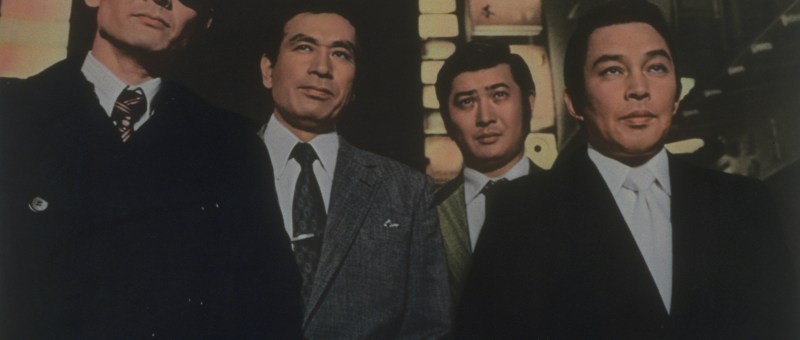
In a touch of irony, former yakuza Noboru Ando stars as a man who’s tried to leave the life behind but is pulled back into underworld intrigue when his former foot soldiers mount an ill-advised bid for revenge against the clan they feel betrayed them. After serving eight years in prison for participating in the last turf war, Egawa was given flamenco bar Madrid on the condition that he dissolve his family and attempt to go straight as a legitimate businessman. The Togiku gang has since gone legit and distanced itself from most of its old school yakuza like Egawa. But now a yakuza conglomerate from Osaka is moving in on their old turf and the Togiku want the Madrid back as a bulwark against incursion from the west which is why they’ve been sending the boys round to cause trouble in the bar. 

Egawa is the classic ex-gangster who wants to turn himself around but is largely unable to adapt to life in a changing society. He is technically in a relationship with a bar hostess who has a severe drinking problem in part exacerbated by his inability to get over his former girlfriend who left him and married the boss, Gohara, while he was in prison. His former foot soldiers attempt to convince him to get the gang back together and take revenge, resentful of having been used and discarded, but he tells them to let it go, that they’ve all got “honest jobs” and that they should try to live as best they can. Like him, the guys are ill-equipped to make new lives in the consumerist society and cannot move on from the post-war past. Hoping to engineer a turf war between the Osaka guys and Togiku, they kidnap a popular TV personality/pop singer (Minami Nakatsugawa) attached to a station which Togiku controls and frame a rival affiliated with the Osakans for taking her. 

This just goes to show the various ways in which newly corporatised yakuza have expanded their business portfolio, heavily participating in the entertainment industry moving beyond bars, clubs, and the sex trade into mainstream television and idol stars. Egawa’s old friend Yazaki (Akira Kobayashi) is his opposing number, just as caged but trapped within the confines of the new gangsterdom, reprimanded by his boss for raiding the rival studio’s offices and undoing the gang’s attempt to rebrand themselves as legitimate businessmen rather than violent street thugs. “I can’t stand being humiliated” he explains as Gohara points out he’s stepped right into their trap now giving the Osakans an excuse for retaliation. “The Togiku group is a defanged, domesticated dog” Yazaki barks, “I can’t pretend to be an obedient company employee forever and do nothing”. 

Neither man is able to progress into the new era of rising prosperity, both little more than caged animals thrashing around trying to break free but continually crashing into the bars. Just as Egawa’s old guys had tried to engineer a turf war hoping that the two gangs would take each other out and leave a vacuum they could fill, arch boss Shimamura (Tetsuro Tanba) flies above the city in a helicopter as the “worms fight among themselves” and observes the chaos below as he completes his silent conquest of the contemporary economy like some modern day Nobunaga of corporatised gangsterdom. 

Taking over the Togiku through a process of corporate infiltration and gradually ridding themselves of all the old school yakuza ill-suited to the shady salaryman life, the contrast between the world of cabaret bars and back street dives and Shimamura’s smart suits and helicopters couldn’t be more stark. A slightly sour note is struck by the use of a transgender assassin (Madame Joy) who performs a lesbian floorshow by day and kills by night while working with a bald sidekick who carries a parrot on his shoulder, her coldness bearing out the tendency of yakuza movies to associate queerness with sadistic savagery. Gosha rams his point home with the otherwise surreal scene of a pile of abandoned mannequins by a swamp that becomes a popular yakuza kill site homing in on the emptiness of their eyes and the uncanniness of dismembered bodies, mere empty shells just like the men who die in this literal wasteland. Egawa perhaps feels himself to be a man already dead long before being pushed towards his act of futile rebellion, somewhere between sitting duck and caged dog fighting for his life between the chicken coops of a moribund small-town Japan. Marching to a frenetic flamenco beat of rising passions and barely contained rage, Violent Streets leaves its former foot soldiers with nowhere to go but down while their duplicitous masters continue to prosper riding the consumerist wave into a new and prosperous future.


Violent Streets opens at New York’s Metrograph on Dec. 16 as part of Hideo Gosha x 3

Trailer (English subtitles)

Onimasa (鬼龍院花子の生涯, Hideo Gosha, 1982)

onimasaWhen AnimEigo decided to release Hideo Gosha’s Taisho/Showa era yakuza epic Onimasa (鬼龍院花子の生涯, Kiryuin Hanako no Shogai), they opted to give it a marketable but ill advised tagline – A Japanese Godfather. Misleading and problematic as this is, the Japanese title Kiryuin Hanako no Shogai also has its own mysterious quality in that it means “The Life of Hanako Kiryuin” even though this, admittedly hugely important, character barely appears in the film. We follow instead her adopted older sister, Matsue (Masako Natsume), and her complicated relationship with our title character, Onimasa, a gang boss who doesn’t see himself as a yakuza but as a chivalrous man whose heart and duty often become incompatible. Reteaming with frequent star Tatsuya Nakadai, director Hideo Gosha gives up the fight a little, showing us how sad the “manly way” can be on one who finds himself outplayed by his times. Here, anticipating Gosha’s subsequent direction, it’s the women who survive – in large part because they have to, by virtue of being the only ones to see where they’re headed and act accordingly.

Beginning with its end, Onimasa’s story finishes with the discovery of the body of his only biological child, Hanako (Kaori Tagasugi ), in 1940. Found bled out and alone in the red light district of Kyoto, the suspected cause of death is a miscarriage. Tragically, our heroine, Matsue, arrives only a couple of hours too late after having spent years searching for her younger sister. We then skip back to 1918 when Matsue was adopted by Onimasa and his rather cool wife, alongside another boy who later ran away. An intelligent girl, Matsue earns her adopted father’s respect but neither he nor his wife, Uta (Shima Iwashita), are particularly interested in the emotional side of raising children. Things change when one of Onimasa’s mistresses gives birth to his biological child who awakens a sense of paternal interest in the ageing gangster beyond rule and possession.

Onimasa’s behaviour is frequently strange and contradictory. Originally intending to adopt only a boy, he and his wife come away from a poor family with two of their children, only for the son to run away home. Having picked her out like a puppy in a pet store window, Onimasa views Matsue as an inalienable possession. When a man arrives and wants to marry her, he goes crazy assuming the man must have been sleeping with her behind his back (despite the fact that this man, Tanabe (Eitaro Ozawa), has only just been released from prison where Onimasa had himself dispatched Matsue to visit him). Exclaiming that Matsue is “his”, has always been “his”, and no one else’s, he forces Tanabe to cut off his finger yakuza style to swear Matsue’s honour is still intact. However, this need for total control manifests itself in a less than fatherly way when he later tries to rape Matsue and is only brought to his senses when she threatens to cut her own throat with a broken glass. Despite this act of madness which he tries to justify with it somehow being for her own good, Matsue remains a dutiful daughter to both of her adopted parents.

Matsue’s innate refinement and reserve contrast’s strongly with Onimasa’s loose cannon nature. Commenting on the long history of “honourable” cinematic yakuza, Onimasa embraces an odd combination of traditions in believing himself to be the embodiment of chivalry – standing up for the oppressed and acting in the interests of justice, yet also subservient to his lord and walking with a swagger far beyond his true reach. All of this contributes to his ongoing problems which begin with a petty clan dispute over a dogfight which sees a rival leaving town in a hurry only to return and raise hell years later. Similarly, when his boss sends him in to “discourage” strike action, the union leader’s reasonable objections which point out the conflicts with Onimasa’s doctrine of chivalry and imply he’s little more than a lapdog, have a profound effect on his life. Severing his ties with his clan and attempting to go it alone, Onimasa does so in a more “honourable” way – no longer will he engage in harmful practices such as forced prostitution no matter how profitable they may be, but old disagreements never die easy and it’s a stupid ancient argument which threatens to bring his old fashioned world crashing down.

Despite concessions to the bold new Taisho era which saw Western fashions flooding into traditional culture from Onimasa’s trademark hat to the record players and whiskey glasses clashing with his sliding doors and tatami mat floors, Onimasa’s world is a childishly innocent one where honour and justice rule. Despite this he often excludes his own behaviour – one minute turning down the offer of his rival’s woman to pay a debt with her body, but later attempting to rape a young woman who had been his daughter in a drunken bid for a kind of droit du seigneur. The times are changing, it’s just that Onimasa’s traditionalist mind can’t see it. Tragically trying to rescue his daughter from a situation it turns out she had no desire to be rescued from he eventually spies the writing on the wall and puts down his sword, defeated and demoralised. Tragically, it seems Hanako may have needed him still though her rescue arrives too late to be of use.

The Onimasa family line ends here, as does this particular strand of history under the darkening skies of 1940. Out goes Taisho era openness and optimism for the eventual darkness of the militarist defeat. Matsue, now a widow – her left wing intellectual husband another victim of her father’s mistakes rather than political stringency, remains the sole source of light in her shining white kimono and pretty parasol even as she’s forced to identify the body of the sister she failed to save. The life of Hanako was a sad one, trapped by her father’s ideology and finally destroyed by her own attempts to escape it. Fittingly, she barely features in her own tale, a peripheral figure in someone else’s story. Slightly lurid and occasionally sleazy, Onimasa is another workmanlike effort from Gosha but makes the most of his essential themes as its accidental “hero” is forced to confront the fact that his core ideology has robbed him of true happiness, caused nothing but pain to the women in his life, and eventually brought down not only his personal legacy but that of everything that he had tried to build. The “manly way” is a trap, only Matsue with her patience backed up by a newfound steel inspired by her cool mother, Uta, is left behind but is now free to pursue life on her own terms and, presumably, make more of a success of it.


Original trailer (no subtitles, NSFW)