Kaiju Guy! (怪獣ヤロウ!, Junichiro Yagi, 2025)

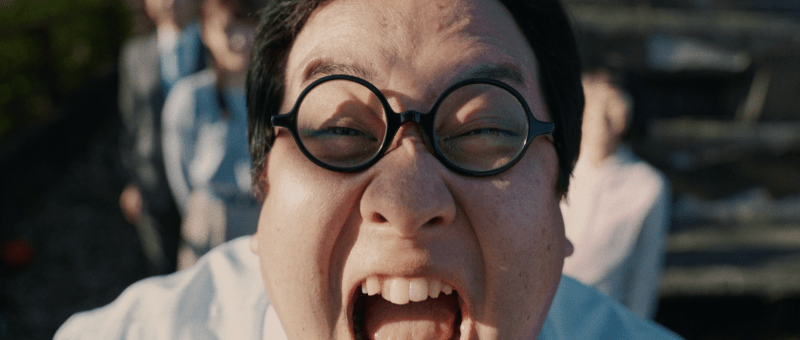
“This is my grand revenge against the world,” a frustrated civil servant insists while watching a giant avatar of himself destroying the town. Yamada (Gumpy) always wanted to make Kaiju movies, but now approaching middle age he’s given up most of his dreams and aspirations and lives a dull life working in the tourism division of the local council. An opportunity presents itself when he’s put in charge of a PR video for the town at the behest of its ultra-conservative mayor.

Junichiro Yagi’s Kaiju Guy! (怪獣ヤロウ!Kaiju Yaro!) has a meta quality given that it’s about a film designed to promote the local area, but there are many other parallels in play. The first would be Yamada’s unsatisfying life standing in for that of a corporate drone, while the mayor (Michiko Shimizu) is later cast as the villain precisely because of her reverence for “tradition” and is under the impression that changing anything would be a betrayal of her ancestors in a nod to the rigidity of local government. Yamada’s teacher had told him to smash through the constraints, though that’s something he’s only just beginning to find the strength to do. 

Though Yamada immediately suggests making a kaiju movie, he’s quickly shot down and reminded the mayor wants a conventional puff piece they can use to promote the town. Back in middle school, everyone had laughed at him for his DIY kaiju movie except his teacher who told him not to worry about what other people think and that those who challenge the status quo will always come in for attack or ridicule. Back then, the town of Seki had been the monster, though this time it’s supposed to be the victim that will eventually be saved. The mayor’s script had ironically been for a particular brand of hometown movie that’s become common in Japanese cinema in recent years in which a young person has their dreams crushed in Tokyo and rediscovers the charms of the place where they grew up after returning home in defeat. But there is something quite sad about the juxtaposition of Yamada thinking through the themes of the movie while riding his moped along empty streets which are flanked by rows closed shops.

The economic possibilities of the town becoming a tourist hotspot if the movie does its job might be one reason why many of the local businesses immediately pitch in to help besides a desire to display their hometown pride. Of course, most of them pull out when Yamada reimagines it as a kaiju movie even if he has a few supporters who think a kaiju movie might be fun and interesting way to sell the positives of Seki. In the course of making his movie, with the help of a grumpy, retired kaiju movie master by the name of Honda (Akaji Maro), Yamada discovers a way to use various local assets, such as filming sparks at the factory to create the fire-breathing effect and capturing the strange sound of a local bird for its roar. The heroes of the film become the local businesses supporting it who appear as a mini squad teaming up to fight the monster, while Yamada himself plays the marauding beast and “saviour” of the town going after the mayor and city hall to challenge their conservative insistence on tradition. 

What he eventually discovers is that even the mayor herself is oppressed by “tradition supremacy” and once had to give up her own hopes and dreams to conform to her family’s insistence on the way things should be done. Her abrupt decision to make the film may have been a reflection of her latent desire for change, both for herself and for Seki even as she constantly harps on about cormorant fishing and sword making which are apparently the two biggest draws. Ironically, the film completely fulfils its role as a PR movie for Seki capturing the small-town charms of the area along with its warm community spirit. Smashing through barriers with his kaiju movie, Yamada’s dull and grey existence is suddenly brightened through accessing his creativity and having his artistic desires validated by those around him. Not only are kaiju movies not naff or nerdy, but a source of fun that can bring the community together as well encourage visitors from outside if only to explore the kind of place that could have produced something so wonderfully unconventional.


Kaiju Guy! screens 30th May as part of this year’s Nippon Connection.

Trailer (English subtitles)

Images: © 2024 Team KAIJU GUY!
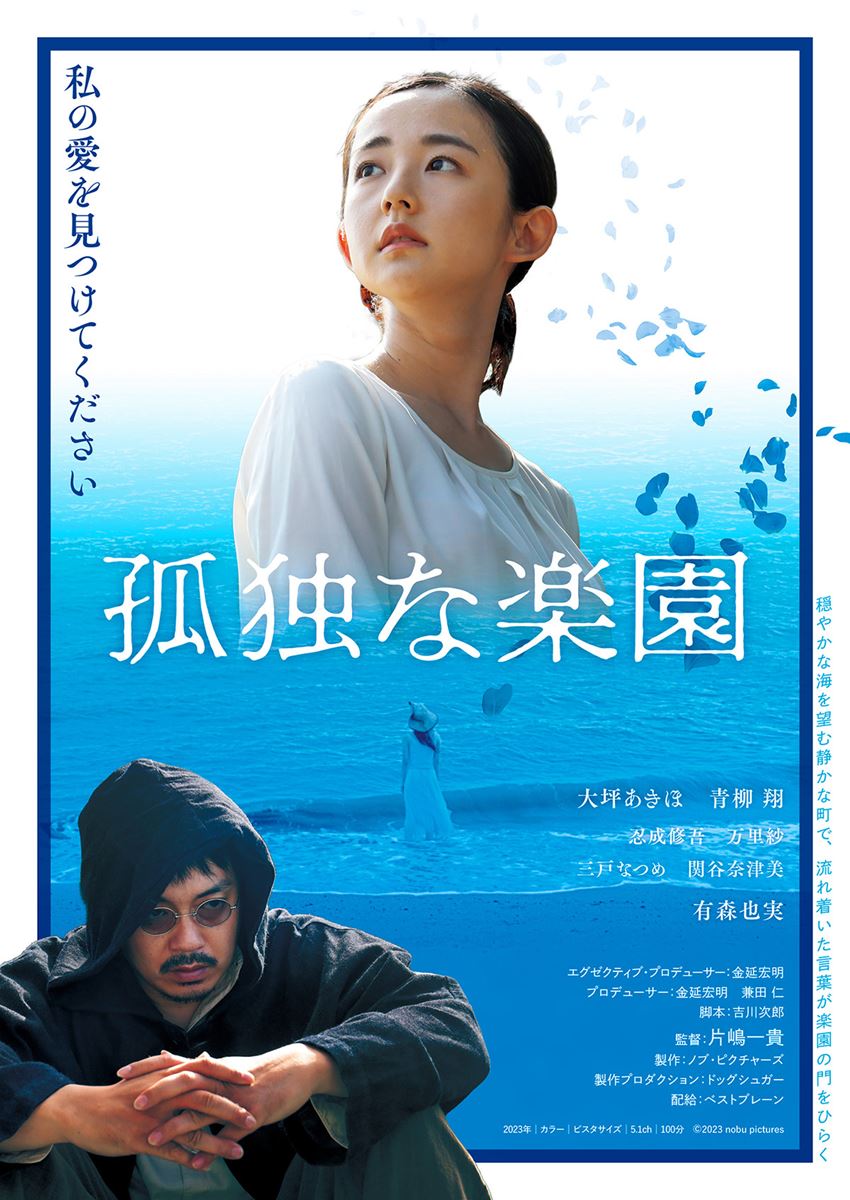
Paradise of Solitude (孤独な楽園, Ikki Katashima, 2024)

A blocked writer and a introverted young woman discover unexpected connection through accidental epistolary communication in Ikki Katashima’s poetic drama, Paradise of Solitude (孤独な楽園, Kodokuna Rakuen). Each wondering what exactly “paradise” means, the pair of them eventually find new ways to face the past and move on with their lives all while undergoing a vicarious romance with yearning at its centre that may or may not develop into something more “real” or else achieve its power solely through its lack of resolution. 

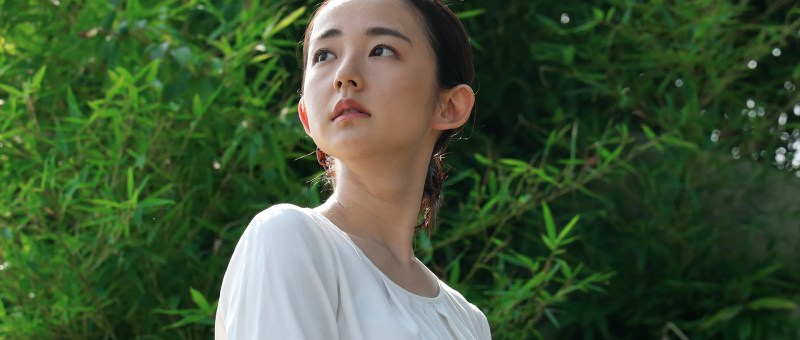
Yu Tsushima (Sho Aoyagi) is a writer struggling to meet his deadlines on a new serialised novel. Suffering with an illness, he’s retreated to his hometown and is now unable to leave because he experiences seizures on boats which understandably leaves him preferring not to get on them. One day, he receives an incredibly poetic love letter from an anonymous address only to notice a link to a porn site at the end of the email like a cruel punch line. Meanwhile, Ayame (Akiho Otsubo) is a nervous and introverted young woman working at a factory on the next island over. To begin with, it seems like she has suffered under the authoritarian rule of her aunt Tsukiko (Narimi Arimori), though as we later discover she may have meant well. 

Showing a talent for writing which sees her exploited by the factory boss, Ayame is tasked with writing a love letter on behalf of her friend Elena to a man she’s apparently only seen once yet has fallen hopelessly in love with. There’s something a little strange about this proposition, and not least because it seems like Elena may actually want this letter for herself and has unspoken (in Japanese, at least) feelings for Ayame. Elena is not the only non-Japanese person working at the factory at which it seems there may be some racist attitudes and behaviour among the employees, though there may be other reasons she feels isolated and otherwise drawn to Ayame.

But somehow, the letters find their way to Yu who is then “inspired” to write a new serial basically ripping off the anonymous correspondence but rewriting it in his own way while Ayame, having read his stories in a literary magazine, is not exactly angry yet confused and continues writing in order to complete this literary back and fore in crafting a new story together. Though the letters spin a tale of a lovelorn soul, it’s really the past that Ayame longs to revisit in the resultant trauma of her mother’s unexplained abandonment.

On top of the weird island drama, Katashima builds on the sense of uncanniness with a subplot about a cult-like local church and its own desire to reclaim Ayame thereby preventing her from fully confronting her past. Just as Yu is suffering from a medical condition, Ayame too experiences panic attacks when in contact with the church. Though it’s not always clear what is objectively true and what part of the story Yu is constructing from Ayame’s prose, parallel stories develop in which Ayame’s father hoped to liberate her mother’s soul though she eventually decided to chase paradise somewhere else. 

Because of her experiences, Ayame comes to believe that love within her has died, but perhaps begins to regain something of it thanks to her correspondence with Yu who becomes remorseful in learning that his actions may have been additionally unethical in encouraging Ayame to engage with her past trauma and risk dragging it all up again. He, meanwhile, begins to discover his creativity and overcomes the psychological dimensions of his condition by leaving his island and breaking out of his self-imposed isolation. The correspondence is like the message in a bottle discovered by Ayame’s mother which claimed to be from “paradise”, a hand across the ocean promising a better world over the horizon. Whether or not they find each other eventually in a more direct sense may not really matter, for simply having this invisible presence has enabled each of them to move past their internalised inertia and restart their lives. They may be trapped in a paradise of solitude, but on the other hand not quite alone and now a little more open to life’s possibilities rather than bound by its hurts and disappointments too frightened to leave the safety of their isolation in search of a more perfect paradise.


Paradise of Solitude screened as part of this year’s Cinema at Sea.

Trailer (no subtitles)

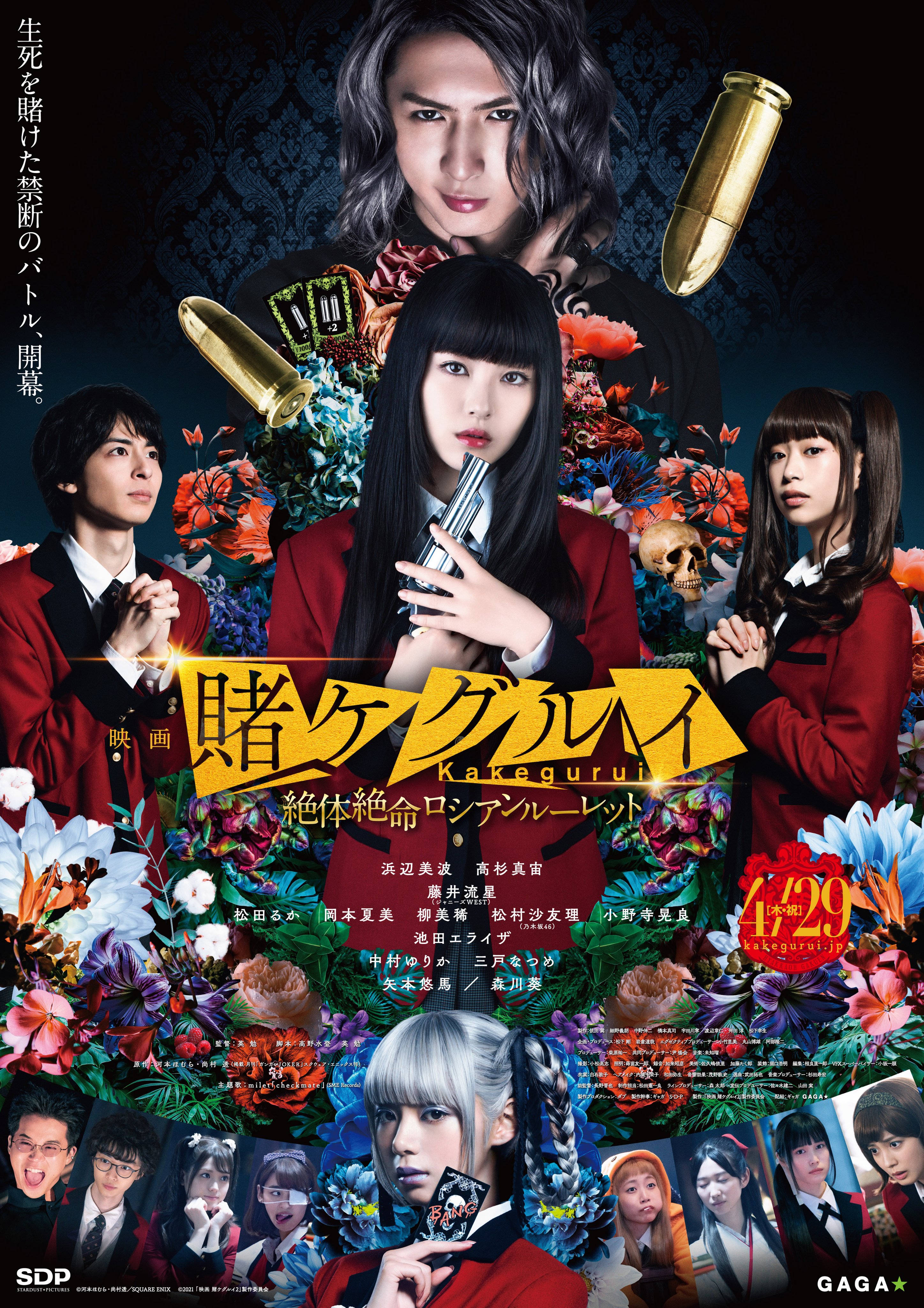
Kakegurui 2: Ultimate Russian Roulette (映画 賭ケグルイ 絶体絶命ロシアンルーレット, Tsutomu Hanabusa, 2021) [Fantasia 2021]

Closet revolutionary or compulsive gambler, Yumeko Jabami (Minami Hamabe) continues to be a thorn in the side of the Student Council in the sequel to hit movie Kakegurui, itself a sequel to a two-series live action drama adapted from the manga by Homura Kawamoto. Set as the opening expositionary narration explains at school for the elite Hyakkaoh Academy where social hierarchy is determined by skill in gambling, Ultimate Russian Roulette (映画 賭ケグルイ 絶体絶命ロシアンルーレット, Eiga Kakegurui: Zettai Zetsumei Russian Roulette) sees the rattled Student Council making a counterproductive and potentially ruinous decision in bringing back a previously exiled player in the hope of permanently neutralising Yumeko. 

Makuro Shikigami (Ryusei Fujii) was suspended some years ago for his part in the “House Pets’ Curse” which led to most of the school being demoted to its lowest, near untouchable ranks. At Hyakkaoh Academy, students are required to pay a tithe to the Council and those who can’t pay end up as “House Pets”, humiliatingly treated as cats and dogs. Yumeko’s friend Meari (Aoi Morikawa) fears she may have fallen foul of the curse herself having hit a lengthy losing streak, but it’s not until Shikigami begins twisting the situation to his advantage that Yumeko is snared by his manipulative trap. 

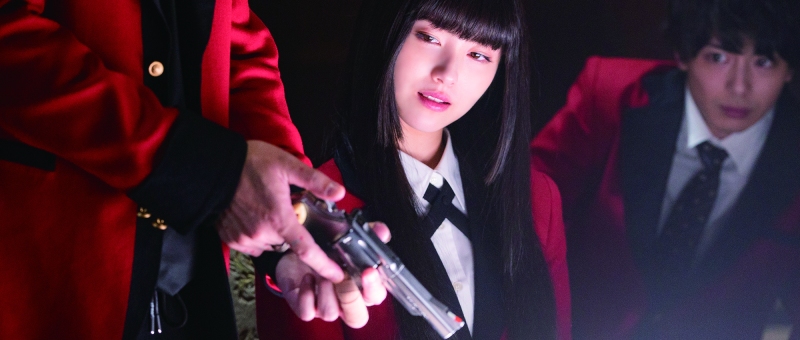
Yumeko, meanwhile, is in the middle of a depressive episode largely down to her reluctance to take part in the school’s upcoming sports’ day. Just as in the previous film her long game was better cakes in the cafeteria, her end goal here is trying to get the event cancelled by whatever means possible. In any case, we also witness another dark side to the oppressive rule of the Student Council as a demoted Maeri finds herself in a literal chain gang forced into hard labour building the facilities for the sports festival in what seems to be a minor dig at preparations for the Olympics. Yumeko and Meari are, however, responsible gamblers in that they refuse to bet on other people’s safety or at least refuse to be complicit in games which are designed to inflict harm or cruelty on others. 

As Shikigami explains in his opening monologue, the skills needed for gambling are strategy, ability to read your opponents, and a killer instinct. This is something Yumeko knows well, she plays players not games and sees straight through Shikigami realising that his crazed psychopathy is an act to mask the meticulous quality of his external manipulations. Nevertheless she is also caught out by her unwillingness to put her friends in danger, willingly sacrificing herself instead. The Student Council too are seemingly caught off guard little realising that Shikigami presents just as much of a threat to their authority as Yumeko and is equally uncontrollable with far fewer principles. Still as Student Council President Kirari (Elaiza Ikeda) ominously reflects, “there must be chaos before order”. 

In any case, they find themselves awkward allies in facing off against Shikigami in the promised game of Russian roulette mediated through a card game but played for real. The Student Council leaves itself surprisingly vulnerable in a loophole which allows House Pets to challenge them directly overruling all of the other school regulations, while Shikigami too falls victim to his own arrogance never quite expecting to be challenged having achieved his primary goals of seizing control of the school via the Council. The only way to beat him is to play him at his own game, disrupting his self-serving plotting and tendency to cheat in an insult to the art of gambling while undermining his confidence in his own intellectual superiority. “Only a twisted mind could beat you” he says of Yumeko believing himself to be a twisted mind though as it turns out perhaps not quite twisted enough. 

Temporarily siding with authority in order to put a stop to Shikigami’s authoritarian potential, Yumeko does not so much challenge the system as work around it while protecting herself and her friends from Shikigami’s machinations. What she defends is in a sense gambling itself, rejecting Shikigami’s intention to subvert it to his own advantage. Maintaining the same absurdist, manga-esque aesthetic as the first film complete with cartoonish CGI pupil shrinking, slick onscreen graphics, and even this time a random musical number, Hanabusa significantly ups the ante with bomb threats and unexpected Satanism while leaving the door open for the next instalment with Yumeko’s final instruction to “Bring on the Madness”. 


Kakegurui 2: Ultimate Russian Roulette streamed as part of this year’s Fantasia International Film Festival

International trailer (English subtitles)

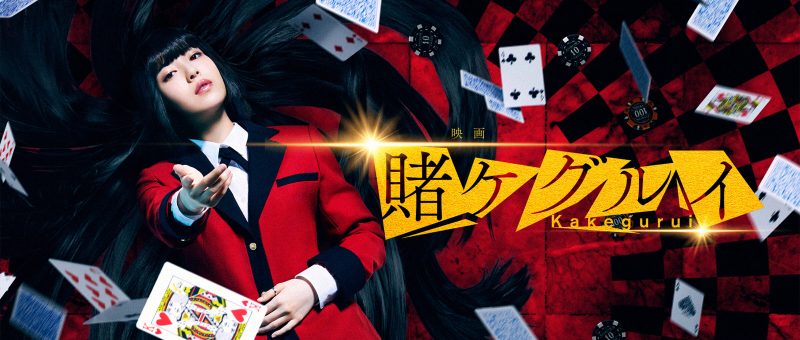
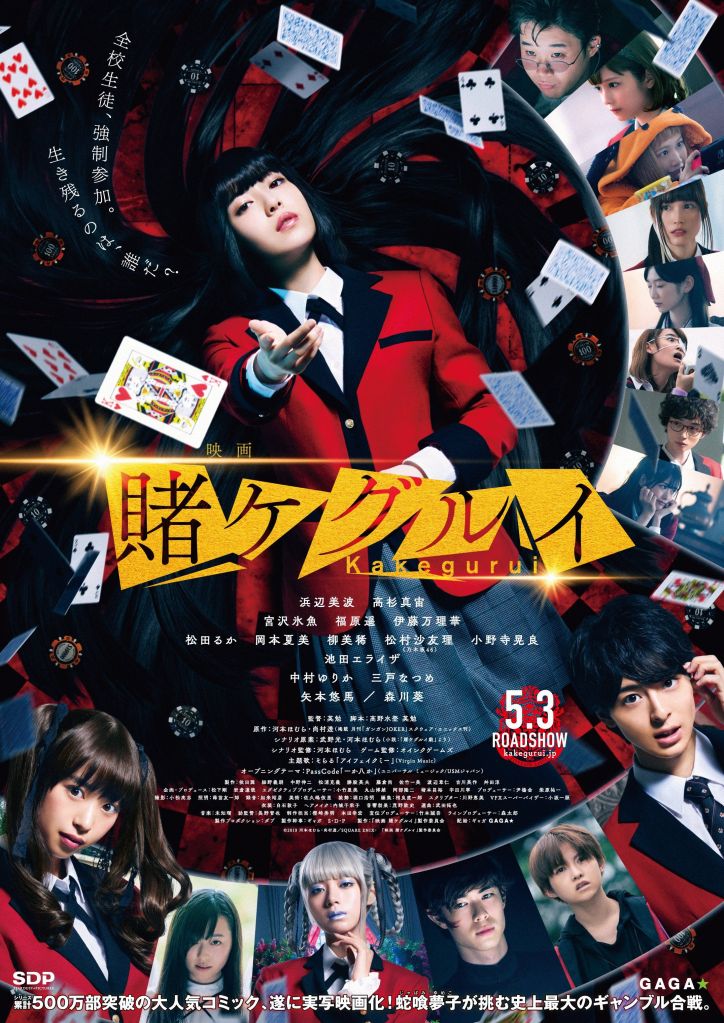
Kakegurui (映画 賭ケグルイ, Tsutomu Hanabusa, 2019)

Gambling, the ultimate act of faith or the height of anarchic genius? Based on the hit manga which has already been adapted as a popular TV anime, Kakegurui (映画 賭ケグルイ) is the sequel to two seasons of a live action TV drama set in a school where hierarchy is decided not by grades or by fists, but by prowess at the gaming tables. Those who lose so badly they bankrupt themselves become a kind of subhuman underclass, tied up like dogs and routinely humiliated, while the Student Council becomes a stand in for an oppressive social order ruling over all and enforcing the law with an iron hand. 

Into this high stress environment walks Yumeko Jabami (Minami Hamabe), a transfer student to the elite Hyakkaou Private Academy determined to bend its rules to her own advantage. Meanwhile, Student Council President Kirari Momobami (Elaiza Ikeda) is forced to deal with a new and unexpected threat – The Village, a small cult made up of students who have rejected the system, dropped out to live a hippy lifestyle in the grounds, and refuse to participate in “meaningless” games of chance. Their priest-like leader, Amane Murasame (Hio Miyazawa), once beat Kirari at cards becoming something like a god of gambling, but lost his zeal for the game after losing the only thing he ever cared about. 

Where he opposes the system passively yet pointedly, Yumeko rebels in her own, fiercely individualistic way by superficially conforming, becoming a top gambler, but only because she is exercising a free choice to do so. She plays for kicks alone, and generally wins because she isn’t stressed enough about losing to let it bother her. This individualist streak makes her a hidden threat against Kirari, but one that might in itself be an interesting gamble for the infinitely bored Student Council President. 

While Yumeko’s individualism threatens to unbalance the system, The Village presents a collectivist threat, agitating wholesale revolution and an end to the oppressive rule of the Student Council which renders losers inhuman. Yet there’s an essential irony in The Village’s creepy monotony that stands in stark contrast to Yumeko’s seeming conformity but insistence on her own freedom. Your life’s your own, she later explains, it’s annoying if people try to manipulate it. In this instance she’s talking not about the “life plans” handed out by the Student Council, but the egotistical desire to “save” the lives of others without considering if they want them saved or if you’re merely infringing on their personal freedom in attempting to make choices for them based entirely on your own value system. 

Murasame perhaps bet something he shouldn’t have and technically won, but ended up losing anyway which is what has made him turn against gambling. Yumeko, meanwhile, believes that the only way to be truly free to entrust yourself to luck and destiny. That is, however, somewhat disingenuous, because what Yumeko excels at is mind games, essentially manipulating those around her in order to win. Yumeko plays players, not cards, and is rarely played herself. Unlike Murasame’s righthand woman Arukibi (Haruka Fukuhara), she doesn’t care that much what people think. Arukibi, meanwhile, is desperate for approval and is playing her own game just to get someone’s attention which makes her a volatile, if easily manipulated, opponent.

Essentially, Murasame wants freedom outside of the system where Yumeko has found it within, but her philosophy is perhaps the more dangerous in that it proposes total freedom that has no regard for the systems of governance. Then again, maybe this is all a long con to get better cakes in the cafeteria, merely gaming the system rather than actively undermining it. Nevertheless, for Yumeko life is risk, rebelling against an oppressive social order through the anarchic individualism of living by “chance”. Living in a society as highly regimented as this is a high stakes game, but you can’t win if you don’t play, and you need to play smart. That’s the peculiar irony of life at Hyakkaou Private Academy where the Student Council literally owns your future but you can win it back by playing them at their own game. Bet your life, win your freedom Yumeko seems to say but she still makes sure to bring cake for everyone, not just the “winners” or the privileged few. 


Screened as part of the Japan Foundation Touring Film Programme 2020.

International trailer (English subtitles)