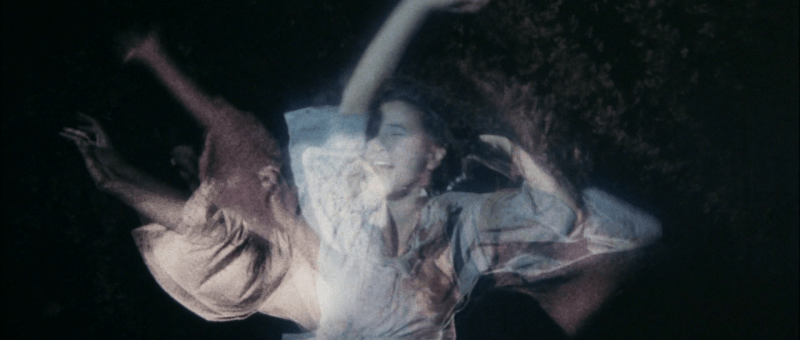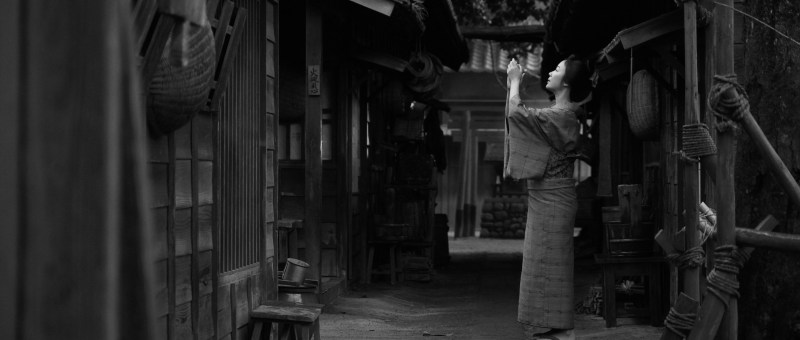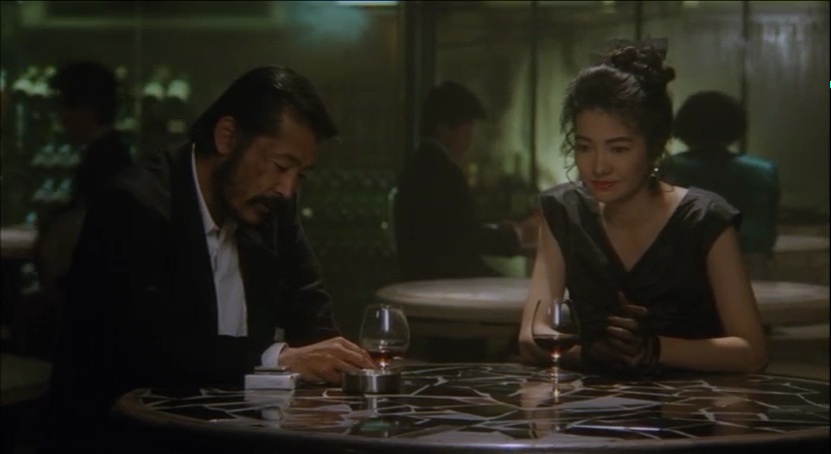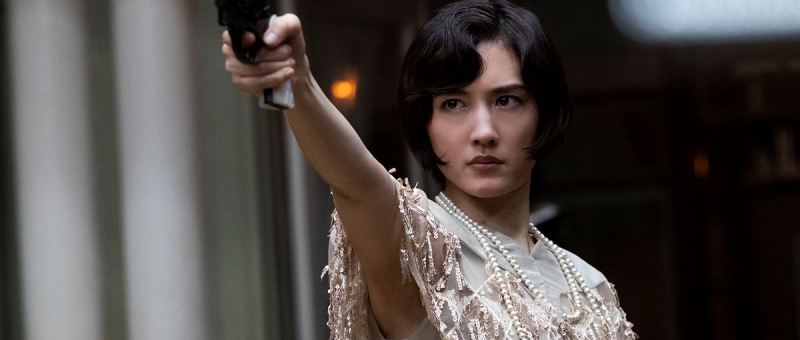

Samurai Hustle Returns (超高速!参勤交代 リターンズ, Katsuhide Motoki, 2016)

At the conclusion of 2014’s Samurai Hustle, it seemed that samurai corruption had been beaten back. Corrupt lord Nobutoki had got his comeuppance and the sympathetic “backwoods samurai” Naito was on his way home having found love along the way. Of course, nothing had really changed when it comes to the samurai order, but Naito was at least carving out a little corner of egalitarianism for himself in his rural domain. 

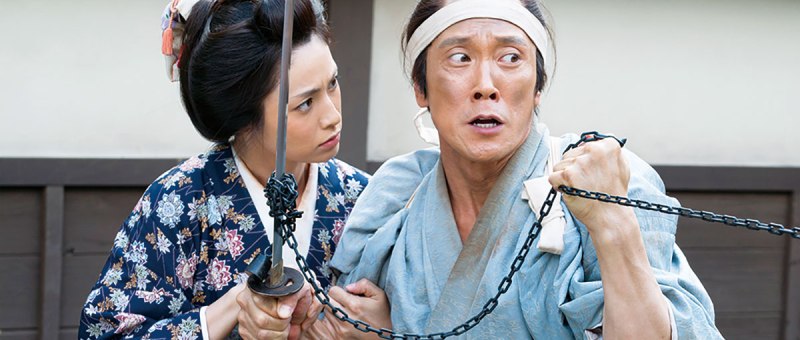
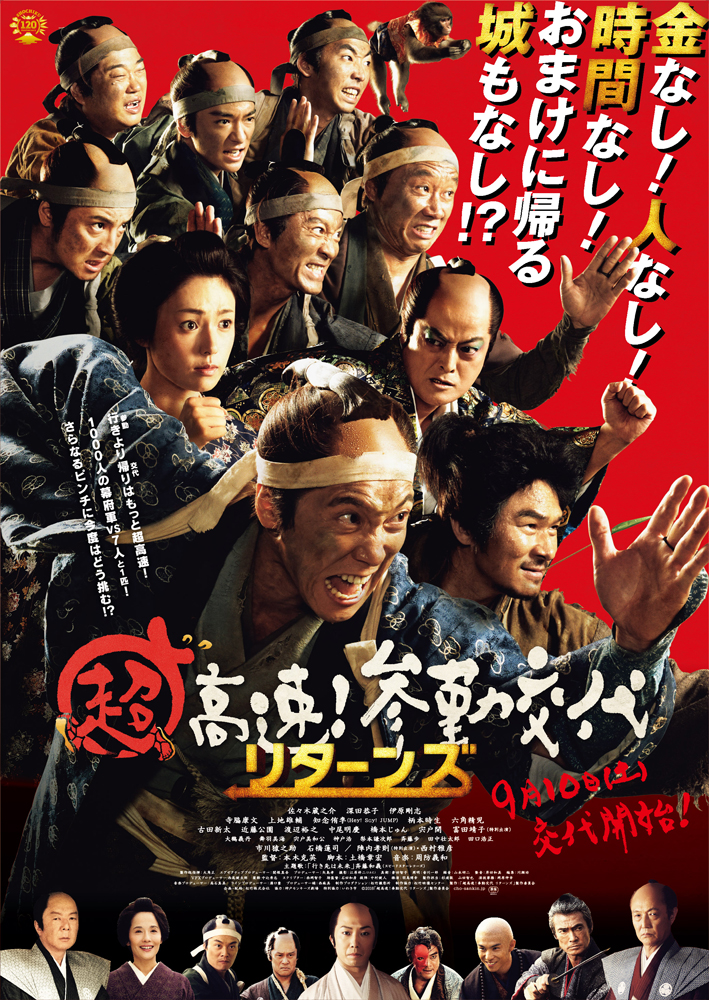
The aptly named Samurai Hustle Returns (超高速!参勤交代 リターンズ, Cho kosoku! Sankin kotai returns) picks up a month later with Naito (Kuranosuke Sasaki) taking a rather leisurely journey home in preparation for his marriage to Osaki (Kyoko Fukada) only to receive news that there has been a “rebellion” in Yunagaya. Predictably, this turns out to have been orchestrated by none other than Nobutoki who has been released early from his house arrest thanks to his close connections with the shogun but has been humiliated at court and is otherwise out for revenge with a slice of treasonous ambition tacked on for good measure. Just as in the first film, but in reverse, Naito and his retainers must try to rush home to get there before the imperial inspector arrives or else risk their clan being disbanded. 

Meanwhile, the shogun is absent at the wheel after having decided to resurrect an old tradition abandoned because of its expense and inconvenience to make a pilgrimage to Nikko. In an interesting parallel, the farmers are uncharacteristically upset with Naito, blaming him for the destruction of their fields because he wasn’t there to protect them. Naito also feels an additional burden of guilt given that, having run flat out all the way to Edo, he took his time coming back leaving his lands vulnerable to attack while he now risks losing the castle. Nobutoki wastes no time at all looking for various schemes to undermine him while secretly plotting to overthrow the shogun and usurp his position for himself. 

As in the first film, the battle is between samurai entitlement and the genial egalitarianism of Naito’s philosophy. “The real lords of Yunagaya are people like you who are one with the soil,” he tells the farmers, while Nobutoki sneers that “lineage rules supreme in this world, inherited wealth breeds more”. It doesn’t take a genius to read Nobutoki’s machinations as a reflection of his insecurity, that he invests so much in his rights of birth because he has no confidence in his individual talents. Naito counters that it’s the people around him that matter most, “people are priceless. Friends are priceless,” but Nobutoki rather sadly replies that people will always betray you in the end. Even the shogun eventually agrees that “anger brings enemies, forbearance brings lasting peace” but treats Nobutoki with a degree of compassion that may only embolden him in his schemes.

“Nepotism has endangered the shogunate,” the shogun ironically sighs apparently lacking in self-awareness even if beginning to see the problems inherent in the samurai society but presumably intending to do little about them. “No government should torment its people,” Naito had insisted on boldly deciding to retake his castle but even if this particular shogun is not all that bad, it’s difficult to deny that his rule is torment if perhaps more for petty lords like Naito than for ordinary people or higher-ranking samurai. Naito struggles to convince Osaki that she is worthy of his world and only finally succeeds in showing her that she has nothing prove and love knows nothing of class. The people of Yunagaya are impoverished but happy, satisfied with the simple charms of pickled daikon unlike the greedy Nobutoki whose internalised sense of inadequacy has turned dark and self-destructive. 

Then again, Naito is still a lord. He obeys the system out of love for his clan and a genuine desire to protect those around him but otherwise has little desire to change it actively even if his quiet acts of transgression in his closeness with the villagers and professions of egalitarianism are in their own way a kind of revolution in a minor rejection of the shogun’s authority to the extent that the time allows. Nevertheless, with his return journey he once again proves the ingenuity of a backwoods samurai getting by on his wits as he and his men race home to save their small haven of freedom from samurai oppression from the embodiment of societal corruption.


Trailer (no subtitles)

The Homeless (無宿 やどなし, Koichi Saito, 1974)

Two men are released from prison on the same day. One, dressed in a 1920s-style white suit and straw hat, tries to befriend the other, in black kimono and geta, but he ignores him. Soon, they arrive at a fork in the road. The man in the kimono walks down a well worn grass path cut between the fields while the man in white, looking back and a little disappointed, continues along the modern roadway making his way towards civilisation.

In some ways, the heroes of Koichi Saito’s The Homeless (無宿 やどなし, Yadonashi) are embodiments of past and future. Jokichi (Ken Takakura), the kimonoed man in black, chooses the path of vengeance. On his release from prison, he learns that his gang leader older brother has been killed while his sister was sold to a brothel. He goes there to find her, but is told that she is already dead. The madam says she died of a chronic illness and that she did for her what she could but treating such a cruel disease is only throwing good money after bad. Sakie (Meiko Kaji), a sex worker who appears to have a childlike quality and possibly impaired mental state, tells a different story claiming the madam had Jokichi’s sister killed for reasons she doesn’t explain but may have more to do with the drama going on with Jokichi’s gang than a desire to cut costs and her losses. 

Gen (Shintaro Katsu), meanwhile, seemingly chooses the path of prosperity. He returns to his wife, Ume (Murasaki Fujima), who is a member of a moribund theatrical troupe, and asks her to return to him what he believes is a treasure map marking the location where his father saw a ship sink during the Russo-Japanese war that may be filled with gold. On finding out Jokichi used to be a diver, Gen becomes determined to bring him onto his mission but Jokichi is set on revenge firstly on a man called Senzo (Noboru Ando) he thinks killed his sister and then on whoever ordered the hit on his brother. This bad news for Gen who realises that if he achieves his vengeance, Jokichi won’t be available to help retrieve the gold because he’ll be in prison so he starts by warning Senzo that his past’s about to catch up with him. 

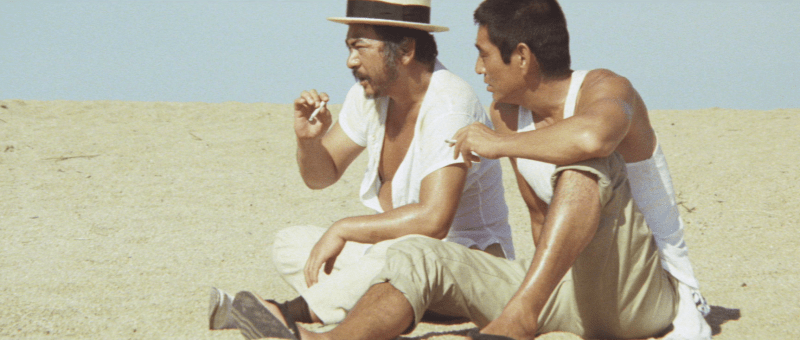
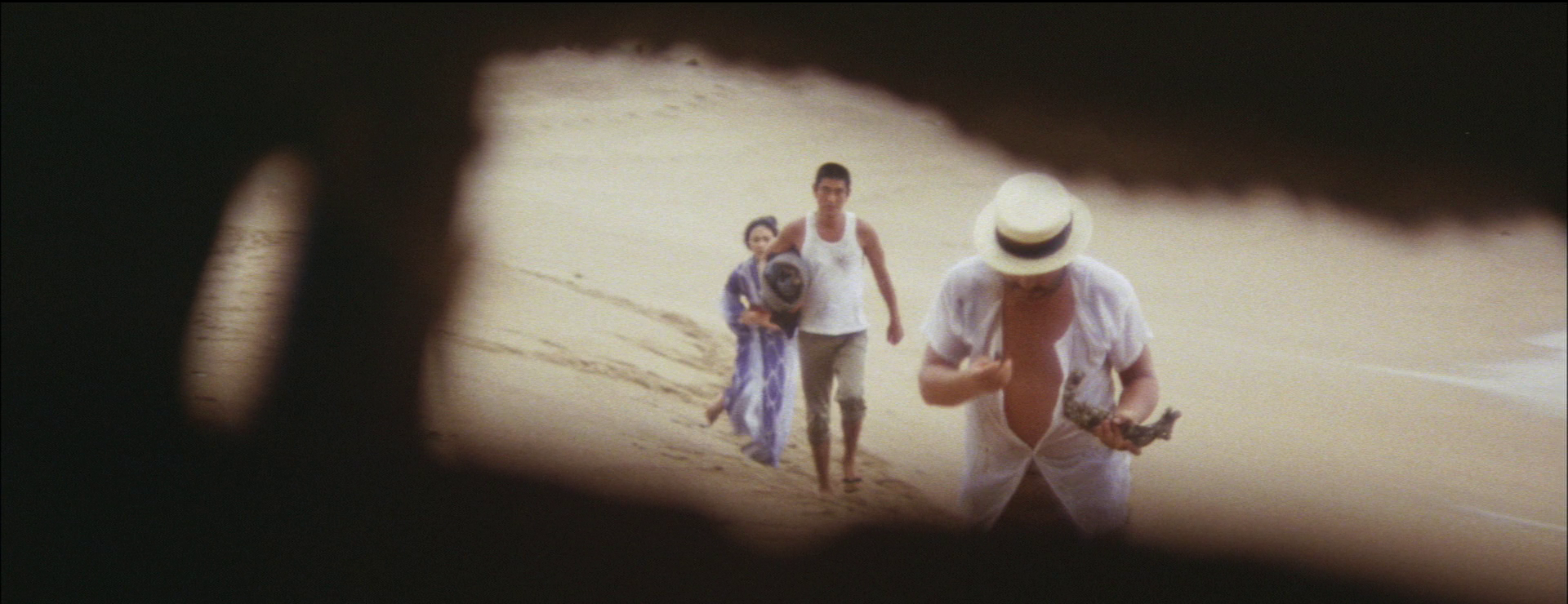
But it’s also Gen that helps Jokichi escape from the rival gang by suggesting he help rescue Sakie from her indentured servitude as sex worker. Childlike and ethereal, Sakie claims not to remember where she was from and has a simple desire to see the sea which represents to her a kind of freedom while for each of the men it may in fact form a kind of border they will eventually be backed up against and unable to escape. Though Sakie develops a fondness for Jokichi, and then begins to love Gen after he ends up taking care of her along the road, the three form a relationship that seems more fraternal or perhaps even forged on the homoerotic tension between the two men who light their cigarettes one from the other and finally find a home on an idyllic beach where they devote themselves to the search for buried treasure.

Sakie may say that the real treasure is her new life of freedom and warmth, but the hint of riches the two men find is itself rooted in warfare and imperialism which are the same forces by which they were each displaced amid the rising militarism of the 1930s. The three of them remain homeless in this environment, unable to fit into the changing society and by degrees exiled from it. An early title of the film was apparently Jingi no Okite (仁義の掟) which means “the law of honour and humanity” and that is in a way what Jokichi is bound by in his desire for vengeance, while Gen is clearly an anarchistic force unable to submit himself to authority and lusting after a more prosperous modernity. Sakie meanwhile is powerless as a woman with few rights, sold into sex work and technically a fugitive from the gang-backed brothel that owned her contract.

As beautiful as the beach is, we have the feeling that in some senses the three of them are already dead and living in their temporary paradise. Indeed, the past eventually catches up with them as if these three homeless fugitives cannot be allowed to survive in resistance to an authoritarian culture. Their existence is elegised by the beautifully composed cinematography along with the childlike rapport between the two men and the sense of domesticity which arises between the trio before reality bites and even their beachside idyll is invaded by the forces of darkness.


Original trailer (no subtitles)

The Inferno (地獄, Tatsumi Kumashiro, 1979)

No one can escape from their sins according to the ominous voiceover that opens Tatsumi Kumashiro’s loose reimagining of Nobuo Nakagawa’s Jigoku, The Inferno (地獄, Jigoku). Then again, some of these “sins” seem worse than others, so why is it that a woman must bear a heavy burden for adulterous transgression while the man who killed her seemingly suffers far less? Perhaps hell, in this case, is born of conservative social attitudes more than anything else besides the darker elements of the human heart such as jealousy and romantic humiliation. 

Those negative emotions are however as old as time as reflected in the folk song which opens the film about a young couple, though not the young couple currently onscreen, who are eloping because their incestuous desire is not accepted by the world around them. The connection between the couple onscreen might also be deemed semi-incestuous for Ryuzo (Ken Nishida) has run off with the wife of his brother, Miho (Mieko Harada), who is carrying (what she claims to be) Ryuzo’s child. Unpei (Kunie Tanaka), the brother, finally catches up with them and shoots Ryuzo with a shot gun. Miho tries to escape, but her foot is caught in a bear trap and Unpei decides to leave here there to die, while Ryuzo’s jealous wife Shima (Kyoko Kishida) later does the same. The body is found by local hunters, and in a strange miracle the baby is born from Miho’s dead body while Miho is dragged to hell for her “sins” where she learns that her baby has been born in hell but remains above. Not knowing what to do, the locals give the baby, Aki, to Shima but she obviously doesn’t want it and so swaps it with a foundling thanks to a weird old man, Yamachi, coming to love this other child, Kumi, as a daughter. 

This is quite literally a tale of the sins of the parents being visited on the child, the 20-year old Aki (Mieko Harada) later lamenting that she has no identity of her own and is solely a vehicle for her mother’s revenge. Though she apparently ends up in the same rural town “by chance” knowing nothing of her past, she resembles her mother physically and discovers she has some of her talents such as an innate ability to play the shamisen. What she also has is a trance-like lust that bewitches the men around her, though this is in a sense complicated by the fact it does not seem to be of her own volition so much so as a manifestation of her mother’s curse. Thus she ends up sleeping with the vulgar younger brother of the man she actually likes, Suchio, who in truly ironic fashion is actually her half-brother. She describes herself as having her mother’s “tainted blood”, while Shima later adds in a degree of class and social snobbery revealing that Miho had been a geisha Unpei unwisely fell for and was unworthy even of being a maid in their upper-middle class household let alone the wife of the second son. 

For all of her resentment, Shima is otherwise a loving mother to her sons and even to Kumi whom she is able to accept as a daughter in a way she would never have accepted Aki who was after all an embodiment of her husband’s betrayal. Colder and more austere than Aki or Miho would seem to be, she clings to the mummified body of her husband kept in a secret vault as a secret triumph over her humiliation laughingly remarking that now he’s hers forever and will never cheat on her again. Even if she left Miho to die, Shima does not particularly resist her fate well aware that her son has fallen for his half-sister (which probably wouldn’t have happened if she hadn’t swapped babies) and merely hoping Aki can be convinced to leave town alone rather than plotting any more drastic action. 

But the inferno of hell envelopes them all, crying out for retribution as the cycles of repressed or inappropriate attractions repeat themselves. Kumi realises that her love for her brother, Suchio, is actually not inappropriate because they are not related after all but is then consumed by her own hell in realising that he does in fact love his biological half-sister but is uncertain if he accept damnation in order to pursue it. What she, Miho, and Aki are punished for is female sexual desire aside the arguably taboo qualities of its direction though in hell it seems men are punished for this too, or more accurately for giving in to it, in a way they often aren’t in the mortal realm. “They cut their own flesh and blood for the vision of a woman in the future,” the guide explains as the brothers and Unpei literally climb over each other reaching for an illusionary representation of Aki/Miho at the top of the tree. In the mortal world they do something similar, grappling with each other, mired in competitions of masculinity as mediated through sexual dominance, conquest, or humiliation. 

Yet Aki’s path to hell is also a confrontation with her femininity and her search for an identity as a woman by reuniting with the birth mother who died before she was born. Kumashiro’s visions of hell are terrifying and outlandish, a giant land in which the dead are thrown into a huge meat grinder they then have to push themselves. For the sin of eating meat, others are condemned to spend eternity eating human flesh. Miho has lost all sense of reason and is incapable of recognising her daughter seeing her only as another source of food but there is a kind of rebirth that takes place even if it’s only once again to be born in the underworld. Surreal and harrowing, Kumashiro’s eerie land of giant demons and shuffling corpses does indeed suggest that as the opening titles put it we all live our lives alongside hell.


Original trailer (no subtitles)

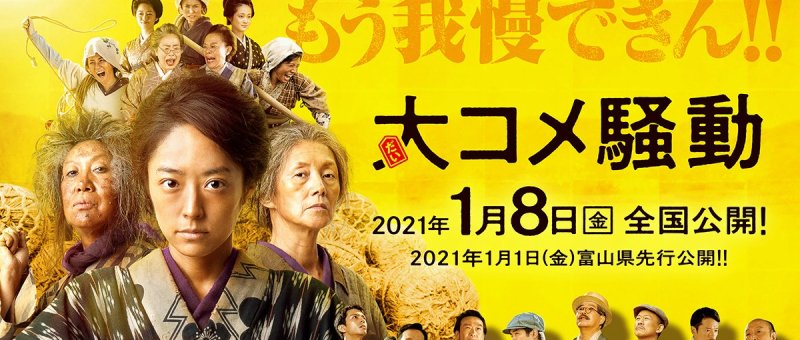
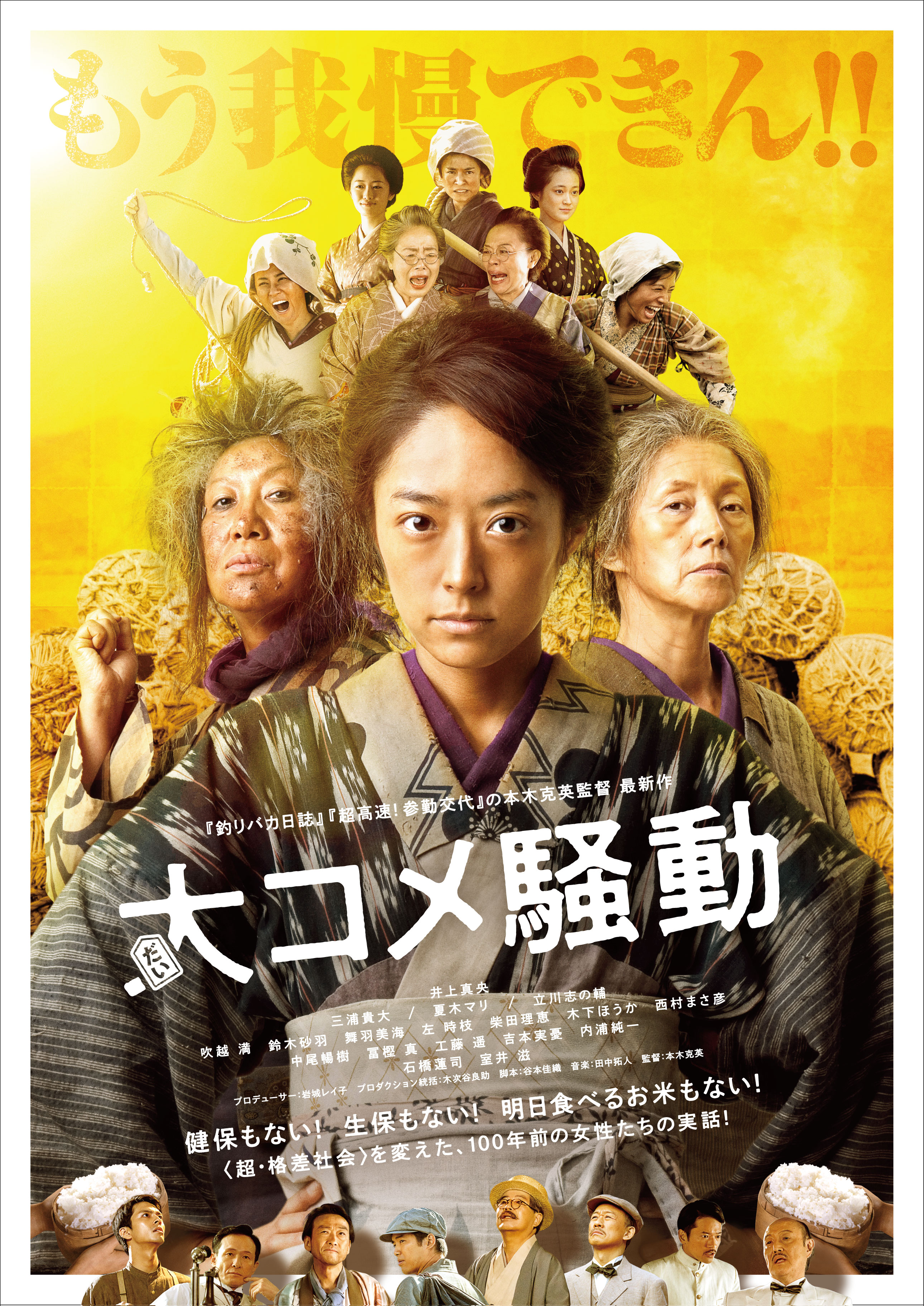
Angry Rice Wives (大コメ騒動, Katsuhide Motoki, 2021)

“Even if women try to do something, nothing will change” a condescending husband insists cautioning his wife not to take part in any more protests lest he lose his protected status and the family its source of income. Set in the middle of the Taisho era, Angry Rice Wives (大コメ騒動, Dai Kome Soudo) dramatises a small moment of revolution in which the resistance movement organised by a community of women towards the spiralling cost of rice sent shock waves through a changing society and in its own way provoked a change of course in an increasingly capitalistic society. 

Beginning in April 1918, the small fishing village of Toyama sees an exodus of its young men who must spend the off-season when the catch is low working other jobs in order to make ends meet, This necessarily means their wives and families are left behind and must make do with what they themselves can earn in doing menial jobs such as transporting rice and the little their husbands might be able to send before their return. A farmer’s daughter who married into the fishing community, Ito (Mao Inoue) is one of the few literate women in the village and looked to as a kind of oracle reporting the contents of the morning paper to the other wives who are keenly interested in the continually fluctuating price rice which seems set to rise still more with news that Japan plans to send troops to Siberia. 

As the voiceover relates, with the catch so low rice is the only form of sustenance available but prices have already exceeded what most of the women can earn in a day leaving them unable to feed their feed their families and giving rise to increasing discontent with the inequalities of the contemporary social order. Taking drastic action and led by eccentric old woman Kiyonsa (Shigeru Muroi), they stage a rebellion by intercepting their locally grown rice in order to stop it being sent to Hokkaido which is reported in the newspapers as an “uprising”. The term is indeed a little grand for what actually took place, but it does at least seem to spark a spirit of rebellion echoing around the country even if nothing much as changes in Toyama. Buoyed by a sense of wider support, the women continue their protests merely asking for the rice merchants to sell at a more reasonable rate (which they are perfectly capable of doing) while decrying the immorality of the obvious profiteering by corrupt authorities including local bigwig Kuroiwa (Renji Ishibashi) who are deliberately stockpiling rice to push the price up while planning to sell it to the government for a hefty price to feed their troops. 

Kuroiwa is entirely unsympathetic to the women’s predicament while the local police chief Kumazawa (Junichi Uchiura) believes himself indebted to him and is therefore entirely under his thumb. Neither of them think the women are much of a threat, Kumazawa randomly arresting a middle-aged man close to several of the women the rationale being as the husband of one puts it that women can never achieve anything no matter how hard they try but a man’s involvement in such rebellious activity would be cause for concern. Similarly, Ito is often told that her education is of no use, partly because the other women feel inferior for not having any, but struggles to find the self-confidence to standup to the corruptions of lingering feudalism owing to her liminal status as a non-native villager despite having given birth to three children there. Even so she is often looked to as a local problem solver and potential successor to Kiyonasa as leader of the village women if only she could learn to embrace the courage of her convictions. 

The children, by contrast have no such qualms, Ito’s young son Soichiro directly telling the profiteering proprietress of the rice store Mrs Washida (Tokie Hidari) that it’s her own fault another child stole food because if she hadn’t insisted in pricing her customers out to the point that they were starving she would never have needed to steal. “What exactly has capitalism done for us?” an opportunistic visitor from the workers party asks but receives short shrift from the cynical Kiyonsa who agrees they should rebel but is non-plussed by the flummoxed canvasser’s admission that he has no real plan for what do afterwards. Washida plays divide and conquer, pitting the women against each other and tempting even Ito with offers of under the table rice deals to feed their starving families if only they back down but though the solidarity of the women is temporarily ruptured it is never truly broken as they stand together to fight for fairness in the face of the Kuroiwas and Washidas of the increasingly capitalistic society. Their resistance eventually forces the government to backdown, realising they can’t simply ignore the plight of society’s poor or take their complicity for granted while attempting to starve them into submission. 


International trailer (English subtitles)

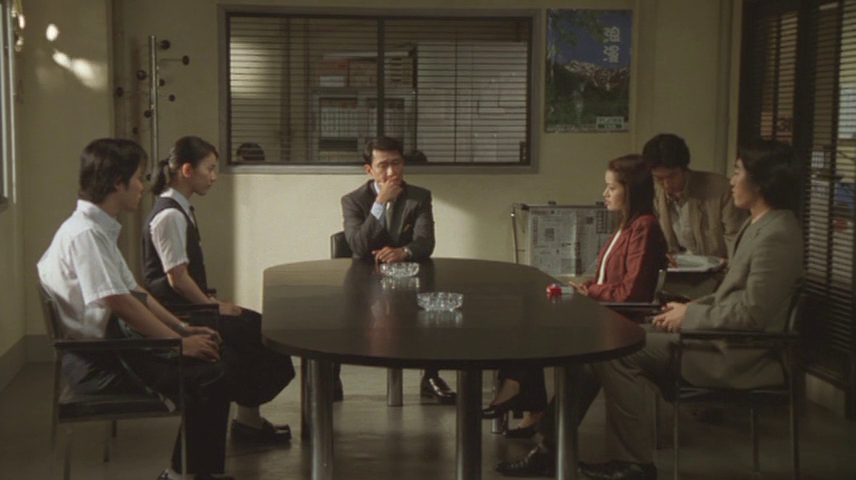
Darkness in the Light (日本の黒い夏ー冤罪, Kei Kumai, 2001)

The summer before the sarin gas attack on the Tokyo subway in 1995, a similar incident had taken place in the small town of Matsumoto, Nagano. A panicked provincial police force quickly homed in on the man who had first reported that something was wrong as the likely culprit, though he was later proved innocent when, following the subway attack, Aum Shinrikyo claimed responsibility for the trial run in Matsumoto revealing that they intended to test out the gas while killing a series of local prosecutors they assumed were about to rule against them in a land dispute raised by townspeople who objected to the cult’s intention to set up a new branch in the area. 

Kei Kumai’s films had often dealt with difficult subjects and particularly with those who suffered under a false accusation, but Darkness in the Light (日本の黒い夏ー冤罪, Nippon no Kuroi Natsu – Enzai) was also personal to him as he knew the man concerned, Kono renamed for the film as Kanbe (Akira Terao), and found it absurd that such an ordinary person could have planned and carried out a deadly chemical attack literally in his own back yard. Essentially putting both mass media and the police force on trial, he frames the tale through the eyes of two earnest high school students who are making a documentary about the way Kanbe was treated for their high school film club. 

The obvious point is that if the Matsumoto police force, which the film claims had become aware that Aum possessed sarin gas, had conducted a better investigation then there is the possibility that the subway attack might have been prevented. The teens want to know what went wrong and how an ordinary citizen can suddenly be made public enemy number one overnight with no physical evidence linking him to the crime. What they discover through interviewing the only local TV news outlet that did attempt to conduct an investigation and contradict the reports being issued by the police, is a dangerous collusion between police and media that is supported by the business interests that underpin the news industry. Most outlets simply print press releases or unofficial leaks from the police without fact checking them. Sasano (Kiichi Nakai), the TV station editor, no longer does this because a previous false report implicating a teenage boy in a murder he had not committed had resulted in his suicide.

Nevertheless, his junior associate, Koji (Yukiya Kitamura), has his mind less on the truth than the scoop. He thinks they should publish the information they get as quickly as possible otherwise other outlets will publish first. Koji is also the most certain that Kanbe is guilty, believing they are being overcautious in their reporting and will pay for it later. The station’s managers and sponsor committee feel much the same, directly telling Sasano that he should refrain from creating his own news and instead publish what everyone else publishes. They also imply that public opinion has now in a sense become “the truth” and his reporting should be in line with it, rather than the other way around with responsible media as an arbitrator of objective facts which have been thoroughly researched and confirmed. 

Sasano airs an alternative view but admits he does so more in the interest of ratings than he does for truth or justice realising that there is some currency in going against the grain and that if Kanbe turns out to be innocent after all they will come out of it much better than everyone else who published the police press releases unquestioningly. Even so, they too become subjects of harassment with relentless calls from locals decrying their irresponsible attempt to undermine the police and let a mass killer go free. Despite the care they had taken in investigating the information presented to them, they too had broadcast falsehoods such as the “expert” testimony that any old fool could make sarin gas by chucking some stuff in a bucket and standing back, only learning later from a university professor that it requires a high level of chemical knowledge, specialist equipment, and professional protective gear not available to a man like Kanbe who did have various chemicals in his home but only the kind easy to buy for use in harmless hobbies such as photography and ceramics. 

Even they have cultivated close relationships with people in the police who feed them information on investigations, Sasano having a personal connection with the officer in charge of the case, Yoshida (Renji Ishibashi). Appearing somewhat conflicted, Yoshida faces pressure from his superiors to pin the case on Kanbe despite beginning to believe he is likely innocent not least because he does not give in to their pressure tactics and confess. Kanbe asks to be allowed to speak to witnesses who have supposedly given the police information on him, as if aware the police may simply be making things up to prod him into confessing while they otherwise break an agreement to restrict interviews to two hours given that Kanbe was also injured in the gas attack and is in poor health. His original reluctance to talk to the police because he was seriously ill and incapable of answering their questions seems to have annoyed Yoshida and given him the impression he must be hiding something as does his sensible decision to consult a lawyer. As Kanbe is interviewed as a “witness” rather than a “suspect” his lawyer is not present in the room allowing police to get away with what is quite clearly an abuse of their power. 

Sasano points out that an Olympic ski event was also taking place nearby so the police were keen to keep the investigation under wraps, while their later reluctance to change tack when Kanbe refused to confess is nothing more than an attempt to protect their reputation fearing that they would look foolish in the press for having painted Kanbe as the villain when he wasn’t. Their plan was to arrest Kanbe anyway and suggest that he was involved with the cult while acknowledging that they had planned the attack to end the land dispute. Kanbe becomes a hapless victim of circumstance, an everyman misused by an authoritarian institution trying to maintain its own grip on power rather than fulfilling its responsibility to keep the people safe by ensuring the real culprits were prevented from committing further crimes. 

Kumai comes in hard for mass media, exposing the network that sees local information bounced back through Tokyo head offices, the collusion between police and the press that leaves reporters unwilling to rock the boat for fear of losing access, and a general indifference for the welfare of individuals caught up in the real events they report on. Despite the youthful eyes of his protagonists whose untainted idealism gives the newspaper men pause for thought, a slightly dated approach displays little of the intensity or visual flair present in some of Kumai’s earlier work while falling back on sentimental cherry blossom imagery if offering a poignant opportunity for reflection on a system in urgent need of repair as Kanbe prepares to go on with his life leaving the past far behind him. 


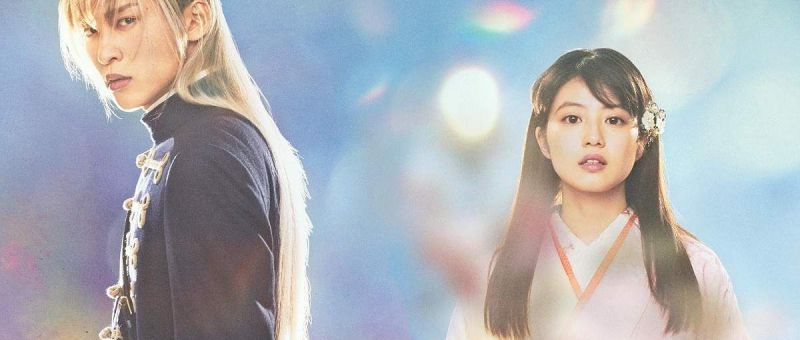
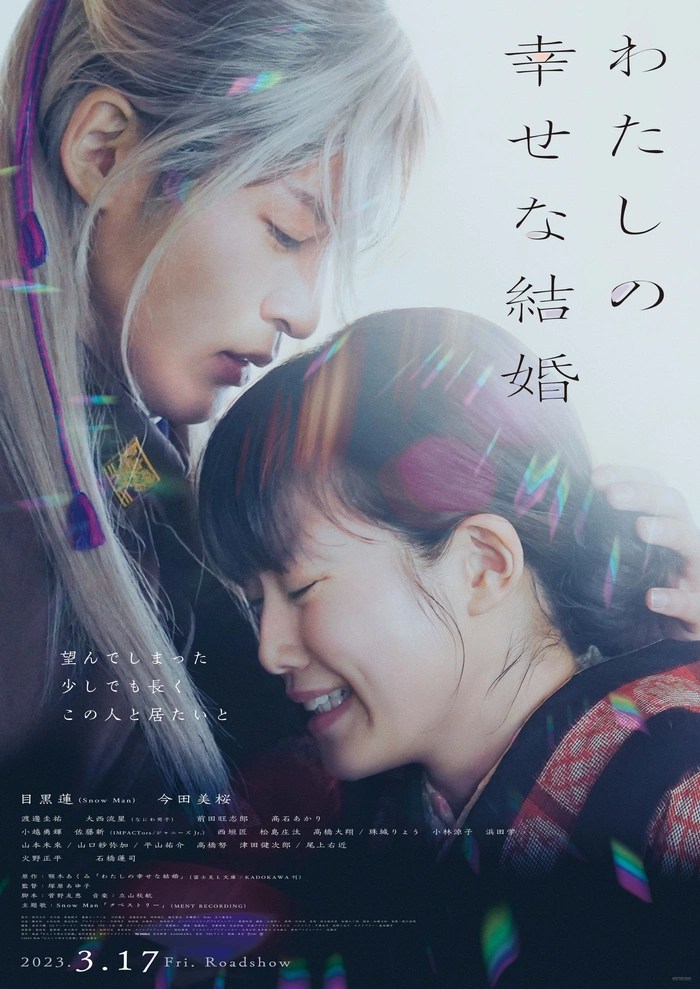
As Long As We Both Shall Live (わたしの幸せな結婚, Ayuko Tsukahara, 2023) [Fantasia 2023]

A young woman with chronically low self-esteem learns to love herself after bonding with a taciturn nobleman in Ayuko Tsukahara’s adaptation of the fantasy romance light novel series by Akumi Agitogi, As Long As We Both Shall Live (わたしの幸せな結婚, Watashi no Shiawasena Kekkon). Set in an alternate version of the late 19th/early 20th century in which the nation is ruled by an emperor who has the ability to foresee the future and leads a series of prominent clans of superpowered soldiers against “aberrations” who wreak havoc in the lives ordinary people, the film is effectively a kind of Cinderella story only the fairy godmothers are a kindly housekeeper a shady underground sect with the power to manipulate people’s minds. 

In any case, Miyo (Mio Imada) was born into a noble house the members of which have the ability to manipulate the wind though sadly she appears to have been born “powerless” and is bullied by her step-mother and step-sister who treat her as a servant. At 19, she learns she’s to be married off and is excited about finally escaping her abusive family home but also wary that it might not make much difference because her potential husband, Kiyoka Kudo (Ren Meguro), is said to be cruel and violent. All three of his matches have fled the house in under three days though being so used to mistreatment Miyo is sure that it will just be a matter of adjusting to her new circumstances. 

What she discovers is that Kiyoka doesn’t seem all that bad just a bit aloof and direct in his manner of speech. Nevertheless, she continues to believe that she isn’t good enough to marry him because she doesn’t have any magical powers and is convinced he will call off the engagement when he finds out. Meanwhile, she bonds with housekeeper Yurie (Mirai Yamamoto) after breaking protocol by helping out around the house for something to do though it is perhaps a bit odd that someone from such an apparently wealthy family has only one servant and seems to lead an incredibly simple life devoted to his role as a soldier helping to keep the aberrations in check especially now that the emperor is dying and someone has apparently released the pent up souls of fellow aberration fighters who died horribly and are filled with dangerous resentment.

Many of Miyo’s self-esteem issues are down to the way she was treated by her family and having lost her mother at two years old though there is obviously parallel in her literal “powerlessness” and the lack of agency that is afforded to her in having been kept a prisoner in the family estate only to be traded off in marriage by a father apparently out for whatever he can get for such a “mistake” of a daughter. It’s perhaps a slight failing in the narrative that she turns out to have powers after all rather than simply beginning to accept herself in the comparatively warmer environment of Kiyoka’s home even if it might also be a little awkward that her self-love is born of feeling loved by Kiyoka and to a lesser extent Yurie and immediately has her pledging to give her life for him if only he should ask it. 

For his part, Kiyoka is also undergoing something of a transformation in that it turns out he also felt estranged from his mother and is actually kind at heart just incredibly awkward and taciturn. The reason he didn’t bond with any of his previous suitors seems to be that he objected to their insincerity and the nonsense that goes along with being a member of the aristocracy like the concept of arranged marriage in itself, later taking Miyo’s family to task for their treatment of her claiming that he doesn’t really care about her social status or whether or not she has any powers. In any case, it’s love that helps her overcome her “powerlessness” even if she uses her newfound inner strength for someone else rather than herself, taking control over and her life regaining self-confidence as someone worthy of love, respect, and basic human decency not to mention happiness. A post-credits trail hints at a potential sequel or even series expanding on the franchise’s rich world building but for now at least it seems as if Miyo has found her happy ending, finally able to embrace life on her own terms rather than feeling as if she needs to make a mends for her existence.


As Long As We Both Shall Live screened as part of this year’s Fantasia International Film Festival.

Original trailer (no subtitles)

The Sea of Genkai (任侠外伝 玄海灘, Juro Kara, 1976)

Juro Kara was an avant-garde playwright and theatre practitioner whose work was a part of the Little Theatre Movement which rejected conventional naturalism and prioritised the physicality of the actor over text and dialogue. Though he performed as an actor in films by other avant-garde filmmakers such as Shuji Terayama and Nagisa Oshima, he directed only one film. By these standards, the The Sea of Genkai (任侠外伝 玄海灘, Ninkyo Gaiden: Genkai Nada), a co-production with the Art Theatre Guild, may seem surprisingly conventional, but is also highly unusual not only in ATG’s filmography but also in its subversions of the yakuza film. 

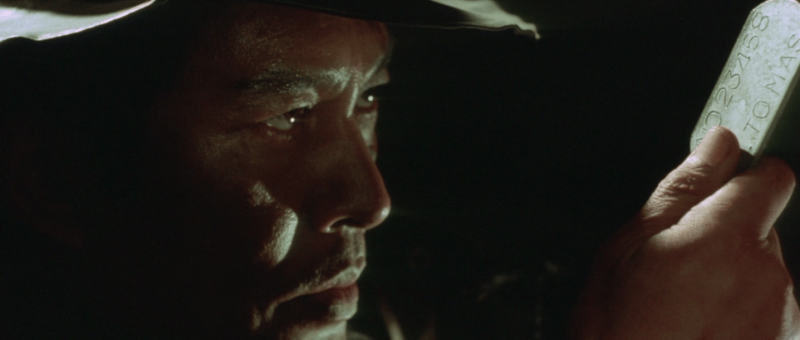
The Japanese title is prefaced by “ninkyo gaiden” which makes it sound like a spin-off to a ninkyo eiga or chivalrous gangster movie, which turns out to be incredibly ironic because there is no chivalry or honour here only cruelty and exploitation. Set in the port of Shimonoseki where boats leave for Korea, the film follows dejected petty yakuza Kondo (Noboru Ando) as fate finally catches up with him. He and his boss Sawaki (Jo Shishido) were once students together and took a job in Busan dealing with the corpses of American soldiers killed in the Korean War. Sent to deliver dog tags to widows, Sawaki spits in a distraught woman’s face and then attempts to rape her, only there is another couple in her home and the man soon wakes to challenge him. Kondo and Sawaki are then drawn into a brutal and ugly fight during which Kondo knocks out the man while Sawaki rapes the widow. The other woman then threatens them with a knife, taking back the dog tag only for Sawaki to pounce and strangle her. Sawaki then flees the scene confused by what he’s done, but Kondo stays behind and rapes the second woman’s corpse before leaving her for dead. 

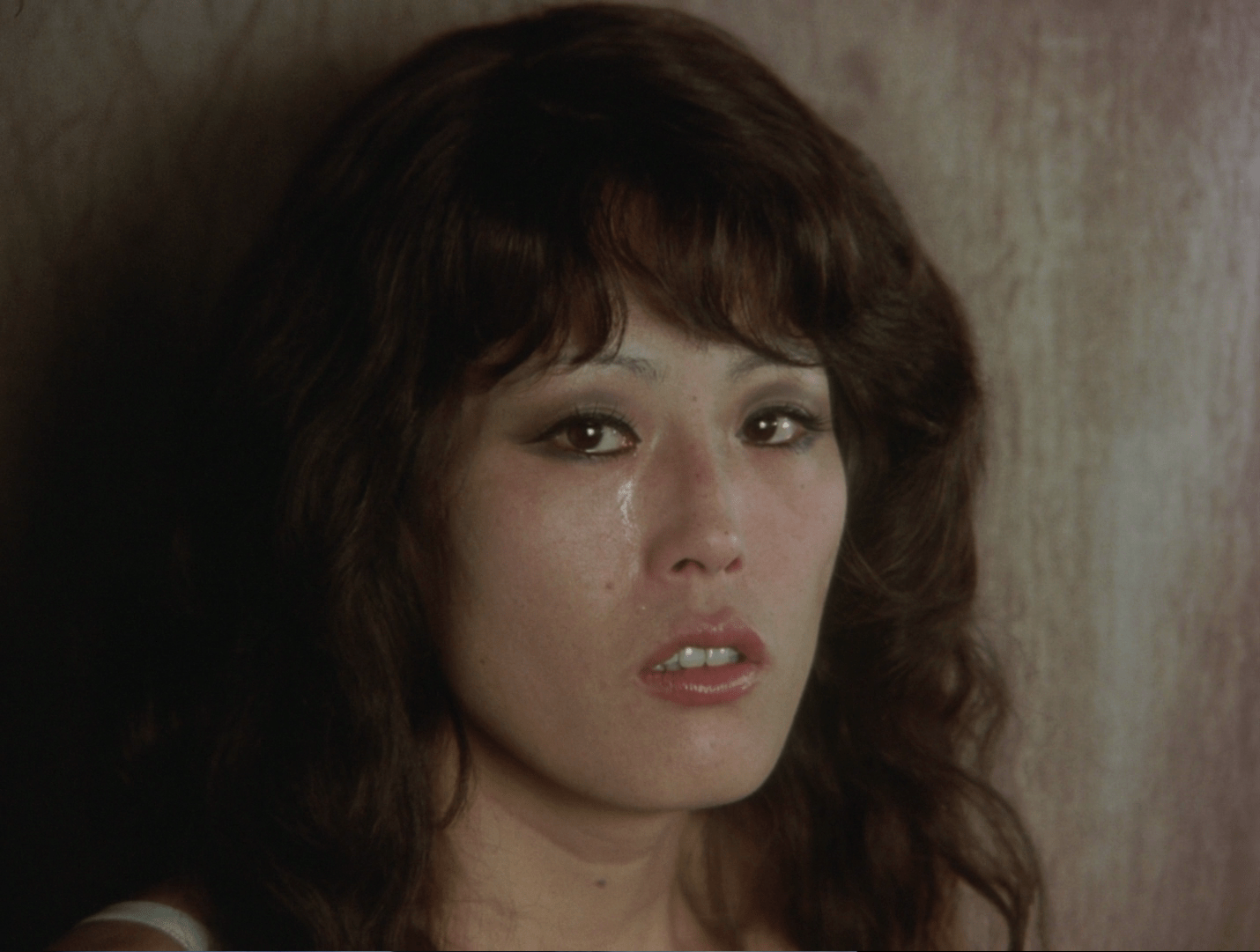
Kondo later relates that he’s been unable to sleep with women ever since his experience of necrophilia in Korea in 1951. Kura often cuts back to the bundle of dog tags Kondo has been keeping all this time which hang by his window like a wind chime. He watches them sway and hears them jingle with the violent motion of Sawaki’s raping the woman, hanging that of, presumably, a random man around the second woman’s neck as he in turn rapes her body. He later finds a woman who reminds him of the one he raped while dead among a cohort of those he’s in the process of sex trafficking who has unwittingly put on one of the dog tags like an ironic necklace while taking a bath in his apartment on the invitation of his more sensitive associate Taguchi (Jinpachi Nezu). On catching sight of Kojun (Reisen Ri), he’s struck by a literal flashback that is a clear homage to Henri-Georges Clouzot’s Les Diaboliques as he watches a “dead” woman rise from a bath. Later he rapes her too, presumably the first (though not the last) “living” woman he’s had sexual contact with in 25 years. 

The dog tags take on a still more ironic relevance in the Korean song which plays over the opening titles and is sung frequently by the trafficked women. The song is sweet and innocent, narrated by a woman who is preparing a “flower garland” for someone that she loves, but its imagery is subverted in Kondo’s grim necklace of dog tags taken from fallen men. Even Sawaki describes him as someone who has been dead for 20 years while preparing to sacrifice him to curry favour with their creepy Tokyo boss Tahara (Taka Ohkubo) who permanently wears black gloves on both hands even while shirtless, while Kondo later sings a song characterising himself as a “black dog” who never stood a chance in this broken world of ruined dreams. Penned by Kura himself and performed by Ando, this song more clearly reflects his absurdist dialogue style in its deeply melancholy imagery as Kondo fully succumbs to his image of death. 

Kondo’s actions come to emblematise the continued violence inflicted on the bodies of Korean women by Japanese men from the colonial era onwards. The woman from the bath, Kojun, suffers continually throughout the film and is later forced to perform in strip shows by the Sawaki gang. She is clever, and fierce, but the world is all against her and the only answers that she ever gets as to why her “uncle” forced her to stowaway on a smuggling boat to Japan only further deepen the wounds inflicted by a deeply corrupted, imperialistic patriarchy. Kojun develops a fondess for Taguchi because he is the only man who doesn’t try to rape her and in fact saves her from being raped though later said to be impotent and rejected by the other gang members for his refusal to participate in their despoiling of the Korean women. Bloodstained underwear becomes a symbol of sexualised violence countered only by the plain white pairs Kojun later buys for Taguchi after replacing her own ruined clothing.  

She and Taguchi attempt to protect themselves by bringing the receipts, threatening to release the smuggling account books and expose a host of dodgy dealings if the Sawaki gang come for them, but in the end there is no escape. Taguchi finds himself wading through oil-soaked waters with his dreams in ruins before finally breaking the chain though it’s unclear if it will really free him. Bleak beyond measure in its deeply tragic denouement, Kara’s intense drama offers no respite from its nihilistic world of violence and exploitation and leaves us quite literally floundering in a dark sea of inevitable corruption. 


Trailer (no subtitles)

꽃목걸이 – 이영숙 (1972)

(꽃목걸이 = “flower necklace”. There doesn’t seem to be an official romanisation of singer 이영숙 (李英淑)’s name, but it does appear in a few places as “‘Iyeongsuk”, or “Lee Young Sook”. A contemporary romanisation would render it as “Lee Yeong-suk”)

Okiku and the World (せかいのおきく, Junji Sakamoto, 2023)

“Where does Edo’s poop go?” it’s a question a child might ask but the rest of us somehow gloss over. In the modern world, if we were suddenly confronted with a lot of problematic poop, we’d have to pay someone to come and take it away and that person might then get paid twice for selling it on. In old Edo, however, manure merchants had to buy their raw materials (well, aside from those they could produce themselves) in the hope of selling them on to peasant farmers desperate for fertiliser. Junji Sakamoto’s Okiku and the World (せかいのおきく, Sekai no Okiku) takes a wry look at this circular economy in the dying days of the feudal era and in the end asks us if a samurai’s shit is really any better than anyone else’s.

In a sense it might be, given that historically samurai are better fed but even they are beginning to feel the pinch these days. Sakamoto opens in 1858 which is the year the Treaty of Amity and Commerce between Japan and the United States was signed opening the door to trade with other nations after two centuries of isolation. It is also 10 years before the Meiji Restoration and the eventual abolition of the samurai. Okiku (Haru Kuroki) is just one woman struggling with this moment of social change. Her samurai father Genbei (Koichi Sato) has been kicked out of his clan for challenging corrupt authority, so now she supports him teaching calligraphy at a local temple while the pair live in a rundown tenement in a forgotten corner of the city. 

Fittingly enough, Okiku’s name and the film’s title with it is written in hiragana, but the character usually used to write it is that for chrysanthemum which is also of course a stand in for Japan itself. Genbei muses on what the world is, defining it as an expanse of skies and lamenting that those who have only just realised that the world is vast are ironically unable to look past their small corner of it amid the chaos of the bakumatsu era and what he describes as continual “unrest”. But then politics have little relevance to those living in this particular corner of the world or for those who quite literally shovel the shit day in day out just to be able to shit themselves. 

Chuji (Kanichiro) and Yusuke (Sosuke Ikematsu) are manure men who purchase excrement from local communities and fine samurai houses to sell on to provincial farmers, transporting it by boat to a silo out in the country they occasionally bulk out with mud seeing as they’re paid by weight. Yusuke rails against his subjugation, revealing that at one particularly low point he was asked to wipe a samurai’s bum while otherwise constantly humiliated by their doorman who really does seem to think his shit’s better than anyone else’s. But as Yusuke points out, samurai or common man everyone eats and shits even if he describes himself as a literal bottom feeder who is nevertheless essential to the Edo-era economy. Without men like him, the samurai wouldn’t eat either because they’d have no crops to buy. Chuji may berate him for being all mouth and no trousers, but times are changing. Even he later mounts resistance by flinging his produce at a now powerless samurai. 

Okiku meanwhile has been rendered mute, her voice silenced by the cruelties of the feudal order leaving her struggling to rediscover her place. She has fallen in love with Chuji, but they think they come from worlds even as they witness them merging and realise there is only one vast expanse under an unending sky. In a decade’s time, it won’t mean anything that Okiku is a samurai’s daughter and Chuji an illiterate peasant but for the moment every step towards each other is transgressive and requires courage in breaking an unthinkable taboo. Sakamoto homes in on the muddiness of this “hopeless shitty world”, the unending drudgery and nihilistic futility of feudalistic life but finally offers his shit-shovelling heroes a new sense of possibility amid the ever expanding vistas of a new society. Presented as a series of black and white vignettes each except the last ending in a moment of vibrant colour, the film finally discovers a sense of serenity as Okiku prepares to reenter the world having finally come to understand her place within it.


Okiku and the World screened as part of this year’s Nippon Connection.

International trailer (English subtitles)

Break Out (行き止まりの挽歌 ブレイクアウト, Toru Murakawa, 1988)

Good cop or bad cop? A maverick detective crosses the line in the name of justice in Toru Murakawa’s hardboiled thriller, Break Out (行き止まりの挽歌 ブレイクアウト, Ikidomari no Banka: Break Out). Like many of Murakawa’s films throughout the ‘80s, the main villain turns out to be political corruption along with a complicit police force which the hero must in a sense divorce realising that he can enforce the law only by breaking it but tragically failing to protect those most in need of his care. 

Kaji (Tatsuya Fuji) is indeed the archetype of the lone wolf cop. Stumbling out of bed with an obvious hangover and fuzzy beard that stands in stark contrast to his clean-shaven colleagues, he immediately butts heads with follow officer Sakura (Renji Ishibashi) who is technically in charge of the latest homicide case which Kaji believes may be connected to the death of a young woman at a hotel that the force has so far proved reluctant to investigate. To him, it all seems to point to local gangster Nakai (Kiyoshi Nakajoe) with whom he seems to have an ongoing rivalry which might be why Nakai has implicated Kaji’s ex wife Saeko (Saiko Isshiki) in his drug smuggling operation. 

Kaji quickly identifies the body as a bass player, Shimada, who just happens to have played at a club connected to Nakai, and soon realises that a young woman, Miki (Yoko Ishino), who belongs to a local biker gang, is most likely responsible for his death. But, somehow feeling sorry for her and suspecting she may have access to information that would help him take out Nakai for good, Kaji actively helps Miki evade the police by harbouring her in his own apartment while they are both stalked by a mysterious, Terminator-esque hitman who seems intent on recovering some kind of evidence obviously harmful to his client whoever that may be. 

Murakawa’s greatest successes had occurred in the 1970s partnering with the great Yusaku Matsuda who had at this point moved away from genre films though he would later reunite with the director in his final screen appearance, a television movie in which he played an earnest policeman investigating a terrorist incident, before sadly passing away of bladder cancer at only 39. In any case the image of Matsuda hangs heavy over Murakawa’s subsequent films and it’s quite obvious that the menacing hitman has a distinctly Matsuda-esque silhouette, while Tatsuya Fuji plays a similar role to that he’d inhabited in Yoichi Sai’s Let Him Rest in Peace only this time as a world weary ‘80s cop who has his own particular code of righteousness he feels the world has failed. 

His more cynical boss, played by Murakawa stalwart Mikio Narita, is quick to tell him that he should have resigned after a previous incident and that if he had done so his wife would not have left him, a sentiment which she later confirms which is in part surprising because the incident involved him fatally shooting her father. The implication is that Kaji is a true defender of justice who refused to surrender to institutional corruption even at great personal cost. Yet we do definitively see him cross the line, coldly executing a suspect who goads him by claiming he has already killed someone he cared about and thereafter little caring for conventional morality deciding to take the bad guys down with him no longer having anything left to lose except perhaps the girl, Miki, with whom he has developed a paternal bond. 

Meanwhile his earnest partner, Nishimura (Hiroaki Murakami), who originally disapproved of Kaji’s old school, maverick policing has changed his tune now seeing the value in his belligerence not least when his own wife is taken hostage by Nakai leaving him equally powerless at police HQ. Kaji is constantly told to back off the hotel case because of pressure from above, eventually discovering a connection to a sleazy politician but knowing that he can’t touch him or Nakai while bizarrely ordered to continue investigating Shimada’s death despite the evidence that suggests they are quite clearly connected. Still as the rather more poetic Japanese title which means something more like “elegy for a dead end” implies, this world is already beyond redemption and the only recourse open to Kaji is to make a sacrifice of himself in the name of justice. A good bad cop, all he can do is pass on his outrage to those left behind. Shot with Murakawa’s trademark hardboiled mist, and a noirish sense of fatalism the film paints a bleak picture of infinite corruption in Bubble-era Japan in which the only hero on offer is a morally compromised cop prepared to die for an illusionary justice. 


Operation Plazma in Osaka (実録外伝 大阪電撃作戦, Sadao Nakajima, 1976)

The precarious balance of the post-war yakuza society begins to crumble in Sadao Nakajima’s jitsuroku eiga, Operation Plazma in Osaka (実録外伝 大阪電撃作戦, Jitsuroku gaiden: Osaka dengeki sakusen). The Japanese title might more accurately be translated as “shock tactics in Osaka” which is a neat encapsulation of the turf war which arises when a larger gang from Kobe decides to muscle in and take over the city while a small upstart continues to agitate contemplating taking the whole prize for themselves. 

Inspired by a real life turf war which took place in Osaka in 1960, the film opens with classic jitsuroku voiceover revealing that a precarious balance had been held in the local underworld since the Meiji era in part because the city is simply too big to be ruled by any one gang. But times are changing, yakuza conglomerates are in style, and so it is that the Kawada gang mounts a largely political campaign to claim the city without bloodshed, as boss Yamaji (Akira Kobayashi) puts it, by convincing the smaller gangs to join up with them. According to the voiceover, however, it wasn’t Kawada that upset the balance but a small upstart group that came out of nowhere, Soryu. 

The screen then cuts to a map of Osaka, while the stills behind the credits feature the Tsuruhashi Market in Korea town. The thing about the Soryu group is that many of its leading members are ethnically Korean which sets them apart from most of the other mobsters in town. Even so, it’s hotheaded Yasuda (Hiroki Matsukata) that first gets them in trouble by getting into a fight with Takayama (Tsunehiko Watase) at a boxing match after climbing into the ring himself when the guy he bet on looks like he’s about to lose. This sets up a conflict between the Soryu and the Nanbara gang who run the boxing hall, but it never takes off because the recently released Daito suddenly announces that he’s bought the “Dance Hall” the ring is being run from and wants to turn it into a cabaret bar. It seems clear that someone’s backing Daito, but no one quite knows who. 

As Yamaji had said it would be, it starts of as a very modern silent war in which he slowly seduces various yakuza gangs convincing them that they’re stronger together with a slight note of join us or die. Yasuda and Takayama are two men who don’t like being told what to do and each end up exiled from their gangs thanks to their opposition to Kawada. Having failed to assassinate Yamaji, boss Nanbara pathetically rolls over and decides to join him instead while the Soryu gang is sent on the run leaving Yasuda and and Takayama to form an unlikely brotherhood brokered by Yasuda’s odd decision to gift his nightclub singer girlfriend to his sometime rival leaving Takayama permanently in his debt and touched by his selfless gesture.

Even by the standards of the jitsuroku, Operation Plazma in Osaka is rabidly misogynistic and often sleazy with an early scene seeing the Soryu gang cause trouble by stripping a hostess naked as one pours alcohol over her body and another drinks it from between her legs. Naked women are repeatedly fondled by fully clothed men, while nightclub singer Yoshiko (Yuko Katagiri) is treated largely as a pawn, a tool used to mediate the latent homoerotic desire between Yasuda and Takayama. Then again, everything in this world is extreme. The conflicted Miyatake (Tatsuo Umemiya) who had once tried to protect Takayama eventually tries to boil a man alive to get him to reveal Takayama’s location while Nakajima’s anarchic handheld camera desperately tries to keep up with the increasingly nihilistic violence. 

The resolution arrives not with death but total defeat, the traditional yakuza forced into submission by the corporatising giant with the survivors realising they will live the rest of their lives in subjugation making an “unconditional surrender” to changing times. Yasuda had claimed that the Soryu gang was a “free democracy” standing in opposition to the latent fascism of traditional gangsterdom which then finds its way into the corporate and the extreme hostile takeover Yamaji has just performed on the city of Osaka. Suddenly all that’s left of traditional yakuza is a pinkie in a jar, a grim a reminder of what happens when those in a position to resist back down in the face of an authoritarian power.