Time Still Turns the Pages (年少日記, Nick Cheuk, 2023)

A dejected teacher is forced to deal with his own unresolved traumatic past when the draft of a suicide note is discovered screwed up in a bin at the school in Nick Cheuk’s poignant drama, Time Still Turns the Pages (年少日記). Informed by a recent rise in the number of adolescents taking their own lives, the film takes aim at those who refuse to take depression among children and young people seriously while simultaneously adopting conservative social attitudes which insist that children who don’t conform to their ideas of conventional success are somehow lazy and selfish. 

That’s definitely not a view held by empathetic teacher, Cheng (Lo Chun-Yip), though he is frustrated by the school’s inability to take the note at face value while otherwise trying to keep it under wraps to avoid potential embarrassment or disruption with the exam season approaching. Consequently, the desire to find the student who wrote the note has the potential to develop into a witch hunt that might only make their situation worse, though Cheng tries to go about it as sensitively as possible. In any case, he discovers that many of his students feel lost and hopeless with no one around to turn to. One boy who is being relentlessly bullied eventually fights back but ends up getting the blame while well-meaning as he is even Cheng originally misreads the situation and fails to help him. 

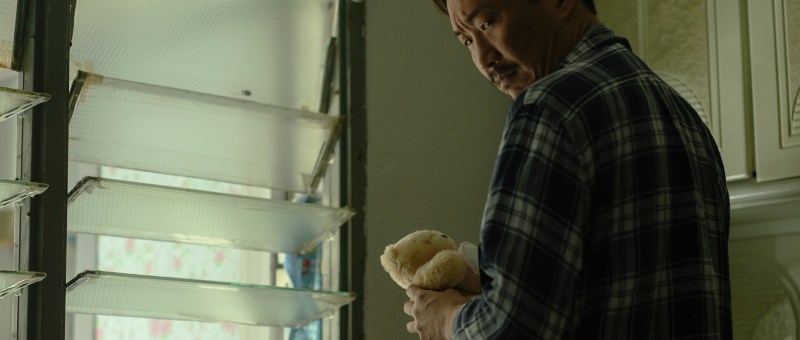
Meanwhile, Cheng is also under a lot of stress following the breakdown of his marriage caused in part by his issues with emotional intimacy. Called back towards the past, he begins re-reading the diary of a young boy who details physical abuse at the hands of his authoritarian father (Ronald Cheng Chung-Kei) that left him feeling worthless as if the world had no place for him. Eli struggles academically and particularly in comparison with his younger brother Alan while his hardline father views him only as an extension of himself and is embarrassed on a personal level that his son doesn’t measure up. Consequently, he beats him senselessly while insisting that he is simply lazy and doesn’t apply himself rather than accepting that he isn’t academically inclined and is unlikely to ever master the piano. 

Only his piano teacher, Miss Chan, is kind and patient with him though his father soon ruins that relationship too leaving the boy with nothing. Learning from this example, Cheng vows to become a different kind of teacher who doesn’t become angry with children who aren’t reaching their potential but makes a point of talking to them to figure out what’s wrong and how he can help. Unfortunately, he feels as if he’s failing to become the person he wanted to be in part because there are too many problems in the contemporary society which places intense pressure on people to conform to outdated notions of conventional success largely though academic achievement. 

Yet what Cheng discovers to be more dangerous is a growing sense of loneliness and alienation among young people who feel lost and hopeless in the contemporary society. He reflects that Eli’s despair stemmed from feeling as if no one wanted him and he wasn’t really included as a member of his family who looked down on and rejected him because of his lack of academic success. Cheng doesn’t want anyone else to feel that way, but ironically isolates himself, alienating his wife who fears he’ll never really be ready to move on into a more settled adulthood as a father with children of his own. 

In many ways, Cheng’s desire to end the cycle turning away from his father’s authoritarian violence towards care and compassion in looking after his students even as he struggles to come to terms with his own traumatic past and fears of abandonment. Granted, he doesn’t and perhaps can’t do very much to tackle the causes of the teens’ depression and their roots in the status-obsessed, politically turbulent contemporary society, but he can at least learn to open himself up to be of help to others who like him are struggling and feel as if they have nowhere to turn. Poignant and empathetic, Cheuk’s drama makes a plea for a little more compassion and understanding not only for the young but for those carrying a heavy burden in the best way they can. 


Time Still Turns the Pages opens in UK cinemas 24th November courtesy of CineAsia.

UK trailer (Traditional Chinese / English subtitles)

Full Strike (全力扣殺, Derek Kwok & Henri Wong, 2015)

A former badminton champ begins to rediscover herself after being permanently banned for bullying behaviour when charged with coaching a bunch of former bank robbers in Derek Kwok & Henri Wong’s zany sports comedy Full Strike (全力扣殺). Dedicated to “all the beautiful losers”, the film is less about literal winning as it is about learning to turn one’s life around in moments of profound despair and draw strength from even non-literal victories in simply refusing to be looked down or belittled.

It’s ironic in a sense that Dan (Ekin Cheng Yee-Kin), Kun (Wilfred Lau Ho-Lung), and Chiu (Edmond Leung Hon-Man) became bank robbers because they didn’t want to be bullied having grown up as friendless orphans. Former badminton champ Kau Sau (Josie Ho Chiu-Yee), meanwhile, was such as tyrannical diva that she gained the nickname “The Beast” before being banned because of her unsportsmanlike behaviour and treatment of her long-suffering assistant. But cast out of the sports world, she’s become a dejected layabout not quite working in her brother’s restaurant and otherwise hiding out from the world. Her life changes when she’s publicly mocked after running into her former assistant who has since gone to take her position as a reigning champion. Running out into the night, she spots a shuttle-cock-shaped meteor and is chased to a badminton club by what she assumes is an “alien” but might have just been a frightened homeless man.

In any case, she takes it as a sign she should pick up a racket once again which as Dan later points out she probably wanted to do anyway and was just waiting for an excuse. He can’t explain why he chose the unlikely path of becoming a badminton player to help him turn over a new leaf after leaving prison but reflects that perhaps you don’t really need a reason only the desire to change. Dan, Kun, and Chiu all developed disabilities as a result of their life of crime but slowly discover that they can actually help them on the court in a literal process of making the most of their life experiences no matter how negative they might have assumed them to be while Kau Sau similarly regains her self esteem while acknowledging the destructive patterns of her previous behaviour careful never to bully her new teammates as they all square off against her bullying cousin “nipple sucking Cheung” (Ronald Cheng Chung-Kei) who tries to use his newfound wealth to cover up a lack of skill by hiring Kau Sau’s old teammate. 

Cheung is also trying to overcome low self-esteem and is later forced to realise that becoming a champion won’t really change that much about how he sees himself, though apparently still relying on an ever capable middle-aged woman to fight (literally) his battles for him. Meanwhile, the gang are coopted by a media mogul hoping to make an inspirational documentary about them but also manipulating their lives and hyper fixating on their criminal pasts to the point of staging a fake arrest as they enter the stadium for a competition. Doubting the chances of success in setting up new lives for themselves as badminton players, Chiu is drawn back towards a life of crime while feeling somewhat distanced from the team as a tentative romance between Kau Sau and Dan seems to fall otherwise flat.

A throwback to classic mou lei tau nonsense comedy, the zany gags come thick and fast but are at times over reliant on low humour while the central premise of staking everything on an “unexciting” game like badminton perhaps wears a little thin by the time it gets to the high stakes finale with the heroes fighting twin battles squaring off against their traumatic pasts rather than the literal opponents in front of them. Winning becomes a kind of irrelevance when the contest was within the self. Each rediscovering the spark of life, the players rediscover the will to live while bonding as a team and sticking to their training in pursuit of their goal. Kwok and Wong lay it on a little thick with the martial arts parody in the uphill battle to master badminton but otherwise lend a poignant sense of warmth and genuine goodwill in sympathy with the underdogs’ quest if not quite to win then to own their loserdom on their on terms in reclaiming their self-respect and dignity. 


Full Strike is available to stream in the UK until 30th June as part of this year’s Odyssey: A Chinese Cinema Season.

Original trailer (Traditional Chinese / English subtitles)

Over My Dead Body (死屍死時四十四, Ho Cheuk-Tin, 2023)

As the opening voiceover of Ho Cheuk-Tin’s darkly comic farce Over My Dead Body (死屍死時四十四) points out, the world is already quite an absurd place. A lot of us know that it’s absurd, but somehow we just roll with it without really asking why. If you stop to think about it, it really is absurd to spend every waking minute scrabbling for money to pay a mortgage on a flat you barely occupy because you’re always at work, but at least it’s less absurd than living with the constant uncertainly of arbitrary rent rises and sudden eviction. 

At least that’s the way it’s always seemed to the residents of 14A Seaside Heights, a swanky apartment block with all the mod cons and a touch of European sophistication. Technically the flat is owned by Ms. So (Teresa Mo Sun-Kwan), though home to daughter and son-in-law Yana (Jennifer Yu Heung-Ying) and Ming (Wong Yau-Nam) plus their small daughter Yoyo and Yana’s paranoid brother Kingston (Alan Yeung Wai-Leun) who is in the process of launching a “brand” selling a special “stealth suit” that can make you invisible to surveillance cameras. The obvious fact is, the flat is far too small for all these people and Ming and Yana want to move out not least so they stop having to sneak around like teenagers to get a little personal time. 

They have each, however, suffered amid the precarities of the post-pandemic economy with Yana losing her job as an air hostess when the airline she worked for went bust, while Ming’s removals business has taken a serious hit and is unlikely to recover as Mrs So points out with so many people leaving Hong Kong due to the ongoing political uncertainty. The young couple propose mortgaging Mrs. So’s flat for the downpayment on their own which they’d be paying a second mortgage on, which is why it’s incredibly bad news when they discover the naked corpse of a random man propped up against their door. 

The film plays with a minor pun in which the word for male corpse sounds like that for “Blue Ribbon”, a name for pro-government supporters during in the protests, the implication being you wouldn’t want one of those turning up on your doorstep either. In any case, any idea of calling the police or an ambulance is quickly abandoned on realising the flat would become known as a “murder house” and dramatically drop in value. The only thing to do is drag the unfortunate man to a neighbour’s door instead and let them deal with it. This goes about as well as could be expected with the whole floor eventually involved in the plan to move the body until they eventually hit on the idea of dumping it on a rundown social housing estate where people often go to commit suicide because no one’s going to notice one more corpse and no one owns those flats anyway so it doesn’t really matter if they ruin their property value. 

It is an incredibly dark and cynical sense of humour, but in its own cheerfully absurd in all the farcical shenanigans trying to remove the body from the building with no one really stopping to ask how it got there in the first place beyond connecting it with the mad streaker the security guard has been desperately trying to catch. Ho’s previous film, stylish true crime drama The Sparring Partner, had similarly had an absurdist vein of dark comedy running underneath it but Over My Dead Body does eventually rediscover a sense of hope if only in irony as it leans in to a New Year comedy-style celebration of family and community as the neighbours find themselves having to work together to protect their property investments. Even the materialistic Mrs So is forced to reflect that actually she’s lucky to be able to feel tired and frustrated, giving her blessing to her daughter and son-in-law to move out, while they in turn reflect that maybe it’s not that bad if they have to stay a little longer. It might seem like an overly saccharine conclusion for a biting satire about the rabid capitalism of a status obsessed, consumerist society but then again as an equally cynical ironic twist reveals maybe the residents are the ones who haven’t quite woken up despite their newfound solidarity. 


Over My Dead Body opens in UK cinemas on April 21 courtesy of CineAsia.

UK trailer (Traditional Chinese / English subtitles)

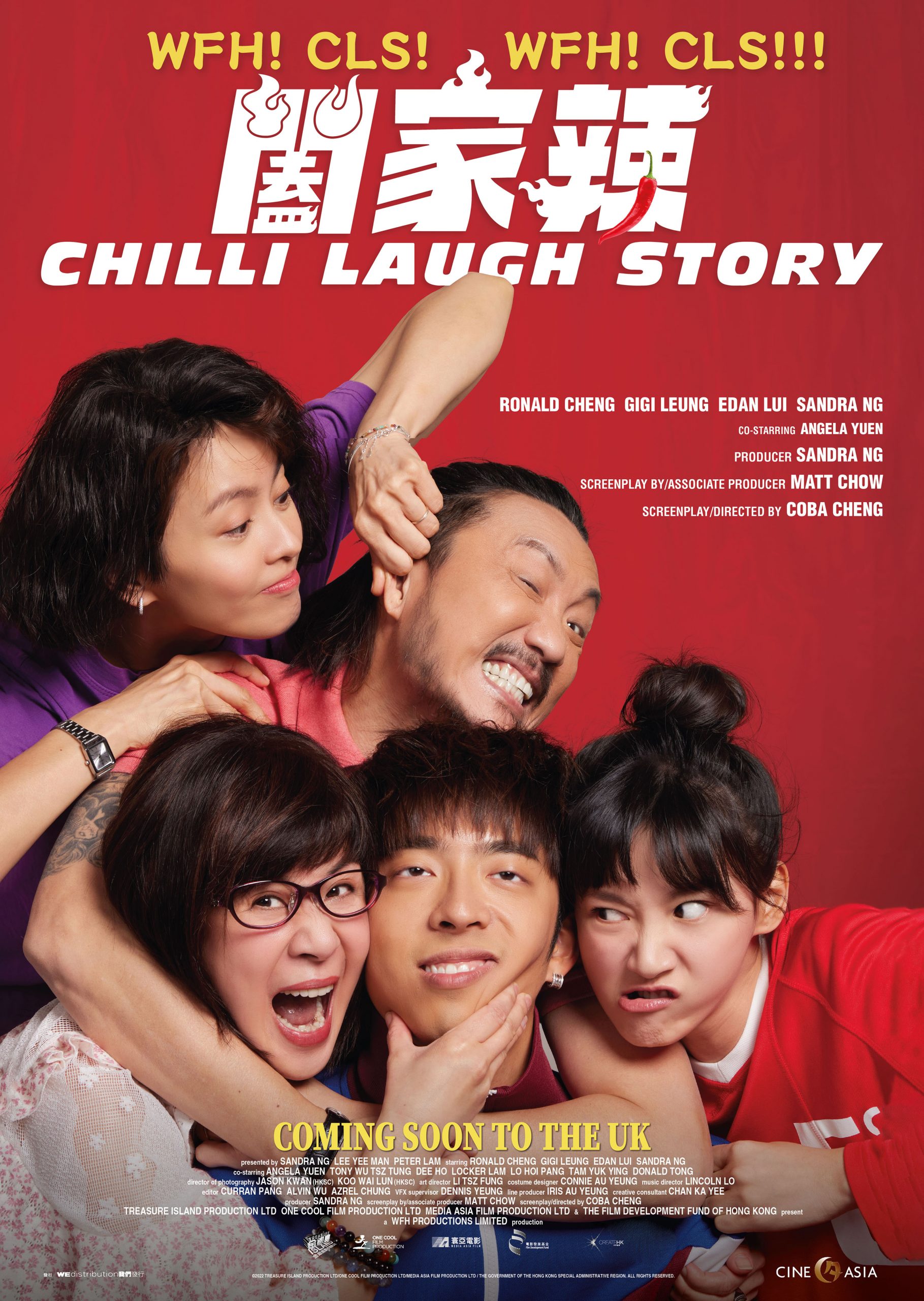
Chilli Laugh Story (闔家辣, Coba Cheng, 2022)

Family gatherings can sometimes be a little spicy, but channeling some of that passion into a family business eventually becomes too hot to handle for the ambitious hero of Coba Cheng’s New Year comedy Chilli Laugh Story (闔家辣). Set during the pandemic, the film finds its young hero embracing his lifelong dream of becoming an entrepreneur while giving his parents something to do so they won’t be bothering him but eventually discovering that the business world can be cruel and it’s family who will be there for you in the end if it all goes wrong.

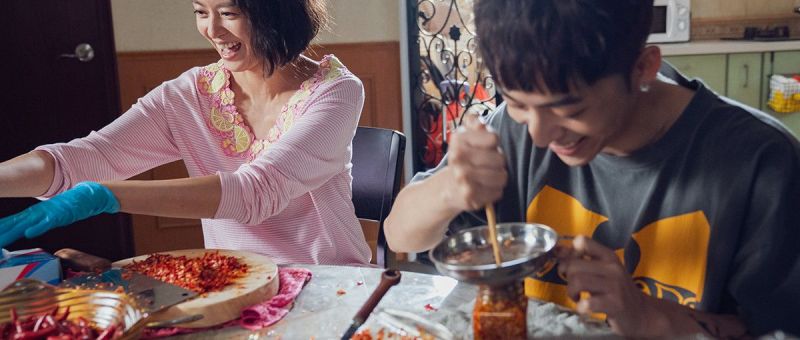
At 24, Coba (Edan Lui) lives with his parents in a rented flat and has a job as a concert promoter which is obviously suffering under the ever changing COVID-19 regulations. Though as a child he’d hated his mother’s hot sauce, he soon realises he’s on to an ideal business opportunity seeing as restaurants are closed and more people are eating at home without easy access to fiery condiments. With his mum Rita (Gigi Leung Wing-Kei) chopping chillies and garlic and his dad Alan (Ronald Cheng Chung-Kei) trying not to get in the way, Coba concentrates on the branding and creates an online sensation with their “Chiu Chiu Chiu” chilli sauce inspired by a local recipe from Rita’s hometown. But while the business begins to take off relationships between the family members suffer under the strain of their differing goals and aspirations. 

Coba’s big thing has been that he doesn’t see the point in owning property and is content with renting, whereas all his mother ever talks about is buying their own place. What she sees as security and freedom, Coba sees as a burden he doesn’t want to be saddled with tied down by a 30-year mortgage. Her plan is to get a loan in Coba’s name to take advantage of a preferential rate for first time buyers, the parents having previously owned a flat they were forced to sell, even if that means applying for one without actually telling him. They are all keeping secrets from each other, Coba choosing not to disclose that he lost his concert gig and is concentrating on the business, while eccentric auntie Wendy (Sandra Ng Kwun-Yu) suffers something similar when her son, who rarely has time to talk, abruptly tells her he’s moving abroad and may not return. Meanwhile, Rita had been using her sister’s restaurant kitchen as a cover to get around licensing regulations but their success puts them at odds with their siblings who resent not being included in the business or its profits. 

Part of Coba’s desire for success to is assert his independence, yet he learns a cruel lesson after being offered an opportunity to collaborate with a weird corporate Guru who speaks only in English and offers pithy maxims while completing a giant all-white jigsaw puzzle in his minimalist all white room. His best friends from school are rich kids who ended up accidental CEOs in the family business, and he desperately wants that kind of approval talking big about being able to buy a flat for his mum with cash to avoid being saddled with the mortgage while hustling in the local food scene trying to talk an old man running a hotdog cafe into collaborating on a chilli dog to expand the brand only for the old man to tell him he’s too old to be jumping on the next new trend. 

Annoyed with his parents for cost cutting behind his back and making his decisions for him by applying for loans in his name, what Coba comes to realise is that having no plan isn’t always a bad thing because it means there are plenty of opportunities while the family strengthen their bonds after a little mutual honesty respecting each other’s wishes and responsibilities in acknowledging they didn’t need to monetise their connection to make it meaningful. Family is after all what New Year comedy is all about. Peppered with references to the pandemic, Cheng’s familial dramedy is full of the anarchic humour the New Year movie is known for from random gags to crazy puns and even throws in a couple of unexpected cameos from major stars in its closing sequences but clearly has its heart in the right place as the family learns to find the sweetness in the spice and Cobo new directions for his future.


Chilli Laugh Story opens in UK cinemas on 15th July courtesy of CineAsia.

UK trailer (Traditional Chinese / English subtitles)

Elisa’s Day (遺愛, Alan Fung Chi-hang, 2021)

The legacy of abandonment visits itself on a trio of displaced Hong Kongers in Alan Fung Chi-hang’s melancholy crime drama, Elisa’s Day (遺愛). Set over 20 years from the Handover to the contemporary era, Fung draws inspiration from a real life crime while casting his ambivalent policeman, himself an orphan, as an ironic hero whose single act of compassion ends in a tragedy for which he feels he may not even have the right to atone. 

Fung begins, however, in the present day as Inspector Fai (Ronald Cheng Chung-Kei) prepares to collect his daughter who is shortly to be released from prison. Flashing back, we’re introduced to Daisy (Carol To Hei-Ling), a pale and distant young woman picked up for suspected drug trafficking while momentarily captivated by a familiar song and carrying a bunch of roses. From there we head further back, all the way to 1996 when 15-year-old Elisa (Hanna Chan Hon-Na) discovers she is pregnant by her bad boy boyfriend Man-Wai (Tony Wu Tsz-Tung). Each abandoned by their parents, the pair decide to run away together and find solace in a family of three, but as expected economic impossibility disrupts their search for happiness. Man-Wai joins the triads and eventually agrees to become a hitman, temporarily separated from Elisa and their daughter while lying low in Thailand. A then Sergeant Fai remains hot on his trail, keeping tabs on Elisa who unwittingly brings her young baby to the cinema where his adoptive mother Auntie Bo (Anna Ng Yuen-Yee) runs the box office, the pair of them becoming surrogate parents to the lonely little girl while Elisa is forced to turn to sex work when Man-Wai’s triad bosses fail to uphold their end of the bargain. 

“Everyone’s gone leaving only me behind” Elisa laments, learning that her estranged mother plans to move to the UK with her second family abandoning her once again in another, more complete sense. Trapped behind in a rundown area of the city, she finds herself caught between conflicting realities. Man-Wai pledges to stay with her forever but is soon gone eventually returning with promises of taking her to Thailand their dream of a better life symbolised by the red roses he brings with him that he claims reminded him of her. Man-Wai meanwhile is constantly told by his triad bosses that the future lies in Mainland China, a place he is originally so reluctant to travel that that he thinks killing is a better option only to later submit himself once again leaving Elisa alone in Hong Kong with no money and only a dwindling hope of ever achieving the familial bliss she longed for when she decided to run away with Man-Wai. 

For his part, Fai is also an orphan though his fate his was different in that he was found by Auntie Bo who gave him a loving home. Even so he has his share of guilt, feeling responsible for Auntie Bo’s spinsterhood fearing that she never married or had children of her own because taking him in made it impossible in the more conservative Hong Kong of 70s and 80s. Ironically enough they become a surrogate family for the infant Daisy, but it’s Fai’s sense of empathy that eventually provokes tragedy in his decision not to arrest Man-Wai on his return seeing how much he loves his family and wanting to give him a chance to put things right rather than take a little girl’s father away from her. Unable to forgive himself, he abandons his responsibilities only to be reminded of them later finally ending the cycle by being willing to accept the responsibility which has been left for him. 

Transitioning through the Hong Kong Handover, Fung evokes a sense of continual displacement, Elisa’s life destroyed firstly through abandonment and then through conflicted desires torn between a potential Thailand paradise and Mainland reality while longing only for a stable home(land). Daisy is offered something similar, her drug trafficker boyfriend to promising to take her to Thailand on their next run, the drugs ironically concealed in a bouquet of red roses just like those her father once brought for her mother. Her only salvation lies in the arms of Fai, a literal authority figure, reassuming his paternal responsibility and thereby restoring a sense of familial and political stability. Told in fragmentary, non-linear fashion, Fung’s melancholy tale of the legacies of abandonment and an innocent love eroded by economic and social realities eventually finds hope in familial repair and the remaking of a home in self-defined family.


Original trailer (English / Traditional Chinese subtitles)

Concerto of the Bully (大樂師.為愛配樂, Fung Chih-chiang, 2018)

Concerto of the Bully posterRemember the heady heydays of the Hong Kong rom-com in which a series of zany, often entirely random adventures eventually led to true love? Director Fung Chih-chiang evidently does judging by the innocent charms of Concerto of the Bully (大樂師.為愛配樂) – a beautifully pitched soulmates thrown together romance with a kidnapping at its centre. For many things to work, they need to be in sync, as an unexpected utterance from the vacuous pop star boyfriend of the female lead points out, but sometimes you have to turn the volume down in order to hear the harmony.

Yung (Ronald Cheng Chung-kei) is a petty thug with a difference. Unable to cope with the noisiness of modern life which often pushes him into fits of erratic violence when overwhelmed, he lives out on a remote fishing raft and carries around with him a soothing track he discovered on the internet by an artist known as “Hit Girl”. His life becomes a lot more complicated when he returns home one evening to find a mysterious sack lying in the middle of the floor with a note reading “please feed” right above it. Yung’s no good gangster friend has kidnapped a young woman, Jamie (Cherry Ngan Cheuk-ling), after recognising her as the girlfriend of a famous pop star from whom he hopes to arrange a ransom. Yung is not very keen on this plan for several reasons but finds himself going along with it. Meanwhile Jamie, who is secretly “Hit Girl”, attempts to plan her escape by ingratiating herself with the guys while thinking about her unfinished composition to keep her mind off the potential danger of her predicament.

The central irony is that Jamie is a girl who loves noise – all the sounds of the world, natural and manmade, are music to her ears and part of the great song of the universe. Yung, however, prefers things quiet save for Hit Girl’s calming song. Forced to babysit Jamie, Yung begins to fall under her spell which is partly weaved solely to lower his guard so that she can escape, but soon enough both begin to get a glimpse of what it is that might be missing in each of their lives.

All the standard romantic comedy tropes are out in force – the boyfriend is a no good heel who isn’t keen on paying the ransom and already has someone else, while Yung is a noble and good man who has been brought low by his no good buddies who have once again gotten him into a lot of trouble. Yung’s inability to process sound turns out to be a life limiting condition which has forced him into a career of violence but Jamie’s musical philosophy eventually allows him to see “another world” – literally, as he re-imagines a crowd of street thugs performing an epic dance routine to Mozart’s Seranade No. 13 in G Major. Unmasked as “Little Fairy”, Hit Girl’s only fan, the shy and under confident Yung gets a new lease on life thanks to Jamie’s less than patient tutelage as she tries to convince him to help her complete her masterwork in time for the big concert finale.

Like her boyfriend said, sometimes it’s no good if it’s not in sync. Many things in the relationship of Yung and Jamie are fake – Jamie has been kidnapped and is taking care to be “nice” and “useful” to her captors, while the pair begin with playacting music through a series of homemade mock up instruments until the arrival of a beaten up tinny piano which might be just the sound Jamie has been looking for. Gradually, the melody begins to come together, working towards a graceful harmony even while the distant drums of trouble in the city continue to threaten their quietly growing romance just as it begins to hit a more authentic key. A strangely sweet love story with a kernel of darkness at its centre, Concerto of the Bully is a hopelessly innocent fairy tale about an unwitting musical genius who never learned to hear his own voice, and a melancholy songstress who finally finds the key to her musical dreams in an unexpected place, as they meet on a floating musical stage which is both silent and somehow alive with all the quiet joys of a melodious life.


Concerto of the Bully is screening in Chicago as part of the seventh season of Asian Pop-up Cinema on 2nd October, 7pm, at AMC River East 21 where Director Fung Chih-chiang and Art Director Chet Chan will be present for an intro and Q&A. Tickets on sale now!

Original trailer (English subtitles)

https://www.youtube.com/watch?v=on2N_00SAQg