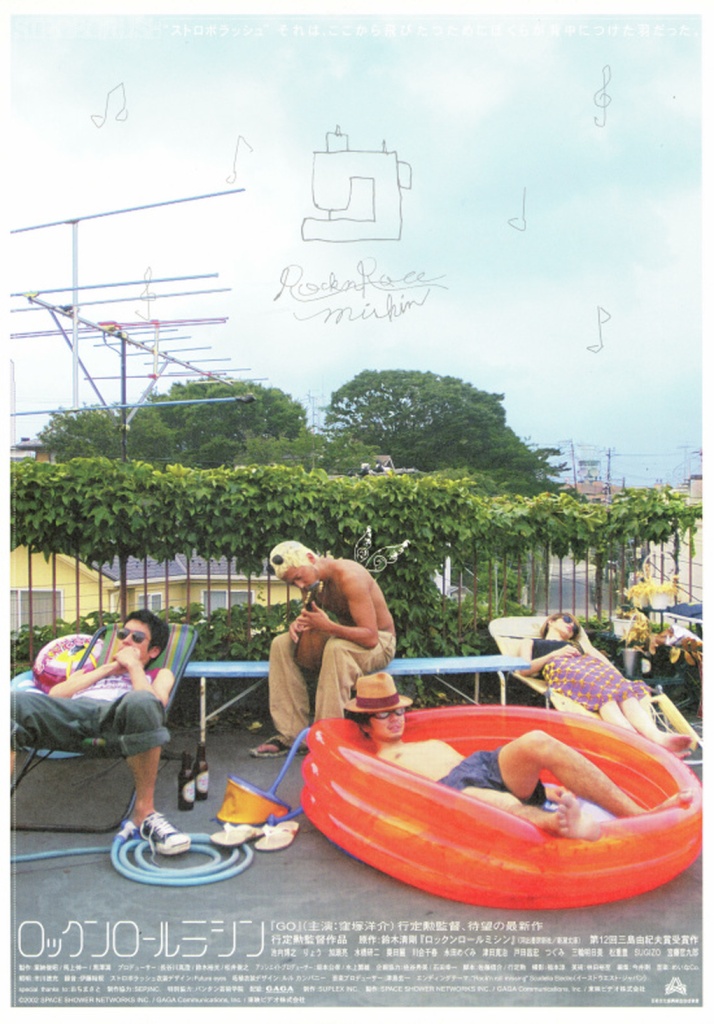
Rock’n’Roll Mishin (ロックンロールミシン, Isao Yukisada, 2002)

rock'n'roll misshinYou know how it is, you’ve left college and got yourself a pretty good job (that you don’t like very much but it pays the bills) and even a steady girlfriend too (not sure if you like her that much either) but somehow everything starts to feel vaguely dissatisfying. This is where we find Kenji (Ryo Kase) at the beginning of Isao Yukisada’s sewing bee of a movie, Rock ’n’ Roll Mishin (ロックンロールミシン). However, this is not exactly the story of a salaryman risking all and becoming a great artist so much as a man taking a brief bohemian holiday from a humdrum everyday existence.

Kenji’s life probably would have continued down a path of corporate serfdom uninterrupted if he had not run into old schoolfriend Ryoichi (Hiroyuki Ikeuchi) who, he learns, is setting up an indie fashion label with some of his friends. Ryoichi has to leave pretty quickly but he pastes a note on the outside of the restaurant window with his contact details so Kenji can find him again.

At work the next day Kenji “enjoys” some “banter” with an extremely unpleasant corporate stooge colleague who seems to be under the mistaken impression that he and Kenji are friends. After making some misogynistic comments about how Kenji is too much of a pushover and should “knock some sense” (literally) into his girlfriend, his colleague sets in on some typical salaryman careerist chat which is exactly the kind of thing Kenji is becoming disillusioned with.

Having failed to meet her at the restaurant, Kenji returns home one evening to find his girlfriend waiting outside his flat. She comes in and immediately takes off her clothes and gets into bed all without saying anything at all. When her T-shirt accidentally blows off the washing line and gets caught on some cabling below, Kenji remembers about his friend’s fashion company and decides to pay them a visit. Kenji is taken in by the sense of freedom and individual enterprise he finds in the workshop in contrast to his corporate drone office job. Eventually Kenji quits and joins the fashion gang full-time though he quickly finds that making a dream come true is surprisingly uphill work.

Unlike other films of this nature, there’s very little inspirational content to be found in Rock ’n’ Roll Mishin. The “mishin” of the title means a sewing machine and early on Ryoichi teases Kenji by telling him that his is a “rock and roll” machine because it beats out 8 stitches a second and if you really step on it it goes up to 16. Ryoichi’s teacher and mentor, Megumi (Ryo) lets Kenji in on the joke by explaining that it’s really called a “lock” machine because it holds the fabric in place for you. The other member of the team is a fashionista, Katsuo (Kenji Mizuhashi), who wants to create fashion that makes a sun of your heart so that you shine forth with an inner light. Needless to say, though the original three all have fashion skills from Ryoichi who’s the designer to Megumi who is a fashion teacher and Katsuo who studied fashion in London, nobody has any kind of business sense or a real business plan for this fledgling business.

In another film this might be where Kenji’s salaryman experience plays in, completing a missing element of the group which will enable them to triumph over adversity. However, Kenji’s experience is also fairly limited but the sensible economic advice he has to offer largely falls on deaf ears with his more creatively orientated teammates. They may understand the business on some level – at least enough to know what they can realistically expect to charge for their wares but are completely clueless about how they can go about managing their costs and maximising their profits. They also don’t really seem to know how to promote their business in anything other than a grungy, underground way which might be cool but is unlikely to take off without a serious amount of cynical marketing gimmickry which Ryoichi isn’t prepared to go for.

What Rock ’n’ Roll Mishin has to say about the youth of today isn’t very encouraging. It paints them as a group of unrealistic dreamers unwilling to put the work in to achieve anything. They might start to go for it in the beginning, but as soon as things start to look up they get scared and childishly run away rather than following through. Ryoichi is very much the tortured artist type, so fixated on maintaining his own image of artistic integrity that he’s completely unable to commercialise to work in any effective kind of way. Kenji is sucked in by the atmosphere of creative freedom but ultimately he has very little to offer and even if he is the one most affected by this new, bohemian lifestyle he’s also the best placed to recognise that you can’t live on dreams alone.

It’s tempting to read Rock ’n’ Roll Mishin as an ultra conservative, stick to the path message movie. It almost wants to say that it’s just not worth trying anything new because you’ll never see it through and you’ll be heading back to your old life with your tail between your legs quicker than you can say haute couture. However, even if the typical underdog triumphs against the odds narrative doesn’t materialise, Kenji at least comes to view his time in the fashion business in a broadly positive light. What he values is the time spent with friends, and, even if it didn’t work out quite the way they would have liked they still created something that was a success on its own terms and was ultimately appreciated by fellow travellers along the same path which, in the end, is what it’s all about.


Not exactly a trailer but this music video for one of the songs used in the film, Rock ‘n’ Roll Missing by Scudelia Electro, contains some footage from the film (lyrics in English)

Dead Run (疾走, SABU, 2005)

Dead run posterSABU might have gained a reputation for his early work which often featured scenes of characters in rapid flight from one thing or another but Dead Run both embraces and rejects this aspect of his filmmaking as it presents the idea of running and its associated freedom as an unattainable dream. Based on the novel by Kiyoshi Shigematsu, Dead Run (疾走, Shisso) is the tragic story of its innocent hero, Shuji, who sees his world crumble before him only to become the sacrifice which redeems it.
The story begins in a voice over narration offered in the second person by Shuji’s older brother, Shuichi. Shuji, it seems was a curious, if shy, little boy full of the usual childish questions and a curiosity about the way his world works. The boys live with their parents in an area they call “the shore” which is next to a settlement created through reclaimed land which the shore people refer to as “offshore” and somewhat look down on. One day, Shuji gets marooned offshore when his bicycle chain snaps and is rescued by the unlikely saviour of “Demon Ken” (Susumu Terajima) – a local petty gangster whom everyone is afraid of, and his girlfriend, Akane (Miki Nakatani), who is some kind of bar hostess. Soon after, Demon Ken is found buried in a shallow grave dead of a gunshot wound to the stomach, but somehow this improbable act of kindness has stuck in Shuji’s mind.

Moving on a few years, a creepy looking priest moves into the offshore area and opens up a church in a small hut complete with shiny silver crosses. Just like with Demon Ken, there’s a rumour about town that the priest, Father Yuichi (Etsushi Toyokawa), is a former criminal and murderer. Shuji becomes intrigued by the strange figure of the priest and a young girl his age, Eri (Hanae Kan), who likes to spend time in the church. However, more gangsters soon turn up wanting to buy up the offshore area to build an entertainment complex and even though most of the other residents have agreed to be resettled elsewhere, Father Yuichi won’t budge. Akane returns to the area as one of the higher ranking gangsters trying to force the church out and is happy to realise that Shuji, at least, has not forgotten Demon Ken. This won’t be the last time the pair meet again as circumstances conspire against the young boy to drag him ever deeper into the darkness of the shady adult world.

As a young boy, Shuji’s life is the ideal pastoral childhood full of bike rides through green fields and under cloudless blue skies, yet his once happy family dissolves and though he tries to run from his destiny he can not escape it. After his over achieving older brother Shuichi is caught cheating at school and is suspended, he begins to lose his mind becoming obsessed with the idea of the priest as a murderer and is fixated on exposing some dark secret about him. Of course, it turns out not to be exactly as he thought it was and Shuichi becomes increasingly disturbed before becoming a suspect in a series of local crimes which see him sent away to reform school. After this string of tragedies, Shuji’s parents start to fall apart too – his father disappearing and his mother mentally absent. Eventually even Eri leaves as the relocation programme finally kicks in.

Around this point our narrative voice shifts to that of Father Yuichi who becomes Shuji’s only responsible adult figure. However, Father Yuichi’s decision to take Shuji on a trip proves to be a disastrous one as it backfires massively forcing him onto the run and, coincidentally, straight into the arms of Akane. Though Akane had originally seemed an austere and difficult woman, she harbours an affection for Shuji as one of the few people to remember Demon Ken and to remember him for his kindness. Though she wants to help Shuji she ends up pulling him into a the darkness of her own world filled with violence and exploitation. Shuji runs again and eventually makes his way to Tokyo and to Eri who is just as broken as he is but there’s no salvation here either. Even when the pair attempt to travel back to their once idyllic childhood town, their problems follow them and destiny catches up with everyone, in the end.

Early on Father Yuichi and Eri are having a discussion about the difference between fate and karma and which might be more frightening. Eri says fate is better because you can’t change karma but perhaps you can change your fate. The film seems to disagree with her. You can try to run but somehow or other something will always stop you so the cold hand of fate can stretch its icy fingers around your heart. Different in both tone and style from SABU’s previous work, Dead Run is a bleak tale filled with loneliness and melancholy which, though it offers a glimmer of hope for those who are left behind, is not afraid to make a sacrificial lamb of its holy fool of a protagonist.


The Hong Kong R3 DVD release of Dead Run contains English subtitles.

Based on the book of the same name by Kiyoshi Shigematsu (as yet unavailable in English).

Unsubbed trailer:

Pecoross’ Mother and Her Days (ペコロスの母に会いに行く, Azuma Morisaki, 2013)

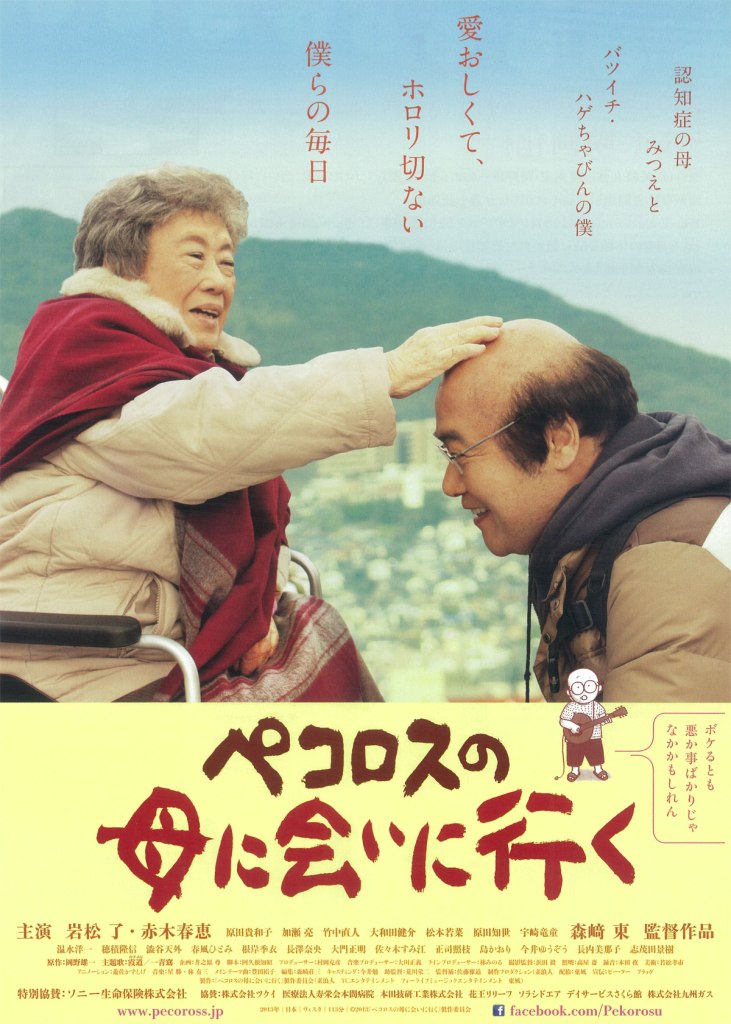
pecorossTopping the “best of 2013” lists in both Kinema Junpo and Eiga Geijitsu (something of a feat in itself), Pecoross’ Mother and Her Days (ペコロスの母に会いに行く, Pecoross no Haha ni Ai ni Iku) is a much more populist offering than might be supposed but nevertheless effectively pulls at the heartstrings. Addressing the themes of elder care and senile dementia in Japan’s rapidly ageing society, the film is both a tribute to a son’s love for his mother and to the personal suffering that coloured the majority of the mid-twentieth century in Japan.

Based on a autobiographical manga by Yuichi Okano who uses Pecoross as his artistic name (it’s the name of a small onion and Yuichi thinks his head resembles one) Pecoross’ Mother and Her Days follows Yuichi in his daily life as he tries to adapt to his mother’s sharp decline. Yuichi is a multitalented artist who draws manga and also plays music at small bars around town, but neither of those pay very much so he also has a regular salaryman job that he’s always slacking off from. He’s also a widowed father with a grown-up son who is currently staying with Yuichi and his mother in the family home.

Ever since the death of Yuichi’s father a decade ago, his mother, Mitsue, has been gradually fading. First she was just forgetful but now she’s easily confused and distracted, often forgetting to put the telephone receiver back (though this does accidentally save her from an “ore ore” scam on the other end) or flush the toilet etc. When grandson Masaki finds her wandering the streets to buy alcohol for the long dead grandfather, the pair start to worry if she might be becoming a danger to herself and perhaps they really do need to consider more specialist care for her.

Of course, the decision to place an elderly parent in a home is a difficult one, especially in a culture where the elderly have traditionally been looked after by family. Generally, the daughter-in-law would end up being responsible for the often onerous task of caring for her in-laws as well as her husband, children and the household in general. Yuichi is a widower who can’t be home all day to watch to his mother and there’s always the fear that she might accidentally do harm to herself in her increasingly confused state.

Mitsue quite often becomes unstuck in time, remembering places and events from decades before as if there were happening right now. Born near Nagasaki, she remembers seeing the giant mushroom cloud rising from the atomic bomb and being worried for a young friend who’d been sent to the city only a short time before. The eldest of ten children she looks back on her childhood which had its fair share of hardships and loss. She became physically strong working in the fields and later married a weak willed man who took to drink and was often violent. Through her ruminations and fixations, Yuichi comes to discover a little more about his mother’s history deepening his respect for her and all that she endured in raising him.

The scene where Yuichi first leaves his mother at the home is heartbreaking as he slowly watches her receding in his rear view mirror, confused and hurt at having been abandoned. However, the staff at the care home are shown to be a group of dedicated and caring people who have the proper knowledge to fully cater to Mitsue’s needs. The other elderly residents each have very different symptoms from one woman who’s regressed to her childhood when she was class president at school and now thinks all the nurses are teachers, to a wheelchair bound man who keeps trying to inappropriately touch the female members of staff (though this is apparently just the way he is rather than any kind of condition). The home isn’t a sad place or a sterile one like a hospital, the guests are well stimulated, loved and cared for and Yuichi is welcome to visit and take his mother out on trips whenever he likes.

Though often sad, the events are depicted in the most humorous way possible often using the cute manga drawings Yuichi is making about his mother and there are also long stretches of animation reflecting on Mitsue’s life. The film is, however, unabashedly sentimental and proves a little too saccharine even if obviously sincere. Curiously pedestrian for such a highly praised film though anchored by superlative performances, Pecoross’ Mother and her Days perhaps plays better to a specific audience who are better placed to appreciate its historical meanderings and sweetly sentimental tone but may leave others feeling a little underwhelmed.


Reviewed as part of the Japan Foundation Touring Film Programme 2016.


Megane (めがね, Naoko Ogigami, 2007)

119236783696916311605When considering their next holiday destination, many people like to peruse some brochures, have a read of trip advisor or head to a well known tourist spot that is likely to impress the guests at their next soirée but then there are always others who just simply show up somewhere and hope for the best. The central character of Megane, Taeko (Satomi Kobayashi), perhaps wishes she’d done a little research before heading out to a very strange inn on a very strange island but the longer she stays, the more the ways of the laid-back islanders seem to make sense to her.


The film begins as inn owner Yuji (Ken Mitsuishi) plays with his dog on the beach before suddenly realising “She’s here!” – referring to a favourite, annual guest who operates a shaved ice stand on that very same beach but for the spring only. Sakura (Masako Motai) has, indeed, arrived but unexpectedly there is also a second visitor, Taeko, all the way from the big city. Yuki seems impressed Taeko managed to find the out of the way hotel and points out their tiny sign (if they had a bigger one there would be too many customers).

Taeko might have been looking for an escape but this is a little more than she bargained for. First off, she gets a wake up call every morning in the form of Sakura kneeling next to her bed and commenting on the weather and she’s sort of expected to attend meals at the same time as everyone else, convenient or not. Sakura also leads a strange callisthenics session on the beach each morning which Taeko is encouraged to join as well as constantly being offered Sakura’s shaved ice which she always declines.

There isn’t much to do in this strange place, Yuji, Sakura and another woman who isn’t a guest but hangs round all the time anyway are convinced Taeko has come for the purpose of “twilighting” which Taeko doesn’t quite understand and they refuse to elaborate on but apparently this weird island is very good for it. Getting sick of these strange people and their odd habits Taeko decides to just check out and try another hotel. BIG MISTAKE. The other hotel on the island turns out to be an even more bizarre cult commune which makes Yuji and co seem much more appealing all of a sudden. Returning humbly to the extremely relaxed hotel and sacrificing her suitcase in the process, Taeko finally begins to embrace the odd ways of the island and open herself up to its benign indifference.

However, part way through she’s rudely interrupted by one of her students who’s managed to track her down despite her having chosen this place specifically for its remoteness and lack of cellphone signal. Yomogi (Ryo Kase) takes to the weird ways of the island like a fish to water, in fact his hipsterish adaptability is a little odd in itself, but against expectations his arrival only slightly irritates Taeko and creates no major drama of its own. The mystery of the overly jealous hanger on, Haruna (Mikako Ichikawa), is partially solved towards the end though her gentle possessiveness of the inn bound family and passive aggression to Taeko’s gradual acclimatisation is also more of the comic variety and eventually works itself out in a gentle way.

“Gentle” may well be the best way to describe Megane. Someone should probably market a “calm” mix which consists entirely of the relaxing island sounds of this film. These people take things slow and are all the happier for it. They know the pleasure of a sunset, shaved ice on the beach on a sunny day, drinking beer outside or enjoying a barbecue with friends. Mellow to the core, Megane is the ideal way to find your own spot of serenity at the end of a busy day and is sure to ease even the heaviest of hearts with its subtle, absurd humour.


The Japanese region A blu-ray release of Megane includes English subtitles!


Like Someone in Love (UK Anime Network Review)

Like_someone_in_love_quad_v5_HRFirst published on UK Anime Network in June 2013.


Like Someone In Love is only Iranian director Abbas Kiarostami’s second international venture after 2010’s Certified Copy but this time sees his familiar preoccupations with ambiguities and poetic imagery transported to modern day Tokyo. Although in this case all the characters are quite clearly drawn and presented somewhat unambiguously, the reasoning behind the decisions they make and the way they behave, however, remains oblique. The title implies someone is acting ‘like someone in love’ if not exactly ‘in love’ themselves but who is it, who or what are they (‘almost’?) in love with, and what exactly would that mean – these are all the gentle ambiguities that Kiarostami wishes us to think about in this perfectly excised cross section of modern life.

As the film opens we are placed statically looking onto a scene which appears to be some sort of bar, a woman’s voice can be heard speaking to someone – not us, this clearly isn’t a voice over, there is obviously someone else involved in this dialogue that we cannot hear. We search the screen for the owner of the voice and even though we can see that nobody else is speaking somehow the thought that the woman is off camera hasn’t quite occurred to us. Eventually we find a young woman has been talking on the phone, presumably to her boyfriend – ‘I’m not lying’ she says, though we know she is. The boyfriend suspects her and makes her go to the bathroom to count the number of tiles so he can come there later and compare to see if she’s telling the truth.

Shortly afterwards, an older man (Denden) starts talking to her and encourages her to break up with said jealous boyfriend ‘not just for business reasons’ but as fatherly advice. He wants her to visit ‘a very important man’, she doesn’t want to because she’s tired after cramming all night for an exam and anyway her grandmother is in town and she’d like to see her. The man makes it very clear he isn’t forcing her, but he leaves her no room to refuse and she goes anyway even though she doesn’t want to. He puts her in a taxi for an hour’s drive across the city – on the way she gets a message from her grandmother that she’ll be waiting outside the station until her train so Akiko (Rin Takanashi) asks the driver to pass the station twice just so she can catch a glimpse of her.

Fast asleep in the car she arrives at a rather nondescript little address behind a ramen shop where a retired sociology professor (now sometime translator), Watanabe (Tadashi Okuno), lives. As soon as they enter the phone rings and Akiko takes the opportunity to poke around – she finds some pictures of an older and a younger woman – a wife and daughter perhaps? Strangely they look a little like her, as does the woman trying to teach a parrot to speak in the famous print on one wall.  ‘I always thought the parrot was teaching the woman’ Akiko says and the professor laughs. Still tired she makes straight for the bedroom, undresses and gets into the bed. This wasn’t what the old man had in mind though – he’s cooked a full dinner and bought wine, soft music ‘Like Someone in Love’ is playing in the background. After trying to convince her to eat and failing the professor gives up and turns the light out to let her sleep.

The next morning he drives her to school only to witness an altercation with the jealous boyfriend, Noriaki (Ryo Kase) who’s been lurking in wait after not being able to get through on Akiko’s phone. It’s clear he’s angry, he grabs at her then sulks after she goes inside before trying to talk to the professor, mistakenly thinking he’s her grandfather. He of course keeps up the pretense simply by not (directly) correcting the mistake. It’s clear though that something is coming to head and the meeting of these three people is going to produce a fundamental change in one or all of their lives.

Like Someone in Love might be one of those films where the reaction to it says much more about the viewer than it does about the film. It’s so much more about what isn’t said, the things that one infers from brief snippets of possible backstory than it is about what is actually seen on the screen. We don’t know exactly why Akiko got into this line of work or why she does it or even how she really feels about it. It’s plain in the first scene that she doesn’t want to go, at least tonight, and that she’s refused to go before but when she arrives at Watabe’s house she’s anything but coy and seems every inch the seasoned pro ready to get down to business. She’s a cipher, the clearest thing you can say about her is that she’s defined by her own passivity. She says she won’t go and then bows to pressure and goes, she obviously wants to break up with her awful boyfriend but doesn’t, she wants to see her grandmother but obeys her pimp(?) instead. She seems to spend her entire life bowing to the whims of other people rather than making any sort of decision for herself.

The two men by contrast appear as virtual mirror images of each other. The elderly scholar Watanabe, contemplative and introspective and the violent, obsessively jealous high school dropout garage owning Noriaki. What is Watanabe’s interest in Akiko? Is this something he’s done often? it seems maybe not, perhaps this is a gift from his former student now Akiko’s ‘boss’. At any rate it seems he’s after some kind of romantic evening rather than a torrid few moments in bed with a girl young enough to be his granddaughter. He’s arranged things for her comfort – cooking her local dish, lighting candles, setting the dinner table etc just as someone in love might do. Perhaps he’s just lonely (though his phone is always ringing and he never answers it) and wants to relive fondly remembered memories of his wife. Noriaki by contrast seems much more territorial – he wants to own Akiko, he’s decided she’s useless on her own and needs his protection but he’s obviously terrified someone’s going to steal her out from under him. He’s also hugely over sensitive about the phone box card which looks like Akiko (because we know it is) maybe because he’s got a Madonna-whore conception of women to begin with.

The film ends as abruptly as it started which is inevitably going to be a problem for many viewers. This is not the end, but it is an end – perhaps the beginning of something new rather than the end of something old. An internal world is penetrated – like the intrusion of falling in love into an otherwise dull life, old securities prove inadequate and perhaps it’s harder to protect the things that are precious to you than you might hope (especially if you are old and your aggressor is not). In many ways we are like the old curtain twitcher whose sole entertainment is her window onto Watanabe’s doorstep – we can’t know what happened before our one and only window was opened, nor can we know what will happen once it’s closed but still we can’t help but wonder.


Available now in the UK from New Wave Films.

Gravity’s Clowns (重力ピエロ, AKA A Pierrot, Junichi Mori, 2009)

wp03_1024-768

Based on a novel by Kotaro Isaka (Fish Story; The Foreign Duck, the Native Duck and God in a Coin Locker), Gravity’s Clowns is the story of two very different brothers who discover a dark family secret following the death of their mother. Part mystery story part character drama, Gravity’s Clowns takes a look at the themes of nature vs nurture as well as the importance of familial love and acceptance.

Returning home for the first anniversary of his mother’s death, Izumi (Ryo Kase) and his younger brother Haru (Masaki Okada) spend some time with their father Tadashi (Fumiyo Kohinata) reminiscing about the past. Watching a local news broadcast, Haru realises the site of a recent arson attack is not far from where he’s been working. Noticing a pattern in the location of the attacks, Haru decides to investigate and ropes his brother in for the ride. However, the mystery Izumi finds himself embroiled in ends up being far different than the one he imagined.

It’s revealed fairly early on in the movie, but the fact of the matter is that Izumi and Haru may only be half brothers as their mother became pregnant with Haru shortly after being brutally assaulted in her own home by a serial rapist operating in the area. Having decided to have the baby and raise the child together whatever his true parentage, Haru’s parents did their best to give him a normal, loving upbringing alongside his older brother. Though there was some gossip in the town thanks to the incident’s notoriety, neither Haru nor Izumi were aware of their mother’s ordeal until after her death. After discovering the truth, both brothers react in different, though ultimately similar ways.

As a mystery, Gravity’s Clowns tries to pack in a fair few twists and turns though ultimately they are all quite obvious and frequent viewers of crime thrillers or psychological dramas will have guessed the entire plot in the first ten minutes. However, the mystery is definitely of secondary importance to the character drama that is being played out in front of it. The real key to the film is in the relationship between the two brothers, and to a larger extent the family as a whole. What’s important is that the brothers support and and love each other no matter what and as their father told them, their family is the strongest family there is. No matter what past traumas or biological facts may interfere, these guys will always come through for each other.

Having said that, the narrative does meander somewhat and in particular the “comedy stalker” subplot feels a little out of place and under developed. Despite playing a crucial plot role, and providing quite an amusing joke early on in the film and at its end, Yuriko Yoshitaka’s “Natsuko” (this is just a nickname and a fairly amusing pun as Haru’s name means “spring” and she always follows him around so they called her “Natsuko” which means “summer’s child” , she doesn’t even get a proper name) doesn’t have a tremendous amount to do. Likewise, the small but important role played by the boys’ father feels as if it bounces around a little in terms of weight as does that of their mother who is only seen in flashback. Ultimately Gravity’s Clowns over reaches itself as it tries to tackle some more weighty themes like nature vs nurture and the ethics of certain kinds of crimes which are only addressed in a very superficial way, and in fact concluded fairly ambiguously.

A flawed, if pleasant enough character drama, Gravity’s Clowns is generally entertaining but ends up feeling a little insubstantial. High quality and committed performances from the cast and especially from Ryo Kase and Masaki Okada as the two central brothers help to elevate the material but somehow it never quite takes off. Heart warming and actually quite funny at times, Gravity’s Clowns is a noble effort but one that ultimately fails to strike home.