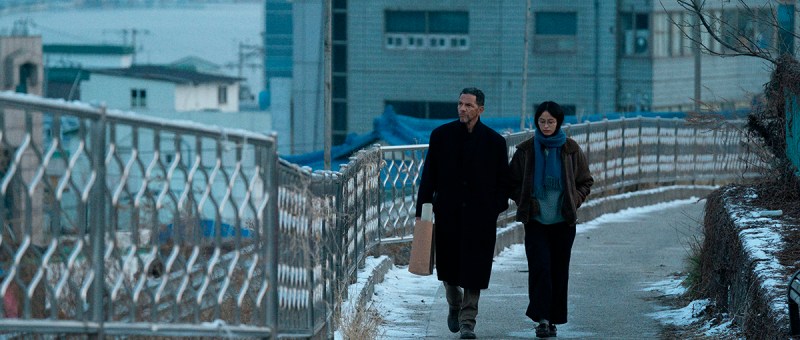
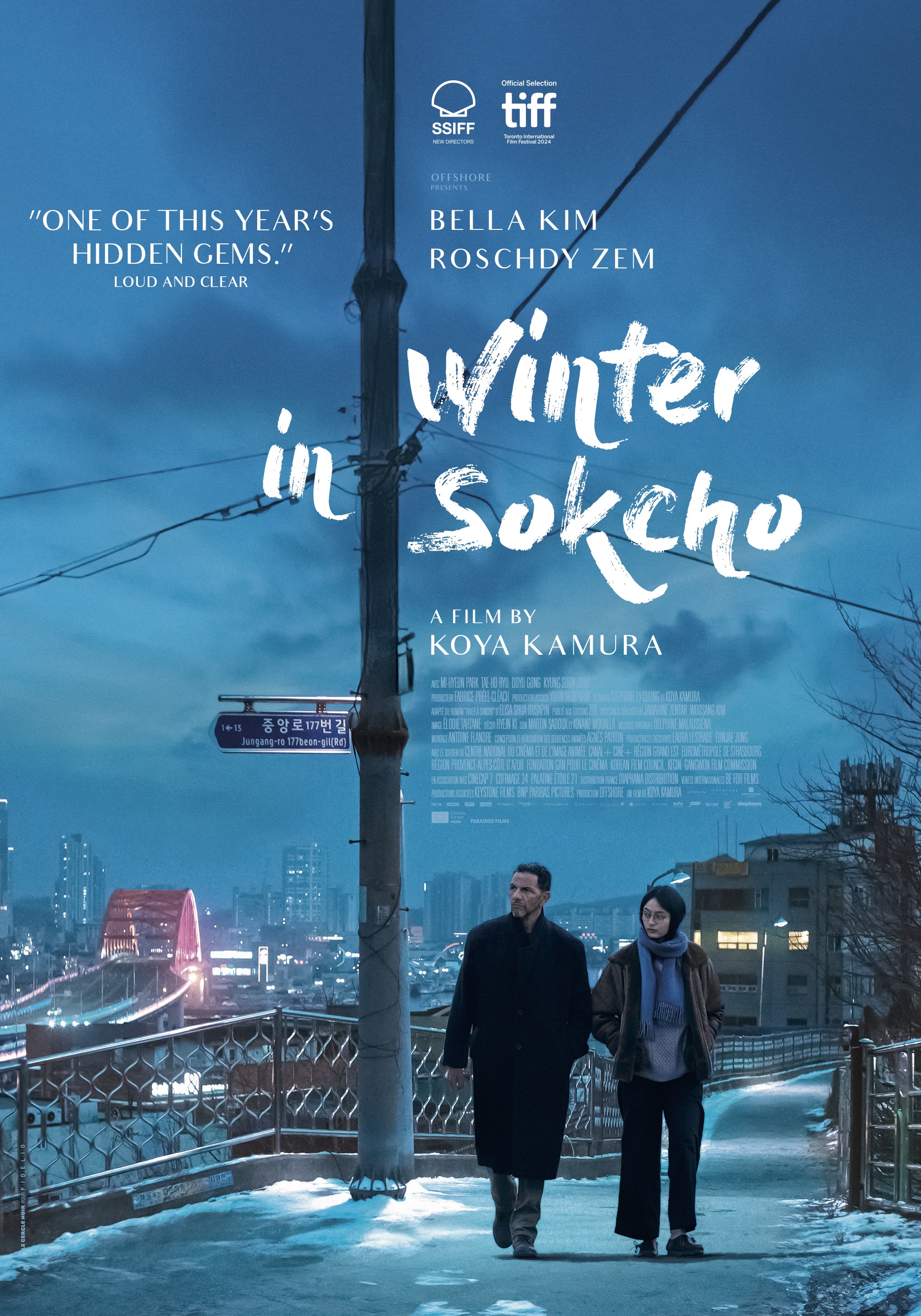
A young woman is awakened from a kind of spiritual hibernation by the unlikely arrival of an incredibly brusque French artist in Koya Kamura’s adaptation of the Elisa Shua Dusapin novel, Winter in Sokcho. Like many, Soo-ha (Bella Kim) is waiting for spring, though it’s less this place that has her feeling trapped than an inability to find her place within it, or indeed anywhere, as she struggles with her own identity and the unanswered questions about the father she never knew.
In any case, it seems clear that Soo-ha as begun to resent herself on some level and is unhappy in her long-term relationship with a high school boyfriend, Joon-ho (Gong Do-yu), an aspiring model. It’s not clear why shy returned to Sokcho after studying French and Korean literature in Seoul, but she otherwise lives her life in peaceful monotony working at a small boarding house where the owner, Mr Park (Ryu Tae-ho), has recently lost his wife and is therefore in need to practical and emotional support. One night a week she spends with her mother (Park Mi-hyeon), a fishmonger specialising in fugu, though there’s a frostiness and frustration to their relationship in which neither seems quite satisfied with the other’s life choices.
Soo-ha repeatedly asks her mother why she never attempted to look for her father, a Frenchman who worked in the fishing industry, though her mother doesn’t really want to talk about, it leaving Soo-ha with unresolved doubts and questions about her past. Her interest in French literature may be a way of trying to explore this side of herself in the absence of a guide, though the attempts at connection a frustratingly one-sided. When a Frenchman suddenly turns up at the boarding house, Mr Park encourages her to use her skills “the one time they’re useful”, though she herself is reluctant, giving Yan (Roschdy Zem) the smallest room in the adjacent annexe like a thought paused for later.
Yan asks her to show him her Sokcho, but as he later says, he’s just a tourist and like the father she never met is just passing through. There may be something a little exploitative in his working visit for though he’s come to draw inspiration from this place, he is willing to give almost nothing to it. He refuses to eat the food that Soo-ha cooks at the boarding house and instead badgers her to take him to restaurants while finding little to like there either. As his incredibly outdated, paper driving licence isn’t valid in Korea, he talks her into taking him to the DMZ which seems to echo the liminal space that exists between them. Soo-ha talks about how sad it is that people still yearn to be reunited with their relatives all these years later, though Yan is indifferent and later mentions a son that it seems he may rarely see. But as he tells her, she may be looking in the wrong place if it’s a deeper connection that she’s seeking or searching for something that will unlock the secrets of herself.
There are reasons for her to feel displaced even in Sokcho given that her unusual height makes her stand out as the nickname “beanpole,” makes plain. Her mother nags her for never eating properly or enjoying her food which may be another expression of her listlessness, but also reminds her not to eat too much and get fat. Joon-ho tells her get plastic surgery, as do a few other people, and though it’s even more insensitive and troubling given that Soo-ha’s father was French. It’s as if they’re telling her to erase these parts of herself, as if she were not “fully” Korean and should become so by adjusting her jawline and the shape of her eyes. Soo-ha’s internal questioning is expressed in brief animated sequences in the style of Yan’s ink paintings as she tries to conjure the image of herself.
There’s a woman at the guest house who’s there recovering from extensive plastic surgery that will give her a whole new face. She sits in the dining area, simultaneously anonymous and instantly identifiable by her bandaged face. Her story is never revealed, so it’s impossible to say whether her decision was motivated by a desire for conformity and conventional beauty or to become more herself and have her outside reflect the person she feels herself to be. Sokcho is also undergoing a process of renewal, as high-rise office blocks spring up everywhere and the traditional quality of the streets disappears as if this urbanisation were creeping up on Soo-ha and taking from her even the anchor of this place which no longer quite exists.
Joon-ho assumes they will move back to Seoul together when his career takes off because “who doesn’t want to get out of Sokcho?” But Soo-ha may be beginning to feel that perhaps this place might suit her after all. A few cosmetic upgrades could breathe new life into the old-fashioned boarding house and brighten an otherwise gloomy existence. While showing Yan around town she describes a local legend, or perhaps concocts one for the occasion, about a bird who wanted to fly above the clouds but couldn’t. She, meanwhile, may have begun to soar amid the arrival of spring, finally ready to break out of her self-imposed winter in having discovered a way to become more herself rather than what others perceive her be.
Trailer (English subtitles)

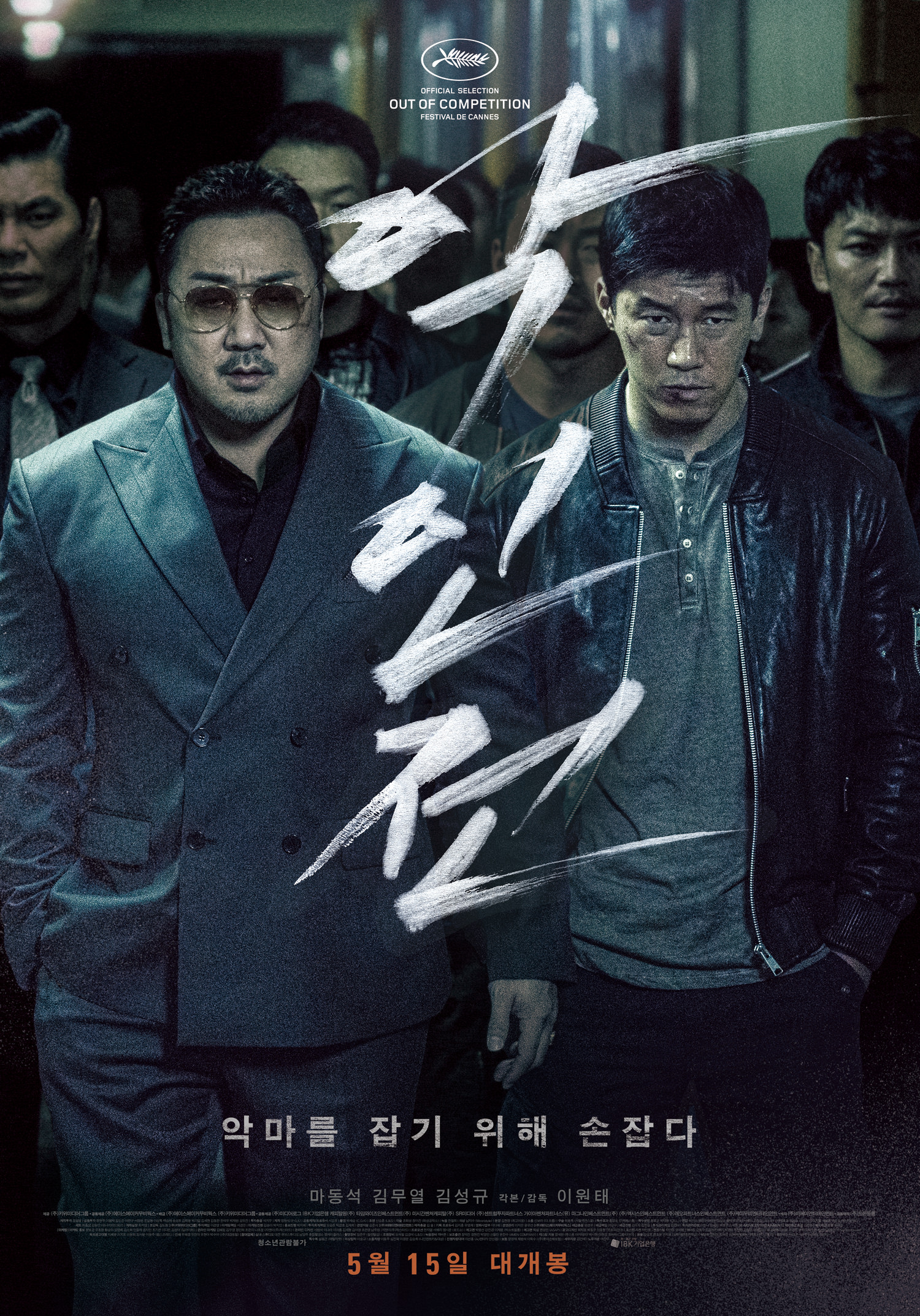

 Absolute power corrupts absolutely, but such power is often a matter more of faith than actuality. Coming at an interesting point in time, Han Jae-rim’s The King (더 킹) charts twenty years of Korean history, stopping just short of its present in which a president was deposed by peaceful, democratic means following accusations of corruption. The legal system, as depicted in Korean cinema, is rarely fair or just but The King seems to hint at a broader root cause which transcends personal greed or ambition in an essential brotherhood of dishonour between men, bound by shared treacheries but forever divided by looming betrayal.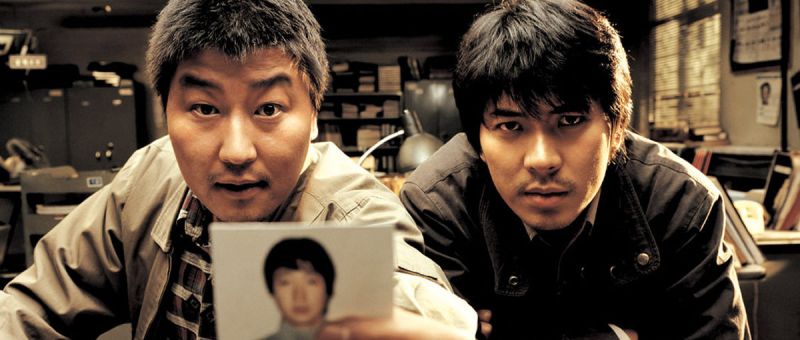
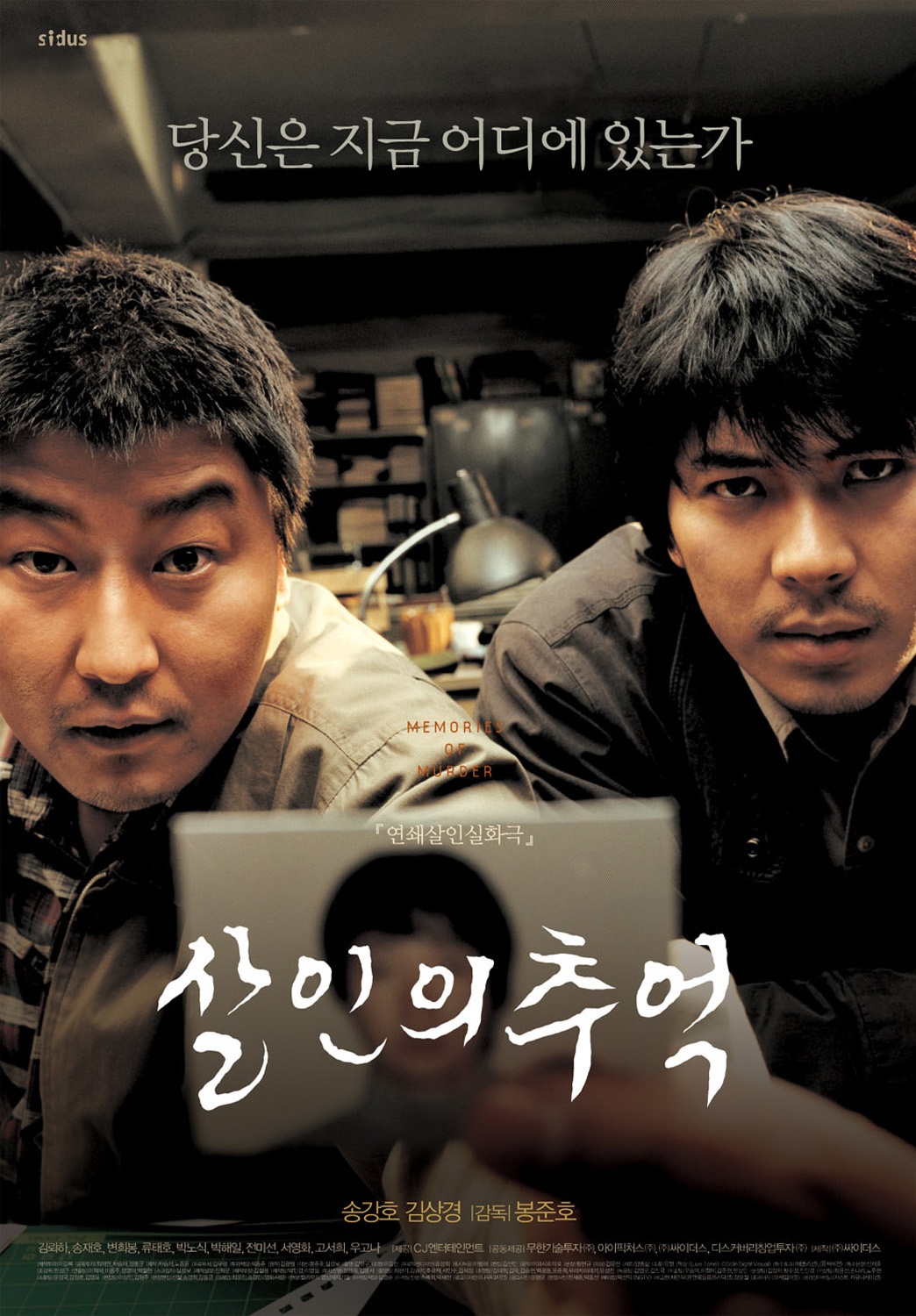 The Korea of the mid-1980s was a society in flux though you might not know it looking at the sleepy small town about to be rocked by the country’s very first publicised spate of serial killings. Between 1986 and 1991, at least ten women ranging in age from schoolgirls to grandmothers were murdered while the killer seemingly got away with his crimes, either dying, fleeing or perhaps getting arrested on other charges explaining the abrupt end to his crime spree. Bong Joon-ho’s fictionalised take on the case, Memories of Murder (살인의 추억, Salinui Chueok), is not so much interested in the killer’s identity, but wants to ask a few hard questions about why the crimes took place and why they were never solved.
 Windows on Worlds