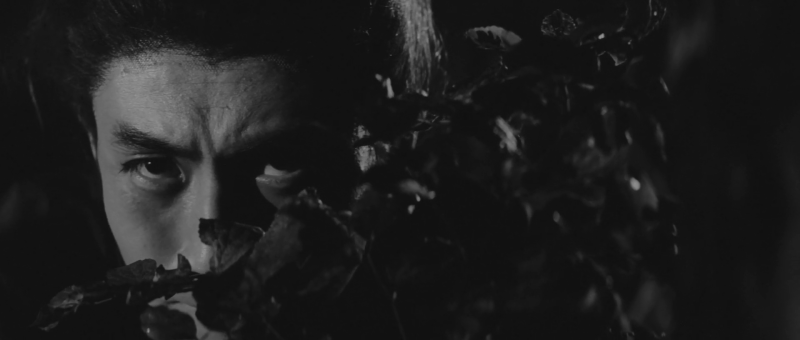
Shinobi no Mono 3: Resurrection (新・忍びの者, Kazuo Mori, 1963)

At the end of the second film in the Shinobi no Mono series, Goemon (Raizo Ichikawa) was led away to be boiled alive in oil after failing to assassinate Hideyoshi Toyotomi. Obviously, Goemon did not actually die, but exchanged places with a condemned prisoner thanks to the machinations of Hanzo Hattori (Saburo Date) which is a clear diversion from the accepted historical narrative to which the film otherwise remains more or less faithful. However, in this instalment more than all the others, Goemon is very much a shadow figure, pale and gaunt, who appears much less frequently on screen and mainly relies on stoking the fires of an already simmering succession conflict in the Toyotomi camp.

At this point, Hideyoshi has already made himself de facto leader of a unified Japan having been made the “kampaku”, advisor to the emperor, only to cede that position in favour of his adopted heir, Hidetsugu (Junichiro Narita) taking the title of “Taiko.” Hideyoshi has been childless for many years which is why he adopted his nephew, but the birth of his son by blood has dangerously unbalanced the palace order with Hidetsugu increasingly certain he’s become surplus to requirements. Meanwhile, in an effort to secure his position Hideyoshi has also embarked on an ambitious plan to conquer Korea as a means of getting to Ming China and circumventing the tributary requirements necessary for trading with it. 

This plan necessarily means that they need more money with Hideyoshi calling an end to all building and renovation projects including that of a Buddhist temple playing into the series’ themes about hubris in the face of Buddha though by this point Goemon too has lost faith in Buddhism in the clear absence of karmic retribution. As Ieyasu (Masao Mishima) points out, this works out well for him as it will stir discord among local lords who will be forced to squeeze their already exploited subjects even more earning nothing more than their resentment which will then blow back on oblivious Hideyoshi.  

Thus Goemon’s role mostly involves sneaking in and telling various people that others are plotting against them and they’d be better to get ahead of it. A secondary theme throughout the series has been a sense of powerlessness which is perhaps inevitable in a historical narrative in which we already know all of the outcomes. Ieyasu scoffs at Goemon, remarking that he thinks he’s walking his own path but is really being manipulated into walking that which Ieyasu has set down for him, though Goemon effectively rejects this stating at the conclusion that as Ieyasu believed he was using him he was also using Ieyasu to achieve his revenge on Hideyoshi for the death of his wife and son. In the historical narrative, Hideyoshi dies of a sudden illness as he does here with Goemon lamenting that his revenge is frustrated by the fact that Hideyoshi is now old and frail though he achieves it through symbolically cutting off his bloodline but explaining to him that Hideyoshi will not become the heir to anything because Ieyasu will be taking the role he has so patiently waited for. Hideyoshi has in any case perhaps disqualified himself as the father of a nation by wilfully sacrificing his adopted son, Hidetsugu, who was ordered to commit suicide to avoid any challenge to Hideyori after becoming desperate and debauched in the knowledge that his days were likely numbered anyway.

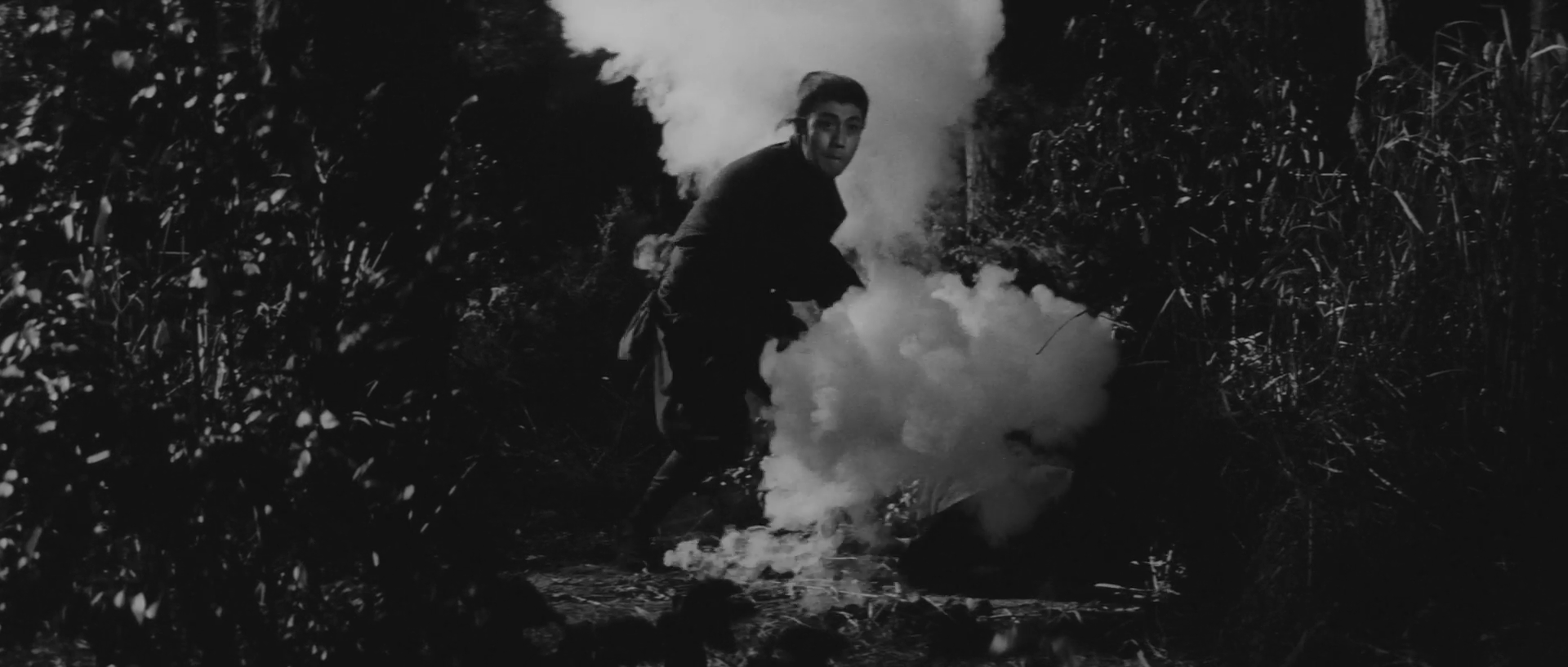
In any case, Goemon perhaps declares himself free in asking why he should care who’s in charge after Hanzo once again tries to recruit him to work for a now triumphant Ieyasu whose long years of simply waiting for everyone else to die have paid off. This is what passes for a happy ending in that he has thrown off the corrupt authority of the feudal era and discovered a way to live outside of it as a “free” man though as others point out the system hasn’t changed. Poor peasants continue to be exploited by lords who are greedy but also themselves oppressed by an equally ruler playing petty games of personal power. Fittingly, ninja tricks mainly revolve around smoke bombs and the covert use of noxious fumes to weaken the opposition as they creep in to spread their poison. Never shedding the series’ nihilistic tone, the film ends on a moment of ambivalent positivity albeit one of exile as Goemon declines the invitation to the fold instead wandering off for a life of hidden freedom in the shadows of a still corrupt society. 
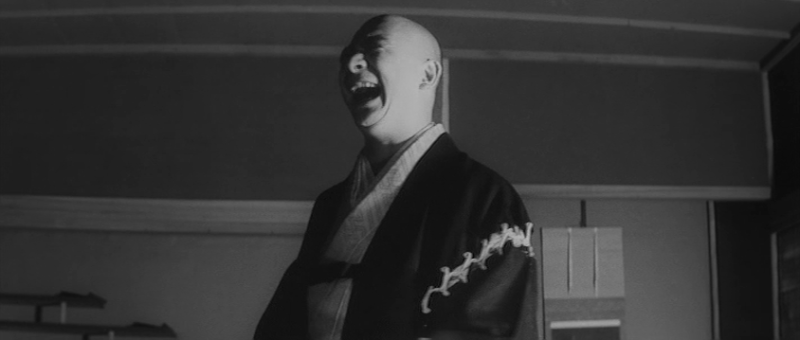
The Blind Menace (不知火検校, Kazuo Mori, 1960)

Two years before finding fame as Zatoichi, Shintaro Katsu starred as his mirror image in a tale of pure villainy, The Blind Menace (不知火検校, Shiranui Kengyo). As the title suggests, the film follows the upward trajectory and eventual downfall of an unsighted man who gleefully rapes and pillages his way to becoming the leader of his community aided and abetted by the ills of the feudal era which allow him to profit from his crimes until the past finally catches up with him.

After all as he later says, “as long you as you keep rising in the world, past misdeeds don’t matter.” In any case, even as a child the man who would later be known as Suginoichi (Shintaro Katsu) is incredibly unpleasant. In the opening festival sequence he picks his nose and flicks it in a barrel of sake so that the men drinking will abandon it. The only sign of possible goodness in him is that he takes the sake home for his mother to enjoy, though he seems to relish the idea of her unwittingly drinking his snot so perhaps that was the real purpose. Other hobbies of his include conning wealthy passersby out of a ryo with a well worn scam in which he asks them to read a letter from his uncle which mentions that it should include one ryo only what’s in there is a stone. When the reader explains the situation, he accuses them of trying to take advantage of his blindness and makes a fuss about it until they’re embarrassed into coughing up a ryo of their own (not a small sum for the time period). 

In some ways his poverty and disability might explain his behaviour. His family set up is subverted with his mother much like him money hungry and willing to do anything to get it while his saintly, henpecked father is gentle and honest. This might have taught him the wrong lessons about masculinity that lead him to see his father as weak in allowing the world to trample him while taking his mother’s advice to heart that if they only had a 1000 ryo they could get him trained up properly so that he might one day become a Kengyo which is a little bit like a community leader for the blind with social status and political influence. 

It’s this kind of social affirmation he seems to crave, but is essentially a narcissistic sociopath who takes advantage a stereotype that in some ways infantilises the blind and those with other disabilities who are believed to be pure-hearted and incapable of intrigue or evil. He seems to come to the rescue of a noblewoman who asked his boss, the Kengyo, to lend her money secretly because her brother has been caught embezzling but then rapes her, asks for the money back, and blackmails her into further acts of sexual exploitation offering her only 5 ryo a time knowing she needs 50. He thinks nothing of using his acupuncture skills to kill a man who was carrying 200 ryo to buy a “boneless girl” for a freak show and then framing a man who saw him do it but agreed to say nothing for a 50% cut for the crime. Suginoichi later teams up with “Severed Head” Kurakichi (Fujio Suga) to commit a series of burglaries including that of the Kengyo master who he also has killed to usurp his postion. 

But as he said, once his recognition is in sight with an invitation from the shogun everything begins to fall apart as all his wrongdoing starts to catch up with him. The feudal world had allowed him to prosper partly because of other people’s greed but also the social codes that favour shame and secrecy along with people’s unwillingness to accept that a blind man can also be selfish and evil despite a lot of evidence to the contrary. Elegantly lensed by Kazuo Mori who brings a sense of realism to the hardbitten backstreets of the feudal poor, the film may suggest that the wealthy only get that way by trickery and exploitation and the only way to rise to the loftiest place is to be like Suginoichi and not care what you do to get there but is clear that once you arrive you won’t stay very long because one day the past will really will come back to bite you. 


4K restoration trailer (no subtitles)

A Lustful Man (好色一代男, Yasuzo Masumura, 1961)

“Why are women in Japan so unhappy?” the carefree Casanova at the centre of Yasuzo Masumura’s 1961 sex romp A Lustful Man (好色一代男, Koshoku Ichidai Otoko) laments, never quite grasping the essential inequalities of the world in which he lives. Masumura is best known for extremity, a wilful iconoclast who flew in the face of golden age cinema’s genial classism, but shock was not his only weapon and he could also be surprisingly playful. Adapted from a well known novel by creator of the “floating world” Ihara Saikaku, A Lustful Man finds him indulging in ironic satire as his hero sets out to “make all the women in Japan happy” chiefly by satisfying their unfulfilled sexual desire while resolutely ignoring all of the entrenched patriarchal social codes which ensure that their lives will be miserable. 

Set in the Edo era, the film opens not with the hero Yonosuke (Raizo Ichikawa) but with his miserly father who berates a servant after discovering a single grain of rice on the hall floor. According to him, the central virtues necessary to become rich are endurance, diligence, and vitality. You must treasure each and every grain of rice in order to accumulate. A cruel and austere man who only thinks of money, Yonosuke’s father keeps his wife in earnest poverty despite their wealth, angrily grabbing an obviously worn kimono out of her hands and insisting that it’s still good for another year, apparently caring nothing for appearances in the otherwise class conscious Kyoto society. It’s this meanness that Yonosuke can’t seem to stand. He hates the way his father disrespects his mother, and her misery is a primary motivator in his lifelong quest to cheer up Japan’s melancholy women though the weapon he has chosen is sex, a convenient excuse to live as a genial libertine to whom money means essentially nothing. 

Yonosuke’s father has set him up with an arranged marriage into a much wealthier family, which is not something he’s very interested in despite the fact she seems to be quite pretty but on learning that she has transgressively found love with the family butler he determines to help her instead, ending the marriage meeting by chasing her round the garden like a dog in heat. Several similar stunts eventually get him sent away from his native Kyoto to Edo but he takes the opportunity to escape, travelling all over Japan making women “happy” as he goes. 

As the first example proves, Yonosuke genuinely hates to see women suffer. His own pleasure, though perhaps not far from his mind, is secondary and he never seeks to take advantage of a woman’s vulnerability only to ease her loneliness. Despite that, however, he remains essentially superficial opting for the transience of postcoital bliss while ignoring the very real societal factors which make an escape from misery all but impossible. During an early adventure, he spends all of the money he conned out of his new employer on redeeming a geisha (at more than three times the asking price) so that she can be with the man she loves, but he continues to visit sex workers without interrogating their existence as indentured servants, “merchandise” which is bought and sold, traded between men and entirely deprived of freedom. In fact, he proudly collects hair cuttings from the various geishas he has known as a kind of trophy only to later discover the grim truth, that the hair likely doesn’t belong to the geisha herself but is sold to them by middlemen who get it by digging up dead bodies. 

Yonosuke remains seemingly oblivious to the duplicitous hypocrisy of the yoshiwara, but is repeatedly confronted by the evils of Edo-era feudalism with its proto-capitalist cruelty where everything is status and transaction. He is often told that as he is not a samurai he would not understand, but seems to understand pretty well that “samurai are idiots” and that their heartless elitism is the leading cause of all the world’s misery. To some a feckless fool, Yonosuke refuses to give in to the false allure of worldly riches. As soon as he gets money he spends it, and does so in ways he believes enrich the lives of women (even if that only extends to paying them for sex), eventually getting himself into trouble once again reneging on his taxes after trying to prove a geisha is worth her weight in gold. 

Yogiri (Ayako Wakao) complains that women are but “merchandise”, valued only as toys for men. “Japan is not a good country for women” Yonosuke agrees, suggesting they run away together to find a place where women are respected, indifferent to Yogiri’s rebuttal “no, wherever you go, no one can change women’s sad fate”. Yonosuke’s naive attempts to rescue women from their misery often end in disaster, a runaway mistress is dragged back and hanged, the woman he was set to marry goes mad after her father and lover are beheaded for having the temerity to speak out about corrupt lords, Yogiri is killed by a samurai intent on arresting him for tax evasion, and his own mother dies seconds after his father only to be immediately praised as “the epitome of a Japanese wife”. Yet he remains undaunted, wandering around like an Edo-era Candide, setting off into exile to look for a supposed female paradise without ever really engaging with the systems which propagate misery or with his own accidental complicity with them. Nevertheless, he does perhaps enact his own resistance in refusing to conform to the rules of a society he knows to be cruel and unfair even if his resistance is essentially superficial, self-involved, and usually counterproductive which is, in its own way, perfectly in keeping with Masumura’s central philosophies on the impossibilities of individual freedom within an inherently oppressive social order.