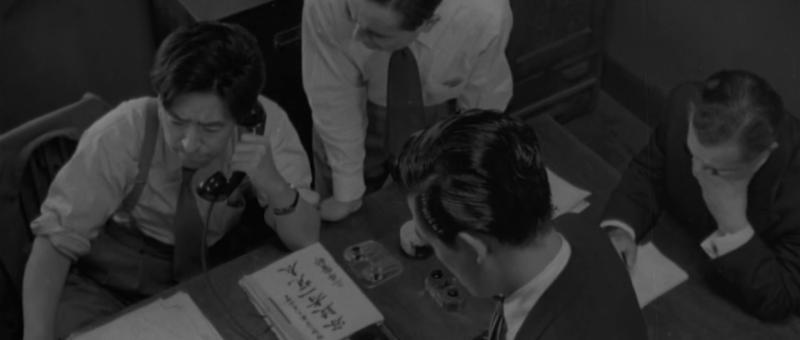
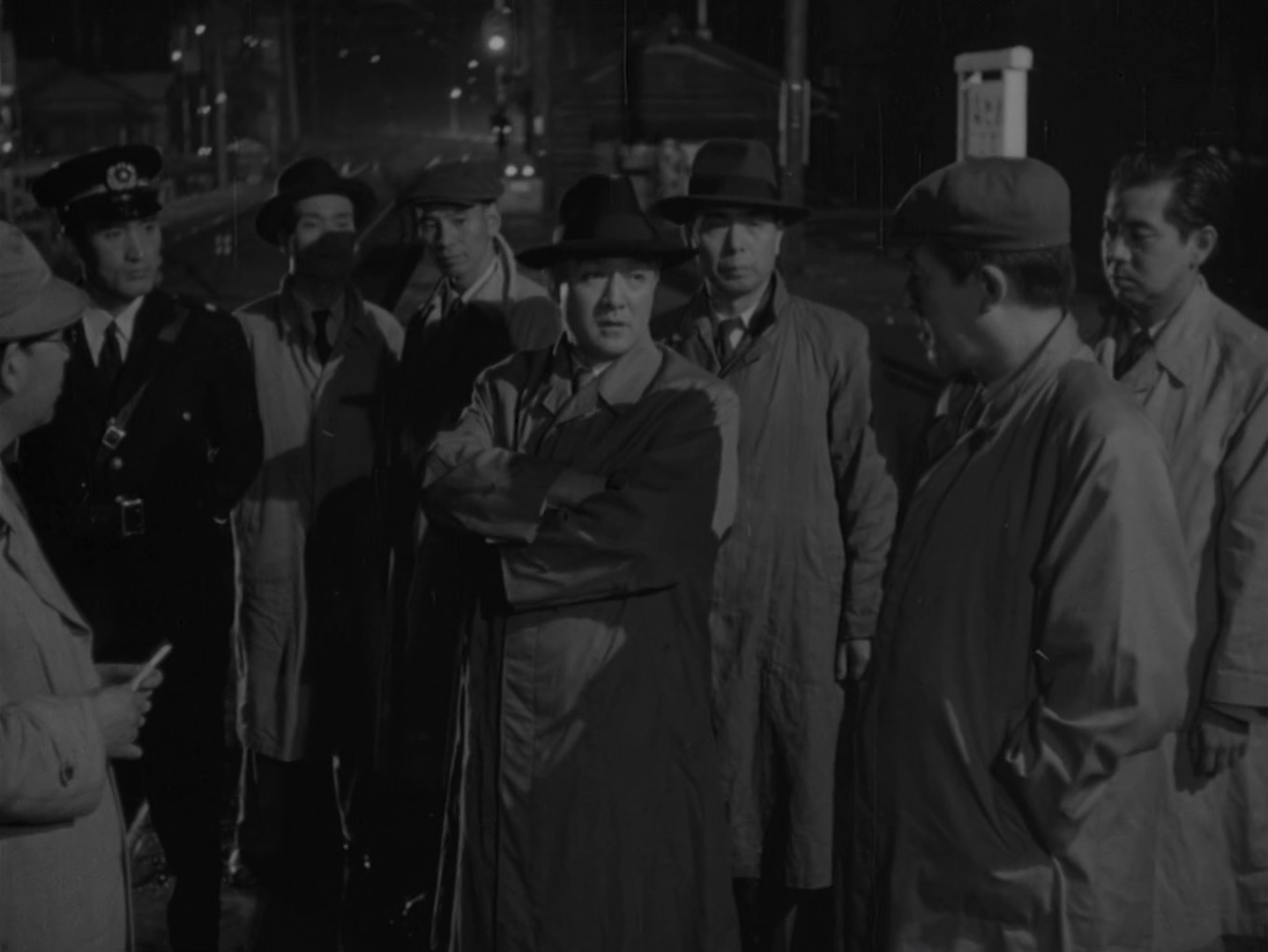
Rather than the hard-boiled tale the title may suggest, Murder on the Last Train (終電車の死美人, Shudensha no Shi Bijin) seems to be one of a number of films made in the early post-war era designed to improve the reputation of the police force. Just as in Bullet Hole Underground, we’re shown several scenes showcasing police technology and depicting detectives as men of science rather than an authoritarian force extracting confessions and pressuring suspects. The film went on to inspire a long-running series of police procedurals, and is shot in the style of a documentary lending an air of realism to its tale of murder, desperation, and spiralling debt.
Yet all the police know in the beginning is that a young woman has been found dead on the last train out of the city at its final stop of Mitaka. Times being what they are, they don’t even know who she is, and have only slim leads to go on such as the possible sighting of a middle-aged man running away across the tracks, though it was dark and raining so no one can be quite sure. Nevertheless, we quickly see the law enforcement machine spring into action. The call centre is alerted and arranges for detectives from the top murder squad to attend the scene. The narrator tells us that they are ready to respond at any time of day or night, and that, like a pack of wolves after their prey, they will not rest until they’ve apprehended the guilty party. The way this and the closing statement are phrased makes it sound a little like the squad is sort of eager for a murder to occur to have something to do, which probably isn’t the intention but does make them seem a little blood thirsty. Especially as one of the policemen we’re introduced to is said to care about nothing other than murder.
Nevertheless, the narrator introduces us to all of the squad members who each have their quirks from the henpecked husband to the former monk. There’s a running gag that they can’t get anything done at their office because of constant noise outside from advertisements, festivals, and children singing. Despite all of their technological advances, all they can really do to begin with is wander round Mitaka with photos of the victim along with one of a man found inside a locket she was carrying, asking local people if they know them. They can only assume the woman must have lived in Mitaka because she was presumably killed between the previous stop and the train’s final destination, but there are other reasons she may not have alighted earlier.
The trail eventually leads them to a land broker, Hayakawa (Eijiro Tono), who has a solid alibi but is acting in an incredibly suspicious way. He also turns out to be in mountains of debt, and may have been acting recklessly trying to right himself financially, while a young man he’s acquainted with, Saburo, may have equally been hooked on the idea of living the high life on stolen money. Another man has been embezzling from his company with no real explanation given as to why save possibly trying to get himself into a financial position appropriate for marriage. The implication that this economy is still a crime factory filled with desperate people who do anything they can either to escape their straitened circumstances or protect what they have.
That might be one reason the police, who all seem very nice and, in general, treat suspects and witnesses kindly and with respect, are keen to get away from the idea the murder may have been a random crime perpetrated by someone trying to ease their frustration or strike back against society. People can feel reassured that this young woman’s death can be explained because it means they are in less danger from a threatening world. The policemen are also there to provide that reassurance, suggesting that any crime that occurs will be swept away neatly, without really dwelling on the other implications of a super-powered police force. The narrator explains that most crimes are committed simply, and for simple reasons, which is comforting, in a way, but also not. In any case, the central message is that modern law enforcement is scientific and compassionate, and the police force a well-oiled machine designed to protect all citizens from the threat of crime wherever and whenever it may arise.
 For one reason or another, the 1970s gave rise to a wave of disaster movies as Earthquakes devastated cities, high rise buildings caught fire, and ocean liners capsized. Japan wanted in on the action and so set about constructing its own culturally specific crisis movie. The central idea behind The Bullet Train (新幹線大爆破, Shinkansen Daibakuha) may well sound familiar as it was reappropriated for the 1994 smash hit and ongoing pop culture phenomenon Speed, but even if de Bont’s finely tuned rollercoaster was not exactly devoid of subversive political commentary The Bullet Train takes things one step further.
 Windows on Worlds