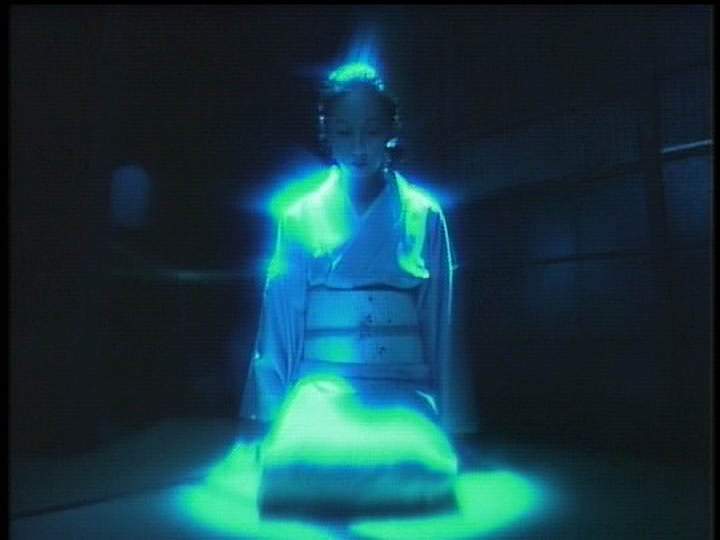
Legend of the Cat Monster (麗猫伝説, Nobuhiko Obayashi, 1983)

Produced as a special marking the 100th episode of the Tuesday Night Suspense Theatre TV drama series, Nobuhiko Obayashi’s Legend of the Cat Monster (麗猫伝説, Reibyo densetsu) is preceded by a title card reading “Elegy for a Faraway Film”. Scripted by Chiho Katsura, the film is indeed in its way a lament for dying world albeit one which owes a heavy debt to Billy Wilder’s Sunset Boulevard with a little Fedora thrown in. Repurposing the classic ghost cat film it casts cinema itself as dangerous illusion, a vampiric compulsion that drowns all who encounter it in irresolvable longing. 

This sense of irrecoverable nostalgia is palpable from the opening sequence which, aside from the melancholy voiceover, introduces us to the world of Setouchi Cinema apparently a moribund studio complex once dubbed the Hollywood of Japan. The new arrival, Ryohei (Akira Emoto), is dressed in noticeably anachronistic fashion as if he were a 1930s newsboy rather than a young man living in the Japan of the early 1980s. His girlfriend, Ryoko (Jun Fubuki), who works as a stage hand dresses in a similarly old-fashioned style and in fact carries an oversize watch that was a heirloom from her late father, an unsuccessful film director. Ryoko remarks that she’s been hoping someone would come and rescue her from this half-dead island but she doubts Ryohei will be the one to do it because he has also come here in search of a dream. 

That dream is, however, already dead at least according to some. The film director working at the studio is berated by a woman of around the same age working as a manager for an idol star for still getting an allowance from his mother at 60 because he has failed to make it as a film director at least in financial terms. There is a poignant, largely unexplored subplot between that suggests the inability to reconcile the dream of cinema with the economic “reality” has kept them apart all these years and that their dream of love may now be over too. 

It seems that the reclusive actress at the film’s centre, Akiko (Wakaba Irie), is also living on a frustrated dream of love withdrawing from the world around her believing that her lover will someday return from “Hollywood” which seems to be another word for paradise or perhaps the world beyond on the other side of the silver screen. To her, film is but a dream with in a dream. A window or screen is a portal to the burdens of the heart, memories of days gone by, and the illusions we once saw that cannot be seen again.  She herself is trapped within her own dream of love, but it is not so much a dream of her that bewitches Ryohei but the impossibility of cinema.

When passing photographer, Tachihara (Toru Minegishi), who lost his own wife to the unobtainable magic of the movies, snaps a picture of Akiko at her window holding a cat and looking exactly as she did the day she abruptly walked out on an incomplete film, it spurs a cynical producer to get the idea of convincing her to make a comeback and in a ghost cat movie, no less. Obayashi’s casting coup is getting mother and daughter Takako and Wakaba Irie to play aged and youthful versions of the famous actress, Takako herself having been a huge star of the 1930s performing most notably for Kenji Mizoguchi in the The Water Magician. There is an undeniable poignancy in her reflection that is only her aging body which is dying, as if she were merely becoming an embodiment of her image migrating to silver screen which exists between this world and next. It’s this screen that is later ruptured by Ryoko as she makes her escape after failing to save Ryohei from the curse of cinema. 

As Akiko laments, he’s writing his script more for himself than for her and it’s the quest for art which has begun to drain and make him mad. When he, pale and zombie-like, attempts to proffer his scripts it appears to be nothing more than his own name written over and over again. Like the Max-esque butler Mizumori (Akira Oizumi) says, film is an eternal dream which by its definition can never realised and exists only a state of longing somewhere beyond the veil. Drawing inspiration from Nobuo Nakagawa in particular and harnessing the sense of gothic dread found in Sunset Boulevard, Obayashi captures the eternal nightmares of artistic creation with the maddening obsessions of unrequited love and the image of the ideal which exists eternally out of reach somewhere on the other side of the screen.

Typhoon Club (台風クラブ, Shinji Somai, 1985)

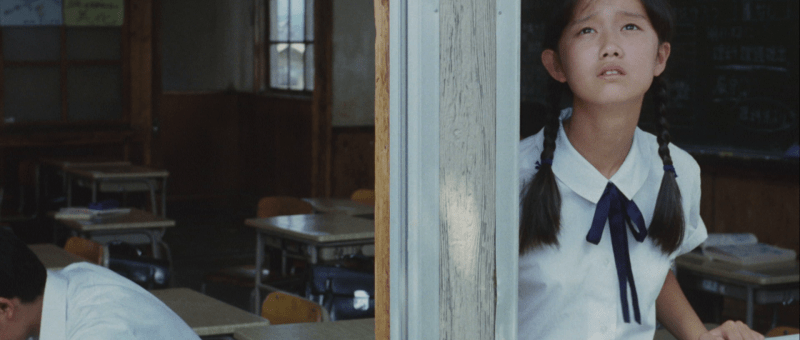
A collection of frustrated teens find themselves trapped within a literal storm of adolescence in Shinji Somai’s seminal youth drama Typhoon Club (台風クラブ, Taifu Club). “You’ve been acting weird lately” one character says to another, but he’s been “acting weird” too and so has everyone else as they attempt to reconcile themselves with an oncoming world of phoney adulthood, impending mortality, and the advent of desires they either are unable or afraid to understand, or perhaps understand all too well but worry they will not be understood. 

Most of the teens seem to look to the pensive Mikami (Yuichi Mikami) as a mentor figure. It’s Mikami they call when some of the girls end up half drowning male classmate Akira (Toshiyuki Matsunaga) after some “fun” in the pool gets out of hand. Luckily, Akira is not too badly affected either physically or emotionally, but presents something of a mirror to Mikami’s introspection. Slightly dim and etherial, he entertains his friends by seeing how many pencils he can stick up his nose at the same time, but he’s also as he later says the first to see the rain once it eventually arrives. Notably he leaves before it traps several of the others inside the school without adult supervision and otherwise misses out on the climactic events inside. Even so, Rie (Yuki Kudo), who also misses out by virtue of randomly stealing off to Tokyo for the day, later remarks that he too seems like he’s grown though her words may also be a kind of self projection. 

Mikami’s kind of girlfriend, perpetual spoon-bender Rie, finds herself at a literal crossroads after waking up late because her mother evidently did not return home the night before. Eventually she sets off for class running all the way, but then reaches a fork in the road and changes her mind heading to Tokyo instead. Mikami has been accepted into a prestigious high school there, and perhaps a part of her wanted to go too or at least to get closer to him through familiarity with an unfamiliar environment. Unfortunately she soon encounters a firearms enthusiast (Toshinori Omi) who buys her new clothes and takes her back to his flat which she thankfully manages to escape even if she’s stuck in the city because of a landslide caused by the typhoon.  

Mikami, however, continues to worry about her unable to understand why he’s the only one seemingly bothered about her whereabouts believing she’s “gone crazy”. Trapped in the school, the kids try to ring their teacher Umemiya (Tomokazu Miura) for help but he’s already drunk and can’t really be bothered. In any case he has problems of his own in that his girlfriend’s mother suddenly turned up during class to berate him for stringing her daughter along and also having borrowed a large amount of money which obviously ought to have some strings attached, only as it turns out Junko leant the money to another guy she was seeing though it’s not exactly clear whether she and Umemiya actually broke up or not. “In 15 years you’ll be exactly like me” Umemiya bitterly intones into the phone when Mikami directly states that he no longer respects him deepening Mikami’s adolescent sense of nihilistic despair. 

Of all the teens, he does seem to be the most preoccupied with death. “As long as she’s an egg, the hen can’t fly” he and his brother reflect on discussing if it’s possible for an individual to transcend its species and if it’s possible to transcend it though death all of which lends his eventual decision a note of poignant irony even if its absurd grimness seems to be a strange homage to The Inugami Family. As he points out to his somewhat disturbed friend Ken (Shigeru Benibayashi), “I am not like you” and indeed Ken isn’t quite like the other teens. Obsessed with fellow student Michiko (Yuka Ohnishi) but unable to articulate his feelings, Ken pours acid down her back and watches her squirm as it eats into her flesh. Repeating pleasantries to himself as a mantra, he later attempts to rape her after violently kicking in the dividing walls of the school only to be stopped in his tracks on noticing the scar again and being reminded that he is hurting her. 

The storm seems to provoke a kind of madness, the teens embracing an elusive freedom entirely at odds with the rigid educational environment. The other three girls trapped in the school are a lesbian couple who’d been hiding out in the drama department and their third wheel friend who might otherwise have been keen to hide their relationship from prying eyes having previously been caught out by a bemused and seemingly all seeing Akira. But in this temporary space of constraint and liberation, the teens are each free for a moment at least to be who they are with even Ken and Michiko seemingly setting aside what had just happened between them. They co-opt the stage for a dance party and then take it outside, throwing off their clothes to dance (almost) naked in the rain while a fully clothed Rie does something similar on the streets of the capital. In some ways, in that moment at least they begin to transcend themselves crossing a line into adulthood in a symbolic rebirth. In any case, Somai’s characteristically long takes add to the etherial atmosphere as do his occasional forays into the strange such as Rie’s encounter with a pair of ocarina-playing performance artists in an empty arcade. “We want to go home, but we can’t move” Mikami says looking for guidance his teacher is unwilling to give him neatly underlining the adolescent condition as the teens begin realise they’ll have to find their own way out of this particular storm. 


Typhoon Club screens at Japan Society New York on April 28 as part of Rites of Passage: The Films of Shinji Somai

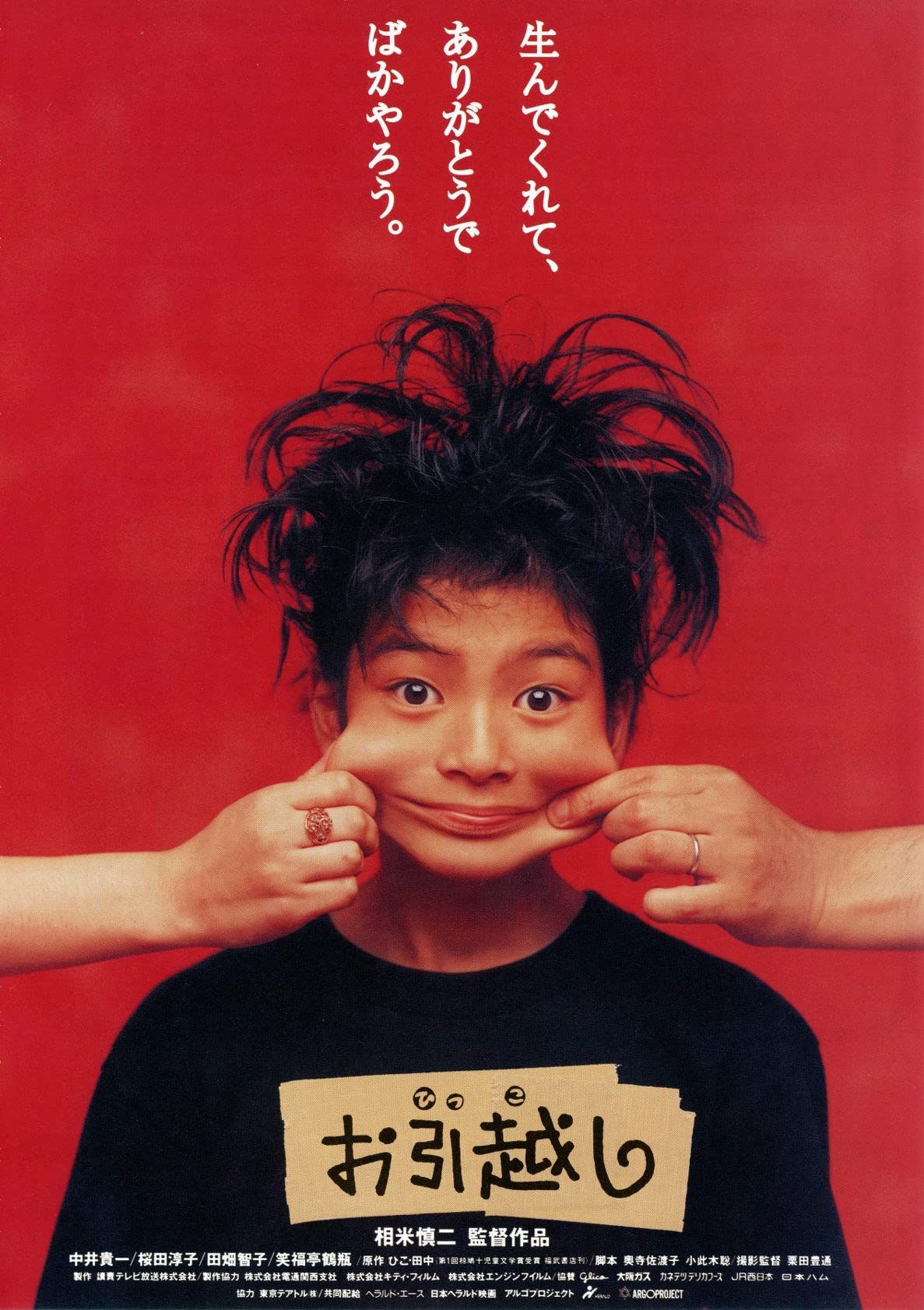
Moving (お引越し, Shinji Somai, 1993)

The title of Shinji Somai’s 1993 coming-of-age drama Moving (お引越し, Ohikkoshi) quite literally refers to the process of vacating one space in order to inhabit another but also to the heroine’s liminal movement into a space of adulthood while caught in the nexus of a recently destabilised society itself in a state of flux. Not only must she process the disruption of her father’s decision to leave the family home, but its wider implications that will one day leave her orphaned while coming to accept that such partings are only a part of life to borne with stoicism and sympathy. 

At around 12 or so, Renko (Tomoko Tabata) finds herself on the brink of change. Not only is she beginning to grow up, soon to be changing schools, but is also facing a further destabilisation of her home as her parents prepare to separate. The tension in the household is clear from our first meeting with the family as they sit around an almost violent, green triangular table the point aimed straight at us with Renko at the opposite end and her near silent mother and father on either side. As she often will, Renko attempts to parent her parents, repeatedly criticising her father for his poor table manners wondering if he’ll be able to take care of himself when living alone while later remonstrating with her mother for having had too much to drink while cautioning her to mind what the neighbours might think. 

Already unbalanced by the economic shock of the bubble bursting, the Japanese society of the early 90s was also changing evidenced in part by the separation itself. Divorce is still a minor taboo, even Renko herself had taken part in the shunning and bullying of another girl who’d transferred to their school after returning to her mother’s hometown following her parents’ separation, but this is perhaps the first era in which it becomes acceptable to end a marriage solely because one or both parties is unhappy rather than there being some additional pressure that endangers the family. “Marriage is survival of the fittest”, Renko’s mum Nazuna (Junko Sakurada) later exclaims during a heated exchange but we can also see that the marriage itself was already unusual perhaps uncomfortably suggesting an altered power balance and shifting gender roles led to its breakdown. Father Kenichi (Kiichi Nakai) had previously worked from home completing many of the domestic tasks while Nazuna had become the breadwinner with a successful career earning higher salary. She complains that when she was pregnant with Renko Kenichi sniped at her for not contributing to the household financially but changed his tune when her economic success undercut his sense of masculine pride. 

Despite apparently embracing her freedom Nazuna nevertheless seems to resent Kenichi for leaving, accusing him of deserting his family while he later floats the idea of trying again but only perhaps because he is feeling the ache of the loss of the home he previously hinted suffocated him in responsibility. Meanwhile, Renko is also forced to process the fact that a family friend, Yukio (Taro Tanaka), on whom she’d had an innocent childish crush, is engaged to be married. Overhearing their conversation she also learns that his fiancée is pregnant but unsure about having the baby. Given all of these changes, she begins to wonder why it is she was born, intensely anxious in potential parental abandonment while witnessing the remaking of her home. 

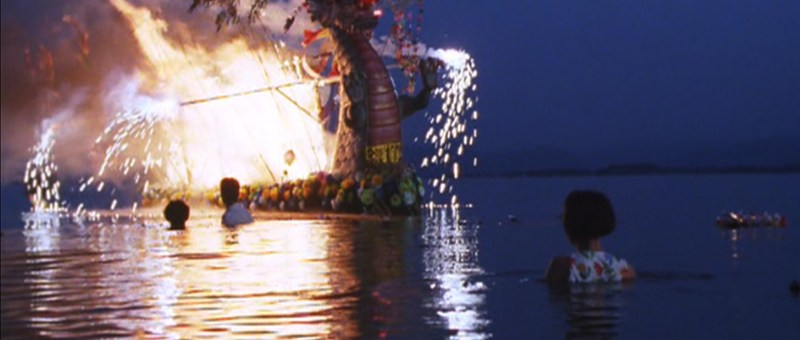
Yet to cure her of her anxiety Somai removes her from her environment, Renko once again taking on a parental role in borrowing her mother’s credit card to book a hotel and train tickets to a familiar destination they’d previously travelled to as a family. It’s in this liminal space that Renko begins roam, eventually encountering an old man with some important life lessons while undergoing a spiritual odyssey of her own as she weaves through a summer festival towards an ethereal encounter with her past self and the spectre of her future orphanhood. Somai’s characteristically lengthy tracking shots add to the sense of destabilisation, Renko’s world constantly in motion yet as she tells us herself she’s on her way to the future, moving on but on a more equal footing and discovering at least a sense of equilibrium in an ever shifting society.


Moving screens at the BFI on 29 December as part of BFI Japan.

Blue Lake Woman (青い沼の女, Akio Jissoji, 1986)

vlcsnap-2016-11-15-01h56m08s744Akio Jissoji had a wide ranging career which encompassed everything from the Buddhist trilogy of avant-garde films he made for ATG to the Ultraman TV show. Post-ATG, he found himself increasingly working in television but aside from the children’s special effects heavy TV series, Jissoji also made time for a number of small screen movies including Blue Lake Woman (青い沼の女, Aoi Numa no Onna), an adaptation of a classic story from Japan’s master of the ghost story, Kyoka Izumi. Unsettling and filled with surrealist imagery, Blue Lake Woman makes few concessions to the small screen other than in its slightly lower production values.
Successful artist Nagare had a serious following out with one of his oldest friends five years ago and is so rather stunned to receive an invitation to his wedding. Nagare had been invited to paint the portrait of Takigawa’s father and then asked to stay at his home for an extended period whilst Takigawa travelled in Europe buying art. Tokigawa’s father was old and frail and therefore retired to an annex each night at 8pm leaving Nagare entirely alone in the house alongside Takigawa’s wife, Mizue. The inevitable occurs when the lonely and neglected Mizue falls for the handsome painter but the romance turns dark when she talks Nagare into a double suicide at Blue Lake. Mizue drowns herself but Nagare survives only to be rescued and confined to a mental hospital.

Now five years later Takigawa wants to forget (if not quite forgive) the past and start again with a new wife by his side. The funny thing is wife number two, Ameko, is the spitting image of Mizue. When Takigawa once again asks him to stay alone in the house with his new wife whilst he jets off to America, Nagare begins to wonder exactly what’s going on. Staying at the house a second time, Nagare finds himself haunted by the ghost of the woman who died for him, but whose sacrifice he ultimately rejected. Mizue seems to want him to come to her at the bottom of Blue Lake, but Nagare still lacks the courage to take his own life, if not the inclination. Thinking of Mizue but inevitably becoming closer to Ameko, Nagare is trapped between the living and the dead but it turns out there may be more than supernatural intrigue to his darkly romantic adventures.

Jissoji creates an oppressive and creepy atmosphere for the woodland mansion noisy with the sound of a hundred ticking clocks, filled with shadows and shot from odd angles. Nagare begins to dream strange dreams in which Mizue comes to him, leaving watery footprints and her signature comb behind her to indicate that her presence is not limited to the dream world. Complaining that she’s “alive” beneath the mud next to Blue Lake where she’s cold and lonely, Mizue waits for him to make good on his promise and join her there. Nagare remains unsure if this Mizue is a manifestation of her grudge towards him, or simply a manifestation of his own guilt in allowing her to die alone.

Trapped in Vertigo-esque conundrum torn between the living Ameko and the dead Mizue, Nagare
finds himself in an impossible position unable to clearly distinguish between the two women, at one point physically attacking Ameko believing her to be Mizue’s ghost. It remains unclear if the resemblance between Mizue and Ameko is real or a figment of Nagare’s imagination prompted by both women’s position as Takigawa’s wife and by their watery names (“mizue” literally meaning “water picture” and “Ameko” “rain child”) both of which lead him straight back to Blue Lake. If it’s death Nagare is chasing rather than either women or friendship, he is ultimately unable to follow through on his desires all the while protesting that it’s “desire” which holds him among the living.

The supernatural elements are emphasised and undercut by turns as Nagare discovers their may be a more solid, real world cause for the strange events plaguing him. Still, the past continues to haunt Nagare in one form or another leaving unexplained and half remembered events to linger in his memory, rendering his reality continually unstable. As her name suggests, the ghostly Mizue is always shown in a hazy, watery blue, radiating waves of unease designed to pull Nagare back to the failure of his love suicide and at least as far as his art life in concerned, there’s part of him always submerged beneath the waters of Blue Lake. Even if not quite reaching big screen standards, Blue Lake Woman displays high production values for a 1980s television special anchored by naturalistic performances and innovative camera technique. Filled with Jissoji’s idiosyncratic surrealist imagery, Blue Lake Woman is a haunting, gothic ghost story which refuses to give up on its supernatural chills even whilst proffering a more rational explanation for all of its strange goings on.


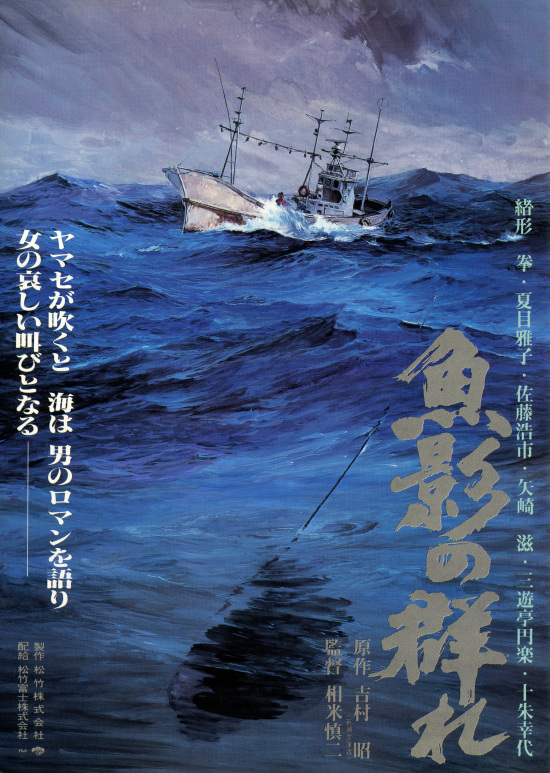
The Catch (魚影の群れ, Shinji Somai, 1983)

the-catch

Some men become their work, the quest for success consumes them to the extent that there is barely anything left other than the chase. The Catch (魚影の群れ, Gyoei no Mure), Shinji Somai’s 1983 opus of fishermen at home on the waves and at sea on land is a complex examination of masculinity but also of fatherhood in a rapidly declining world filled with arcane ritual and ancient thought.

Fusajiro (Ken Ogata) is a middle aged man who looks old for his years. Man and boy he’s spent his life at sea, hunting down the elusive tuna fish which can be sold for vast amounts of money in the rare event that one is actually caught. This “first summer” as the title card refers to it, marks a change in his life as the daughter he’s been raising alone since his wife left him many years ago, Tokiko (Masako Natsume), has found a man she wants to marry. Her boyfriend, Shunichi (Koichi Sato), owns a coffee shop in town and Fusajiro has his doubts about a city boy marrying into a fisherman’s family. However, Shunichi isn’t just interested in Tokiko, he wants to set sail too. Though originally reluctant, Fusajiro eventually agrees to take Shunichi as a kind of apprentice but is dismayed when he gets seasick and seems to have no hint of a fisherman’s instinct.

Fusajiro is a legend among his peers – a big man of the sea, a true sailor and top hunter. He’s the one people turn to whenever anything goes wrong on the waves. However, he’s also a gruff man who speaks little and seems to prefer his own company.  In the rare event that he is speaking, it’s generally about tuna. When Shunichi first meets Fusajiro he remarks that he knew it must be him because he “smells of the sea”.

A later scene sees Fusajiro catch sight of a woman caught in the rain who immediately starts running away from him. Chasing her  just like one of his ever elusive tuna he eventually pins the woman down and takes her back to his boat to complete his conquest. The woman turns out to be his ex-wife, who left him precisely because of this violent behaviour. After momentarily considering returning to him, she realises that he hasn’t changed and accuses him of being unable to distinguish people from fish – he hooks them, reels them in, and if they don’t come willingly he hits them until they do so he can keep them with him. This overriding obsession with domination also costs Fusajiro his daughter when Shunichi is gravely injured on the boat and Fusajiro delays returning to port until he’s secured the tuna he was chasing at the time. Shunichi’s blood and the fish’s mingle together on the deck, one indistinguishable from the other, both victims of Fusajiro’s need to reign supreme over man and fish alike.

Fusajiro tried to warn Tokiko not to marry a fisherman, it would only make her miserable. Shunichi is warned that a fisherman’s life is a difficult one and the seas in this area less forgiving than most, but his mind is made up. Finally acquiring his own boat after selling his cafe, Shunichi, just like Fusajiro, starts to fall under the fisherman’s curse – endlessly chasing, living only for the catch. Unlike Fusajiro, however, Shunichi has little instinct for life at sea and fails to bring home his prey. Little by little, the mounting failures eat away at his self esteem as he feels belittled and humiliated in front of the other sailors culminating in an attempt to reinforce his manhood by raping his own wife. These men are little better than animals, consumed by conquest, permanently chasing at sea and on land. To be defeated, is to be destroyed.

Somai never shies away from the grimness and brutality of the work at hand. Ogata catches and spears these magnificent fish for real and the unfortunate creatures are then carved up right on the dockside before our very eyes. As we’re constantly reminded, physical strength is what matters for a fisherman and Fusajiro is a strong man, duelling with the tuna fish and straining to hold the line with all his might. Yet he’s getting old, his body is failing and like an aged toreador in the ring, his victory is no longer assured. The Japanese title of the film which translates as crowds of shadows of solitary fish expresses his nature more clearly, his fate and the tuna’s are the same – a lonely battle to the death. Unable to forge real human connections on land Fusajiro and his ilk are doomed to live out their days alone upon the sea wreaking only misery for those left behind on the shore.


Original trailer (No subtitles, graphic scenes of animal cruelty)