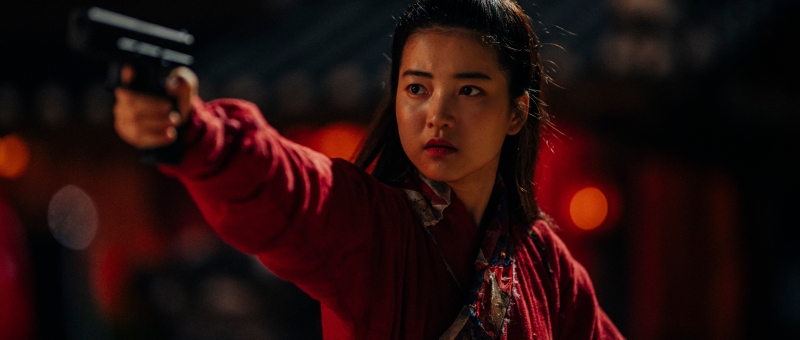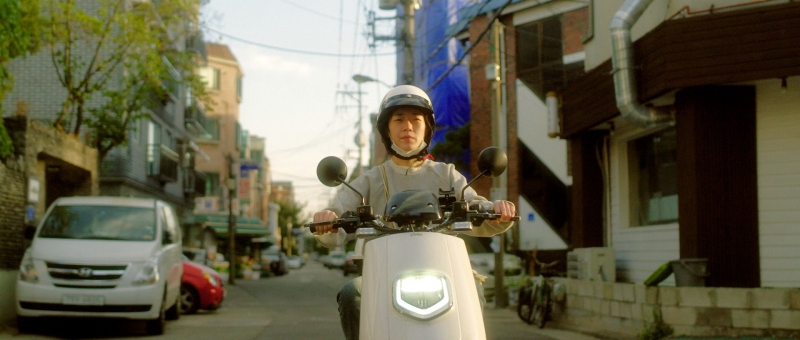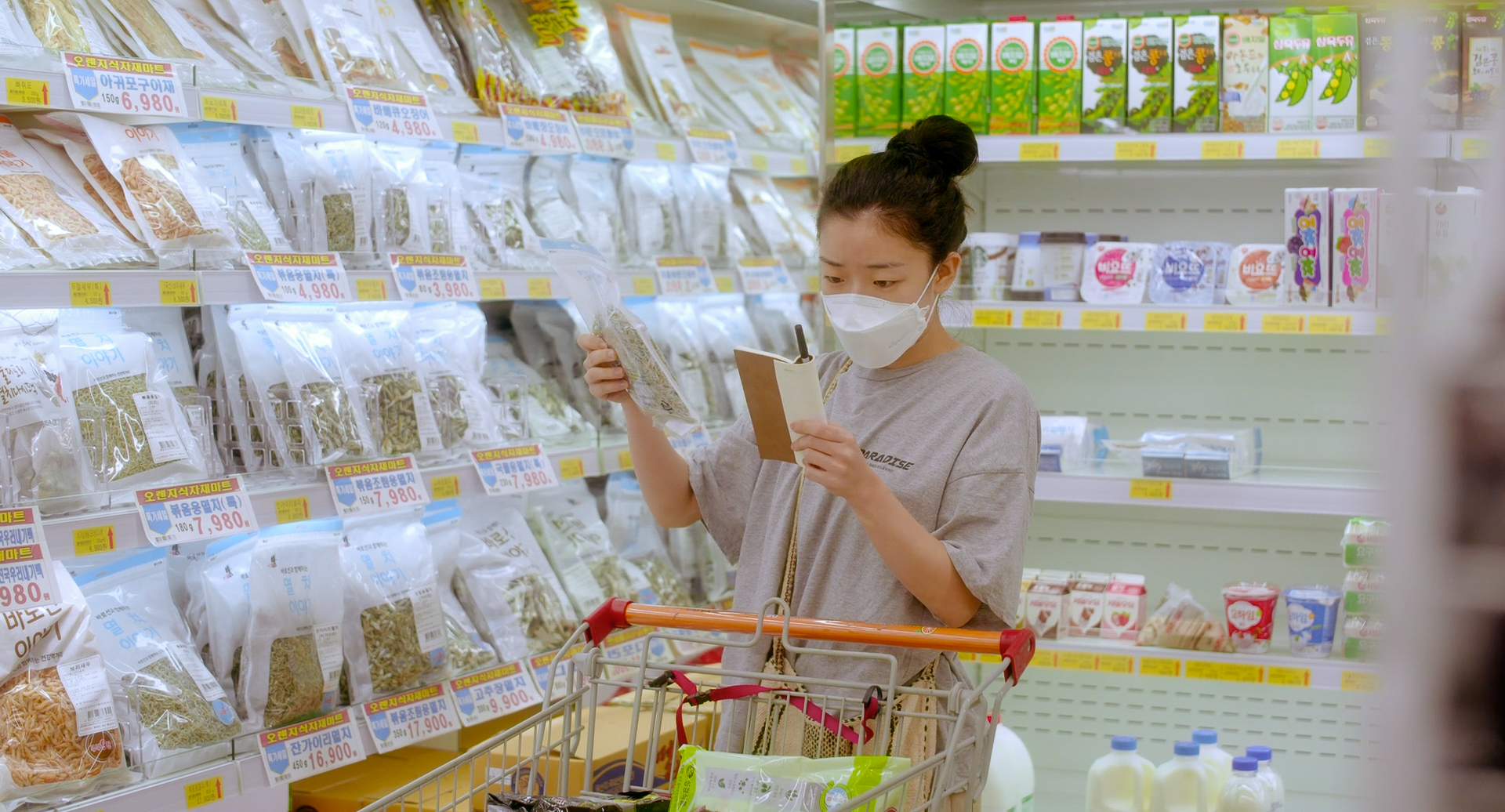
Following (그녀가 죽었다, Kim Se-hwi, 2024)

“None of this would have happened if you didn’t follow me,” the hero of Following (그녀가 죽었다, Geunyeoga jug-eossda) is told by his opposite number though he himself doesn’t see anything untoward about his voyeuristic hobby and justifies his habit of “peeping” into the lives of others on the grounds that it does no harm. Of course, he’s not very well placed to make that decision and too narcissistic to consider that while he watches someone may be watching him. 

In any case, what Jung-tae (Byun Yo-han) claims to want to see is “the real you” rather than the persona created for public consumption which is why he’s drawn to duplicitous influencer Sora (Shin Hye-sun) whom he spots simultaneously munching on a sausage and posting about eating a vegan salad. Of course, as an influencer “followers” are what most she most craves though not of the kind Jung-tae becomes nor does she want this particular kind of attention not least because it threatens the facade she’s created for herself as a “good person” posting about her altruistic deeds such as rescuing dogs and cats for which her followers send her monetary gifts and donations for various funds and charities. 

As for himself, Jung-tae thinks he remains a fairly anonymous person. As an estate agent, he projects an image of himself as being kind and trustworthy, while he runs a popular online blog under a pseudonym. He gives little of himself away and later acknowledges that part of the thrill of his voyeurism is a sense of superiority, that he is privy to privileged information about strangers that others do not have. Misusing his position, he sneaks into people’s houses and takes something insignificant as a trophy while also performing small household tasks in recompense. Perhaps it should have seemed like a red flag to him that Sora suddenly wanted to sell her apartment (on her landlord’s behalf), let alone that she didn’t make any attempt to tidy up before giving him a key, but he is so assured of himself that the possibility he has been discovered doesn’t really occur to him until he sneaks into Sora’s place and finds her dead, covered in blood on her living room sofa. Predictably, he does not call the police because he’d have to admit he let himself into her apartment when he shouldn’t have. 

Receiving a threatening letter, Jung-tae then becomes a classic wrong man in the firing line for Sora’s murder and in his mind unfairly persecuted for his “harmless” hobby. The irony is that the person who’s targeting him is doing so because they had something they did not wish others to see and fear Jung-tae may have done so which would give him power over them, while what Jung-tae wants to keep hidden is his own voyeurism. “It’s all about reputation,” he explains and his would be ruined if his clients knew he’d been misusing the keys they entrusted to him for professional purposes let alone the embarrassment of being exposed as a peeping tom even if in this case his peeping isn’t sexual but intimate on another level. 

The power dynamics between the seer and the seen are always shifting, not least because Jung-tae believed himself invisible and in fact continues to think that he is the victim as does the person targeting him. He later comes to realise that what he did was wrong and that he invaded these people’s privacy, but continues to centre himself and despite the glasses he now wears at the film’s conclusion he may not see anything any more clearly than before. What unites him with his own stalker is a sense of frustrated loneliness and longing for connection if also a kind of acceptance even if mediated through a “fake” persona to paper over the cracks in their identity. Yet ironically, even the killer’s words that none of this would have happened if he hadn’t been following them further bolsters his narcissistic sense of importance as much as it reflects the words of an abuser deflecting responsibility for their own actions. Jung-tae has met his mirror image and may not like what he sees (or perhaps does not see at all) while they equally struggle to understand why others cannot see that they are the victim. Told with a touch of humour and a degree of B-movie silliness, Kim Se-hwi’s taut psychological thriller nevertheless suggests that even as we obsess over the image we project to others and that they project to us, we remain largely blind to ourselves and all too keen to justify our actions to maintain a carefully constructed self-hood that is otherwise unlikely to stand up to scrutiny.


Following screened as part of this year’s London Korean Film Festival.

Original trailer (no subtitles)

Killing Romance (킬링 로맨스, Lee Won-suk, 2023) [Fantasia 2023]

A once famous actress sets out to reclaim her autonomy from an abusive, controlling, billionaire husband in Lee Won-suk’s hilariously off the wall comedy Killing Romance (킬링 로맨스). Partly a satire on the extreme power of wealth, social inequalities in contemporary South Korea, toxic masculinity and rampant patriarchy, along with the stigma of failure and loserdom, the film is also an inspirational rallying cry to break of oppressive social codes and embrace your authentic self even if others don’t quite understand. 

It’s a sudden fall from grace for top star Yeo-rae (Lee Hanee) that causes her to rethink her career goals when a sci-fi movie she starred in becomes a cult hit for all the wrong reasons leaving her a national laughing stock derided for her poor performance. Deciding to get out of the spotlight for a while, she travels to the remote island of Qualla but is immediately mugged by locals and rescued by mysterious Korean billionaire environmentalist Jonathan (Lee Sun-kyun) who sees them off with a well placed Taekwondo neck chop. One has to wonder if Jonathan had that set up, but in any case Yeo-rae soon falls in love with her handsome suitor and the pair marry. 

But seven years later it’s clear the marriage has not been a success. Yeo-rae is miserable, trapped in the ostentatious house Jonathan has had built in Seoul which is covered in oversize pictures of himself in muscle poses. He controls everything in her life right down to what she eats because he likes her at a certain weight and even goes so far as to cancel a job offer on her behalf telling the director of a movie she wanted to star in that she’s mentally ill while pelting her with tangerines for daring to envision a life as anything but a doll for him to play with. 

His control over her is born of a sense insecurity that his money cannot cover. Attempting to strike an alpha male persona, Jonathan wears a fake moustache and struts around in ostentatious outfits but is also always accompanied by his well-built bodyguard Bob while waited on hand and foot by twin servants he refers to as “The Susans”. The romantic song he uses to control Yeo-rae through a kind of brainwashing isn’t even his own but a pop hit from 1997, while Yeo-rae tries to recover herself by singing her own iconic hit Yeo-raeism (a repurposed version of the classic hit by Rain, Rainism) with its defiant chorus of “I’m gonna be a bad girl” in her attempt to shake off Jonathan’s patriarchal programming. 

Jonathan’s bid for hyper masculinity, his hatred of losing, is subverted in the the softness of Yeo-rae’s top fan Bum-woo (Gong Myung) who is perpetual student on his fourth attempt to get into Seoul University in the hope of fulfilling familial expectations. On realising his new next-door neighbour is none other than his favourite idol, Bum-woo figures out that she’s trapped and abused by Jonathan and is determined to rescue her even if it means killing him but is in reality too nice to carry it through. A bizarre series of assassination plots using paper aeroplanes and Jonathan’s personal kryptonite peanuts along with an attempt to steam him to death in a sauna flounder when a remorseful Bum-woo saves him at the last second potentially swayed by Jonathan’s promise to “change his life” in gratitude. But in the end neither he nor Yeo-rae are fully capable of actually killing him or escaping his control. After all, “Jonathan is above the law” as Yeo-rae laments.

Then again, even he seems to be a little swayed by her song as do his yellow-clad henchmen slowly moving to the music persuaded by her beat over his. The battle ends in a huge sing-off in which Yeo-rae is joined by her ever supportive fan club and finally gets to dance to her own tune accompanied by a cohort of “losers” fighting back against sneering chaebol oppression though vengeance eventually comes from an unexpected source. Quirky in the extreme, Lee plays with a retro ‘70s aesthetic framing the story as a fairytale performed Log Lady-style by an old woman for a TV children’s book hour while throwing in constant references to ostriches and tangerines along with zany karaoke and musical sequences in a deadpan fantasia of self-actualisation that is quite simply sublime.


Killing Romance screened as part of this year’s Fantasia International Film Festival.

International trailer (English subtitles)

Alienoid (외계+인 1부, Choi Dong-hoon, 2022)

According to the strangely warmhearted AI robot at the centre of Choi Dong-hoon’s Alienoid (외계+인 1부), the universe is already finished, destined only to tear itself apart in destructive instability. According to him, his society evolved, became compassionate and forgiving, yet like many others sought to avoid a problem it did not want to deal with in exiling its most dangerous prisoners to the minds of oblivious Earthlings who apparently rarely realise they’re sharing body and soul with an alien killing machine until that is one decides to escape. 

Thunder (Kim Dae-myung), an AI unit accompanying the sullen Guard (Kim Woo-bin) who is also a kind of guardian, paints the aliens as dangerous mutants who live only for violence yet it might be worth considering that their rebellion may be justified as members of an oppressed minority apparently considered harmful to mainstream society were it not for the fact their plan involves poisoning the Earth’s atmosphere to free their brethren while suffocating humanity in the process. Guard is fond of saying that he cares nothing for humans and does not involve himself in human affairs, yet it’s obvious that as much as his duty is to ensure the aliens stay captive he feels a responsibility to protect humanity, coming to care for an infant child Thunder spirited away in compassion after its mother died when the alien hosted inside her tried to escape. 

There is something a little curious in the fact these alien beings have chosen to live in what is our present day when according to them time is not linear but happening all at once and they appear to have the ability to travel through it at will, even stashing mutant criminals back in the 14th century where a Taoist dosa magician, “The Marvellous Muruk” (Ryu Jun-yeol) is on the hunt for the Divine Blade and a young woman who “shoots thunder” (Kim Tae-ri). Alien technology may seem like magic even if rooted in “science”, but feudal Korea is a place of majestic fantasy in which wizardry is apparently very real to the extent that a pair of powerful sorcerers tour the land hawking magical supplies such as random sutra stickers and mirrors that enlarge whatever passes through them to mysteriously masked warrior monks. Yet as we can see the girl who shoots thunder is merely welding a pistol, a kind of halfway house of technology which seems like strange magic to the people of Goryeo but nothing more than a child’s toy to the laser-wielding robotic aliens. 

In any case, Choi eventually connects these two worlds bridged by temporal conspiracy as if implying that the future’s salvation lies only in the past. Guard is forced to reflect that their strange act of colonial imperialism in secretly implanting alien prisoners in human minds may have been misguided when challenged by his plucky little girl (Choi Yu-ri) who has already realised there’s something a little different about her distant dad while the fact she’s effectively being raised by two men passes as incidental detail even as the Guard is stalked by her best friend’s apparently smitten aunt (Lee Honey). 

This being the first instalment in a two part film, there is a notable lack of resolution in its closing moments though Choi excels in world building running from hard sci-fi to feudalistic fantasy imbued with the strange magic of technology and underpinned by an interrogation humanity as the heroes battle through time looking for a way to repair an “unstable” world ruled by greed and violence and largely find it in each other. While the chief thrill may come from the incongruity of a young woman firing a pistol in the age of the crossbow (not to mention blasting her way out of a coffin), Choi packs in a series of innovative action sequences shot with a knowing irony as Muruk faces off against the masked monks in the past while the Guard and Thunder try their best to keep the aliens at bay with their high tech weaponry, shooting electric pulses from their palms and dodging lasers but still making a last ditch attempt by leaping at the enemy spaceship and trying to stab it in the heart. Whether this disordered world can be stabilised through a moment of cosmic connection will have to wait for part two, but this opening instalment at least is quite literally a charming affair.


Alienoid is in US cinemas from Aug. 26 courtesy of Well Go USA.

US trailer (English subtitles)

Rolling (말아, Kwak Min-seung, 2021)

A young woman begins to find new purpose in the wake of global pandemic and unrelated familial loss in Kwak Min-seung’s charming indie debut, Rolling (말아, Mala). Trapped in an arrested adolescence of snack food and video games, Kwak’s heroine drifts along without direction still dependent on her ageing mother while reluctant to move forward or accept responsibility, yet after some gentle prodding perhaps begins to realise that different doesn’t necessarily mean wrong and that there are things she she may be good at if only she gave herself the chance. 

25-year-old Juri (Shim Dal-gi) dropped out of college and doesn’t seem to be doing much of anything at all which is perhaps understandable given it’s the middle of a global pandemic. Her mother Young-shim (Jung Eun-kyung), meanwhile is in something of a fix seeing as her kimbap cafe is already struggling with customers preferring to stay at home while the bills continue to climb just as she needs to take some time off to look after her own mother who has recently been taken ill. Seeing as Juri never answers her text messages, Young-shim takes the drastic step of putting Juri’s flat, on which she co-signed, on the market in order to get her attention, presenting her with the ultimatum that she either watch the store while she’s away or prepare to move out. Though reluctant, Juri agrees going through something of a baptism of fire not only learning how to make kimbap from scratch, but trying to mimic her mother’s cooking to cause as little disruption as possible to their regular customers. 

The kimbap conundrum exposes some of Juri’s insecurity as she worries she can’t measure up to her mum and the customers will be angry or disappointed that their favourite dishes aren’t quite the same. Nevertheless, she takes pride in her work and buckles down to run the cafe as best she can albeit with a slightly reduced menu even if slightly disappointed not to be making as much as her mother usually would. As the friendly auntie from the bakery, Chun-ja (Jung Eui-Soon), points out, however, times are hard for everyone and no one’s really doing the kind of business they’d been doing the year before. Many businesses have already closed while others wonder if it’s really worth trying to carry on when no one knows when or if the situation will improve. 

The weighty responsibility of saving her mother’s store begins to give Juri a new sense of confidence as do her interactions with her customers including a good looking if nervous young man, Won (Park Hyo-won), for whom she makes a note to remove the yellow radish noticing that he always picks them out, and with whom she later ends up on an accidental date delivering a bulk order for a hiking club. A bored little boy meanwhile sick of being cooped up inside asks her some very direct questions but later concedes her kimbap are “OK” which is all things considered high praise. The experience gives her the motivation to start looking for a regular job, but the world of employment is not always kind to those who take a little time to find their way, a rather rude interviewer pointing out that if she quit college she could quit the company while condescendingly asking if there’s anything she’s good at aside from word processing and driving only for her to suddenly realise there actually might be (though it won’t be very helpful in terms of this particular opportunity). 

Her isolated, studenty lifestyle and recent business experience provide Juri with the means to turn the situation to her advantage, thinking outside of the box to expand her mother’s business while making use of all of her skills old and new to take control over her life no longer “dependent” on her mother but working alongside her. Originating from a web drama, Kwak’s gently humorous drama makes the most of the uncanniness of everyday life during the pandemic as Juri’s world ironically expands through working in the cafe dealing with quirky customers and even potential romance while also contending with anxiety over her grandmother’s health and her mother’s business but finally stepping into herself with a new sense of confidence and possibility for the future.


Rolling screens 16th November as part of this year’s London Korean Film Festival.

International trailer (English subtitles)

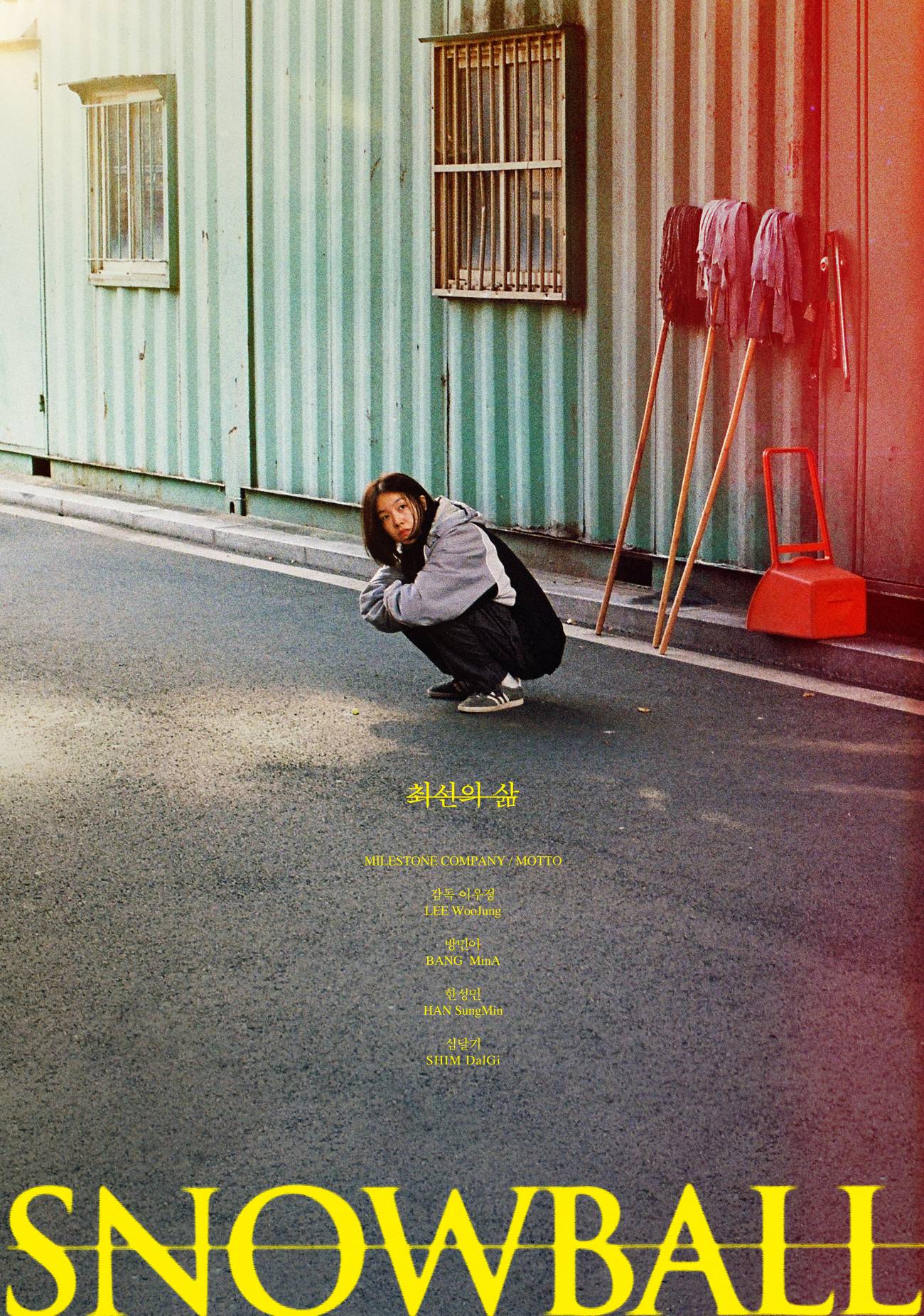
Snowball (최선의 삶, Lee Woo-jung, 2020)

Three teenage girls seeking escape from an unsatisfying adolescence find only betrayal and disappointment in Lee Woo-jung’s sensitive adaptation of the novel by Lim Solah, Snowball (최선의 삶, Choisunui Sarm). Each oppressed by a resolutely patriarchal society, the three women nevertheless differ in the their respective traumas and resentments finding solidarity in the strength of their friendship only to witness it crumble when its barriers must necessarily be confronted. “Why did you do this to me?” Kang-yi (Bang Min-ah) eventually asks, only to receive no answer and realise that in the end they did to and for themselves. 

Though perhaps feeling a sense of familial rejection in the otherwise peaceful home she shares with her overly religious Buddhist mother, emotionally reserved father, and a little dog also yearning for love, Kang-yi is ostensibly the least burdened of her friends if facing a similar sense of detachment. Aloof golden child So-young (Han Sung-min) is clever and pretty, everything seems to go right for her as Kang-yi enviously explains, except for her dream to become a model and actress which her family apparently don’t support. Ah-ram (Shim Dal-gi), by contrast, is quirky and rebellious with a tendency to collect stray animals and other items from the street little caring who they may or may not belong to but is also trapped in abusive home with an authoritarian father. When So-young one day suggests running away together the other girls agree, but after the novelty wears off and they begin to run out of money the realities of a forced adulthood are suddenly brought home to them. 

The depths of their naivety are perhaps signalled in an early and misguided attempt to misuse a potentially predatory middle-aged man who offers them money for food, allows them to stay in his apartment, and suggests an improbably low stress job they might be able to do for him. As she’s want to do, Ah-ram runs off with his wallet only to begin feeling sorry him seeing as there’s so little in it and he is so clearly lonely even if So-young proclaims him a creep. Picking up a mattress in the street the girls end up sleeping in a stairwell, only for Kang-yi and So-young to return and find Ah-ram apparently beaten and raped by a man she later willingly returns to, talking as if such brutal treatment is a normal part of any relationship. “Children, when you’re in love you sometimes get into fights” she depressingly explains, later implying that her violent boyfriend has become her pimp as she slides into sex work in an effort to provide economic support to all three of them. 

So brutalised is she, that Ah-ram thinks nothing of the abuse she continues to suffer while So-young solipsistically wallows in a sense of defeat and despair. It’s at this point she whips out a credit card she’s apparently been carrying all along, her choice not to use it seemingly less about the possibility of its being traced than a stubborn desire to insist she is as underprivileged as her two friends. As we later discover, Kang-yi lied about her address to get into the school and in fact lives in a run-down semi-rural area some distance away, secretly regarded as even more of a hick provincial by the upwardly mobile So-young. Nevertheless, it’s not class differences which eventually shatter their friendship but repressed sexuality. One extremely hot evening, So-young and Kang-yi share a moment of physical intimacy but while it only seems to bind Kang-yi more closely to her friend, So-young is unable to cope with the taboo realisation of her desires and becomes increasingly irritable, distancing herself from both of the other girls before abruptly deciding to call the experiment in independence short and return to her parental home. 

All Kang-yi wants is a return to their former friendship, but So-young’s repression eventually turns violent. Rejecting Kang-yi and Ah-ram she becomes a part of the popular set and embarks on a campaign of bullying that leaves Kang-yi both physically bruised and emotionally wounded. Yet she is also in her own way repressed, unable to accept her parents’ love for her and often ignoring the plaintive cries of the family dog longing to be picked up and held. Neither she nor Ah-ram are able to conceive of a future for themselves, Kang-yi’s sense of rejection eventually pushing her towards a self-destructive act of violence that will further rob her of possibility and the potential for happiness. Captured with a restless, roving energy imbued with with the colours of twilight, Lee’s melancholy indie drama suggests that not even friendship can provide a refuge from the pressures of the modern society and its relentlessly oppressive social codes in which internalised shame can quickly snowball into an avalanche of violence.


Snowball screened as part of this year’s New York Asian Film Festival.

Festival trailer (no subtitles)

Tune in for Love (유열의 음악앨범, Jung Ji-woo, 2019)

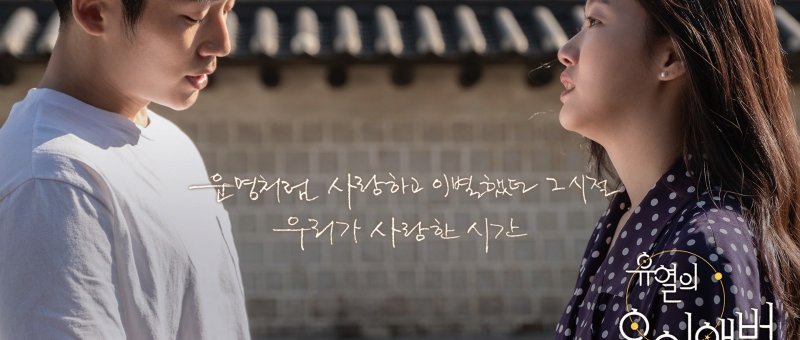
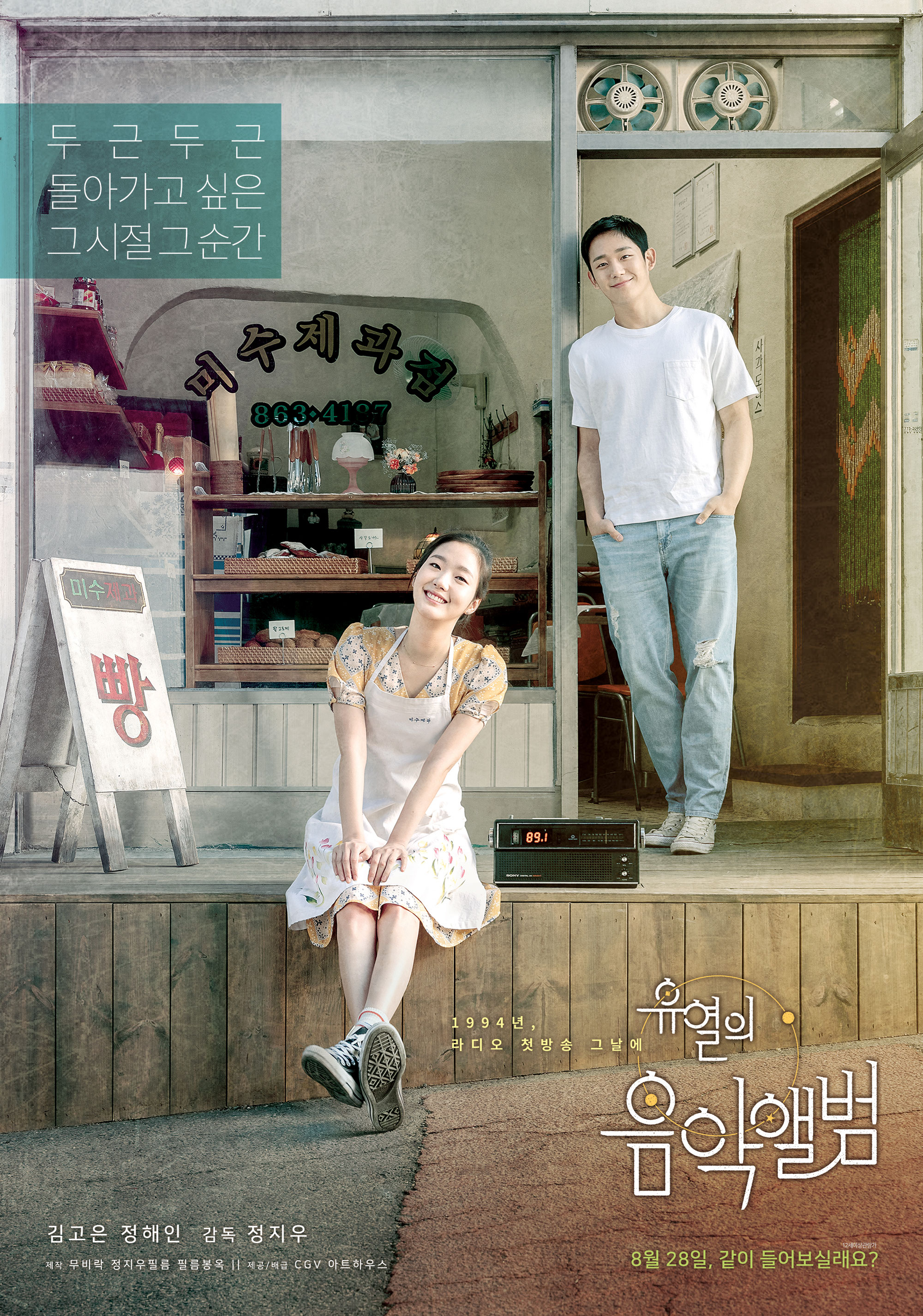
Tune in for love poster 2The course of true love never did run smooth. Another in the recent series of nostalgic ‘90s romances, Tune in for Love (유열의 음악앨범, Yooyeolui Eumakaelbum) takes a pair of nervous youngsters and charts the course of their love story over a decade which, though not quite turbulent, saw its share of difficulties and a host of technological changes. “Miracles are nothing special” the heroine tells us, but when it comes to love miracles are all there is and in the end you’ll just have to learn to trust them.

On Oct. 1, 1994 Hyeon-u (Jung Hae-in) walks into Mi-su’s (Kim Go-eun) bakery looking for something with tofu in it. While inside, he hears the first broadcast of Yoo Yeol’s Music Album, a new morning program which seems to signal the beginning of a new era. Though Mi-su is quick to realise that the only reason someone would be desperately looking for plain tofu early in the morning is because they’ve just been released from prison, she decides to offer him a part-time job in the bakery where he becomes a member of the family alongside her “aunt” Eun-ja (Kim Guk-Hee) who’s taken care of her since her mother died. His past, however, refuses to let him go however much he tries to move away from it. Tracked down by his delinquent friends, Hyeon-u is unable to return to the bakery and will spend the next decade trying to do just that.

Fate parts the youngsters repeatedly, but always brings them back together again seemingly by chance. Military service, changes of address, miscommunication and changing technology all conspire to keep them apart but like any good rom-com the problems aren’t so much circumstantial as personal. A deeply wounded young man, Hyeon-u is taken with the familial atmosphere at the bakery because he feels a sense of acceptance he hasn’t anywhere else, but deep down he still doubts he deserves the “normal life” he so deeply craves. His friends doubt it too, always turning up unexpectedly to remind him of their shared trauma and the debt of guilt he can’t repay. His insecurity prevents him from sharing the source of his pain with Mi-su, keeping her somehow outside the bubble of his shame as the only one capable of knowing the “real” him. She meanwhile is frustrated in realising that he’s holding something back, hurt he doesn’t trust her enough to let him in, and worrying he’ll never truly be ready for full commitment. 

Nevertheless, though often apart they remain painfully in sync, until that is fate brings them back together. As young man with a checkered past and no safety net, Hyeon-u has to fight twice as hard to get ahead, eventually graduating high school and getting into college while supporting himself with part-time jobs. Mi-su, meanwhile, is burdened by the knowledge that she’s lost her mother’s bakery and is desperate to get it back. Dreaming of being a writer, she turns down an internship at the all important radio show to go for a steady job she’s told is at a publisher’s but is actually somewhere more like a print shop where she’s stuck doing incredibly boring admin work. Hyeon-u is unable to get back in touch with her after miraculously reappearing because he’s ashamed to admit that he ended up getting in trouble again thanks to his awful friends even though it really wasn’t his fault. She meanwhile confesses that a part of her was relieved not to hear from him because she too is unhappy in herself, feeling lost and confused, disappointed not to be living the kind of life she could be proud of. 

Times change, but their one constant is the radio show broadcasting every morning and providing additional though indirect methods of communication when they are otherwise unable to make contact. Pay phones give way to email and then to mobiles all the way into the early days of the smartphone era, but face to face conversation remains the most difficult. Mi-su gives up on Hyeon-u while he, ironically, probably does sort something out by having a good old fashioned punch up with his generally unhelpful friend. She wonders if she’s better off to make the “smart” choice rather than waiting on love. Hyeon-u is hurt that in the end she didn’t trust him, but is eventually made realise that the problem was that he didn’t trust himself. Then again, you can’t fight the power of true connection or the pain of its absence, all you need to do is a little fine tuning to make sure the signal comes through loud and clear.


Currently available to stream online via Netflix in the UK (and possibly other territories)

Netflix trailer (English subtitles)

Juror 8 (배심원들, Hong Seung-wan, 2019)

Juror 8 poster 1What is the role of the law in a free and democratic society? In an effort to democratise justice, Korea held its first jury trial in 2008 giving “the people” a voice in the courts. As might be expected the judiciary had its doubts. Where judges and lawyers are best placed to assess the evidence and draw their conclusions, might not ordinary citizens be swayed by emotion or argument? Then again, compassion might be a force sorely lacking in a legal process some might feel to have become too efficient in its keenness to see justice is done speedily, losing all important scrutiny and allowing corruption and complacency to sneak their way in.

Juror 8 (배심원들, Baesimwondeul), a courtroom comedy drama, subtly puts the nation on trial as it asks what the point of the law is if it’s wielded like a blunt object. The case in hand concerns a middle-aged man, Kang Du-sik (Seo Hyun-woo), accused of hitting his elderly mother (Lee Yong-yi) on the head with a hammer and then throwing her off the balcony to disguise the crime. Though the defendant made a confession to police shortly after the incident, he did so vaguely from a hospital bed after being knocked out and now claims he can’t remember the events in question. This presents a problem for the judiciary who had chosen this case for the first jury trial precisely because it seemed so open and shut, all the jury was supposed to do was consider sentencing. Now they’re being asked to consider guilt or innocence and asking lots of awkward questions in what was supposed to be a token effort on behalf of law enforcement to demonstrate that it is listening.

Everything might have gone to plan if it hadn’t been for problematic “Juror 8” Nam-woo (Park Hyung-sik ) who, despite giving some worryingly conservative answers in his interview, instantly sympathises with the suspect and worries that there are too many unanswered questions in the evidence presented. His conviction only strengthens when he wanders off trying to get to the patent office to file sample of a self-defence device he was trying to launch as a business and accidentally meets Kang who seems despondent and frightened, worried he really might be guilty but fundamentally unable to remember.

More cynical minds might ask if Kang’s memory lapse is merely convenient and he hopes to exploit the jury trial to win acquittal through sympathy. Having noticed that Kang has no fingers, Nam-woo insists on a test to see if he is able to swing a hammer only for others to point out that there is no real way to know if he is not physically able to do it or chooses not to to aid his case. Meanwhile, Kang sits sullenly like a defeated ball of pent-up rage, eventually exploding when the jury is handed a letter he claims he was forced to write expressing frustration with his mother’s refusal to sign a legal separation form so that he would be eligible to receive welfare payments.

As his lawyer later puts it, the real villain here is poverty. Kang was raised by a single-mother, something still frowned upon, who had to leave him alone to go out to work. She locked the door from the outside to keep him safe, but that also meant he was unable to escape a house fire and was badly burned at only five years old sustaining prominent facial scarring and the loss of the fingers on both hands which means he is unable to work and cannot easily write. According to the testimony, Kang and his mother argued constantly over money, especially since her job washing dishes at a restaurant came to an end. As her son and dependent, he was unable to claim benefits and wanted, the prosecution claims, to legally sever ties. When his mother refused, they allege that he lost his temper, killed her, and tried to make it look like an accident.

Nam-woo is unconvinced as is another juror whose 30 years as an embalmer tell him that the head wound was unlikely to have been caused by a hammer. Juror 6 is dismissed for speaking out in court, his exuberance held up as an example of teething problems in the jury system, but his words strike a chord with some of the other jurors who wonder if the smug expression on the forensic scientist is there to mask the fact that he didn’t really bother to investigate because there had already been a confession and all he needed to do was “confirm” the police’s findings. Time and again, the jurors accidentally uncover the failings of justice in a system geared towards efficiency. Kang was pushed to confess by police keen to meet their targets, the confession then became basis for deprioritising his case. Or as some of the legal minds put it, they got “sloppy” because there was no sense in devoting time and energy to a matter already closed.

The same thing happens in the jury room. The jurors are ordinary people. They have lives waiting for them. Nam-woo wants to file his paperwork for the business loan, another juror has a child to get back to, one is a salaryman with an angry boss on the phone. Everyone has a vested interest in getting this over with as quickly as possible so they can all go home, but they also take their responsibilities seriously – much more seriously than they were intended to. Korea is a conservative society in which it is natural to follow the guidance of the authorities and the collective will, and so it seems natural to everyone that you simply rubber-stamp whatever the judge says. Nam-woo is a bit different, he notices details and he asks awkward questions. “Just go with the flow” the other jurors urge him, “when in doubt follow their lead”, but he wants to do what feels right. The exasperated businessman orders him to fall in with the boss, in this case the judge, but crumbles when another juror asks for his own opinion. He doesn’t have one, because he’s corporate drone and he’s been conditioned to do whatever the boss says without really thinking about it.

In any case, the jury system itself is a bit of a sham. The jury’s opinion is not legally binding, the judge only has to take it under advisement and can overrule. Sympathetic judge Kim (Moon So-ri), defended in her appointment as “strong and resolute like a man”, is fighting her own battles in a male-dominated arena, hoping for a long overdue promotion following the successful handling of this high profile case she only got through lottery. She begins to notice things she might not have when it was just a formality of sentencing a man who had confessed, but she is under pressure to maintain control and authority while demonstrating the magnanimity of the state. The jurors’ deliberations expose their pettiness and snobbery, some taking against Kang just because he lives in the poor part of town, but also their keenness to ensure the law is fair and exists to protect and not to oppress. Genial and humorous, Juror 8 addresses a serious subject with a lightness of touch and a subtlety that gently exposes the shortcomings of its society while placing its faith in “the people” to make a compassionate choice in the face of a fierce pressure to conform.


Juror 8 screens in Chicago on Sept. 12 as part of Asian Pop-Up Cinema season 9 where director Hong Seung-wan will be in attendance for an introduction and Q&A moderated by Korean cinema expert Darcy Paquet.

Original trailer (English subtitles)