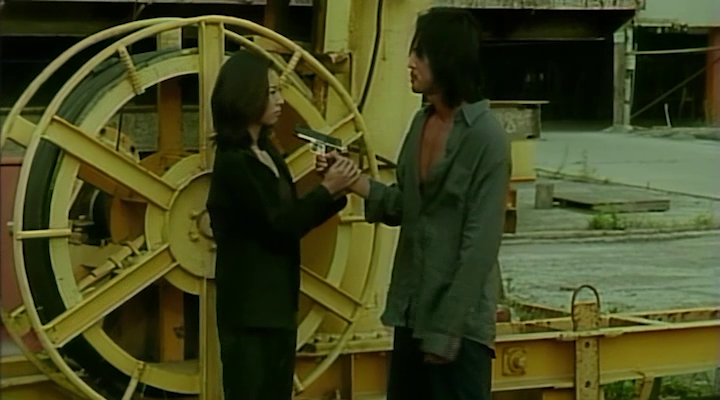
Scorpion: Double Venom 2 (サソリ 殺す天使, Ryoji Niimura, 1998)

Some years after the conclusion of Scorpion Double Venom, Nami (Chiharu Komatsu) is still on the run. Now apparently using the name Sayuri, that of the surrogate sister she again failed to save in the previous film, she’s been working as a dancer in a club while continuing to look for the one-armed man she believes killed her younger sister. Spotting a one-armed gang boss on TV, she becomes convinced that Goda is the man she’s looking for and becomes a cabaret hostess to get close to him. But before she can pull the trigger, Goda is gunned down by a man in a police uniform who turns out to be a hitman hired by a local gang. 

This leaves Scorpion: Double Venom with a problem because Nami no longer has a clear target for her revenge and therefore no reason to live. She takes the gun used to kill Goda and at one point tries to use it to kill herself but is saved by Eiji (Ryo Karato), the hitman she rescued from the scene of the crime. Eiji’s mission of vengeance is however not yet over. Hoping to escape the gangland life, he robbed a bank with his girlfriend Ichiko (Aya Sasaki), but when she got shot in the leg, he ran off with the money and left her there. Nami then becomes determined to rescue Ichiko instead, making use of her old boyfriend, who has since married someone else, to get her a job as the prison doctor.

This is another break with the pattern, as Nami is not a woman in prison but undercover among the corrupt authorities who are in league with the rival yakuza gang to buy cheap drugs to use on the inmates while forcing released prisoners to deal for them. Forced into a straitjacket and sedated, Ichiko is repeatedly raped by the warden’s henchman. A female guard then takes her own life because she can no longer bear to listen to Ichiko’s screams, only the prison get a backstreets doctor to falsify the death certificate to eliminate evidence they’d been drugging her too and make it look like she died in an accident. 

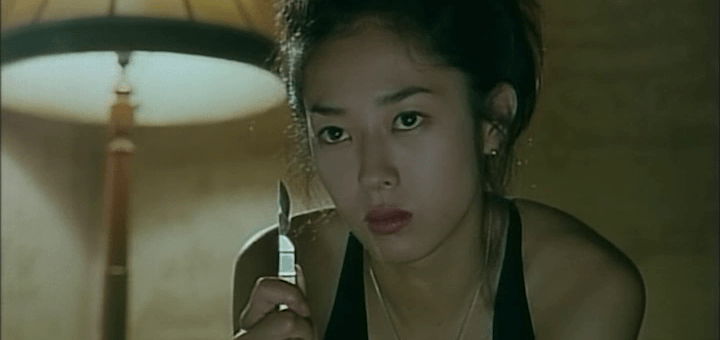
Sucked into a yakuza gang war, Nami is constrained by the darkness of the world around her and once again uses her medical skills for the purposes of revenge. The irony of her using a scalpel to kill is not lost on anyone, though this time she does also use healing abilities to nurse Eiji back to health which might explain the Japanese title “Killing Angel” even if there’s a serious plot hole along given some vague sci-fi style justifications in the film’s closing moments as Nami finally learns some unwelcome information about her sister’s death. In a way, the ending the brings the cycle full circle as Nami is one again betrayed by a man she had trusted and bonded with in a shared desire for justice and liberation.

In essence, they’re all trying to escape the prison of the wider society but as Nami discovers, society is not exactly tolerant of fugitives from order and the implications of the ambiguous ending are fairly bleak. It seems that once again, Nami has been denied her vengeance and granted only a cruel irony that suggests there can be no escape or starting over for those like Nami nor can there be closure for the traumatic past. While trying to rescue Ichiko, she’d encountered one of her former cellmates who had become a turncoat, taking the place of the guard who had killed themselves to facilitate Ichiko’s perpetual rapes. She at first refuses to help Nami because her parole is coming up, but then changes her mind, takes a shot at her own vengeful protest and pays a heavy price for it. 

Moving away from the exploitation roots of the franchise, Niimura takes the sequel in an artier direction with its love scene montage and melancholy blue-tinged colour palette while scaling back a little on the action preferring to focus on Nami’s non-romance with Eiji until her daring attempt to break Ichiko out of prison. But as has become abundantly clear, no one is able to escape from the prison of contemporary Japan and least of all Nami who remains trapped by her desire for vengeance and perhaps a willing victim of it.

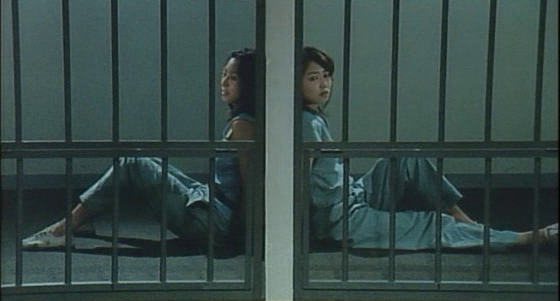
Scorpion: Double Venom (サソリ・女囚701号, Ryoji Niimura, 1998)

Scripted by Sasori in USA’s Daisuke Goto, Scorpion: Double Venom (サソリ・女囚701号, Sasori: Joshuu 701-go) brings Nami back to Japan but with an all new backstory and motivation for revenge. In the films up to this point, Nami is betrayed by a man she loves and thereafter seeks a revenge that becomes progressively less personal, striking out against entrenched patriarchy and societal misogyny. This time, however, she’s to avenge the death of a girl she couldn’t save, her sister, Yumi, who was kidnapped and murdered as a child.

Like that of Sasori in the USA, this Nami (Chiharu Komatsu) is a highly educated woman, in fact a doctor. Immediately recognising a patient as the man responsible for abducting her sister all those years ago she is left with a dilemma. She confronts him and he laughs at her. As it turns out, the statute of limitations on his crime ran out the day before, so Nami’s plan to turn him in to the police is rendered a no go. As he continues to taunt her and makes suggestive comments about the little girl inexplicably in the next bed sharing a ward with an adult man, Nami ends up stabbing him to death with her scalpel but just before he dies, he tells her that he didn’t kill her sister after all. It was his accomplice, a one-armed man!

Nevertheless, Nami’s revenge will be delayed because she’s quickly carted off to prison for 10 years of hard labour. Unlike those in the other films, this prison is mainly run by women but the warden is a predatory lesbian who extracts sexual favours from the inmates with the vague promise of early parole and claims that this place is like heaven if you play by the rules. After getting sent to solitary for fighting, Nami befriends another woman, Sayuri (Miho Kiuchi), who reminds her of her younger sister, and discovers that she is shortly to be executed at the gallows hidden in the deepest recesses of the prison. Sayuri is apparently not guilty of the crime for which she is serving her sentence but was talked into taking the fall for a sleazy politician who murdered her friend so that her older sister’s medical bills would be covered. Her death sentence is for accidentally killing a guard during a previous escape attempt. All her subsequent attempts to escape have been so that she could see her sister one last time before she dies.

The theme this time is then sisterhood as the two women fill in the missing half for the other and bond in their shared misuse at the hands of the justice system. Nami becomes determined to save Sayuri in the way she couldn’t save Yumi, but her struggle eventually takes on a larger dimension in keeping with those of the previous films as she tries to get revenge for Sayuri too after discovering that her death sentence was partly handed down by the murderous politician trying to tidy up loose ends as he plans career advancement with the aid of his entire amoral aide, Naruse (Tomorowo Taguchi). Escaping from the prison, she literally and symbolically frees all of the women who then take their own revenge on the sadistic warden.

For all of its seriousness, the film does have its faintly ridiculous qualities such as Nami’s use of electrical wiring as a defibrillator that allows her to resuscitate Sayuri after she’s hanged by the warden at the politician’s instigation. She later uses these same wires ripped from the wall to electrocute the warden’s bruiser male guard though it’s Sayuri who hot wires the prison van so they can escape. Eventually, she’s hunted down by a man with a crossbow and in a nod to the original trilogy, stabs him in the eye. Still, with her own revenge still in progress, Nami effectively avenges all her sisters while fighting for justice. Tracking down the videotape Sayuri had hidden proving the politician’s guilt, she eventually exposes him along with all his corruption bringing down the complex network that had extended out into the prison and trapped so many other women. Now a fugitive, Nami chases the one-armed man and has once again become an avenger of women bringing justice to those failed by an inherently corrupt and misogynistic justice system.


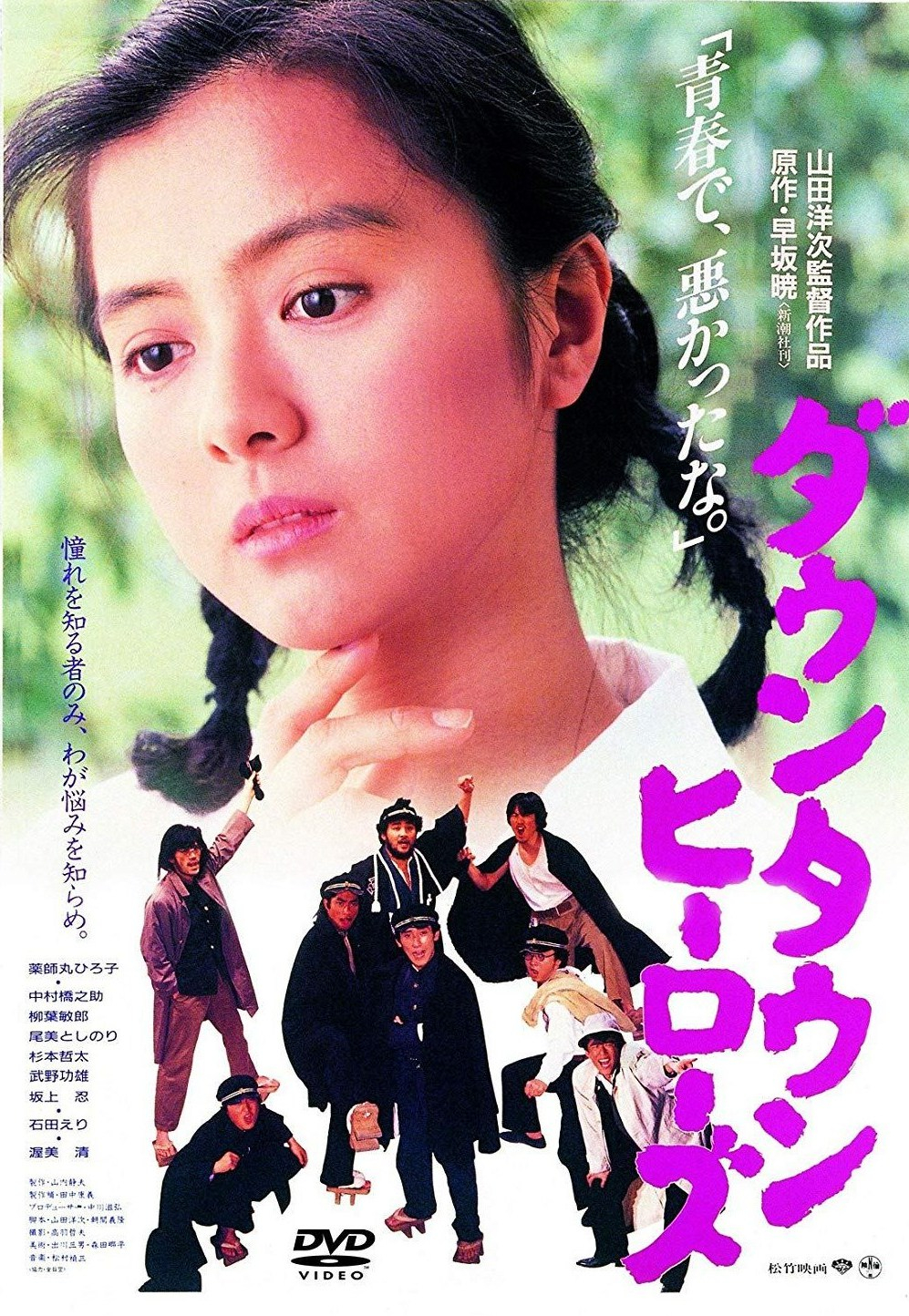
Downtown Heroes (ダウンタウンヒーローズ, AKA Hope and Pain, Yoji Yamada, 1988)

Downtown Heroes posterUnlike many of his contemporaries, Yoji Yamada was an infrequent visitor to the youth movie. Best remembered for his long running Tora-san series, Yamada’s later output is marked by an alternation of laughter and tears, running between raucous family comedies and poignant examinations of wartime loss. Set in the immediate postwar period, 1988’s Downtown Heroes (ダウンタウンヒーローズ, AKA Hope and Pain) adapts the autobiographical novel by Akira Hayasaka for a twin tale of endings and beginnings as a group of boys prepare to leave the Japan of their childhood behind and set out into the brand-new post-war future.

Our narrator for the tale is Hayasaka’s stand-in, Kosuke (Hashinosuke Nakamura), a sensitive young man from the mountains studying at the prestigious boys’ boarding school in town. The Matsuyama high school is one of the last to still be operating in Japan’s pre-war educational model. In fact, when the boys graduate the school will shut down in favour of the American 6-3-3 standard model of organising the educational system. Nevertheless, Kosuke and his friends enjoy what seems like a fantastically broad curriculum to modern eyes, much of which consists of classic German literature. Rather than their family names, the boys refer to each other with a series of nicknames inspired by their studies and have been heavily influenced by European left-wing political ideology. Accordingly, they are less than happy about the imposed American “reforms” and, paradoxically, the restrictions placed on their individual “freedom” by the “imperialist” occupation.

The central drama revolves around two episodes occurring one after another during the final year of high school. The first involves Kosuke’s friend Arles (Toshinori Omi) and a prostitute he helps to rescue from the red light district – Sakiko (Eri Ishida) was supposed to elope with a student from the school, but he didn’t show up and if the people from the brothel she was sold to find her she’ll be in big trouble. Her suitor turns out to be a fraud, but the boys are committed to saving her and hide Sakiko in their dorm, sharing their meagre rations with her before helping her escape to her home town. Meanwhile, the boys are also preparing for the very last culture festival the school will ever see at which they will present their adaptation of a classic German play. The snag is, the play needs a girl. Eventually the gang enlist the help of Fusako (Hiroko Yakushimaru) – a student at the girls’ school recently repatriated from Manchuria who also happens to be the young lady Kosuke had a meet cute with on the road and has been in love with ever since. Trouble brews when Gan (Tetta Sugimoto), the play’s director, falls in love with her too.

Told from the POV both of the old and the young Kosuke, the atmosphere is one of intense melancholy and inescapable nostalgia. Though these were times of hardship – rationing is fierce and intense, so much so that the school no longer serves meals at all on Sundays and the boys largely subsist on rice gruel, they were also times of joy and possibility. These are however youngsters in the best tradition of the sensitive young men of Japanese literature. They feel everything deeply, fully aware that they are living on the cusp of something new, which necessarily also means to be standing atop a grave. Their world is collapsing and the values they’ve been given (progressive though they seem to be) are about to be thrown out of the window. They have been taught that nothing is more important than their personal autonomy and that personal freedom is attained only through overcoming hardship, but their lives will increasingly be dictated by occupying forces and they feel themselves robbed of something without the right to reply.

Nevertheless their problems are also ordinary teenage ones of romantic crises and friendship dilemmas. Kosuke struggles with his love at first sight crush on Fusako but remains too diffident to say anything until it’s almost too late, while he also struggles to figure out what the most proper thing to do is when Gan reveals he is also in love with her. Gan, a sensitive writer, apparently burns with longing – so much so that he’s written a book long confession of love in apology for being unable to declare himself in person. Kosuke, a good friend, agrees to deliver the letter but both of them have neglected to consider Fusakao’s feelings so bound up are they in their own solipsistic dramas. Fusako was also struck by the love bug on her first meeting with Kosuke and has been patiently waiting for him to say something (as is the custom of the time). She is therefore doubly hurt and offended when he delivers a mini-tome on the theme of love from someone else before attempting to leave abruptly in a huff. Truth be told, there are few women who would enjoy being handed a thesis as a confession, but Fusako is really not in the mood to read one now.

Ending on a melancholy epilogue in which the old Kosuke looks on at field of young men playing American football before some others in running shorts brush past him and a young couple enjoy an evening walk, Yamada embraces the mild sense of deflation that has been building since the beginning. Young love faded and the dreams of youth were destined to come to nothing – not quite a tragedy, or perhaps only one of the ordinary kind, but food for the regrets of age all the same. The times were hard, and then they got better but somehow they were never so happy again. A youth drama indeed.


Original trailer (no subtitles)

Theme song “Jidai” performed by Hiroko Yakushimaru

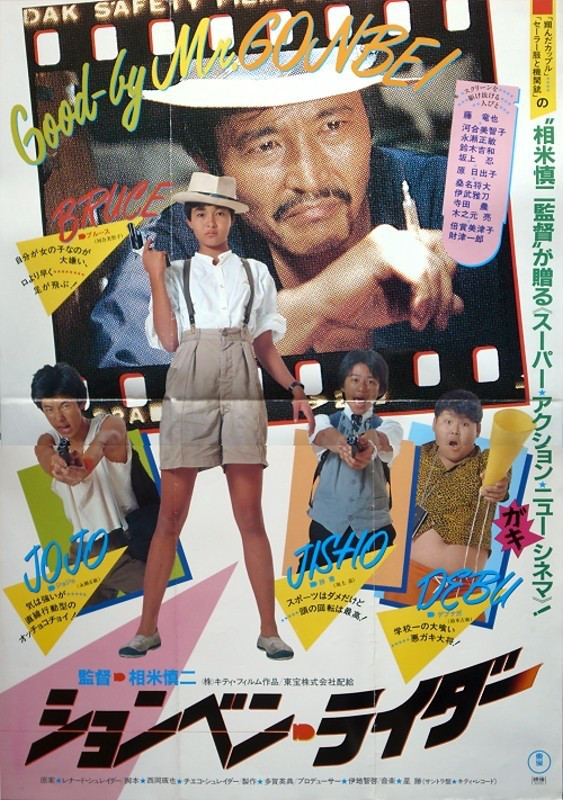
P. P. Rider (ションベンライダー, Shinji Somai, 1983)

PP rider poster

Despite a brief resurgence following a retrospective at Tokyo Filmex followed by another at Edinburgh International Film Festival, Shinji Somai remains frustratingly underrepresented in the West. Though his career is more varied than most give him credit for, encompassing the melancholy pink film Love Hotel and masculinity drama The Catch among others, Somai is justifiably most closely associated with his youth films. Running from the artier Typhoon Club and The Friends to the rabidly populist in the Kadokawa idol movies Sailor Suit and Machine Gun and Tokyo Heaven, Somai’s work is unique in managing to catch hold of a zeitgeist, capturing the essence of the contemporary teenager more or less in the way they saw themselves rather than the way they were generally seen by adults. Like many Japanese teen movies of the ‘80s, the world of P.P. Rider (ションベンライダー, Shonben Rider) is essentially a safe one. Our three protagonists get themselves mixed up in some dark and shady business but they are never afraid, do not lose heart, and face danger with only contempt and determination.

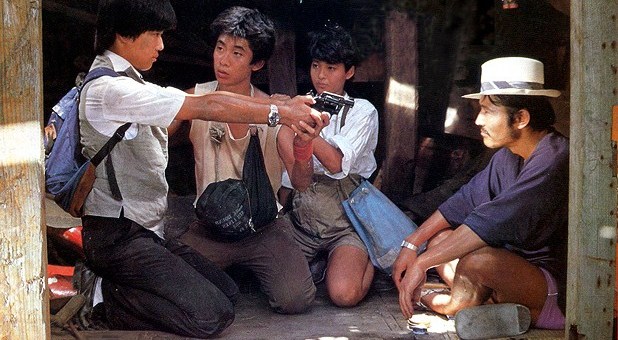
Somai opens with one of his trademark long takes which whirls around from two suspicious looking yakuza types to a bunch of kids playing around in the school swimming pool. One of the kids, a rotund boy who goes by the nickname Debunaga (his full name being Nobunaga (like the historical tyrant) Deguchi, ‘Debu” essentially meaning “fat”) is being a bit of a twit and having a go at one of our heroes, JoJo (Masatoshi Nagase). Debunaga (Yoshikazu Suzuki) then tries to “drown” JoJo’s friend Jisho (lit. “Dictionary”) (Shinobu Sakagami), before the third member of the trio arrives, an androgynous girl who goes by the name of Bruce (Michiko Kawai). Bruce neatly dispatches the petty high school punks while a teacher, Arane (Hideko Hara), attempts to shift some bosozoku bikers who’ve invaded school property.

Meanwhile, the petty yakuza get on with their plan. They’ve come to kidnap Debunaga, his pharmacist dad apparently has a sideline in drug dealing, but before they can grab him, Debunaga is kidnapped by entirely different kidnappers! Our three heroes, JoJo, Jisho, and Bruce are very annoyed about this because they didn’t get a proper chance to get even with him. Accordingly, they decide the best way to make use of their summer holiday is to rescue Debunaga themselves and make sure they get their revenge before the kidnappers do him in.

P.P. Rider means exactly you think it means, except it doesn’t quite mean anything at all aside from perfectly capturing the strange mix of childish jokes and serious crime that defines the movie’s tone. The atmosphere is absurd and ironic, the kids distrust adult authority and attempt to define their own nascent personalities by effectively rejecting them by using nicknames, dressing in highly codified ways, and either conforming to or subverting social codes as they see fit. Amusingly enough, the trio take a brief pause in the middle of their quest to get haircuts and change outfits, after which they emerge dressed in each other’s clothes as if implying they are almost interchangeable. 

In keeping with most Japanese youth dramas, parents are an entirely off screen presence. Adult input comes from two very different directions (plus the occasional interventions of bumbling beat cop Tanaka), a down-at-heels yakuza called Gombei (Tatsuya Fuji), and the kids’ teacher, Arane. Gombei, a drug-addled gangster, is hardly an ideal role model (especially when he tries to drown Bruce and attacks Jisho with a samurai sword), but he does eventually take the kids under his wing with JoJo picking up the classic deputy role in learning the yakuza ropes. Arane, by contrast begins by letting them down. Harried by the bosozoku she tells the kids to buzz off when they try to talk to her, telling them that she’s off to hot springs town Atami and they’d best come back next term. Nevertheless she eventually becomes an integral part of their group, assisting in the quest and helping to rescue Debunaga while the strange finale plays out before her impassive eyes.

The kids didn’t really want to save Debunaga, and are conflicted when they eventually locate him, but in the end it’s friendship which wins out as they each celebrate their various roles in the successful rescue whilst lamenting the relative lack of care they’ve received from adults and authority figures aside from Arane and Gombei. Absurdist and ironic, P.P. Rider is a strange children’s odyssey in which the adolescent teens head out on a dark and dangerous adventure but live in the relative safety of the world and so nothing very bad is going to happen to them despite the terrible things they eventually witness. Classical long takes jostle alongside Somai’s mobile camera, random intertitles, and frequent breaks for pop music (this is an idol movie after all) in a frenzy of post-modern gags but somehow it all just works, and does so with wit and charm.


Opening scene (no subtitles)

Interview with actor Masatoshi Nagase from the Tokyo Filmex screening in 2011 (Japanese only, no subtitles)

Michiko Kawai’s main titles song – Watashi, Takanna Koro